

























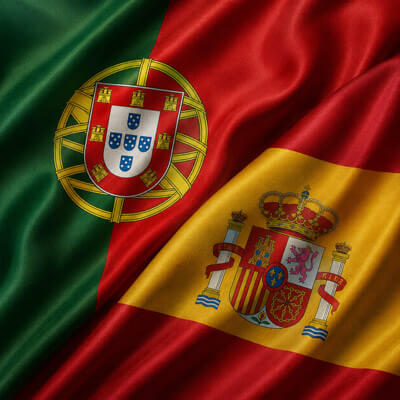
Portugal vs. Spain
 NBA: LeBron James Next Team
  Norway vs. England
 World Cup Winner


Odds, liquidity, volume, and open interest are sourced from Polymarket and last synced at Jul 6, 2026 10:27 pm.
What could move the odds
Informational summary of factors that may affect reported probabilities.
Market-implied thesis
Pricing frames Spain as the more likely winner, implying a materially stronger read on squad quality, form and matchup than on Iberian rivalry variance.
The draw price is meaningful because soccer resolution may hinge on regulation-time scoring, not simply tournament advancement.
What could reprice it
The next major repricing point is likely FIFA-confirmed match logistics and later official lineups, injuries and tactical selections near kickoff.
National-team markets often move most when availability becomes concrete rather than from long-range reputation.
Where the market may be weak
The resolution wording is thin for a three-way soccer market, leaving ambiguity around regulation time, extra time, penalties or postponements.
That rules gap can make a draw price harder to interpret versus outright qualification-style expectations.
Counter-signal
Spain’s favorite status may overstate durability: tournament variance, neutral venue effects and Portugal’s elite attackers can compress the edge.
A two-year horizon also increases uncertainty around coaches, injuries, squad turnover and tactical fit.
AI-generated market summary, reviewed for clarity. This summary is informational only, may contain errors, and is not financial, investment, betting, or trading advice.
Market details
- Resolution criteria
- This event is for the upcoming FIFA World Cup game, scheduled for Monday, July 6, 2026 between Portugal and Spain.
- Platform
-


- Category
- Sports › World Cup
- Close date
- July 6, 2026, 7:00 PM UTC
- Settlement source
- fifa.com
- Market rules summary
- Multi-outcome Polymarket event. Each listed option is represented by its Yes price on the underlying market. View full rules
Spain’s Majority Price Faces a Persistent Draw Problem
The market’s shape suggests Spain’s advantage is being treated as real, yet fragile enough for a stalemate to command meaningful attention. With settlement tied to FIFA’s official record and the close arriving on match day, small pieces of verified team news could carry outsized influence.

Spain’s 51.5% Yes price makes it the only outcome sitting above half in this Portugal-Spain World Cup market, but the more revealing feature is the draw at 26.5%, ahead of Portugal’s 23.5%. The market-implied story is Spain favored, with deadlock acting as the main pressure valve on that view. That matters because a three-way soccer market can reward a favorite’s control only if that control converts into the exact listed outcome.
Spain’s majority price turns pre-match perception into the anchor
In a three-outcome event, a price above half for one side implies the crowd is assigning a clear superior chance to Spain before the match resolves. The supplied context contains no rankings, player lists, injuries, venue detail, or tactical data, so this is an inference from the odds themselves. Its market importance is psychological and structural: once one outcome becomes the anchor, subsequent news tends to be interpreted through whether it confirms Spain’s control case or chips away at it.
The price also compresses Portugal’s direct path. Portugal’s 23.5% is below the draw, which implies the market sees a Portuguese win as requiring more than merely preventing Spain from imposing itself. For the market, that distinction matters: defensive solidity or slow tempo would more naturally feed draw probability unless accompanied by evidence that Portugal can turn transition chances, set pieces, or sustained pressure into a winning result. Those match scripts are hypothetical and should be read as inference from market structure.
The draw price is the main constraint on Spain’s favorite status
At 26.5%, draw is the second-highest outcome and a large part of the market’s risk budget. The listed draw option forces a different reading of Spain’s 51.5% price: the market can believe Spain has the stronger win case while still assigning meaningful weight to a match that fails to separate the teams. This matters because every item of late information has to be mapped across Portugal, draw, and Spain as separate resolution paths.
A compact way to read the current structure is that Spain owns the largest single route, while Portugal and draw together represent the resistance case. The resistance case is split in a way that favors stalemate over upset. If late news points toward caution, fatigue, or balanced tactical choices, the draw may absorb more of the reaction than Portugal. Those scenarios are hypothetical, but the price stack already indicates where such information would likely land.
Depth of liquidity can make narrative changes demand stronger evidence
The market lists $657.52K in volume, $3.01M in liquidity, and $612.02K in open interest. Those figures matter because the current shape is backed by committed capital and available depth. A thin market can swing on isolated orders; this one may require cleaner evidence to change its center of gravity, especially with the close scheduled for July 6 at 7:00 PM UTC.
Near-close depth can cut both ways. It can stabilize the favorite narrative when information is vague, and it can accelerate repricing when official or widely verifiable information arrives. The reason is incentive-based: with settlement tied to FIFA’s official World Cup source, the final outcome leaves little room for narrative debate after the match record is confirmed. Before kickoff, however, any credible update that affects the probability tree has to pass through a market with real inventory across all outcomes.
Matchday information has only a short window to matter
Because the event closes on match day, remaining catalysts are concentrated. The largest potential movers are hypothetical unless confirmed by the market page, FIFA, or official team communications: starting lineups, last-minute injuries, suspensions, tactical surprises, weather, or venue-specific conditions. Each would matter through a different channel. A missing attacker could lower a side’s win conversion. A conservative setup could lift draw sensitivity. A lineup tilted toward control could reinforce Spain’s existing price anchor.
- Evidence supporting the current structure would make Spain’s win path look more direct while keeping draw risk contained.
- Evidence weakening the structure would turn Spain’s control case into possession without finishing threat, or give Portugal a clearer scoring route.
- Any rule clarification affecting the draw would be sensitive because the draw already sits above Portugal.
The main failure mode is a reputation anchor meeting a low-margin match
The strongest counter-signal is already embedded in the board: Portugal plus draw is roughly comparable to Spain’s single listed outcome, even before accounting for market spread. That means the Spain case depends on converting a perceived advantage into a win, while the opposing half of the structure can be satisfied by either Portugal breaking through or the game failing to separate. This is why the draw price carries more analytical weight than a casual glance at Spain above half might suggest.
The market may be pricing Spain this way because a clear favorite is easier to coordinate around in the absence of richer public inputs, and the available liquidity gives that coordination staying power. The blind spot is that three-way soccer outcomes can punish confident single-result narratives through the draw channel. If matchday evidence narrows the perceived gap, the first visible effect may be a reshuffling between draw and Portugal before Spain’s headline position changes sharply.
Sources
Related markets
 Argentina vs. Switzerland
 Spain vs. Belgium
 Wimbledon ATP: Jannik Sinner vs Jan-Lennard Struff