Overview
Introduction
Market making in crypto is a razor-thin margin business. Your edge comes from execution quality, predictable trading economics (fees + rebates), low-latency connectivity, and operational resilience (risk controls, custody, and compliance).
This playbook gives market makers, HFT desks, and other high-volume traders a practical framework to evaluate a crypto exchange, and shows how WhiteBIT positions its institutional stack for liquidity providers.
What this guide covers
- How market makers actually make (and lose) money in crypto venues
- The execution-quality checklist, depth, spreads, matching behavior, and market data
- Infrastructure due diligence, APIs, stability, and latency (including colocation)
- Capital efficiency, margin and portfolio margin concepts
- Institutional risk controls, custody, audits, and compliance signals
- A practical scorecard you can use in vendor conversations
Who this is for
- Market makers, HFT firms, prop desks, and algorithmic trading teams
- Prime brokers and “brokerage-like” platforms routing flow to venues
- High-volume traders evaluating an additional liquidity venue
Trust bar
What “institutional-grade” means for market makers
“Institutional-grade” gets overused in crypto. For market makers and HFT teams, it has a very specific meaning:
- Execution quality you can measure: stable matching behavior, realistic market data, and consistent fills when you scale size and message rate.
- Economics you can model: fee tiers, maker rebates, and rules that don’t change mid-strategy.
- Operational resilience: security controls, custody integrations, and compliance processes aligned with your risk team’s requirements.
- A relationship model: responsive support and clear escalation paths when you hit edge cases (API anomalies, symbol changes, incident response).
WhiteBIT positions its institutional offering around deep liquidity, low fees, and infrastructure features used by professional trading clients (e.g., sub-accounts, portfolio margin access, colocation).
Profit anatomy
How market making P&L really works on centralized exchanges
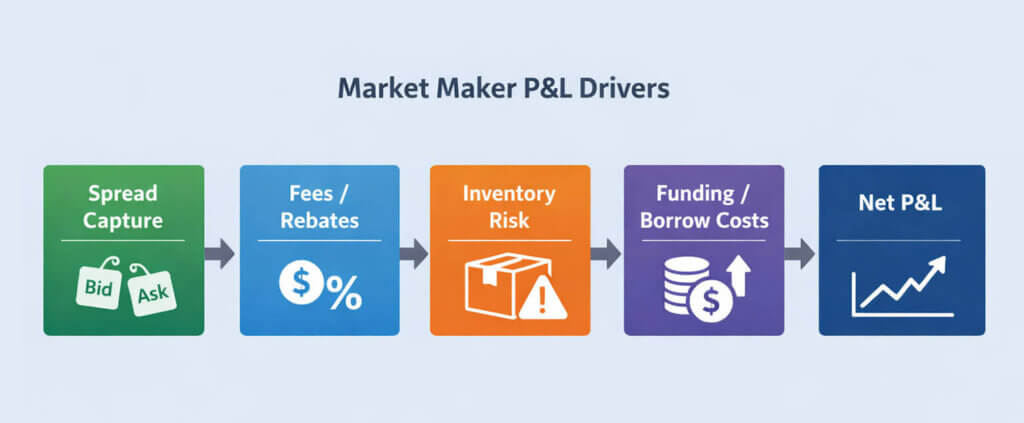
Most market making strategies are a trade-off between spread capture and adverse selection.
Your P&L typically comes from four buckets:
- Quoted spread capture: the difference between your buy and sell prices, net of fees.
- Fees + rebates: maker/taker schedules can decide whether a tight-spread strategy is viable. Some venues explicitly market low fees and rebates for market makers.
- Inventory management: if you accumulate one-sided inventory in a trending market, your “spread capture” can be wiped out by mark-to-market moves.
- Funding and carry (if you use margin/perps): funding rates, borrow costs, and collateral efficiency become part of the strategy design.
A practical takeaway: you don’t evaluate a venue only by “headline liquidity.” You evaluate whether the combination of microstructure, fees, and latency supports your strategy’s actual P&L mechanics.

Fill reality
Execution quality: the microstructure checklist
“Deep liquidity” is only useful if it is accessible liquidity — meaning you can consistently place, update, and cancel orders at scale, with fills that match your expectations.
Here are the microstructure areas institutional traders typically verify:
Depth and resilience: not just top-of-book; look at depth at multiple basis-point levels and how quickly the book refills after sweeps.
Spread behavior in volatility: does the book stay two-sided when volatility spikes, or does it gap?
Market data quality: WebSocket streams, sequencing, completeness, and recovery behavior after disconnects.
Order handling: rejection rates, minimum order constraints, order type availability, and self-trade prevention.
“Toxic flow” indicators: frequent sweeps, high adverse selection around news, and unusually high cancel-to-fill ratios.
WhiteBIT’s institutional positioning frequently highlights deep liquidity across hundreds of trading pairs and professional-grade trading infrastructure for high-volume markets.
| Category | What to validate (key questions) | Red flags |
|---|---|---|
| Order book depth | Depth at ±1/2/5/10 bps on target pairs, book resilience after sweeps, slippage vs size. Ask for historical depth and volatility snapshots. | Depth collapses in volatility, frequent gaps, no transparency or inability to provide basic depth analytics. |
| Spread stability | Median and tail spreads (p90/p95), spread widening during stress, spread vs volatility. Ask about circuit breakers and price bands. | Spreads blow out without clear market cause, opaque halts, inconsistent post-only behavior in fast markets. |
| Matching behavior | Priority rules (price-time), order type semantics (post-only, IOC/FOK), self-trade prevention, modify queue rules. Confirm any exceptions. | Undocumented exceptions, unpredictable queue behavior, post-only occasionally taking liquidity unexpectedly. |
| Market data reliability | WebSocket latency and jitter, sequencing and gap detection, resync procedure, completeness. Ask for documented snapshot + delta workflow. | No sequence numbers, frequent disconnects, stale books, trade prints not aligning with book updates. |
| API limits and errors | Rate limits (steady and burst), penalties, determinism of error codes, retry and idempotency guidance. Confirm institutional limit increases. | Random throttling, ambiguous errors, bans under load, no clear retry guidance. |
| Cancel and reject behavior | Cancel latency, cancel acknowledgments, reject reasons distribution, reconnect order state. Test place, modify, cancel under load. | Cancels acknowledged but orders still trade, high rejects without actionable codes, unclear post-reconnect order state. |
| Risk controls | Exposure limits, kill switch, price bands, sub-accounts, scoped API permissions. Ask if controls are self-serve and real-time. | No kill switch, slow manual interventions, all-or-nothing API permissions. |
| Fees and rebates | Maker/taker tiers, rebate eligibility, volume attribution, billing accuracy. Ask for examples and edge-case fee treatment. | Fee logic does not match published schedule, frequent changes without notice, hidden add-on costs. |
| Margin and collateral | Eligible collateral and haircuts, cross vs isolated margin, liquidation logic, risk model clarity, portfolio offsets if applicable. | Opaque liquidation rules, sudden haircut or eligibility changes, unpredictable margin jumps. |
| Custody and security | Custody model, asset segregation, withdrawal controls (whitelists, multi-approver), audits or certifications under NDA. | Unclear custody model, weak withdrawal controls, unwillingness to share any security posture even under NDA. |
| Compliance and KYB | Contracting entity, licensing posture by region, KYB requirements and timeline, monitoring and reporting support. | Unclear entity and regulatory answers, endless onboarding, unexplained freezes or restrictions. |
| Support and escalation | Dedicated coverage, 24/7 escalation channel, incident comms, maintenance and symbol-change notices, response SLAs. | Retail-only support, no escalation path, slow incident response, breaking changes without notice. |
Speed plumbing
Connectivity and latency: APIs, stability, and colocation
For market makers, the exchange is a technology counterparty. Your evaluation should treat it like one.
What to validate
API surface area: order placement, cancel/replace, account data, risk endpoints, and “edge case” behaviors (invalid params, partial fills, disconnected sessions).
Real-time market data: WebSocket channels, reconnection logic, and throughput consistency.
Operational maturity: documentation quality, change management, and predictable versioning.
WhiteBIT maintains public API documentation for institutional integrators, which is the baseline you want before committing engineering capacity.
For latency-sensitive strategies, colocation can be a differentiator. WhiteBIT explicitly markets colocation access in Europe or Asia, aimed at faster trading by providing direct access to its servers.
Balance sheet
Capital efficiency: margin, collateral, and portfolio margin
For many market makers, capital efficiency is the hidden edge — especially when you run multiple pairs, multiple strategies, or both spot and derivatives.
Key concepts to evaluate:
Collateral flexibility: what assets count as margin and how haircuts are applied.
Cross-collateral and netting: can positions offset risk, or is margin calculated per-instrument?
Portfolio margin (risk-based margin): instead of applying fixed margin requirements per position, portfolio margin models look at net portfolio risk. In some setups, this reduces required collateral versus isolated or simple cross margin — especially for hedged portfolios.
WhiteBIT markets “portfolio margin access” as an institutional feature to “unlock flexibility” in crypto trading — worth evaluating if capital efficiency is a constraint in your strategy design.
Survival rules
Risk, custody, and compliance: “don’t blow up the firm” basics
Institutional trading failures are often operational failures: custody mistakes, inadequate controls, or counterparty risk underestimated until it’s too late.
When your risk team asks, “Why this venue?”, you’ll want clear answers across:
Security and custody posture
Cold storage policies: WhiteBIT states that it stores 96% of digital assets in cold wallets and uses WAF protections.
Institutional custody integration: WhiteBIT highlights Fireblocks integration on its institutional pages and in its custody offering.
External security signals: third-party frameworks and audits can be useful inputs. For example, Hacken’s case study discusses WhiteBIT’s CCSS Level 3 certification and references a perfect CER.live cybersecurity score.
Compliance
KYB onboarding, jurisdictional alignment, and licensing posture matter for banks, fintechs, and regulated firms. WhiteBIT states it has “over 10 VASP authorizations.”
Operational controls
Withdrawal policies, incident response, communication cadence, and escalation paths.
Deal terms
Commercials and onboarding: fees, rebates, and the relationship model
Once execution quality and risk posture pass your minimum bar, economics decide whether the venue is worth allocating engineering time and balance sheet.
Commercial terms market makers care about
Transparent tiering: fee schedules by volume and market type (spot/margin).
Maker rebates and incentive structure: how rebates are earned, what thresholds apply, and whether rules are stable over time.
Support and escalation: the best venues behave like B2B infrastructure providers, not just retail apps.
WhiteBIT’s institutional positioning includes:
A stated fee starting point of 0% maker / 0.05% taker for spot volumes of $100M+ (as displayed on its institutional site), and a stated maker rebate example (-0.012%) with taker fees “up to 0.020%” under specific maker-volume conditions.
A “market making program” framed around low fees, rebates, and tooling/support for efficient trading.
Broader stack
Beyond the matching engine: OTC, payments rails, and CaaS
Even for market makers, your “venue stack” often includes more than order-book trading.
When OTC makes sense
You need to execute large size with minimal market impact
You want bespoke settlement terms or a conversational workflow
You’re hedging a large inventory move and don’t want to telegraph it to the market
WhiteBIT’s institutional OTC offering is positioned around executing large orders on favorable terms, including chat-based execution today and automated RFQ (request for quote) workflows described as “coming soon,” plus real-time quotes and on/off-ramping support.
When payments rails matter
Market makers and brokers increasingly support clients who need fiat ↔ crypto movement alongside trading
For EU corridors, SEPA is a common expectation in on/off-ramp discussions. WhiteBIT’s institutional payments content describes SEPA rails and notes that limits can be customized based on KYB level.
When Crypto-as-a-Service (CaaS) matters (even if you’re “just” a trading firm)
You’re building brokerage infrastructure
You embed wallets or trading into another product
You want a turnkey stack for client-facing crypto features
WhiteBIT markets Crypto-as-a-Service with a stated “4 Weeks to go live” and embedded features such as wallet generation (330+ cryptos across 80+ networks) and cold storage positioning.
Payments for businesses (WhitePay)
For merchants or payment providers, WhitePay positions itself as “powered by WhiteBIT” and notes that clients must complete KYB.
Token and listing services
If you work with token projects (or you are one), WhiteBIT’s listing page highlights scale metrics such as “330+ projects listed” and “800+ trading pairs,” plus marketing support concepts.
One-page audit
Due diligence scorecard (copy/paste checklist)
Use the checklist below to structure a first-pass evaluation and keep internal stakeholders aligned (trading, engineering, risk, compliance).
Quick scorecard (1 = weak, 5 = strong)
Execution quality (fills vs expectations)
Depth on your target pairs
API + market data reliability under load
Latency/jitter controls (incl. colocation options)
Capital efficiency (margin rules, portfolio offsets)
Security posture (custody, audits, controls)
Compliance readiness (KYB + licensing posture)
Commercial terms (fees/rebates clarity, stability)
Support model (escalation, account coverage)
Additional rails (OTC, on/off-ramp, CaaS)
What’s the difference between a market maker and a liquidity provider?
Market makers typically quote two-sided markets continuously and manage inventory risk to earn spread and/or rebates. “Liquidity provider” can be broader, including firms that only supply liquidity opportunistically or via specialized strategies.
How do maker rebates change market making strategy design?
Rebates can turn an otherwise marginal tight-spread strategy into a viable one — especially in highly competitive pairs. But rebates are not “free money”: you still face adverse selection, inventory risk, and venue-specific rules.
Is colocation only for ultra-low-latency HFT?
Not always. Colocation can also reduce jitter and improve order placement consistency during volatile conditions. If your strategy depends on fast cancel/replace or quote refresh, colocation may matter.
What is portfolio margin in plain English?
Portfolio margin is a risk-based margin framework that considers your portfolio as a whole. If you have hedged positions, it may reduce required collateral versus treating each position independently.
What security signals should institutional traders look for?
Look for clear custody posture (e.g., cold storage claims), documented security controls, and credible third-party frameworks or audits. WhiteBIT references cold storage and WAF protections on its institutional pages, and there are public discussions of CCSS Level 3 certification and CER.live scoring in external writeups.
When should I use OTC instead of the order book?
When size is large enough to materially move the market, when you need a bespoke workflow (chat execution), or when you want to avoid signaling. WhiteBIT markets its OTC service around large-order execution with minimal market impact.
How long should an exchange integration take?
It depends on your stack and controls, but you should expect time for KYB, security review, and technical testing. WhiteBIT markets faster go-live for some embedded solutions (e.g., “4 weeks to go live” for CaaS), but integration timelines still depend on your requirements.
Why would a market maker care about a platform’s CaaS offering?
If you support brokers, fintechs, or payment providers (or you are building one), embedded wallets, on/off-ramp rails, and trading APIs can turn a single venue into a broader infrastructure partner.
Action plan
How WhiteBIT approaches it
WhiteBITSee WhiteBIT’s institutional stack in action
If you’re evaluating a new venue for market making or high-volume execution, dig into WhiteBIT Institutional, colocation options, portfolio margin access, fee and rebate structures, custody integrations, and the support model built for professional trading teams.