


 Part 1 Beginner Why long-term crypto holders borrow against assets instead of selling A strategic guide to liquidity management, capital preservation, and the real tradeoff between selling and borrowing crypto Open guide
 Learn what Dogecoin is, how DOGE mining works, why supply keeps growing, and how to weigh payment use against meme-coin volatility.
 Yousra Anwar Ahmed Updated May 20, 2026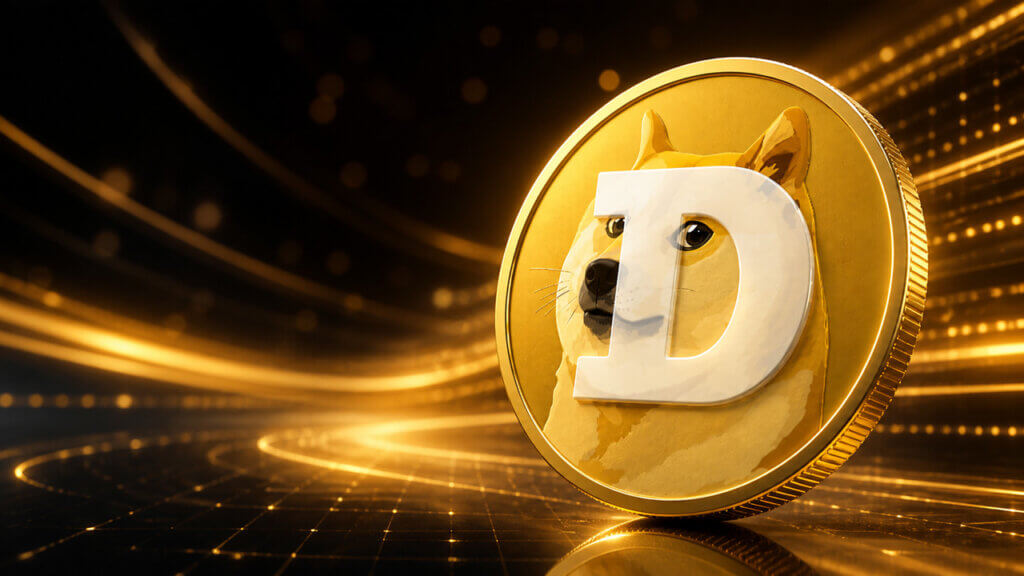
Overview
Dogecoin is a meme-inspired, open-source cryptocurrency used for peer-to-peer payments, online tips, trading, and community activity. It launched in December 2013 as a joke about the altcoin market and became one of the most traded and recognized crypto assets in the world.
Dogecoin runs its own proof-of-work blockchain, settles transactions in about one minute per block, and has been continuously maintained since 2013. It cannot be staked, has no fixed supply cap, and does not run a smart-contract ecosystem. What it does have is liquidity, a long operating history, and a community that treats the asset as a shared internet identity.
Dogecoin, shortened to DOGE, lets people send value without a bank or payment processor. It is a peer-to-peer digital currency maintained by a distributed network of computers called nodes, and every transaction is recorded on a public blockchain.
The technology is not the unusual part. Dogecoin's software comes from the same family of early proof-of-work coins as Bitcoin and Litecoin. What set it apart was the culture. Dogecoin was created around the “Doge” Shiba Inu meme, and its community built an identity around humor, tipping, and approachability rather than whitepaper-driven claims about transforming finance.
That combination explains why DOGE can be confusing for newcomers. It is both a meme coin and a working blockchain asset. It can be used for payments where accepted, held in a wallet, traded on exchanges, and mined by proof-of-work miners. None of that makes it equivalent to Bitcoin in terms of supply design, security profile, or investment case. Understanding the difference matters before buying.
| Field | Detail |
|---|---|
| Asset name | Dogecoin |
| Ticker | DOGE |
| Asset type | Native proof-of-work cryptocurrency and meme coin |
| Launch | December 2013 |
| Creators | Billy Markus and Jackson Palmer |
| Consensus | Proof of work |
| Mining algorithm | Scrypt |
| Target block time | About one minute |
| Block subsidy | 10,000 DOGE per block after block 600,000 |
| Max supply | No fixed cap |
| Main uses | Payments, tipping, trading, community activity, and meme-coin exposure |
| Live market page | Dogecoin market data |
Dogecoin’s fixed block subsidy creates roughly 5.256 billion new DOGE per year if blocks arrive on the one-minute target. That figure comes from 10,000 DOGE per block multiplied by 60 minutes, 24 hours, and 365 days. The issuance rate is predictable in absolute terms, but its percentage inflation falls over time as total supply grows.
Dogecoin was created in late 2013 by Billy Markus and Jackson Palmer. Both founders thought cryptocurrency was being taken too seriously. Palmer created Dogecoin.com and Markus worked as the solo developer on the first four releases, producing a joke that escaped its own punchline.
That origin matters because Dogecoin never fit the standard pitch for a crypto project. It did not begin with a corporate issuer, a formal token sale, or a detailed roadmap. It began as a parody of the increasingly intense altcoin market of 2013. The Doge meme made the asset instantly recognizable, and the low unit price made it easy for early users to send large-looking amounts as tips.
The joke also gave Dogecoin a survival advantage. Many early altcoins disappeared when their technical novelty faded. Dogecoin kept a community that used the coin socially, promoted charitable drives, and treated the asset as a shared internet object. That community did not remove the financial risk, but it helped DOGE outlive many projects with more serious branding.
Dogecoin has since crossed into traditional finance infrastructure. REX-Osprey announced the first U.S.-listed exchange-traded funds offering exposure to spot Dogecoin and spot XRP on Sep. 18, 2025, and Deutsche Börse listed a 21Shares Dogecoin ETP on Xetra on Apr. 10, 2026. These products are not the same as holding DOGE in a wallet, but they show that Dogecoin's market footprint has moved well beyond forum culture and exchange order books.
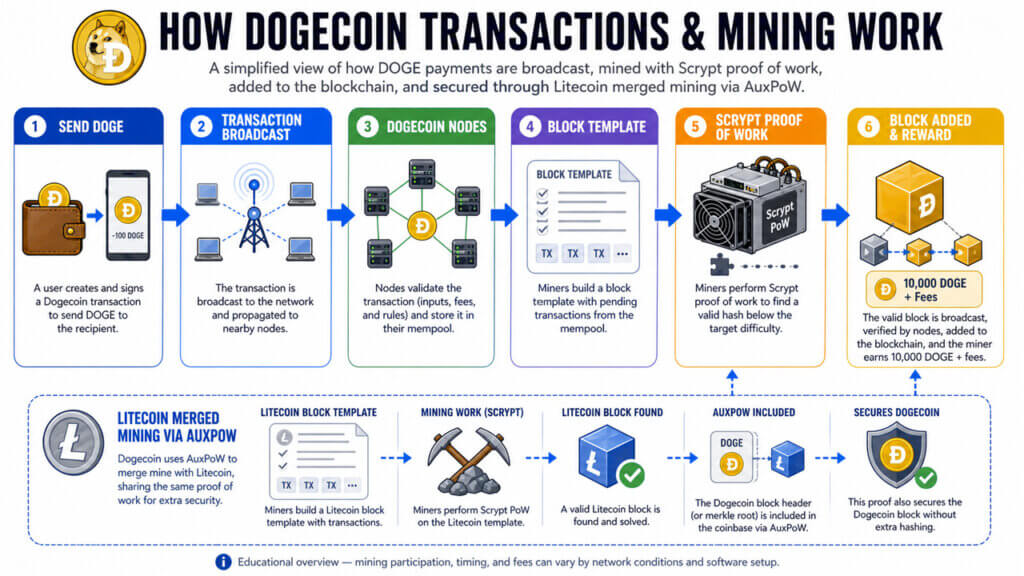
Dogecoin uses a blockchain, which is a shared ledger of transactions. A transaction moves DOGE from one address to another, miners collect valid transactions into blocks, and once the network accepts a block, those transactions become permanent on Dogecoin's transaction history.
Mining is what secures that ledger. The network uses a simplified version of the Scrypt key derivation function as proof of work, targets one-minute blocks, and adjusts mining difficulty after every block. Starting at block 600,000, the reward became a permanent 10,000 DOGE per block, which means miners know exactly what they will earn per block regardless of when they are mining.
Dogecoin is also connected to Litecoin through merged mining, referred to as AuxPoW or auxiliary proof of work. Miners can use Scrypt mining work in a way that contributes to more than one compatible chain at once. Merged mining with Dogecoin began on Sep. 11, 2014, and Dogecoin's current source tree still includes AuxPoW code paths for merge-mined blocks. In practical terms, this means Dogecoin's security is linked to the broader Scrypt mining economy, not just to standalone DOGE miners.
For everyday users, Dogecoin is not something mined on a laptop. Most people interact with DOGE through exchanges, wallets, and on-chain transfers. Running a full node is still possible through Dogecoin Core, the reference software for the network. Dogecoin Core 1.14.9 is the current release, published Dec. 1, 2024, with bug fixes inherited from upstream Bitcoin and Namecoin code. Dogecoin is not a fast-moving smart-contract platform, but its core client is still actively maintained.
Dogecoin's most natural use is simple value transfer. DOGE can be sent between wallet addresses, used for tips in communities that support it, and accepted by merchants that choose to take it. Its one-minute block target gives it a faster block cadence than Bitcoin, though final settlement, exchange crediting, and merchant policy still depend on the service handling the payment.
DOGE is also widely used as a trading asset. Many users encounter it first through exchange apps rather than through direct on-chain payments. That makes liquidity and custody important. A user who buys DOGE on an exchange is relying on that exchange for access, security, and withdrawals until they move funds to a personal wallet. A user who self-custodies DOGE controls the private keys but also carries the full risk of losing access.
Dogecoin also functions as a cultural asset. It is used to express community membership, participate in meme-driven market narratives, and gain exposure to the meme-coin sector. Assets in this sector can move sharply on attention, social media activity, exchange listings, and shifts in market risk appetite.
That cultural role is separate from revenue, cash flow, or product utility. Dogecoin does not run a large smart-contract ecosystem. It does not offer native staking. Its core function remains a proof-of-work currency with a meme-driven brand and a long operating history, and its valuation reflects that more than protocol usage.
There are several realistic ways to earn DOGE, but they do not carry the same risk profile. Dogecoin itself pays miners through the block subsidy, not passive holders. Profitable Dogecoin mining today generally requires Scrypt ASICs and pool membership rather than desktop hardware.
Here is how the main routes break down:
| Method | How It Works | Native Or Third-Party? | Main Risk |
|---|---|---|---|
| Mining DOGE | Run Scrypt mining hardware and compete to help create Dogecoin blocks that pay the block subsidy and transaction fees. | Native network | Hardware cost, electricity cost, price volatility, and low block-finding odds if mining alone |
| Mining pools | Combine hash power with other miners, then split pool revenue under the pool operator’s payout rules. | Third-party pool on the native network | Pool fees, payout rules, and operator risk |
| Merged mining with Litecoin | Use compatible Scrypt mining work to contribute to Dogecoin and another Scrypt chain through AuxPoW. Dogecoin-Litecoin merged mining began on Sep. 11, 2014. | Native mining design plus pool support | Dependence on Scrypt hardware, pool support, and changing DOGE/LTC economics |
| Exchange earn or lending products | Deposit DOGE into a centralized earn, savings, or lending product such as Binance DOGE Earn or Nexo DOGE Savings, which offers flexible and fixed-term options. | Third-party | Custody risk, counterparty risk, changing rewards, eligibility limits, and lockups |
| Rewards, tips, or payment income | Receive DOGE from another person, customer, or community tip. | Native transfer, often using third-party tools | No on-chain chargeback, price volatility, and tool or payment-processor risk |
| Faucets | Claim very small DOGE payouts from a site or task flow only after checking payout proof, terms, and withdrawal minimums. | Third-party | Tiny payouts, high withdrawal thresholds, ads, phishing, upfront-fee scams, and non-payment |
Mining is the only route in that table that comes directly from Dogecoin's protocol. Earn products, tips, merchant payments, and faucets are outside the protocol, so their terms can change without any Dogecoin software update. Centralized DOGE earn products should be treated as financial products from the provider, not as Dogecoin staking. Earn eligibility can vary by region on Binance, and Nexo rates can vary by loyalty tier and product terms.
No. Dogecoin is a proof-of-work network, and its consensus mechanism runs through miners, not token holders. The protocol uses Scrypt proof of work, one-minute blocks, per-block difficulty adjustment, and a permanent 10,000 DOGE block reward after block 600,000. There is no staking mechanism in the Dogecoin protocol.
When an app advertises “DOGE staking,” it is using the word loosely. It usually means a custodial earn account, a lending account, an exchange promotion, or a DeFi position using wrapped DOGE rather than native DOGE. Coinbase's cbDOGE represents DOGE as a 1:1 backed wrapped asset on Base, and wrapped tokens generally add interoperability by representing a native asset on another blockchain. Binance Simple Earn pays daily rewards for depositing assets into flexible or locked terms, and Nexo lists DOGE Savings with flexible and fixed-term options.
The risk profile of these products differs from native mining. Custodial earn products create custody and counterparty risk. Rewards can change, fixed terms create lockups, and wrapped DOGE or DeFi routes add smart-contract and wrapper risk. The label “staking” does not change the underlying mechanics.
Dogecoin’s supply model is one of the biggest differences between DOGE and Bitcoin. Bitcoin has a fixed maximum supply of 21 million BTC. Dogecoin does not have a Bitcoin-style hard cap. Instead, it issues a fixed 10,000 DOGE block subsidy after block 600,000.
The practical result is simple. Dogecoin’s total supply keeps rising, but the yearly issuance is fixed in DOGE terms rather than increasing forever as a percentage of supply. Early in the network’s life, 5.256 billion new DOGE per year represented a larger percentage of total supply. As total supply grows, that same annual issuance becomes a smaller percentage.
This design can be read two ways. Supporters argue that predictable ongoing issuance keeps miner incentives alive and helps DOGE function as a spending currency rather than a scarce digital asset. Critics argue that no fixed cap makes long-term value harder to assess because new coins continue entering circulation every year.
Both views can be true at once. Dogecoin’s monetary policy is transparent, but it is not scarce in the way Bitcoin is scarce. Anyone comparing DOGE with Bitcoin price data or Litecoin market data should treat supply design as a core difference, not a footnote.
Dogecoin is often compared with Bitcoin because both are proof-of-work cryptocurrencies, but the comparison only goes so far. Bitcoin is built around fixed supply, high monetary scarcity, and a role as crypto's benchmark reserve asset. Dogecoin is built around faster blocks, ongoing issuance, and community-led payment culture. They share a technical lineage but serve different purposes in how their communities use them.
Litecoin is the closer technical peer. Dogecoin's code lineage, Scrypt mining, and merged-mining relationship make Litecoin the more relevant comparison for understanding network security. The two chains are linked through AuxPoW, which means Dogecoin's security is partly a function of the broader Scrypt mining economy rather than a standalone calculation.
Newer meme coins belong to a different category. Most are tokens deployed on existing smart-contract networks like Ethereum or Solana. They do not run their own native proof-of-work chain and depend entirely on the host chain for settlement. Dogecoin has older infrastructure and slower feature expansion, but it also has a longer public history and its own native blockchain, which most newer meme assets do not.
| Comparison | Dogecoin difference |
|---|---|
| Bitcoin | No fixed supply cap, faster target blocks, and a more payment-and-meme-centered culture |
| Litecoin | Shared Scrypt mining context, but Dogecoin has different branding, supply policy, and community dynamics |
| Shiba Inu | Dogecoin is a native chain, while SHIB is an Ethereum-based token with a broader token ecosystem |
| New meme tokens | DOGE has older network infrastructure and deeper history, but many newer meme tokens move faster on chain-specific trends |
The cleanest way to think about Dogecoin is not “better Bitcoin” or “just a joke.” It is a long-lived meme coin with its own blockchain, predictable ongoing issuance, and a community that made it more durable than many early altcoins.
Dogecoin’s mining flow has two layers: a transaction path inside the Dogecoin network and a merged-mining path that connects compatible Scrypt mining work with Litecoin.
A beginner does not need to mine Dogecoin to understand or use it. The practical approach is to separate research, buying, storage, and transfer practice into small steps before committing real money.
Start with live data. CryptoSlate's Dogecoin market data page tracks DOGE price, market context, exchange listings, and news. Use it to check current liquidity and movement before making any decisions.
Then compare venues before buying. A DOGE purchase usually starts on a centralized exchange, especially for users who need fiat deposits, account recovery, and order-book liquidity. CryptoSlate's crypto exchange reviews and beginner exchange guide help compare fees, supported regions, security signals, and funding methods.
After buying, decide how to store it. Small trading balances may stay on an exchange for convenience. Longer-term holdings are usually better moved to a personal wallet. CryptoSlate's best crypto wallets and wallets for beginners explain the custody tradeoffs before anyone handles private keys.
Anyone already holding DOGE should also think about recordkeeping. Sending DOGE between wallets, selling it, using it to buy goods, and converting it into another asset can each carry different tax treatment depending on jurisdiction. Keeping clean records from the start is easier than reconstructing transaction history later.
Dogecoin cannot be staked natively because the network uses proof of work, not proof of stake. The protocol rewards miners for creating blocks, while third-party “DOGE staking” labels usually refer to earn, lending, promotions, or wrapped-DOGE DeFi products. Those routes carry custody, counterparty, lockup, or smart-contract risk.
The main routes are mining, pool payouts, merged mining, tips, payments, and third-party earn products. Mining is native to Dogecoin, while tips and payments depend on other people sending DOGE. Earn accounts or lending products are third-party arrangements, so rewards are not built into the Dogecoin protocol.
Yes. DOGE can be mined because Dogecoin is a proof-of-work network using Scrypt. In practice, profitable mining now generally uses Scrypt ASICs and mining pools. Solo mining is possible in theory, but pool mining is the more realistic path for most miners because block-finding odds are shared.
Yes. Dogecoin was modified in 2014 to allow merged mining with other Scrypt coins, especially Litecoin. That lets compatible miners contribute to Dogecoin while also mining another chain from the same work. It matters because DOGE security is tied to the broader Scrypt mining economy.
Sometimes, but faucets should be treated as tiny promotional payouts, not income. Legitimate faucets may have low rewards and withdrawal minimums, while fraudulent ones can use fake rewards, ads, phishing, or upfront-fee requests. This is separate from Dogecoin’s native network and should not be confused with staking.