Ledger Flex is a premium touchscreen hardware wallet for people who want a more comfortable signing experience than Nano-style devices usually offer. It is best for users who switch between phone and desktop, sign often enough to care about screen comfort, and want better mobile support without paying Stax pricing. Its biggest strength is the 2.8-inch E Ink touchscreen, which makes address checks, approvals, and transaction review easier than on Ledger’s smaller button-based devices. That convenience comes with clear trade-offs. Flex is expensive, not air-gapped, and still leans on Ledger Wallet and some third-party workflows instead of offering a fully open or fully isolated design.
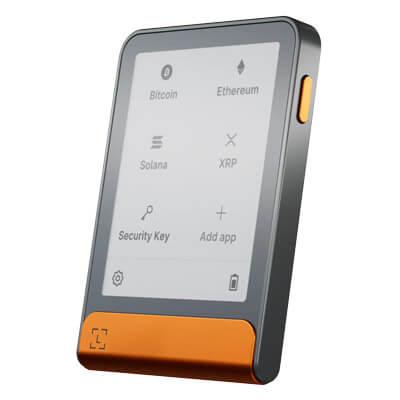
The 2.8-inch E Ink touchscreen makes addresses, token approvals, and transaction details easier to review than on button-based Ledger devices.
iPhone support over Bluetooth and Android support over Bluetooth or cable make Flex much more practical for mixed mobile use than USB-only hardware wallets.
The backup setup is more flexible than older Ledger models because it combines a standard 24-word Secret Recovery Phrase with an included Ledger Recovery Key and optional Ledger Recover.
Recovery is not locked to Ledger. You can restore the wallet with the recovery phrase in a compatible BIP39 environment.
It keeps most of the practical touchscreen and mobile value people want from Stax while staying at a lower price.
Cons
- At $249, Flex is still expensive if you mainly buy, hold, and rarely approve transactions.
It is not air-gapped, because normal use still relies on USB-C, Bluetooth, and NFC rather than QR-only isolation.
The security model is not fully open-source, which matters if you want a more transparent firmware and hardware stack.
Desktop use still leans heavily on USB-C because Ledger Wallet desktop does not support Bluetooth pairing.
Some assets and chain-specific workflows still depend on compatible third-party wallets instead of staying fully inside Ledger Wallet.
Who Ledger Flex Is Best For — And Who Should Skip It
Ledger Flex makes the most sense for people who already know they want a hardware wallet and want less friction when reviewing transactions. It fits buyers who sign often, move between desktop and mobile, and want a clearer secure-review experience without paying Stax pricing.
It is a weaker fit for buyers who care more about low cost, full air-gap isolation, or a more open-source design. If your wallet mostly sits in storage and you rarely move funds, the bigger screen and smoother mobile flow are harder to justify at this price.
Best fit
Why it fits
Who should skip it
Why they should skip it
Phone-and-desktop user who signs often
Flex is built around screen comfort, mobile support, and smoother day-to-day approvals
Passive long-term holder who rarely transacts
The price premium is harder to justify if the screen advantage rarely gets used
Nano user frustrated by cramped confirmation screens
The larger touchscreen makes reviewing addresses and prompts much easier
Buyer who wants the cheapest Bluetooth Ledger
Nano X is the lower-cost Bluetooth option inside Ledger’s lineup
Buyer choosing between Flex and Stax
Flex keeps most of the practical benefit while costing less than Stax
Buyer who wants a cheaper touchscreen Ledger
Nano Gen5 is the closer lower-cost internal alternative
User who wants a hardware wallet that feels more natural on phone and desktop
iPhone Bluetooth support and Android Bluetooth or cable support make mixed-device use more practical
Buyer who wants fully air-gapped signing
Flex uses USB-C, Bluetooth, and NFC
Buyer who wants a more comfortable secure-review experience without paying for Stax extras
Flex is mainly a usability upgrade that improves transaction review and everyday workflow
Buyer who wants a more open-source leaning design or fully native one-app workflows
Flex does not meet the fully open standard some buyers want, and some assets still work better through compatible third-party wallets
What Is Ledger Flex And How Does It Work?
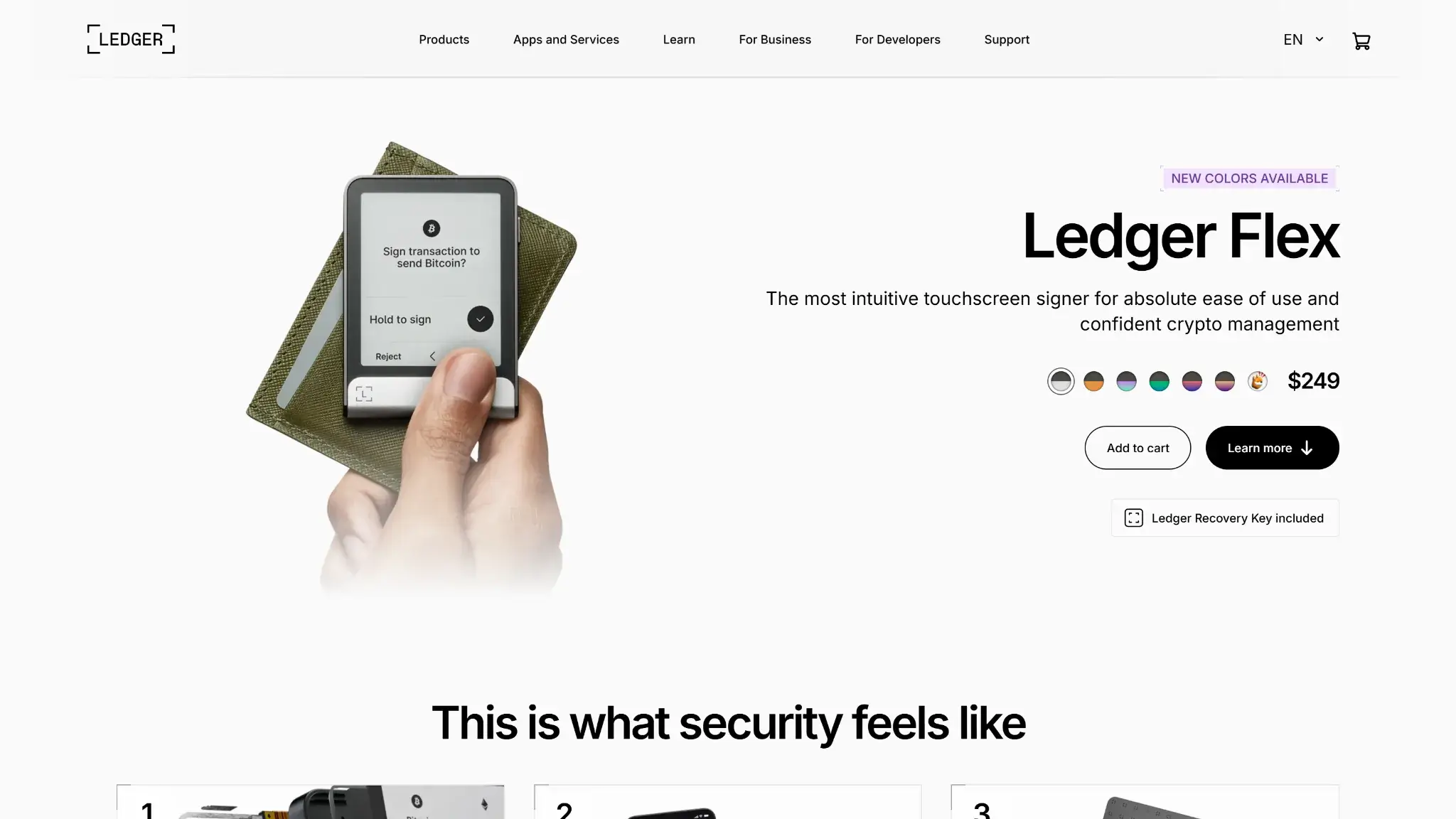
Ledger Flex product page hero section showing the device, price, color options, and Ledger Recovery Key included.
Ledger Flex is a non-custodial hardware wallet. Its job is to keep your private keys inside dedicated hardware and make you approve transactions on the device itself instead of trusting only a phone or computer screen.
In daily use, Ledger Flex works through two parts: the device and Ledger Wallet. The device is where the keys stay and where approvals happen. Ledger Wallet is the companion app for balances, account views, app installs, swaps, staking access, and transaction history.
Here is how the flow works:
You use Ledger Wallet on desktop, iPhone, or Android to manage accounts and prepare actions.
You connect Ledger Flex by Bluetooth on iPhone, by Bluetooth or cable on Android, or by USB-C on desktop.
The private keys stay inside the Secure Element in the device.
Transaction details appear on the 2.8-inch E Ink touchscreen for review.
You approve or reject on the device itself.
If you approve, the device signs the transaction and the connected app broadcasts it.
This is where the larger screen matters. It does not change the core self-custody model, but it does make address checks, token approvals, and supported contract prompts easier to read than on smaller button-based devices.
Flex does more than basic cold storage. It can hold and manage major assets, install chain apps, view balances, send and receive crypto, access selected swaps and staking flows, and connect to some supported dApp paths through Ledger Wallet. The security model stays the same throughout: the phone or computer prepares the action, but the final decision still happens on the device.
Within Ledger’s lineup, Flex sits above Nano Gen5 and below Ledger Stax. It is the mid-tier touchscreen model focused on easier signing and better mobile use.
Ledger Flex is a cold wallet because the keys stay in dedicated hardware. It is not air-gapped because normal use involves USB-C, Bluetooth, and NFC rather than QR-only isolation.
Wallet Type, Custody and Recovery Model
Ledger Flex is clearly non-custodial. The user controls access through the device, PIN, and recovery setup. Ledger Wallet is the management layer, but it does not turn the product into a custodial account.
The recovery model is more flexible than older button-based Ledger setups because it can combine a standard 24-word Secret Recovery Phrase with Ledger Recovery Key and optional Ledger Recover. That gives users three recovery routes, but each one only helps if it was stored safely and is still available when needed.
Can you export keys or seed?Yes, the recovery setup is portable through the 24-word Secret Recovery Phrase; private keys themselves stay in the device
Portability to another walletEasy with a compatible BIP39 wallet
What happens if you lose the deviceYou can restore access with the recovery phrase or, where set up correctly, with Ledger Recovery Key or Ledger Recover
What happens if you lose the recovery methodAccess can be permanently lost if you no longer have any valid recovery path
Who can help recover accessNobody by default; Ledger Recover only helps if it was set up in advance
Best use caseLong-term storage with regular signing across phone and desktop
Ledger Recovery Key is an extra offline recovery route, not a replacement for understanding the core recovery model. It can make recovery easier, but it does not remove the need to manage backups properly.
Passphrase support is available, but it adds recovery complexity. Ledger Recovery Key also does not back up a passphrase, so anyone using a passphrase has to keep that separately.
Supported Assets, Networks and Compatibility
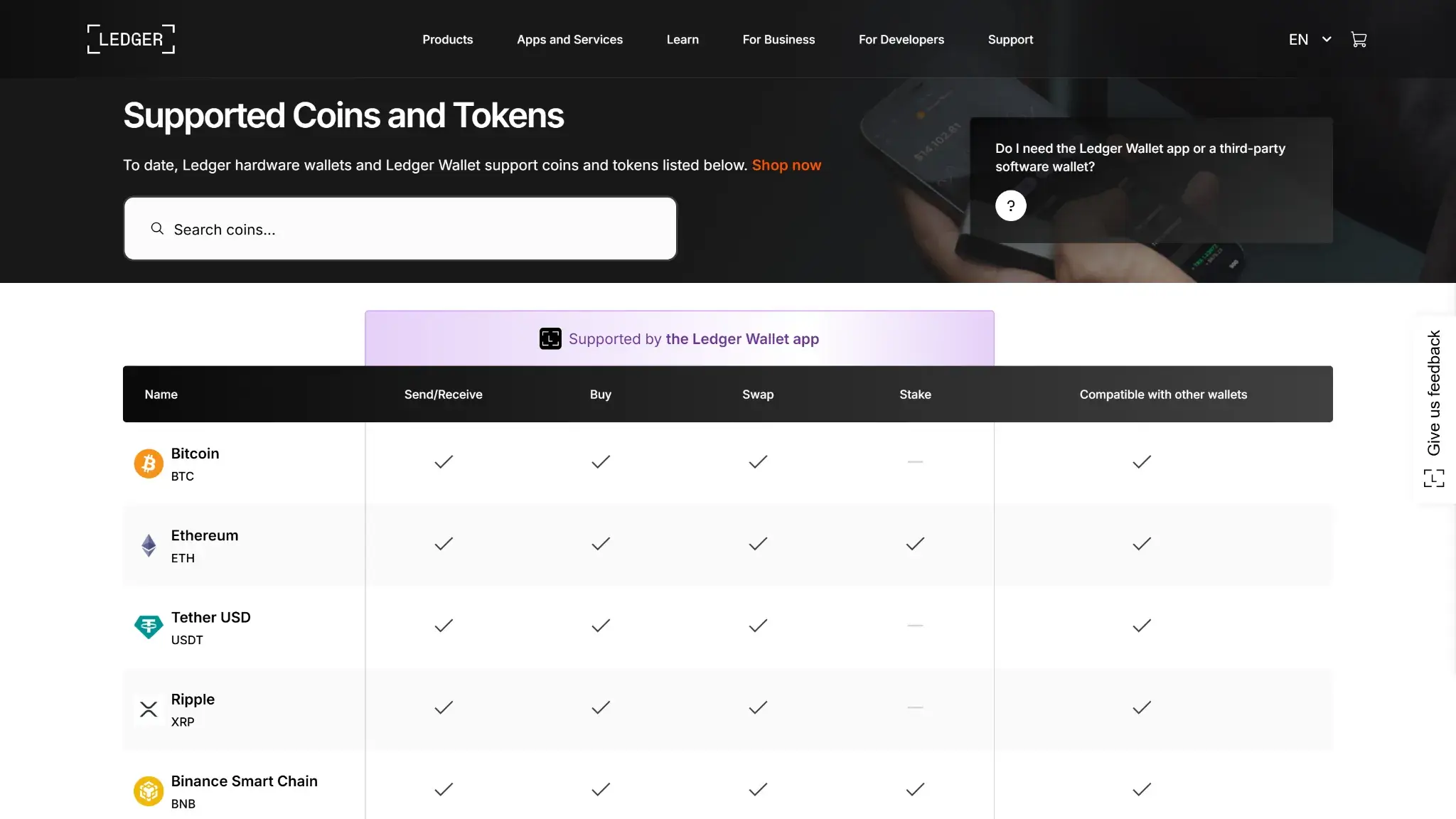
Ledger Wallet supported coins and tokens page showing asset support for Bitcoin, Ethereum, USDT, XRP, and BNB.
Ledger Flex supports a broad mix of major assets and networks, but not every chain works the same way. Some assets run natively in Ledger Wallet, while others still depend on compatible third-party wallets.
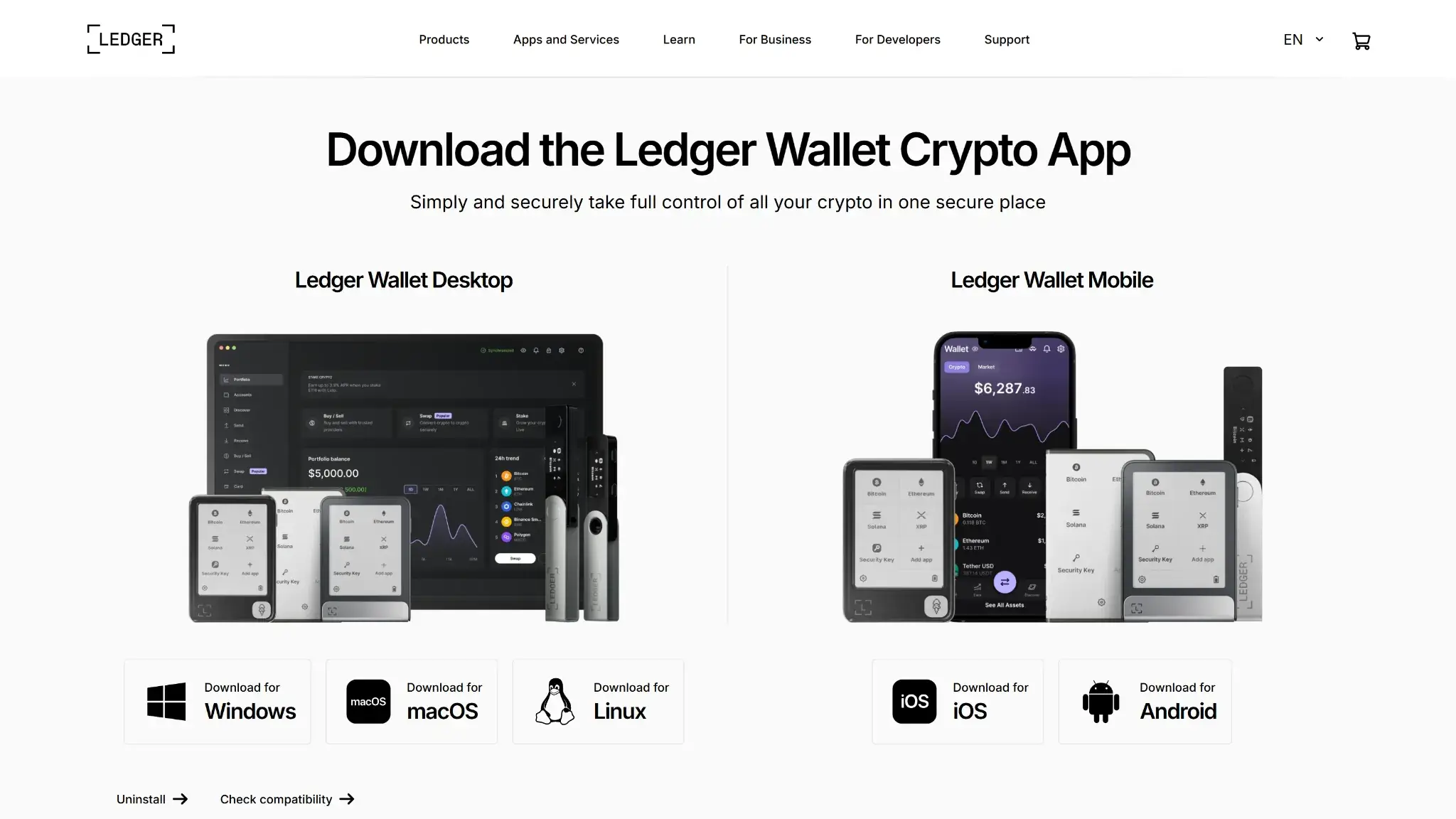
It works across desktop, iPhone, and Android, with Bluetooth, USB-C, and NFC support. The main limits are simple: desktop stays cable-first, Chromebook is not supported, and some chain-specific workflows still rely on third-party wallet support.
Major chains supportedBitcoin, Ethereum and EVM chains, Solana, XRP Ledger, Hedera, Sui, XDC, and Flare
Token Support500+ coins and Ethereum/Polygon NFTs directly in Ledger Wallet; 1,000+ coins and multi-blockchain NFTs via third-party wallets; compatible with 50+ wallets
PlatformsDesktop, iPhone, Android
Hardware supportNot applicable; Ledger Flex is the hardware wallet
Connection methodsBluetooth 5.2 LE, USB-C, NFC
Notable gapsNo Chromebook support, no desktop Bluetooth pairing in Ledger Wallet, and some assets still rely on compatible third-party wallet workflows
The experience is smoother on major chains that work natively in Ledger Wallet than on chains that still depend on compatible third-party wallets. Because of that, Flex is a better fit for users who are fine with mixed workflows than for users who want every chain and every action inside one app.
Core Features and Real-World Use Cases
Ledger Wallet download page showing desktop and mobile app availability for Windows, macOS, Linux, iOS, and Android.
Compared with Nano X, Nano Gen5, and even Stax, Ledger Flex mainly improves how common hardware-wallet tasks feel in daily use. It covers the features most active self-custody users need, including sending, swapping, staking, NFT handling, and supported dApp connections. The larger screen, stronger phone support, and more flexible backup setup are the main reasons to pick it. Even so, it still works best as a secure storage and signing wallet, especially because partner services and third-party wallets make the experience less consistent once you move outside Ledger Wallet’s core paths.
Feature area
What users can do
How it works in practice
Key limitations, costs, or risks
Swaps and trading
Swap supported assets and use basic buy or sell flows
Ledger Wallet handles the main flow, with partner swap routes such as Changelly, Velora, and other supported services inside the app
Service quality, spreads, and asset coverage can vary by provider, route, and network
Staking and earn
Stake selected assets
Staking access is available through supported Ledger Wallet workflows and compatible integrations
Support is selective rather than universal, and workflow quality can vary by asset
dApp access and connectivity
Connect to supported dApps and approve on-chain actions from the device
Supported flows run through Ledger Wallet and compatible wallet connections, with on-device review and approval on the Flex screen
Some dApp paths are smoother than others, some workflows still rely on third-party wallet routes, and unsupported flows can feel less direct
NFTs
View and manage Ethereum and Polygon NFTs, with broader NFT reach through compatible wallets
Native handling is stronger for Ethereum and Polygon, while other ecosystems can depend on compatible third-party support
NFT support is not equally native across all chains
Exchange and account features
Buy, sell, and manage assets through Ledger Wallet
Ledger Wallet provides the account view, while partner services such as Transak and BTC Direct handle buy and sell flows
Third-party service dependence, regional availability, variable fees, and provider-level identity checks can apply
Smart account, MPC, or passkey features
Use passkey and security-key style features alongside the wallet
Ledger Flex can also serve Security Key use cases beyond pure crypto signing
This is a secondary feature, not the main reason to buy the wallet, and it does not turn Flex into an MPC or smart-account wallet
The feature mix is useful, but it is not equally native from start to finish. Ledger Flex feels best when the job is storing assets safely, reviewing transactions clearly, and using mainstream supported flows inside Ledger Wallet. Once a workflow moves into third-party wallet routes, partner services, or niche chain behavior, the experience gets less consistent. That makes Flex a strong fit for users who want active self-custody without giving up hardware-wallet discipline, while users who expect one fully unified app experience across every asset and workflow may find it limiting.
Fees and Total Cost Of Ownership
Ledger Flex starts at $249, but the real cost is shaped by more than the device price alone. Shipping, taxes, backup accessories, and partner-powered services such as swaps, buys, or sells all affect what you actually pay over time. It helps to separate hardware costs from network costs and service-provider costs so the total is easier to read.
Cost component
What users pay
When it applies
Notes
Device or wallet price
$249
One-time
Core hardware purchase
Wallet fee
None for core wallet use
Ongoing
Ledger Wallet does not add a mandatory software fee for standard wallet use
Shipping and import costs
Varies
Hardware orders
Shipping fees are calculated at checkout. Taxes and duties depend on destination, and checkout shows whether duties/taxes are included, prepaid, estimated, or payable on delivery. Seller details also vary by region.
Optional accessories
Varies
After purchase or at checkout
Cases, folios, and metal backup products add to total ownership cost
Network fees
Variable
Send, swap, stake, and other on-chain actions
Chain dependent and not paid to Ledger
Swap spread or routing fee
Variable
Swaps
Provider dependent and not standardized across partner swap routes such as Changelly, Velora, and other supported services
On-ramp fee
Variable
Buying crypto
Partner dependent and country dependent; identity verification is handled by the provider, not Ledger
Withdrawal fee
Not applicable at the wallet level
Not applicable for basic self-custody use
Moving assets still involves normal network fees
Subscription or premium fee
Optional paid Ledger Recover subscription
Recurring if used
Only relevant if you want ID-based recovery in addition to phrase and Recovery Key backups
For most buyers, total cost comes down to how much value they get from the larger screen, better mobile support, and more flexible backup setup. Those are the features doing the work here, and they need to justify not just the $249 device price, but also the extra costs that can come from shipping, taxes, accessories, and partner-based service flows.
Ledger also includes a one-year limited warranty, and the optional Ledger Replace protection plan can extend device coverage to three years.
Security Architecture And Trust
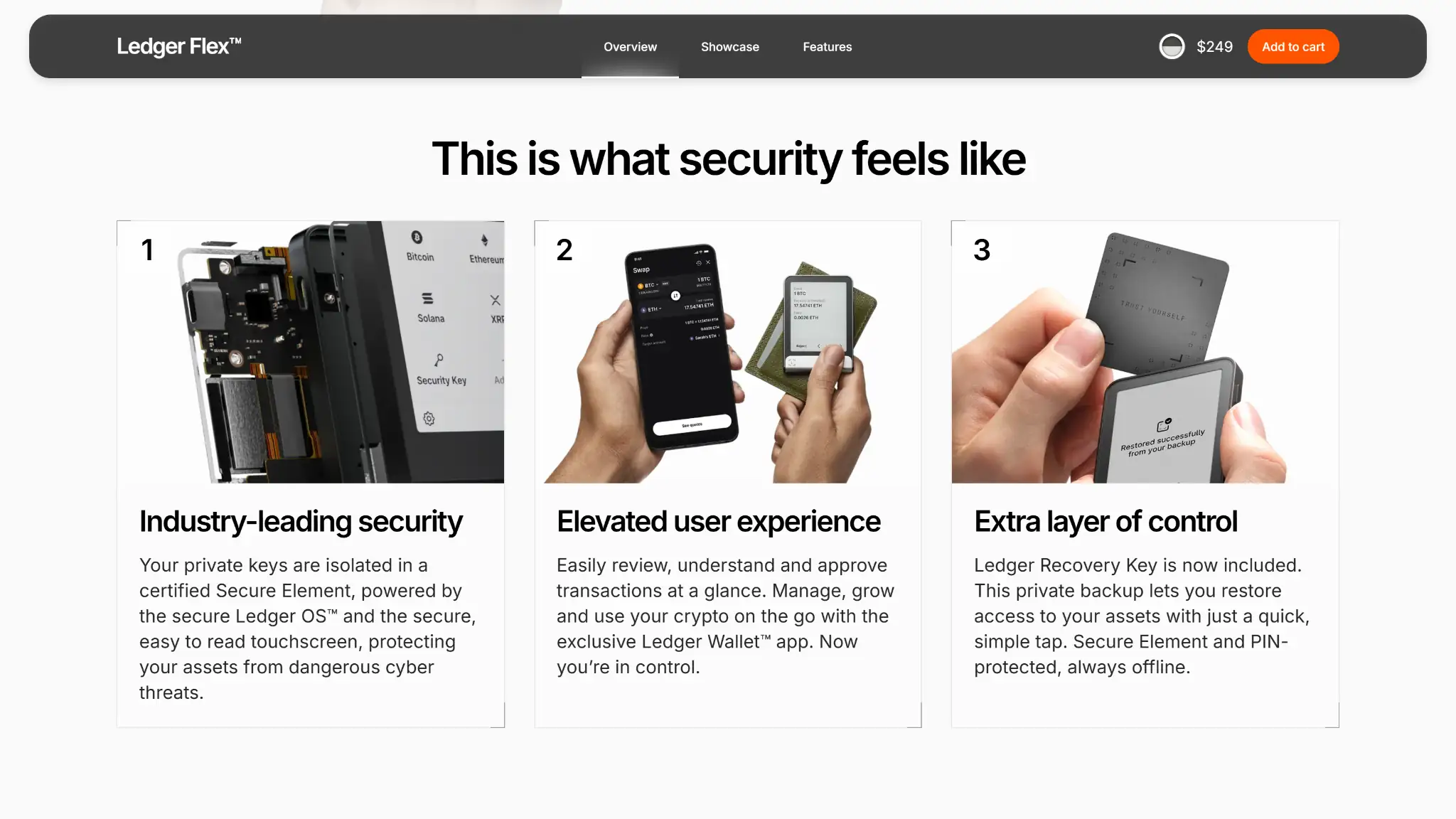
Ledger Flex security features section highlighting Secure Element protection, user experience, and included Recovery Key backup.
Ledger Flex has a strong mainstream hardware-wallet security model. Private keys stay inside a Secure Element, transaction approval happens on the device, and the larger screen makes review easier than on smaller button-based models. Flex is built around convenience-first cold storage, with USB-C, Bluetooth, NFC, and Ledger Wallet as part of normal use. Because of that, the main trade-offs sit around connectivity, partial open-source boundaries, and workflows that still depend on compatible third-party integrations.
Key control modelUser-controlled keys stored inside the device’s Secure Element
External validationST33K1M5 Secure Element, CC EAL6+, Genuine Check, published Ledger OS third-party security assessment reports, and a public bug bounty through Donjon
Incident posturePublic security bulletins, incident notices, and a live status page
The core design is straightforward. Your phone or computer prepares a transaction, but the signing key stays in the device and the final approval still happens on the Flex screen. That keeps the approval step on the device instead of leaving it to the connected phone or computer. Flex also adds practical trust checks around device authenticity and maintenance. Genuine Check is part of setup. Buying direct or through an official reseller is the safer route. Firmware updates are a normal part of ownership.
The device gives you a strong signing boundary, but the rest of the stack is more mixed. Ledger Wallet’s app code is open source; the Secure Element firmware is not. On supported flows, Clear Signing and Transaction Check improve review quality, while fake-app warnings, scam guidance, and token-approval revocation tools add more guardrails. Unsupported or third-party routes can still feel less clean. Physical protection also depends on user setup: the device uses a 4 to 8-digit PIN, resets after three wrong attempts, and supports passphrases. That helps with device security, but passphrase users take on more recovery complexity because Ledger Recovery Key does not back up a passphrase. Ledger also runs a public bug bounty through Donjon and publishes security bulletins and third-party security assessment reports.
Backup, Recovery and Loss Scenarios
Ledger Flex gives users more than one recovery path, and the order still matters. The 24-word Secret Recovery Phrase remains the main backup, while Ledger Recovery Key and optional Ledger Recover add extra recovery routes if they were set up correctly in advance. Because of that, the main failure point is usually not losing the device itself. It is losing every valid recovery method at the same time.
Scenario
What happens
What can help
When loss becomes permanent
You lose the phone or computer
Funds are not lost as long as the device or a valid recovery path still exists
Connect Flex to another supported device or restore from backup if needed
Not permanent if the device or backup remains available
You lose the Ledger Flex device
Assets remain on-chain, but you need a valid recovery path to regain access
24-word phrase, Ledger Recovery Key, or Ledger Recover if it was set up in advance
Permanent loss happens if the device is gone and no valid recovery method remains
The device is broken or unusable
Access can still be restored on another compatible wallet environment
24-word phrase, Ledger Recovery Key, or Ledger Recover if available
Permanent if the broken device was the only remaining access point and no backup exists
You forget the PIN
The device protects itself; after three wrong PIN attempts it resets
Restore from the recovery setup after reset
Permanent if the device resets and no recovery path exists
You lose the recovery phrase
The wallet may still be usable if the device still works or another recovery path exists
Ledger Recovery Key or Ledger Recover, but only if they were already set up
Permanent once the device is lost, reset, or broken and no other backup remains
You lose the Recovery Key
The phrase or Ledger Recover may still preserve recovery
24-word phrase or Ledger Recover if already configured
Permanent only if all recovery methods are gone
You use a passphrase and lose it
Standard backup may no longer restore the same hidden wallet context
Only an accurate passphrase record helps
Loss can be permanent even if the 24-word phrase is still intact
You contact support after losing access
Support can help with troubleshooting and workflow issues, not recreate missing secrets
Setup guidance and device troubleshooting only
Permanent if every valid recovery path has been lost
Recovery options are more flexible than on older Ledger models because Flex adds Recovery Key in the box and still keeps standard BIP39 portability. Even so, recovery still fails if the device is lost or resets and no valid backup remains.
UX, Performance and Platform Support
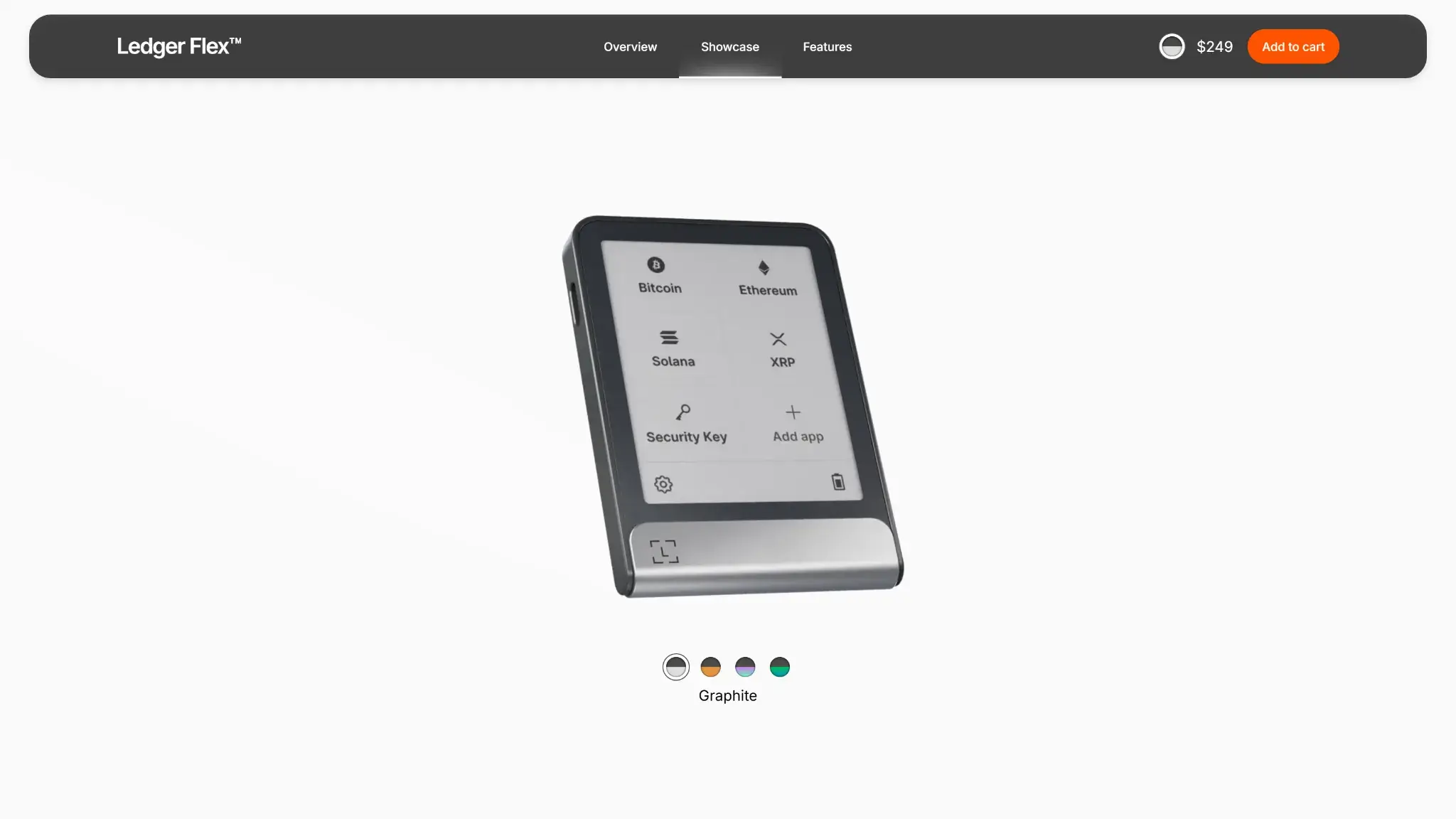
Ledger Flex product image in graphite color with color selector shown on the official product page.
Ledger Flex is easier to use correctly than most small-screen hardware wallets, and that is the main reason it exists. The large E Ink touchscreen improves signing clarity, PIN entry, and address review, which lowers the chance of rushed approvals on button-based devices. It feels more forgiving for beginners than older Nano-style wallets because the prompts are less cramped, but it still leaves room for expert use through passphrase support, broader asset coverage, and phone-plus-desktop flexibility.
The trade-offs are mostly about parity and maintenance rather than screen usability. Mobile support is one of Flex’s best traits, especially on iPhone, while desktop remains more limited because Ledger Wallet desktop does not support Bluetooth pairing. Browser-based flows are also more fragmented because they usually rely on compatible third-party extensions rather than a native Ledger Wallet extension. Because of that, the smoothest experience stays inside Ledger Wallet itself, while extension-based and third-party wallet routes take more setup and vary more by asset.
Platform
Availability
Notes
iOS
Yes
Bluetooth support makes iPhone use one of Flex’s strongest workflow advantages
Android
Yes
Works over Bluetooth or cable
Browser extension
Partial
Ledger supports direct dApp connectivity for supported dApps on desktop Chromium browsers, while many other flows still use third-party wallets/extensions such as MetaMask, Phantom, Rabby, and Trust Wallet.
Desktop
Yes
USB-C only in practice because Ledger Wallet desktop does not support Bluetooth pairing
Web app
No
Ledger Wallet is designed for desktop and mobile rather than as a browser-based web app
The hardware side is where Flex justifies its place in Ledger’s lineup. The 2.8-inch E Ink touchscreen is the real UX upgrade, and the aluminum frame, Gorilla Glass, and anti-glare coating make it feel more like a small device than a USB stick. Battery life is rated at up to 10 hours of normal use or about 150 transactions, so charging becomes part of upkeep in a way it is not on battery-free designs. Portability is decent rather than minimal: it is easier to use than smaller devices, but less discreet to carry than Nano-sized or card-style alternatives.
Customer Support, Documentation and Incident Handling
Ledger Flex has stronger documentation than many wallets, and that matters because most real support needs on a non-custodial hardware wallet are about setup, compatibility, updates, and recovery rather than account-level intervention. Official coverage is broad across onboarding, compatibility, Genuine Check, Recovery Key setup, Bluetooth issues, update-mode failures, asset support, xPub export, and general device management.
Support requests start in the support widget, which offers email support and, when available, live chat. Ledger also runs a public status page and official social channels for announcements and peer help. The hard limit stays the same: support can help with setup, troubleshooting, and recovery guidance, but it cannot reverse an on-chain transaction or recreate a missing recovery phrase, passphrase, or other lost secret.
Channel
Availability
Typical use
Notes
Help center
Yes
Docs, setup, troubleshooting
Broad self-serve coverage for onboarding, compatibility, Genuine Check, Recovery Key, Bluetooth, updates, and asset support
Live chat
Yes, when available
Urgent support
Accessed through the support widget
Email or tickets
Yes
Account or technical issues
Opened through the support widget after email verification
Status page
Yes
Outages and incidents
Public Ledger Status page with real-time and historical service data
Community channels
Reddit, YouTube, Discord, X, and other official social channels
Announcements or peer help
Useful for updates and education, not for secret recovery or transaction reversal
Ledger is fairly open about service issues. It publishes security bulletins, incident notices, and live status updates, while firmware updates and Genuine Check remain part of normal ownership discipline. Users have a clear first-party path for checking service problems and security issues through those channels. That helps with troubleshooting, but it does not fix lost secrets or other user-side recovery mistakes.
Final Verdict
Ledger Flex is a strong premium hardware wallet for users who care about comfortable on-device signing, better phone support, and a smoother everyday workflow than Nano-style devices provide. Its biggest strengths are the large touchscreen, solid mobile usability, and standard recovery flexibility. Its main weaknesses are price, partial dependence on Ledger’s own software and third-party flows, and a design that prioritizes convenience over air-gapped or fully open-source ideals.
The 2.8-inch E Ink touchscreen makes addresses, token approvals, and transaction details easier to review than on button-based Ledger devices.
iPhone support over Bluetooth and Android support over Bluetooth or cable make Flex much more practical for mixed mobile use than USB-only hardware wallets.
The backup setup is more flexible than older Ledger models because it combines a standard 24-word Secret Recovery Phrase with an included Ledger Recovery Key and optional Ledger Recover.
Recovery is not locked to Ledger. You can restore the wallet with the recovery phrase in a compatible BIP39 environment.
It keeps most of the practical touchscreen and mobile value people want from Stax while staying at a lower price.
CONS
- At $249, Flex is still expensive if you mainly buy, hold, and rarely approve transactions.
It is not air-gapped, because normal use still relies on USB-C, Bluetooth, and NFC rather than QR-only isolation.
The security model is not fully open-source, which matters if you want a more transparent firmware and hardware stack.
Desktop use still leans heavily on USB-C because Ledger Wallet desktop does not support Bluetooth pairing.
Some assets and chain-specific workflows still depend on compatible third-party wallets instead of staying fully inside Ledger Wallet.
Affiliate Disclosure
Disclaimer: CryptoSlate may receive a commission when you click links on our site and make a purchase or complete an action with a third party. This does not influence our editorial independence, reviews, or ratings, and we always aim to provide accurate, transparent information to our readers.
FAQ
Is Ledger Flex custodial or non-custodial?
It is non-custodial. The user controls the device and recovery setup.
Is Ledger Flex a hot wallet or a cold wallet?
It is a cold hardware wallet. Keys stay in dedicated hardware, not on the phone or computer.
Does Ledger Flex give you a seed phrase?
Yes. Its recovery model includes a 24-word Secret Recovery Phrase.
Is Ledger Flex safe?
It has a strong mainstream hardware-wallet security model with a Secure Element, on-device approval, Clear Signing, and PIN protection. The trade-offs are that it is not air-gapped and not fully open-source.
Which chains does Ledger Flex support?
It supports major networks including Bitcoin, Ethereum and EVM chains, Solana, XRP Ledger, Hedera, Sui, XDC, and Flare, plus broader asset coverage through compatible third-party wallets.
What fees does Ledger Flex charge?
The main fixed cost is the $249 device price. Other costs can include shipping, taxes, network fees, optional accessories, and partner-service fees for swaps, buys, or sells.
Does Ledger Flex require KYC?
No for core wallet use. Buy, sell, and recovery services can add provider-level identity verification, depending on the feature you use.
What happens if you lose your device or recovery method?
Losing the device is not fatal if you still have a valid recovery path. Losing every valid recovery method can permanently block access to your assets.