

Is Polymarket Legit? Safety & Risks Analysis
We believe in full transparency with our readers. Some of our content includes affiliate links, and we may earn a commission through these partnerships. However, this potential compensation never influences our analysis, opinions, or reviews. Our editorial content is created independently of our marketing partnerships, and our ratings are based solely on our established evaluation criteria. Read More





Yes, Polymarket is legitimate and safe in many leading markets worldwide. In this guide, we will examine its credibility, security, reputation, and trustworthiness. We’ll also discuss the platform’s legal standing, ownership, and potential bias, among other factors. Before we review Polymarket in more detail, let’s begin with the most important takeaways.

- In This Article
- Show Full Guide
Key Takeaways
- Polymarket is a $9 billion venture-backed company, supported by blue-chip investors like Polychain Capital, Ethereum co-founder Vitalik Buterin, and the parent company of the NYSE (ICE).
- The Polymarket platform incentivizes honest forecasting using financial incentives in a peer-to-peer marketplace.
- According to independent tracking, Polymarket is over 95% accurate in the closing hours of a market, making it a trusted barometer of event outcomes.
- Polymarket’s parent company acquired a derivatives exchange in 2025, providing a path to regulatory compliance in the U.S.
Is Polymarket Legit? Key Indicators of Credibility
The term “legit” can be loaded in some contexts. Regarding Polymarket, legitimacy refers to the platform’s security and its track record of functioning as advertised. The platform uses a proven decentralized finance (DeFi) structure that uses computer programs running on blockchain technology (smart contracts) to manage transactions.
These programs use conditional logic to bypass the need for intermediaries (“middlemen”). It runs simply on “If this condition happens, then do that.”
Using a blockchain like Polygon to host prediction markets makes the process transparent and tamper-resistant: Every token exchange is visible on the blockchain.
Users connect to the platform’s decentralized application (dApp) using a cryptocurrency wallet. The wallet holds the private keys that control the user’s assets on the blockchain. When you purchase Outcome Shares, you hold the token in your non-custodial wallet rather than entrusting Polymarket with custody.
For example, if you buy Outcome Shares at $0.50, the shares will settle at $1.00 or $0, depending on whether you hold the winning shares or the losing shares. However, you can trade these shares at any time before the event closing.
Is My Money Safe on Polymarket?
Whether your money is “safe” on Polymarket depends on two separate factors that are often conflated: The safety of your deposit method and the safety of the funds once they are on Polymarket.
Let’s start by addressing the deposit methods first:
- Direct crypto transfers
- Card
- SEPA
- Centralized exchange transfer
- PayPal
Each of these methods introduces its own risk that is external to Polymarket. Regardless of what method you choose, funds are automatically converted to USDC to make trades. To allow you to deposit funds, Polymarket generates a non-custodial wallet for each user (if you do not already have your own wallet). However, there is limited documentation clarifying whether Polymarket retains knowledge of your private keys.
With this in mind, it is important to clarify that you can lose money from exploits due to bad operational security, phishing, or bad trades.
To continue, certain aspects of the Polymarket platform are off-chain and centralized, such as order matching. Assuming Polymarket uses the same contracts, ChainSecurity’s audit highlights the degree to which Polymarket has control:
“Operators in the Exchange have to be fully trusted. All orders are sent off-chain to the operators, and they have the power to match different orders with each other in any order or to discard particular orders altogether.
The Exchange contract also has one or multiple admins who are the only addresses allowed to register tokens. Additionally, admins are allowed to pause the contract, which halts all order processing from operators.”
At the time of writing, it is unclear from public documentation how user funds are escrowed during open positions. This is most relevant to abnormal conditions, such as contract pauses, disputes, and account restrictions.
With this much, it is reasonable to conclude that, while users do maintain control and access to funds held in their non-custodial wallets, once you deposit funds to the platform (or make a trade), Polymarket does have some ability to exercise control over your funds, in some capacity. The scope of this control can be separated between the frontend and the off-chain infrastructure.
👉 Learn More: How to Use Polymarket: Complete Beginner’s Guide (2026)
Smart Contract Audits & Technical Security
The Polymarket platform provides three distinct security assurances: non-custodial funds, smart contract audits, and a bug bounty program.
- Non-Custodial Funds: Polymarket does not hold user funds. This structure protects against breaches or other Polymarket risks that could threaten your Outcome Share tokens.
- Smart Contract Audits: Trading and settlement functionality on Polymarket is governed by immutable (unchangeable) smart contracts. These open-source contracts are available for public review and have been audited by ChainSecurity, a well-known Web3 security firm.
- Bug Bounty Program: Polymarket also incentivizes the global hacking community to find vulnerabilities through a bug bounty program on Immunefi, with rewards of up to $1,000,000.
Past Hacks, Exploits, and Security Incidents
Polymarket hasn’t suffered a publicly confirmed exploit of its core on-chain smart contracts, but it has experienced multiple security incidents affecting users at the account and ecosystem level. These events are important when evaluating platform safety, even if they fall outside classic DeFi contract hacks.
The earliest widely reported issues took place in 2024, when users claimed their balances were drained after logging in via third-party authentication (Google SSO). While no protocol flaw was identified, the incidents shed light on risks introduced by Web2 login abstractions.
In late 2025, Polymarket confirmed a breach affecting a limited number of users caused by a vulnerability in a third-party authentication provider.
According to reporting, attackers gained unauthorized account access and withdrew funds. Polymarket stated that the protocol itself was not compromised and that the issue was patched, though details such as total losses and the provider involved were not publicly disclosed.
Separately, Polymarket has been repeatedly targeted by social-engineering attacks, particularly phishing links embedded in market comment sections.
These campaigns redirected users to spoofed sites that harvested credentials or session data, leading to account takeovers and losses reportedly totaling hundreds of thousands of dollars across incidents.
Finally, several Polymarket-adjacent tools, including unofficial trading bots and malicious typosquat npm packages posing as Polymarket libraries, have been linked to wallet key exfiltration and fund theft.
It’s worth noting that these incidents are linked to ecosystem and supply-chain issues, not failures of Polymarket’s core smart contracts.
Overall, Polymarket’s security track record shows strong protocol integrity, but risk remains at the authentication, UI, and third-party tooling layers.
User Reviews and Community Reputation
Polymarket has become an essential gauge of community sentiment, often cited alongside trusted polling platforms and industry expert consensus. In many ways, the platform is regarded as more trustworthy in its crypto predictions than its legacy counterparts, as its financial incentives encourage honest appraisals from a broad community rather than from groups or individuals with potentially hidden agendas.
Well-known media outlets such as Bloomberg, Forbes, and The New York Times have cited the platform as a real-time barometer of political and global events. Polymarket earns these citations through a proven track record of prediction accuracy.
- 91%+ accurate one month before an event resolves.
- 95%+ accurate in the final hours before resolution.
Independent analysts like Alex McCullough aggregate data on Polymarket’s historical accuracy. This track record demonstrates that Polymarket’s economic incentives distill “the wisdom of the crowd” into reliable probabilities.
Although the contracts themselves and the platform’s accuracy appear sound, Polymarket isn’t without controversy. In particular, user ratings on Trustpilot point to what they believe were unfair outcomes by oracles or to perceived Universal Market Access (UMA) manipulation.
The latter refers to a secondary decision-making process that comes into play when a disputed outcome arises.
In short, critics assert that the decentralized human element of the dispute process is not as decentralized as the marketing copy suggests.
User Ratings From Reddit, X, and Trustpilot
Let’s examine community discussions on Polymarket, followed by key examples of controversial outcomes.
- Reddit: Users give the platform mixed reviews, with some praising its historical accuracy and its reputation as a “truth machine.” However, others highlight the potential for corruption in the UMA process, suggesting that whales who hold large amounts of UMA tokens can steer outcomes in their favor. The most vocal critics describe the platform as a plutocracy designed to extract money from retail traders through ambiguous questions and a flawed decision-making process.
- Twitter/X: Discussions on X cover a wider range of topics, with Polymarket appearing in political debates, crypto predictions, and other areas. Polymarket also enjoys a reputation boost on X, where Elon Musk has been a vocal proponent, and has inked an agreement with X to integrate with X and Grok AI.
- Trustpilot: As is common with crypto-based platforms, Polymarket has received poor user reviews. Trustpilot users rate the platform at 1.3 out of 5 stars. Complaints mirror those found elsewhere, focusing on “unfair outcomes” and accusations of whale manipulation.
Polymarket Controversies
Two major controversies centered on Ukraine and its leader, President Volodymyr Zelenskyy.
- The Ukraine Mineral Deal ($7 Million Alleged Manipulation): A Polymarket question asked whether Ukraine would agree to a rare-mineral deal before a specified date. Accusations centered on a UMA token holder who controlled an estimated 25% of the UMA vote, claiming this one whale had manipulated the outcome to “Yes.” However, critics claimed that no rare mineral deal had been reached. Polymarket acknowledged the governance attack, but stated the outcome was not a market failure.
- The Zelenskyy Suit Market ($14 Million Ambiguity): Another controversy erupted over a widely watched media discussion: whether Ukrainian President Volodymyr Zelenskyy would wear a “suit” before a specified date. Disagreements over the definition of a suit emerged, with a $14 million market at stake. In situations where definitions are unclear, the UMA again steps in, with token holders voting on an outcome that might benefit them.
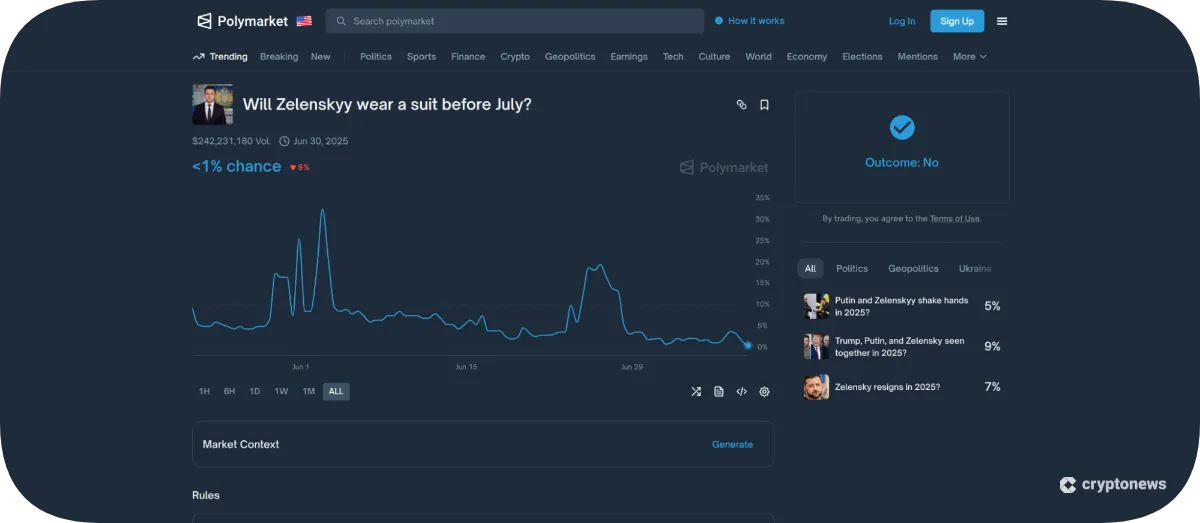
Despite its occasional controversies, Polymarket remains a fun attraction and a relevant barometer of upcoming event outcomes. The platform’s transparency makes it a viable alternative to top prediction markets like Kalshi and PredictIt.
In fact, some would argue that Polymarket’s transparency directly contributes to its occasional controversies. Everything that occurs on the platform occurs on-chain, exposing it to scrutiny.
Is Polymarket Legal in the U.S. and Other Countries?
Polymarket is available to U.S. traders, though functionality varies by state.
The Commodities and Futures Trading Commission (CFTC) labeled Polymarket’s prediction markets as “binary options,” which can only be offered by a registered exchange. This initially resulted in a $1.4 million civil penalty for Polymarket and forced the platform to restrict access to U.S. users.
However, Polymarket’s parent company acquired the QCX LLC derivatives exchange in July 2025 and later received approval from the CFTC to operate onshore. However, as of this writing, Polymarket remains in read-only mode for U.S. visitors, but is gradually rolling out its new app.
Polymarket remains legal worldwide, but specific countries have banned the platform, including Poland, France, Australia, Switzerland, Taiwan, and Singapore. The QCEX acquisition does not address the bans in these countries.
If the platform is restricted in your regions, check out our picks for the best sites like Polymarket.
Is Polymarket Biased or Manipulated?
Examples of Polymarket markets in which manipulation was alleged do exist. However, the vast majority of markets on the platform trade and close without incident. Misinformation, such as social media rants, can also skew perception toward claims of manipulation. Low-liquidity markets bring another source of possible confusion, particularly when traders make large bets that move the market meaningfully.
Polymarket’s structure seeks to prevent bias through financial incentives. Traders make money when they are on the winning side of the outcome, and the platform penalizes incorrect predictions by design. This means the platform rewards objective probabilities over personal or political bias. In the end, whether a trader likes the topic or the person at the center of a prediction market takes a back seat to the factual outcome.
The Polymarket team creates markets (questions) with some community input. This moderation helps ensure clear outcomes and eliminates illegal markets, although it does not provide a 100% safeguard against bias. In the end, math wins, and the platform rewards accurate predictions.
However, low-liquidity (typically new) markets can skew perception.
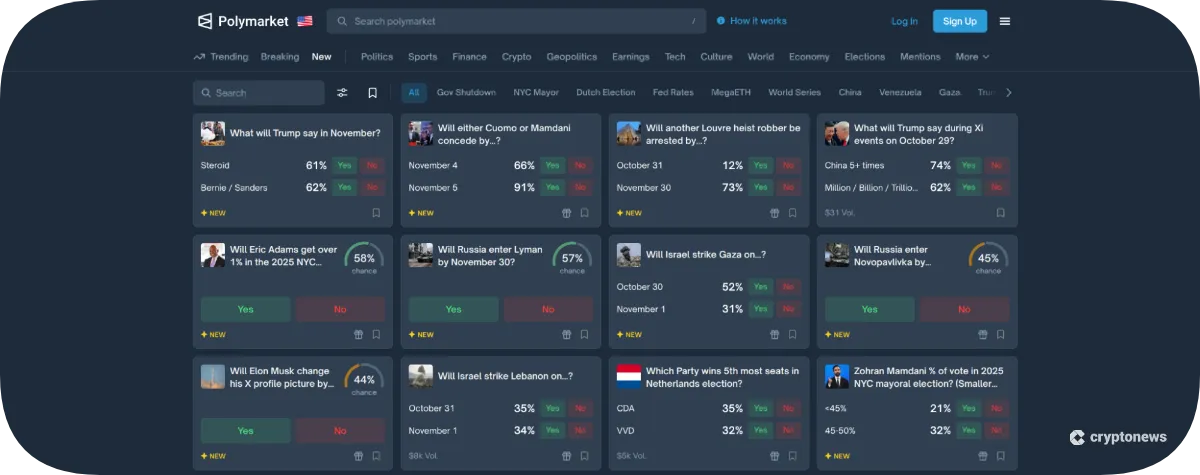
A large buy or sell with limited market participation to absorb the transaction can move prices dramatically. Without further research into liquidity, the chart could be interpreted as manipulation. These types of chart movements are common in newer markets that haven’t yet attracted much trading activity. As more traders enter the market, prices naturally move toward the community’s assessment of the market’s probability.
In one high-profile market, the 2024 U.S. election, accusations of political bias echoed across social media, putting the trading market at odds with traditional media sources. Polymarket’s traders called the winner of the 2024 election long before the media reported the outcome.
However, the market also faced accusations of manipulation and bias, with the Wall Street Journal reporting that a cumulative $30 million bet by four accounts had moved odds on the platform heavily in Trump’s favor. At the time, major traditional polls had the race neck and neck.
How to Secure Your Polymarket Account
Securing your Polymarket account depends on the method you used to sign up. Polymarket uses email and cryptocurrency wallet-based sign-in methods.
To secure your account with email, use a strong password, enable two-factor authentication (2FA), keep your device and browser updated, and remain cautious of suspicious links and attachments sent to your email.
💼 Cryptocurrency Wallet
You should follow the suggested method for securing your crypto wallet to secure your Polymarket account created via a wallet. These include never sharing your private key, seed phrases, or passwords, using secure internet connections, segregating funds, and rotating wallets regularly.
👉 For more tips on how to secure your wallet, check out our guide on cryptocurrency security.
Beyond Security: Financial Risks & Ethical Considerations
When assessing risks outside of Polymarket’s strategies and technical structure, there are some things you should keep in mind. Let’s start with the financial risks. Liquidity is specific to events, time, and narratives.
For starters, Polymarket is unlike a traditional exchange with two sides for every price level. For example, even high-profile markets (e.g., elections or geopolitical events) will experience deep liquidity at popular prices, but thin out as you move away from the consensus probability.
This means that a market with high volume does not cleanly translate to exit liquidity. You may incur high slippage when exiting an unpopular trade. For drawn-out events, liquidity may appear sporadic and may only increase when new information appears regarding that event.
The dark side of prediction markets, seldom discussed, is the ethics of betting on war, death, or other tragic events. Ethically speaking, some may see this as financial nihilism and callous, with regard to profiting on the misery of others.
Furthermore, prediction markets are a form of gambling and can lead to addiction or compulsive behavior. Therefore, you should learn to recognize the signs of a gambling addiction, self-regulate if possible, and seek help if necessary.
Is Polymarket Betting Legit or Just Gambling?
Polymarket and substantially similar platforms differ from betting in their structure. Polymarket’s tokens represent tradable event contracts, which the U.S. CFTC identified as binary options. One key distinction is the ability to sell your position at any time, which makes the structure a peer-to-peer market rather than a win-or-lose bet against the house.
Despite the distinction, several countries, including Poland, Belgium, and France, have banned the platform. Regulators in these jurisdictions see Polymarket’s derivatives label as a way to sidestep gambling laws.
Critics who see the platform as a gambling venue point to a lack of economic purpose. For example, binary options in traditional markets can serve as a hedge against unexpected market movements, giving them financial utility. By contrast, it would be challenging to find a market on Polymarket that offers similar utility.
Despite varying perceptions depending on jurisdiction, Polymarket differs from sportsbooks and exchanges:
- Sportsbook gambling centers on irreversible bets in which the bookmaker sets the odds. Unlike Polymarket, a bet cannot be closed by selling shares.
- Exchanges that offer binary options typically require KYC identity verification to prevent fraud and money laundering. Currently, Polymarket operates as a permissionless decentralized application. Users can access the platform with a crypto wallet and without providing identification.
However, perhaps the most compelling argument distinguishing the platform from gambling is its decentralized determination of outcomes.
Rather than using an intermediary (the bookmaker) who has a vested interest in the outcome to determine winners and losers, Polymarket resolves outcomes objectively. The platform uses a two-step oracle process, although the second step is often unnecessary.
- Optimistic Resolution: After an event concludes, a proposer submits an outcome for the market. This submission is accompanied by an at-risk bond, in keeping with Polymarket’s financial incentive alignment. For most markets, this bond amount is $750. A two-hour challenge period follows, during which users can dispute the outcome. An estimated 98% of markets resolve following this fast settlement flow.
- Dispute and Vote: Any user can challenge an outcome by posting a counter bond (also at risk). This action sends the matter to the UMA Data Verification Mechanism (DVM), in which UMA token holders vote on the outcome. Voters are also financially incentivized to represent outcomes honestly through a reward/penalty mechanism.
Polymarket makes decisions on outcomes to the community, a stark contrast to traditional betting markets.
How Does Polymarket Make Money?
Financial incentives for the platform itself also support fair outcomes. Unlike traditional betting, the platform (the house) does not make money from losing bets and does not charge a trading fee. However, this no-fee structure on Polymarket requires a more nuanced discussion.”
- Polymarket takes 2% of winnings at settlement.
- Liquidity providers offer trading inventory through limit orders, earning fees in USDC based on the limit order price relative to the current trading price. Polymarket funds these LP fees through 2% of winnings collected as protocol fees.
- The platform can also earn revenue through partnerships, such as the recently announced partnership with X.
The Polymarket model attracts a vibrant ecosystem that incentivizes the community to participate and rewards market efficiency.
👉 Learn More: What Is Polymarket, and How Does It Work?
Who Owns Polymarket?
Polymarket was founded in 2020 by Shayne Coplan, who now serves as the CEO. The platform is operated by its parent company, Adventure One QSS Inc., which is incorporated in Panama and which now also owns the QCX LLC derivatives exchange.
Investors span a wide range, including venture capital firms, crypto personalities, and institutional investors.
Venture Capital Funding: Polymarket raised significant capital from top-tier firms and individuals across both crypto and traditional finance, including:
- Founders Fund (Peter Thiel’s firm)
- Vitalik Buterin (Ethereum Co-founder)
- Polychain Capital, Balaji Srinivasan, Naval Ravikant
- Intercontinental Exchange (ICE) – Parent company of the New York Stock Exchange (NYSE)
Polymarket remains a private company. As a result, specific ownership percentages are unknown. Multiple funding rounds also complicate the math for outsiders. However, the largest equity stakes are believed to be held by ICE, Polychain, Naval Ravikant, and Balaji Srinivasan.
Final Verdict: Should You Trust Polymarket?
Yes, Polymarket is legit for informed users with risk tolerance. Although Polymarket is still working through regulatory challenges in some parts of the world, the platform’s current structure offers a non-custodial way for users to participate in vibrant trading markets tied to world events.
The ideal user profile would be someone who is crypto-savvy and comfortable with self-custody crypto wallets. However, access may be restricted in some areas of the world, putting users into a legal gray area, even when using a VPN.
Traders looking to dip a toe into Polymarket can start with a small position in an actively traded market. As with any contract, read the terms carefully and conduct your own research.
Visit PolymarketFAQs
What is Polymarket?
How accurate are Polymarket markets?
Can you lose money on Polymarket?
Has Polymarket undergone smart contract audits?
Is Polymarket legal and regulated?
Is Polymarket halal?
Can Polymarket be hacked?
What happens if I lose my private key?
Can Polymarket freeze my funds?
References
- Polymarket (Github)
- Polymarket Exchange Smart Contracts Security Audit (ChainSecurity)
- Bounties (Polymarket) (ImmuneFi)
- Polymarket Historical Accuracy and Bias (Dune)
- Trustpilot Polymarket (TrustPilot)
- Polymarket says governance attack by UMA whale to hijack a bet’s resolution is ‘unprecedented’ (The Block)
- Betting Market in Disarray Over Zelensky Suit That’s Also Maybe Not a Suit (NewsWeek)
- CFTC Orders Event-Based Binary Options Markets Operator to Pay $1.4 Million Penalty (CFTC)
- A Mystery $30 Million Wave of Pro-Trump Bets Has Moved a Popular Prediction Market (The Wall Street Journal)
- How Are Prediction Markets Resolved? (polymarket.com)
- Liquidity Rewards (Polymarket)
- Polymarket and 𝕏 Announce Official Prediction Market Partnership (PR Newswire)
- Polymarket users complain of mysterious Google login wallet attacks (Bitget News)
- Polymarket cites third-party vulnerability in recent user account hack (The Block)
- Polymarket Suffers Major Security Breach (OneSafe Blog)
- Telegram Trading Bot Polycule on Polymarket Hacked, $230K Stolen (KuCoin)
- Malicious NPM packages target Polymarket crypto ecosystem (Get Safety)
2M+
250+
8
70







 in numbers

About Cryptonews
Our goal is to offer a comprehensive and objective perspective on the cryptocurrency market, enabling our readers to make informed decisions in this ever-changing landscape.
Our editorial team of more than 70 crypto professionals works to maintain the highest standards of journalism and ethics. We follow strict editorial guidelines to ensure the integrity and credibility of our content.
Whether you’re looking for breaking news, expert opinions, or market insights, Cryptonews has been your go-to destination for everything cryptocurrency since 2017.
