

Polymarket Strategies: The Complete 2026 Guide for Profitable Trading
We believe in full transparency with our readers. Some of our content includes affiliate links, and we may earn a commission through these partnerships. However, this potential compensation never influences our analysis, opinions, or reviews. Our editorial content is created independently of our marketing partnerships, and our ratings are based solely on our established evaluation criteria. Read More





Polymarket strategies like arbitrage, market making, and whale copying can give you an edge in prediction markets. They offer a chance to take advantage of “free money” across marketplaces, get out ahead of news, and even benefit from prediction market spreads.
While no strategy guarantees profits, approaches like these are your key to boosting your win rate and leveling up your trading. In this guide, we’ll cover these strategies and more to help you trade on Polymarket more profitably in 2026.
Read on to find your edge.
Summary: Best Polymarket Strategies Compared
Here’s an overview of the best Polymarket strategies for 2026 and what they entail.
| Strategy | Capital Required | Technical Difficulty | Regulatory Risk | Time Commitment |
|---|---|---|---|---|
| Manual Edge | $50-$1,000 | Low | Medium | High |
| Arbitrage | $100-$5,000 | Medium | Medium | Low |
| Market Making | $10,000+ | High | High | High |
| Whale Copying | $5,000+ | Medium | High | Medium |
| Bot Automation | $10,000+ | High | Medium | Medium |
Manual edge strategies are best for beginner and intermediate traders with a low risk tolerance or low capital. Meanwhile, arbitrage strategies can be suitable for all types of traders, but require more capital.
Market making, whale copying, and bot automation strategies entail more risk and require large amounts of capital, making them most suitable for intermediate to advanced traders.
Jump to the Polymarket Strategies SectionWhat Are Polymarket Strategies?
Polymarket strategies are systematic plans you can use to trade on sites like Polymarket. Strategies are designed to generate profits while carefully managing your risk, though profits are never guaranteed. They typically center around a set of rules, data, or indicators that remove emotion from your trading and aim to make your trading more consistent.
Polymarket-specific strategies are necessary because prediction market trading is fundamentally different from related niches like crypto trading or sports betting.
You can’t use the same strategies you already use to trade Bitcoin, for example. Bitcoin is a real asset with fundamental value and an unlimited time horizon, whereas Polymarket predictions focus on the probability of time-limited events, so prices move in vastly different ways.
However, the unique nature of Polymarket’s decentralized betting also creates some unique opportunities for profit. Prediction markets, for example, tend to be highly volatile and news-driven, so you can potentially profit just by staying calm through stormy markets. Prediction markets are especially well-suited to savvy traders and bettors who have a strong strategy and follow it with discipline.
We’ll focus on five main Polymarket trading strategies in this guide: manual edge, arbitrage, market making, whale copying, and bot automation.
Can You Actually Make Money on Polymarket?
Making money from Polymarket trading is definitely possible, but you should go in knowing it won’t be easy. According to Dune data, only 7.6% of wallets on Polymarket are profitable. That’s roughly 120,000 traders making money while more than 1.5 million traders are losing money.
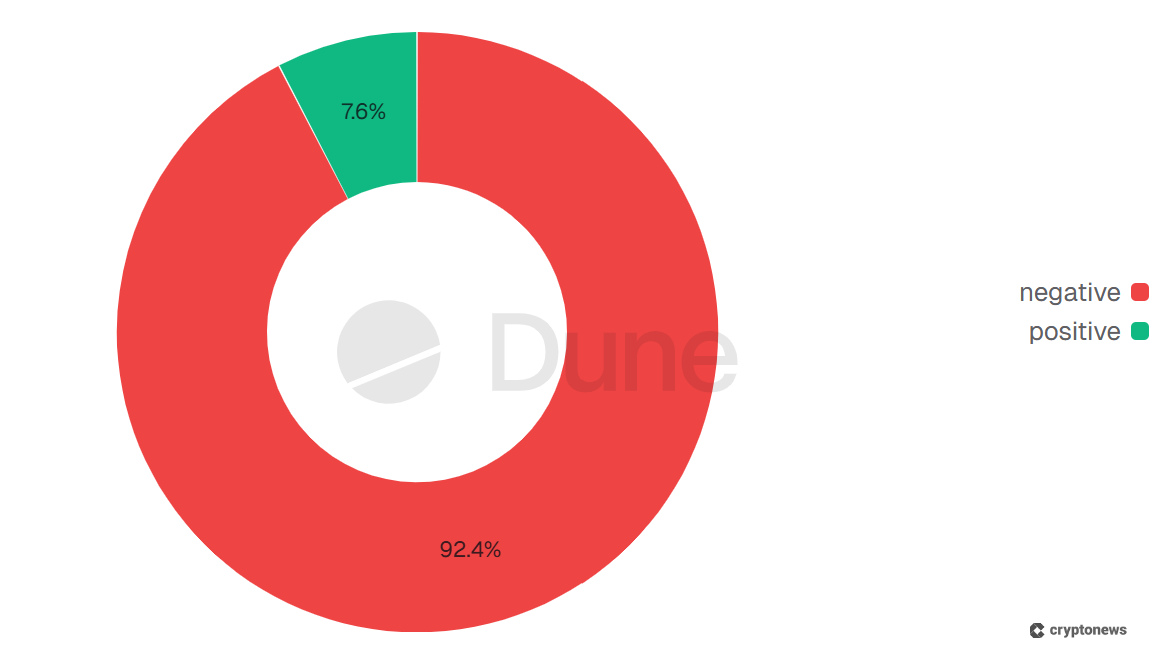
Traders can lose money for a variety of reasons, including poor discipline, inefficient execution, or simply lacking an edge. Put simply, you’re unlikely to make money on Polymarket unless you either have inside knowledge or a trading system that positions you to win trades consistently.
So what makes those 120,000 profitable traders different?
They have an edge — a consistent, measurable advantage over all the other traders on Polymarket. Some of them might be insiders with early access to news, only betting on outcomes they can predict with certainty.
But many others are simply smart, disciplined traders who know how to manage risk carefully and maximize their win rate with proven trading strategies like the ones we’ll cover.
Importantly, different strategies have different risk and reward profiles. Manual strategies, for example, tend to offer moderately large payouts, but involve more risk since they often require taking contrarian positions.
Whale copying strategies offer similar payouts, but with a very different risk profile. Spread trading can be low-risk with small and steady returns, while automated Polymarket trading strategies are high-risk, high-reward. Think carefully about your risk tolerance and trading preferences when evaluating the strategies below.
Visit PolymarketHow Polymarket Works: What You Must Understand Before Using Any Strategy
If you’re reading this guide, you likely already know the basics of how Polymarket works. But it’s important to think carefully about every step of the trading chain involved since small details can make a big difference to your strategy’s profitability. Here are some of the key points to understand.
Odds Formation
Unlike sportsbooks, where odds are set by bookmakers, Polymarket sets odds based on trader behavior. Supply and demand dictate prices, and both are set by traders.
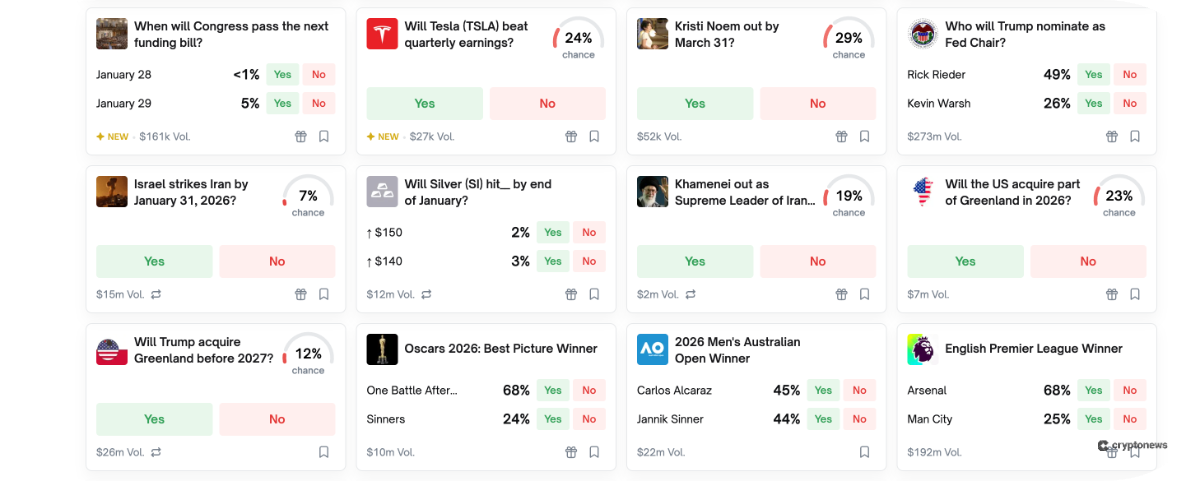
Supply is created when Polymarket users mint conditional tokens, a type of ERC-1155 tokens that represent YES or NO outcomes. When a conditional token is minted, it locks up $1 of the creator’s USDC as collateral and creates both YES and NO tokens at the current market prices. Tokens can then be freely traded, and they become worth either $1 or $0 when the event they represent is resolved.
Demand is created by traders buying and selling these YES and NO tokens. The price of each token represents the probability that an event will or will not happen rather than a bet in the traditional sense. If a YES token costs 75 cents, that means the market thinks the event is 75% likely to happen.
Importantly, demand can change in response to new information. If news breaks and it seems more likely that an event will happen, for example, traders will buy YES tokens and sell NO tokens. This will push up the price of YES and push down the price of NO, reflecting the market’s increased certainty of a YES outcome.
Liquidity, Timing, and Speed
Just as in crypto markets, liquidity, timing, and speed all heavily influence the profitability of a trade on Polymarket.
Liquidity reflects the total number of YES and NO tokens minted for a specific event and the trading volume in those tokens. High liquidity is important to smooth out price changes and keep spreads to a minimum. In low liquidity markets, prices can whipsaw rapidly, and traders could pay large spreads to buy or sell tokens.
Timing matters because liquidity and prices can change significantly over the lifespan of an event. There are typically large liquidity spikes in response to news and just before an event’s outcome is settled. Prices for either YES or NO can be significantly undervalued immediately before or after news.
Speed is important because prediction markets move incredibly quickly, especially when new information comes out. Traders have to be first to react in order to get an edge. In addition, strategies like arbitrage and market making are highly dependent on fast confirmation to get ahead of price movements that can eliminate potential profits.
Polymarket Strategy Progression: From Beginner to Advanced
Now, let’s dive into the best Polymarket strategies. We’ll organize them by trader skill so you can progress to more advanced strategies as you get more comfortable trading on Polymarket.
Beginner: Manual, Low-Tech ($50–$500)
Beginner-friendly Polymarket trading strategies focus on long-duration events. The goal is to limit your risk as much as possible while giving you consistent, modest wins. This can build confidence for new Polymarket traders and help you build your skills on the platform, but it’s also a worthy approach even for more advanced traders who want to minimize risk.
Long-duration events to focus on include politics, court cases, tech trends, macroeconomics, and geopolitical events. These events typically see spikes of interest and liquidity around news, but they often have long periods of illiquidity when weeks or months go by without new information.
There are two reliable ways to trade these markets.
“Nothing Ever Happens”
First, you can take a “nothing ever happens” approach that assumes that most big, speculative events won’t take place. For example, you can bet against a war breaking out or an upset election.
For this strategy to work, it’s important to initiate your trade right after the news, when liquidity is high, and many traders are overestimating the probability of something big happening. The media tends to hype unlikely events, making them seem more likely than they actually are, and many traders buy into this. You can buy NO tokens at a discount at this moment, then hold for the long-term until the event resolves.
Keep in mind that you may need to hold through significant volatility for this strategy to succeed. The news you bought on could keep hype going for longer than anticipated, or there could be another news cycle in the future that creates even more hype. It’s important to continuously evaluate the true, hype-free likelihood of an event happening to limit the chances of being caught on the wrong side of the event when it resolves.
You also need to keep your position sizes small and consistent for this strategy. Some events will happen, and you’ll be on the wrong side of them and lose money. The key to profitability is to ensure a streak of bad trades doesn’t take you out entirely and to stick to high-probability events as much as possible.
Intra-Market Arbitrage
During long periods between news cycles and hype, long-duration events can have relatively low liquidity. That presents an opportunity for YES and NO shares to be mispriced simply because there isn’t a lot of attention on the trade. In effect, you can profit from arbitrage on YES and NO prices around a single event.
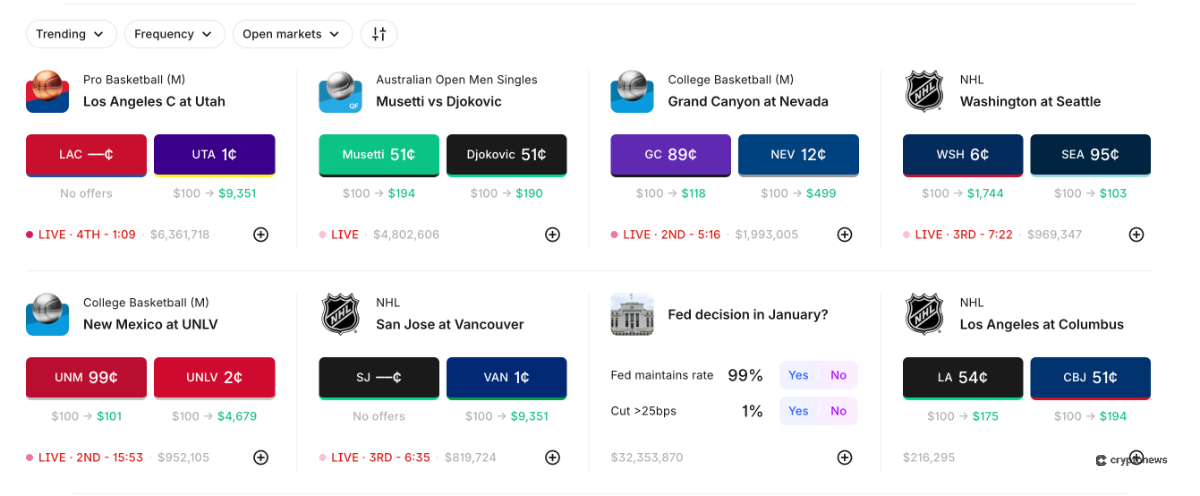
Of course, it’s important that you have a strong conviction around the event in question to support your theory that YES and NO shares really are mispriced. Make sure to check the entire price history around the event to see what traders have thought about it during periods of high liquidity.
In addition, you may have to pay a steep spread to get into these trades because of the poor liquidity. Keep that in mind when considering what trades are worthwhile and calculating your profit-to-risk ratio.
Intermediate: Semi-Active ($1,000–$10,000)
Intermediate traders may be willing to take greater risks or have more capital to deploy multiple trading strategies simultaneously. With that in mind, there are several strategies that can work well if you’re a Polymarket trader with some experience under your belt.
A popular strategy that we’ll cover in more depth below is copy trading. In short, you can track what Polymarket whales are trading, then mimic their moves. These whales are often insiders with access to privileged information, so simply watching what they’re trading in large volumes can provide a lot of information to inform your own trading.
Another good intermediate strategy is spread trading in moderately liquid markets. One way to do this is by using limit orders to try to “capture” the spread. For example, say YES is trading for 40 cents with a 39-cent bid and a 41-cent ask. You could put in limit orders to buy at 40 cents (1 cent below the ask) and sell at 40 cents (1 cent above the bid), potentially capturing 2 cents in profit.
Don’t sleep on beginner-friendly strategies, either. Intra-market arbitrage can still be very powerful for intermediate traders. If you have good reaction speed to news, you may also be able to get better pricing and squeeze more profitability by fading news-driven hype.
Advanced: Technical ($10,000+)
Advanced traders can take advantage of more technical and high-risk trading strategies. These include arbitrage across multiple prediction markets like Polymarket and Kalshi and deploying automated trading bots, both of which we’ll cover in more detail below.
Advanced traders can also take intermediate strategies to the next level, for example, by using wallet detection frameworks to identify and copy the trades of Polymarket whales with insider information about an event.
In addition, advanced Polymarket traders can get directly involved in market making around high-demand events; that is, actually minting conditional YES and NO tokens and then offering them to the market at a spread.
This strategy allows market makers to take advantage of trading volume and provide liquidity, which Polymarket also rewards through rebates. However, it also carries significant risks since market makers can end up holding large amounts of YES or NO tokens if there’s a sudden sentiment shift in the market for an event.
The Most Profitable Polymarket Strategies in 2026
Here’s a closer look at the most profitable Polymarket trading strategies for traders at all levels. We’ll cover exactly how they work and how you can implement them in 2026.
Arbitrage Strategies
Polymarket arbitrage strategies take advantage of differences in pricing within or across markets. There are multiple possible arbitrage strategies that can be successful depending on the event in question:
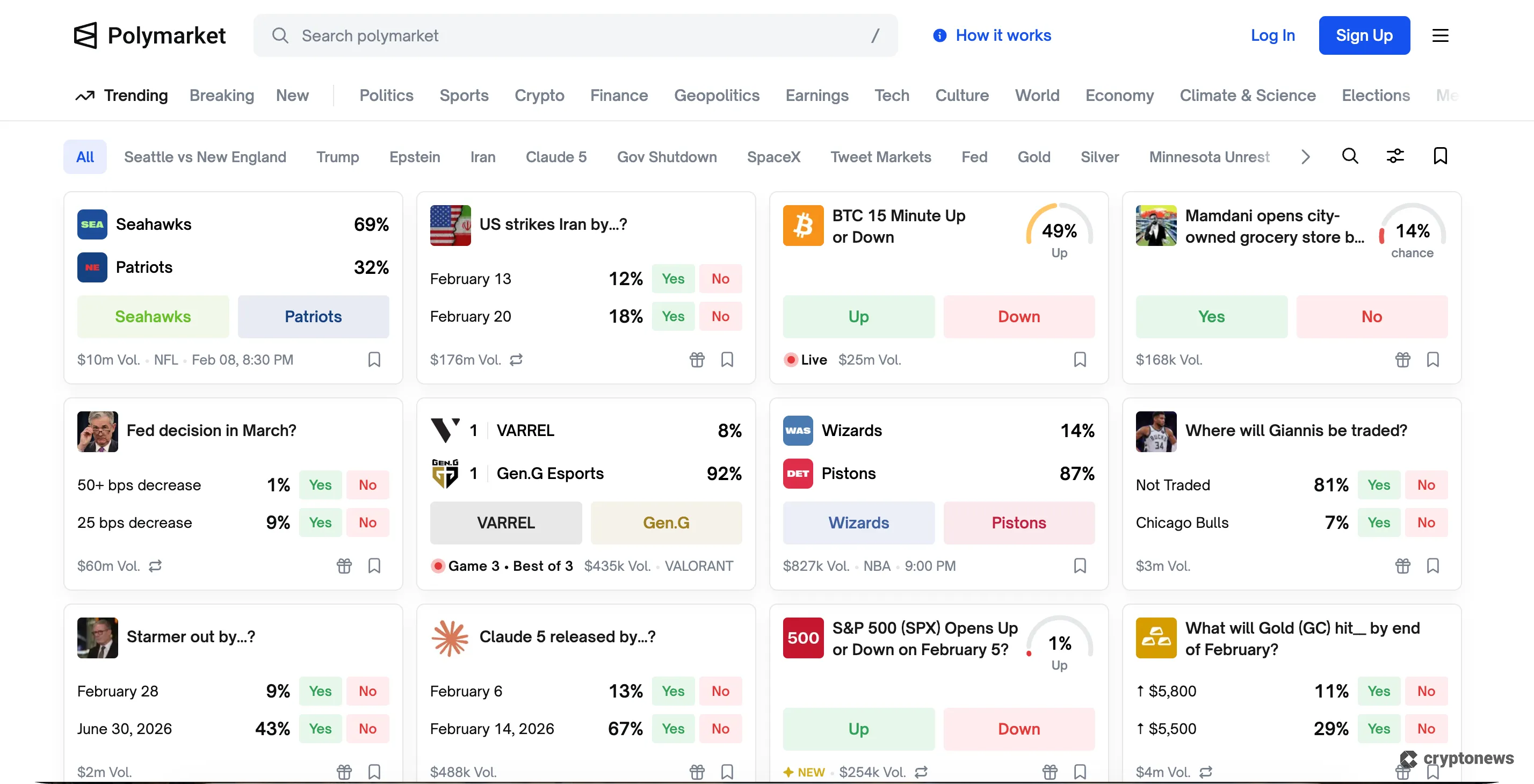
- Intra-market arbitrage: Looks for YES and NO token mispricing, often in low liquidity markets. YES and NO prices in these cases don’t reflect the “true” probability of an event occurring or not.
- Cross-market arbitrage: If there are multiple Polymarket markets around the same event, YES and NO shares could be trading at different prices and indicating different resolutions. This provides an arbitrage opportunity to buy YES shares in one market and NO shares in another and turn a profit no matter the event’s outcome.
- Cross-platform arbitrage: Similar to cross-market arbitrage, but involving trades on multiple crypto prediction platforms (e.g., Polymarket and Kalshi). If the same event has different pricing, indicating different resolutions on two platforms, you can buy YES shares on one platform and NO on the other, and profit no matter the event outcome.
Arbitrage trades have a high win probability, making them very attractive to traders of all skill levels. However, arbitrage trading is increasingly dominated by bots, which automatically scan the market 24/7 to identify arbitrage possibilities and trade rapidly until the arbitrage opportunity disappears.
It’s still possible for human traders to compete in arbitrage trading, though. You just need low-latency systems and scanning tools that can identify arbitrage opportunities that bots might miss.
The best opportunities are in cross-market or cross-platform arbitrages, since bots may not automatically detect that two different markets refer to the same event or have highly correlated outcomes.
For example, you might know that one politician winning an election will also flip control of a legislative chamber, which is two separate bets with different outcomes predicted based on YES and NO prices. But an arbitrage bot won’t know those two bets are riding on the same outcome and thus can’t compete with you to trade that opportunity.
Importantly, arbitrage trading requires a lot of capital. Arbitrage trades typically have very small payoffs, so you need to trade in large volumes to make this strategy profitable.
Market Making Strategies
Market making is an advanced strategy that involves minting YES and NO conditional tokens by providing USDC as collateral. It allows you to capture spreads as you sell your newly minted tokens, but it also involves significant risk.
Capturing spreads is relatively simple, but requires high volumes to turn a significant profit. After minting YES and NO tokens at current prices, you sell them at bid and ask prices that are just above and below the mint prices. Profits are typically less than 1 cent per token, but that can add up if you sell thousands of tokens across multiple markets.
In addition, Polymarket itself provides rewards to market makers for providing liquidity in markets. These rewards are small (usually a fraction of a cent per token) and can vary widely depending on the market’s current liquidity, but they also add up if you mint a large number of tokens.
The risk in Polymarket market-making strategies is that you could get stuck holding a lot of tokens for the less probable side of a market.
Say, for example, YES is priced at 80 cents and NO at 20 cents, and sentiment increasingly indicates that the event is likely to happen.
In this case, you might have no trouble selling your YES tokens, but there may be very little demand for your NO tokens, and you’ll suffer a major loss on them when the outcome is resolved.
So, it’s important to carefully evaluate the demand for both the YES and NO sides of a market before providing liquidity for that market.
The best opportunities are typically in 50/50 events with moderate trading volume, when there’s a high likelihood of selling your tokens and liquidity rewards are high enough to justify your risk.
Whale Copying & Insider Tracking
Highly informed traders and “sharps” tend to outperform the average Polymarket trader. These individuals have access to privileged information that allows them to know with some certainty how an event will resolve. It’s an information edge, and on Polymarket, that’s the most powerful type of edge there is.
While you might not have direct access to this insider information, you can get indirect access by monitoring what whales, sharps, and other insiders are trading. Then, depending on your confidence in the whale and their knowledge of the event outcome, you can mimic the direction of their trade.
This strategy requires you to first identify high-signal wallets on the Polygon blockchain (the network that Polymarket runs on). There are multiple wallet tracking tools to help you do this, including:
- Unusual Whales
- Polywhaler
- Dune Analytics
- Arkham Intelligence
You can also create your own chain scanning tools to look for large, successful trades in the past and build a list of smart money wallets to follow.
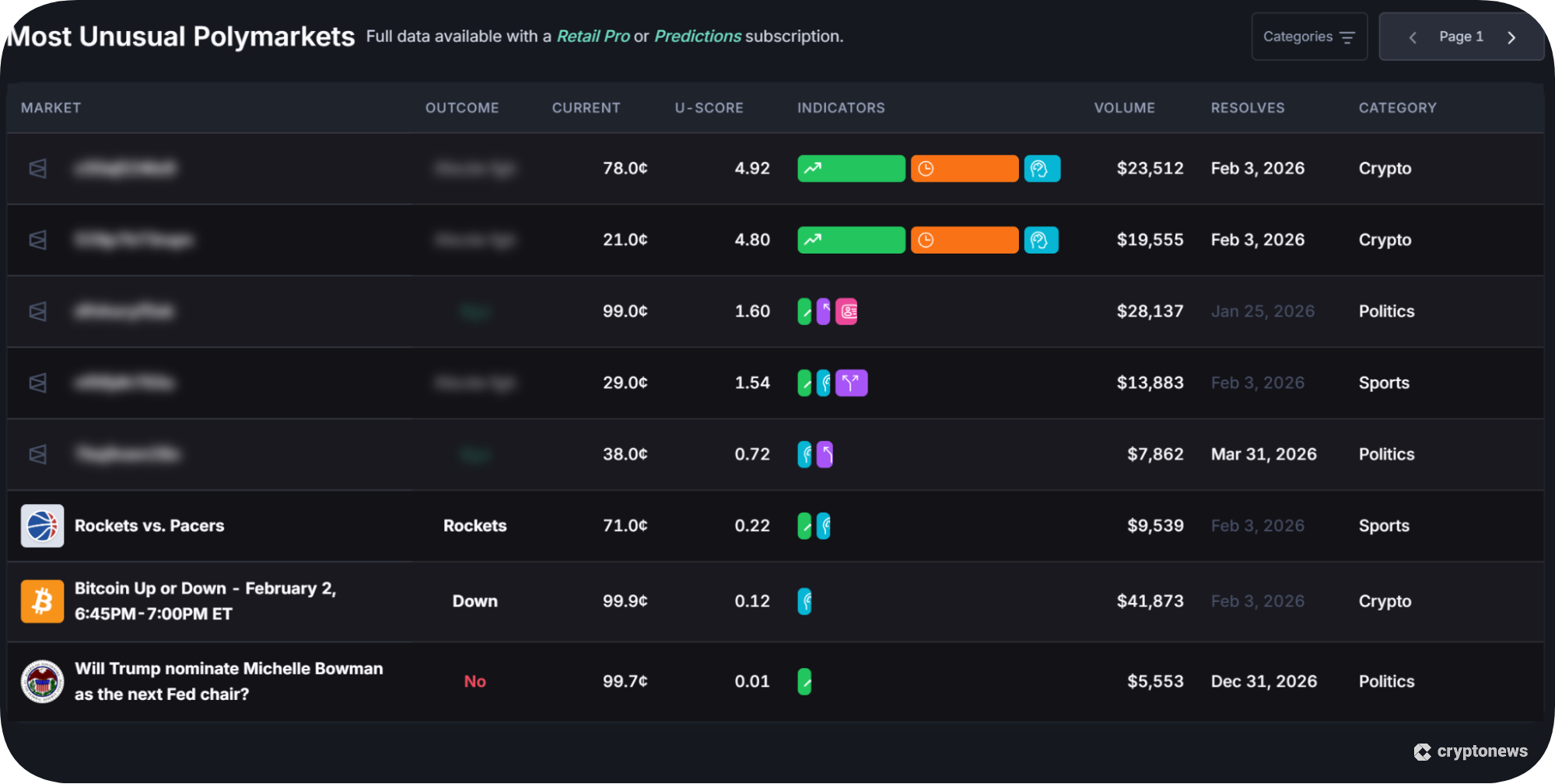
Once you’re tracking a set of wallets, you can monitor for large trades. Pay attention to the timing and size of entries, which can provide clues as to whether a whale is just guessing big or really has insider information about an event. Other clues to look for include an alignment of whale trades in the same market or online whispers that indicate insider information is about to leak.
Never blindly copy whales, especially if you don’t actually know who’s behind a wallet. It’s impossible to say with certainty whether someone just got lucky a few times. You also need to make sure that the whale you’re watching has past experience in that market niche.
For example, a wallet that’s gotten several big political bets right in the past is likely to be a political insider, so a sudden large bet on sports might just be them betting on their favorite team.
Bear in mind that whale copying is extremely risky. The more confidence you have in the whales you’re following and their specific, insider knowledge of a specific market, the more likely this strategy is to succeed.
Manual Edge Strategies
While manual trading doesn’t sound like a strategy, it can be extremely effective in specific prediction markets and situations. There are a few specific types of markets that lend themselves well to manual edge strategies.
- Niche markets: Certain niche domains like law, science, and geopolitics require specialized knowledge that only some people have and bots can’t mimic. If you’re an expert in a domain like this, you could potentially trade like an insider and quickly identify when outcomes are mispriced.
- Slow-moving events: The probability of slow-moving events is often over- or underestimated, leading to mispricing that you can take advantage of. You can also trade these events by fading news catalysts, when liquidity and YES prices suddenly spike, but the real probability of an event happening hasn’t changed.
- Low-liquidity markets: Bots often don’t trade in low-liquidity markets because of the high bid-ask spreads and difficult exits involved. These markets can be inefficient, leading to mispricing or opportunities for intra-market arbitrage.

Bots & Automated Polymarket Trading Strategies
Automated Polymarket trading strategies are becoming increasingly popular as prediction markets become more professional.
Trading bots can be very effective because of their speed and 24/7 trading capability, but they also carry significant risks. We’ll explain everything you need to know about Polymarket bots, including when to use them and common types.
When Bots Make Sense (And When They Don’t)
Automated trading sounds great. Who wouldn’t want to sit back while a bot trades for them? But it’s important to remember that bots lack many of the capabilities of humans and are only suitable for certain situations.
First, it’s important to think about the capital and costs involved. Most bot trading strategies require a lot of capital — think $50,000 or more — because they open a lot of positions quickly and often rely on high-volume trading. Running out of capital to fund these positions can be a disaster.
On top of that, bots come with infrastructure costs. You need to pay for a bot service or server to run your bot, for example, and there may be extra fees for each trade. Because of that, the minimum return per trade that you need to be profitable increases compared to manual trading. In a lot of cases, that means trading with bigger positions, so you need a lot of available capital.
Even if you have the capital to spare, it’s important to carefully compare the outcomes you expect for trading your strategy manually vs. automating it. Some strategies won’t benefit from more frequent trading, in which case manual trading might save you money and yield a better overall return.

Other strategies might only produce similar profits with or without a bot, and it’s up to you to decide whether you prefer the hands-off nature of automated trading or the in-depth control of manual trading.
Also, remember that bots aren’t suitable for all strategies, especially manual edge strategies. Bots don’t make sense in niche markets that require specialized knowledge. They also don’t work well in low-liquidity markets, when spreads are large, and the risk of getting stuck in a position is high.
Types of Polymarket Trading Bots
While Polymarket bots can be designed to suit any custom strategy, there are a few general categories of bots widely in use today:
- Arbitrage bots: Arbitrage bots automatically search Polymarket for intra-market arbitrage opportunities. They can also search for cross-platform arbitrage opportunities. The majority of arbitrage trading on Polymarket is conducted by bots.
- Market-making bots: Market-making bots provide liquidity on Polymarket by minting YES and NO tokens or creating and cancelling limit orders. They aim to profit from spreads while minimizing the number of tokens they hold to control risk.
- Momentum bots: Momentum bots automatically open trades in the direction of a price movement when YES or NO prices for an event are undergoing major price shifts. They typically close these trades quickly, seeking to capitalize on the price movement rather than hold a position until the event is resolved. Momentum bots are also known as news-reaction bots since they often trade in the wake of market-shifting news.
- Whale-following bots: Whale-following bots can automatically copy trades made by specific whale or insider wallets you task them with following. You can customize these bots to only copy a trade if it’s larger than a certain threshold or if it is confirmed by multiple wallets the bot is monitoring.
Bot Infrastructure Requirements
While there are platforms that can help you build and launch automated Polymarket trading strategies, the majority of bot traders choose to create their own bots to reduce fees and achieve full strategy customization.
There are a few things required to get started:
- Programming skills: Python or JavaScript is recommended since Polymarket provides SDKs for either language.
- Gnosis Safe wallet: Gnosis Safe wallets support gasless transactions and batch transactions on Polymarket. Other non-custodial wallets, like MetaMask and Best Wallet, are also compatible.
- Virtual private server (VPS): A VPS offers low-latency hosting for your bot so it can collect data and send orders to Polymarket quickly. Look for a VPS that offers low latency to London, where Polymarket’s servers are located.
When setting up your bot, you’ll need to connect it to Polymarket. The Gamma API allows your bot to discover available prediction markets, the CLOB API provides a path for order entry and execution, and WebSockets provides real-time price and order book updates.
You’ll also need to give your bot access to your crypto wallet. Make sure to provide both the wallet’s private key and API credentials so your bot can fully access your funds and sign orders on your behalf.
Always test your bot in paper trading mode before allowing it to start executing live trades with your crypto. This gives you a chance to make sure it’s functioning properly and to test your automated trading strategy against real market conditions.
When you begin trading with real funds, start with small amounts and limit the total amount of crypto in your wallet to prevent your bot from suffering large losses.
Understanding Polymarket Fees & How to Minimize Them
Polymarket fees are very low, leading to the common misconception that this prediction market is “fee-free.” But the reality is that Polymarket does have some fees—and if you’re not careful with them, they could turn profitable trades into losing trades.
The fee-free misconception stems from the fact that Polymarket has no trading fees for most event markets and no gas fees. However, the platform recently rolled out a fee of 0.01% for liquidity takers in the U.S., and global Polymarket users will still pay spreads for every trade.
Polymarket also charges fees on takers in its 15-minute crypto markets, which allow you to place up or down directional bets on specific crypto assets (similar to crypto futures). These fees are used to fund Polymarket’s liquidity provider rebates.
Notably, all Polymarket trading fees apply only to liquidity takers, meaning you can avoid them by using limit orders rather than market orders to trade. There’s no way to avoid spreads, but you can minimize them by focusing on high-liquidity markets with lower spreads.
Polymarket Wallet Setup & Technical Requirements
Polymarket has specific requirements for how to set up your wallet that are important to follow for smooth trading.
First, you need a non-custodial wallet that supports both ERC-20 and ERC-1155 tokens. Polymarket recommends the Gnosis Safe wallet because it supports gasless transactions, but you can also use other wallets such as MetaMask and Best Wallet.
👉 Learn More: Best Polymarket Wallets for Secure Trading in 2026
We highly recommend using a dedicated wallet for trading on Polymarket since anyone on the blockchain will be able to monitor your trading activity. It’s also a good idea to enable two-tier authentication for trading, which separates your Polymarket orders from your wallet ownership and allows you to keep your wallet’s private key fully secure.
This is especially important if you plan to trade with a bot since you have to provide the bot with your wallet’s private key. Never use a wallet that’s linked to your identity, as you could become a target for hackers if your Polymarket trading strategy is highly successful.
Polymarket supports deposits in a wide variety of tokens, including USDC and USDT on multiple chains, ETH, MATIC, and SOL. You can deposit tokens on Polymarket from your wallet or directly from Coinbase. Note that if you deposit tokens other than USDC on Polygon, they will be converted to USDC.e and bridged to Polygon using Uniswap, and this will incur a fee.
When trading, keep only funds you plan to actively trade in your crypto wallet. The remainder of your funds should be held in a cold storage wallet to minimize the chance of theft.
Risk Management for Polymarket Trading
Risk management in prediction markets is a key part of trading on Polymarket. A successful trading strategy doesn’t just help you win more trades, but also limits your losses on trades that go against you.
With that in mind, here are a few key things to keep in mind to manage your risk on Polymarket.
📏 Position Sizing
One of the best things you can do to limit your risk while trading on Polymarket is to limit your position sizes. A string of trades going against you won’t wipe you out if each position is just a small fraction of your total available capital.
A good rule of thumb is to risk no more than 10% of your capital on any single trade. For most trades, an appropriate position size might be closer to 1-3% of your total capital.
Positions should be sized according to the potential risk. Low-risk arbitrage trades may be larger (5-10% of your total capital), while high-risk whale copying strategies should use smaller positions. Manual edge strategies can be sized according to your conviction in the outcome based on your specialized knowledge.
🛡️ Capital Preservation Rules
Putting strict rules in place around when to cut losses is an important way to keep emotion out of trading and preserve your capital over the long term. For example, you could implement a personal rule that all trades must be closed if they reach a 50% drawdown, no matter how convinced you are that the trade will eventually come back into profit.
You can also preserve your capital by diversifying trades. If you make multiple trades around a single event or a series of correlated events, count them as one trade for your position sizing and drawdown rules. This prevents you from risking overly large amounts of capital on a single outcome.
🔄 Event Correlation
Many events on Polymarket are correlated, often in ways that may not be immediately obvious. For example, which candidate wins an election can influence geopolitical outcomes (or at least, the market’s expectation of a geopolitical outcome, and thus YES/NO prices for that outcome).
It’s important to think carefully about whether the positions you hold are correlated. If they are, your risk is multiplied since one trade going against you means several trades could go against you. Consider avoiding correlated positions altogether or using correlation as a hedge to trade opposite outcomes and limit your potential losses.
🌊 Liquidity Concerns
Liquidity around individual prediction markets can change rapidly, creating the risk that you could get stuck in a position or have to pay a large spread to exit. Liquidity changes are especially common for long-term events that occasionally get attention when news comes out, then go dormant for weeks at a time.
However, they can also impact low-liquidity events, which can fluctuate between very low and moderate trading volume.
Pay close attention to an event’s volume history before trading, and be especially cautious if there are few market makers for that event. You may need a larger profit margin from a trade to buffer against potentially high spreads for low-liquidity events.
⚖️ Oracle Disputes
Polymarket events are settled by an on-chain oracle in which participants propose and vote on resolutions. During black swan events like an assassination or outbreak of war, there can be conflicting news, and the first proposed resolution may not represent the ultimate event settlement.
In the event of a dispute, a small number of whales hold the majority of voting power and could potentially manipulate the outcome, causing positions to fail.
In addition, black swan events and disputes can cause shares that are priced at near-certainty (around 99 cents) to suddenly crash to 50 cents or even 0 cents. There’s often no liquidity when this happens, making it impossible to exit positions.
Given these potential issues, it’s often safest to avoid trading around highly volatile black swan events. In the event of an oracle dispute, try to exit your position as quickly as possible without giving up too much money to wide spreads.
Common Mistakes That Kill Polymarket Profits
Too many Polymarket traders make the same mistakes over and over again, killing their profits and ending up among the 90+% of traders who lose money on the platform. Here are the most common mistakes we see and how to avoid them.
- Overtrading efficient markets: Most on-chain markets on Polymarket are highly efficient, with ample liquidity and smart participants who correctly price the odds of an event occurring. It’s hard to find an edge in these markets, and you’re not likely to win trades consistently without an edge.
- Ignoring fees and spreads: Trading fees and spreads can eat significantly into profits. If you don’t account for these costs when planning your trade, you could end up losing money even if your strategy worked as planned.
- Chasing whale entries too late: A lot of people on Polymarket are following whales. If you’re late to copy a trade, the price could have moved significantly against you, and the trade may no longer be profitable. Following whales is a strategy, but chasing them isn’t.
- Using bots without an edge: Automated trading strategies aren’t a silver bullet. For Polymarket bots to be effective, you need to set them up to trade a strategy that has a built-in edge. Otherwise, bots will just help you lose money faster.
- Confusing luck with skill: A string of good trades doesn’t necessarily prove that your strategy works, but it can lead to overconfidence and a mistaken feeling of infallibility. Skilled trading requires long-term consistency, discipline, and profitability.
Polymarket vs. Other Prediction Markets
Polymarket has some important differences from other prediction markets that traders should be aware of.
First, Polymarket is a crypto-only prediction market that operates fully on-chain. This makes it fundamentally distinct from fiat-based markets like Kalshi, which operates as a centralized marketplace. This is important because the difference in structure can lead to different pricing and liquidity dynamics for certain prediction markets, leading to cross-platform arbitrage opportunities.
Another key difference between Polymarket and Kalshi is that Polymarket is legit but unregulated, while Kalshi is fully regulated by the Commodities Futures Trading Commission (CFTC). The CFTC is proposing new rules that could potentially limit what events Kalshi supports for trading or that make it more expensive to trade on Kalshi.
There are also differences in liquidity, speed, and access between the major prediction markets. Polymarket remains the leader in liquidity among on-chain marketplaces, but Kalshi has earned an increasing market share for economic and sports events.
Polymarket typically puts up information markets for new events faster, especially for breaking news-related events, while Kalshi has to wait for regulator approval.
Kalshi and Polymarket are both legal in the U.S. Kalshi blocks traders from Canada, the UK, Australia, France, and Singapore. Polymarket blocks traders from France, Belgium, Australia, Singapore, Thailand, Taiwan, Portugal, and Hungary. Differences in who’s trading on the platform impact liquidity around specific events like national elections.
👉 Learn More: Kalshi vs. Polymarket Comparison (2026)
Final Takeaways: Choosing the Right Polymarket Strategy
Getting the right Polymarket trading strategy can help you turn more consistent profits from this prediction market. Your strategy will define what kind of trades you pursue, how you manage risk, and whether you use automation or focus on manual trading.
The best approach is to experiment with several of the strategies we’ve laid out here to find which ones meet your trading goals and style. No matter which Polymarket strategy you choose, always maintain discipline, a focus on data, and patience to boost your chances of long-term success.
Visit PolymarketFAQs
Can you really make money on Polymarket?
How does Polymarket get its odds?
What is the best Polymarket strategy for beginners?
Are bots required to be profitable?
How much capital do you need to succeed?
Is Polymarket predictive or just speculative?
References
- Polymarket (Dune Analytics)
- On Polymarket, ‘privileged’ users made millions betting on war strikes and diplomatic strategy. What did they know beforehand? (The Guardian)
- Arbitrage Bots Dominate Polymarket With Millions in Profits as Humans Fall Behind (Yahoo Finance)
- Betting on Prediction Markets Is Their Job. They Make Millions (New York Times)
- Polymarket Begins Rolling Out Fees in US App and Crypto Markets (The Defiant)
- Polymarket adds taker fees to 15-minute crypto markets to fund liquidity rebates (The Block)
2M+
250+
8
70







 in numbers

About Cryptonews
Our goal is to offer a comprehensive and objective perspective on the cryptocurrency market, enabling our readers to make informed decisions in this ever-changing landscape.
Our editorial team of more than 70 crypto professionals works to maintain the highest standards of journalism and ethics. We follow strict editorial guidelines to ensure the integrity and credibility of our content.
Whether you’re looking for breaking news, expert opinions, or market insights, Cryptonews has been your go-to destination for everything cryptocurrency since 2017.
