Polymarket vs. Opinion Labs: Which Should You Use?
We believe in full transparency with our readers. Some of our content includes affiliate links, and we may earn a commission through these partnerships. However, this potential compensation never influences our analysis, opinions, or reviews. Our editorial content is created independently of our marketing partnerships, and our ratings are based solely on our established evaluation criteria. Read More



After the 2024 U.S. election, when betting volume eclipsed traditional polling in terms of relevance, platforms like Polymarket became household names.
While Polymarket leads the space, challengers like Opinion Labs are attempting to capture the “long tail” of social sentiment: markets that are too niche, too weird, or too specific for the giants.
While Polymarket and Opinion Labs offer a similar service, there are some key differences. You are comparing a massive, order-book-driven whale (Polymarket) against a decentralized challenger (Opinion Labs). One offers safety and tight spreads; the other offers volatility and early-entry alpha.
This article strips away the marketing language to compare the sites, their spreads, payouts, and risks of both platforms.
Quick Verdict: Opinion vs. Polymarket
If you are betting more than $1,000 on a major event (like an election or a Fed rate cut), use Polymarket. The liquidity is deeper, the spreads are tighter, and the resolution mechanics are battle-tested.
If you are a crypto-native looking for high-variance plays on niche topics, or you want to farm incentives on a newer chain, look at Opinion Labs. Just be aware that you are trading against a smart contract with higher slippage, not a deep book of market makers.
- Choose Polymarket if you want to trade size, care about slippage, and are betting on global news.
- Choose Opinion Labs if you are already active in the Mantle ecosystem, you want to bet on “sentiment” rather than binary outcomes, or you are hunting for early-protocol rewards.
- In This Article
-
- Liquidity Comparison: Opinion Trade vs. Polymarket
- Accuracy: Polymarket vs. Opinion Labs vs. Traditional Polls
- Blockchain-Based Betting & Technical Architecture
- User Experience & Onboarding Comparison
- Fees, Costs, and Hidden Trade-Offs
- Legal & Regulatory Status: Polymarket vs. Opinion Labs
- Withdrawals & Cashing Out: What Users Experience
- In This Article
- Show Full Guide
-
- Liquidity Comparison: Opinion Trade vs. Polymarket
- Accuracy: Polymarket vs. Opinion Labs vs. Traditional Polls
- Blockchain-Based Betting & Technical Architecture
- User Experience & Onboarding Comparison
- Fees, Costs, and Hidden Trade-Offs
- Legal & Regulatory Status: Polymarket vs. Opinion Labs
- Withdrawals & Cashing Out: What Users Experience
What Is Polymarket?
Polymarket is currently the world’s largest prediction market. Founded by Shayne Coplan in 2020, it operates on the Polygon blockchain and allows users to trade event contracts using stablecoins (primarily USDC). Its value proposition is simple: it allows its free market userbase to price and wager on the probability of future events.
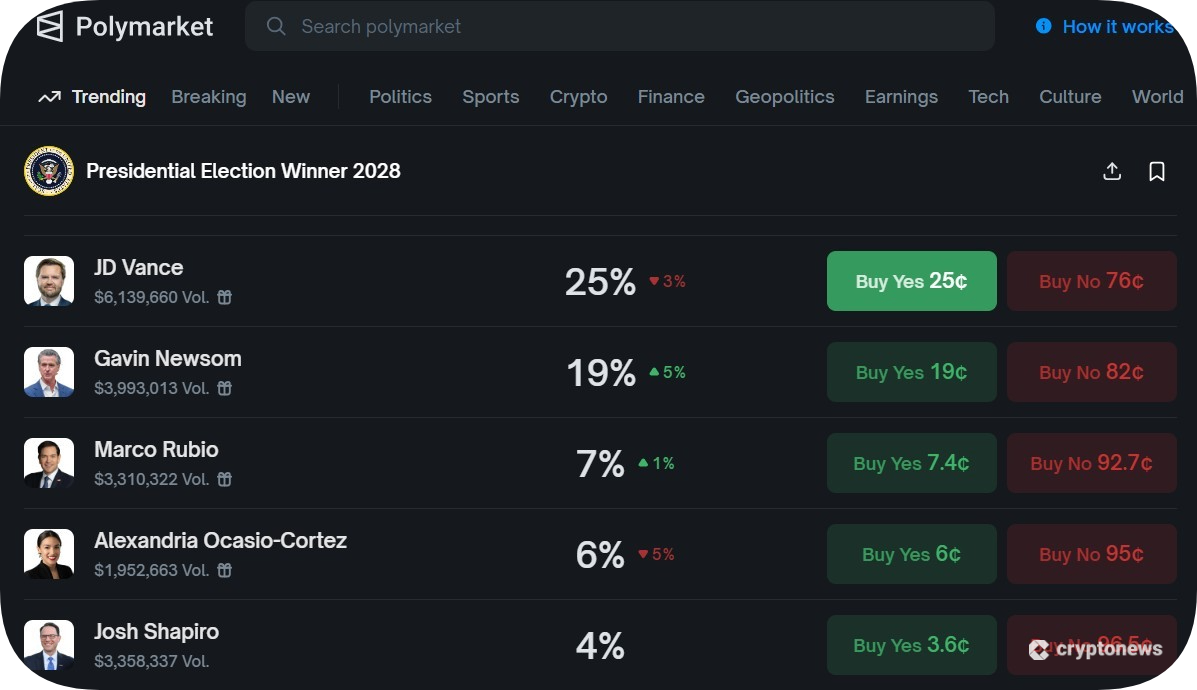
Unlike traditional betting platforms, Polymarket does not set the odds. The users do. If a share of “Yes” costs $0.60, the market believes there is a 60% chance of that event happening.
Polymarket has evolved from a pure Automated Market Maker (AMM) to a hybrid model that relies heavily on Central Limit Order Books (CLOBs) for its most popular markets.
This shift – which lets the price of a wager be determined directly by bids and asks – allowed professional market makers to step in, tightening spreads and allowing institutional-grade volume.
As of January 2026, more than $7 billion in trading volume happens on the platform each month.
What Is Opinion Labs?
Opinion Labs describes itself as an “omnichain” prediction market, though it has found its primary footing within the Mantle ecosystem, along with Arbitrum and Base.
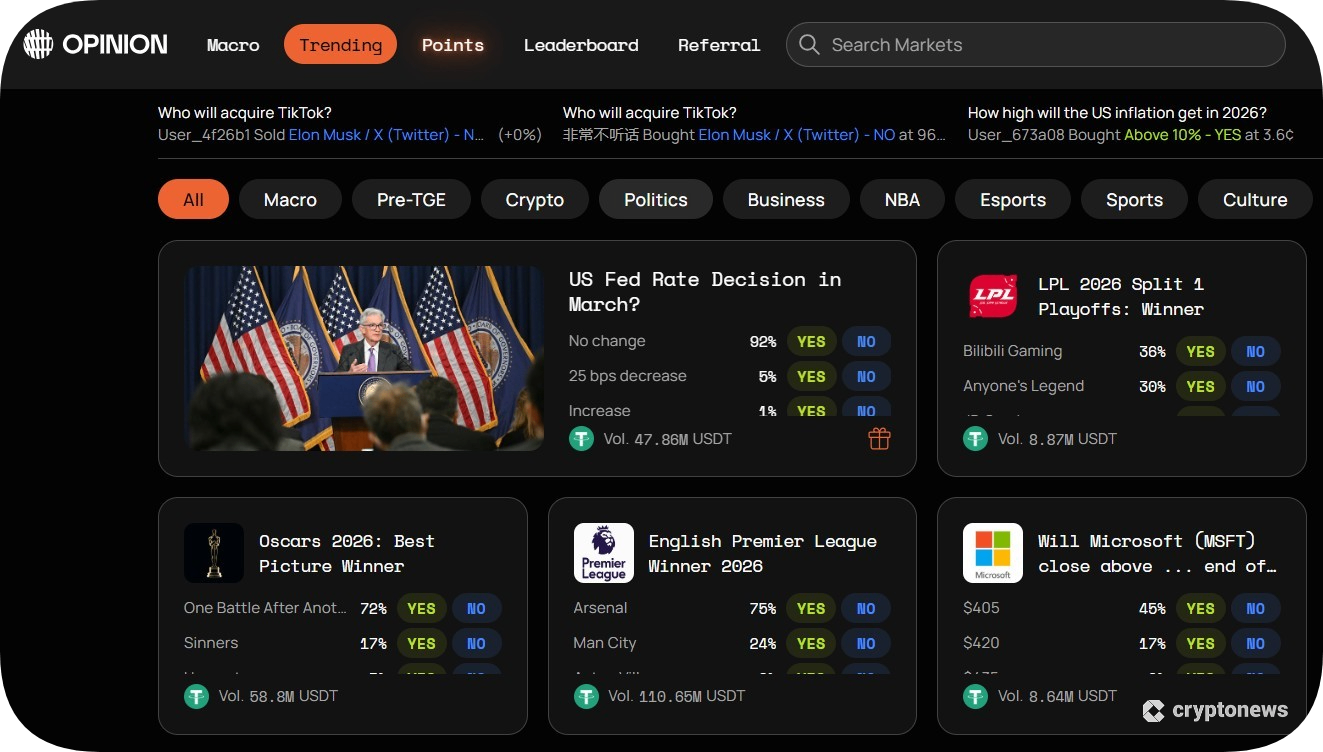
Where Polymarket strives to be the “Bloomberg Terminal” of probabilities, Opinion Labs leans into the “social” aspect of probability. It focuses on capturing value from continuous opinion trading; dynamic markets that don’t always have a hard “expiry” date in the same way a binary election does.
Opinion Labs uses a centralized order book model (similar to Uniswap) for pricing. This allows for instant execution on niche markets without needing a counterparty to match your order immediately. However, it introduces the risk of high slippage if the liquidity pools are shallow.
Between its launch in October 2025 and February 2026, Opinion Labs generated more than $13 million in fees.
Does The Platform Chain Matter?
Polymarket’s deployment on Polygon gives it access to a mature, stablecoin-heavy ecosystem with established infrastructure and deep liquidity.
Opinion Labs’ multi-chain approach allows it to tap into different liquidity pools and user communities, but it also means users need to understand varying gas token requirements, bridging requirements, and wallet configurations depending on the network.
But in broad terms, all the chains used by these platforms offer lower transaction costs and faster confirmations than Ethereum.
Polymarket vs. Opinion Labs: Side-by-Side Comparison
The following table breaks down the key structural differences between Polygon and Opinion Labs. Note the distinction in settlement layers, which dictates the gas fees and bridging requirements you will face.
| Market | Polymarket | Opinion Labs |
| Infrastructure | Polygon (POS) | Mantle (L2) / Omnichain |
| Settlement Currency | USDC (Polygon) | USDC / MNT / USDT |
| Market Mechanism | Hybrid (CLOB + AMM) | Central Limit Order Book (price is discovered between bids and asks) |
| Liquidity Depth | Very High (Billions in volume) | Low to Medium (Emerging) |
| Market Focus | Politics, Crypto, Global News | Social Sentiment, Niche Crypto |
| Oracle / Resolution | UMA (Optimistic Oracle) | Consensus Oracle / token-weighted voting |
| Fees | No trading fees (mostly); Liquidity fees apply | Fees (0-2%) apply to the taker only |
| KYC/Geo-blocking | Blocks U.S. Users (Strict) | Less restrictive (DeFi native) but some regional geoblocking (including U.S.) |
Liquidity Comparison: Opinion Trade vs. Polymarket
Polymarket has achieved a network effect. In major markets with high liquidity, you can enter and exit six-figure positions with negligible price impact. This is because market makers are incentivized to keep the order book deep. If you buy $10,000 worth of “Bitcoin > $100k,” the price might move 0.1%.
Opinion Labs, relying on a Central Limit Order Book (with every order recorded on-chain), functions differently. Price discovery happens between actual bids and asks, not along a bonding curve. If the order pool is thin – which is common in newer projects – a $1,000 bet could shift the odds by 5% or 10%. This is “slippage.” You are effectively paying a premium to enter the trade and a penalty to exit it.
For the average trader, Polymarket offers a safer execution environment. Opinion Labs requires you to check the “price impact” warning before every transaction.
Accuracy: Polymarket vs. Opinion Labs vs. Traditional Polls
Prediction markets are touted as “truth machines,” but they are only as accurate as the capital behind them.
Because the liquidity and betting limits are high, sophisticated actors (hedge funds, insiders) are motivated to correct mispricings – or, “the wisdom of the wealthy”. During the 2024 election, Polymarket signaled a Trump victory weeks before traditional polls converged on a toss-up. The financial incentive to be right outweighed the social pressure to be polite.
Opinion Labs is currently less of a truth machine and more of a sentiment gauge. With lower volume, the markets are more susceptible to manipulation by a single whale or a coordinated group of community members. If a market has only $5,000 in liquidity, one user can skew the “probability” from 20% to 80% with a few clicks. Do not treat Opinion Labs’ odds as a definitive forecast, but rather as a reflection of the specific crypto-native community using the app.
Blockchain-Based Betting & Technical Architecture
Both platforms remove the typical gambling “house”, but they do it differently.
Polymarket uses a token framework. When you bet, you are minting a pair of tokens (Yes and No). These are ERC-1155 tokens held in your wallet (or a proxy wallet). When the market resolves, the losing token becomes worthless, and the winning token becomes redeemable for $1.00.
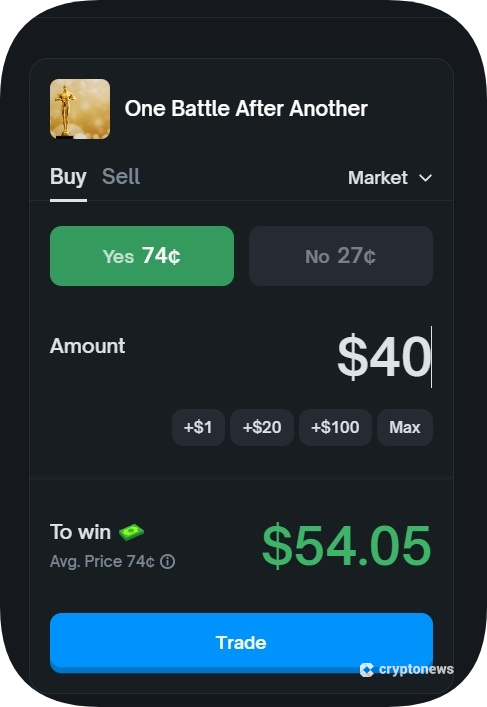
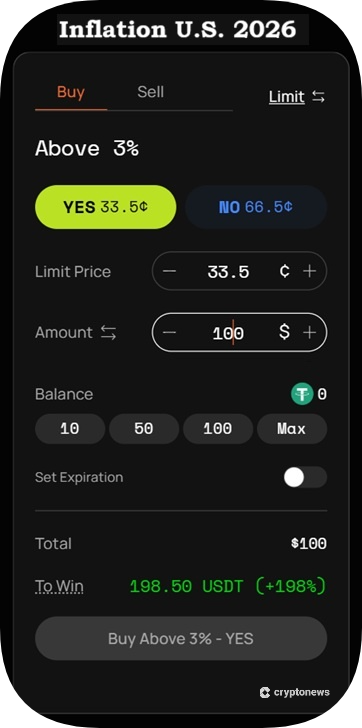
On the other hand, Opinion Labs uses a dynamic pool. When you trade, you are swapping assets against a smart contract. The architecture is more akin to trading a memecoin on a DEX than placing a bet at a sportsbook.
This hybrid approach makes Opinion Labs more composable with other DeFi protocols (e.g., by using your position as collateral), but it also introduces smart contract risk.
User Experience & Onboarding Comparison
Polymarket’s UX has graduated over the years to look more like a Web2 app.
- Login: Email login (via Magic Link) creates a non-custodial wallet for you.
- Deposit: You can deposit USDC directly from an exchange, a USDC-compatible wallet, or bridge from Ethereum
- Friction: The hardest part is getting USDC on the Polygon network if you are totally new to crypto.
Opinion Labs feels like a dApp.
- Login: Connect Wallet (MetaMask, Rabby).
- Deposit: You need gas tokens (MNT) and stablecoins on the Mantle network.
- Friction: High. You must understand bridging to Layer 2s. If you don’t know what “RPC” means, you will struggle here.
Fees, Costs, and Hidden Trade-Offs
On Polymarket, the costs are invisible. There are no explicit “trading fees” on the order book markets, but you pay the spread. If “Yes” is trading at 60 cents, you might have to buy it at 60.5 cents. Nearly all markets are fee-free, though there are some small exceptions, such as 15-minute crypto markets and college basketball markets. The platform has largely subsidized its growth costs.
On Opinion Labs, you pay gas fees (in MNT, usually cents) and a swap fee to the liquidity providers (typically 0.3% to 1%). However, the hidden cost is impermanent loss for liquidity providers or slippage for traders. In a volatile sentiment market, you might be right about the outcome, but lose money because the cost to enter the trade was too high relative to the payout.
Polymarket offers lower and more predictable trading costs, especially when Opinion Labs becomes more expensive in thin markets where spreads and price impact affect returns.
Legal & Regulatory Status: Polymarket vs. Opinion Labs
Polymarket is under the legal microscope in the U.S. In 2022, they settled with the CFTC for $1.4 million and agreed to block U.S. users, and the site enforces this aggressively. If you access the site from a U.S. IP address, you cannot trade. While many users bypass this with VPNs, doing so violates their Terms of Service and risks account freezing. Polymarket is facing backlash in Europe, with Portugal and Hungary banning the platform in January 2026, and other countries expected to follow suit. Polymarket is fully banned in 33 countries at the time of writing, including the UK and France.
Opinion Labs is still in the “Wild West” phase. It is smaller, decentralized, and unlikely to be on the radar of U.S. regulators yet. However, the underlying asset (binary options) is the same. The lack of KYC (Know Your Customer) makes it attractive to privacy-focused participants, but the regulatory risk remains, which is why the site began geoblocking some regions, including the U.S. and China.
If the CFTC decides to crack down on the DeFi prediction market sector, front-ends like Opinion Labs might become easy targets.
Withdrawals & Cashing Out: What Users Experience
On Polymarket, cashing out typically means selling your position for USDC, then withdrawing it to your exchange or wallet.
Polymarket runs on Polygon, so on-chain transfers usually settle within minutes. That said, markets do not always resolve instantly as Polymarket relies on an optimistic oracle framework that includes a dispute window before final settlement. This can mean waiting between 24 and 48 hours after an event finishes before winnings become redeemable. While Polymarket doesn’t have KYC for basic trading (in permitted jurisdictions), it does have strict geo-blocking and, if your account is flagged, withdrawals can be delayed or restricted.
On Opinion Labs, withdrawals depend more directly on market liquidity. If you hold a large position in a thin market, exiting may move the order book significantly, forcing you to accept a worse price. In some cases, you may also need to wait for resolution before redeeming collateral. Opinion Labs operates in a more DeFi-native manner, so there is typically no KYC-driven withdrawal delay.
In short, Polymarket offers faster, more reliable exits in liquid markets, but comes with stricter compliance controls (and potential resolution delays), while Opinion Labs offers fewer identity checks but can expose traders to liquidity-driven exit risk.
Can You Make Money on Polymarket or Opinion Labs?
It is possible to make money on both platforms, but consistent profitability rarely comes from “guessing correctly.” Prediction markets are competitive environments where prices already reflect collective expectations and, in efficient markets, obvious outcomes are quickly priced in.
More experienced traders tend to focus on structural edges – not predictions, but pricing inefficiencies, including:
Arbitrage
Arbitrage is the practice of exploiting pricing discrepancies between markets and, because prediction platforms operate independently, the same event can trade at different implied probabilities across sites.
For example, if Polymarket implies a 65% probability of an event occurring while another venue like Kalshi prices it at 58%, a trader may attempt to buy the undervalued side and hedge exposure across platforms. The profit comes not from forecasting the outcome, but from helping the prices converge.
These discrepancies can also emerge between prediction markets and real-world data sources. Traders sometimes compare market odds to polling aggregates, betting markets in other jurisdictions, or even financial instruments that imply similar probabilities. The key insight is that prediction markets react to news quickly – but not always rationally.
Trading Over-Reactions
On Polymarket, liquidity is deep enough that major events often behave like high-speed information markets. When news breaks (say, a debate performance, a legal ruling, a surprise data release) prices can swing sharply within minutes.
Experienced traders look for emotional over-reactions. If a candidate’s odds collapse after a widely shared clip, but nothing has changed fundamentally, the selloff may be excessive. Buying into these dips can be profitable if the market later corrects.
This strategy depends on liquidity and the ability to enter and exit positions without moving the market. Polymarket’s deeper order books make this more feasible for larger traders.
Exploiting Thin Liquidity
On Opinion Labs, the opportunity profile is different. Because some markets have thinner order books, inefficient pricing can persist for longer periods.
A neglected market might sit at 50/50 simply because no one has actively traded it, and not because the probabilities are balanced. In theory, this creates opportunities to buy mispriced outcomes.
However, thin liquidity cuts both ways. While you may enter at an attractive price, exiting can be difficult without impacting the book. A profitable position on paper does not always translate to realized gains if there is insufficient counterparty demand.
Polymarket vs. Opinion Labs vs. Alternatives
There are numerous other competitors to Polymarkets and Opinion Labs; here’s a quick look at some of the key alternatives:
- Kalshi: The only fully regulated, CFTC-approved exchange in the US. Use this if you want legal protection and direct bank deposits. The downside: lower limits and fewer “fun”, highly speculative markets.
- Manifold Markets: Uses “Mana” (play money). This makes it a popular option for learning probability without risking real cash, and many users enjoy the social aspect of the site.
- Crypto.com / Primitives: Many exchanges are launching simple “Up/Down” prediction buttons. These are usually high-fee derivatives, not true peer-to-peer markets.
To explain primitives more, these are typically structured products offered directly by the platform. Traders select a direction (for example, whether Bitcoin will be above or below a price at expiry), and the payout is predefined, rather than a peer-to-peer market where users set prices.
The advantage is simplicity and instant settlement, without concerns about order book depth. The downside is a lack of cost transparency, with spreads, fees, and pricing determined by the platform rather than by open-market competition.
Who Should Use Which Platform?
For traders who are focused on major global events, Polymarket is generally the stronger choice. A more mature and Web2-esque structure make it better suited for users who care about execution quality, tighter spreads, and the ability to scale positions without moving the market.
Opinion Labs may appeal more to crypto-native users who are comfortable wth thinner order books and are interested in niche or community-driven markets where pricing inefficiencies can persist longer.
The Data Analyst
Polymarket is the more practical platform for analysts and quantitatively minded traders. Its API is established, market data is structured and accessible, and higher volumes tend to produce more stable implied probabilities.
For users building dashboards, running models, or incorporating prediction data into research workflows, the cleaner liquidity profile all point to Polymarket.
Opinion Labs may still offer useful data, particularly around niche sentiment, but thinner participation can make probabilities more volatile and more easily skewed by individual actors.
The DeFi-Native Trader
Opinion Labs is likely more attractive to users embedded in the DeFi ecosystem. Because it operates in a more crypto-native framework, traders may find opportunities beyond simple directional bets, including participation incentives, potential ecosystem rewards, or exposure to markets that larger platforms would not list. The trade-off again is higher execution risk and greater sensitivity to liquidity conditions.
Polymarket, while also crypto-based, is designed more as a structured information market than a yield or ecosystem play.
The U.S.-Based User
For U.S. users, regulations are a massive consideration. Polymarket blocks U.S. users following its CFTC settlement, and accessing the platform via VPN carries account and legal risk. It is a concern in Europe, where many countries have banned or are banning Polymarket. Polymarket also cannot operate in the UK.
Opinion Labs also restricts certain jurisdictions. For users who want regulated access and clearer legal standing, platforms like Kalshi – which operate under CFTC approval – are the more appropriate route, though they may offer fewer markets or lower limits.
Risks You Should Understand Before Using Either Platform
Before placing a single trade, it’s crucial to understand that prediction markets remove the traditional house but replace it with oracle governance, smart contract code, and stablecoin exposure, each of which introduces its own form of technical and financial risks:
- Oracle Risk: Who decides who won? Both platforms generally rely on UMA (an optimistic oracle). If UMA token holders vote incorrectly (maliciously or by mistake), your winning bet could be marked as a loss. This is rare but possible.
- Smart Contract Risk: Polymarket is older and has survived more scrutiny. Opinion Labs is newer. In crypto, “newer” often means “riskier.”
- Stablecoin De-pegging: On Polymarket, you are betting with USDC, and on Opinion you are using USDT. There is always a risk that stablecoins can depeg – or worse, fail completely.
For most users, Polymarket is going to be the better bet. It has the liquidity to support real trading, the interface to support new users, and the track record to support trust.
Opinion Labs is an exciting experiment in decentralized sentiment, but it currently lacks the volume to be a reliable financial tool for serious traders. Use it to explore the Mantle ecosystem or hedge niche risks, but keep your serious capital on the order books of Polymarket.
Visit PolymarketFAQs
Is Polymarket more accurate than opinion polls?
Is Opinion Labs safer than Polymarket?
Is Polymarket legal in the United States?
Can beginners use these platforms?
Is Polymarket the biggest prediction market?
References
- Polymarket to Let Users Wager on Brand Popularity and Public Opinion in Kaito AI Tie-Up (The Block)
- Opinion Labs (Opinion Labs)
- Opinion Labs Generated More Than $13 Million in Fees (MEXC)
- Geoblocking FAQ (Polymarket Docs)
2M+
250+
8
70







 in numbers