Manifold Markets Review (2026): Accuracy, Play-Money Mechanics, Pros & Cons
We believe in full transparency with our readers. Some of our content includes affiliate links, and we may earn a commission through these partnerships. However, this potential compensation never influences our analysis, opinions, or reviews. Our editorial content is created independently of our marketing partnerships, and our ratings are based solely on our established evaluation criteria. Read More



Manifold Markets is a prediction platform where users forecast real-world events using play money instead of cash. It allows anyone to create a market on almost any question, from elections and economic data to niche technology milestones and personal goals.
That openness has made Manifold one of the most active and unconventional forecasting communities on the internet, and one of the most debated.
Supporters argue that removing real money lowers barriers and encourages experimentation, but critics ask whether predictions made in this way can ever match the accuracy of markets backed by financial risk.
This review covers the state of Manifold Markets in 2026. We analyze its unique “Mana” economy, the accuracy of a market without the potential for financial ruin, and whether a platform built on “fake” money can actually predict the real future.
- In This Article
- Show Full Guide
Overview: What Is Manifold Markets?
Manifold Markets is a play-money, social prediction market that allows anyone to create a market on any topic. Unlike traditional betting sites that restrict you to sports or politics, Manifold is an open ecosystem. If you want to bet on whether a specific GitHub issue will be closed by Friday, you can create that market in seconds.
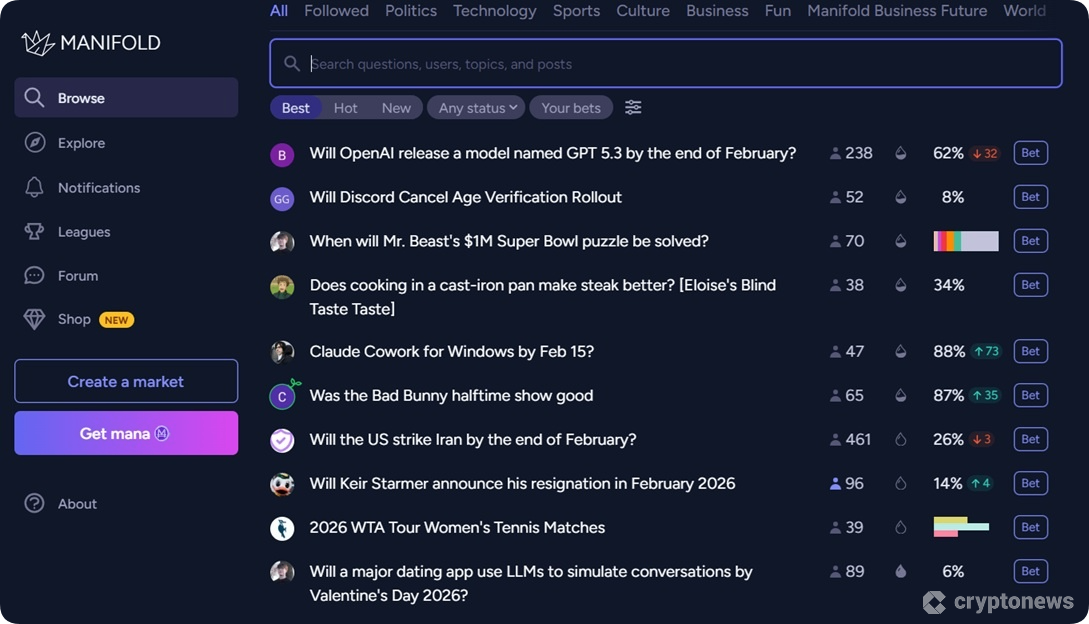
In short:
- Risk-Free Forecasting: Users bet with “Mana” (M$), a virtual “play” currency.
- User-Generated Markets: Anyone can create a betting market on the platform.
- Gamified Reputation: Success is measured in calibration scores and leaderboards.
It is widely used by the rationalist community (LessWrong, Astral Codex Ten) and AI researchers to track probabilities on niche topics that real-money markets ignore due to low liquidity.
How Does Manifold Markets Work?
Manifold operates less like a casino and more like a stock exchange for probabilities. When you bet “Yes” on an event, you are buying shares that pay out M$1 if the event happens. The price of those shares reflects the probability (e.g., M$0.60 = 60% chance).
Market Creation & Resolution
The defining feature of Manifold is that anyone can be the house. You can launch a market on “Will I finish my novel by December?” and set the resolution criteria yourself.
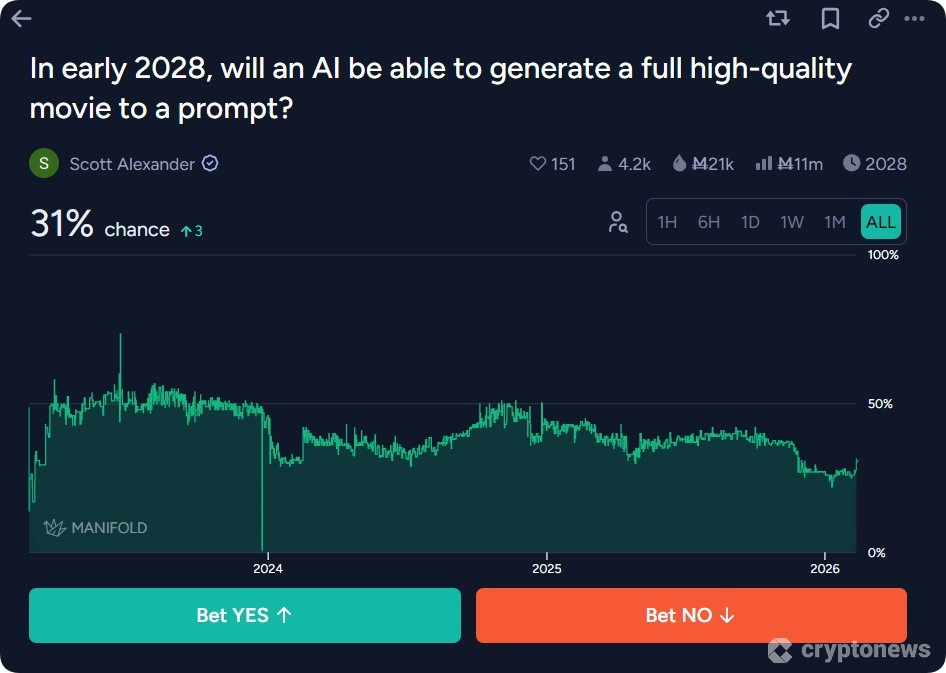
Questions can range from a simple Yes/No to more specific ranges, including:
- Binary Markets: Simple Yes/No questions.
- Multiple Choice: Markets with several competing outcomes (e.g., “Who will be the next GOP nominee?”).
- Numeric Markets: Forecasting a specific number within a range (e.g., “Global temperature anomaly”).
- Pseudo-Numeric Markets: Usually multiple-choice “buckets” (e.g., “0-10”, “11-20”, “21+”) when a precise numeric resolution is difficult.
Resolution Disputes & Edge Cases: Resolution relies on a trust model in which the creator resolves the market. This creates edge cases:
- If a market asks “Will Bitcoin hit $100k?” without specifying “on which exchange” or “for how long,” the creator’s interpretation is final.
- If a creator abandons the site, markets can remain in limbo until moderators intervene.
- Creators might bet on their own markets using inside information (e.g., a personal goal), though this is generally discouraged by the community norms.
The Maniswap Automated Market Maker (AMM)
Manifold uses a custom Automated Market Maker (AMM) called “Maniswap.” Unlike an order book, where you need a counterparty, the AMM allows you to trade against a liquidity pool.
Why Early Bets Matter More:
The AMM pricing curve is convex. Moving a probability from 50% to 51% requires very little capital, while moving it from 98% to 99% requires exponentially more.
- First Mover Advantage: Early bettors who identify a mispriced market (e.g., a 50% coin flip trading at 10%) can buy a large number of shares cheaply.
- Slippage: As you buy more shares, the price increases against you. A M$100 bet might move the probability by 5%, meaning your average entry price is worse than your starting price.
Is Manifold Markets Real Money or Play Money?
Manifold Markets is primarily a play-money platform, though it has experimented with “Sweepstakes” models.
What is Mana (Ṁ)?
Mana, the platform’s native currency, is effectively a database entry, not a cryptocurrency. It cannot be withdrawn for cash, just simply used to keep score, climb leaderboards, and signal confidence.
No Cash Withdrawals for Mana:
You cannot convert Mana balances into USD, ETH, or gift cards. This separation is deliberate to keep Manifold firmly outside the realm of gambling, speculation, or profit motivation.
It means users from jurisdictions with strict gambling laws can participate freely with no money changing hands, and you can bet on hyper-local or silly questions that would be illegal on a real-money site.
You also don’t need to worry about Know Your Customer (KYC), aka confirming your identity with the platform by uploading government documents.
Note: Manifold previously operated a “Sweepcash” layer allowing for sweepstakes-style redemptions, but this is distinct from the core Mana economy, subject to stricter verification, and was abandoned in March 2025.
Is Manifold Markets Legal in the United States?
Mana has no cash value and cannot be redeemed, so it is not considered gambling and instead falls into the same category as video game currencies or fantasy leagues played for pride.
When users previously participated in “Sweepstakes” modes (Sweepcash), the platform relied on sweepstakes laws (with no purchase necessary to enter) rather than gambling licenses. This model is used by apps like Fliff, but it faces increasing scrutiny from state regulators. Manifold shuttered this part of the platform in 2025.
As no money is staked on the platform, Manifold does not fall under gambling regulations or the same level of scrutiny as competitors like Polymarket. While, for instance, some countries have banned Polymarket from operating, we cannot find equivalent instances of bans for Manifold.
Can You Make Money on Manifold Markets?
You cannot directly win (or lose) money on Manifold, but there are ways to grow a reputation, and a high ranking on the leaderboard could qualify as a line on your CV in roles that require prediction, such as within trading firms or AI labs.
In the past, we’ve seen companies sponsor forecasting contests with cash prizes for the most accurate participants, though these seem to have fallen out of favor.
So while an inventive and motivated user might find a way to use Manifold as a springboard in their career, we’d say there is not a direct route at the moment.
How Accurate Are Manifold Markets’ Predictions?
The “play money” label leads many to assume Manifold Markets’ forecast data is useless. However, the reality is that Manifold can be surprisingly well-tuned for predicting the future, but it suffers from specific structural biases.
Manifold tracks its own Brier Score, which is a statistical metric where 0 is a perfect forecast, and 1 is completely wrong. So a low Brier score means predictions were close to what later happened in reality, while higher scores mean bigger gaps between forecasted chances and reality.
At the time of writing, Manifold’s Brier score is 0.1736 (any number between 0.1 and 0.2 is considered excellent). The platform notes case studies such as the arrest of Sam Bankman-Fried, where users were ahead of the mainstream in predicting what would happen, as examples of its accuracy.
However, in one Effective Altruism Forum write-up, Manifold generally performed worse than competitor Metaculus and real-money markets. Another analysis on the EA Forum suggested scores were lower due to “play money” noise and the “Yes Bias”, which is where users prefer betting “Yes” on long-shot events (e.g., “Will AI destroy the world this year?”) because it is more fun
In practice, Manifold delivers reasonably accurate forecasts, especially within tech and AI communities. But incentives matter, so when capital is virtual and partially leverageable, you might expect discipline to weaken at times.
That does not make the platform ineffective – it often captures informed sentiment quickly – but it does help explain why its Brier scores tend to lag behind platforms where traders face real financial loss.
User Experience & Platform Features
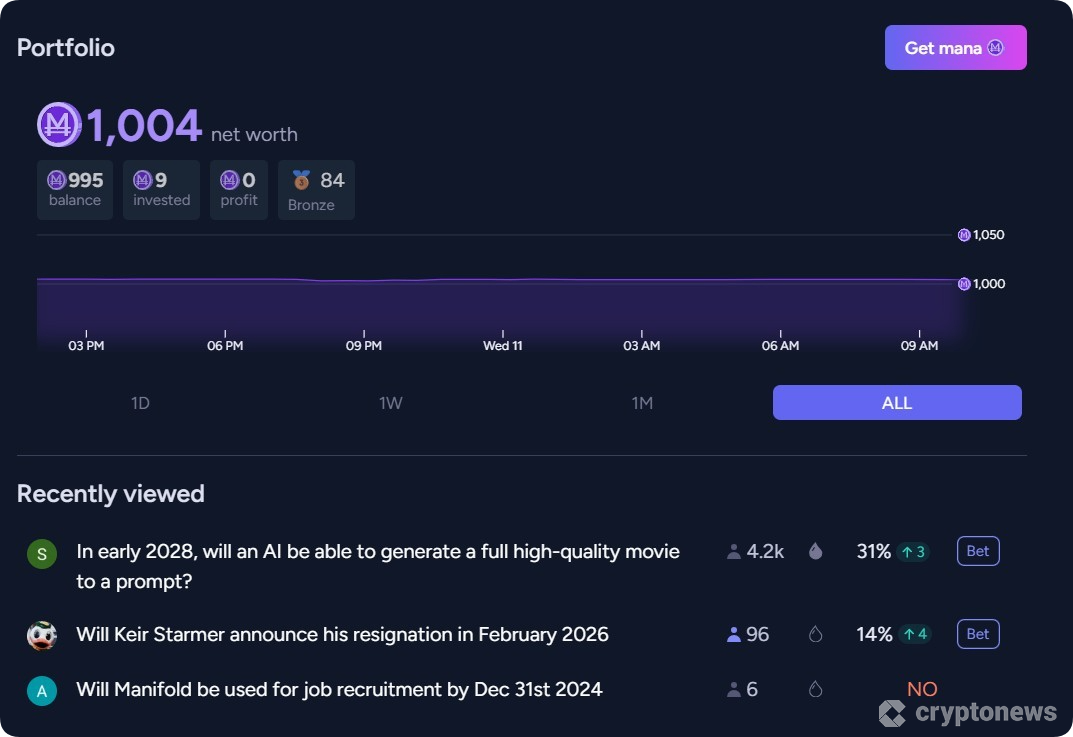
In many ways, Manifold feels like a modern social network. One of the best features, in our eyes, is the comment section on each forecast page, where users debate methodology, share news links, and argue about resolution criteria. All of this adds context: you can read why the probability spiked, rather than just seeing the number move.

We are also a fan of the “Feed”, which uses an algorithm to surface markets relevant to your interests (e.g., AI, Politics, Destiny streamers), and finds bets you are interested in across all of the user-generated content.
The web app is responsive and information-dense, with markets displayed as cards with probability history graphs. Then there are native apps for both iOS and Android, providing a mobile experience with push notifications for market updates. Once you are registered, making bets and following forecasts is easy in your summary dashboard.
The Manifold Markets Loan System Explained
To solve the problem of “locked capital” (where users stop betting because all their Mana is tied up in long-term markets), Manifold introduced a loan system. For example, if you bet M$1000 on a market that will not resolve until 2029, Manifold automatically lends you a portion of that value back to bet on other things.
For much of its history, these loans were interest-free, effectively allowing users to leverage their virtual net worth significantly. This has changed to 0.03% interest, calculated daily, as of January 2026.
It’s a slightly contentious situation that’s still playing out. A core critique is that loans effectively “print” new Mana. If everyone were to leverage their bets, the total amount of Mana in circulation would explode, potentially inflating prices across the board.
Meanwhile, loans can distort the “true” cost of a bet. If you can bet M$100 and immediately get M$50 back to bet again, you are less risk-averse than someone betting real money or someone without a loan. This likely contributes to the platform’s tendency to overprice longshots, reinforcing both the “Yes bias” and the “play money” effect.
What Real Users Say About Manifold Markets
Manifold is held in high regard by the 20,000 users who visit the site weekly, seen as the most experimental, community-focused prediction market. Comments on Reddit praise its design, ease of use, and range of markets.
The use of play money is seen as a blessing and a curse: it keeps markets “liquid”, allows for more niche bets, and lets people take more risks without money on the line. At the same time, without risks, users are more likely to play loosely with their Mana.
As The Bayesian Investor blog said: “An advantage of play money is that Manifold can create more Mana whenever they want.
“Manifold has taken advantage of that to enable traders to, in effect, buy on margin. In addition, they give daily handouts of mana to people who trade daily.
“Those two features ensure that I mostly don’t end up in the situation that I got into on some other platforms of spending all my money and then waiting for markets to be resolved.
“My more regular trading on Manifold helps ensure that, at least for markets that get some minimal amount of attention, there are enough regular traders to keep the markets somewhat efficiently priced.”
There are critiques. As one Reddit user pointed out, resolution criteria can include “this [prediction] will resolve when the market owner feels the topic has been resolved,” so, as the user pointed out: “The smart way to bet on them is to figure out the biases of the market owner and bet on that.”
Manifold Markets API: Data Access & Integrations
For developers and researchers, Manifold can be a goldmine, as it offers a free, public API that is easy to scrape, containing live market probabilities (fetch the current % chance for any market), a full history of trades on any market, which can be used to analyze sentiment over time, and user bets (so you can follow individual traders).
This openness has helped make Manifold a dataset for academic papers on forecasting accuracy, with research papers published based on the platform’s data. An API key isn’t required for access, making it incredibly friendly for hobbyist dashboards.
You can even find discussions on using the API to build trading bots based on sentiment – although you might expect that anyone finding success in this area will keep it to themselves.
Summary: Manifold Markets’ Pros & Cons
🟢 Pros
- Zero Financial Risk: Great for learning how to think in probabilities.
- Infinite Variety: Markets on everything from politics to personal goals.
- Social Experience: Active comments and debates enhance the data.
- Mobile App: Native iOS and Android apps for betting on the go.
- Developer Friendly: Excellent API and open data.
🔴 Cons
- No Cash Out (Mana): Mana is strictly for fun; no withdrawals.
- Accuracy Issues: “Yes bias” and play-money incentives distort probabilities.
- Resolution Risk: User-created markets rely on the market creator’s honesty.
- Niche Focus: Heavy bias toward tech/AI/rationalist topics.
Manifold Markets vs. Real-Money Prediction Markets
Here’s a look at Manifold Markets compares to similar platforms that use real money for prediction markets:
| Platform | Manifold | Polymarket | Kalshi |
| Incentives | Play Money (Mana) | Crypto | Fiat |
| Accuracy | Good for niche; “Yes” bias | High (Market forces) | High (Regulated) |
| Liquidity | Algorithmic (AMM) | Global Crypto Liquidity | Institutional/Retail |
| Regulation | Unregulated (Game) | Offshore/Gray | CFTC Regulated |
| User Experience | Social, Gamified, Mobile App | Financial, Transactional | Brokerage-style |
As the table shows, Manifold is the better choice for learning and entertainment. If you want to track the probability of a specific celebrity getting cancelled or a new AI model dropping next week, Manifold is the quick and easy way to take a position or see what the crowd thinks.
If you want to take on real-world risk, you need a real-money platform. The likes of Klashi and Polymarket let you place real stakes on many different markets, from crypto to sports and politics. However, remember that if you move to Polymarket or another service, you can lose as well as make money.
Who Should (and Shouldn’t) Use Manifold Markets?
Manifold Markets is probably best suited for forecasters, researchers, and curious users who want to practice probabilistic thinking, and you will have fun if you like exploring niche markets and engaging in low-stakes community prediction without risking real money.
But it will be less suitable for profit-seeking traders or anyone chasing strong financial incentives.
Best for:
- News Junkies: Who want to see probabilities attached to headlines.
- Aspiring Superforecasters: Who want to train their calibration without losing money.
- Researchers: Looking for crowd sentiment on topics too small for betting markets.
Not ideal for:
- Gamblers: There is no “house” to beat for profit here.
- Crypto Traders: If you want yield or ROI, look elsewhere.
Final Verdict: Is Manifold Markets Worth It?
Manifold Markets is the most “alive” prediction market on the internet. By removing the barrier of real money, it has created a community that is faster than its financial counterparts and contains multitudes of niches to get lost in.
The platform’s ability to host markets on literally anything – from global geopolitics to office drama – makes it a unique part of the internet, with a community to match.
If you treat it as a massive multiplayer online game for current events, it is unbeatable. And without money on the table, it is the cheapest way to realize how wrong you usually are about the future.
While this may not appeal to people looking to make money on prediction markets, Manifold Markets is a hugely popular choice for those who want to enjoy the social and fun aspects without any of the risk.
FAQs
Is Manifold Markets free?
Is Manifold Markets accurate?
What other sites are like Manifold Markets?
How many users does Manifold have?
Are prediction markets useful?
References
- “Manifold Markets isn’t very good” (“Yes Bias” Critique)
- Calibration Data (Official Dashboard)
- Sweepstakes & Sweepcash Rules (Official Docs)
- Loan System & Margin Trading (Manifold)
- Market Types & Resolution (Official Docs)
2M+
250+
8
70







 in numbers