

How to Use Polymarket: Complete Beginner’s Guide (2026)
We believe in full transparency with our readers. Some of our content includes affiliate links, and we may earn a commission through these partnerships. However, this potential compensation never influences our analysis, opinions, or reviews. Our editorial content is created independently of our marketing partnerships, and our ratings are based solely on our established evaluation criteria. Read More


Whether you are in the U.S. or the rest of the world, using Polymarket involves a few simple steps: users need only create an account, deposit, and begin trading.
Polymarket is a premier prediction market that has taken the world by storm. Since its inception, it has achieved integrations with large institutions like Google and Bloomberg, and even coined the term “Polymarket polling.”
In this guide, you will not only learn how to use the platform to place trades, but you will also learn the best practices for engaging with the platform and how to stay safe.
Overview: How to Use Polymarket in 5 Steps (U.S. & Non-U.S. Users)
Using Polymarket is simple, but it depends on whether you are based in the U.S. or outside the U.S.
Here is the general process for how U.S. and global users can use the platform:
- Create an account.
- Deposit funds.
- Choose a market.
- Place a trade.
- Manage your position or cash out.
Note that in the U.S., you’ll need to join the waitlist and be approved before being able to complete these steps.
Visit PolymarketHow to Use Polymarket in the U.S. in 3 Steps (Updated for 2026)
Polymarket is re-entering the U.S. market in a limited, regulated form, but access is still restricted. U.S. users cannot use the main global Polymarket exchange. Instead, access is rolling out gradually through a CFTC-compliant U.S. platform.
Step 1: Join the U.S. Polymarket Waitlist
U.S. users must join the official U.S. onboarding waitlist, currently available through the Polymarket mobile app. Public access is limited, and most users are admitted via invitations or staged rollouts.
The standard Polymarket website is not the correct entry point for U.S. users.
Step 2: Create a Verified Account When Invited
Once approved, you’ll be prompted to create an account on the U.S.-regulated Polymarket platform.
This version requires:
- Identity verification (KYC)
- Acceptance of U.S.-specific terms
- Use of compliant payment rails (no unrestricted crypto wallets)
This differs materially from the non-custodial global Polymarket experience.
Step 3: Trade U.S.-Available Markets
U.S. users can currently trade a limited set of markets, primarily:
- Sports-related event contracts
- Select, regulator-approved prediction markets
Markets like politics, crypto prices, and culture, which are available globally, may not yet be accessible to U.S. users. Market availability may also vary by state, as some state regulators continue to scrutinize prediction markets.
⚠️ Important Warning for U.S. Users
Upon entering the page for a market, you will get the following warning:
“Trading is not available to people or companies who are residents of, or are located, incorporated, or have a registered agent in, the United States, France, or a restricted territory. See our Terms of Use.”
This notice still applies to the global Polymarket exchange. We advise all U.S. to stop and not attempt to interact with Polymarket beyond this point. Do not attempt to bypass restrictions using VPNs or offshore wallets. Doing so may violate the platform’s terms and expose users to legal or account risks.
How to Use Polymarket Outside the U.S. in 5 Steps
In five simple steps, you can recreate an account and start trading on Polymarket. These steps require little more than a crypto wallet or email and cryptocurrency. Here is how you use Polymarket in legal jurisdictions.
Step 1: Set Up Your Login
Navigate to the Polymarket website. In the top right corner, select ‘SignUp’.
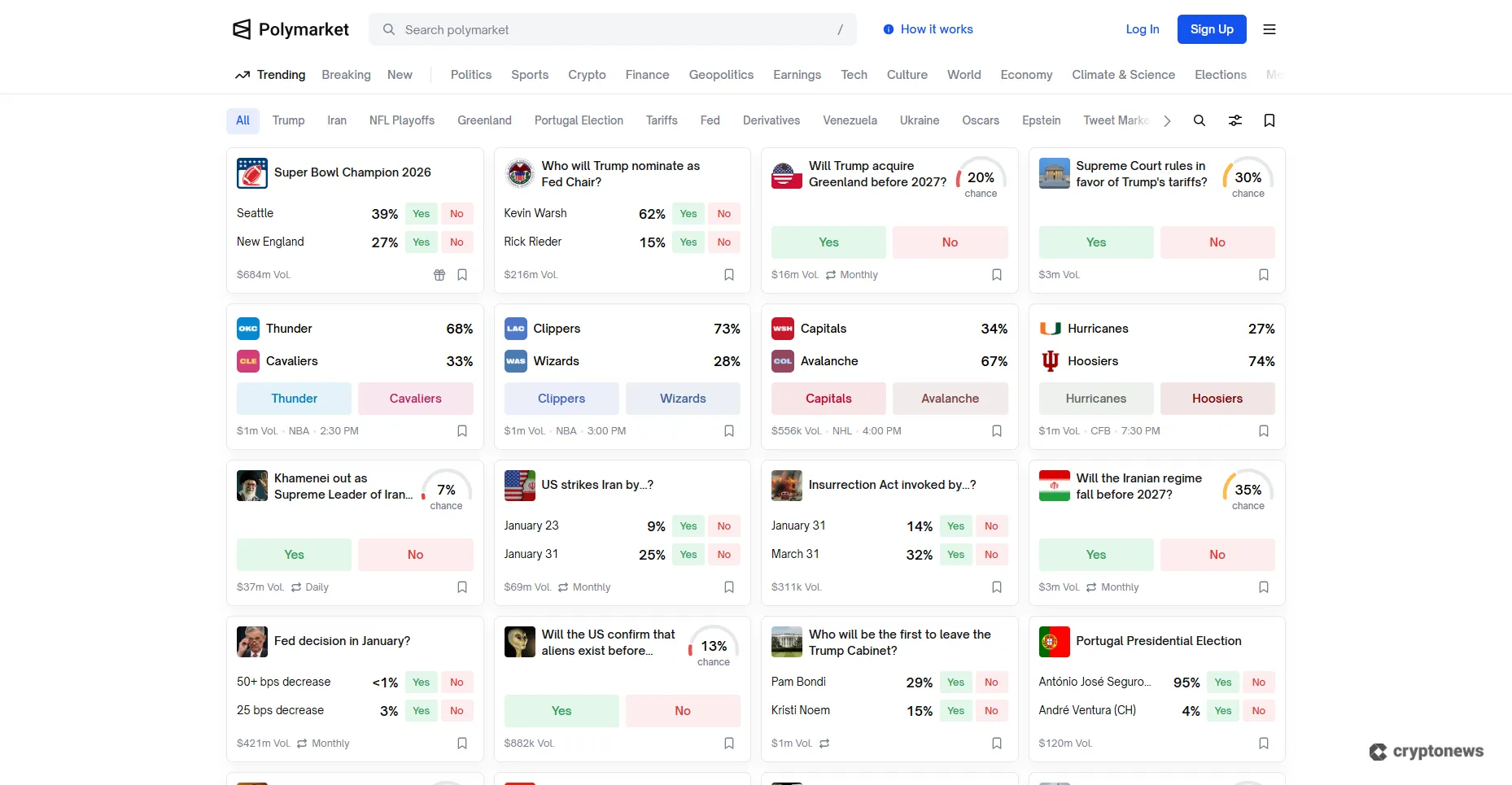
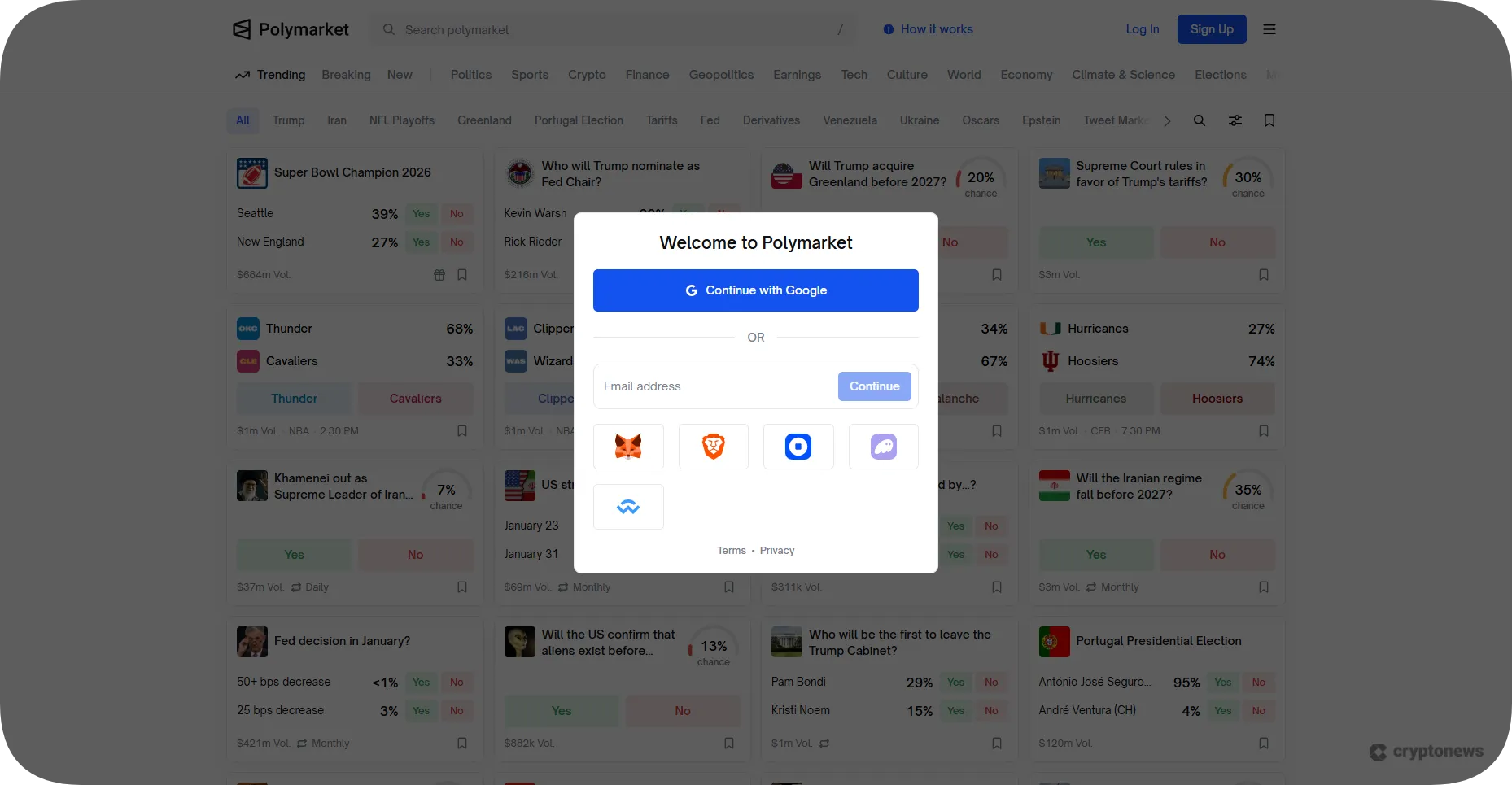
Select a login method. In the previous example, we used an email address. This time, we will use our own non-custodial wallet.
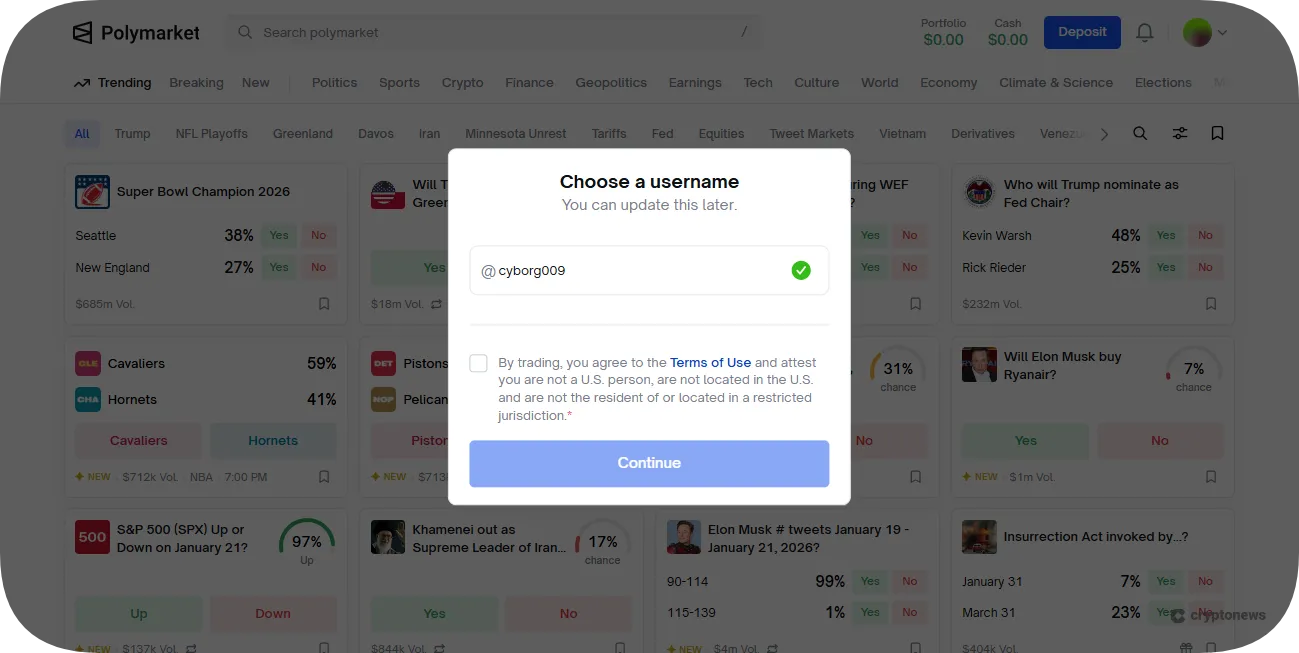
Select a username. The site will also prompt you to give an email address, but you can bypass this step until later.
Step 2: Bridge or Deposit Funds
After you complete the previous steps, you will be prompted to fund your account. If you chose another sign-up method, simply look in the top right corner for the deposit button.
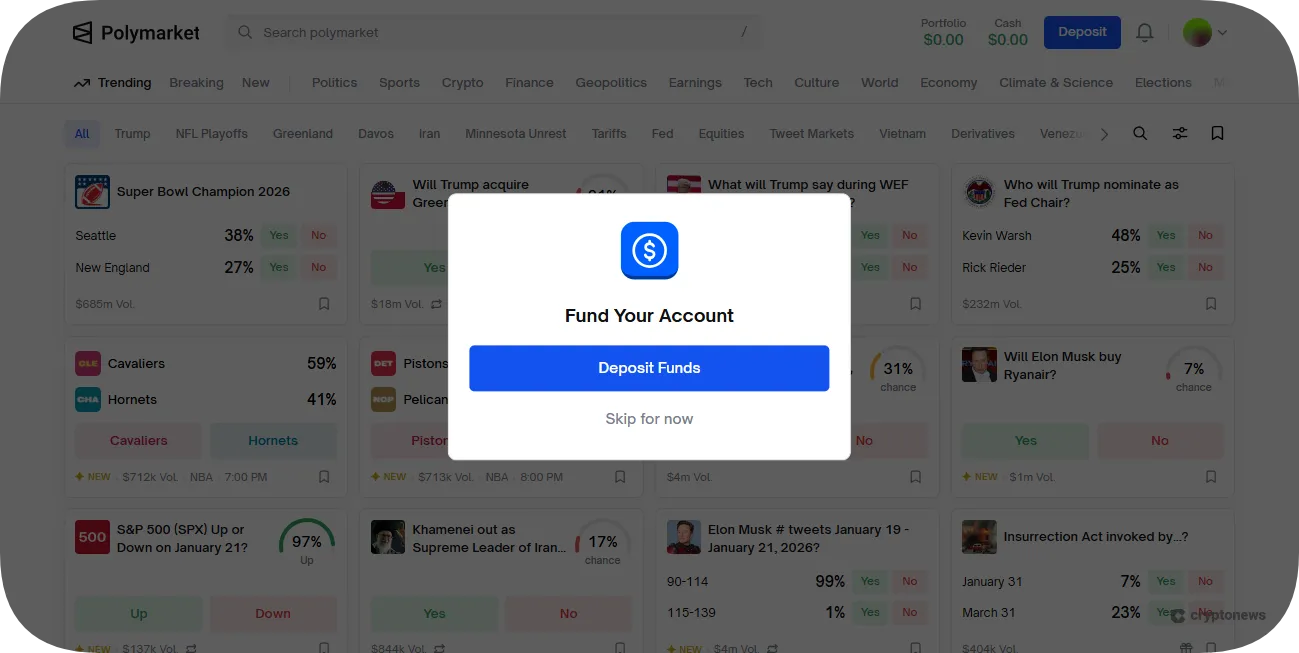
There are multiple ways to deposit onto Polymarket. Regardless, each method will automatically convert your balance into USDC.
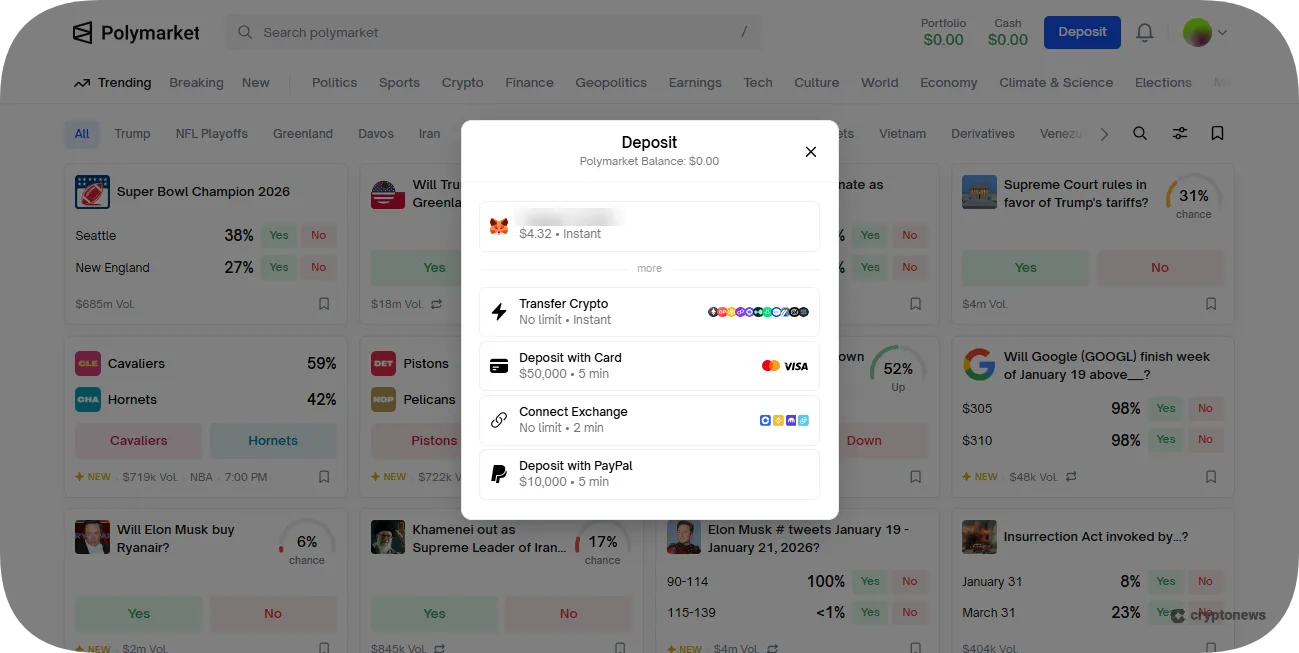
Enter the amount of crypto you would like to deposit. Ensure that you have enough gas to complete the transfer if you chose the crypto method. Select ‘Confirm Order’ to continue.
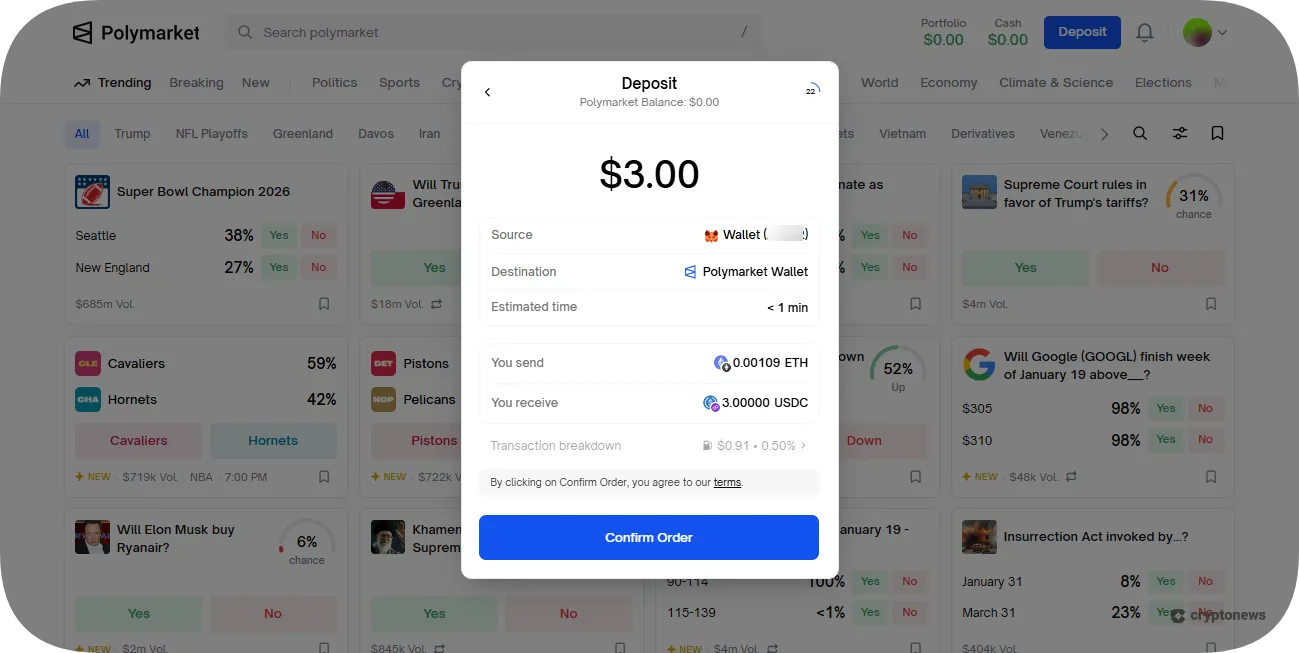
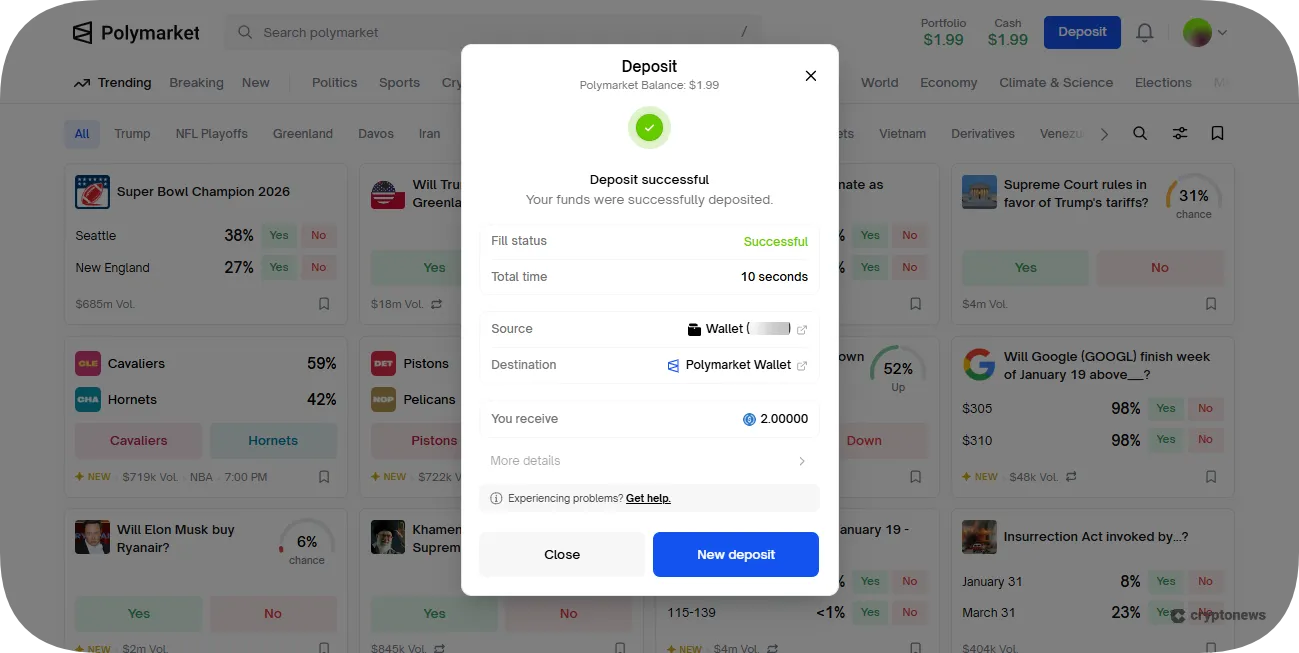
After you have confirmed your order, you should see the following screen and your funds deposited into your account.
Step 3: Choose Your Market
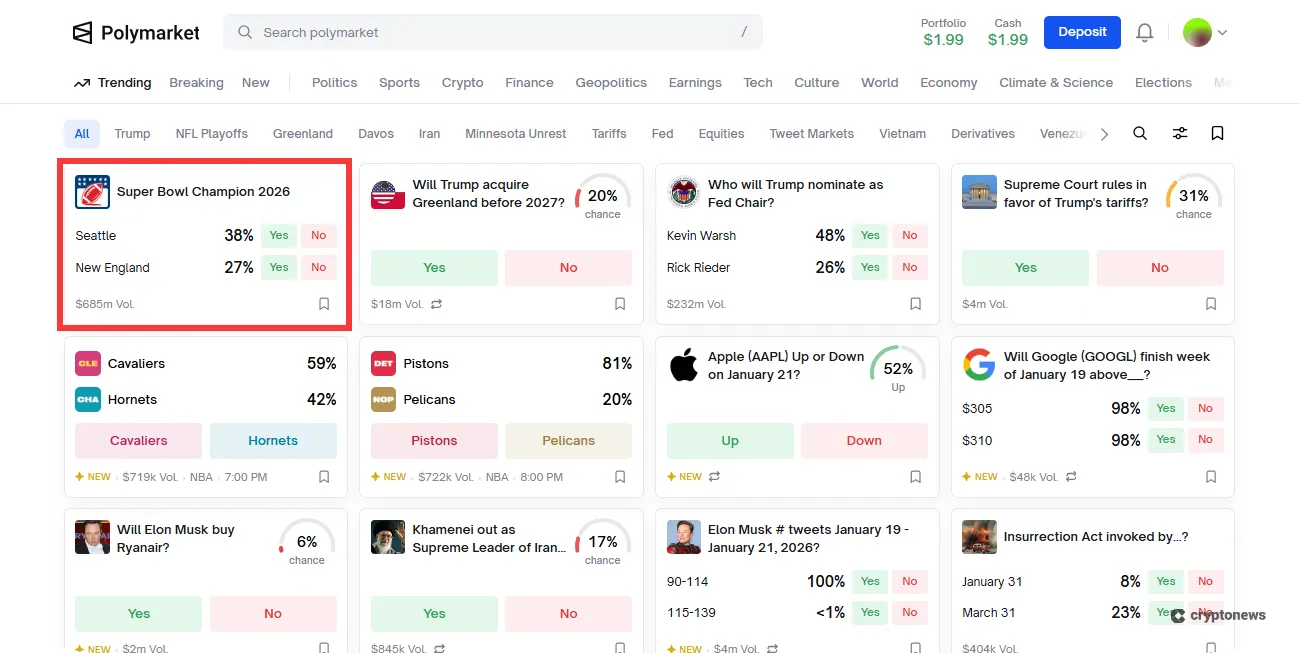
To pick a market, navigate back to the front page and select an event. You can choose from a wide variety of events, including sports, politics, and crypto price predictions on Polymarket.
Step 4: Place the Trade
Before you can make a trade, you will have to approve trading and tokens in your wallet.
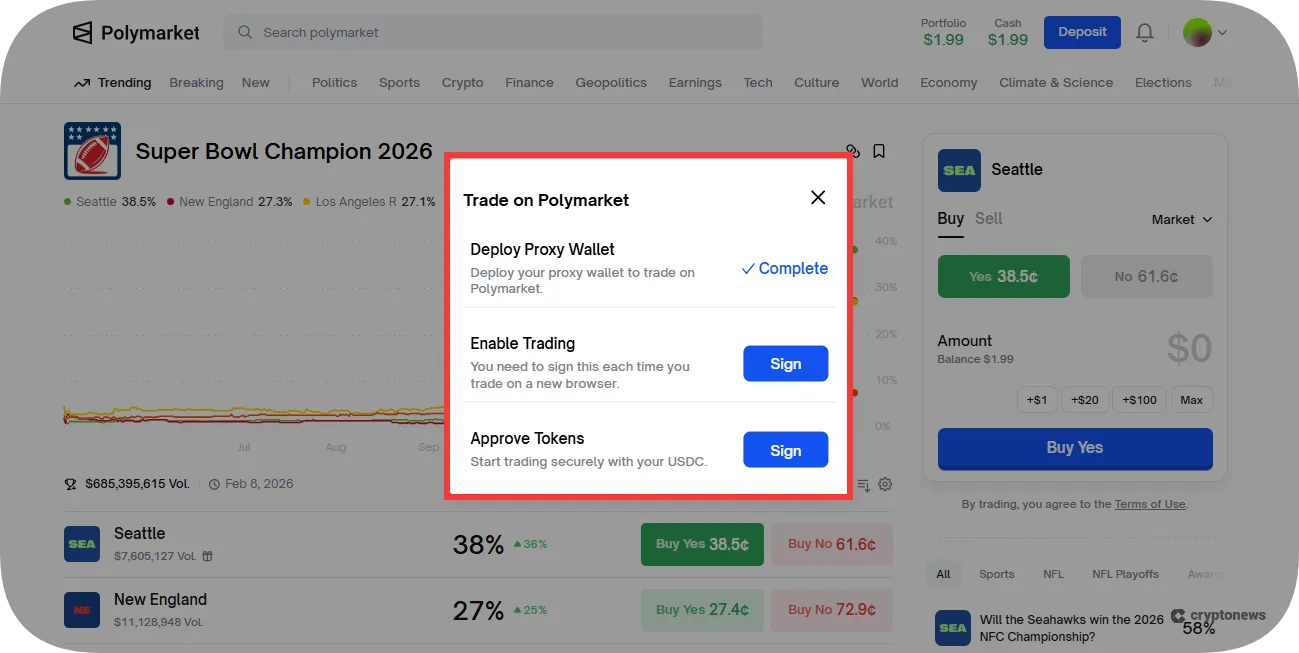
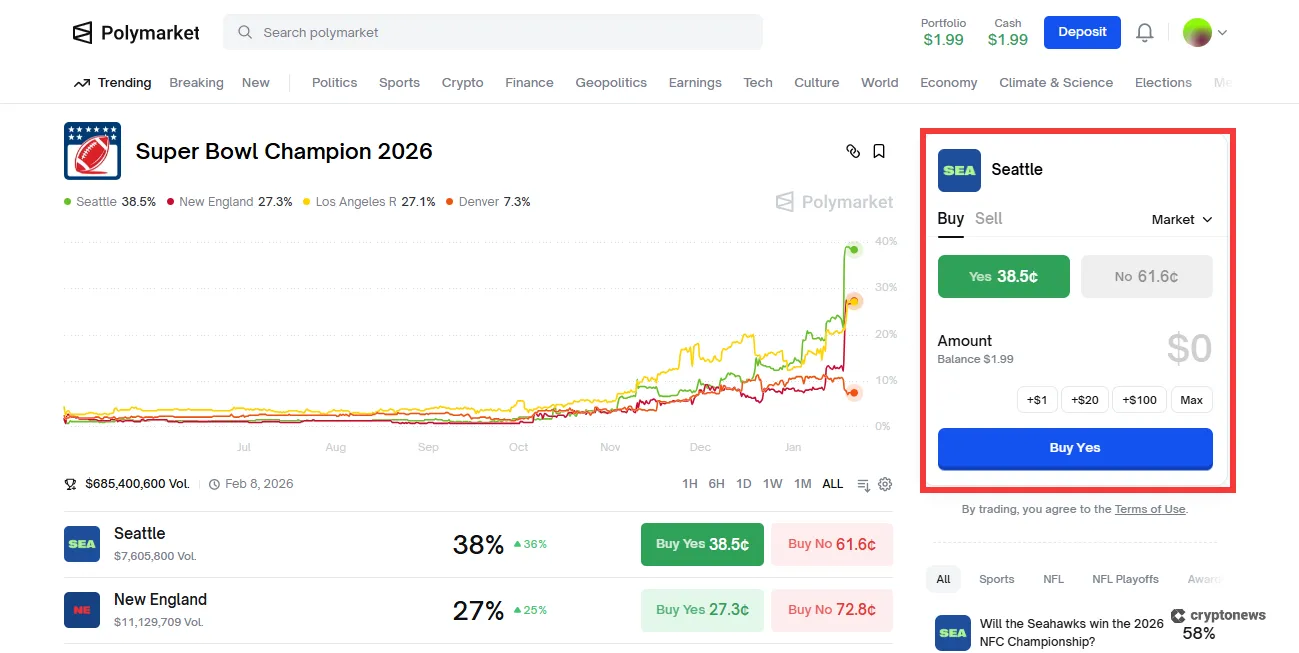
Place an order by selecting ‘Yes’ or ‘No’ and entering a price. At this point, you can also select a limit order. This setting allows you to pick a price at which you want to buy, and create an expiration time if the order has not been fulfilled.
A market order is the default setting for trades. It simply means that your order will be fulfilled immediately at the best available current price.

Keep in mind, even if you have deposited USDC to your account, you will still need POL on the Polygon blockchain to pay for gas fees.
Step 5: Manage Your Positions and Cash Out
Once you have placed an order, look in the upper right corner for ‘Portfolio’ to manage your positions.
On the following page, you can manage your open positions and cash out by pressing the ‘Withdraw’ button.
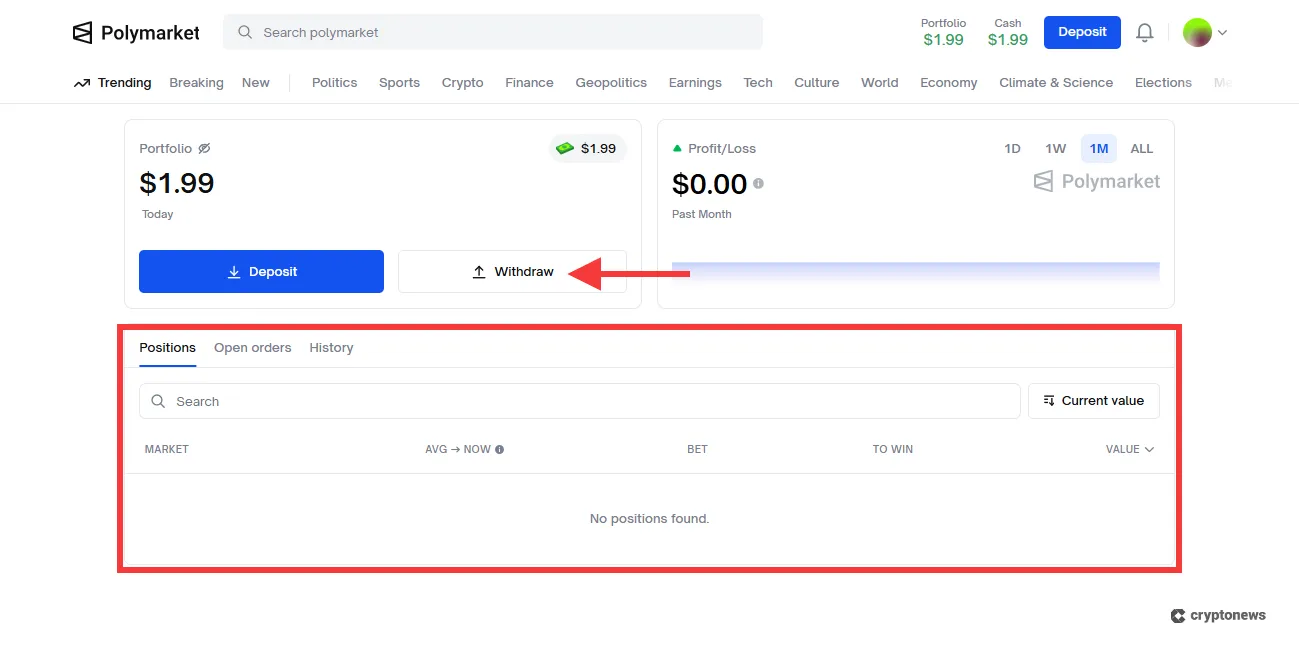
You can choose to sell your shares before the market closes. Some users may want to do this to cut their losses or lock in profit.
How to Deposit on Polymarket
In the previous sections, we covered how to deposit on Polymarket by transferring crypto. In this section, we will cover the other available options. Keep in mind that this will not apply to U.S. users, who presently cannot use the platform.
Let’s reiterate a few points. Regardless of the method you choose, all deposits will convert to USDC on Polygon. You should also keep some POL for gas fees on the network.
₿ Transfer Crypto
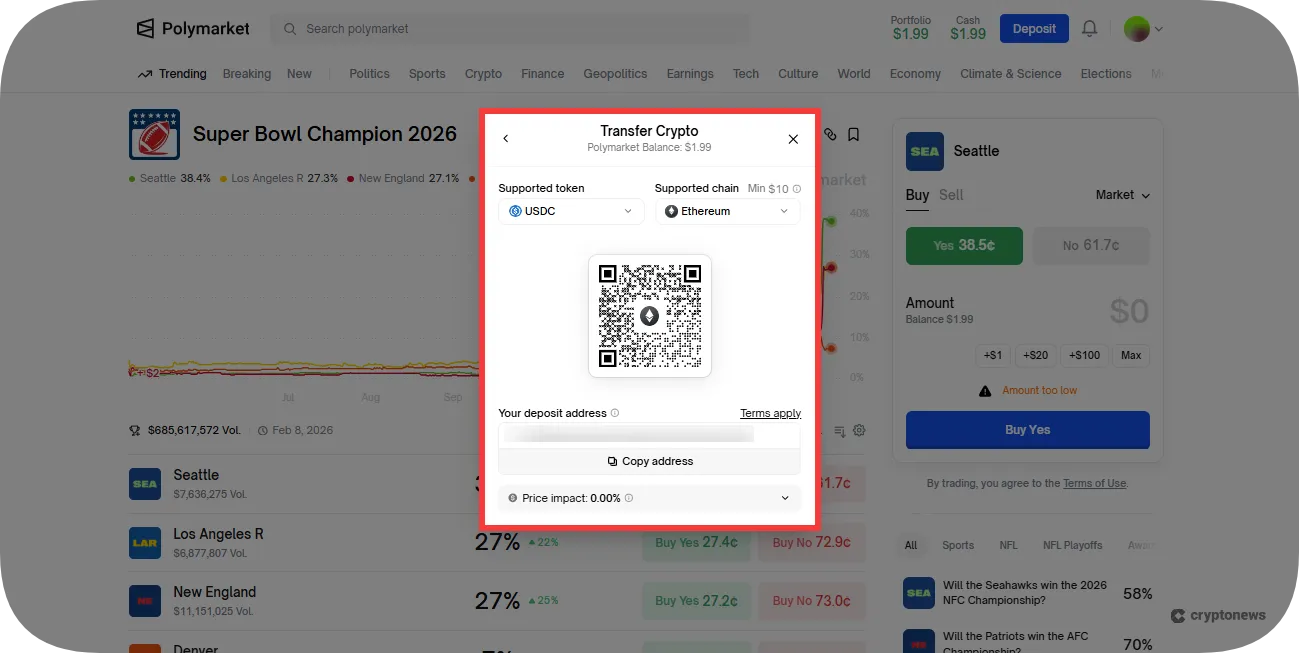
One thing that we didn’t mention is that when you choose the transfer crypto method, you can deposit crypto that you already hold without bridging. Polymarket supports over 20 different cryptocurrencies and 11 blockchains.
You are essentially depositing crypto into one of Polymarket’s wallets, after which the platform credits you in your account. Not all cryptocurrencies are supported on blockchain, and each network has a minimum deposit requirement. So keep this in mind before you deposit. Thankfully, the other methods are a lot simpler than transferring crypto.
💳 Visa Card
The next available method is by a Visa card. This method uses various instant exchanges, such as Moonpay, Binance Connect, Paybis, and others. As a result, depositing with a Visa card supports multiple fiat currencies. Each provider has a minimum deposit requirement as well, usually about $20 or higher.
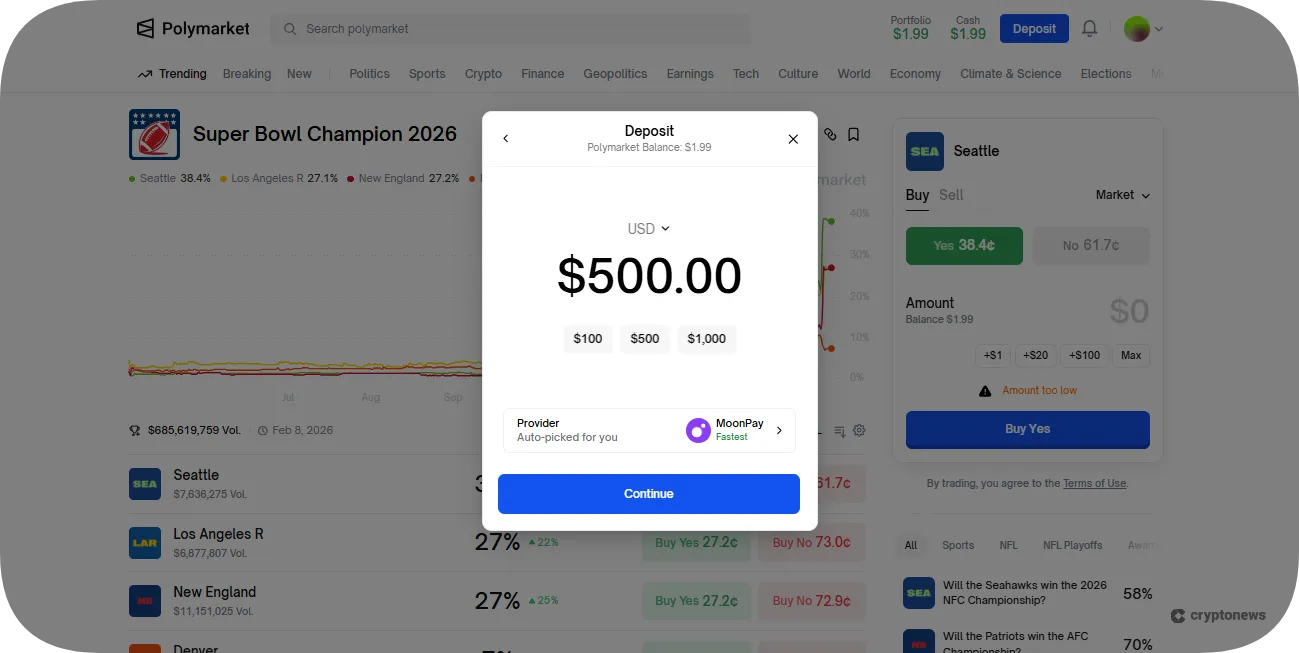
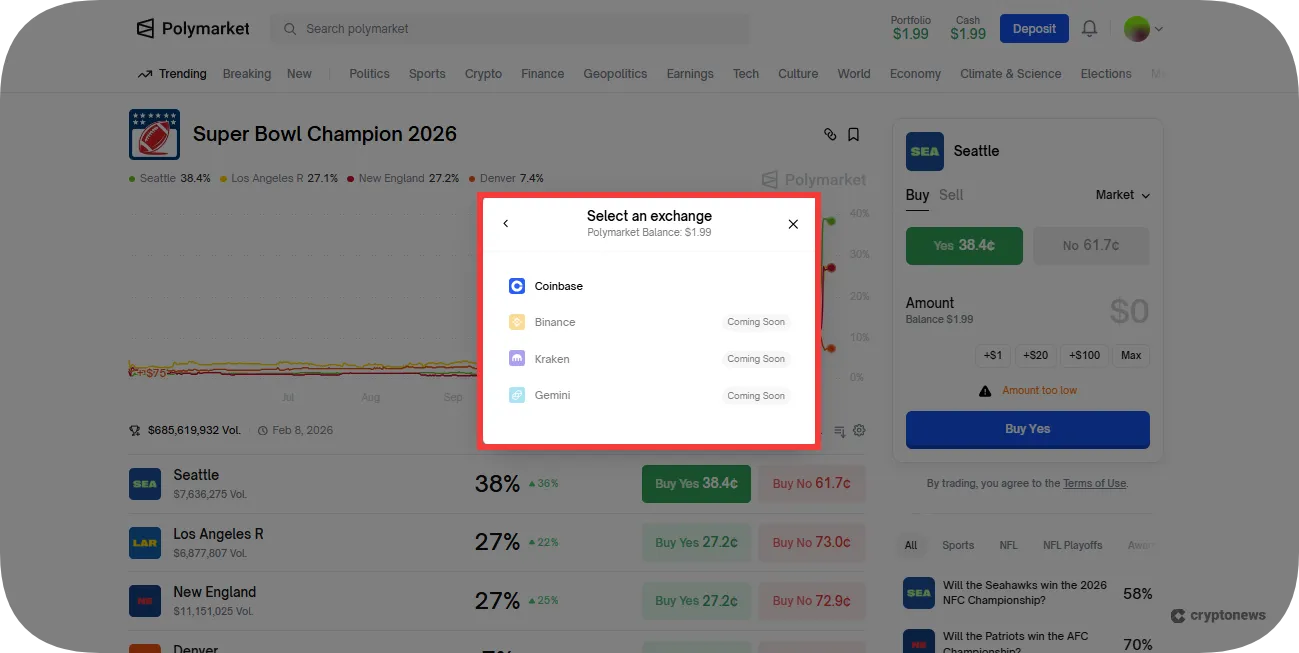
🏛️ Connect Exchange
Connecting an exchange allows you to transfer your balance from your centralized exchange account (CEX) to Polymarket. However, this is a new future that has not been launched yet. So, there is not much to say about it beyond speculation.
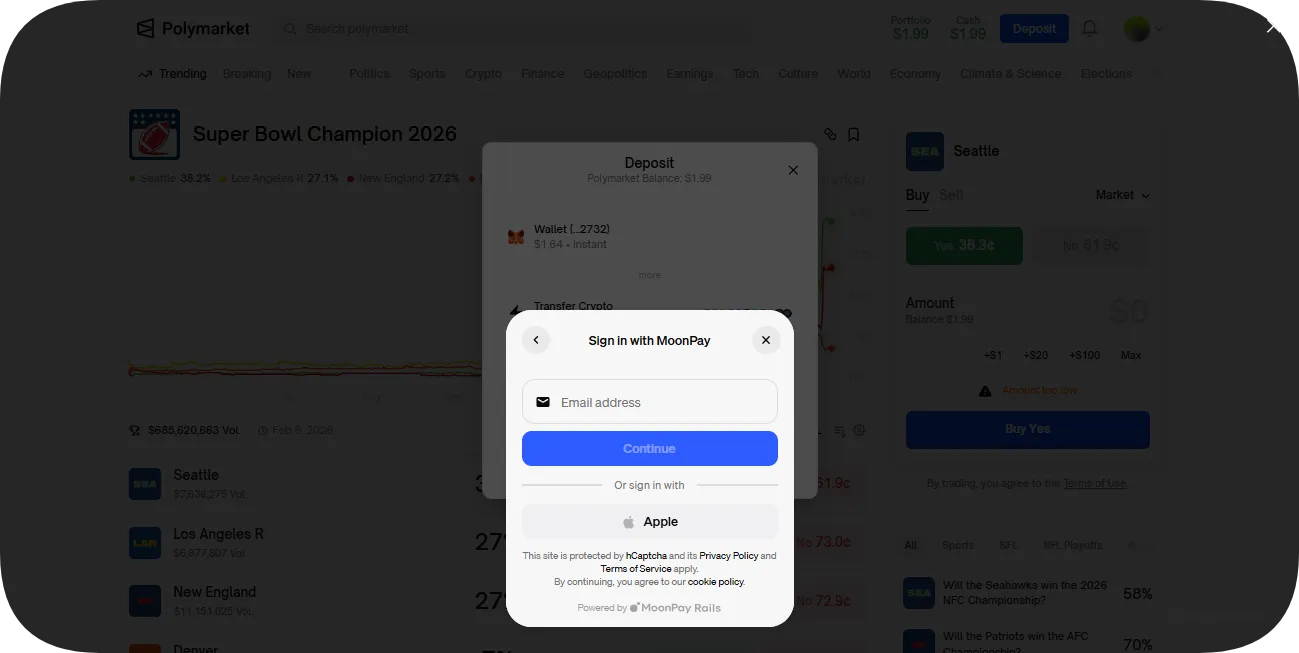
💲PayPal
The last method is depositing with PayPal. This method simply uses MoonPay as the crypto on-ramp and allows you to pay for crypto via a PayPal account. The most important thing to remember here is that MoonPay and PayPal have their own fee structures.
Withdrawals: How to Cash Out Your Money
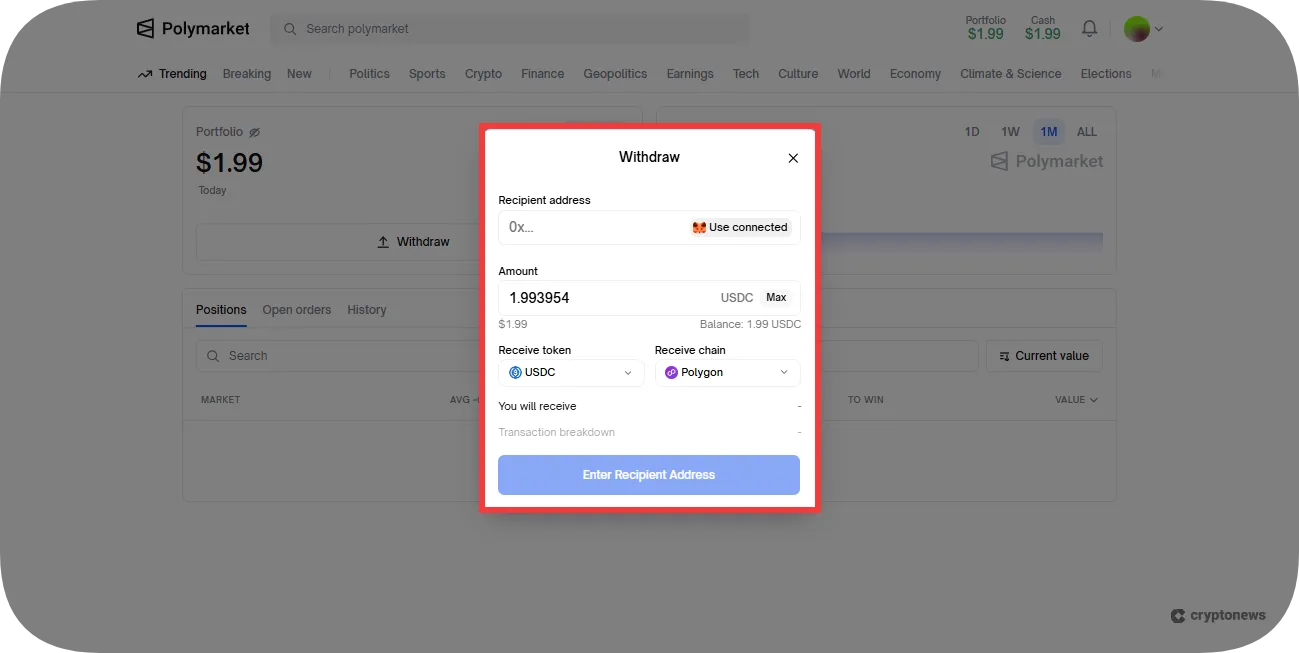
While you are trading on Polymarket, you may find that you want to take a profit or withdraw your balance. To do this, you need only to navigate to your portfolio. At the moment, the only way to withdraw from Polymarket is by sending crypto back to your wallet.
One useful feature you may want to remember is that you can select the receiving token and chain; you do not have to withdraw using USDC. Some of the chains that you can withdraw to include Ethereum, Arbitrum, Solana, and four others.
This is important to keep in mind because you don’t want to send your crypto on a chain where you don’t have crypto to pay for gas fees. In this case, it is probably better to send it back to the chain (and the wallet) that you deposited with. From there, if you want to cash out into fiat, you will have to utilize another service.
What Is Polymarket and How Does It Work?
Polymarket is a blockchain-based prediction market where users buy and sell shares that represent the likelihood of a future event occurring (e.g., “Who will win Brighton versus Bournemouth?”, “Will Trump acquire Greenland before 2027?”, etc.). Polymarket launched in 2020, but would not become one of the top prediction markets until 2024.
Since its ascent, the platform has become popular for:
- Speculation: Allows one to profit on predicting events with simple, binary outcomes.
- Hedging: Users hedge on Polymarket to offset exposure they have in the real world.
- Information Discovery: Polymarket is somewhat accurate in predicting outcomes like elections and is therefore useful for research.
Unlike alternative platforms to Polymarket, such as sportsbetting, users trade against each other — not the house. Each event on Polymarket is referred to as a “market,” and every market offers corresponding ‘Yes’ or ‘No’ shares, which represent the possible outcomes. Users can buy, sell, and trade these shares, which cost between 0 and 1 USDC (or zero and one dollar).
From this point of view, share prices reflect current market sentiment, or the implied probability of an outcome (e.g., a ‘Yes’ share trading at $0.65 = 65% probability). At the conclusion of a market, the shares that represent the correct outcome are paid out 1 USDC; losing shares are worthless, and the market halts trading indefinitely.
Markets are resolved through a decentralized oracle model, particularly the UMA Optimistic Oracle. For now, just think of this as a group of trusted third parties that compete to give the correct answer for a reward. These oracles receive heavy penalties for submitting incorrect answers.

Is Polymarket Legal?
Polymarket is legal in various parts of the world. In countries like the U.S. and Canada, legality differs by state and province, respectively. Countries where Polymarket is banned directly by law or by implication of the law include Poland, France, Australia, Switzerland, Taiwan, Singapore, and, more recently, Portugal.
While not directly due to legality, Polymarket also geoblocks some countries and territories due to restrictions that may inhibit its operations or ability to give users optimal service.
Due to the platform being incorporated in the U.S., any residents of OFAC-Sanctioned Countries cannot use Polymarket. For a detailed list of geographic restrictions, you can review Polymarket’s documentation.
Legality in the U.S. and State-Level Restrictions
The CFTC initially banned the use of Polymarket. The reason is that it allegedly operated an unregistered binary options platform on U.S. shores. This resulted in a $1.4 million penalty for Polymarket in 2022.
In 2025, Polymarket’s parent company acquired the U.S.-based QCX LLC derivatives exchange and received approval from the SEC to operate in the U.S. However, participation is still limited and restricted in some U.S. states.
For example, Tennessee has banned Polymarket and other platforms from offering sportsbetting to its residents specifically. Other states have moved to ban prediction markets or sports-related betting on similar platforms, but have either been unsuccessful or had mixed results.
Polymarket’s U.S. rollout is still underway, and while it is generally legal in the U.S., interested parties should check their local laws before attempting to access the platform.
Is Using a VPN to Access Polymarket Legal?
According to Polymarket’s Terms of Use, the use of a VPN is strictly prohibited to circumvent any restrictions by the platform or local laws. In the U.S., using a VPN is not illegal at the national or state level at all, even for Polymarket.
Regardless, you should always adhere to the terms of service and local laws and avoid attempting to circumvent any restrictions, as it could potentially lead to account freezes, loss of funds, and tax and compliance issues for the individual, and possibly enforcement penalties against the platform for failing to properly block users.
Polymarket U.S. vs. Global: Key Differences Users Must Understand
| Polymarket (U.S.) | Polymarket (Global) |
| Only available via private beta | All markets available |
| Crypto, Card, SEPA, and 2+ | Crypto, Card, SEPA, and 2+ |
| No KYC | No KYC |
| N/A | Zero fees except for crypto markets, which take a 0.01% fee on 15-minute markets |
Polymarket U.S. users will encounter a largely different experience than global users. This is because the U.S. app is currently in private beta and only available via an early access waitlist — a relatively long one at that.
You know what, Tony? You are absolutely correct. I did not believe it when you said it, so, I went back and troubleshot myself.
1) Polymarket's terms of service have not been updated since August, 2025, so, even those are probably not accurate.
2) My understanding is that… pic.twitter.com/49SwqFe1wo— D👽☢️MerDaddy (@UlrichNeujahr) January 12, 2026
Fees, Profits, and Taxes on Polymarket
Perhaps the biggest question users want to know is “what are Polymarket’s fees, profits, and taxes?” Well, look no further. In this section, we will cover everything you need to know.
Does Polymarket Take a Cut of Winnings?
Polymarket does not take any fees on the majority of markets — that’s it. For the majority of its history, Polymarket has not taken any fees from trading, nor from market resolutions.
"Polymarket doesn't make money, we lose money"
The founder of Polymarket @shayne_coplan, explains how the platform makes revenue pic.twitter.com/q47iIQRX5n
— Ordi (@OrdiRums) December 7, 2025
According to the founder, this was an effort to grow the market early on. Market makers do, however, earn from spreads. Polymarket has implemented fees with short-duration, 15-minute crypto markets. But these fees do not apply to the majority of markets.
Polymarket introduced its maker rebates program in 2026. With it, takers pay 0.06% – 1.56%. These taker fees fund maker rebates paid out in USDC.
All other markets do not charge any fees on trades; however, payment providers may charge a separate fee, which Polymarket does not receive.
Do You Need Crypto to Use Polymarket?
Yes, all users, regardless of region, will place trades in USDC and receive payouts likewise. While you can deposit through a variety of methods, each method will ultimately convert your deposit to USDC.
This is extremely convenient for global users because settlements in the traditional banking system can be expensive and take days to complete.
Do I Pay Taxes on Polymarket Winnings?
Polymarket winnings are most likely taxable in many cases, but it depends on the region.
Polymarket winnings will likely be subject to capital gains taxes or those relevant to derivatives trading. However, this could be subject to modification, given that prediction markets are still in their infancy.
Always seek the expertise of a certified tax professional before filing for taxes, and keep adequate records of your winnings. Please keep in mind that anonymity is not an excuse for avoiding taxes; you should never attempt to avoid any tax obligations.
Common Mistakes New Polymarket Users Make
Polymarket is unlike sportsbetting, but it is not quite like day trading either. It takes parts of both to create an entirely new market with unique properties. Here are some common misconceptions and assumptions new users may make.
📝 Liquidity Is Conditional
Liquidity is conditional (around heightened news/attention), not continuous. This means that thin order books are common around certain probabilities in a market.
If you buy shares of an unpopular outcome, it may be difficult to exit that position. Or, given how long it takes for a market to reach its conclusion, you may still experience thin liquidity if interest in a certain market dies down.
➗ Prices Are Based on Probabilities
When you see a price for an outcome (e.g., a ‘Yes’ outcome priced at $0.65), this represents the (implied) probability that a market will resolve to this outcome. The price is not the result of demand for this share, nor the payout (as all winning shares resolve to $1 anyway).
Moreover, implied probability, meaning the likelihood of that outcome being true, does not necessarily mean that the market will resolve to that outcome. In other words, even if a market has a 65% chance of resolving to ‘Yes’, for example, the market could still resolve to ‘No’.
In this scenario, those who bought the unpopular outcome would be more profitable because they bought the unpopular outcome at lower prices.
⚠️ Polymarket Has Distinct Risks
Polymarket is a hybrid exchange; parts of its operations are on-chain and off-chain. The risks are distinct and include:
- You can log into the platform with your personal wallet, but the responsibility of securing your wallet is all your own.
- Once funds are deposited into your account on Polymarket, and you enter a market, Polymarket does have some ability to censor or block activities.
- The Polymarket team creates markets, matches orders off-chain, and can halt a market’s operations altogether.
Advanced Polymarket Tips & Strategy
Now that you know the basics, let’s cover some Polymarket tips and strategies that will help you navigate the platform.
New Users
If you are a new user, you should not try to implement any advanced strategies. It is best to hold your positions until the market resolves. Additionally, keep in mind that just because a share has a higher probability (i.e., price) does not mean it is correct. However, for geopolitical events, such as elections, Polymarket has historically been relatively accurate.
Use Limit Orders
Limit orders help to reduce the risk of slippage in thin (low liquidity) markets. Market orders are more likely to incur slippage.
Early Markets
It is better to enter new markets with a smaller size in some cases. You could get stuck with an illiquid position as the market is in price discovery. Moreover, early entrants are not inherently better off; you may risk worse entry points if the market reprices (it most likely will).
Slippage Risk
A few cents of slippage can significantly reduce your odds, especially at extreme probabilities. For example, if you want to buy shares at $0.55, but you incur some slippage that results in an average price of $0.58, this significantly reduces your profit. This is even worse when approaching probabilities nearing 100%.
Avoid Emotional Trading
As with forms of trading, you should avoid trading emotionally. Sticking to your trading strategy, taking breaks, and using stop-losses are all good ways to avoid emotional trading.
Final Thoughts: Is Polymarket Worth Using?
Polymarket is unlike most trading platforms in that it takes aspects of betting and trading to create an all-new, unique experience. It is slightly more complicated than sports betting, while not quite as complex as day trading.
However, if you are into casual betting and you want to try a new experience, Polymarket may be the platform for you. On the other hand, if you are a trader who implements complex strategies, the platform is not as demanding, and you may find better luck than what you’re used to.
Regardless, you should avoid all habit-forming activities that cause you to lose more than you can uncomfortably afford to lose or lead to self-harm. If you do decide to join the Polymarket community, start small, learn the platform, and gradually work your way up to full engagement.
Visit PolymarketFAQs
Is Polymarket gambling or investing?
Can I lose more than I deposit?
Can I trade on multiple markets at once?
What happens if a market is disputed?
Is Polymarket safe?
Can you use Polymarket on mobile, and is there an official app?
How liquid are Polymarket markets? Can you get stuck in a position?
Can multiple outcomes be true in a single Polymarket market?
References
- How Are Prediction Markets Resolved? (Polymarket)
- QCX LLC, d/b/a Polymarket US (CFTC)
- Portugal joins growing list of countries cracking down on Polymarket (CoinDesk)
2M+
250+
8
70





 in numbers

About Cryptonews
Our goal is to offer a comprehensive and objective perspective on the cryptocurrency market, enabling our readers to make informed decisions in this ever-changing landscape.
Our editorial team of more than 70 crypto professionals works to maintain the highest standards of journalism and ethics. We follow strict editorial guidelines to ensure the integrity and credibility of our content.
Whether you’re looking for breaking news, expert opinions, or market insights, Cryptonews has been your go-to destination for everything cryptocurrency since 2017.
