

Top Dino Coins List (2026) – Best Dinosaur Crypto Coins to Buy
We believe in full transparency with our readers. Some of our content includes affiliate links, and we may earn a commission through these partnerships. However, this potential compensation never influences our analysis, opinions, or reviews. Our editorial content is created independently of our marketing partnerships, and our ratings are based solely on our established evaluation criteria. Read More





The term “dino coins” refers to two distinct groups of cryptocurrencies. The first includes battle-tested projects, cryptocurrencies that launched early and survived multiple market cycles. These legacy coins include rugged survivors, such as XRP, Litecoin, and Zcash.
The second group centers on more speculative dinosaur-themed meme coins. These coins are a fun take on ancient reptiles, but also much more volatile.
In this guide, we’ll review both of these categories. On our top dino coins list, we’ll highlight some of the leading choices, discussing what makes each of these projects stand apart from the herd, their historical roles, and key risks to consider before investing.
We’ll also cover where to buy dino coins and discuss strategies for evaluating which dinosaur crypto coins align with your investment goals.
Key Takeaways
- Our dino coins list covers two groups: legacy survivors like XRP, LTC, ZEC, and newer dinosaur-themed meme coins on chains like Base, Ethereum, and BSC.
- The best legacy dino coins have something in common: real usage, deep liquidity, active communities, and the scars to prove they’ve weathered multiple market cycles.
- Meme-style dinosaur coins can be entertaining and occasionally profitable, but they’re extremely speculative and rely almost entirely on branding and community momentum.
- Market cap, liquidity, usage, development activity, and community strength are the key factors to check before buying any dino coin.
- Dino coins can play different roles in a portfolio. Legacy projects fit long-term stability and growth strategies. Meme coins are speculative plays or short-term trading opportunities.
Top Dino Coins List – Best Veteran Crypto Projects
The most well-known dino coins are now household names, and they even trade in exchange-traded funds. Bitcoin and Ethereum (launched in 2009 and 2015, respectively) defined the crypto market and remain the strongest examples of long-term staying power.
With that said, the dino coin category stretches far beyond these two market-cap leaders. It also includes on-hain development activity as a ranking factor, which shows continued interest.
The years between Bitcoin’s 2009 launch and the 2017–2018 ICO (initial coin offering) boom gave rise to an esteemed group of projects that remains active today. However, we added a few notable latecomers to our dino coins list, such as Algorand and Avalanche, each of which fits the niche in its own way.
Looking for the best crypto to buy? In the following sections, we’ll review several of the best dino coins to consider, why they’ve endured, and how they’re positioned heading into the next cycle.
1. Cardano (ADA)
- Launch Date: 2017
- Blockchain: Cardano
- Price: $0.22
- Market Cap: $9.92B
- 24H Price Change:
 ADA +0.71%
Cardano launched in 2017 with a unique approach compared to competing projects. The team wanted a blockchain built on academic research as opposed to the trial-and-error approach common to other early networks, with the early roadmap reading more like a university project than a typical crypto launch.
The project also favored ground-up construction rather than forking an existing project. Charles Hoskinson headed the effort.

Cardano has endured some criticism for its methodical pace, but the project has never really disappeared from the crypto conversation, and its token (ADA) has survived multiple market cycles, with staking helping to ensure demand.
However, chain usage and dApp development remain low compared to larger projects. The project’s proven staying power earns Cardano a place on any dino coins list, even if younger than projects like Litecoin or XRP. Investors who want to buy Cardano can find the ADA token on leading exchanges worldwide.
Pros
- Long history dating back to 2017
- Academic foundation and peer-reviewed approach to upgrades
- Staking is simple and widely supported
- Energy-efficient consensus model
Cons
- Slow development pace
- Lower real-world usage compared to bigger ecosystems
- Smart-contract adoption has lagged behind competitors
- Relatively low TVL compared to competitors
2. XRP (XRP)
- Launch Date: 2012
- Blockchain: XRP Ledger
- Price: $1.49
- Market Cap: $149.01B
- 24H Price Change:
 XRP +0.87%
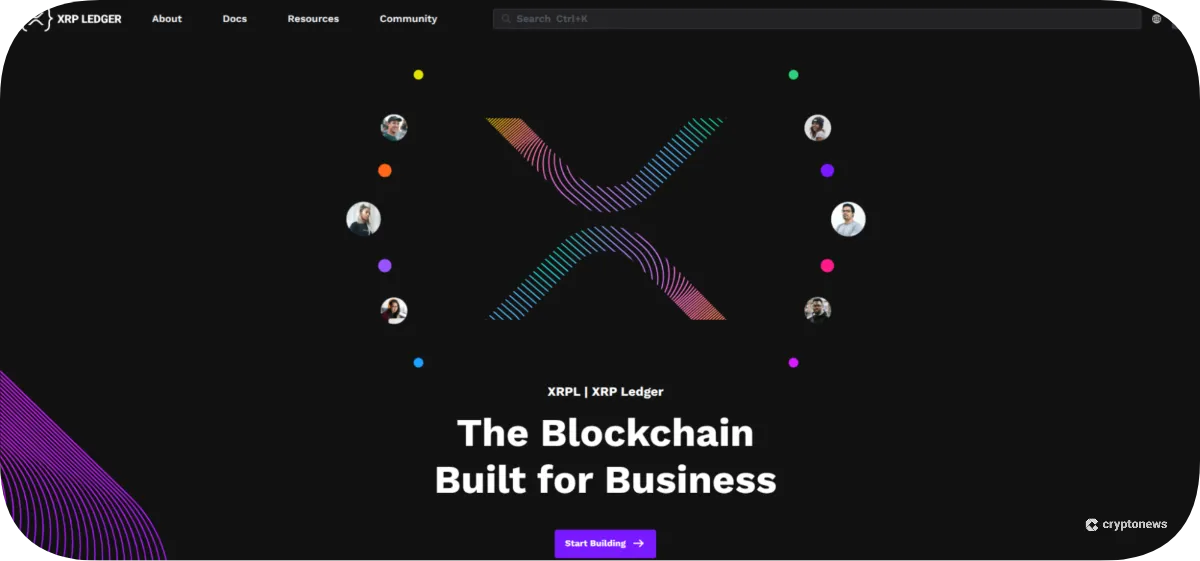
The XRP Ledger launched in 2012, introducing an alternative consensus mechanism to the then-prevalent Proof of Work (PoW). This allowed the XRP Ledger to focus on fast settlement and predictable transaction costs using a core of trusted validators (Unique Node List).
Although Ripple and XRP are often used interchangeably, Ripple is a company independent of XRP, which is an open-source project with several features not integrated with Ripple’s services, such as automated DEX trading and NFTs. While independent, having Ripple as a well-connected partner has helped bring attention and real-world use cases to the XRP network.
Ripple’s long-running legal battle with U.S. regulators over XRP’s disputed status as a security dominated blockchain news and business headlines for years. However, markets rallied around XRP at the conclusion of the suit in 2025, which resulted in a $50 million penalty for Ripple.
Meanwhile, the XRP Ledger has continued to evolve on its own. The protocol now supports automated market makers (AMMs) for decentralized swaps and non-fungible tokens (NFTs), with sidechain support on the roadmap. Although regulatory uncertainty caused XRP’s price to lag the broader market, the project has survived previous cycles and remains one of the crypto market’s most traded altcoins. Investors can easily buy XRP with deep liquidity on the most popular platforms.

Pros
- Fast, low-cost global payments
- Long track record dating back to 2012
- Strong corporate partnerships and real-world integrations
- High liquidity across major exchanges
Cons
- Centralization concerns due to the UNL validator model
- Ongoing regulatory noise despite partial clarity
- Price historically lags during alt seasons
- Ripple Labs’ focus has shifted from XRP to RLUSD
3. Hedera (HBAR)
- Launch Date: 2018
- Blockchain: Hedera
- Price: $0.080
- Market Cap: $4.02B
- 24H Price Change: HBAR +4.26%
Hedera entered the market in 2018, following the ICO boom, with a notably different structure compared to earlier blockchains. Instead of a typical PoS or PoW security model, Hedera uses a hashgraph consensus model designed for high throughput.
This fast network also launched with a governing council made up of global corporations, including Dell, IBM, and Google, as well as crypto names like Chainlink Labs.
The project has made steady progress over the years, and its real-world use cases include supply-chain tracking, tokenization, and compliance-heavy financial applications for institutions. Recent updates center on enterprise-grade stablecoin infrastructure.
The chain’s compelling value for institutional use cases gives Hedera the staying power to earn a place among the best dino coins. Our long-term Hedera price prediction shows what the future could have in store for this business-focused coin.

Pros
- High-throughput hashgraph consensus with fast finality
- Governance council made up of major global corporations
- Strong enterprise use cases (tokenization, compliance, stablecoins)
- Low and predictable transaction fees
Cons
- Governance is more centralized compared to typical blockchains
- Lower retail adoption compared to other chains
- Complex architecture can slow development
- Token unlock schedules create price pressure
4. Stellar (XLM)
- Launch Date: 2014
- Blockchain: Stellar
- Price: $0.19
- Market Cap: $9.79B
- 24H Price Change: XLM +2.23%
Jed McCaleb, one of the key co-founders of the XRP Ledger, later co-founded Stellar (XLM) in 2014. However, instead of working with big banks, the project focused on fast and inexpensive payments for real people.
The goal was simple: make sending money across borders feel as easy as sending an online message. Stellar’s payment-rail network runs on the Stellar Consensus Protocol, which finalizes transactions in a few seconds and relies on a more open trust setup than XRP.
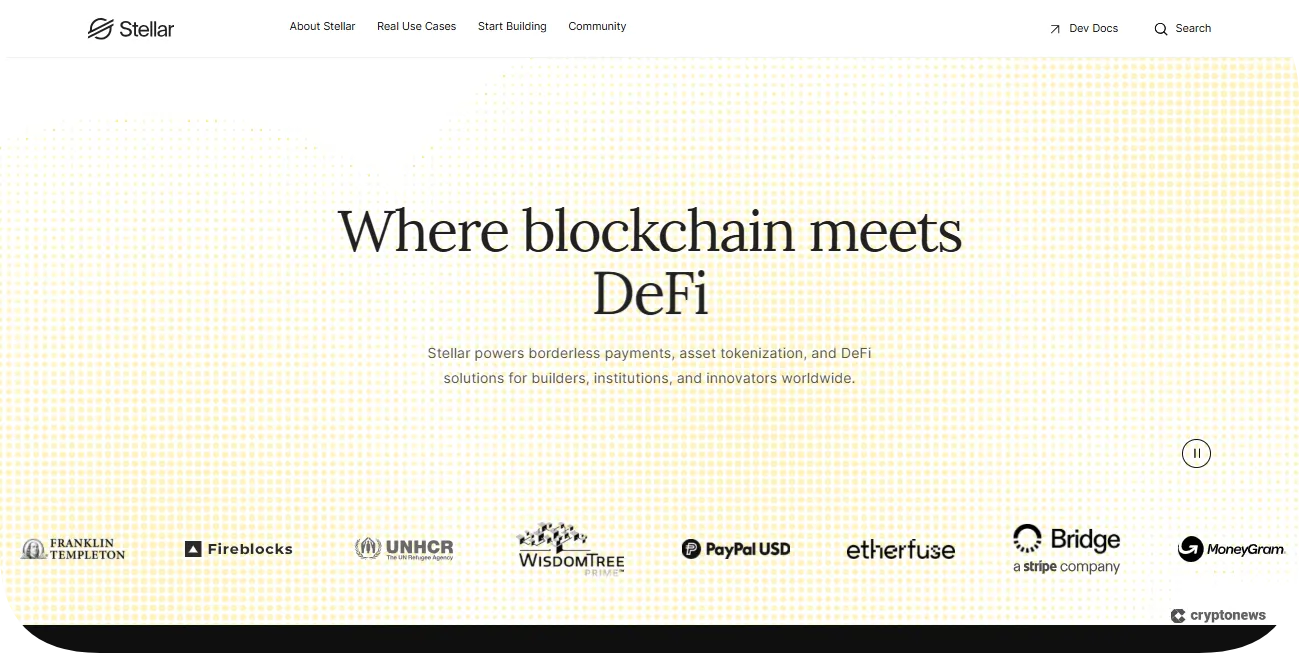
As the project grew, Stellar picked up partners like remittance apps and digital wallet providers to help people move money in the real world. The Stellar Development Foundation also helped bring USDC to the network, making payments smoother and improving liquidity on the Stellar network. More recently, the team has worked to strengthen its tools and streamline international transfers.
Stellar rarely grabs headlines, but remains true to its roots and continues to build through bull runs and market crashes. That kind of consistency makes it one of the crypto dinosaurs worth considering, while availability on leading exchanges makes it easy to buy Stellar safely.

Pros
- Long track record dating back to 2014
- Fast, low-cost cross-border payments
- Strong focus on real-world financial access and underserved markets
- Active nonprofit foundation guiding development
Cons
- Limited smart contract capabilities
- Slower adoption compared to newer chains
- Heavy competition in the payments space
- Less retail hype than similar dino projects
5. Algorand (ALGO)
- Launch Date: 2019
- Blockchain: Algorand
- Price: $0.092
- Market Cap: $782.53M
- 24H Price Change: ALGO +2.62%
Algorand launched in 2019, making it a bit late to the dino coin party. However, arriving late allowed the project to identify the challenges faced by earlier chains. Silvio Micali, an MIT professor and Turing Award winner, led the project with a simple goal: build a fast chain that remains affordable as usage increases.
The protocol uses a Pure Proof-of-Stake system that randomly selects validators for the next block, which helps keep things moving without the typical scaling bottlenecks seen on competing chains, such as Ethereum.

Algorand is now used in real-world payment projects. Circle chose the network as one of the official chains for USDC, and the European fintech firm Quantoz launched its regulated EURQ and USDQ stablecoins on Algorand as well.
Developers also like the chain because fees stay low, and the platform’s Ethereum Virtual Machine (EVM) compatibility makes building a breeze. Algorand isn’t the loudest dino coin in the herd, but taking its stability into account, our Algorand price prediction concludes that this dino coin could be worth a second look.

Pros
- Fast, low-cost transactions even during high network activity
- Pure proof-of-stake design
- Strong focus on real-world payments and regulated stablecoins
- EVM-compatible tools make building on the chain easier
Cons
- Network usage remains low compared to larger chains
- Limited mainstream awareness
- Ecosystem growth is slower than early expectations
- Competes directly with better-known L1s
6. Avalanche (AVAX)
- Launch Date: 2020
- Blockchain: Avalanche
- Price: $7.50
- Market Cap: $3.43B
- 24H Price Change: AVAX +1.51%
 AVAX
AVAX Avalanche launched in 2020, which makes it another relatively young project on our dino coins list. Led by Cornell professor Emin Gün Sirer and the team at Ava Labs, Avalanche set out to create a high-speed network built for modern use cases.
The chain addresses fundamental issues of balancing scaling and decentralization that older chains struggled with, and the resulting sub-second finalization makes Avalanche stand out even by today’s standards.
Avalanche also introduced the idea of multiple subnets, which are custom blockchains that allow developers to build specialized applications. The approach is similar in spirit to Polkadot’s parachains, although the two designs were developed independently.
Moreover, Avalanche’s innovative structure offered customization unavailable elsewhere at the time. Popular apps like Trader Joe and BENQI have been built on the network, and OpenSea later added support for Avalanche NFTs. Investors can buy Avalanche (AVAX) on major crypto exchanges.

Pros
- Sub-second transaction settlement
- Flexible architecture with customizable subnets
- Strong developer activity and ecosystem growth
- EVM compatibility eases onboarding for builders
Cons
- Complex subnet model can confuse new users
- High competition from other high-performance chains
- Network activity and fees can fluctuate during peak usage
- Shorter track record than other dino coins
7. Litecoin (LTC)
- Launch Date: 2011
- Blockchain: Litecoin
- Price: $52.38
- Market Cap: $4.06B
- 24H Price Change: LTC +1.18%
Litecoin’s 2011 launch brought a faster and less expensive alternative to Bitcoin. Litecoin has four times the supply of Bitcoin and the network also processes blocks four times as fast as Bitcoin (2.5 minutes versus Bitcoin’s 10-minute block time).
Additionally, Litecoin uses a different mining algorithm compared to Bitcoin (Scrypt), which makes mining more accessible with CPU or GPU mining. However, differences aside, the goals of the two projects remain similar, including decentralization and permissionless access.
The project’s similarities to Bitcoin effectively made Litecoin a testbed for new features that would later make their way to Bitcoin. SegWit, which improves transaction efficiency, went live on Litecoin before Bitcoin added the feature. The same was true for the Lightning Network for Litecoin, which enabled faster and cheaper payments by using dedicated payment channels.
More recently, merged mining with Dogecoin (a second cousin to Litecoin) increased hashrates and security for both chains. Wide availability makes it easy to buy Litecoin. Sometimes described as silver to Bitcoin’s gold, Litecoin has proven it has the staying power to earn a spot on our dino coins list.

Pros
- Longest-running Bitcoin alternative (launched 2011)
- Faster block times (2.5 minutes) and lower fees than Bitcoin
- Widely listed and easy to buy or trade
- Testbed for major upgrades like SegWit and Lightning
Cons
- Limited unique use cases compared to modern chains (payment focused)
- Slower growth during hype-driven market cycles
- Scrypt ASICs reduced its original “CPU-friendly” benefit
- Development pace is steady but not fast
8. Zcash (ZEC)
- Launch Date: 2016
- Blockchain: Zcash
- Price: $849.12
- Market Cap: $13.86B
- 24H Price Change:
Zcash launched in 2016 with a simple goal of making peer-to-peer transactions as private as cash, while allowing payments anywhere in the world. While simple in concept, the project uses advanced cryptography and complex zero-knowledge proofs (zk-SNARKs) to let users transact without exposing amounts or addresses on-chain.
Anyone can still choose transparent transactions, but shielded transfers remain Zcash’s signature feature and the main reason it stands apart in a crowded field of older proof-of-work coins.
The network’s early years weren’t without controversy. Higher computing requirements for generating zk-proofs limited adoption. The project’s “founders’ reward” also allocated a portion of Zcash’s block rewards to the development team and investors, but later development upgrades improved proof generation and shifted the reward structure.
The most important changes, such as Halo and Orchard, cut proof sizes, reduced hardware strain, and pushed the project toward a future without trusted setups. Through nearly a decade of trading through thick and thin, including multiple bear markets, Zcash has remained one of the most popular privacy coins, making it a natural fit for our dino coins list.

Pros
- Strong privacy using zk-SNARKs
- Option for public or private transactions
- Long history (2016) with proven staying power
- One of the most recognized privacy coins
Cons
- Privacy features are complex for some users
- Lower adoption compared to larger chains
- Regulatory pressure on privacy coins
- Founders’ reward remains a point of debate
- Mining remains specialized and less accessible
Where to Buy Dino Coins?
Many dino coins covered in this guide are large, established cryptocurrencies. That makes them easy to buy because they’re listed on nearly every major centralized exchange. Larger dino coins trade on Binance, Coinbase, Kraken, and similar platforms, although availability can vary by region. Leading exchanges typically offer the best liquidity and an easy sign-up process.
For buying dino meme coins in a non-custodial environment, you can consider a platform like the Best Wallet mobile app (iOS and Android). This mobile app supports decentralized exchanges (DEXs), giving you easier access to coins that don’t trade on major exchanges. Best Wallet’s self-custody also provides a safer alternative if you want to keep long-term holdings off of exchanges.
Dinosaur-Themed Crypto Coins
We have already covered one group of dino coins that includes a number of high-profile coins that have stood the test of time. But there is another collection of coins popularly referred to as dino coins. These are mostly light-hearted meme coins that play into the dinosaur theme in one way or another.
While often cute, playful, or humorous, some, but not all, dino coins of the second category tend to be no less serious tech-wise than their older brethren. They may be appealing to emotions or meme narratives, but many do this to better fit in with current cryptocurrency market trends, while some are also building noteworthy infrastructure in the background.
Let’s take a look at the dinosaur cryptos in the meme category.
1. Dinosol (DINO)
- Network: Solana
- Contract Address: 6wCYEZEBFQC7CHndo7p7KejyM4oGgi5E1Ya1e9eQpump
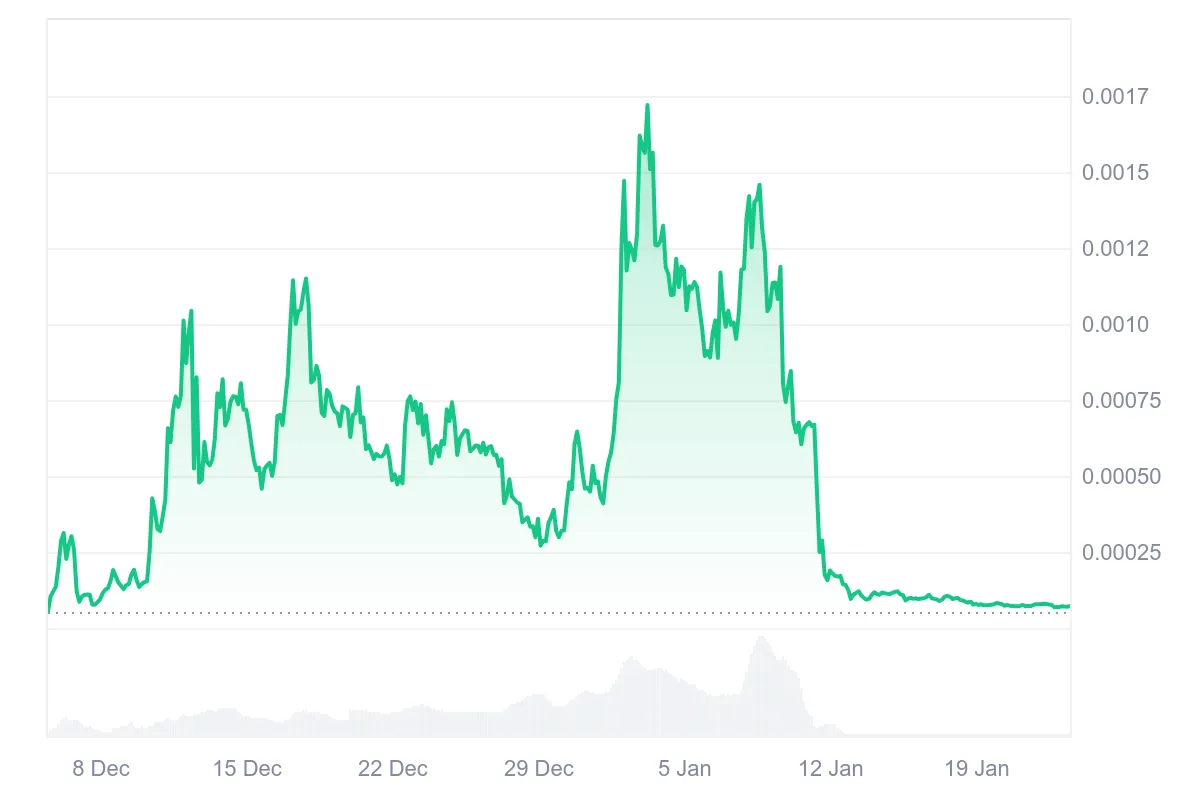
- Market Cap: ~$62K
- Liquidity Locked: No
Dinosol (DINO) is a Pump.fun meme coin themed around dinosaurs. According to the project’s description, it is the “most memetic dinosaur in existence.” It has a total supply of 1 billion, and the developer implements a buy-back-and-burn policy to limit its supply.
Pros
- It has a fair token allocation and launch.
- Implements a burn policy to drive value towards the token.
- Airdropped NFTs to top holders.
Cons
- Almost no meaningful activity
- Low market cap
- No ecosystem traction
2. Dinolfg (DINO)
- Network: Ethereum
- Contract Address: 0x49642110B712C1FD7261Bc074105E9E44676c68F
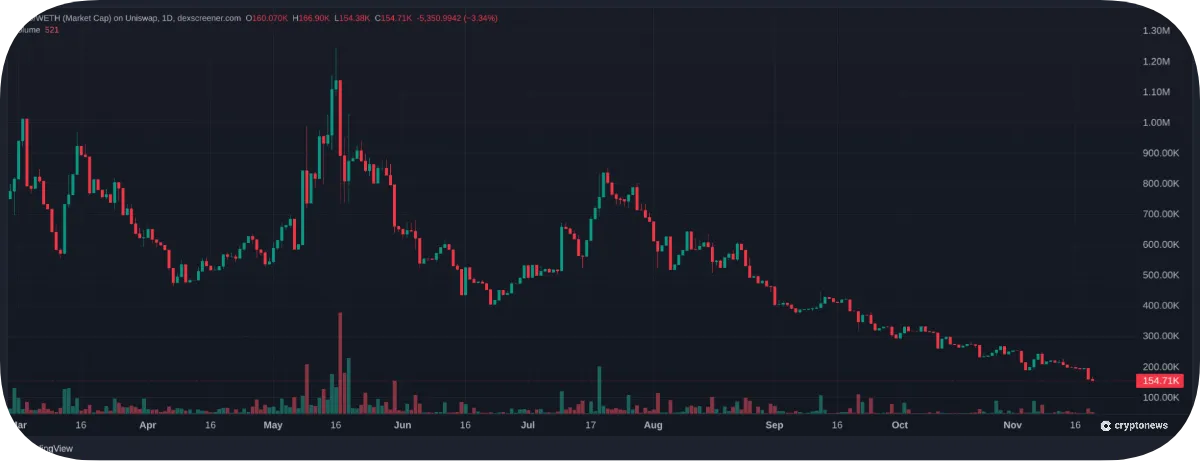
- Market Cap: ~$154K
- Liquidity Locked: Yes, expires on November 15, 2026
DinoLFG is a small-cap meme coin launched on Ethereum. Its dinosaur theme makes it a true dino coin, but like many micro-cap meme tokens, activity spikes during brief periods and fades quickly. There are no major utility features, and long-term prospects depend almost entirely on renewed community interest.
Pros
- Clear Dino meme theme appeals to dinosaur enthusiasts
- Occasional bursts of trading activity
- Time-locked liquidity
Cons
- Very low liquidity
- No utility or ecosystem presence
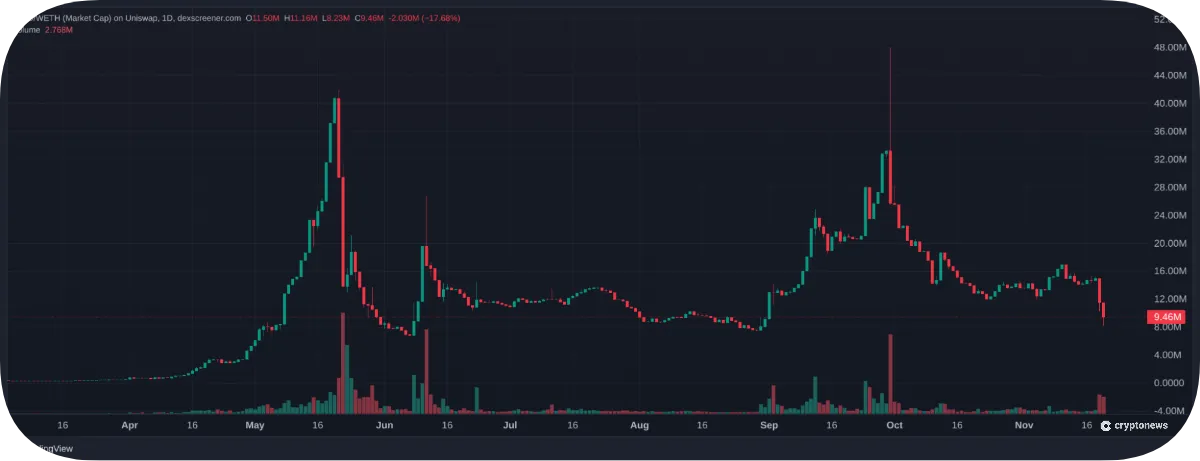
3. Coding Dino (DINO)
- Network: Base
- Contract Address: 0x85e90a5430af45776548adb82ee4cd9e33b08077
- Market Cap: ~$11.0 million
- Liquidity Locked: No
This Base network version of DINO is currently the most viable dinosaur-themed coin. It has a maximum supply of 20 billion and had a fair launch. Liquidity and trading volume are healthier than its dino-meme competitors, but the project still relies on community hype rather than fundamentals.
Pros
- Highest liquidity and market cap among dino memes
- Active community presence
- Strong meme branding
Cons
- Liquidity not locked
- No website
What is a Dino Coin?
Dino coins fall into two groups: legacy cryptocurrencies that helped define crypto and have survived at least two full market cycles, and newer coins that lean into dinosaur themes or branding. The former are projects that date back to the early days of crypto and still maintain active networks with real users. They also still trade on exchanges. The second relies more on culture and community than real-world use cases.

The “dinosaur crypto” term speaks to the tough-skinned nature of crypto’s hard-to-kill projects. Legacy dino coins show they can handle years of market swings without disappearing from the face of the earth.
For the legacy group, the baseline criteria follow a simple pattern, with a bit of flexibility on longevity. They typically also hold a market cap in the nine-figure range and show consistent trading volume. But age alone isn’t enough: utility, adoption, and real liquidity set meaningful legacy coins apart from the estimated more than half of all cryptocurrencies that die.
For a more in-depth analysis of what makes a dino coin, see our article “What are Dino Coins.”
Why Are Investors Interested in Dino Coins Now?
Interest in dino coins is picking up again, and it isn’t just nostalgia pushing the charts higher. The crypto market is often overrun with new protocols, AI narratives with questionable fundamentals, and pump-and-dump meme coins. Simply put, investors grow tired of losing money on hyped projects.
By comparison, older projects with long histories look like seasoned rock stars. They’ve been through multiple market cycles, they still have active users, and they haven’t vanished during crypto’s ugly bear markets. These are the battle-scarred survivors that always stand up one more time.
As for dinosaur-themed meme coins, some investors look for alternatives to dominant narratives to diversify. Regardless of the type of dino coin, here are a few reasons why investors show interest in them.
💪 Resilience
Legacy dino coins have stood the test of time and survived several boom and bust cycles. This makes them more resistant to “bust” phases than newer tokens.
🏛️ Liquidity and Institutional Access
The larger dino coins often trade on major exchanges. This gives them deeper liquidity and aceess to retail and institutional investors, especially through structured financial products like ETPs and DATs.
🌐 Nostalgia, Community, and Branding
For the theme-based dino coins, the draw is different. Communities built around these coins lean into the playful vibe, even if the fundamentals aren’t the main story. Legacy dino coins also share the community aspect, but without utility, these communities would likely disappear.
📊 Diversification
With the market’s attention splintering off toward experimental protocols, chains with big promises but no usage, and endless new token launches, dino coins can serve as a counterweight for better crypto portfolio diversification.
They aren’t risk-free, but they bring a different profile to a portfolio. Legacy coins are slower-moving, better-known, and usually supported by established user bases. Dino memes are fun, and their volatility brings trading opportunities.
What Are the Risks of Dinosaur Crypto Coins?
Dino coins combine nostalgia and staying power and real utility, but they come with real risks to weigh before you open your wallet to invest.
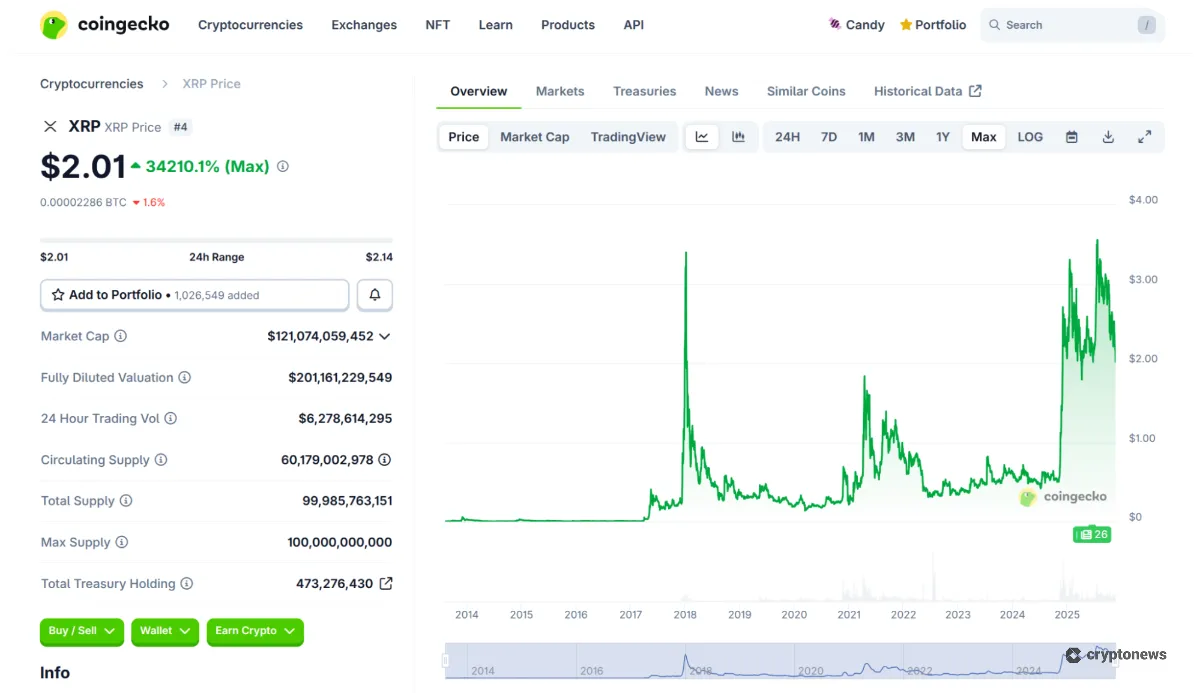
- Market Risk: Even the strongest projects can take a beating when the market gets jittery. XRP’s multi-year slide from 2017 to 2020 (and 95% loss) demonstrated that with charts painted in deep red.
- Innovation Risk: Legacy chains have another problem too: fast-moving new protocols that roll out fresh tech and siphon off users, leaving many coins fighting to keep a share. Think of it as a capital drain that also collapses usage.
- Meme-Branding Risk: Theme-based dino coins bring their own set of problems. If the community loses interest, the coin’s value can drop in a flash. Remember, there is no utility here, just community vibes.
- Liquidity/Trading Risk: Lower-volume dino coins, whether legacy or meme, can become difficult to sell during peak volatility. Additionally, meme coins usually draw from one liquidity pool, making rug pulls a concern and amplifying volatility with every trade.
- Timing and Portfolio Risk: Buying into a dino coin during heavy hype leaves less room for upside. And like any crypto investment, over-allocating to one project or category can tilt a portfolio out of balance.
- Regulatory/Technological Risk: Like any crypto investment, dino coins require careful sizing allocations and realistic expectations.
Dyor: What to Consider Before Buying a Dino Coin
We can’t offer you financial or investment advice, so it’s time to roll up your sleeves for some crypto DYOR (do your own research). Buying a dino coin, whether a legacy coin or meme coin, means checking under the hood to see if there’s a running engine before you buy.
Top things to consider include the market cap and trading volume, both of which are relevant for legacy coins and dino memes. After that, your research will vary depending on which type of coins you’re considering.
For legacy coins, you’ll want to consider utility, usage, and protocol upgrades. For memes, focus on the community and brand strength.
Let’s explore each of these considerations in more detail and discuss how to find the information you’ll need.
Market Capitalization and Trading Volume
Market cap and trading volume speak to the health of any dino coin. Market cap shows size, whereas volume indicates whether people are actually trading it.
Without liquidity (a willing trading market), even the strongest-looking project can experience bigger price moves on relatively small trades.
What to look for:
- On CoinGecko or a similar trusted data site, check Market Cap and 24h Volume.
- Look at the Volume/Market Cap ratio. Higher is healthier, but you may need to calculate this manually.
- Review volume across multiple exchanges, not just one small listing.
- Check the volume chart to see if trading activity is growing or fading.
- Context matters. Weigh your findings against the overall crypto market.
Utility and Adoption
The next questions to answer are what the coin does (usage) and whether anyone is using it (adoption). However, utility alone isn’t enough. With legacy coins, utility is a given, but if only a handful of users are on the network, it’s less meaningful. A healthy project should show signs of activity, such as transactions, wallet growth, or integrations.
What to look for:
- Use a block explorer or a crypto data site like Messari to check daily transactions and active wallet addresses.
- Look for recent integrations, merchant activity, or ecosystem tools that still support the project.
- Search GitHub or the project’s development page to see if the codebase is being maintained. Also, check the discussion boards. What types of protocol improvements are in the pipeline?
- Compare current network usage levels over time to spot trends; direction matters as much as the raw numbers. Utility coins should show steady or rising usage.
Community and Brand Strength
For meme dino coins, the community is everything. Even if the project has no utility whatsoever, an active community helps keep the coin in the spotlight. For legacy coins, community strength still matters because it signals long-term interest and helps support liquidity. When the community goes quiet, the price usually follows.
What to look for:
- Check the project page and related discussions on social media platforms like X, Reddit, Telegram, and Discord. Look for real engagement and get a sense for the conviction holders have.
- Check Google Trends (search interest). Is interest rising, falling, or holding steady?
- Observe how the crypto community reacts to news or market moves. Fast and consistent engagement is usually a healthy sign. Crickets indicate that the community isn’t all that interested.
- Check for ongoing branding efforts, such as collaborations, events, or content creation from the community. Active branding shows the project still has momentum.
Innovation and Protocol Upgrades
Legacy dino coins need ongoing development to stay relevant (and secure). GitHub updates and governance discussions show that someone is still maintaining the network. However, meme dino meme coins are a different sort of beast altogether. To stay relevant, meme projects need viral memes, community engagement tools, or project-adjacent tools (staking, NFTs) that keep the project exciting.
What to look for:
- Visit GitHub or the project’s website to check for recent updates or maintenance activity. Even small updates matter for older chains.
- Read the project’s roadmap or update posts to see what the team is planning. Is anything new in progress or recently completed?
- Look for protocol upgrades, wallet releases, network security patches, or planned performance improvements.
- For meme-focused dino coins, check the social channels for new branding memes, collaborations, or even smart contracts to support the meme. Stagnant branding is usually a warning sign.
How to Incorporate Dino Coins Into Your Crypto Portfolio
Working dino coins into a portfolio requires knowing the role each coin plays. Some belong in the “core” bucket alongside coins like BTC and ETH. Others fit better as medium-term holds, where you have a bit more risk but still enough history to make a reasonable case for holding.
Then there are the more speculative dino memes. They can be fun and sometimes profitable, but they can also eat your portfolio gains.
It helps to sketch out a rough allocation range before you buy anything. Set percentages for each category so you don’t drift too far toward one type of coin.
Some people prefer a small allocation for speculative assets (~1%) and a larger one for legacy alts (~10% – 20%). Timing also matters. Give shorter durations for speculative assets to perform (e.g., 1-3 months) and longer times for legacy assets (~ one year).
Dino coins can move fast when hype hits, so it’s often better to build your position when the market is distracted by shiny things. That said, you also need an exit plan. Plan how much you want to sell at which price targets.
Consider occasional rebalances to manage your exposure. A semi-annual or annual review usually works for long-term holdings, but dino meme coins require more frequent evaluations.
Last, but not least, always put safety first. Use trusted exchanges and always move long-term holdings into a non-custodial or cold wallet that only you control.
Outlook: Will Dino Crypto Coins Continue to Perform?
Let’s start by addressing the simplest question: Will Dino-themed coins continue to perform? Dino-themed coins are tantamount to meme coins, which have historically short-lived lifecycles.
So, while dino-themed meme coins as a broad category may last, each dino meme coin is subject to similar attention cycles as typical meme coins. This means that they may experience initial hype after launch, but interest often fades after an extended period of time. Those that are successful may still be subject to the phases of a meme coin supercycle, which tends to ebb and flow.
Dino coins, on the other hand, while described as early-generation cryptocurrency projects, are an arbitrary categorization. Some may or may not perform; however, this is orthogonal to their classification as “dino coins.” In other words, their performance or underperformance is independent of them being a dino coin.

Final Thoughts on Buying Dino Coins
Dino coins bring together two very different sides of the crypto market. Proven projects like XRP, LTC, and ZEC earned their dinosaur status by offering real utility and steady development over multiple market cycles. The projects with the longest shelf life tend to deliver real-world utility that offers measurable value.
On the other hand, dino-themed meme coins are fun, but most memes don’t work as long-term investments. While they can quickly jump in price during viral spikes, they’re extremely speculative, and their communities can disappear over time.
Whether you’re looking for decade-old coins with a proven track record or a high-potential meme opportunity, our list should help you make an informed decision. But remember, a disciplined approach to choosing your portfolio helps separate investment-worthy dino projects from those slowly sliding toward extinction.
FAQs
Can dinosaur crypto coins still grow?
How do I pick a crypto dinosaur coin?
Are dino coins less risky than newer altcoins?
Can I buy all the top dino coins in one place?
Are meme dinosaur coins better than legacy ones?
When is the best time to buy a dino coin?
References
- Goguen – Cardano Roadmap (roadmap.cardano.org)
- XRPL AMM Ledger Entry Types (xrpl.org)
- Hedera Governing Council (hederacouncil.org)
- Stellar + Circle: USDC & EURC (stellar.org)
- Algorand Pure Proof-of-Stake (algorand.co)
- Quantoz: Regulated EURQ & USDQ Stablecoins on Algorand (quantoz.com)
- Avalanche Subnets Overview (avax.network)
- Litecoin and the Lightning Network (litecoin.com)
- Zcash: Shielded vs. Transparent Transactions (z.cash)
- Crypto Failure Rates: 50%+ Dead Coins (coingecko.com)
- Nine More XRP ETFs Launch (finance.yahoo.com)
- Altcoin Season Index Chart (coinmarketcap.com)
2M+
250+
8
70




 in numbers

About Cryptonews
Our goal is to offer a comprehensive and objective perspective on the cryptocurrency market, enabling our readers to make informed decisions in this ever-changing landscape.
Our editorial team of more than 70 crypto professionals works to maintain the highest standards of journalism and ethics. We follow strict editorial guidelines to ensure the integrity and credibility of our content.
Whether you’re looking for breaking news, expert opinions, or market insights, Cryptonews has been your go-to destination for everything cryptocurrency since 2017.
