

What Is Leverage Trading in Crypto? And How to Get Started
We believe in full transparency with our readers. Some of our content includes affiliate links, and we may earn a commission through these partnerships. However, this potential compensation never influences our analysis, opinions, or reviews. Our editorial content is created independently of our marketing partnerships, and our ratings are based solely on our established evaluation criteria. Read More





Leverage trading in crypto refers to using collateral to power larger trades. Using leverage has become one of the most popular ways to trade crypto, with leveraged futures markets far outpacing spot trading volume on many exchanges – and with good reason. The strategy provides better capital efficiency and the potential for outsized gains.
However, leverage works both ways, and like the see-saw rides of youth, sky-high gains can come crashing down quickly. This makes it essential to use appropriate amounts of leverage, enter well-reasoned positions, and plan exit strategies that allow a graceful landing.
In this guide, we’ll explain how leverage works in crypto trading, discuss its advantages and disadvantages, and also walk through an example trade. Let’s start with some key terms related to crypto leverage trading.
What Is Leverage Trading in Crypto?
Leverage trading in crypto refers to using margin (collateral) to make larger trades. For example, if you have $100 available for a trade, you can only fund a $100 trade on the spot market without using leverage. By contrast, with 10x leverage, you can make a $1,000 trade. Additionally, when using margin, you can trade long or short positions, meaning you can bet on an increase or decrease in value.
In its simplest form, leverage trading uses margin to make relatively low-leverage spot market trades. In effect, it’s a spot trade with a loan attached. The exchange charges interest on the money you borrow to fund the trade and typically limits leverage to 2x to 5x, with some platforms going as high as 10x.
Crypto futures trading, specifically perpetual futures, offer several advantages over traditional spot margin trades by offering higher leverage and extremely liquid markets that allow efficient trading. In many cases, you can use up to 100x leverage on leading assets like Bitcoin and Ethereum, with other alcoins offering 25x to 50x leverage.
Crypto Leverage Trading Terms Explained
Leverage trading comes with its own vocabulary, and understanding the meaning of key terms makes the topic much easier to grasp. Let’s get started with some of the most essential terms.
- Leverage: Crypto leverage refers to using collateral to control larger trades. For example, with 10x leverage, you can make a $1,000 trade using $100 of collateral.
- Margin: In leveraged trades, margin refers to the collateral used to back the trade. In the next section, we’ll discuss types of margin and how margin applies in trades.
- Leverage Ratio: A leverage ratio is a multiplier used in leveraged trades. You’ll see this expressed as a number, such as 5x, 10x, 25x, or 100x. A 1x leverage ratio indicates no leverage is being used in the trade.
- Risk per Trade: Usually expressed as a percentage, risk per trade refers to the percentage of your crypto portfolio that you put at risk in a given trade. A conservative rule of thumb is to invest no more than 1% of your trading capital in a single trade.
- Liquidation: Leverage trading uses collateral, and if the market moves against your trade enough, the trading platform can close your position, selling the assets. This is called liquidation.
- Funding fees: Perpetual futures trades use a funding fee to keep the contract price close to the market price. For example, if the contract is too heavy on longs, pushing up the price, longs pay a fee to the shorts. This mechanism encourages traders on the overweighted side of the trade to close their positions or even open an opposing position.
How Does Crypto Leverage Trading Work?
Leverage trading in crypto takes three primary forms: spot margin, futures, and perpetual futures. We’ll discuss leveraged futures vs margin trading in a later section. First, let’s look at how perpetual futures work, as they are the most common trading tool in leverage markets. Then, we’ll compare against traditional (expiration futures).
Futures are a derivative, meaning that you’re not trading the actual underlying asset. Instead, you’re trading a contract that centers on the price of the asset. In the case of perpetual futures, also called perps or perpetual swaps, this contract does not have an expiration date. Traders can keep the trade open indefinitely, assuming there is enough margin to back the trade.
To make a perpetual futures trade, you need to choose the type of margin you want to use. Some platforms offer USDT-margined futures, and a subsection of these offer coin-margined futures. The margin in the trade, whether it’s USDT in USDT-margined trades or, for example, Bitcoin in coin-margined futures, becomes the collateral for the trade.
Perpetual Futures Trading: Example
Let’s say you think Bitcoin will go up. In this case, you would open a long perpetual futures trade and select a leverage ratio, such as 10x. At 10x, you can use $100 in margin to open a $1,000 BTC long position.
The $100 margin committed to the trade is called initial margin. However, trading platforms also use a maintenance margin requirement, which is often 50% of the initial margin, or $50. This buffer allows the market to move against the trade, within limits.
If the price of Bitcoin increases 5%, you would earn $50 on this trade, less trading fees (and funding fees, if applicable). That’s a 50% return on investment.
However, if Bitcoin’s price falls by more than 5%, the position would be at risk of liquidation because the equity in the trade falls below the maintenance margin requirement. In brokerage trading, this would trigger a margin call, which is a request for more collateral. In futures trading, the exchange simply liquidates the position, with many platforms charging a liquidation fee.
At the end of this losing trade example, you would only receive a portion of the initial margin, or perhaps nothing if there was no equity left in the trade after liquidation and fees.
Another factor centers on funding fees, which can be a positive or negative for your trade equity. If the trade is heavy on shorts, the shorts pay a funding fee to the longs, and vice versa. Funding fees vary based on the imbalance of the trade and can either increase or decrease your available margin in the trade.
Perpetual Futures vs. Expiration Futures
Both perps and traditional expiration futures offer high leverage, but they have two distinct differences. Traditional futures contracts have an expiration date, typically quarterly. They also do not use a funding fee to balance the trade. Instead, the contract price converges with the market price as the contract nears expiration.
Leverage Trading vs. Margin Trading
While the term margin is relevant to all three types of leverage trading we’ve discussed so far, the term margin trading typically refers to spot margin trading. In spot margin trades, you put a percentage of the trade as collateral, and the exchange lends you the balance needed for the trade. Rather than paying a funding fee, you pay interest on the balance.
Unlike simple spot trades in which $100 can buy $100 worth of crypto, margin trades allow leverage of up to 10x, depending on the platform. This means $100 can power a $1,000 trade. The exchange charges interest on the $900 you borrow for the trade.
Similar to perpetual futures trades, you can trade long or short positions, and the trade requires a minimum amount of maintenance margin, typically 50% of the initial margin. Much like futures trades, the exchange can liquidate your position if the margin value falls below the minimum level.
Spot margin trading has fewer moving parts than futures trades, but available leverage is often much lower, and relatively few platforms offer this type of trade. By comparison, perpetual futures have become ubiquitous in crypto trading.
How to Trade Crypto With Leverage: Step-by-Step Guide
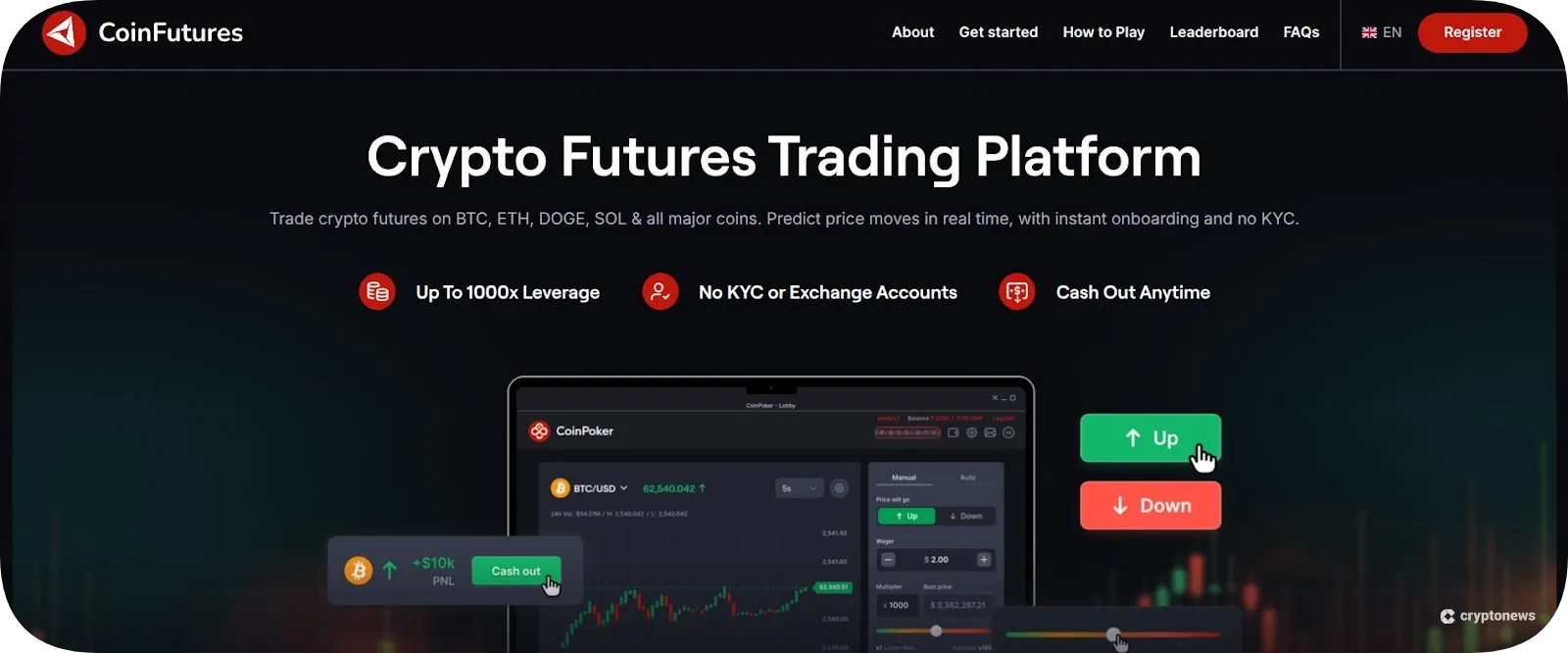
As an example, we’ll walk through the basic steps to trade crypto with leverage using one of the easiest platforms: CoinFutures. CoinFutures allows up to 1000x leverage, but offers a much safer 10x multiplier as a default. The platform does not require Know Your Customer (KYC) identity verification and simplifies the overall trading experience.
1) Set Up a CoinFutures Account
Visit CoinFutures to create an account and download the app (Windows, macOS, Android APK). Provide an email address, choose a username, and choose a secure password. CoinFutures uses your email address to confirm the account.
2) Fund Your Trading Account
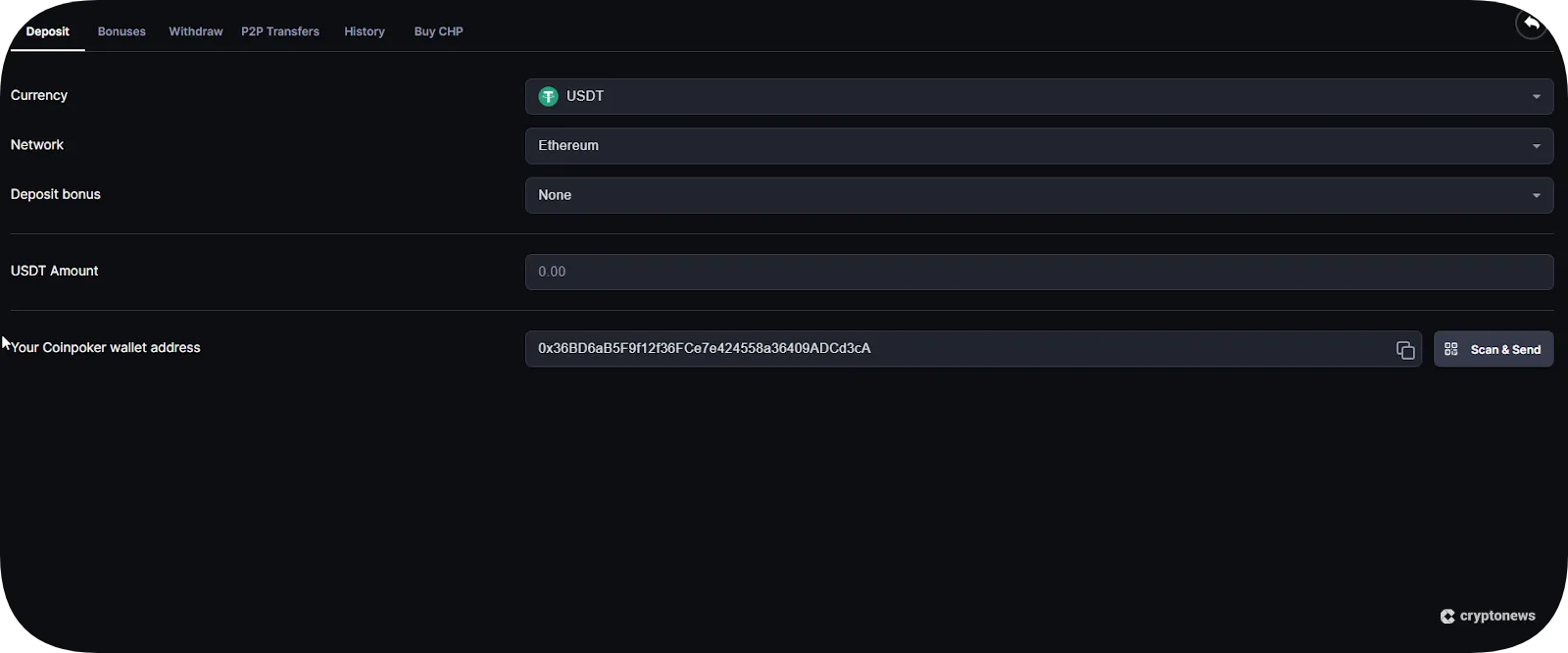
Once the app is installed, click on the wallet icon. CoinFutures supports deposits on several leading networks, including Ethereum, BNB Smart Chain, Bitcoin, Solana, and more. If you don’t have crypto that you can transfer to the wallet, you’ll need to buy crypto on a crypto exchange or through a crypto wallet app.
3) Select a Cryptocurrency
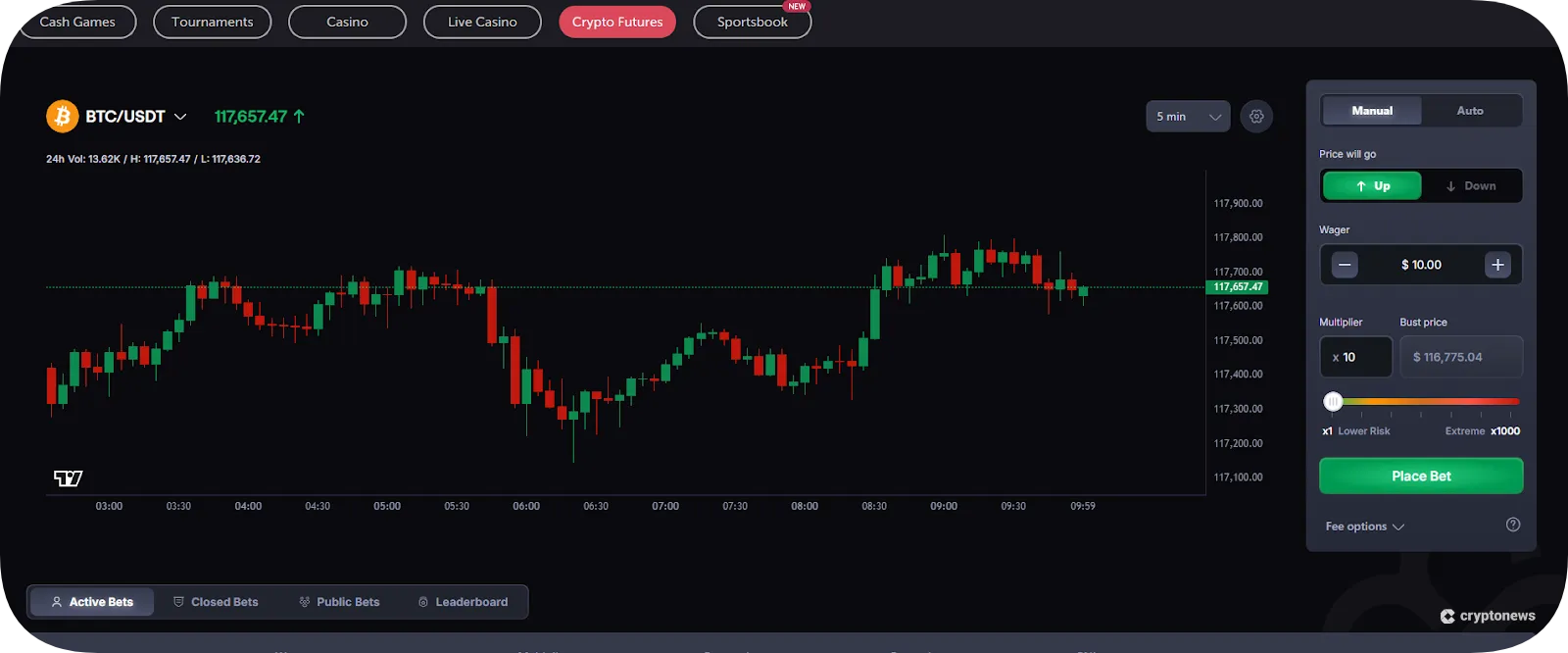
Navigate to Crypto Futures and choose the cryptocurrency you want to trade. In this example, we’ll use BTC.
4) Set Up Your Trade
The default settings use a $10 wager with a 10x multiplier. CoinFutures simplifies the trading experience. The wager is your investment in the trade, and the multiplier provides leverage. In this example, we’re controlling a $100 trade with $10.
Select a direction for the price. We’ll use UP in this example, because we think BTC will increase in price.
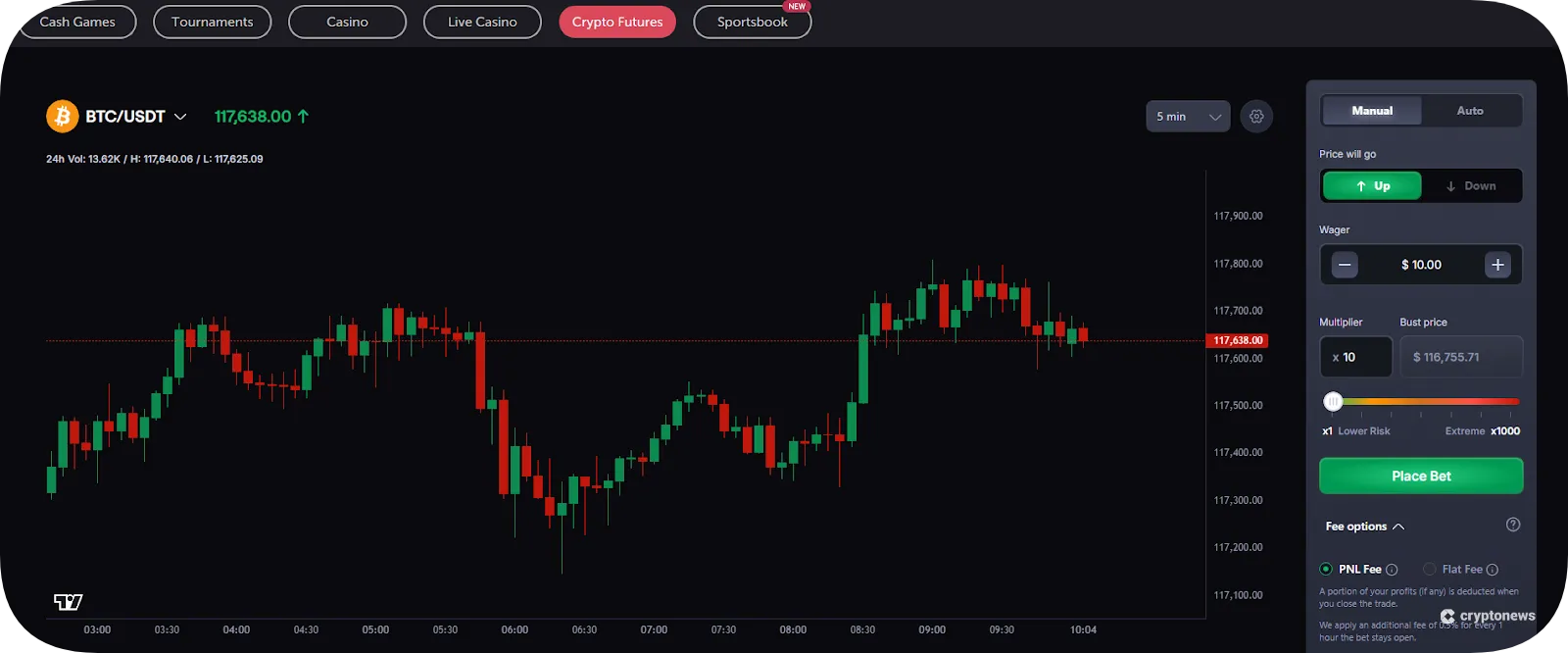
CoinFutures also lets you choose your trading fee structure. By default, the platform uses PNL, meaning you only pay a fee on profitable trades.
Take note of the Bust Price. If the price of the asset you’re trading reaches the Bust Price, you lose the investment in the trade. Adjusting the multiplier affects the Bust Price. A lower multiplier is less risky.
5) Choose Optional Auto Settings
Click on Auto to set advanced trade options. Here, you can select a price at which to take profit automatically and a price at which to close the position if it’s losing money.
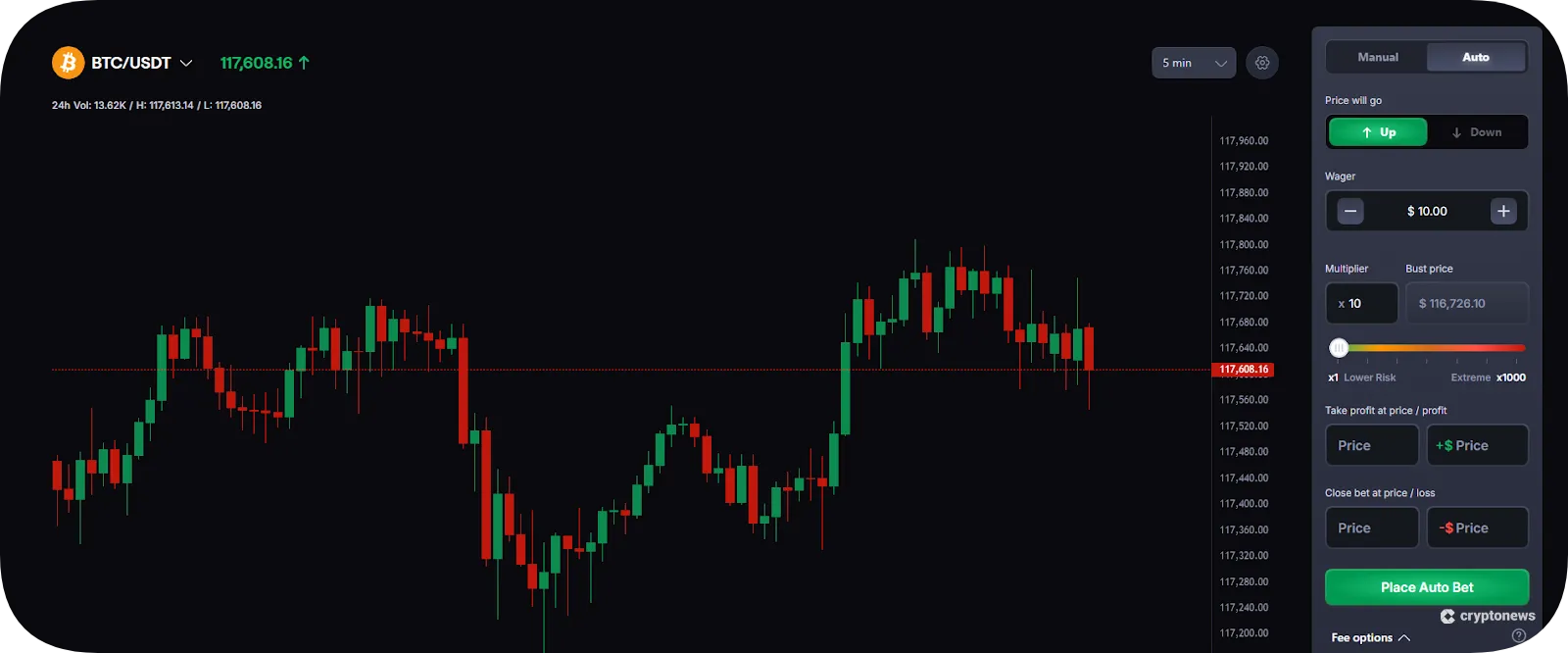
Double-check your trade settings and place your bet if everything looks correct. CoinFutures does not use a funding fee. Instead, the platform charges a 0.5% fee for every hour the trade stays open.
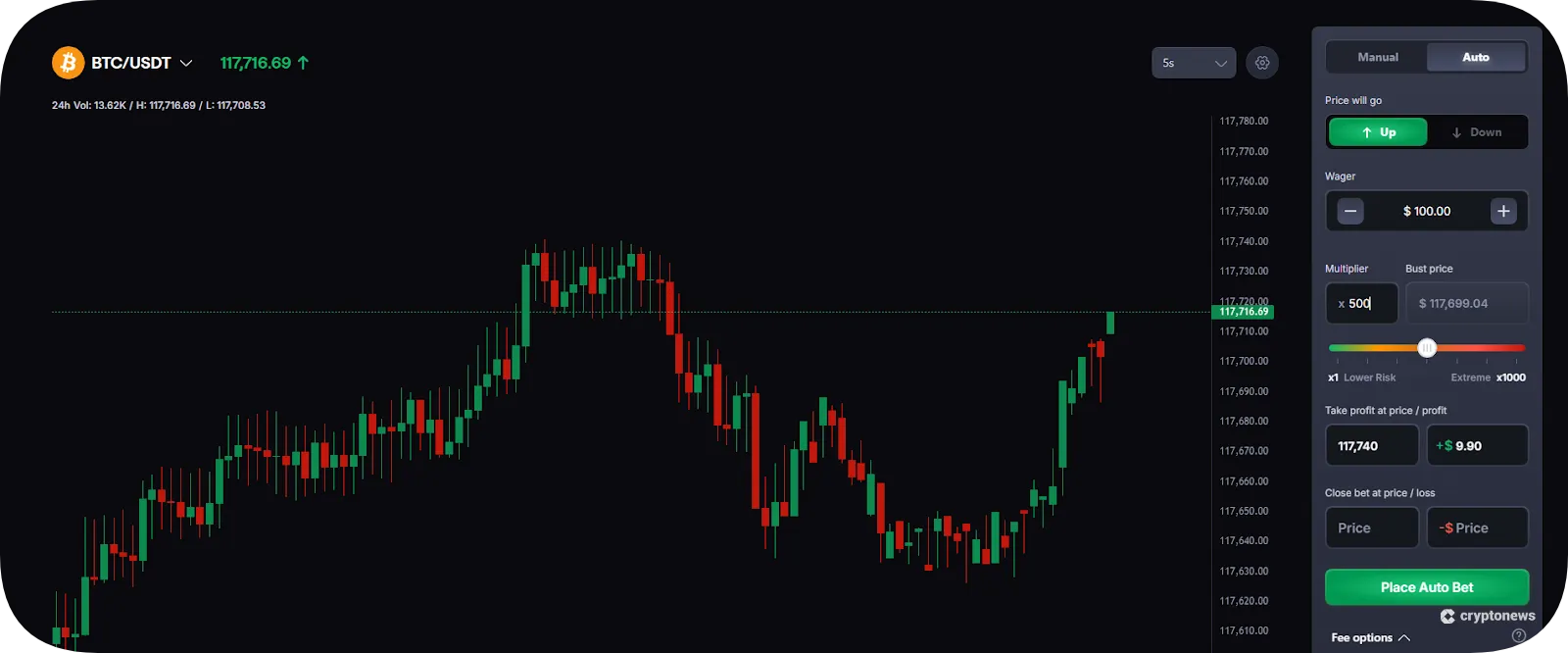
We built a $100 high-leverage trade (500x). This trade closed at the top of the short-term BTC chart ($117,740), with a gross profit of $9.90. Total trade time: ~30 seconds.
Best Platforms for Crypto Leverage Trading
The popularity of leverage trading in crypto means you’ll have a wide range of trading platforms to choose from, ranging from simplified trading platforms like CoinFutures and Margex to full-featured exchanges, such as MEXC and OKX. Full-featured exchanges offer a wider range of trading tools as well as vibrant spot trading markets. However, for a quick trade, a simpler platform often provides a more direct way to profit from the crypto market’s volatility.
Let’s review some of the best crypto leverage trading platforms and what they offer.
- CoinFutures: The CoinFutures app gamifies crypto trading by providing a simple interface and multipliers (up to 1000x) to maximize winnings. Under the hood, futures trading on the app follows a similar structure to what you’d find on other platforms, but more complicated aspects like funding fees are replaced by a flat fee charged once per hour. The platform is designed for ease of use and quick profits.
- MEXC: The MEXC exchange offers a full range of trading tools and one of the largest selections of cryptocurrencies anywhere, with an estimated 3,000+ crypto assets available for spot trading. Futures pairs feature a growing list that includes today’s top trading pairs and a wide range of altcoins. The platform now offers up to 500x leverage on select pairs and a demo account to help users learn the platform or test strategies.
- Margex: The popular Margex trading platform specializes in futures trading, offering a well-designed and easy-to-use interface and leverage ranging from 25x up to 100x, depending on the trading pair. The platform integrates liquidity from more than a dozen liquidity providers to ensure efficient trades.
- OKX: The OKX exchange provides a large selection of perpetual futures pairs as well as delivery futures (Bitcoin and Ethereum only). OKX also offers a wide range of futures trading bots to automate profits from daily volatility, including AI-powered bots that can optimize strategies.
Some platforms, such as BlockchainFX, support leverage trading for a wide range of assets beyond crypto, including stocks, exchange-traded funds, foreign exchange pairs, and commodities.
Types of Leverage Trading In Crypto
We’ve discussed margin as a broad topic, but many platforms offer two ways to use margin: isolated margin and cross margin.
- Isolated-margin uses one defined asset as collateral for the leveraged trade. For example, in a USDT-margined trade with isolated margin, the USDT committed to the trade is the only collateral.
- Cross-margin uses your entire exchange balance as collateral for all your open positions. In this case, you’re giving the exchange permission to close other positions if needed to keep the leveraged trade open.
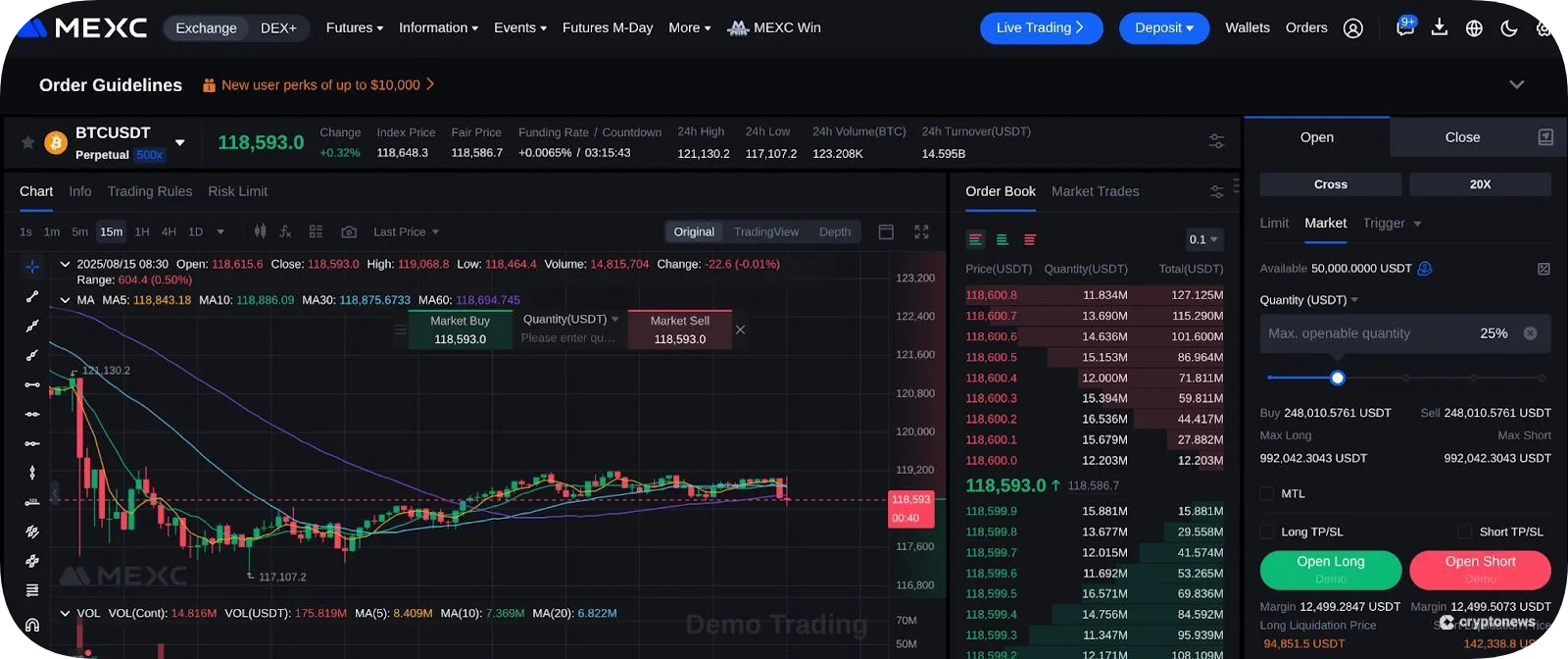
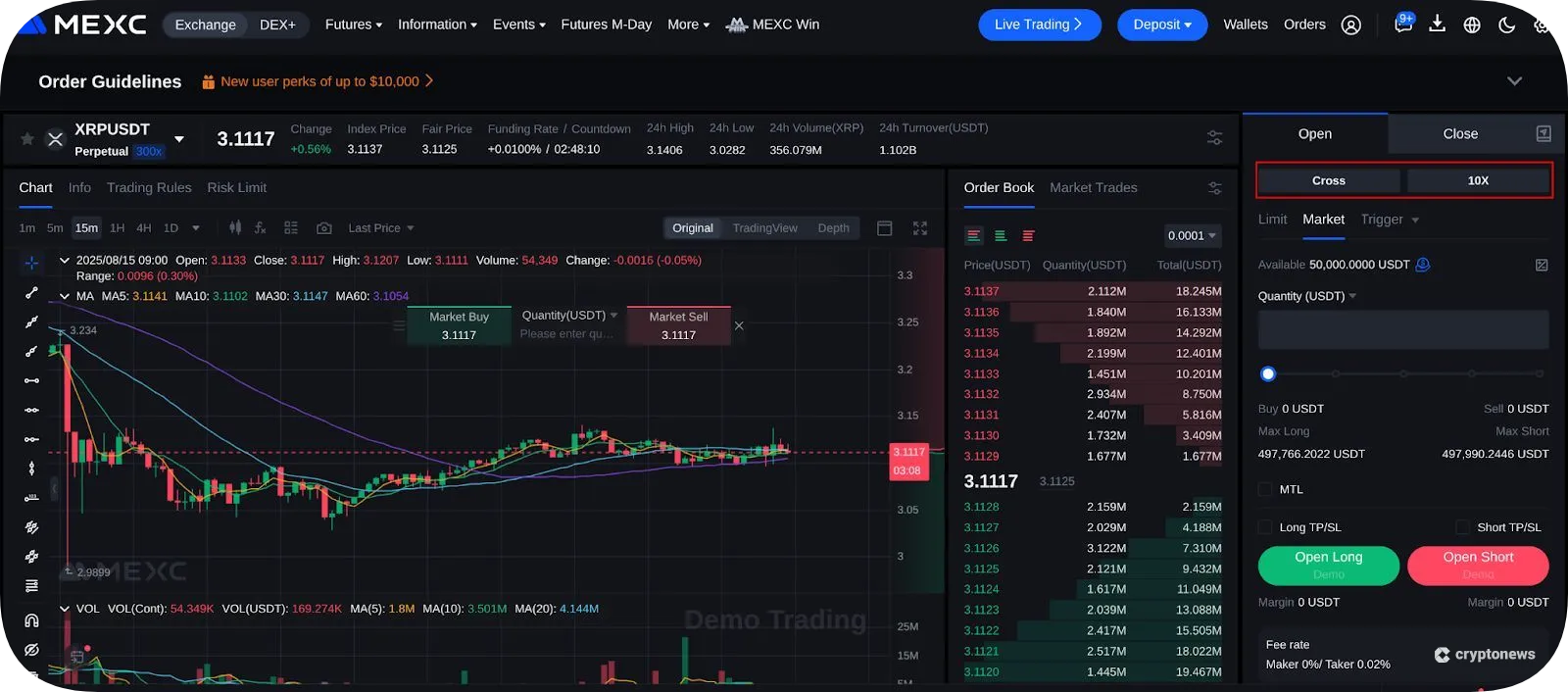
Pay careful attention to the default settings on each platform. For example, MEXC defaulted to cross-margin in the example below. You may or may not want to put other positions at risk for a single trade.
Perpetual futures remain the most common way to trade on many leading exchanges, but these leveraged tools have found their way into automated tools such as trading bots.
Platforms like OKX and MEXC provide automated trading using futures to build a portfolio quickly. However, because these tools use leverage, they can amplify both gains and losses. Consider starting with a smaller amount of money to fund trading bots until you can see how it performs with any customizations you make to the settings.
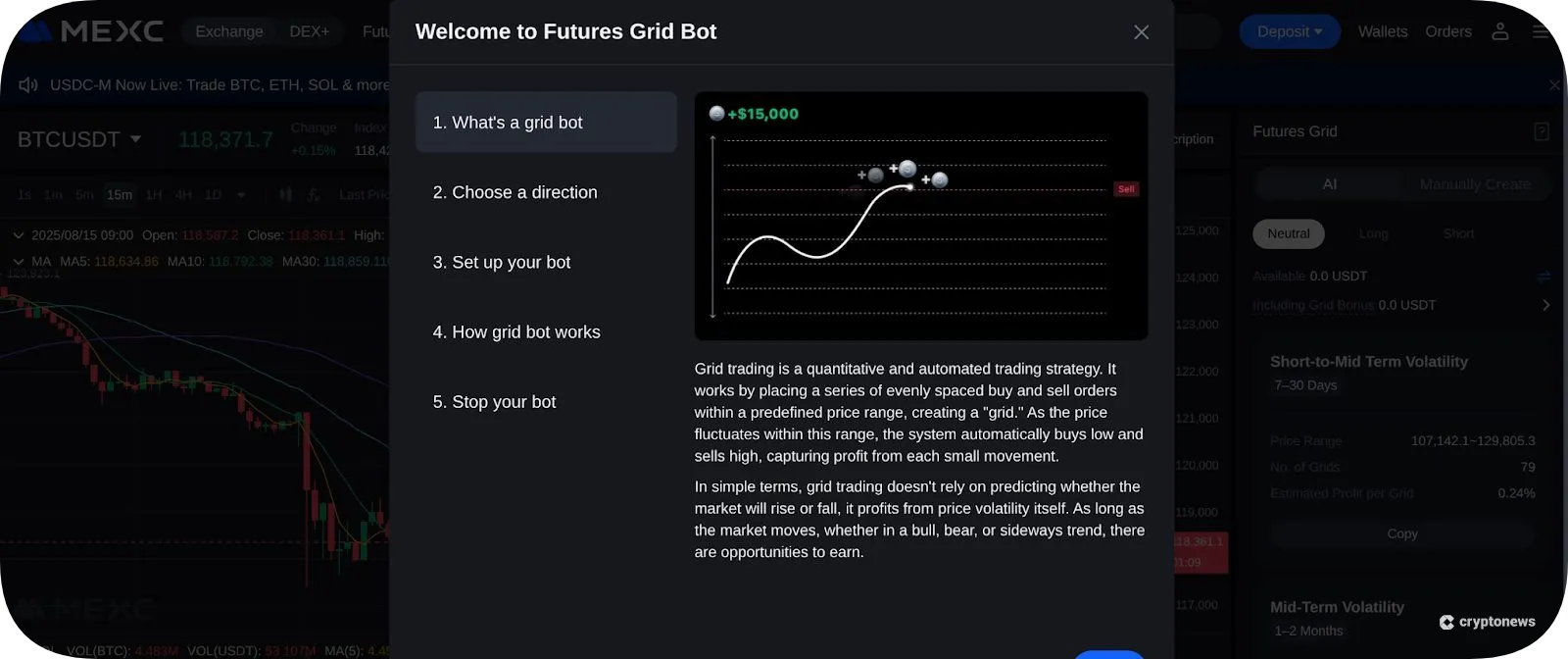
Some trading platforms also offer leveraged tokens, usually capped at 3x, with short or long tokens available for leading cryptocurrencies. These tokens make it easy to enter or exit positions while increasing gains through automated leverage.
Advantages of Leverage Trading in Crypto
Crypto leverage trading comes with both pros and cons. Advantages compared to spot trading include a lower capital requirement and the ability to trade the market in either direction. Let’s explore some of the key benefits of leverage trading in crypto.
High Profit Potential
In an earlier example, we illustrated how a 5% upward move on Bitcoin with a 10x leveraged trade nets $50 in profit with only $100 invested. By comparison, this same level of profit would require a 50% upward move in BTC using traditional spot trading.
Low Capital Requirement
Many platforms let you trade futures with as little as $10, and CoinFutures offers a $1 minimum trade. This accessibility makes leverage trading available to more traders and also provides an inexpensive way to experiment before scaling to larger trades with winning strategies.
Short-Selling
Both margin trading and futures allow traders to bet on price moves in either direction. This flexibility provides profit opportunities from daily volatility. It also allows traders to hedge long positions, creating a profit opportunity on pullbacks.
Margin Preservation
Advanced trading tools like perpetual futures offer several ways to protect your trading capital. These range from customizable leverage levels to a choice of isolated-margin over cross-margin. Most platforms also offer customizable settings to take profits or cut losses automatically.
Disadvantages and Risks of Crypto Leverage Trading
Leveraged trades bring risks as well. While leveraged trades provide better risk management than other trading tools, such as crypto binary options, the possibility of losing your entire investment in the trade still exists. And with cross margin, other positions may also be at risk. Let’s explore some of the potential downsides of leverage trading in crypto. In a later section, we’ll discuss some best practices for leverage trading.
Loss Amplification
Leverage amplifies gains and losses. Small price moves can put a big dent in your trade equity at higher leverage levels. For example, many platforms offer up to 100x leverage on leading assets like BTC and ETH, but let’s look at how that could play out with a sudden dip.
Let’s assume a $100 trade at 100x ($10,000 trade size). The initial margin is 1% ($100), but the maintenance margin is likely half of that ($50). A 0.5% downward move on BTC puts the trade at risk of liquidation. Although Bitcoin’s daily volatility has fallen, a half-percent move in either direction is commonplace.
Liquidation Risk
Liquidations occur with no notice if your position’s maintenance margin falls below the minimum threshold. When this occurs, the exchange sells the position to cover the failed trade, charging a liquidation fee, which is typically up to 1% of the position. In addition, the sale likely occurs during adverse trade conditions, reducing the trade equity further.
Steep Learning Curve
The toggles and settings for futures trades can make it seem like an airplane cockpit. This leaves room for confusion and potentially costly mistakes. As a caveat, platforms like MEXC and OKX offer a demo account where new traders can learn risk-free and experienced traders can test strategies without risking real money. Other platforms, like CoinFutures, simplify the settings for a trade, making trades more accessible for newer traders.
High Fees
Leveraged trades appear to have lower fees if you compare percentages. However, the trading fee is applied to the leveraged trade amount rather than the amount you invest in the trade. At 100x, trading fees pile up quickly, and you pay on both sides of the trade (buying and selling).
Additionally, perpetual futures use funding fees to help maintain a contract price that’s close to the spot price. These fees can either add to or subtract from the trade equity.
Best Practices for Trading Crypto With Leverage
Leverage allows you to control larger positions with a comparatively low amount of capital, but using leverage in high-volatility markets benefits from following best practices.
- Position Size Management: Higher leverage can lead to fast losses. Consider using the 1% rule, which suggests never risking more than 1% of your portfolio value on a single trade.
- Stop-Loss Orders: Stop-loss orders do what they say on the tin. They’re designed to exit your position at a level you choose and preserve your trading capital for the next trade.
- Monitoring Positions: If a trade is going well, you might want to take profits. Indicators like the Relative Strength Index (RSI) can help you identify overbought or oversold conditions that can guide your trade.
- Understanding Volatility: With some study, additional tools like Bollinger Bands and Average True Range (ATR) can help you better understand volatility for the trading pair to make informed decisions on entry and exit strategies.
Conclusion
Leverage trading in crypto is a powerful tool to focus trading capital, amplifying gains on successful trades and outperforming non-leveraged spot trades. However, it’s essential to manage risks effectively because leverage can amplify losses as well. Other trading costs, such as trading fees on larger trades and funding fees, also create more complexity in managing trades.
Some trading platforms, such as MEXC, offer a demo trading platform that allows newer traders to learn without risking real money. Other platforms, like CoinFutures, simplify the entire experience and enable traders to learn the ropes with smaller trades (as low as $1). CoinFutures also offers plenty of flexibility for experienced traders making high-conviction trades. With leverage of up to 1000x, traders can boost returns while utilizing safety tools, including take-profit orders and stop-loss orders.
FAQs
Is crypto leverage trading risky?
Is trading leverage in crypto legal?
Where can I trade crypto with leverage?
What is the best platform for crypto leverage trading?
What are the most common cryptocurrencies for leverage trading?
References:
- Crypto’s Shocking Transformation: How Bitcoin Volatility Plummeted From 400% To 80% (finance.yahoo.com)
- The 1% Rule: A Key to Long-Term Trading Success (tradingview.com)
- Relative Strength Index (RSI) (fidelity.com)
- BOLLINGER BANDS (bollingerbands.com)
2M+
250+
8
70







 in numbers

About Cryptonews
Our goal is to offer a comprehensive and objective perspective on the cryptocurrency market, enabling our readers to make informed decisions in this ever-changing landscape.
Our editorial team of more than 70 crypto professionals works to maintain the highest standards of journalism and ethics. We follow strict editorial guidelines to ensure the integrity and credibility of our content.
Whether you’re looking for breaking news, expert opinions, or market insights, Cryptonews has been your go-to destination for everything cryptocurrency since 2017.
