

Is Bitcoin Munari a Scam or Legit? In-Depth Review
We believe in full transparency with our readers. Some of our content includes affiliate links, and we may earn a commission through these partnerships. However, this potential compensation never influences our analysis, opinions, or reviews. Our editorial content is created independently of our marketing partnerships, and our ratings are based solely on our established evaluation criteria. Read More





Bitcoin Munari (BTCM) is building a modern Layer 1 blockchain that implements Bitcoin’s economic principles within a proof-of-stake (PoS) network. Once launched, the blockchain aims to enable high-speed transactions, lower network fees, and support for smart contracts.
The project is currently raising funds through its public presale. It states that users can potentially earn 100% to 5,900% by participating in the presale, leading many investors to wonder: Is Bitcoin Munari legit or a scam?
In this detailed review of Bitcoin Munari, we discuss the project’s core features and fundamentals to help users understand if it is safe to invest in.
- In This Article
- Show Full Guide
Is Bitcoin Munari a Scam or a Legit Crypto Presale?
With an audited smart contract and verified contract address on Solana, Bitcoin Munari shows it’s a real token presale that’s ready for public trading upon launch. However, we believe investors should consider several critical risks related to its proprietary blockchain, launch pricing, and anonymous team.
Let’s highlight the main reasons why we don’t recommend Bitcoin Munari right now.
- The Bitcoin Munari mainnet is still set to launch in 2027, while the testnet will only go live in Q3 2026. With an unproven Layer 1 blockchain still under development, BTCM remains highly speculative, with currently no solid basis for future performance.
- The presale launched with an initial token price of $0.10 and advertises a $6.00 launch price (up to 5,900% ROI). Since there is no vesting scheme for presale buyers, BTCM could encounter significant selling pressures from early investors upon launch.
- While the Bitcoin Munari team has secured a KYC verification certificate from SpyWolf, the individuals behind the project remain anonymous. This could raise accountability concerns regarding the project, especially during key events in the future.
- For long-term sustainability, Bitcoin Munari requires continuous development, growing user activity, and validator adoption to help it survive the initial presale-driven hype. With all these assumptions, the project’s survival beyond launch is not guaranteed.
What Is Bitcoin Munari?
Bitcoin Munari is a new cryptocurrency presale offering early investors an entry-level opportunity to invest in a modern, DeFi-ready version of Bitcoin. It combines BTC’s scarce monetary policy with a purpose-built PoS blockchain that promises high-speed transactions, energy-efficient consensus, and smart contract programmability.
📊 Project Tokenomics
BTCM has a fixed total token supply of 21 million, the same as Bitcoin’s. The project markets a community-driven presale, with 53% of the total supply reserved for the public presale. Another 29% is allocated for network validator rewards, which is gradually distributed over 10 years.
📈 Presale Details & Performance
According to the Bitcoin Munari whitepaper, the presale launched on November 17, 2025, and will run for 59 days. It has 10 presale rounds, each running for a limited time before progressing to the next, where BTCM’s price will gradually increase.
At Round 1, the presale offered BTCM at $0.10 per token. If the cryptocurrency reaches the team’s expected launch price of $6.00, Bitcoin Munari would have a fully diluted valuation (FDV) of $126 million.
The team scheduled the Bitcoin Munari presale to end on January 15, 2026. On January 20, BTCM will officially launch on Solana via the Raydium exchange.
📇 Token Utility
Given Bitcoin Munari’s deflationary design, the team designed BTCM primarily as a store of value with some DeFi capabilities. Additionally, the cryptocurrency can act as a form of payment, especially given the project’s promised sub-second transaction speeds and near-zero fees.
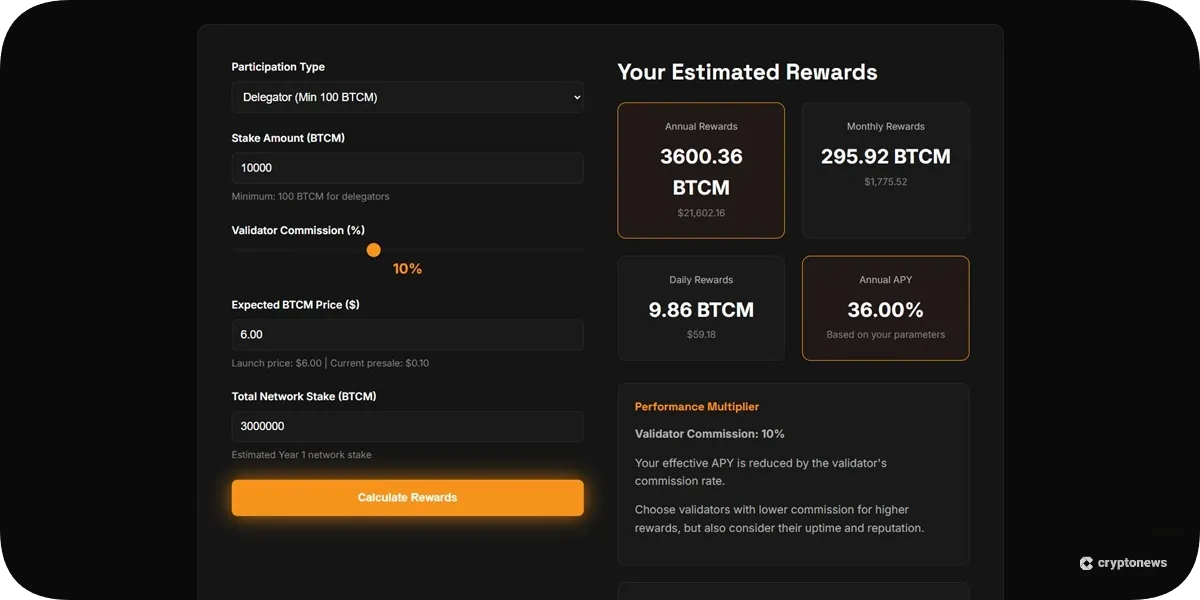
Unlike Bitcoin, BTCM natively operates on a PoS blockchain, enabling crypto staking opportunities for validators. According to the project’s network architecture, Bitcoin Munari requires a minimum of 100 BTCM for delegated staking. Validator rewards range from approximately 5% to 25% APY, depending on the emission schedule.
📰 Media Coverage
As part of its ongoing marketing initiatives, Bitcoin Munari has been featured in several crypto and financial online publications. These news outlets are announcing the project’s presale progression and key details.
🌍 Community
Bitcoin Munari has over 1,400 members in its Telegram channel, 57 followers on X, and just one follower on Medium. Overall, these are still low figures for a project that will rely on community adoption.
Revealing the Team Behind Bitcoin Munari
A core team of blockchain developers and crypto experts runs the Bitcoin Munari project. Combined, the team has over 10 years of experience in the cryptocurrency industry. However, the project states that its team members will maintain anonymity for security and privacy reasons.
However, the Bitcoin Munari team completed a KYC verification with SpyWolf on November 16, 2025. The process required ID verification, a video statement, and a video interview with the project’s developers.
Bitcoin Munari’s Technology & Use Cases
Bitcoin Munari envisions its own blockchain as a modified PoS protocol where validators can stake BTCM tokens to help secure the network. For contributing to the Layer 1 chain’s overall crypto security, validators can also earn block rewards in BTCM.
The consensus aims for a 4 to 9 second block time, over 10,000 transactions per second (TPS), and network fees under $0.01. With its high-speed, low-cost transaction capabilities, Bitcoin Munari advertises itself as an ideal blockchain for microtransactions, frequent trading, and everyday purchases.
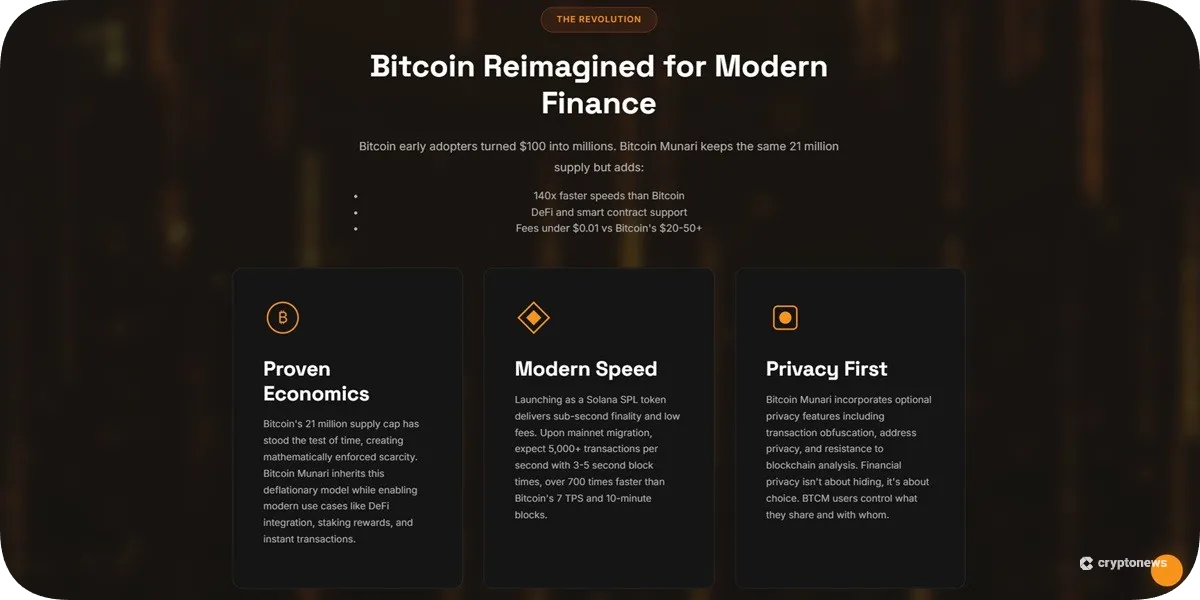
The team has also stated that Bitcoin Munari will be EVM-compatible, allowing the blockchain to support decentralized exchanges (DEXs), lending, borrowing, yield farming, and other DeFi activities.
It’s important to understand that these are not yet real-world use cases, as there is no proof of Bitcoin Munari’s blockchain technology yet. The public testnet is scheduled to launch by Q3 2026, while the mainnet is expected to go live in Q2 2027.
Are Bitcoin Munari’s Tokenomics Sustainable?
While Bitcoin Munari follows Bitcoin’s economic principles with a fixed total supply of 21 million tokens, the upcoming project has a different token distribution structure. Here’s how it allocates BTCM tokens:
| Allocation | Percentage | Details |
|---|---|---|
| Public Presale | 53% | 11,130,000 BTCM tokens are reserved for community distribution via presale. |
| Validator Rewards | 29% | For network security and decentralization. |
| Liquidity Pool | 8% | Supports DEX liquidity on launch. |
| Team | 5% | Allocation for the project’s core development team. |
| Marketing | 5% | Token allotment for fueling growth and market adoption initiatives. |
Bitcoin Munari’s team allocation is subject to a 12-month cliff, followed by 24 months of linear vesting. However, that’s just 5% of the total token supply. Presale allocations, which make up the majority of the supply, will have no vesting schemes.
Given this, BTCM will be susceptible to significant price declines once it officially launches on exchanges.
Additionally, 29% of the total BTCM token supply is reserved for validator rewards, which will gradually be released over 10 years. So far, Bitcoin Munari has not yet announced any plans on how to continue incentivizing validators after the 10-year period, when all rewards are distributed.
How Realistic Is Bitcoin Munari’s Roadmap?
Bitcoin Munari’s roadmap centers on a few key milestones: its presale, the Solana SPL token launch, and the public mainnet launch. Let’s outline the roadmap phases according to the project whitepaper:
- Phase 1: Presale launch, smart contract audits, marketing campaigns, partnerships, mainnet development updates, liquidity pools smart contract deployment, and more.
- Phase 2: BTCM goes live on Solana on January 20, 2026, with a $6.00 launch price. CEX listing by Q1 2026.
- Phase 3: Additional tier-2 exchange listings by Q2 2026. Public testnet launch for the Bitcoin Munari Layer 1 chain by Q3 2026.
- Phase 4: Bitcoin Munari blockchain officially launches by Q2 2027, marking a complete transition from Solana to the independent mainnet.
- Phase 5: Ecosystem development by the second half of 2027, including native DeFi protocol launches and developer grants.
- 2028 and Beyond: Implementation of Layer 2 scaling solutions, cross-chain expansions, and attracting institutional players to the blockchain.
With a relatively short presale period, Bitcoin Munari will deploy the BTCM token for public trading and exposure by early 2026. While going live on exchanges early could facilitate organic community growth and market momentum, the issue is the $6.00 expected launch price.
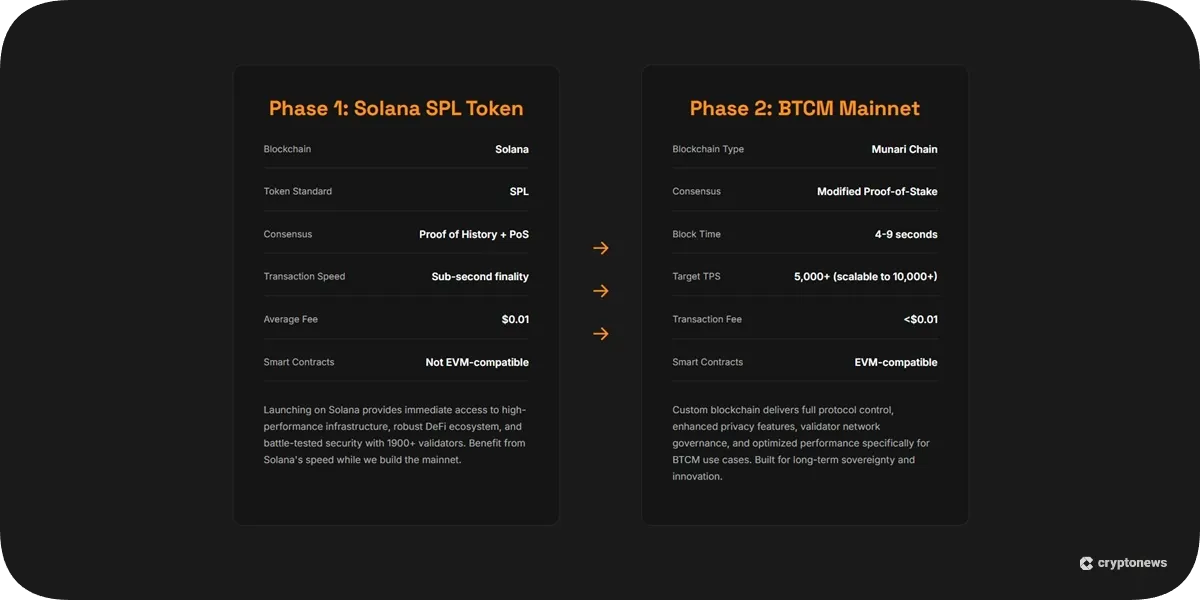
Once Bitcoin Munari launches its token at this price, early presale investors with returns of up to 5,900% would likely sell their holdings. As a result, BTCM could experience significant volatility and downward pressure after listing.
Furthermore, if the project meets its Q2 2027 deadline for launching the public mainnet, the team has just about a year and a half to develop a functional, reliable blockchain. While this is possible given the team’s claimed expertise, we expect challenges, bug fixes, and delays should the proprietary PoS blockchain be built nearly from scratch.
Is Bitcoin Munari Audited to Ensure Safety?
Bitcoin Munari has completed two separate smart contract audits from reputable firms SolidProof and SpyWolf. The SolidProof audit did not identify any critical issues of high or medium severity and gave the project a TrustNet Score of 80 out of 100.
Meanwhile, the SpyWolf audit report found one vulnerability regarding the smart contract’s update authority. The finding suggests that the project poses a high risk of social engineering and branding manipulation, as the project owner can rebrand the token or change its name and symbol unexpectedly.
Bitcoin Munari Marketing: Pure Hype or Genuine Community?
With statements like “Your second chance at early Bitcoin prices” and aggressive 5,900% ROI claims, Bitcoin Munari seems to focus heavily on early investor gains. While the project also highlights its underlying technology and BTC-like scarcity, it can’t prove its real-world use until it launches a proof-of-concept.
However, the project does not rely solely on hype-driven marketing and has taken the first few steps toward building a genuine community. Bitcoin Munari is gradually increasing its social media presence, but its following is still relatively low.
At this stage of the project’s lifecycle, users should carefully evaluate Bitcoin Munari’s upside potential and risk before investing. Do your own research to avoid common crypto mistakes when buying into new tokens like BTCM.
Top Alternative Crypto Presales to Consider
Because of Bitcoin Munari’s unsustainably high initial exchange listing price, unproven PoS blockchain, and possible bearish price pressures at launch, we recommend investors stay clear of the presale until these issues are clarified.
It’s still possible for the project to succeed, but other early-stage cryptocurrencies have much more potential. Let’s explore 3 of the best crypto presales in 2026.
Bitcoin Hyper (HYPER)
Instead of building a new BTC-like crypto from scratch, Bitcoin Hyper  HYPER +19.00% operates on the existing Bitcoin ecosystem as a Layer 2 (L2) solution. It’s also powered by the battle-tested Solana Virtual Machine (SVM) protocol.
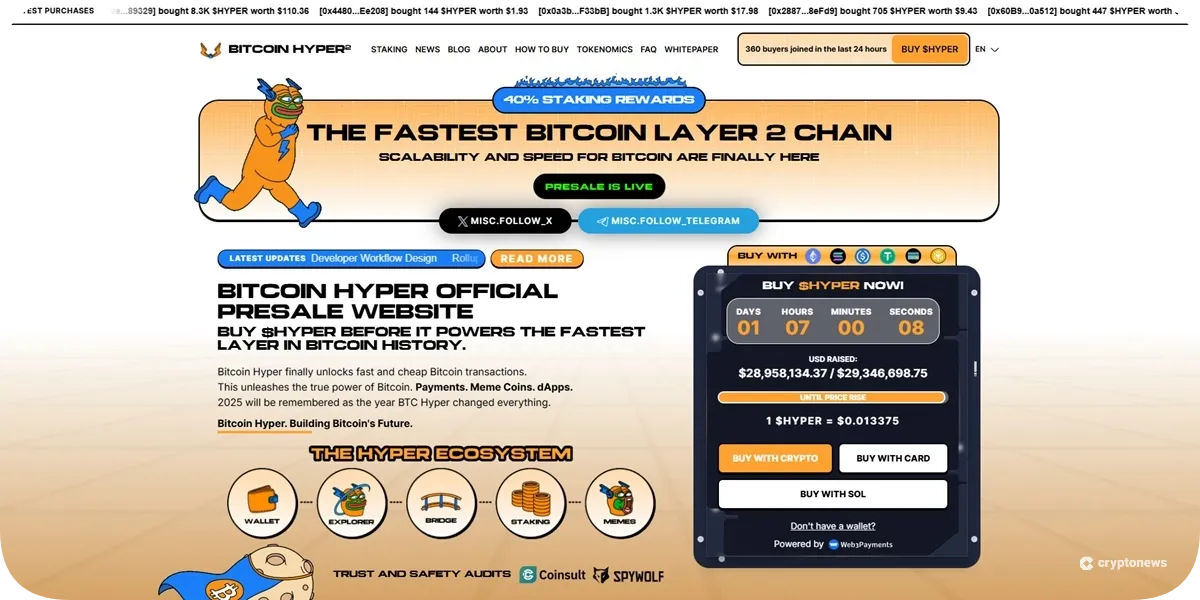
Bitcoin Hyper enables users to participate in various DeFi activities using their native BTC holdings. The L2 also addresses Bitcoin’s scalability issues, making BTC transactions as fast and cheap as those on Solana.
So far, the Bitcoin Hyper presale has raised over $33.09M, reflecting significant early investor adoption. It’s selling the native crypto, HYPER, at just $0.01368550 before it goes live on exchanges.
Visit Bitcoin HyperMaxi Doge (MAXI)
Maxi Doge  MAXI +13.46% packages community-driven meme culture in a dog-themed token. With this unique approach, it aims to surpass the legendary Dogecoin.
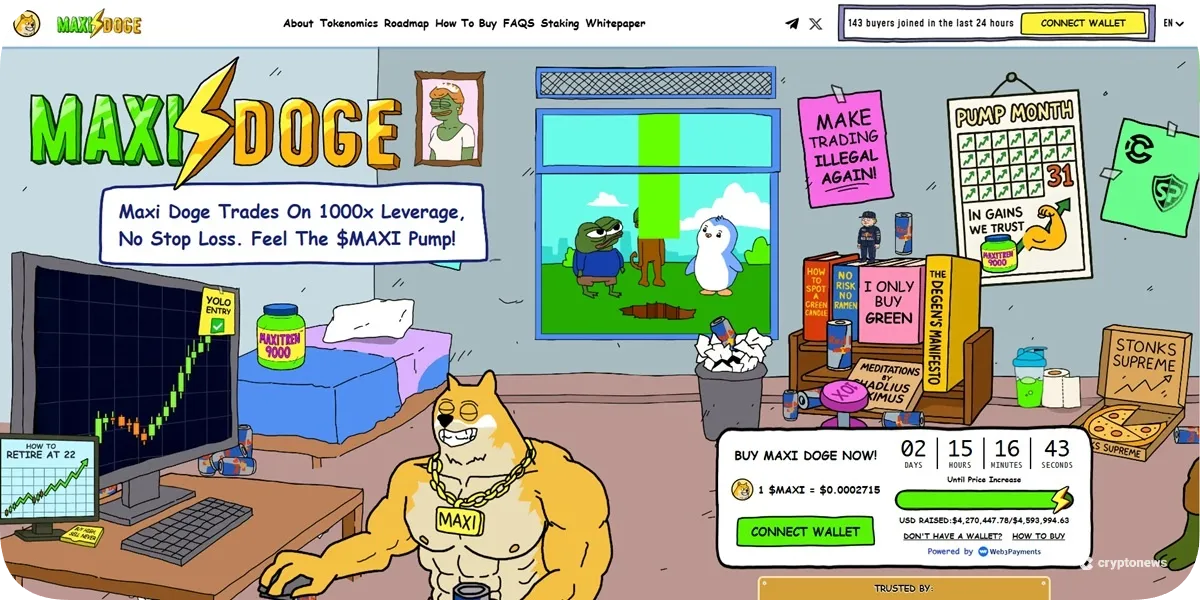
Currently, the Maxi Doge presale has raised $4.85M, despite offering minimal utility. Beyond its meme-based design, the project is a lifestyle token that embodies a “1,000x leverage” trading and non-stop grind mindset.
MAXI, the native crypto, is priced at $0.00028365, gradually increasing as the presale progresses. Before it goes public, investors can stake their MAXI holdings to earn variable staking rewards for extra passive income.
Visit Maxi DogePEPENODE (PEPENODE)
PEPENODE introduces a virtual crypto mining ecosystem where players can earn meme coin rewards. Since its presale launched last August 2025, the project has secured over $2.49M in crypto capital.
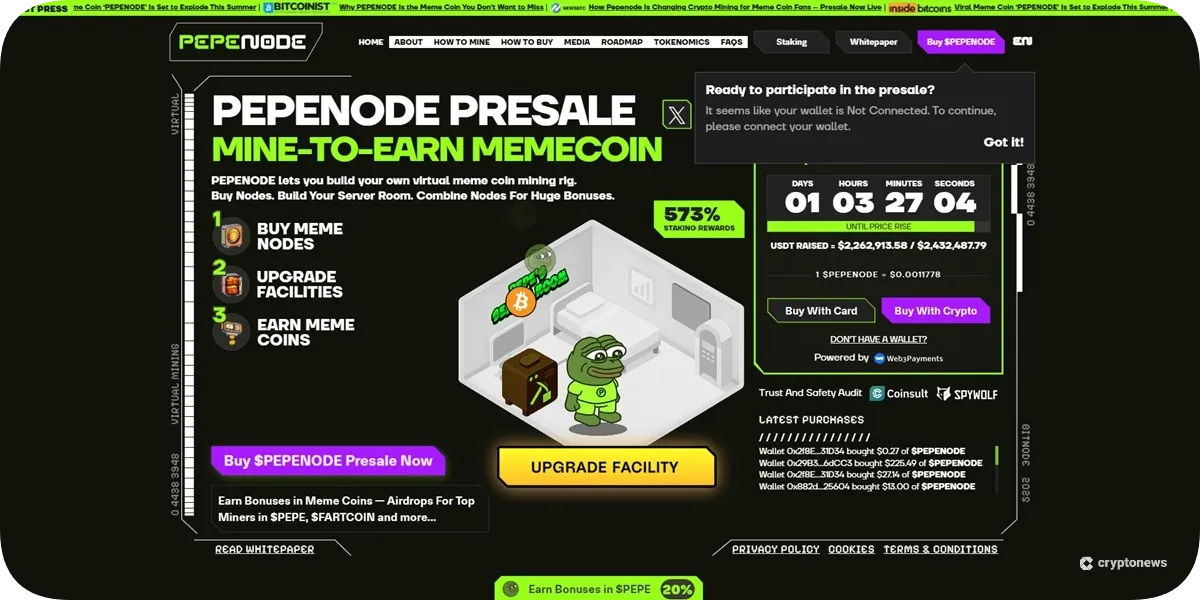
As the world’s first mine-to-earn meme coin, PEPENODE invites players to build their own digital mining rigs to increase their mining power. It doesn’t require any specialized hardware, making it easy for Web3 users to participate in the virtual mining ecosystem and start earning rewards.
The PEPENODE token will mainly be used to purchase node upgrades, which help players increase their yield. Additionally, 70% of all PEPENODE used to pay for mining upgrades will be burned to increase token scarcity. The presale currently offers the meme utility token for $0.0012161.
Visit PEPENODEConclusion: Is Bitcoin Munari Legit or a Scam?
After a thorough review of Bitcoin Munari, we recommend investors stay cautious due to concerns about the project’s claims. While it is an actual upcoming SPL token with a verified smart contract, potential users should be aware of the absence of a working prototype and the fact that the token launch will occur without a public mainnet.
Additionally, the project markets returns of up to 5,900% for early investors, which could cause significant volatility at launch, given the expected $6.00 initial listing price. Since the team remains anonymous, no one can be held accountable for future development delays or security issues.
👉 To learn more about BTCM’s future, read our Bitcoin Munari (BTCM) Price Prediction 2025-2030.
FAQs
Who runs Bitcoin Munari?
Is Bitcoin Munari safe?
References
- KYC Certificate Bitcoin Munari (SpyWolf)
- Bitcoin Munari Whitepaper (Bitcoin Munari)
- Bitcoin Munari SolidProof Audit (SolidProof)
- Bitcoin Munari SpyWolf Audit (SpyWolf)
2M+
250+
8
70





 in numbers

About Cryptonews
Our goal is to offer a comprehensive and objective perspective on the cryptocurrency market, enabling our readers to make informed decisions in this ever-changing landscape.
Our editorial team of more than 70 crypto professionals works to maintain the highest standards of journalism and ethics. We follow strict editorial guidelines to ensure the integrity and credibility of our content.
Whether you’re looking for breaking news, expert opinions, or market insights, Cryptonews has been your go-to destination for everything cryptocurrency since 2017.
