

What Are Dino Coins? Crypto Dinosaurs Explained





The term “Dino Coins” refers to older cryptocurrencies that launched in the early days of the industry and still trade today. Like the dinosaurs of prehistoric times, these crypto assets have survived multiple market cycles and everything short of a direct asteroid hit. These dependable tokens benefit from long-established communities and a proven legacy.
Dino coins still matter now because interest in time-tested cryptocurrencies tends to spike when markets rotate out of high-risk speculation phases and back toward assets with staying power. As newer chains struggle with scaling bottlenecks, gee-whiz tech that doesn’t always work as advertised, short-lived hype, and regulatory concerns, many traders choose to revisit older networks that have already proven they can survive crypto’s darkest days.
The recent uptick in volume on several legacy chains shows that investors are paying attention to the classics again.
In this guide, we’ll break down what qualifies a coin as a dinosaur crypto coin, why some of these older assets are experiencing a resurgence, and which projects remain relevant today. We’ll also look at risks, market narratives, and what sets a true dino coin apart from dead or abandoned chains.
Key Takeaways
- Dino coins are generally thought of as cryptocurrencies that launched before 2017, withstood multiple market cycles, and still have active networks and communities.
- Crypto dinosaurs often spring back to life with good liquidity and long-term charts — a relief against newer hype-driven tokens.
- When looking for the best dino coins, focus on fundamentals (use case, upgrades, developer activity), along with liquidity and market sentiment.
- Dino coins do carry risks, including technological stagnation, regulatory concerns, and competition from modern chains.
What Are Dino Coins?
While there is debate around what constitutes a dino coin, most agree that the category consists of older, established cryptocurrencies that have been around long enough to feel ancient by crypto standards.
These mature projects launched early and survived multiple market cycles. Yet they still maintain communities of true believers in an industry known for its short attention span.
Think XRP, Monero (XMR), Litecoin (LTC), and Dogecoin (DOGE), all OG coins that refuse to die. Some people call them “dino alts” or “crypto dinosaurs,” referring to the same concept: legacy coins that continue to advance year after year.

The “dinosaur” metaphor fits for a few reasons: These projects have been around for years, sometimes for a decade or longer. Dino coins don’t enjoy the same hype as newer chains with slick marketing or cutting-edge features, but they’ve proven they can take the hits, adapt, and keep going.
Notably, some people use “dino coin” in a different context: dinosaur-themed meme tokens like Dino (DINO). But that’s not today’s topic, as we’re discussing the true crypto dinosaurs: the long-running, thick-skinned, battle-tested protocols that shaped the early cryptocurrency industry and are still in use today.
What Qualifies as a “Dinosaur Crypto”?
A true dinosaur crypto is more than just “old.” Most dino coins share a few defining traits that set them apart from the more than 3.7 million cryptocurrencies and meme coins that have failed.
First is timing. These hardy coins launched early in the crypto era, in many cases prior to the 2017 bull market or even before Ethereum reshaped the industry. Projects that survive not only a decade-plus test of time but also the tsunami of change in the industry automatically earn some prehistoric street cred.
Next is endurance. Dino coins have withstood multiple market cycles and remain standing, giving credence to HODLers who have remained steadfast.
They’ve survived crashes, competing projects built from the same codebase, exchange delistings, regulatory uncertainty, and enough FUD to sink all but the stoutest ships. If a coin made it through crypto’s wildest years without going extinct, it deserves an exhibit in the Smithsonian next to T. Rex.
Finally, there’s market recognition. A dinosaur crypto still has some level of adoption or name recognition. Dino coins like Litecoin and Monero still find daily use cases among niche communities.
Beyond that, many dino coins remain household names, even if mostly as nostalgic reminders of crypto’s early self-sovereign roots. These are the coins people have heard of, which still have active trading pairs, diehard communities, or ongoing development.
It’s a project that launched early, survived the chaos, and remains relevant today, even if not making headlines.
Why Do Dino Coins Matter?
Dino coins behave differently from the many newer altcoins that often dominate headlines, and their steadier and sometimes more predictable price action makes them an important part of the crypto dialogue.
While fresh projects can be exciting, many of them rely on viral marketing or short-term speculation, they often run on hype rather than fundamentals. Additionally, liquidity can be much thinner for newer coins, amplifying the volatility of every price move.
By comparison, dino coins typically offer active trading markets and a community that doesn’t race for the exits at the first sign of turbulence. Although price action can still be volatile, price swings for these established projects typically reflect more reasoned investor sentiment anchored by a solid base of long-term HODLers.
Dino coins aren’t immune to risk, but they’re less affected by whatever narrative happens to be trending. This comparative stability gives select older cryptocurrencies a place in crypto portfolio diversification, providing balance if investors want to allocate a percentage of their portfolio to newer coins.
However, dino coins aren’t necessarily sleepy assets. Under the right circumstances, they can soar like an eagle. XRP more than doubled in value in 2025, responding to positive news regarding Ripple’s court battle.
Zcash, a nine-year-old privacy coin that many thought was extinct, suddenly saw a 10x increase at the tail end of 2025. With the right catalyst and a solid holder base, there’s plenty of life in the older coins.
Dino Coin Season: the Recent Resurgence of Dinosaur Cryptos
Every few years, the market rediscovers its forgotten heroes and returns them to the spotlight. Traders have a name for this rotation: dino coin season, a part of the market cycle loosely tied to altcoin season, which itself is driven by the Bitcoin halving cycle. Arguably, the altcoin season’s familiar patterns of outsized profits and spectacular collapses drive investors into the arms of more reliable dino coins.
The recent resurgence of these legacy projects has a few drivers, beginning with simple fatigue. The wallet-burning effects of rapid-fire meme coins, questionable presales, and “revolutionary” projects that disappear within months drive investors back to coins with a proven track record.
Nostalgia also plays a role. Like a childhood memory, investors remember these coins from crypto’s formative years. Buying LTC, XLM, DOGE, or ETC feels like an earlier, simpler version of the industry, built around experimentation and self-sovereignty rather than hype. This nostalgia can translate into renewed demand when the rest of the market feels fragile.
Finally, network effects also provide a solid base for growth when the market returns to these thick-skinned legacy projects. Dino coins already have existing infrastructure, rather than relying on whitepaper promises.
New and returning investors are welcomed by ample exchange liquidity, a large number of node operators, a variety of wallets, and a well-established community.
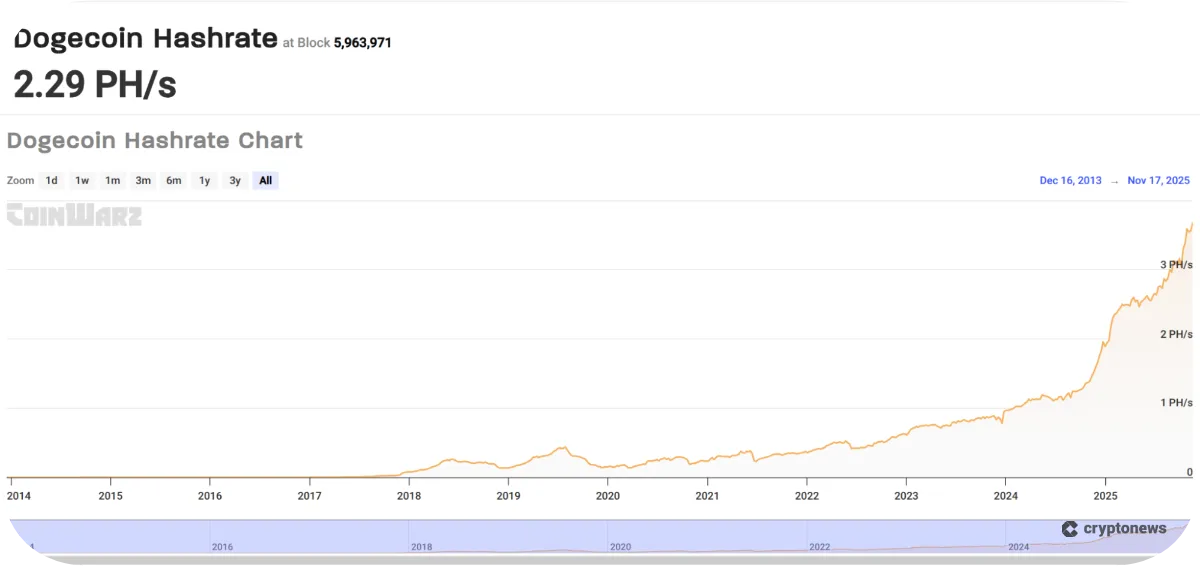
For example, Dogecoin’s hashrate has climbed steadily over the past several years. The community never really left.
Types of Dino Coins
Much like Triceratops differs from Velociraptor, dinosaur crypto coins are not all built the same, even if they share some similar DNA. There are coins that have quietly powered transactions for a decade or more, outside of the limelight. Meanwhile, others only show signs of life again as attention cycles back to older networks.
Generally, older coins fall into two groups: The first includes infrastructure projects that helped define cryptocurrency in the early days and still serve real-world use cases today. These include cryptocurrencies such as Bitcoin, Ethereum, Monero, and Dogecoin.
The second group includes revival projects, sometimes referred to as “zombie chains,” which ran hard for a while but later stagnated, and now show renewed activity as investors revisit proven networks. Projects like Zcash and Dash fall into this category.
Legacy Infrastructure Coins
Legacy infrastructure coins are the oldest and most durable projects in cryptocurrency, built long before the 2017 bull market and the initial coin offering (ICO) boom. They launched early, survived through each major market cycle, and still show real activity today.
The largest examples are the ones everyone knows —  BTC +1.94% and
  ETH +2.46%. We’ll go over other pre-2017 networks within the legacy group below.
Litecoin  LTC +1.18%
Litecoin was launched in 2011 as a fork of Bitcoin, aiming to achieve a faster network without compromising security. The project is widely supported across exchanges, with regular protocol upgrades and an active mining community.
XRP  XRP +0.87%
Perhaps the biggest ‘name’ after BTC and ETH, XRP was introduced in 2012 as a faster settlement layer for banks and institutions, and is one of the largest cryptocurrencies by market capitalization.
The project has a massive, loyal community of true believers and continues to grow through Ripple’s ongoing ecosystem development.
Stellar Lumens  XLM +2.23%
Stellar Lumens began in 2014, focused on low-cost global payments and token transfers. XLM continues to benefit from an active developer community and a long list of payment partners, including Mastercard, PayPal, MoneyGram, and Visa.
Monero  XMR 1.45%
Monero launched in 2014 and remains the dominant privacy coin, surviving regulatory scrutiny, network upgrades, and exchange delistings. Many still see this hard-to-kill coin as the de facto privacy alternative to BTC.
Coins in this group aren’t defined by hype or marketing budgets. These crypto dinosaurs deliver real use cases and time-tested infrastructure that have survived for a decade or longer.
Hybrid or Revival Coins
Some dino coins took a hiatus or fell out of public view, without completely disappearing. Coins like Ethereum Classic and Zcash have lost market share to newer rivals, while their blockchains have remained active.
These are often called revival coins or zombie chains, not because they died, but because they drifted out of the conversation until the market came back around.
Several older networks fit this profile, and a resurgence in one often leads to renewed interest in others in this group.
Ethereum Classic  ETC 0.54%
Ethereum’s contentious hard fork in 2016 left the crypto community with two versions of the Ethereum network, each with its own token.
Although smaller than ETH in terms of usage and market cap, ETC’s community remains dedicated to Ethereum’s original goals of decentralization, immutability, and security, all of which are enforced by proof-of-work.
Ethereum Classic often experiences periods of renewed attention within a smaller segment of the cryptocurrency community, and is used for mining apps such as Unmineable, which lets users mine ETC and exchange it for a range of other cryptocurrencies, including BTC, UNI, or ADA.
Zcash  ZEC +5.17%
Zcash was launched in 2016 as a privacy-focused blockchain built on zero-knowledge proofs, and grabbed attention as a privacy asset, until interest cooled as new competitors emerged and the market slowed.
However, thanks to upgrades, governance debates, and a noticeable increase in trading activity, Zcash is back; it never really left. Supporters saw Zcash realize 10x gains across 2025.
Dash  DASH +7.84%
One of the earliest payment-focused cryptocurrencies, Dash enjoyed widespread experimentation in merchant transactions during the mid-2010s.
Adoption slowed over the years, but the project continues to release upgrades, and Dash’s PrivateSend feature keeps Dash relevant in the privacy coins sector.
Revival coins can see meaningful gains when the market shifts back to dino coins, as the foundation is already in place: real networks, real users, and years of development history.
How to Evaluate a Dino Coin
Dino coins can form a strong foundation for a diversified portfolio, but the age of a chain isn’t the only consideration to weigh. You’ll want to consider the fundamentals (usage and use cases) as well as market conditions and sentiment.
The following sections provide a more detailed examination of these factors. Let’s start with fundamentals.
1. Review the Fundamentals
It’s essential to evaluate a project’s overall health if you are thinking of buying in. The real questions center on whether anyone still uses it and whether usage can grow.
🕹 Technology and Upgrade Path
Is the project still evolving? Is the project’s GitHub page seeing regular updates and pull requests? Is there a roadmap? This also gives you the opportunity to compare the project with newer solutions. However, it’s also vital to keep dinosaur crypto coins in perspective.
🛠 Use Case and Ecosystem
Is there a genuine real-world application, and is there meaningful network adoption? No matter how nostalgic, a dino coin without a clear purpose is not likely to see lasting gains.
Network usage reflects real-world use cases. It’s wise to weigh these as well. For instance, if the main use case is meme coin trading, network usage will drop significantly when the bear market arrives. To measure overall usage, watch the number of active wallet addresses.
🧑💻 Developer Activity and Community Health
Is there still an active team? Research the current team versus the founding team. This is also the time to research funding. It’s more challenging to run a viable project on a shoestring budget.
However, well-established projects with strong decentralization can be self-sustaining based on the economic interests of the holders/developers.
⛓ Network Security
Notably, investors should also weigh the economic security of dino coins. For example, Bitcoin and Ethereum remain secure due to the significant cost associated with compromising the network’s security.
Simply put, it’s not impossible to attack these networks. It’s just prohibitively expensive. However, smaller networks can be more vulnerable, as demonstrated by the 2025 51% attack on Monero.
The key takeaway is that the security needn’t be as strong as Bitcoin, but there should be a minimal level of (decentralized) economic interest securing the chain.
2. Assess Liquidity, Trading Volume, and Market Conditions
Next, you’ll want to assess the trading conditions. Is the coin still available on major exchanges or decentralized platforms?
Coins with low liquidity (a lack of willing traders on either side of the trade) become less efficient to trade and can see more dramatic price moves with relatively small trades. Crypto depth charts provide a visual representation of the liquidity on a given trading platform.
It’s essential to weigh this potential for increased volatility before making an investment decision. Although dino coins are typically much more stable than meme coins, remember this is still crypto, so prepare for double-digit percentage moves at times. Low liquidity can amplify these price moves.
Lastly, it’s essential to consider the current market conditions. Buy and sell timing both benefit from knowing where we are in the crypto cycle.
Bear-market crypto investments typically yield greater gains for long-term positions. However, this assumes that the coins will attract increased interest when the market recovers.
3. Consider Branding, Narrative, and Sentiment
Trends in crypto can become memes unto themselves. Specific dinosaur crypto coins might see a resurgence simply because they become a popular topic on social media.
However, if there is no underlying value, they perhaps hold no more promise than a pump-and-dump meme coin. Treat community commentary carefully to separate the hype from long-term promise.
What Are the Risks of Dino Crypto Coins?
Dino coins can help stabilize a diversified portfolio, but they also present potential risks.
- Old chains may rely on outdated code, exhibit slow throughput, or use legacy consensus models.
- Low hashrate or minimal staking activity can make older networks more vulnerable to attacks, such as transaction reordering, double spending, or stalled finality.
- Early projects may still face unresolved legal challenges or compliance hurdles.
- Dino coin season can fade quickly if attention shifts back to newer narratives.
- Faster, cheaper, or more scalable chains can easily overshadow slower legacy networks. Markets also compete for capital, and dino coins may capture a smaller share.
Risk Management Tips for Investing in Dinosaur Cryptos
Investing in dino coins benefits from a balanced approach to crypto trading risk management. The key is deciding whether you want long-term exposure or short-term trading opportunities.
📈 Long-Term Hold vs Trading
Some investors treat dino coins as core long-term positions because they have established communities and a track record of surviving multiple market cycles. Others prefer to trade in or out of these assets during rotation periods or when specific coins see increased activity.
📊 Position Sizing and Diversification
Consider position size. For example, you may choose to allocate 10% of your portfolio to dinosaur crypto projects, and then consider how much to allocate to each dinosaur crypto project you select. It’s often wiser to size positions conservatively.
🩺 Stay Updated on Network Health
Similar to assessments you would make before entering a position with a legacy asset, stay abreast of changes to the project fundamentals. If usage trends move in the wrong direction, it may be time to adjust your strategy.
Monitor key metrics like active wallet addresses and network fees. Hash rates and the percentage of supply staked also become metrics to watch closely.
🗣️ Monitor Sentiment and Market Cycles
Community sentiment often drives renewed interest in dinosaur cryptos. Track social discussions, ecosystem events, and broader crypto narratives.
Timing also matters, and dino coins tend to perform better during rotation phases or after Bitcoin’s dominance cools. Knowing where we are in the cycle can improve both entries and exits, although you’ll often find the lowest prices during bearish downturns.

Examples of Dino Coins
Let’s review a few long-standing cryptocurrencies that fit the definition of true dinosaur coins.
1. Monero (XMR)
Monero’s 2014 launch began the trend for privacy-focused cryptocurrency, built around the idea that financial transactions should remain confidential by default. The protocol’s ‘ring signatures’, stealth addresses, and hidden transaction amounts put Monero at the top among privacy coins.

Recent Highlights:
- Active development ecosystem with regular protocol updates, such as Optimal Static Parametric Estimation of Arbitrary Distributions (OSPEAD), which would improve Monero’s decoy wallet address selection to enhance privacy.
- Up to 40% growth in transactions between 2023 and 2025.
- Strong user base even after multiple regulatory delistings.
- Mining participation reflects a 22% increase in hashrate during 2025.
2. Litecoin (LTC)
Created in 2011 as a faster alternative to Bitcoin, Litecoin is one of the oldest cryptocurrencies with plenty of active use.
The project has the same core principles of Bitcoin (decentralization, PoW security, permissionless access) but with faster block times and lower average fees. It is known as reliable and low-drama, a project that many traders use for payments, transfers, and exchange withdrawals.
Despite being overshadowed by newer chains, Litecoin is widely supported, and almost every major exchange, wallet, and payment processor includes LTC. The protocol continues to receive upgrades, and a large global pool of ASIC miners provides security for the chain.

Recent Highlights:
- Network upgrades like MWEB, SegWit, and Lightning support.
- Widely accepted cryptocurrencies for payments, including integrations with BitPay, NOWPayments, and others.
- Consistently high transaction volume of about 200k per day.
- Strong mining participation, currently second only to Bitcoin in hashrate.
3. Dogecoin (DOGE)
What began as a lighthearted experiment in 2013 caught fire, and today Dogecoin remains one of the leading cryptocurrencies both in market cap and mindshare.
Tongue-in-cheek origins aside, the dog-themed dino coin maintains a strong proof-of-work network secured through merged mining with Litecoin. High transaction throughput and widespread name recognition have helped Dogecoin persist through every major market cycle.
While a meme at heart, the project has become the coin of the people in many ways, seeing real-world usage as a tipping currency and payment asset.
Recent Highlights:
- Growing institutional visibility, including the launch of Dogecoin investment products through the 21Shares partnership with House of Doge.
- Increased network security provided by merged mining with Litecoin, with DOGE’s hashrate steadily rising over the years.
- Expanding merchant and payment support, including integrations through providers like BitPay.
- Ongoing development activity aimed at improving scalability and tooling.
Final Thoughts on Dinosaur Cryptos
Dino coins remind us that, sometimes, time-tested uses win out over hype — newer and shinier are not as important as perseverance.
These older networks have survived market crashes and waves of new competitors jostling for market share, yet they continue to generate new blocks with real activity.
Dino coins are not for everyone, though. Some investors prefer emerging technology or higher-risk opportunities.
What matters most is understanding why a coin has survived this long and whether it still has a place in today’s ecosystem. Be forward-looking, but never forget staying power.
👉 Read Next: Most Popular Cryptocurrencies in 2026
FAQs
How do crypto dinosaurs differ from new altcoins?
Why are older coins seeing a resurgence?
Are dino coins safer than new tokens?
Is the dino coin trend just hype?
Are dino coins the same as dino alts or dino altcoins?
What are zombie chains?
References
- Dead Coins: Over 50% of Cryptocurrencies Have Failed (coingecko.com)
- SEC Ends Lawsuit Against Ripple Company, Pay $125 Million Fine (reuters.com)
- Dogecoin Hashrate Chart (coinwarz.com)
- PrivateSend and InstantSend (dash.org)
- Explained: The Monero 51 Percent Attack (August 2025) (halborn.com)
- OSPEAD (github.com)
- Monero Transactions – 3y Comparison (bitinfocharts.com)
- It’s Back to Bitcoin for Darknet Markets After Monero’s Binance Delisting: Chainalysis (coindesk.com)
- Monero Hashrate Chart (coinwarz.com)
- Litecoin and MWEB: What It Is and How to Use It (litecoin.com)
- Litecoin Transactions – Comparison (bitinfocharts.com)
- Network Hashrate Charts (coinwarz.com)
- 21Shares Forms Exclusive Partnership with the House of Doge to Launch Dogecoin ETPs Globally (etfgi.com)
- dogecoin/dogecoin (github.com)
2M+
250+
8
70





 in numbers

About Cryptonews
Our goal is to offer a comprehensive and objective perspective on the cryptocurrency market, enabling our readers to make informed decisions in this ever-changing landscape.
Our editorial team of more than 70 crypto professionals works to maintain the highest standards of journalism and ethics. We follow strict editorial guidelines to ensure the integrity and credibility of our content.
Whether you’re looking for breaking news, expert opinions, or market insights, Cryptonews has been your go-to destination for everything cryptocurrency since 2017.

Keeping your size reasonable means you stay liquid, and that liquidity is what lets you take advantage of opportunities others will be stuck watching from the sidelines.“