

Utility Tokens: Definition, Types, and Examples





Utility tokens allow you to access specific products or services within a pre-existing blockchain ecosystem. This kind of asset differs from security tokens mainly due to its purpose. While utility tokens primarily serve functional purposes within a platform, security tokens act like an investment contract, similar to bonds and stocks.
Editor’s Pick – Best Utility Token

- Introducing the first Bitcoin L2 solution
- Allows users to trade BTC almost instantaneously
- Enhanced transaction security with ZK-proofs
 USDC
USDC- ETH
- usdt

Key Takeaways on Utility Tokens
- Utility tokens can be sub-categorized based on their function, including payment, access, reward, and governance token.
- The value of a utility token is tied to the service or product within the ecosystem. For this reason, utility tokens aren’t viewed as investments.
- Since utility tokens are not considered investments, they are not regulated like security tokens. This can lead to uncertainty and a lack of regulations.
How Do Utility Tokens Work?
Utility tokens are digital assets designed to unlock access to different services, features, or products in a blockchain ecosystem. Unlike Bitcoin, which works as a store of value token, utility tokens aren’t designed for investment but for use within a particular environment. They grant you access to services or features within that ecosystem.
Utility tokens are usually created through smart contracts and can be traded on exchanges, but their value primarily derives from their use in a specific context.
For example:
- On Ethereum, you might use ETH +2.46% to pay for transactions.
- On a decentralized storage platform like Filecoin, you would use FIL +1.43%, to pay for storage services.
 FIL
FIL Utility Tokens vs Utility Coins: What are the Differences?
Utility tokens and utility coins both serve specific functions within blockchain ecosystems, but differ in scope and use. Utility coins are native to a blockchain and vital for its operations, while utility tokens are application-specific and built on existing blockchains.
For example,  SOL +2.20% is native to the Solana blockchain and used for transaction fees and staking within the network. It’s integral to the operation of the entire blockchain.
Conversely, utility tokens are built on top of existing blockchains, often through smart contracts. They are used within specific applications or platforms on that blockchain. For example,  LINK +2.14% is used to pay for services within the Chainlink decentralized oracle network, which operates on the Ethereum blockchain.
Types of Utility Tokens
Utility tokens can serve various roles within an ecosystem. By recognizing their differences, you can better evaluate an asset’s value, functionality, and potential risks, enabling more informed investment decisions.
💰 Payment Tokens
Payment tokens are utility coins used to transfer value between two people. They have the same function as traditional money, such as making purchases, transferring funds, or paying for services within a specific ecosystem.
The main objective of a payment token is to be more decentralized and efficient than traditional currencies, making transactions safer and without the need for intermediaries, such as the banking system.
The main advantage of payment tokens is that they facilitate transactions with lower processing times and fees, especially between countries. Another benefit is that some payment coins offer discounts to encourage you to use their network.
However, a significant downside is that their acceptance is limited to their network. For example, if you own  BNB +1.92%, the Binance utility token, you can’t use it on any other crypto exchange.
Examples of payment tokens:
- Litecoin
- SpacePay
- Tether
🔑 Access Tokens
Access tokens grant you access to specific features, services, or content within a blockchain platform; For example, in some crypto games, utility tokens allow access to particular game modes, rare items or features, or exclusive parts of the game.
Examples of access tokens:
- SushiSwap
- Saros
- Kava
💝 Reward Tokens
Reward tokens are distributed to incentivize you to participate in specific ecosystem goals. They are usually used in projects such as DeFi protocols, play-to-earn games, and various blockchain-based services, where you earn coins as a reward for your participation.
The distribution of these assets is typically automated via smart contracts, which allocate tokens based on activities like staking, task completion, or reaching game milestones. Reward tokens generate user engagement, but maintaining long-term value can be challenging.
Cryptocurrencies that pay dividends are a popular type of reward tokens. Similar to dividend-paying stocks, they offer holders a consistent income stream. Dividends are paid through methods like staking rewards and profit-sharing. These rewards are often distributed as additional tokens or cryptocurrency.
Examples of reward tokens:
- Gradient
- Dawn
- Silencio Tokens
🪙 Governance Tokens
Governance tokens allow you to participate in the decision-making process of a blockchain project or decentralized application (dApp). The main objective is to make decentralized governance possible; token holders can vote on crucial issues such as protocol upgrades or the allocation of treasury funds, for example.
Some ecosystems use the most basic voting method: 1 token = 1 vote. Others apply different forms, such as quadratic voting, to prevent disproportionate influence by large holders.

The decentralization of governance tokens is essential. It ensures that no single entity or small group can control the project’s direction, promoting transparency and fairness within the community.
However, governance tokens also come with risks and challenges. The most significant issues include low voter participation, leading to decisions made by a small, active minority, and the unbalanced concentration of assets, which can undermine the project’s decentralized nature.
Examples of governance tokens:
- Uniswap
- Aave
- PancakeSwap
Utility Token Examples
As previously noted, utility tokens power decentralized applications, enable transactions, and grant access to platform-specific services. Let’s explore some of the best utility tokens and how they contribute to the growth and efficiency of their blockchain environments.
Binance Coin (BNB)
Binance Coin BNB +1.92% is primarily used to pay for trading fees and transactions on the Binance exchange. Binance encourages using its native token by offering discounts on fees paid with BNB rather than stablecoins or other cryptocurrencies. BNB can also be used as collateral for loans on some platforms and even for purchasing goods and services.
| Token Standard | BEP-20 |
| Utility Type | Payment and Reward Token |
| Primary Use Case | Payment for transaction fees on Binance |
| Unique Advantages | Holders get discounts on Binance trading fees |
Arbitrum (ARB)
Arbitrum  ARB +2.69% is a utility token powered by the Arbitrum DAO’s on-chain governance protocol. Its primary objective is to allow holders to vote on governance proposals that influence the operation and development of the Arbitrum One and Arbitrum Nova chains.
In this ecosystem, the voting system is on a token-weighted basis, where the influence of your vote increases with the number of ARB coins you hold. It’s also possible to delegate your assets to others, meaning that someone else can cast votes using your ARB tokens.
| Token Standard | ERC-20 |
| Utility Type | Governance Token |
| Primary Use Case | Voting on policies within Arbitrum |
| Unique Advantages | Use a democratic system to make decisions in the Arbitrum ecosystem |
Chainlink (LINK)
Chainlink LINK +2.14% is an ERC token and the native token of the Chainlink ecosystem. It is used to incentivize data accuracy, keep contracts stable, and reward nodes for validating transactions.
Chainlink is one of the most undervalued cryptos because it offers investors significant value at a relatively low cost. Many investors underestimate Chainlink’s full potential, viewing it merely as an oracle service. It provides excellent infrastructure for multiple blockchains, enabling smart contracts to interact with real-world data and services.
| Token Standard | ERC-20 |
| Utility Type | Reward Token |
| Primary Use Case | Give rewards to users that help in data accuracy, contract stability, and transaction validation |
| Unique Advantages | A feature called “transfer and call” that helps communication with smart contracts |
Render (RNDR)
Render is the Render Network’s utility token. It leverages distributed GPU power to render high-quality animation, motion graphics, and VFX at faster speeds and lower costs.
The three main participants in Render’s Network are creators, node operators, and OctaneRender (the platform’s rendering technology). Creators use the network to access GPU resources, while node operators rent out their spare GPU capacity in exchange for RNDR coins.
| Token Standard | ERC-20 |
| Utility Type | Payment and Access Token |
| Primary Use Case | Reward node operators that rent out their GPU capacity for rendering projects |
| Unique Advantages | It’s compatible with various dApps, wallets, and exchanges within the Ethereum ecosystem |
Filecoin (FIL)
Render is the Render Network’s utility token. It leverages distributed GPU power to render high-quality animation, motion graphics, and VFX at faster speeds and lower costs.
The three main participants in Render’s Network are creators, node operators, and OctaneRender (the platform’s rendering technology). Creators use the network to access GPU resources, while node operators rent out their spare GPU capacity in exchange for RNDR coins.
| Token Standard | ERC-20 |
| Utility Type | Payment and Governance Token |
| Primary Use Case | Rewarding storage providers who offer space and validate blocks |
| Unique Advantages | FIL holders are encouraged to participate in Filecoin governance actively |
What Are the Challenges of Using Utility Coins?
Using utility tokens has some challenges that may impact their functionality and efficiency. Here are the main drawbacks you should be aware of:
- Lack of Regulations: Utility tokens still need a well-established set of regulations. Since there is no certainty about how they will be approached, this might be a risk for users and investors.
- Limited Use: A utility token is usually specific to a platform or system. This means that its value and use cases are strictly linked to the services and functionalities provided by its particular project.
- Market Volatility: These assets can be highly volatile. Their value can fluctuate dramatically based on market demand, project developments, and broader economic factors, impacting their stability and utility.
- Insufficient Demand: Utility tokens may face insufficient demand within their ecosystems if the platform’s user base is too small or the asset’s use cases are limited, reducing functionality and decreasing value.
Utility Token vs Security Tokens
Utility and security tokens differ in their functions and legal status. Since utility tokens don’t represent ownership or investment in a company or asset, they are exempt from being classified as securities and face much less regulatory scrutiny.
In contrast, security tokens have more in common with traditional securities. They represent ownership in a company or asset. For this reason, they are regulated by securities laws and must adhere to strict registration and disclosure requirements.
Since investing in security tokens may generate capital gains, dividends, or other forms of income, their functionality is more closely aligned with conventional financial instruments.
| Utility Tokens | Security Tokens | |
|---|---|---|
| Purpose | Provide access to special features in a pre-existing network | Represent ownership in a company |
| Expectation | Functionality within the platform | Financial returns linked to the asset’s performance |
| Regulations | Regulations are still in their beginning stage and are not solidly established | Similar to conventional financial instruments’ regulations |
| Legal Rights | Typically grant access to platform services, not ownership or profit | Provide ownership, profit-sharing, and voting rights, similar to traditional securities |
| Issuance | Issued primarily during ICOs to fund projects and access services | Issued through regulated offerings representing equity, debt, or investment contracts |
Utility Coin and Token Regulations
In 2017, companies started issuing utility tokens to increase investment capital during Initial Coin Offerings (ICOs). However, the lack of regulations at the time led to several scams.
One study conducted by Statis Group found that around 80% of the ICOs advertised were frauds. Two of the most prominent examples are the Pincoin and the Arisebank scams, which both gathered $660 million each from their investors.
After that, the U.S. Securities and Exchange Commission (SEC) noticed the urgent need for a better-regulating process of token distribution during ICOs. They started employing the Howey Test, which consists of four criteria that determine if an asset should be qualified as an investment contract, and consequently be regulated as such.
The Howey test evaluates four criteria to analyze if a token can be considered an investment:
- If it requests a money investment
- If the investment is made into a common enterprise
- If the investors expect profits from it
- If profits are expected to come primarily from the efforts of a third party or promoter
In case all or some of these criteria are met, the SEC classifies it as an investment contract, and regulates the token as a security.
These regulations were established in 2017, but the SEC has still charged various crypto companies. This has increased uncertainty, as no uniform regulations have been enforced.
One of these charges was the action taken against Longfin in early 2020. In this settlement, Longfin’s CEO agreed to pay $400,000 in disgorgement and penalties to resolve the SEC’s fraud action against the company, which alleged that it had unlawfully generated $26 million in profits.
Are Utility Tokens a Good Investment?
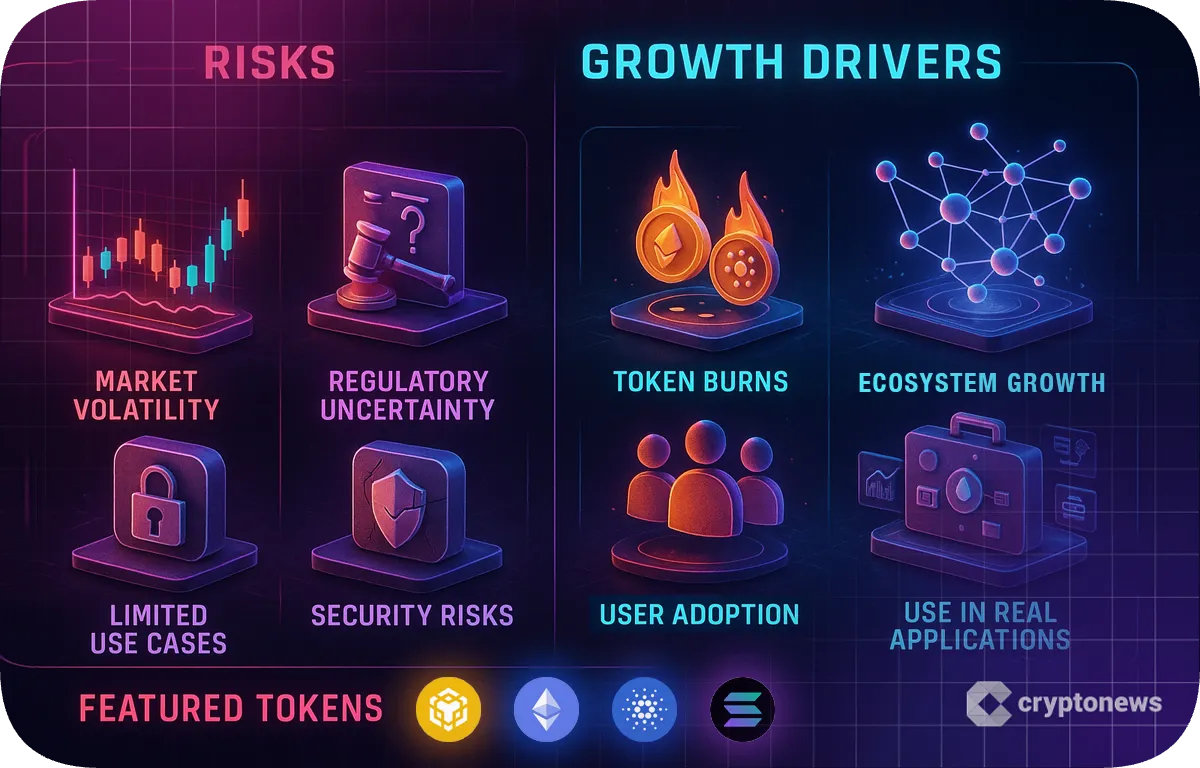
Investing in utility tokens can be risky due to several factors. The main contributors are market volatility, regulatory uncertainty, limited use cases, and security risks.
Despite these risks, utility tokens like BNB +1.92%,  ETH +2.46%, and
  ADA +0.71% remain some of the best cryptos to buy now because of their strong ecosystems, widespread adoption, and crucial roles in powering various blockchain applications. These factors contribute to their long-term potential and attractiveness to investors.
How Do Utility Tokens Increase in Value?
The main reason utility tokens might gain value over time is the increased demand driven by the growth and success of the platform or ecosystem they are associated with. As more people join the ecosystem and engage in its activities, the demand for utility tokens rises, driving up their value.
A limited supply can also help increase the utility token’s value. In this case, some mechanisms, such as token burns, can be used to reduce the circulating supply.
A great example of a token that has managed to rise in value is SOL +2.20%, the utility token of the Solana blockchain. Due to its scalable, high-speed blockchain network, this token has become one of the fastest-growing cryptocurrencies in 2025.
Over the last 12 months, SOL has increased around -, a remarkable rise that attracted new developers and projects, further increasing the demand for the tokens.
Are Utility Tokens Subject to Different Tax Implications?
In general, utility tokens have the same tax implications as other cryptocurrencies — they are subject to capital gains tax based on their value appreciation.
But remember, regulations can change depending on the region you are located in. We recommend you consult a local tax professional if you have doubts or need advice.
Final Thoughts on Utility Tokens
Utility tokens have become an important element of the crypto industry. They offer various purposes, from facilitating transactions to granting access to services within blockchain networks.
While these tokens enable innovative applications and foster ecosystem growth, they are also subject to regulatory uncertainties, market volatility, and limited use cases, posing significant risks to investors.
Fortunately, companies and developers are working to overcome those risks. Some of the actions taken include enhancing token utility, implementing robust security measures, and navigating regulatory landscapes to ensure the long-term viability of their projects.
Understanding the differences between utility and security tokens is critical, as Security Token Offerings (STO) have a completely different set of regulations than utility tokens.
👉 Read our guide on Security Token Offerings (STO) to learn more.
FAQs
Is Bitcoin a utility token?
 BTC
BTC Is Ethereum a utility token?
What sets utility tokens apart from cryptocurrencies?
References
2M+
250+
8
70







 in numbers

About Cryptonews
Our goal is to offer a comprehensive and objective perspective on the cryptocurrency market, enabling our readers to make informed decisions in this ever-changing landscape.
Our editorial team of more than 70 crypto professionals works to maintain the highest standards of journalism and ethics. We follow strict editorial guidelines to ensure the integrity and credibility of our content.
Whether you’re looking for breaking news, expert opinions, or market insights, Cryptonews has been your go-to destination for everything cryptocurrency since 2017.


 Ihssan El Medkouri
 Anatol Antonovici