Cardano vs Solana: Which Blockchain is Better in 2026?





Cardano and Solana are two of the largest proof-of-stake (PoS) blockchains. Their main differences lie in their consensus mechanisms and performance. Solana is faster and more developer-friendly than Cardano, although it has experienced multiple network outages.
The native coin of Cardano is ADA, while Solana is powered by SOL. In 2025, Solana remains the winner between the two due to its superior performance and larger ecosystem. Solana’s dominance is also reflected in its market capitalization, which is three times larger than that of Cardano.
Both Cardano and Solana were conceived as improved alternatives to Ethereum, trying to achieve faster speed and greater scalability. However, they’re both yet to exceed Ethereum in terms of adoption.
In this article, we explore Cardano vs Solana to help you understand how they differ and which one could be the better option this year.
Cardano vs Solana: Key Differences at a Glance
Let’s begin with a quick comparison of Cardano and Solana across several key metrics.
| Feature | Cardano | Solana |
| Consensus | Ouroboros PoS
|
Proof-of-History + PoS
|
| Smart Contract Language | Plutus (based on Haskell) | Rust, C, C++ |
| TPS (theoretical) | 250–1,000 | 65,000+ |
| TPS (real-world) | 250 | 2,000–3,000+ |
| Finality Speed | 1–2 minutes | <13 seconds |
| Average Transaction Fees | $0.10–$0.30 | <$0.01 |
| Ecosystem Age | Launched mainnet in 2017 | Launched mainnet in 2020 |
| Decentralized Finance TVL | $466M | $11.4B |
| Stablecoin Market Cap | $31M | $11.3B |
| Smart Contract Dev | More conservative, research-driven rollout | Fast-paced, developer-friendly |
| Uptime/Outages | 100% uptime, no major outages | Several major outages in past years |
A quick glance shows that Solana outperforms Cardano on key fronts and boasts a much larger ecosystem.
Before exploring each aspect in more detail, let’s introduce you to each of the two chains.
What is Cardano?
Cardano is a decentralized, public blockchain launched in September 2017 by former Ethereum co-founder Charles Hoskinson and former Ethereum executive assistant Jeremy Wood.
Hoskinson and Wood sought to improve Ethereum infrastructure, which at the time used a proof-of-work (PoW) algorithm, by offering higher speed and throughput and cheaper fees.
The network is supervised by three separate entities:
- Cardano Foundation: The Swiss nonprofit focuses on ecosystem growth and community engagement.
- Input Output Global (IOG): Formerly known as IOHK, it focuses on protocol research and engineering.
- Emurgo: The commercial arm that develops tools and advises projects willing to build on Cardano.
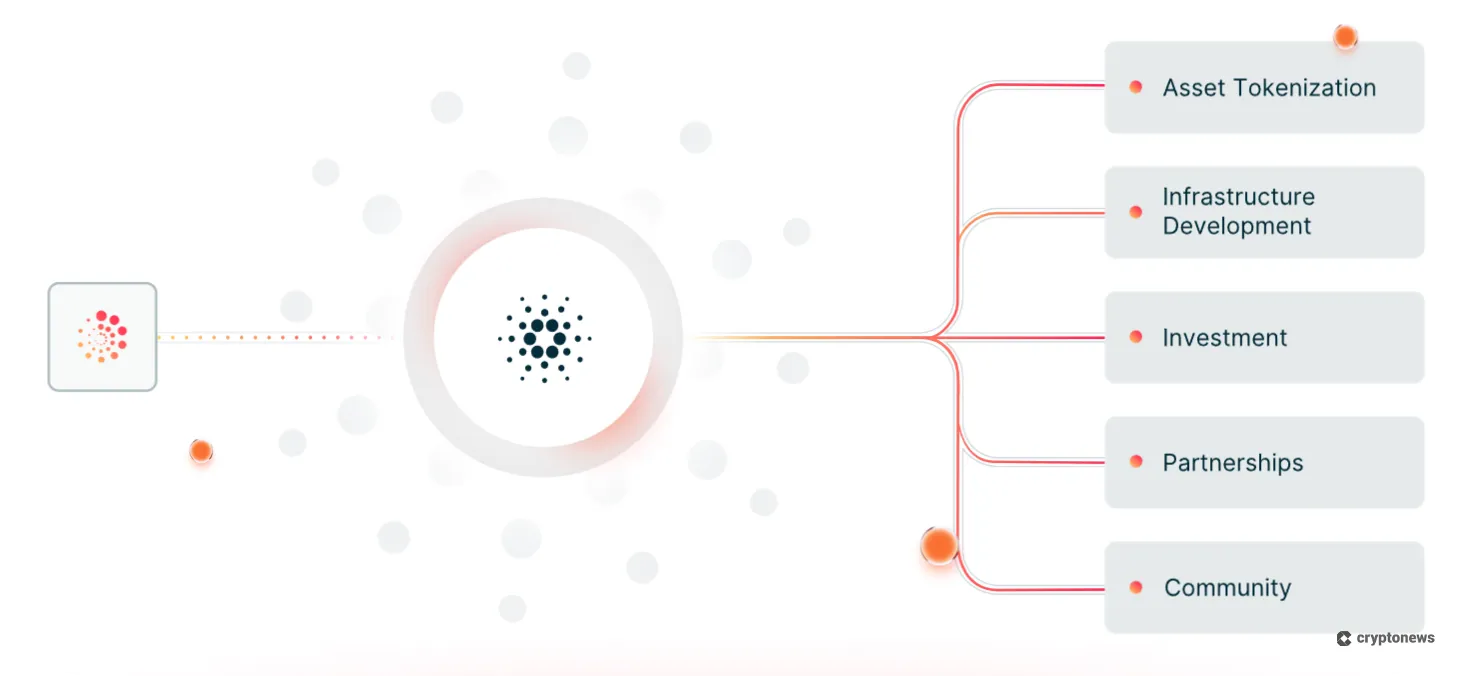
Like Ethereum and Solana, Cardano supports smart contracts, which are self-executing computer programs that power decentralized applications (dApps). Cardano added support for smart contracts at the end of 2021, after years of testing.
The Cardano chain is comprised of two layers:
- The Cardano Settlement Layer (CSL) is used for ADA transfers.
- The Cardano Computation Layer (CCL) supports the smart contract functionality, enabling developers to create dApps.
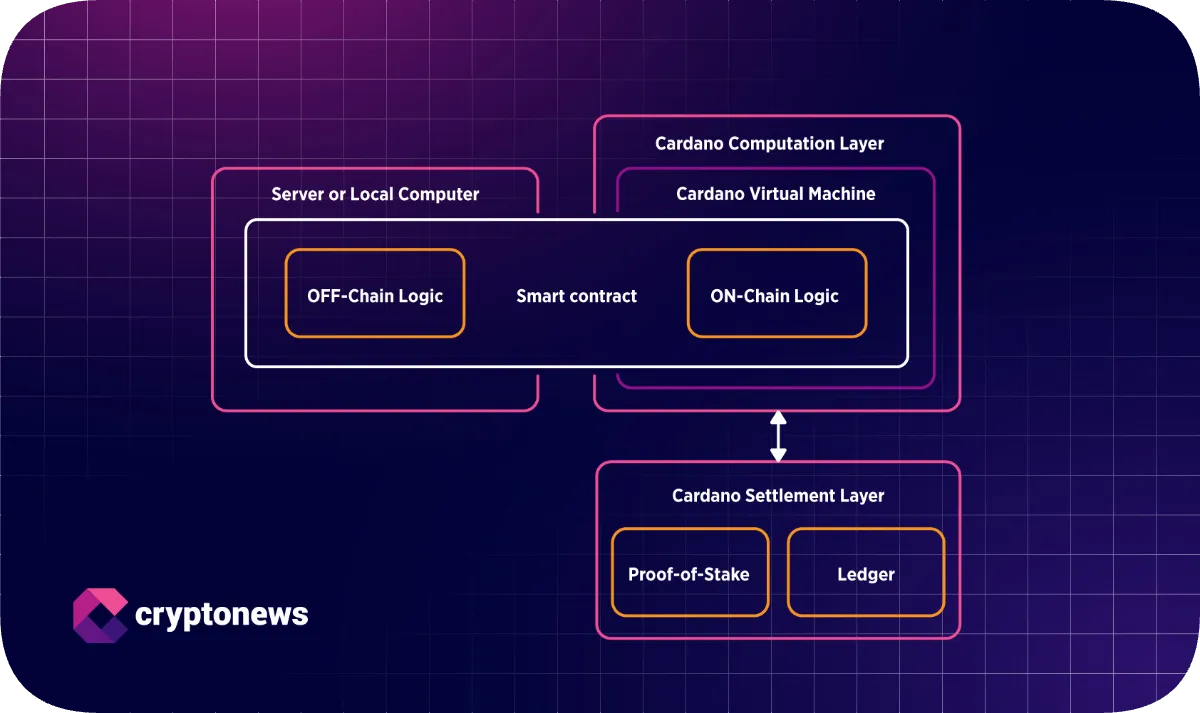
This separation makes Cardano more efficient and flexible compared to the first version of Ethereum.
What sets Cardano apart is its unique PoS consensus algorithm called Ouroboros, which claims to be the first provably secure system of its kind.
As with any PoS system, ADA holders can stake the token to participate in the block validation process. However, unlike most other PoS chains, there is no lockup period and no slashing penalties when staking ADA.
Interestingly, Cardano uses a scientific, peer-reviewed process before developing any new product or service.
Cardano raised over $60 million during multiple initial coin offering (ICO) rounds until 2017. Its main goal is to become a global crypto ecosystem, reach the unbanked people, and support decentralized finance (DeFi) services.
What is Solana?
Solana is a public blockchain network that offers smart contract functionality to build dApps and crypto projects.
While offering similar features to Ethereum and Cardano, Solana’s main focus is performance, delivering some of the highest speeds in the industry.
Solana is the brainchild of Anatoly Yakovenko, the computer scientist who co-founded the network with entrepreneur Raj Gokal.
The duo established Solana Labs in 2017, which laid the foundation for the Solana mainnet launched in 2020 after raising $1.76 million in a public sale. Eventually, Solana Labs raised nearly $350 million in multiple private rounds.
The blockchain also uses a PoS algorithm, but it stands out thanks to its additional proof-of-history (PoH) feature, which works as a cryptographic time-stamping system that allows validators to process transactions in parallel. The PoH generates a historical record of each event, working in tandem with Tower BFT, a consensus system that enables validators to agree even if some computer nodes fail.
This system has worked since the mainnet launch, but Solana Labs is planning to implement a major upgrade called Alpenglow. It will eliminate the PoH and Tower BFT systems altogether, replacing them with Votor and Rotor features. The former will manage voting and block creation, while Rotor will take over communication between nodes.
The upgrade is meant to reduce latency even further and streamline Solana transactions.
While the roadmap for Alpenglow is still in discussion, Solana is rolling out the much-anticipated Firedancer upgrade in 2025, which will enable the network to handle over 1 million transactions per second (tps).
Today, Solana has a theoretical capacity of 65,000 tps, which is already one of the highest figures in the industry.
The main goal of Solana is to offer a Web2-like dApp experience for developers and users.
Now let’s compare Solana and Cardano side by side to see how they perform.
Performance Comparison: Solana vs Cardano Speed, Scalability, Cost, and TPS
Developers looking to create applications that scale will first pay attention to the performance of a blockchain. Solana demonstrates much faster blockchain speed than Cardano.
TPS Capacity
Cardano vs Solana TPS data shows the latter as the clear winner. Solana has claimed it can handle 65,000 tps, while Cardano can process up to 300 tps, which is still a major leap from what Bitcoin and Ethereum are capable of.
At the end of 2024, Cardano demonstrated that it can reach an impressive 1 million tps with its Layer 2 scaling solution called Hydra.
However, Solana aims to hit that mark on its Layer 1 chain with the Firedancer upgrade.
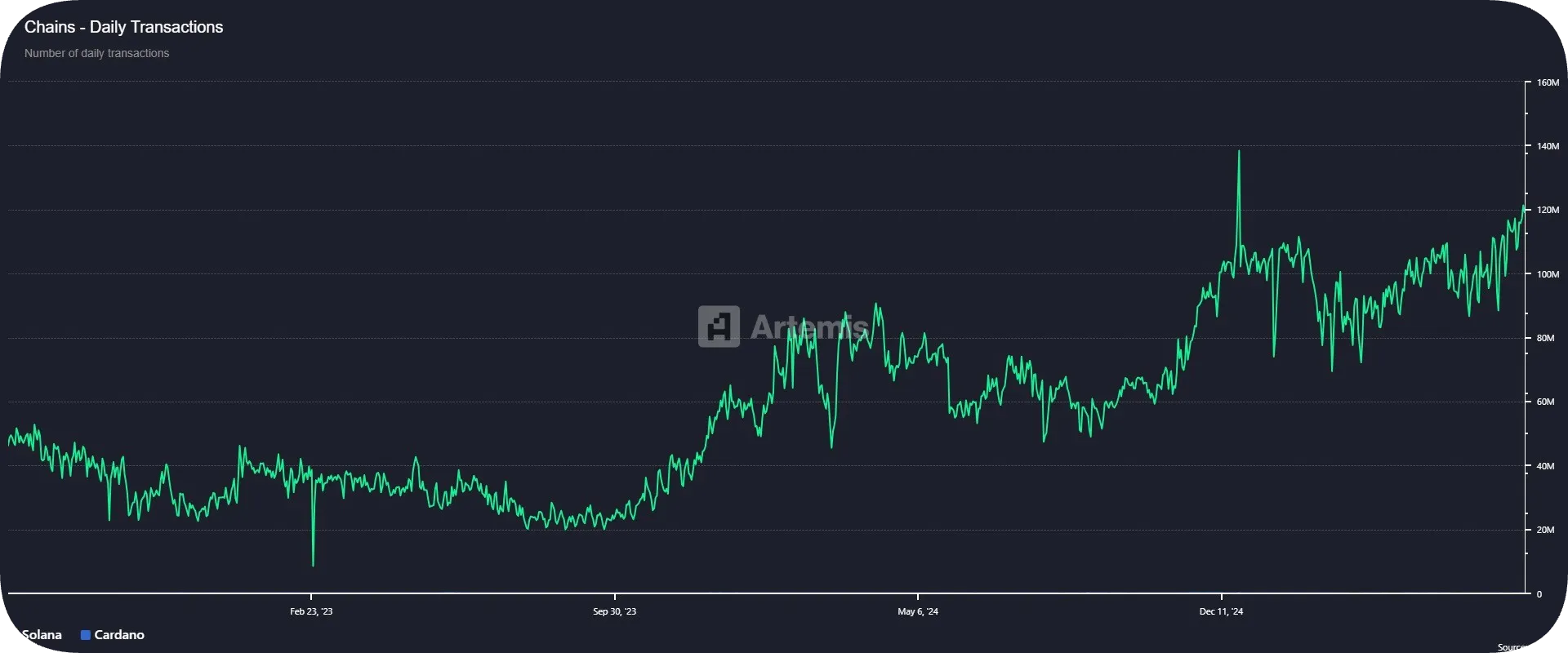
In reality, Solana has been handling over 100 million transactions per day for most of 2025, while Cardano’s daily transaction count has remained below 100,000, which reflects the major adoption discrepancy between the two.
Transaction Finality
Transaction finality refers to how fast any transaction is confirmed, and Solana is the winner here as well, as it reaches finality within less than 13 seconds versus 2 minutes on Cardano, as per Chainspect.
With the Alpenglow upgrade, Solana plans to cut finality by 100 times, to 100-150 milliseconds.
Execution Approaches
Solana achieves parallel processing thanks to its smart contract execution engine called Sealevel. It works like a factory with multiple product lines running simultaneously. Elsewhere, Cardano uses the eUTXO model, which functions like a single line where each step is verified.
While Solana focuses on speed, Cardano is more predictable and may be more secure for certain use cases.
Cost
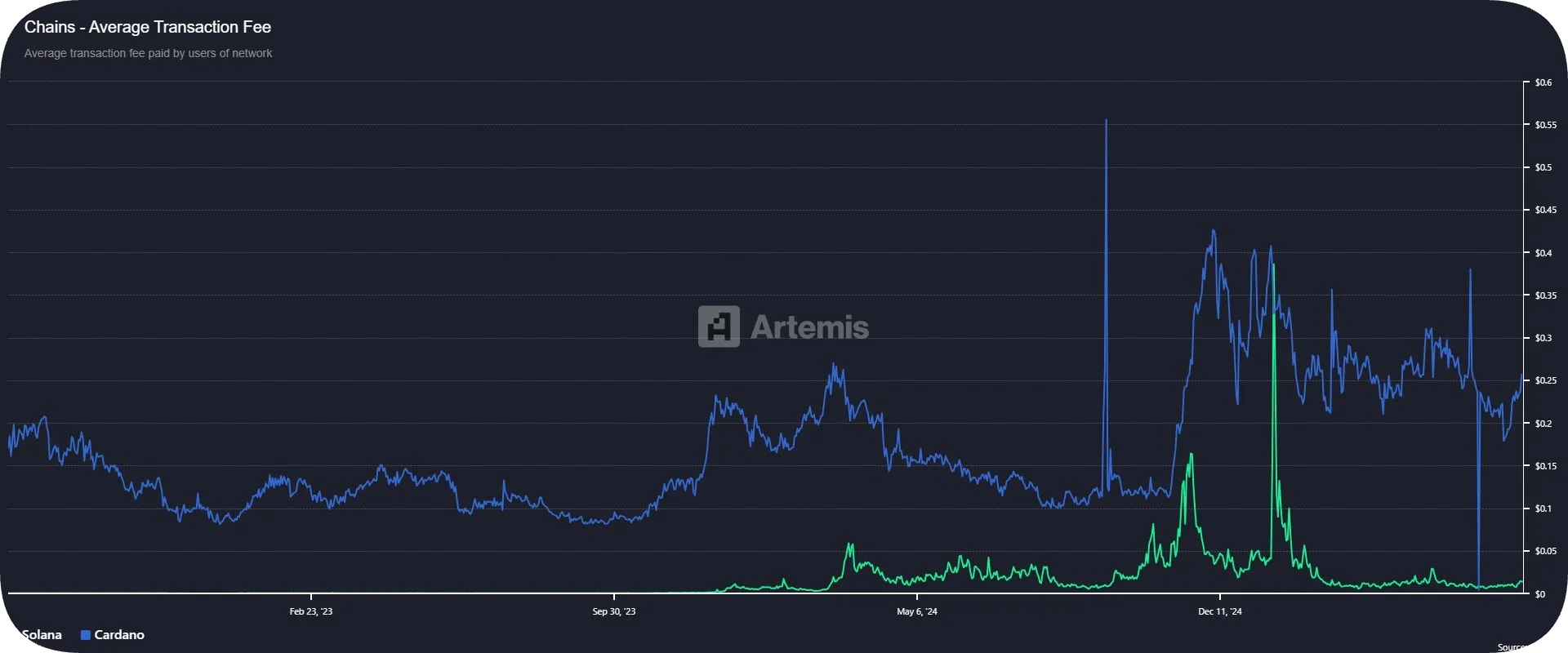
Both chains offer low fees, but Solana is over ten times cheaper than Cardano. Solana’s average transaction fee ranges between $0.001 and $0.02, compared to up to $0.4 on Cardano.
Scalability
The scalability of Cardano can be significantly improved with Hydra. Meanwhile, Solana aims to scale directly on its Layer 1 network.
By offering higher throughput and lower transaction costs, Solana attracts more developers and users, demonstrating its ability to scale better.
Smart Contracts and Developer Tools: Cardano vs Solana for Builders
In addition to superior performance, next-generation blockchains like Cardano and Solana must be developer-friendly if they seek to build large ecosystems of apps across multiple use cases. Let’s see how the two networks compare:
Plutus vs Rust Smart Contracts
When it comes to programming languages, Cardano uses Plutus, a Haskell-based language that enables developers to build secure apps. However, it’s more difficult to learn and less common.
Elsewhere, Solana smart contracts are built in Rust or C, which are quite popular among developers.
For example, DeFi protocols like Jito, Jupiter, and Meteora are built in Rust, leveraging Solana’s speed and low latency.
Difficulty Level:
- Cardano: Hard
- Solana: Medium
Developer Tools and Support
Solana offers better tools for developers to build with, including frameworks like Anchor, which simplify app building and deployment. It offers detailed and updated documentation and active Discord channels to help programmers.
Cardano also provides great tools, such as Aiken. While its tools have improved over the last few years, they’re still typically harder to grasp.
Difficulty Level:
- Cardano: Medium–Hard
- Solana: Easy–Medium
Ecosystem Maturity and Libraries
The Solana developer ecosystem is more diverse and includes more open-source templates and SDKs. Developers can also analyze hundreds of DeFi protocols built on Solana, compared to only about 50 dApps on Cardano.
Ecosystem Maturity:
- Cardano: Low
- Solana: High
Complexity vs Performance
Cardano focuses on security and sticks to a research-driven approach that is more rigid and complex. Solana prioritizes performance, but developers should be ready for occasional runtime problems.
Overall, Solana is more developer-friendly and its dApp ecosystem is more diverse and mature compared to Cardano.
Overall Difficulty for Builders:
- Cardano: Medium–Hard
- Solana: Medium
Cardano vs Solana Ecosystem: NFTs, DeFi, and dApp Adoption Compared
Thanks to the smart contract feature, both Cardano and Solana can host dApps and tokens, serving as the underlying infrastructures for a wide range of use cases. However, Solana has a much larger ecosystem. In fact, it is the second-largest chain by ecosystem value after Ethereum.
DeFi Growth
When comparing Solana vs Cardano DeFi growth, we can observe that Solana has experienced a boom-and-bust cycle before consolidating its position as the second-largest blockchain in DeFi, with $11.5 billion in total value locked (TVL) as of mid-July 2025, overcoming the likes of BSC and Tron.
Elsewhere, Cardano has never crossed the $1 billion mark, but its TVL has followed a growth trajectory since 2022.
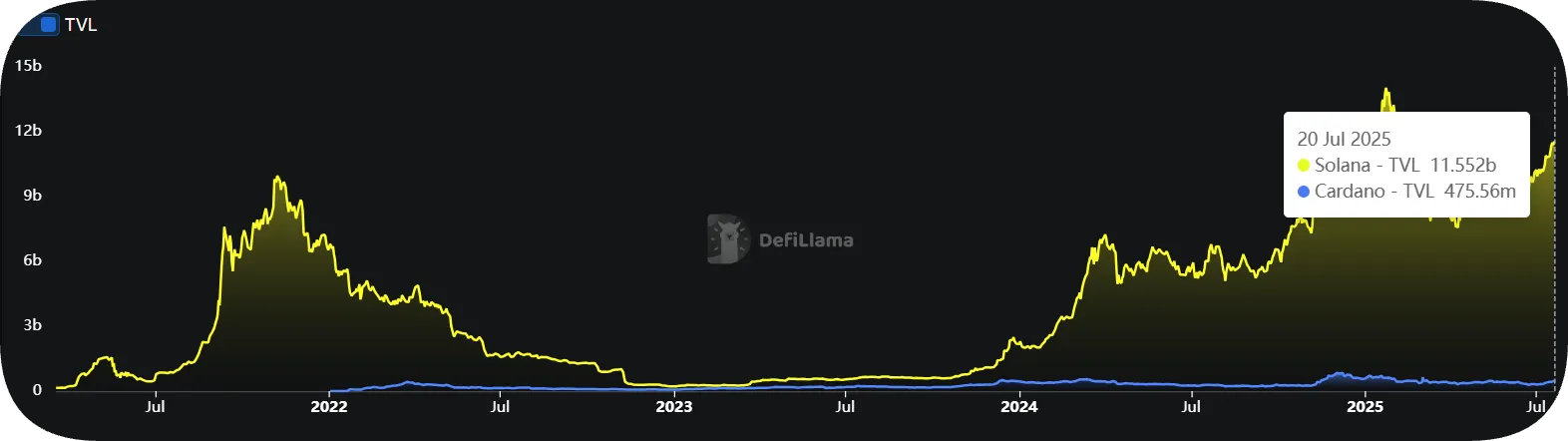
Currently, Solana accounts for nearly 8% of the DeFi TVL, which continues to be dominated by Ethereum.
DefiLlama, the go-to DeFi analysis platform, tracks over 230 protocols built on Solana versus 51 on Cardano.
Some of the largest protocols on Solana include Jito, Jupiter, and Raydium, each exceeding $2 billion in TVL. Raydium is also the third-largest decentralized exchange (DEX) by trading volume after PancakeSwap and Uniswap.
The two largest protocols on Cardano are Liqwid, a lending platform, and Minswap, a DEX, each with over $100 million in TVL.
Interestingly, Solana holds the record for the highest monthly DEX trading volume, reaching $260 billion in January 2025. It is currently the second most active DEX chain after BSC.
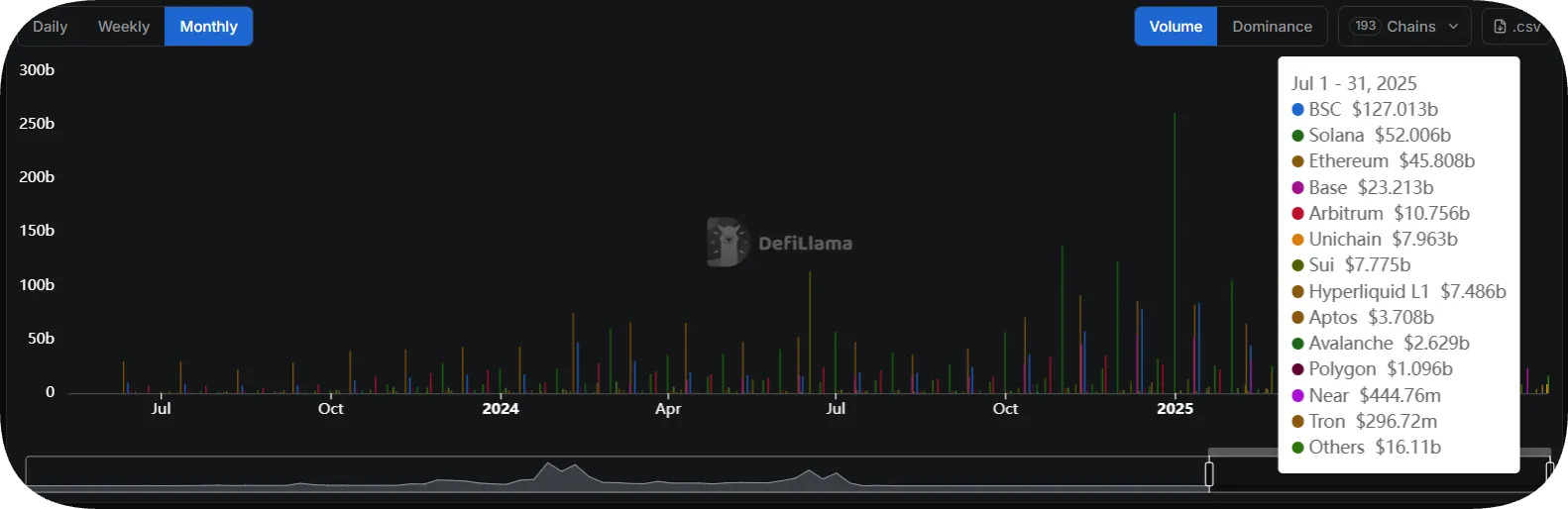
In conclusion, as it stands, Cardano is far from being a competitor to Solana in DeFi.
NFT Ecosystems Compared
While non-fungible token (NFT) sales have been steadily declining since 2021 peaks, Solana and Cardano remain the leading blockchains for NFT collectibles and in-game assets.
Cryptoslam data shows that Solana is the second-largest chain by all-time NFT sales, after only Ethereum, with nearly $6.4 billion. Cardano ranks ninth with $661 million, surpassing BNB Chain, Arbitrum, and Base.
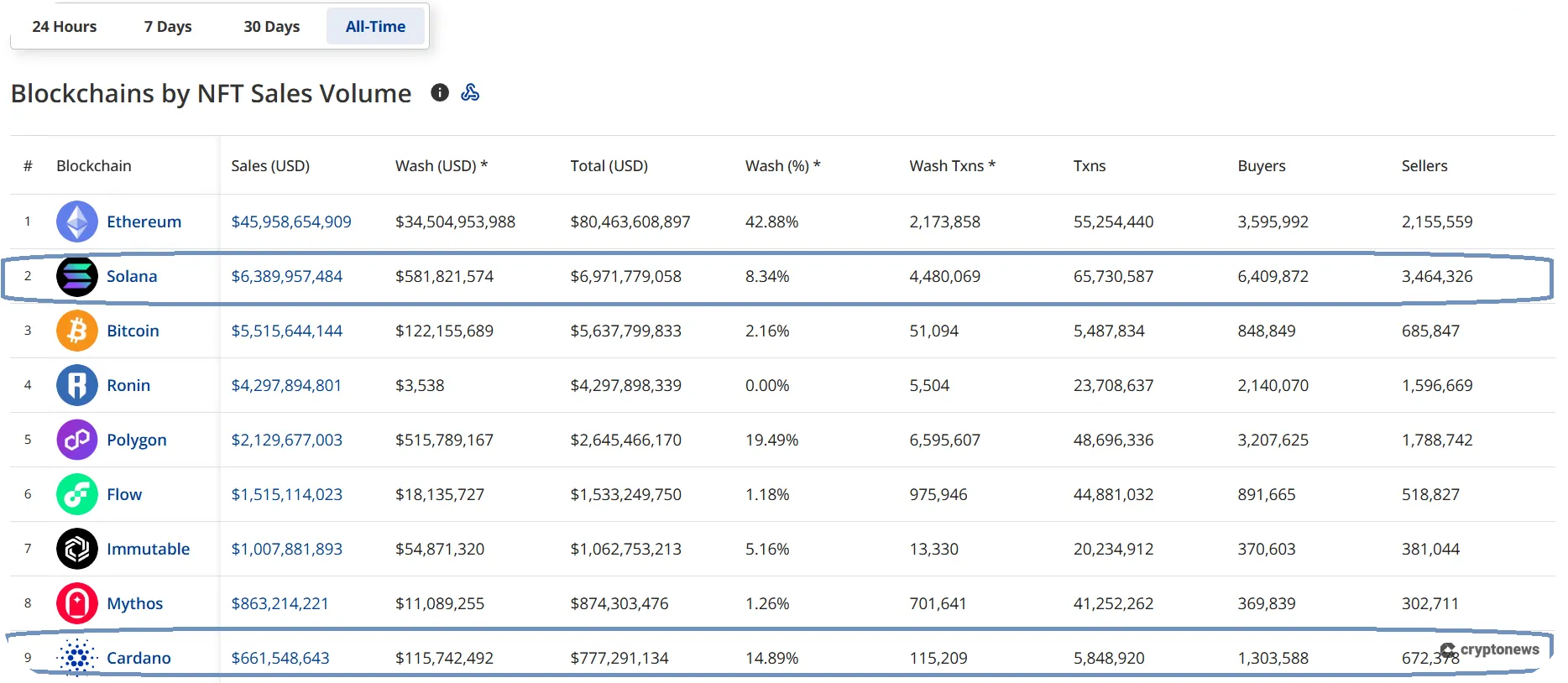
In July 2025, Solana was only on the 7th, followed by Cardano. However, the monthly sales gap between Cardano NFTs vs Solana NFTs is still wide.
Real-World Assets and Tokenization
One of the main selling points of smart contract chains is the ability to tokenize real-world assets (RWAs), including stocks, bonds, real estate, and commodities.
The World Economic Forum (WEF) calls asset tokenization the next generation of value exchange, highlighting benefits like programmability, shared system of records, fractionalization, and flexibility.
According to data from RWA.xyz, Solana holds over $500 million worth of RWAs, excluding stablecoins, making it the third-largest chain. Meanwhile, Cardano’s RWA market is too small to make the list.

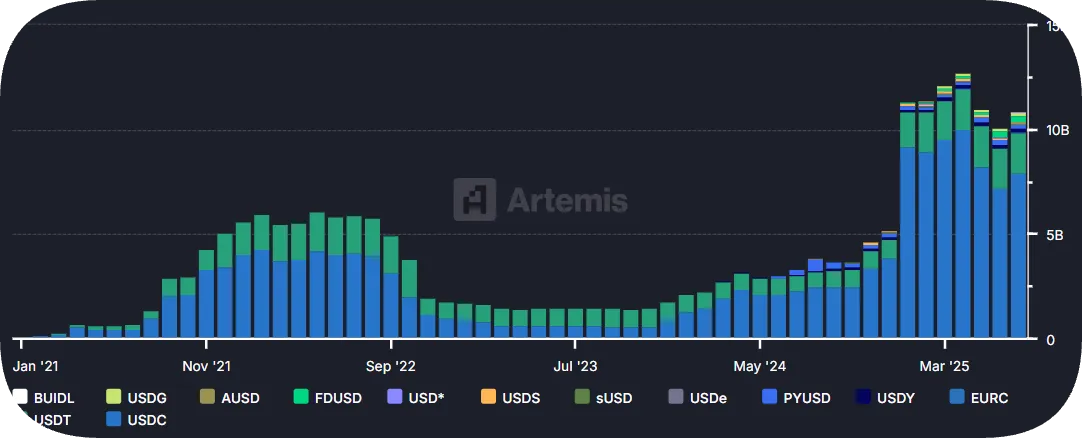
When it comes to stablecoins, Solana boasts a market cap of over $11 billion versus only about $30 million worth of stables on Cardano.
USDC accounts for over 70% of the stablecoin supply on Solana, followed by USDT.
User Adoption and Real-World Usage
Solana has a much wider ecosystem, and activity on its network is more intense compared to Cardano. In fact, Solana has consistently had the highest number of active addresses and transactions.
In 2025, Solana has had between 3 million and 8 million active addresses per day, versus 20,000-30,000 on average on Cardano. This is less than 1% of the active wallets on Solana.
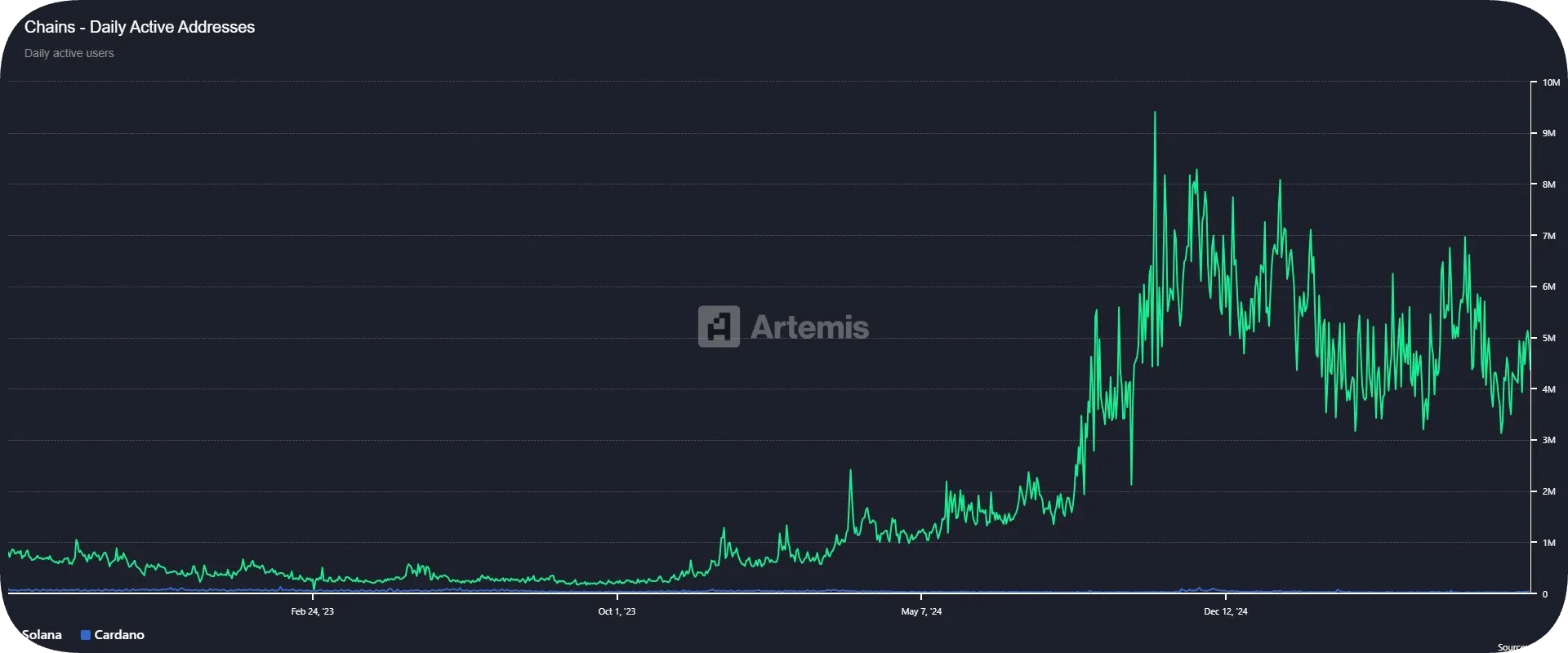
As mentioned earlier, Solana has been handling over 100 million transactions per day for most of 2025, being in a league of its own. Sui, Near, and Aptos follow next with only 4-5 million each. Meanwhile, Cardano’s daily transaction count remains below 100,000.
One of the main drivers behind Solana’s activity is meme coins. The network boasts one of the largest meme coin ecosystems, with a total market cap of about $15 billion. Cardano hosts only a few dozen meme coins with a tiny market cap.
ADA vs SOL: Staking, Supply, and Tokenomics Breakdown
Solana is the clear winner from a developer and user perspective, but which native coin is the better investment? Despite the major gap between their ecosystems, SOL’s market cap of $59.80B is only about three times larger than that of ADA. Does that mean Cardano is overvalued?
Let’s take a glance at some ADA vs SOL tokenomics factors to see whether it’s still worth investing in them.
Both coins are used to pay for transaction fees, interact with smart contracts, and participate in network security through staking. Also, both Solana and Cardano plan to add governance features in the future to let the community vote on proposals.
ADA has a maximum supply capped at 45 billion coins, 45.00B of which are in circulation, representing 78%. New ADA is issued from the reserve at a controlled inflation rate of 0.3% per epoch, which is about 2% per year. Inflation is designed to decrease over time. As of September 6, 2026, ADA is priced at $0.22, with a market cap of $9.92B, making it the ninth-largest coin.

SOL has no maximum supply limit, and it started with an initial total supply of 500 million, gradually minting new tokens to reward stakers. The circulating supply is currently at 630.74M tokens. SOL started with an inflation rate of 8% per year, decreasing 15% every year toward a long-term floor of 1.5%. The current inflation rate is about 4.4%.
Solana also implements a deflationary mechanism, burning 50% of all fee revenue.
SOL is currently priced at $94.81, having a market cap of $59.80B, which makes it the sixth-largest cryptocurrency.

Cardano Staking vs Solana Staking
Both Cardano and Solana use their own versions of PoS algorithms and support staking. The main difference is that ADA has no lockup and doesn’t impose penalties.
SOL provides one of the best staking rewards in crypto at 7.5%, attracting nearly $75 billion worth of tokens, which represents 66% of the circulating supply. Users can stake with one of over 1,000 Solana validators, being able to unlock at any time, although with a 2-4 unbonding period.
ADA offers a reward rate of 2.5%, with $19 billion worth of tokens, or 60% of the supply, being staked at the time of writing. ADA holders can delegate or run pools by staking with no lockup periods.
| Metric | Cardano (ADA) | Solana (SOL) |
| Max Supply | 45 billion | No hard cap Initial supply of 500 million |
| Staking Available | Yes | Yes |
| Avg. Staking APY | 2.5% | 7.5% |
| Token Burn Mechanism | No | Yes |
| Inflation Rate | ~2% | ~4.4% |
While Cardano has a capped supply and offers more flexible staking conditions, Solana has a higher staking reward and implements a deflationary mechanism to control supply.
Considering staking yields, token utility, network activity, and investor incentives, SOL currently offers a more rewarding token model for high-risk investors, while ADA is more predictable and stable.
Wallet Support and User Accessibility: Cardano vs Solana
Both Cardano and Solana are independent blockchains incompatible with the Ethereum Virtual Machine (EVM). However, they have extensive digital wallet ecosystems and multiple interoperability tools.
Some of the best Cardano wallets include Daedalus, AdaLite, and Yoroi, which can be paired with hardware wallets like Ledger and Trezor. ADA holders can also use non-custodial wallets like Trust Wallet, as well as applications like Exodus and Atomic Wallet.
Phantom and Solflare are the best Solana wallets. SOL can also be stored on popular wallets like Exodus, Atomic Wallet, Trust Wallet, and hardware devices like Ledger and Trezor.
In 2025, MetaMask, the most popular EVM wallet, announced full support for Solana.
Network Security and Decentralization: Cardano vs Solana Stability
Solana has often been criticized for being influenced by a small group of entities. Is Cardano more decentralized than Solana? Let’s find out.
As of this writing, there are over 1,000 validators, 21 of which form the so-called superminority, controlling over 33% of the total stake. Some of the biggest validators include Helius, Binance, Coinbase, Ledger, and SOL Community.
Solana validators have high hardware requirements that limit accessibility for regular SOL stakers.
The high centralization of Solana drew attention again in April 2025, when a group of validators coordinated the release of a patch to fix a serious bug that allowed unlimited creation of certain tokens. While the move prevented network failure, it raised concerns about the level of control of a few validators.
In addition to centralization concerns, Solana has also experienced multiple network outages, including an 18-hour halt in 2022. While there have been no Solana network outages since February 2024, the past incidents raised concerns about the network’s long-term reliability.
In contrast, Cardano is considered one of the most decentralized chains, with nearly 3,000 active stake pools distributed globally. As mentioned earlier, its Ouroboros algorithm is backed by peer-reviewed research, and updates are implemented gradually and transparently.
Unlike Solana, Cardano is lightweight enough for retail users to run a node, being more accessible for the public.
While Solana prioritizes high performance, this comes at a cost. Cardano is currently more reliable and decentralized than Solana.
Meanwhile, Solana’s expanding ecosystem attracts many low-quality meme coins and even scam projects, but this is common for other major chains with high activity, including Ethereum.
Which Blockchain Is Better for Users and Investors in 2025?
Solana and Cardano have advantages and drawbacks, and both implement a dynamic approach to continually improving and adding new features.
Let’s see how they meet the demands of users and investors.
Users
- Cardano – Offers a stable, secure network with 100% uptime and no staking lockups, but slower speeds and a small app ecosystem.
- Solana – One of the fastest and cheapest networks, though occasional network outages remain a concern. It has a large and expanding dApp ecosystem.
- WINNER: Solana – Its speed, low fees, and more vibrant app ecosystem make it more attractive for users.
Investors
- Cardano – ADA has a capped total supply, generous staking rewards, and a conservative growth model attracting long-term investors.
- Solana – SOL has no supply cap but implements token burns. It offers higher staking yields and strong market performance, but with greater volatility and centralization risks.
- WINNER: Cardano – While Solana may offer higher returns, Cardano’s predictable tokenomics and lower risk make it a more balanced investment.

Final Verdict – Is Solana or Cardano the Better Blockchain Overall?
Solana and Cardano are PoS chains that support dApps and tokens, offering increased efficiency compared to Ethereum.
Solana prioritizes speed, low fees, and a user-friendly experience, making it a top choice for users and dApp developers. It has a large DeFi and NFT ecosystem and the highest transaction count in the industry.
Elsewhere, Cardano focuses on security, decentralization, and peer-reviewed research, attracting long-term investors and applications that require stability. It doesn’t boast the same activity level, but its balanced approach remains attractive.
You can choose Solana if you want to build or interact with fast, low-cost dApps. If you prioritize decentralization and predictability, you can go with Cardano.
Before making any decision, make sure to thoroughly research all the options and consider how each blockchain aligns with your own goals.
Cardona vs Solana Frequently Asked Questions
Which is faster: Cardano or Solana?
Is Solana better than Cardano for NFTs?
Which is a better long-term investment: ADA or SOL?
Is Solana or Cardano more energy efficient?
What are the staking rewards for Cardano and Solana?
Do Cardano or Solana support meme coins?
References
- Emurgo Diagram (Emurgo)
- Cardano Architecture Diagram (Cexplorer.io)
- Cardano vs Solana Daily Transactions (Artemis xyz)
- Cardano vs Solana Transaction Fee (Artemis xyz)
- Cardano vs Solana TVL (DefiLlama)
- DEX Volume by Chain (DefiLlama)
- NFT Sales Volume (Cryptoslam)
- RWA Markets by Chain (RWA xyz)
- Solana Stablecoins Market Cap (Artemis xyz)
- Cardano vs Solana Daily Active Addresses (Artemis xyz)
- SOL vs ADA Price Chart (TradingView)
2M+
250+
8
70







 in numbers

About Cryptonews
Our goal is to offer a comprehensive and objective perspective on the cryptocurrency market, enabling our readers to make informed decisions in this ever-changing landscape.
Our editorial team of more than 70 crypto professionals works to maintain the highest standards of journalism and ethics. We follow strict editorial guidelines to ensure the integrity and credibility of our content.
Whether you’re looking for breaking news, expert opinions, or market insights, Cryptonews has been your go-to destination for everything cryptocurrency since 2017.


 Camila Karam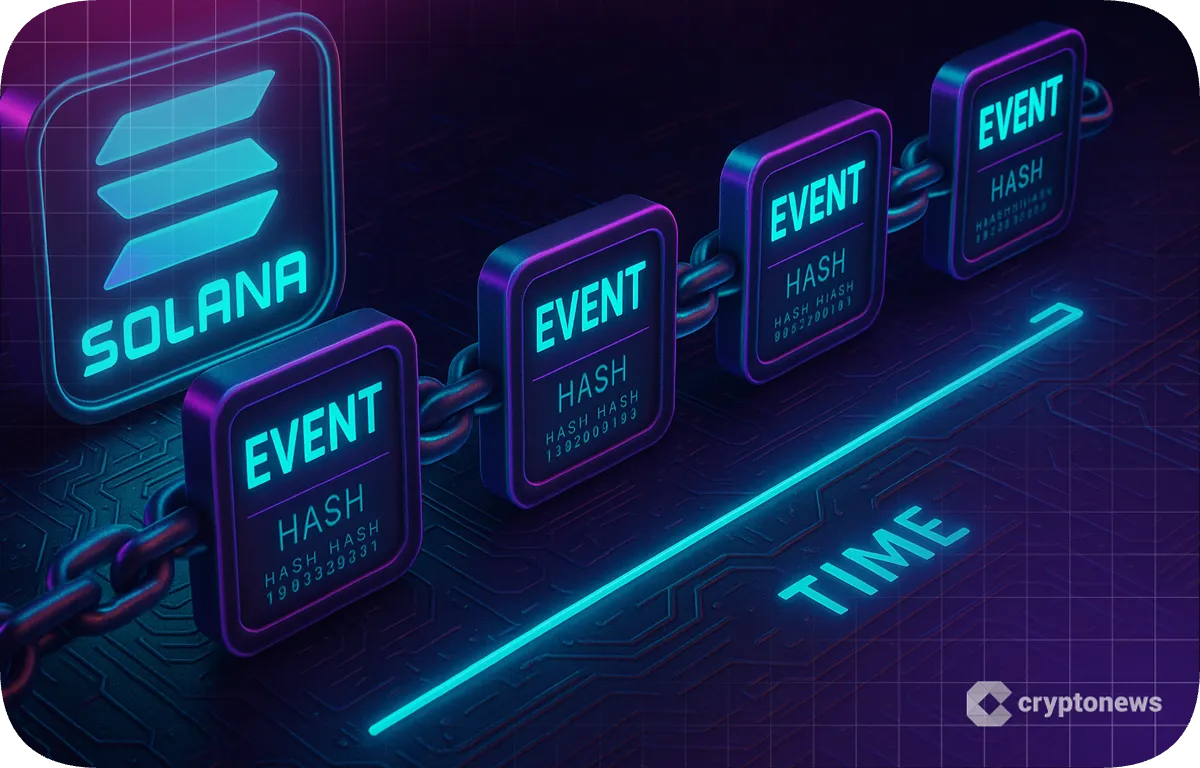
 Ihssan El Medkouri