What Is Proof of History? Solana’s Unique Consensus Guide





Proof of History (PoH) is Solana’s built-in clock. It creates a record of time by linking events together in a chain of hashes, like a cryptographic timeline. This helps the network agree on the order of transactions quickly without needing to check external clocks.
PoH was first introduced in 2017 by Solana’s founder, Anatoly Yakovenko, to solve a core inefficiency in blockchain: the time it takes for nodes to agree on when things happen. To overcome this problem, Yakovenko proposed to bake time directly into the ledger.
This article will help you understand how PoH works. Learning this is important for anyone interacting with blockchain since it’s what makes Solana stand out; PoH is key to Solana’s speed, low fees, and trade-offs.
Key Takeaways
- Proof of History (PoH) is Solana’s built-in way of keeping time. It records events in a cryptographic timeline that lets everyone agree on the order of events without relying on an external clock.
- PoH is not a consensus mechanism; it provides a time source that helps Solana’s Proof of Stake (PoS) reach consensus faster.
- It was created by Anatoly Yakovenko in 2017, based on his work with distributed systems and timing problems.
- PoH works by repeatedly running SHA-256, creating a chain of hashes where each one proves that time has passed.
- Validators can then place events into this timeline, making their order clear and verifiable.
- Solana uses PoH alongside PoS, with help from components like Tower BFT, Gulf Stream, and Sealevel to keep the network fast and efficient.
- That’s how it handles 2,000 to 5,000 transactions per second on average, with ultra-low fees and near-instant confirmations, often in under a second.
- PoH is especially useful in fast-moving applications like DEXs, NFT launches, gaming, and real-time networks.
- The future depends on whether Solana can stay reliable and whether others adopt similar ideas.
What Is Proof of History in Blockchain?
Proof of History, or PoH, is a cryptographic method for keeping track of time on a blockchain without needing an external source. It proves exactly when events happen by recording them in a verifiable sequence.
Each event is hashed one after the other, creating a timestamp. Anyone can check the order and timing just by looking at the data.
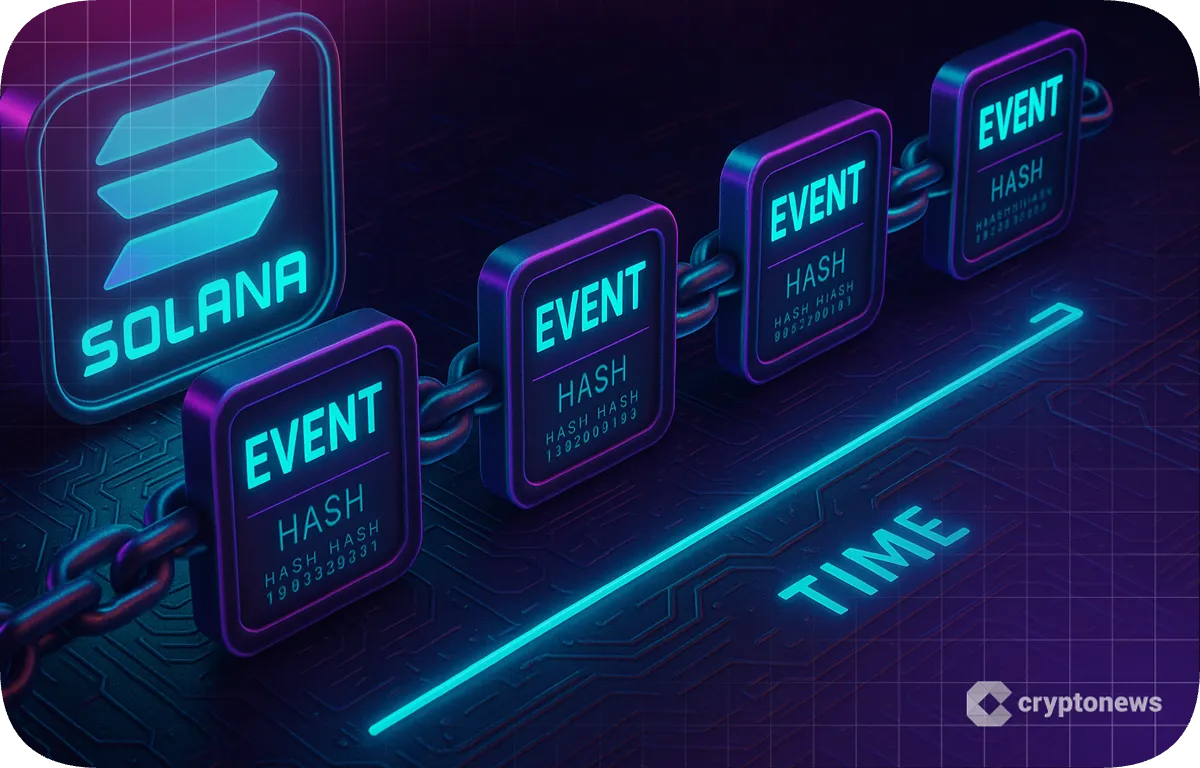
Solana was the first blockchain to use PoH, which helps solve a key problem in distributed systems: agreeing on the order of events without slowing things down. By doing so, Solana could process transactions much faster and more efficiently than most other blockchains.
Who Invented Proof of History?
Proof of History was created by Anatoly Yakovenko, the founder of Solana. In 2017, he published a whitepaper outlining the idea of a cryptographic timekeeping system that could make blockchain run faster and more efficiently.
Before Solana, Yakovenko worked at Qualcomm on distributed systems and clock synchronization. His experience there shaped his thinking, making him realize that if blockchains could trust time without waiting for consensus, then they could move much faster.
That’s how PoH came into life and became the foundation of Solana’s high-speed architecture.
How Does Proof of History Work?
Proof of History keeps hashing data using SHA-256 repeatedly. Each result feeds into the next, creating a chain that shows time has passed. Since each stop depends on the one before, it creates a clear and verifiable timeline.
This process is known as a Verifiable Delay Function. It takes a predictable amount of time to compute, and no one can shortcut it, not even with massive computing power. So, the resulting chain of hashes acts like a trustless clock embedded in the ledger.
Think of time-lapse photography. Each frame proves the moment it was taken because it’s part of a continuous sequence. In PoH, each hash is a timestamp that proves when an event occurred and in what order, without needing a central time source.
This timeline lets Solana pre-order transactions before running consensus. That makes the process faster and takes pressure off blockchain validators, which is how Solana keeps block times typically under a second and handles so many transactions.
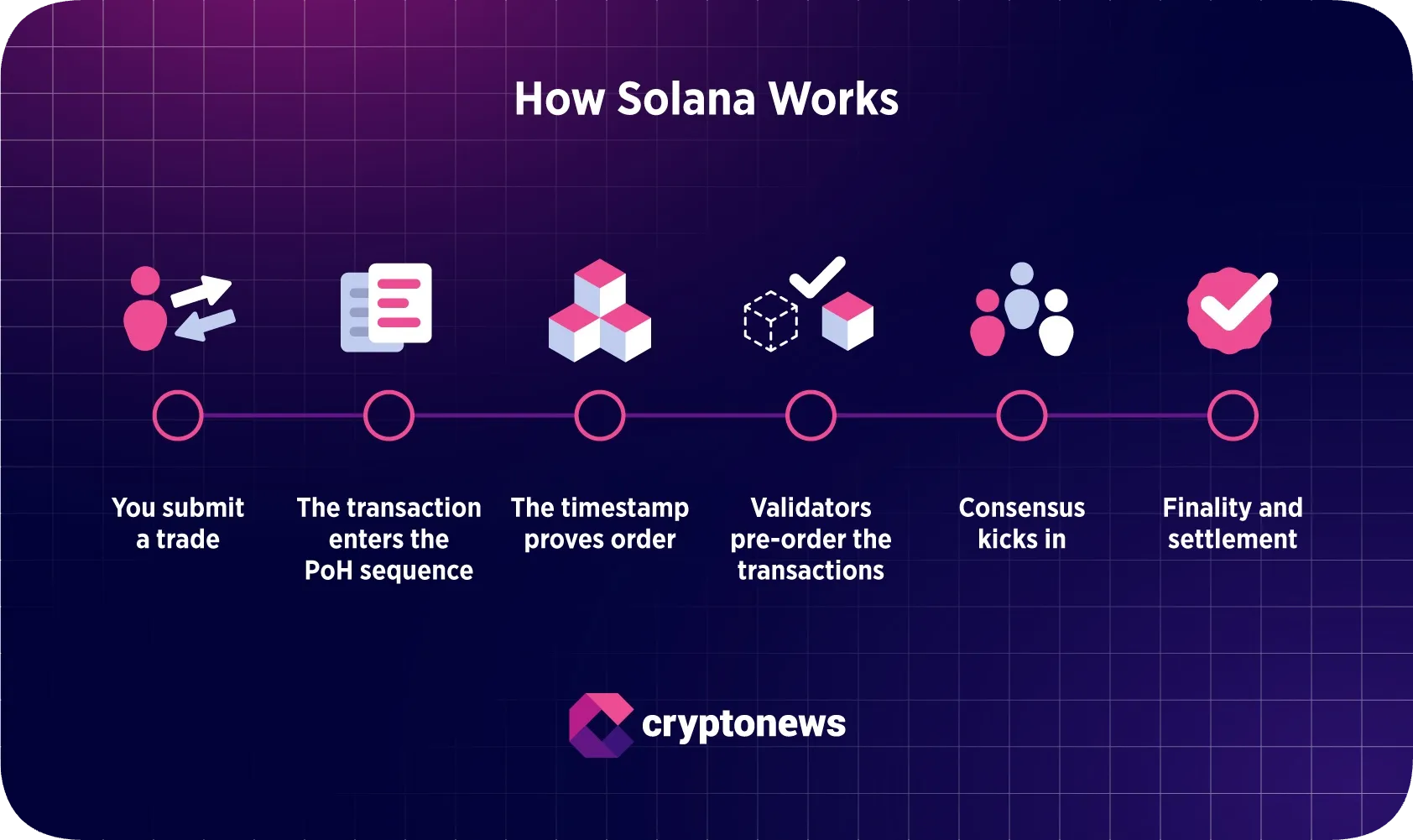
Example of Proof-of-History in Action
Let’s say you are using a decentralized exchange (DEX) on Solana to swap tokens. Here’s how PoH comes into play:
- You submit a trade: A transaction request is sent to the network to exchange Token A for Token B.
- The transaction enters the PoH sequence: Before anything else happens, it gets hashed into Solana’s ongoing chain of SHA-256 hashes, which assigns it a unique, verifiable timestamp.
- The timestamp proves order: Because the hash is part of a sequence, anyone can see when it happened relative to other events, without relying on an external clock.
- Validators pre-order the transactions: Thanks to the built-in timeline, validators don’t need to waste time figuring out which trade came first. The ordering is already done.
- Consensus kicks in: Solana’s PoS + Tower BFT handles final agreement and confirmation, but it now works faster because PoH dealt with the timing.
- Finality and settlement: Your trade clears in under a second, and you receive Token B. Compared to traditional blockchains, the whole process took fewer steps and less coordination.
Solana’s Consensus: Proof of Stake + Proof of History
Solana doesn’t rely only on one system; it combines PoH with PoS to reach consensus. In this hybrid model, PoH handles time while PoS provides security.
Here’s how it all fits together:
- PoH timestamps every event, creating a cryptographic history of all transactions.
- Tower BFT, a version of Practical Byzantine Fault Tolerance, uses those timestamps to vote and finalize blocks. It’s optimized for speed because it trusts the ordering PoH already provided.
- Gulf Stream pushes transactions to validators before they’re even included in blocks, reducing mempool size and improving throughput.
- Turbine breaks data into smaller packets and sends them in parallel, like BitTorrent for blockchains so that Solana can scale effectively.
- Sealevel is Solana’s parallel runtime. It allows smart contracts to run side-by-side, rather than one at a time.
Validator Hardware Requirements
All of this high-speed performance comes at a cost; running a Solana validator requires serious hardware to keep up with the network’s throughput and parallel processing demands. Here’s what you’ll need if you’re thinking about becoming one.
| Component | Recommended Minimum |
| CPU | 12-core / 24-thread, 2.8GHz+ |
| RAM | 128 GB |
| Storage | 2TB NVMe SSD (PCIe Gen4) |
| Network | 1 Gbps upload/download |
| GPU (optional) | Some performance tools support GPU |
Proof of History vs. Proof of Stake vs. Proof of Work
Blockchains need two big things:
- Security: Who gets to add blocks? Can we trust them?
- Ordering: In what sequence did things happen?
Proof of Stake and Proof of Work (PoW) are consensus mechanisms that secure the network and decide block leaders.
Proof of History is not a consensus mechanism; it’s a cryptographic clock that gives the network a trusted timeline so that consensus can move faster.
👉 PoH doesn’t replace PoS or PoW; it supercharges them when combined.
In Solana, PoH supplies a verifiable timeline; PoS and Tower BFT use that timeline to reach a fast, secure consensus.
Let’s see where Proof of History fits alongside today’s dominant consensus methods — how it teams up with Proof of Stake and differs from Proof of Work.
Proof of History + Proof of Stake
- PoS: Selects validators based on staked tokens; provides Sybil resistance and economic security.
- PoH: Produces a running, verifiable timeline so validators know when things happened and can order transactions quickly.
- Solana: Uses PoH to timestamp events; Tower BFT (its PoS consensus) votes and finalizes blocks using that ordering.
Unlike staking‑based PoS, Proof of Work secures chains like Bitcoin, Litecoin, and Dogecoin by making miners burn electricity, solve hashes, and reward the first to find each block. Solana’s Proof of History sidesteps that energy race and speeds up finality.
Proof of History vs. Proof of Work
- PoW: Miners expend energy solving hash puzzles to propose blocks; it’s secure but energy-heavy and has limited throughput.
- PoH: No mining race. A cryptographic clock establishes ordering up front, reducing coordination delays and helping consensus finalize faster.
- Result: Where PoW offers probabilistic finality tied to accumulated work, PoH-accelerated systems like Solana can achieve much quicker confirmations and higher scalable throughput.
What Are the Pros and Cons of Proof of History?
PoH helps Solana scale and perform better but introduces trade-offs. Let’s break them down.
- Deterministic ordering: Events are time-stamped before consensus, reducing latency and validator coordination.
- High throughput: Solana regularly hits 2,000+ TPS, making it one of the fastest blockchains.
- Low fees: Efficiency keeps transaction costs near zero, even during heavy usage.
- Energy-efficient: PoH avoids the energy demands of mining, unlike Proof of Work.
- High hardware requirements: Running a validator on Solana requires serious specs. This raises the barrier to entry and can limit decentralization.
- Clock drift scenarios: Because PoH relies on continuous hashing, recovery can be tricky if the system falls out of sync.
- Limited adoption: No other major blockchain uses PoH. That means its tooling, community, and resilience are mostly tied to Solana alone.
Use Cases and Ecosystem Applications
Proof of History gives Solana the speed and timing needed for demanding use cases. One example is decentralized exchanges like Serum, where fast trading depends on knowing exactly which transaction came first. That kind of precision helps avoid frontrunning and makes trades more fair.
It also comes in handy during NFT launches, where thousands of people try to mint at once. PoH helps keep things moving without crashing the network. Beyond trading and NFTs, PoH also works well for real-time systems.
In projects related to IoT, gaming, or decentralized networks like DePIN, delays of even a second can ruin the experience. Solana’s fast timing helps keep everything in sync. Some trading firms, like Jump Crypto, use it to run high-speed strategies that would be impossible on slower chains.
Because PoH records the order of everything ahead of time, Solana can handle this kind of heavy activity without slowing down.
Future of Proof of History and Competitor Landscape
Solana is still the only major blockchain using Proof of History, but the idea is starting to catch on. A few newer projects are experimenting with ways to add trusted time to their systems, though none have gone as far as Solana has.
That said, PoH faces a few challenges going forward. Its hardware demands could make it harder for everyday users to run validators, which affects decentralization.
The system is also complex, combining PoH with other components like Tower BFT and Sealevel, which isn’t easy to replicate or maintain.
And then there’s the question of how well PoH can play with other blockchains. Interoperability matters, and PoH is still primarily a Solana-only solution.
Additionally, Solana isn’t standing still. It’s rolling out upgrades like Firedancer, a validator client from Jump Crypto that aims to boost speed and stability.
Work is also happening on zero-knowledge compression to cut down data size and light clients, which could make it easier to access the network on mobile. All this could help make Proof of History more accessible in the long run.
Whether or not other blockchains adopt PoH, Solana’s approach is already shaping the conversation about scaling without compromising the user experience.
Conclusion: Why Proof of History Matters
Proof of History changes how blockchains track time. Solana doesn’t wait for everyone to agree on when things happened. It keeps its timeline as it goes. That’s what helps it stay fast, keep fees low, and handle way more activity without getting bogged down.
It’s not without issues. Running a validator isn’t cheap, and the network has had some rough patches. Plus, no other major chain uses PoH, so it still lives in its own corner of the space.
Even so, Proof of History shows there’s another way to do things. If Solana keeps building and improving, we’ll see whether this approach can stick or even spread.
👉 Learn More: Solana vs Ethereum: Which is Better in 2026?
FAQs
Does Solana use Proof of Stake or Proof of History?
Is PoH or PoS better?
Would Proof of History still work if SHA-256 became obsolete or insecure?
How does PoH impact transaction fees and network congestion on Solana?
References
- Solana and the SOL Market Documentation (Papers SSRN)
2M+
250+
8
70






 in numbers

About Cryptonews
Our goal is to offer a comprehensive and objective perspective on the cryptocurrency market, enabling our readers to make informed decisions in this ever-changing landscape.
Our editorial team of more than 70 crypto professionals works to maintain the highest standards of journalism and ethics. We follow strict editorial guidelines to ensure the integrity and credibility of our content.
Whether you’re looking for breaking news, expert opinions, or market insights, Cryptonews has been your go-to destination for everything cryptocurrency since 2017.


 Camila Karam
 Anatol Antonovici