Why Does Bitcoin Have Value?





Bitcoin is a decentralized digital currency envisioned as a borderless money system that can operate without the supervision of a centralized authority, i.e. a government, institution, company, or regulator. Launched in 2009 by a pseudonymous entity, it is the first use case of blockchain – the underlying technology that ensures its decentralized design.
But why does Bitcoin have value without being governed by a traditional entity and having no physical backing? The answer will lead us to a mix of blockchain features and an unshakable community trust.
The key factors that contribute to Bitcoin’s value include:
- Limited supply – Bitcoin has programmed scarcity that limits its total supply to 21 million coins.
- Underlying technology – Blockchain technology ensures the coin’s robust security and immutability, preventing double-spending and transaction tampering.
- Decentralized design – While it may seem counterintuitive, Bitcoin earns trust by operating in a trustless environment. This means there is no single entity controlling it. Instead, a decentralized network of computers spread all over the world collectively manages the transactions.
- Utility – Bitcoin is used as a means of exchange and store of value, driving its adoption.
Let’s dive deeper to understand how we ended up paying so much for Bitcoin.
The Concept of Value in Money
A currency has value because people trust and accept it as a means of exchange. Throughout history, the use of different currencies helped us evolve from barter trade, where people exchanged one good for another directly, such as wheat for meat.
The U.S. Federal Reserve (Fed) lists six traits for an item to serve as money: scarcity, portability, durability, divisibility, acceptability, and uniformity (or fungibility). As you’ll see, Bitcoin meets all these criteria.
To begin with, we should recognize that trust and acceptability are the most important ingredients for making a currency valuable and ensuring its demand. Any item can become a currency if the community adopts and trusts it.
Commodities as a Means of Exchange
Did you know that the word ‘salary’ likely derives from the Latin equivalent for ‘salt’? This is because Roman soldiers were paid a ‘salarium,’ representing a form of money used to buy salt. In West Africa, salt was used as a currency and often traded for gold.
Other goods that were used as currencies include coffee, rice, and tobacco. However, these commodities had regional demand and were often prone to erosion. Gold and silver emerged as better currency alternatives due to their scarcity and durability, being used in international and eventually global trade until modern times.
The Shift to Fiat Money
Fiat money originated as IOU (I owe you) notes for gold and silver coin deposits. You will be surprised to know that some of these IOUs were made of wood, such as these tally sticks issued by the Royal Treasury of England since the 1100s.

Over time, paper money has become the global standard for exchanging value due to its portability and flexibility. However, the world abandoned the gold standard about fifty years ago, leaving fiat money backed solely by trust in the government issuing it.
Without gold backing, governments gradually expanded the fiat supply to stimulate the economy. For example, here is the total value of USD banknotes and liquid deposits over the past seven decades:

Yes – that jump reflects the U.S. Fed’s effort to help the economy during the COVID-19 lockdowns.
The problem is that the resulting inflation erodes fiat currency’s purchasing power, making long-term savings less reliable. Now, here is where Bitcoin comes in:
- The cryptocurrency has programmed scarcity, being rarer than gold itself.
- It is as portable and easy to use as fiat money.
Sharing the two best features of gold and fiat, Bitcoin can set the standard for a new form of money.
Bitcoin’s Limited Supply and Scarcity
An asset’s value is determined by the interplay between its supply and demand. Contracting supply and increasing demand are what drive prices.
Bitcoin is a deflationary asset, being programmed to have a fixed total supply of 21 million BTC. As of this writing, BTC’s circulating supply is 19.83 million, and the maximum supply is expected to be reached by 2140.
How do we know this? The algorithm dictates the pace of new coin production. New BTC units are issued as rewards to remunerate so-called miners, who spend computing power to win the right to create new blocks with transaction data.
When Bitcoin was launched in early 2009, the reward size per block was set at 50 BTC. To ensure a long-term deflationary effect, the reward is cut in half after every 210,000 blocks – we call this ‘halving.’ Since Bitcoin produces a new block every 10 minutes, the halving events occur every three or four years. I bet Bitcoin holders look forward to this moment more than the Olympic Games.
After every halving event, Bitcoin’s inflation rate – the percentage of new coins issued during a year – is declining, leading to increased scarcity. This table shows the history of previous halvings – check how the inflation rate is declining:
| Halving Date | Block Nr. | Block Reward | Inflation rate after halving | BTC Price Before | BTC Price 1 Year Later |
| Nov 28, 2012 | 210k | 25 BTC | 12% | $12 | $960 |
| July 9, 2016 | 420k | 12.5 BTC | 4.2% | $660 | $2,800 |
| May 11, 2020 | 630k | 6.25 BTC | 1.8% | $8,800 | $54,000 |
| April 20, 2024 | 840k | 3.125 BTC | 0.83% | $63,500 | TBC |
Note how the price of Bitcoin is increasing after each halving event. This is more visible on the chart below, which shows how the new all-time highs (ATH) came several months after each halving:

Bitcoin’s S2F Ratio
Back in 2019, Twitter (now X) user PlanB introduced the stock-to-flow (S2F) model for Bitcoin, arguing that the cryptocurrency’s value is driven by its scarcity.
The S2F ratio shows the relationship between a commodity’s supply and the production rate during a given period, such as monthly or annually. Specifically, it reflects the number of years required to achieve the circulating supply at the current output pace. Therefore, the scarcer a commodity is, the higher the S2F ratio. Among commodities, gold has the highest S2F ratio, ranging between 50 and 70 over the past 40 years.
In 2024, Bitcoin’s S2F ratio surpassed gold’s, and today it’s three times scarcer than gold.
This chart shows a direct relationship between the BTC price and its S2F ratio, which increases gradually as the output pace slows due to halving.

Utility and Use Cases
Beyond pricing models, Bitcoin is valuable because it has real utility. Let’s explore some of its use cases:
- Medium of Exchange – Bitcoin can be used as a means of exchange, as it was designed as a decentralized peer-to-peer (P2P) electronic cash system from day one. However, due to its high volatility, it has struggled to serve as a practical option for everyday payments.
- Store of Value – While Bitcoin may not be an ideal medium of exchange, it has become a strong store of value (SOV) asset, offering protection against inflation and economic instability. Bitcoin’s scarcity, transferability, and durability make it one of the best SOV assets, often called “Digital Gold.”
- Decentralization and Borderless Transactions – Bitcoin’s key feature is its decentralization, which enables borderless transactions. This makes Bitcoin useful in economies with unstable currencies, such as Sub-Saharan Africa.
- Smart Contracts & Layer 2 Solutions – Decentralized finance (DeFi) applications leveraging Bitcoin liquidity are on the rise, creating new opportunities for BTC holders. Layer 2 networks like Stacks bring the smart contract feature to Bitcoin’s rigid network, while restaking solutions like Babylon and Lombard offer yield and make Bitcoin more DeFi-friendly.
Security and Network Strength
Bitcoin is the first real-world application of blockchain, and it remains the most secure network thanks to its proof of work (PoW) consensus mechanism. As a public chain, all daily transactions are permanently recorded and visible, ensuring transparency and preventing tampering.
The decentralized ledger of transactions is collectively managed by miners who spend computing power to compete for the next reward. Following the launch of Bitcoin, there was no competition among miners since few people knew about it. At the time, you could mine BTC with your laptop. For example, James Howells mined 8,000 BTC but lost the hard drive holding his digital wallet.
Today, it’s 110+ trillion times more difficult to mine the next block due to the fierce competition.

Thanks to this insane competition, a 51% attack to manipulate Bitcoin transactions is highly unlikely.
Bitcoin represents a global network of thousands of nodes (computers hosting the history of transactions) dispersed across all continents. These nodes validate and store transaction history synchronized, reducing the risk of a single point of failure. This makes the network resistant to hacking attacks that can affect centralized systems.
The cryptocurrency’s unmatched security is another key feature that makes it valuable.
Decentralization and Trustlessness
As mentioned earlier, Bitcoin is a decentralized network that operates independently of governments, banks, or any other third parties. It has no centralized authority.
In fact, the digital currency was created as a protesting response to the banking system that allowed the financial crisis in 2008, when more than 10 million U.S. residents lost their homes to foreclosure. Back then, banking institutions exploited people’s trust in their low-quality mortgage-backed derivatives.
To prevent similar scenarios, Bitcoin was built as a trustless system where users are not required to trust any intermediary. Unlike banks or credit rating agencies, Bitcoin cannot be corrupted, offering the most transparent financial system to date.
BTC holders rely on the code instead of financial institutions, eliminating the need for third-party trust. They can be confident that the system won’t go bankrupt like some “too big to fail” banks did, nor will it cheat users like some bank executives did.
As a trustless system powered by decentralization, Bitcoin is censorship-resistant, even in countries that prohibit its use. Technically, anyone with internet access can create a Bitcoin address and hold BTC, even in regions with restrictions. Once you have it in a non-custodial wallet, no government can seize or freeze it.
Thanks to its resistance to censorship, many people in regions with capital controls and financial restrictions use Bitcoin to transfer value. For example, Bitcoin has some of the highest adoption rates in African countries like Nigeria, which have restricted the use of foreign currencies.
Bitcoin’s Market Adoption and Liquidity
With Bitcoin’s supply limited and predictable, the demand side drives its price appreciation. Bitcoin adoption is accelerating both among retail users and institutional investors.
According to a recent study, crypto ownership has nearly doubled in the U.S., the home of the largest crypto market, since 2021. Today, nearly 28% of American adults, or about 65 million people, own cryptocurrencies, and Bitcoin is on the list of 75% of them. Moreover, 14% of people without crypto said that they planned to purchase it this year, and two-thirds of current owners plan to increase their holdings.
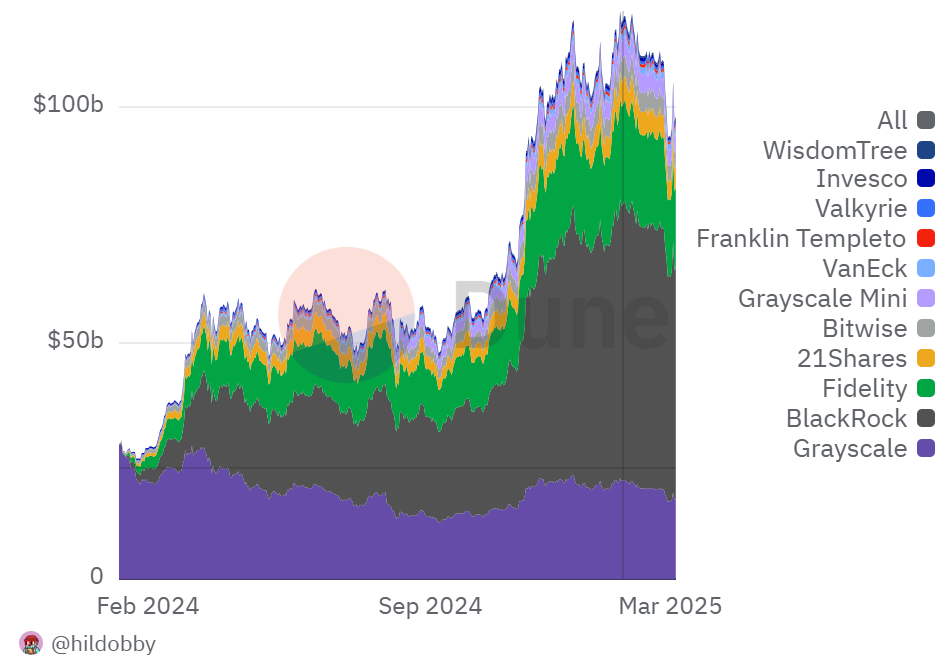
Institutional investors have also been hoarding Bitcoin for years. The U.S. Securities and Exchange Commission’s (SEC) approval of BTC exchange-traded funds (ETFs) in January 2024 opened the door to more institutional money from Wall Street.
In mid-January 2025, Bitcoin ETFs held a record $126.1 billion worth of coins.
More and more companies are integrating Bitcoin into their treasury operations.
Today, the number of BTC held by companies, governments, funds, and other institutional entities is at a record high.

Strategy, which recently rebranded from MicroStrategy, is the public company with the largest BTC portfolio, currently holding over 499,000 coins.
Bitcoin is becoming increasingly integrated into traditional financial markets.
For example, in March 2025, U.S. President Donald Trump announced his plans for a Crypto Reserve, including Bitcoin and a few altcoins. Several U.S. states pushed for Bitcoin reserves before the federal government did.
As Bitcoin gains a stronger foothold in the world’s financial system, its value increases with growing demand.
Inflation Hedge and Macro-Economic Factors
Institutional investors and high-net-worth individuals (HNWIs) prefer Bitcoin for its ability to hedge against inflation. The U.S. dollar and other fiat currencies have been devaluing over the years due to loose monetary policies from central banks. As explained earlier, the markets have been flooded with fiat money to constrain the effect of the COVID-19 pandemic lockdowns.
Inflation has been an inherent part of modern economics, especially thanks to the influence of Keynesian theories. These theories encourage economic stimulation by driving demand with new cash. The U.S. first adopted this model to respond to the Great Depression of 1929.
Ideally, the U.S. Fed targets a 2% annual inflation rate, but in June 2022, it went over 9% — the highest in over four decades.
Rising concerns about economic crises and potentially harmful monetary policies have prompted many investors to turn to Bitcoin as a safe-haven asset that can hedge against inflation despite its high volatility.
It’s no coincidence that Bitcoin reached a new ATH in December 2024, followed by gold – the most popular safe-haven asset – reaching its own new record a few weeks later. Check how close the correlation between BTC and the precious metal has been since inflation figures soared in 2022 (note that this chart doesn’t compare the return performance):
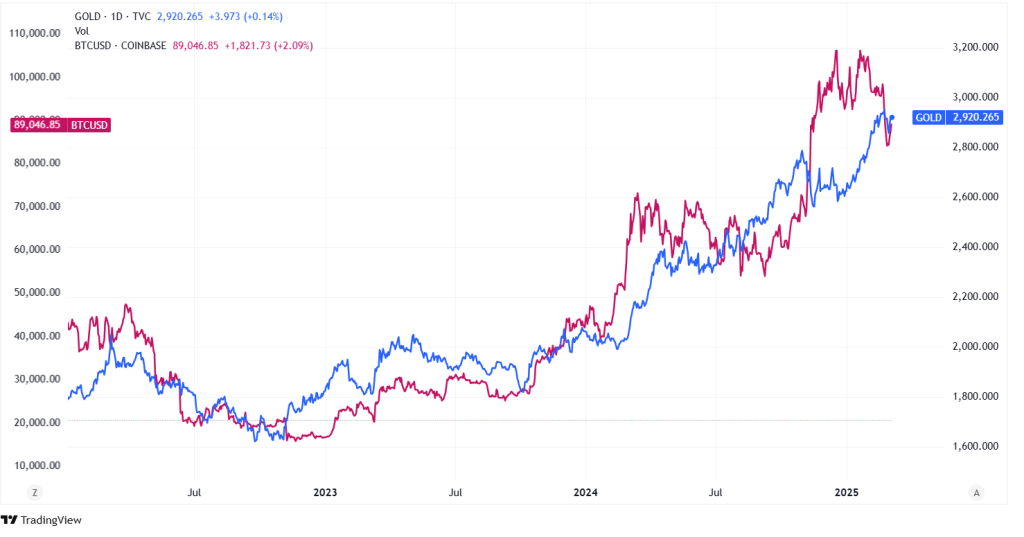
Both Bitcoin and gold have beaten inflation over the long run, but the former is more portable and accessible. Storing physical gold requires more effort and costs. With Bitcoin, all you need is a digital wallet.
Institutional investors have increased their exposure to Bitcoin, especially because it is an efficient hedge against macroeconomic risks.
Psychological and Social Factors
Earlier in the article, we highlighted that trust and acceptability are the most important factors that give currencies their value.
So why does Bitcoin have so much value today?
Are people trusting it more than before?
The answer is yes — the network effect is a crucial aspect driving BTC’s value. More and more people are beginning to understand the potential impact of Bitcoin on their wealth preservation and the broader financial system.
The network effect drives Bitcoin’s user base, and growing demand means higher prices for the crypto asset.
In the short- and medium-term, perception and speculation have always played a key role as the cryptocurrency fluctuates in search of its fair price. Bitcoin derives its value from changes in investor behavior, and human emotions are very unpredictable.
As you may notice, the crypto community is very active online. Positive headlines, government endorsements, and celebrity advocacy have often led to short-term spikes in demand. If you learned about a family selling their house and possessions to buy Bitcoin, wouldn’t you be intrigued?
Conversely, negative news — such as crypto exchange hacking attacks, bankruptcies, or regulatory crackdowns — can lead to massive sell-offs.
In the digital era, media narratives and social media trends have a huge impact, allowing the exaggeration of Bitcoin’s price movements due to FOMO and FUD effects. Platforms like X, Reddit, and YouTube have fueled major bull and bear cycles, repeatedly burying and reviving Bitcoin.
Besides shaping narratives, large BTC holders, known as ‘whales,’ can shape market trends with the push of a button. These entities – which include early adopters, institutional investors, hedge funds, and other major players – can influence market trends by executing large trades.
However, the Bitcoin market is maturing, with liquidity improving as adoption increases among institutional and retail investors. As the crypto integrates into traditional finance, it may become more stable. BTC’s volatility in percentage terms has been gradually declining since its inception, and this normalization is likely to continue amid a growing user base.
Common Criticisms and Counterarguments
Despite all the unique features that give Bitcoin value, some people are still unconvinced about its potential. At the beginning of 2025, JPMorgan CEO Jamie Dimon criticized Bitcoin again, arguing that it had no intrinsic value.
The truth is that fiat money doesn’t have intrinsic value either, but this doesn’t stop people from using it as a unit of account.
Another criticism is that Bitcoin is too volatile. Indeed, the cryptocurrency’s price can show wild fluctuations, but high volatility is normal for a new asset class driven by innovation. Remember the dot-com bubble in the late 1990s? Now, the tech sector has matured, and companies like Google (Alphabet), Facebook, and Amazon are part of investors’ portfolios.
Ok, I’m almost convinced, but what if governments ban or destroy Bitcoin at some point? Well, the cryptocurrency is decentralized and censorship-resistant. No one can ban it entirely unless they can ban the Internet altogether.
Conclusion
So, why does Bitcoin have so much value?
The main factors driving its price are programmed scarcity, blockchain-powered security, utility, and the network effect.
Cryptocurrencies meet all the criteria for a medium of exchange as they are scarce, portable, durable, divisible, fungible, and accepted worldwide. However, they mainly serve as an SOV asset thanks to their ability to hedge against inflation.
This is why companies and countries like El Salvador are buying it for their reserves, and developed economies like the U.S. are pondering its integration into their financial systems.
If you plan to invest in Bitcoin, research its unique features and the best way to buy and store it. We have several crypto guides that can help you. But remember: don’t invest more than you can afford to lose!
FAQs
How is Bitcoin different from traditional currencies?
What gives Bitcoin scarcity?
Can Bitcoin’s value drop to zero?
How does Bitcoin’s price relate to supply and demand?
Is Bitcoin’s value purely speculative?
What role do miners play in maintaining Bitcoin’s value?
Why is Bitcoin so volatile if it has real value?
What happens when all 21 million Bitcoin are mined?
References
- A History Lost – The English Tally (GIMMS UK)
- USD M1 Supply (U.S. Fed)
- Halving Progress Chart (Bitbo)
- Stock to Flow Chart (Bitbo)
- BTC Mining Difficulty Chart (Blockchain.com)
- BTC ETF AUM Chart (Dune)
- BTC in Treasuries Chart (bitcointreasuries.net)
- Gold vs BTC Chart (TradingView)
2M+
250+
8
70







 in numbers