

Polymarket vs. PredictIt: Which Is Better in 2026?
We believe in full transparency with our readers. Some of our content includes affiliate links, and we may earn a commission through these partnerships. However, this potential compensation never influences our analysis, opinions, or reviews. Our editorial content is created independently of our marketing partnerships, and our ratings are based solely on our established evaluation criteria. Read More



Online prediction markets have seen huge growth over the past few years, with Polymarket and PredictIt among the largest platforms in this sector. But which is best?
Polymarket is the crypto-native giant that processed over $20 billion in volume in 2025 and is now attempting a delicate reentry into the U.S. with a regulated, “beta” version. You also have PredictIt, the academic survivor that stared down the CFTC, settled its lawsuit in mid-2025, and offers a familiar, if potentially more expensive, safe harbor for political bets.
Traders compare these two not just for their odds, but for their architecture: one is a permissionless, global (albeit geofenced) order book running on Polygon; the other is a federally approved, capped-limit exchange running on trust and fiat.
Below, we are going to explore whether Polymarket or PredictIt does it better in 2026 and determine which platform is best for which type of user.
- In This Article
- In This Article
- Show Full Guide
Polymarket vs. PredictIt Overview
Polymarket dominates in volume and odds efficiency, while PredictIt offers a simpler, bank-connected on-ramp for U.S. traders who refuse to touch crypto.
| Platform | Polymarket | PredictIt |
| Platform Type | Decentralized (Global) / Regulated (US) | Centralized (Academic/Regulated) |
| KYC Requirements | None (Global) / Mandatory (US) | Mandatory (SSN required) |
| Supported Currencies | USDC (Polygon) | USD (Fiat) |
| Fees | ~0% (Global) / 0.10% Taker on some bets (US) | 10% on Profits + 5% Withdrawal |
| Betting Limits | Uncapped | $3,500 per contract |
| Liquidity & Volume | High ($20B+ annual volume) | Low to Medium (Niche political) |
| US Legality Status | Regulated (via QCEX acquisition) | Legal (CFTC Settlement June 2025) |
| Best Use Case | High-volume trading, hedging, arbitrage | Casual political betting, non-crypto users |
Key Conclusion: Choose Polymarket if you are a volume trader or understand crypto rails; choose PredictIt if you want a strictly regulated, fiat-only experience and don’t mind paying a premium on your winnings.
Visit Polymarket
What Is Polymarket?
Polymarket is the world’s largest prediction market, built on the Polygon blockchain. Unlike traditional bookmakers, it operates as a decentralized exchange (DEX).
The platform uses a Central Limit Order Book (CLOB) system for its major markets, similar to how the New York Stock Exchange or Binance works. There are markets for pretty much anything, from crypto to politics and sports to Elon Musk’s tweets.
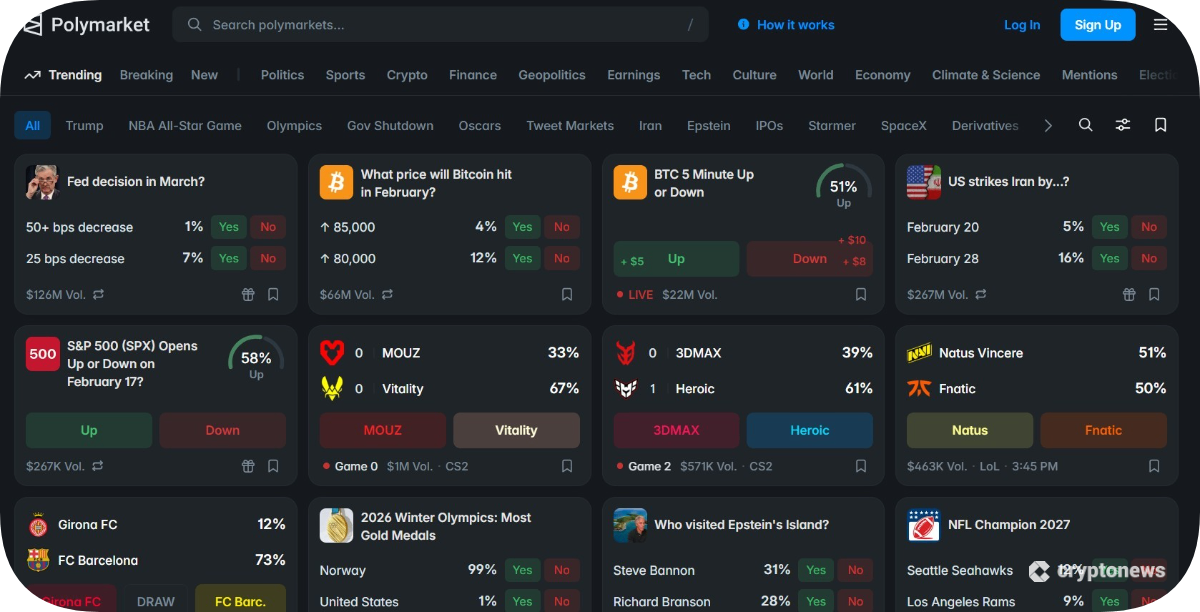
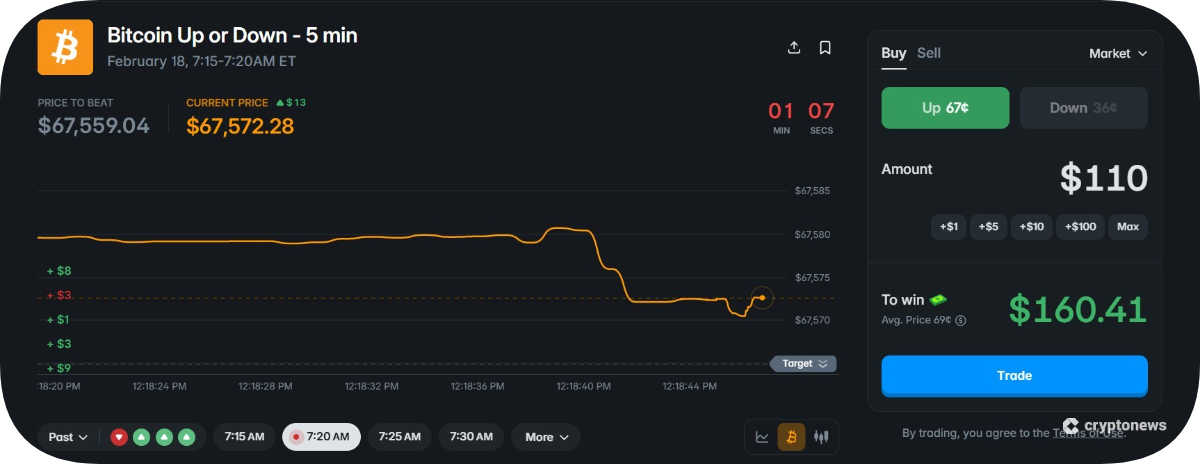
Each market offers “Yes” and “No” shares. When you buy a “Yes” share on a market, you are buying it directly from another user selling that share, not from a third party. This peer-to-peer structure is critical because it means the platform itself takes no risk on the outcome.
The platform’s foundation is non-custodial. For its global user base, funds are held in smart contracts rather than by the company. Settlement is automated via the UMA optimistic oracle, a decentralized verification system where token holders vote to resolve disputes (e.g., “Did the Fed cut rates?”). This means payouts occur automatically on-chain, without the risk of a centralized operator refusing to honor a bet.
In July 2025, Polymarket fundamentally altered its structure by acquiring QCEX, a CFTC-licensed exchange. This allowed it to launch a compliant U.S. product. While the global platform remains permissionless and crypto-native, the U.S. version (currently accepting users by a waiting list) is a “walled garden” that requires KYC and operates under strict federal oversight.
What Is PredictIt?
PredictIt is a New Zealand-based project run by Victoria University of Wellington, operating in the U.S. under a unique regulatory status. For years, it operated under a “No-Action” letter from the CFTC, which limited its use to academic research. When that status was threatened in 2022, it led to a protracted legal battle that concluded with a settlement in June 2025.
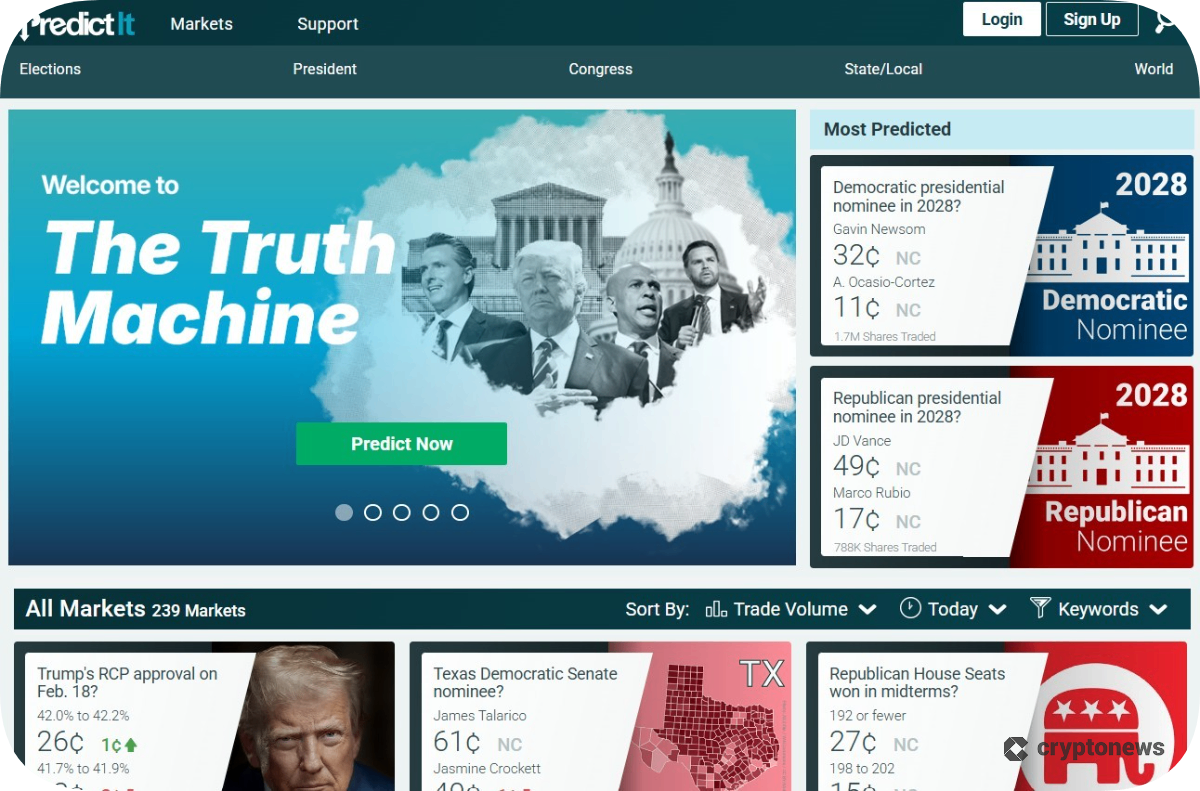
Today, PredictIt operates under CFTC supervision with revised terms. It retains its centralized order book model: you deposit USD via bank transfer, buy shares, and the platform holds your money.
PredictIt is strictly a political exchange. Its market definitions are narrow, specific, and geared toward policy wonks. You will find markets on whether a specific bill will pass the Senate Judiciary Committee, or how many votes a confirmation hearing will get. It does not host sports, pop culture, or economic indicators. If you are looking to bet on the Federal Reserve interest rate decision or the Oscars, PredictIt is useless to you.
Polymarket vs PredictIt: Key Differences Explained
Decentralization vs Regulation
The core difference between the two platforms lies in custody. On Polymarket Global, you own your funds until the moment you trade by connecting a Web3 wallet (like Best Wallet, MetaMask, or Phantom), with your USDC sitting on the blockchain. If the website goes down, you can technically interact with the smart contracts directly to withdraw funds or trade.
PredictIt is a custodial silo. You transfer money to them, and they hold it. If the site freezes during a high-profile event like a debate – something that hasn’t happened for a while, but did at times across 2020 – you have no alternative route to exit your position.
However, the 2025 CFTC settlement has solidified PredictIt’s legal standing, removing some of the dread (“will the site go offline and take my money with it?”) that hung over the platform for years.
Crypto-based Betting vs Fiat Betting
Polymarket runs on USDC, a stablecoin pegged to the dollar. To trade, you must bridge funds to the Polygon network. While on-ramps like MoonPay have made this easier, users should still be familiar with gas fees and wallet security.
👉 Learn More: How to Bridge USDC to Polygon for Polymarket.
PredictIt is purely fiat. You link a bank account, deposit USD, and trade. There are no wallet keys to lose, no gas fees to calculate, and no blockchain confirmations to wait for. For the average U.S. voter, this familiarity makes using the site easy.
No-KYC vs Mandatory KYC
Polymarket Global (accessed via VPN by many in the U.S., and in other restricted regions like the UK, China, and parts of Europe) requires no identity verification, just a wallet address. This allows for instant onboarding but carries risk if you access the site in a legally restricted area.
PredictIt and the new Polymarket US require full KYC (Know Your Customer). You must provide a Social Security Number and a valid ID. This creates a paper trail for tax purposes, which is a benefit for institutional compliance but a deterrent for privacy-focused traders.
Unlimited Trading vs $3,500 Account Cap
For years, PredictIt was hamstrung by an $850 limit per contract. Following the 2025 regulatory updates, this cap was raised to $3,500. While an improvement, it still prevents “whales” from entering the market. A trader with high conviction cannot move the line by much, except in the smallest markets, leading to sticky odds that don’t always reflect reality.
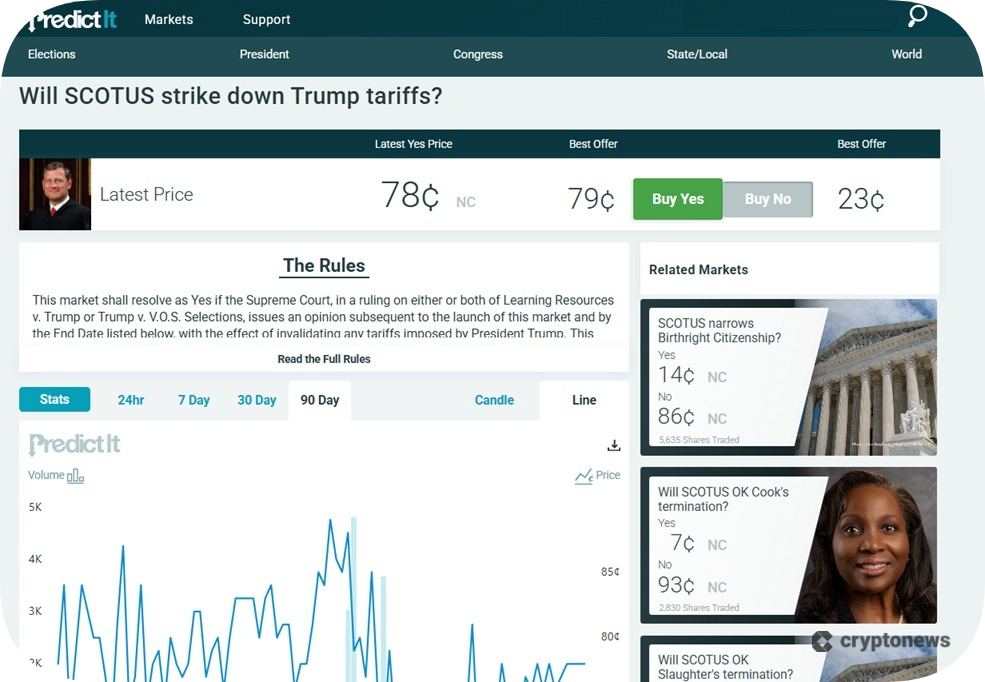
Polymarket has no such limits – a trader can bet $1 million on a single outcome if the liquidity exists. This attracts institutional capital and sharp bettors, theoretically making the odds more efficient, but it can also allow manipulation (as seen during the 2024 election “whale” saga).
Liquidity & Volume
Polymarket is the undisputed king of volume – it processed over $20 billion in volume in 2025. On major events like the U.S. Presidential Election, the order books are deep enough to absorb six-figure bets with minimal slippage. This global liquidity pool aggregates views from around the world, creating a responsive price discovery mechanism.
PredictIt suffers from liquidity fragmentation caused by its betting limits. Because no single trader can hold more than $3,500 in a contract, the order book is composed of thousands of small retail bets, which makes it impossible to execute large trades instantly. You are forced to “work” an order, buying small chunks over time, which exposes you to price shifts.
User Experience & Ease of Use
PredictIt offers a Web 1.0 experience. The interface is text-heavy and functional, resembling a legacy stock brokerage. Signup is simple but slow due to identity verification. Funding via ACH takes days unless you pay for a wire. It is not scalable for high-frequency trading, but it is intuitive for dedicated politics betting.
Polymarket has a steeper learning curve but superior tooling. The interface is modern, responsive, and data-rich, and advanced users can access the API for algorithmic trading. However, the “Global” experience requires managing a crypto wallet, which is a non-starter for many. The new “US” app attempts to bridge this gap with a cleaner, more traditional fintech interface, but it is still rolling out features.
Fees & Costs Comparison
This is where the math can get brutal for PredictIt users.
PredictIt charges a 10% fee on profits. If you bet $100 and win $100 (total payout $200), PredictIt takes $10. On top of that, there is a 5% fee on withdrawals.
If you are a profitable trader, you are effectively paying a 15% tax to the platform before you even touch your money. Let’s look at two real-world examples:
- The $100 Bet: You bet $100 on a candidate at 50 cents. You win, doubling your money to $200 ($100 profit). PredictIt takes $10 (10% of profit), you now have $190. When you withdraw that $190 to your bank, PredictIt takes a 5% withdrawal fee ($9.50). You receive $180.50, after total fees of $19.50 (approx 20% of your profit).
- The $500 Bet: You bet $500 at 50 cents. You win, payout is $1,000 ($500 profit). PredictIt takes $50 (10% of profit), leaving a balance of $950. You withdraw, and PredictIt takes $47.50 (5% of the withdrawal). You receive $902.50, after total fees of $97.50.
Polymarket Global charges no trading fees on the core protocol. The main cost is “gas” (transaction fees) on the Polygon network, which is typically pennies (assume $0.01 – $0.05 per trade). You also face conversion costs when moving from USD to USDC.
Polymarket US introduced a 0.10% taker fee in late 2025 (note that this is the new “beta” version currently rolling out. On that same $500 bet (winning $500), you would pay roughly $0.50 to enter the trade and $0.50 to exit. Total fees: $1.00.
Safety, Reputation & Trust
Trust in PredictIt is based on institutional concerns. You are trusting that Victoria University of Wellington and its vendor, Aristotle International, will not close up shop. The risk here is not malice, but operational failure.
In past election cycles, PredictIt’s servers have crashed during peak volatility (like election nights), leaving traders unable to exit positions. However, the 2025 CFTC settlement has removed the regulatory existential threat that hung over the platform for years. Your money is expected to be safe, even if the website is slow at times.
Trust in Polymarket is based on its technical foundations. The platform uses the UMA optimistic oracle for dispute resolution. If there is a disagreement about an outcome (e.g., “Did the candidate concede?”), it is not decided by a Polymarket CEO, but by a decentralized vote of UMA token holders.
This removes the “house” from the equation. The risks here are smart contract failure or wallet security issues; if you lose your private keys or sign a malicious transaction, Polymarket customer support cannot help you. You are your own bank, which means you are also your own security guard.
Legality for U.S. & Global Users
PredictIt is legal in the U.S, with its June 2025 settlement with the CFTC cementing its status. You can trade there without fear of account seizure or legal action. It’s the “safe” option for compliance-minded Americans.
Polymarket is in a transition phase. The Global platform officially blocks U.S. IPs, but the U.S. platform is fully legal and regulated as a Designated Contract Market (DCM) following the acquisition of QCEX.
Many U.S. traders use VPNs to access Polymarket Global to avoid government restrictions. While technically possible, this carries significant personal risk, and Polymarket’s terms of service explicitly prohibit this. If the platform detects VPN usage or requires “Step-Up KYC” for a large withdrawal – a practice that is becoming more common – your funds could be frozen indefinitely. Furthermore, engaging in unregulated derivatives trading can have tax and legal implications depending on your jurisdiction.
We do not encourage the use of VPNs to bypass regulatory blocks. Users should adhere to the laws of their country of residence.
👉 For more information, read our guide on the legality of Polymarket worldwide.
Which Prediction Market Is More Accurate?
Accuracy in prediction markets is measured by how closely the market odds (e.g., 60%) match the event’s actual frequency.
A landmark study published in January 2026 by Vanderbilt researchers Joshua D. Clinton and TzuFeng Huang analyzed over 2,500 political contracts from the 2024 election cycle. The findings were counterintuitive: PredictIt achieved 93% accuracy, significantly outperforming Kalshi (78%) and Polymarket (67%).
The study suggests that PredictIt’s betting limits, while annoying for traders, actually prevent “whales” from distorting the odds with massive, sentiment-driven bets. The crowd of peers on PredictIt proved sharper on granular, state-level outcomes.
However, Polymarket generally reacts faster to breaking news. The “wisdom of the crowd” on Polymarket often identifies shifts earlier than polls, but the lack of limits can also lead it to overshoot due to hype. But it is seen as the strongest source for real-time prediction data.
The Verdict: PredictIt appears more accurate for niche, lower-volume political event contracts (Senate seats, specific legislation). Polymarket is the better signal for major, high-volume world events where liquidity allows the “smart money” to overwhelm noise.
Why Polymarket and PredictIt Show Different Odds
If you compare the same political contract on Polymarket and PredictIt, you will often notice different prices. A political candidate, for instance, might trade at 48 cents on Polymarket while sitting at 52 cents on PredictIt.
That price difference isn’t random, but reflects structural differences between the two platforms.
Liquidity and Position Limits
Polymarket operates with deep, crypto-native liquidity and no meaningful retail cap. A well-funded trader can deploy $500,000 or more to correct a mispricing instantly.
PredictIt, by contrast, caps traders at $3,500 per contract. Even if a participant believes the market is clearly wrong, they cannot deploy enough capital to force the price towards what they see as the “true” probability. As a result, inefficiencies can persist longer.
User Demographics
Polymarket’s order books are largely driven by global, crypto-native traders who are comfortable with risk and rapid execution. PredictIt draws heavily from U.S.-based political enthusiasts and academics.
These differing communities can create subtle bias; for example, crypto-native traders may skew odds toward candidates perceived as favorable to technology or libertarian policy positions.
Fee Structure
PredictIt takes 10% of profits, which raises the effective break-even probability for traders. A contract trading at 90 cents is less attractive than it appears once fees are factored in.
Polymarket’s fee structure is lighter, meaning traders can price contracts closer to their perceived “true” probability without as much friction.
How Traders Use Differing Odds for Arbitrage
When meaningful gaps appear (such as between 48 cents and 52 cents), traders can pursue arbitrage strategies – buying the lower-priced contract on one platform and shorting or selling the higher-priced equivalent on the other can lock in a spread.
In practice, arbitrage is limited by factors such as withdrawal fees, settlement timing, capital controls, and platform restrictions. PredictIt’s position cap, in particular, constrains how much capital can be deployed to exploit pricing differences.
Still, persistent cross-platform gaps are one of the clearest examples of how structure (not just sentiment) shapes prediction market odds.
Tax Implications for Traders
One often-overlooked difference between the two platforms is how the IRS (and other tax bodies) views the activity.
PredictIt issues a Form 1099-MISC if you have net profits over $600 in a calendar year. They treat winnings as “miscellaneous income,” not capital gains. This means your profits are taxed at your ordinary income tax rate, which can be as high as 37% for high earners, and you cannot offset these gains with stock market losses.
Polymarket (Global) does not issue tax forms. However, in the eyes of the IRS, trading on Polymarket likely falls under capital gains rules (if viewed as property/crypto trading) or gambling income, depending on your specific accountant’s interpretation. The lack of a 1099 does not absolve you of tax liability. Every trade on Polymarket is a taxable event (disposing of USDC). The burden of tracking the cost basis for thousands of transactions falls entirely on the user.
For the Polymarket US-regulated product, users should expect standard regulated tax reporting (likely Form 1099-B), similar to trading stocks or futures, though specific guidance is still evolving post-launch.
Polymarket vs. PredictIt vs. Kalshi
The third major player in the prediction market space, Kalshi is a CFTC-regulated exchange that won a landmark legal victory in May 2025, allowing it to offer election betting. So how does it compare to Polymarket and PredictIt?
- Kalshi is the middle ground. It is regulated like PredictIt but has higher limits (up to $7 million for eligible traders) and lower fees than PredictIt.
- Polymarket is for the crypto-native volume trader.
- PredictIt is for the retail political hobbyist.
Users may prefer Kalshi when they want the safety of regulation but the ability to bet more than $3,500. However, Polymarket still dwarfs Kalshi in total volume and event variety.
Summary: Pros and Cons
Polymarket
- Massive Liquidity: With over $20B in annual volume, the platform supports institutional-sized trades with minimal slippage.
- Fee Efficiency: Trading is effectively free on the Global platform (minus gas), and the U.S. platform charges a negligible 0.10%.
- Uncapped Trading: The absence of position limits allows traders to express high-conviction views without hitting artificial ceilings.
- On-Chain Transparency: Every trade and settlement is verifiable on the Polygon blockchain, eliminating “black box” custody risks.
- Variety: Markets for crypto, pop culture, science, and macro.
- Onboarding Friction: Managing USDC, bridging to Polygon, and securing a Web3 wallet presents a steep learning curve for beginners.
- Geo-Blocking: The flagship Global product restricts U.S. IP addresses, forcing Americans into the more limited U.S. regulated app.
- Whale Manipulation: Without position limits, wealthy traders can temporarily distort market odds with massive sentiment-driven bets.
- Tax Complexity: Tracking thousands of on-chain transactions for tax purposes requires specialized crypto-tax software.
PredictIt
- Fiat Simplicity: Direct bank transfers and a familiar interface make it the easiest on-ramp for non-technical users.
- Regulatory Safety: Operating under a settled CFTC agreement provides legal certainty that offshore crypto platforms cannot match.
- Granular Accuracy: Academic studies confirm it outperforms competitors on niche, state-level political contracts.
- Stability: As a centralized entity, it avoids the specific risks of smart contract exploits or bridge hacks.
- Punitive Fees: The 10% profit fee plus 5% withdrawal fee creates a high break-even threshold for profitability.
- Strict Limits: The $3,500 contract cap makes the platform unviable for professional traders looking to scale capital.
- Slow Banking: ACH deposits and withdrawals can take several business days to clear, unlike the near-instant settlement of crypto.
- Limited Scope: Only political markets available.
Final Verdict: Which Should You Choose?
The choice in 2026 comes down to your capital and whether you want to use crypto.
Choose PredictIt if you are a casual observer of U.S. politics who wants to put $500 on a Senate race for fun. The fees are high, but the platform is safe, legal, and easy to understand. It is the “Robinhood for politics”.
Choose Polymarket if you are a serious trader, an arbitrageur, or someone who understands how to move USDC. The liquidity is superior, the fees are non-existent (Global) or negligible (US), and the lack of betting limits allows you to express high-conviction views. The friction of on-ramping is worth the savings in fees.
For the vast majority of readers looking to make money rather than just participate, Polymarket is the superior choice.
Visit PolymarketFAQs
Which is better for presidential odds?
Do I need crypto to use Polymarket?
Is PredictIt shutting down?
Can I withdraw Polymarket winnings to my bank?
Which platform is better for forecasting beginners?
Do I need KYC to use Polymarket and PredictIt?
Which platform has better mobile trading?
References
2M+
250+
8
70







 in numbers

About Cryptonews
Our goal is to offer a comprehensive and objective perspective on the cryptocurrency market, enabling our readers to make informed decisions in this ever-changing landscape.
Our editorial team of more than 70 crypto professionals works to maintain the highest standards of journalism and ethics. We follow strict editorial guidelines to ensure the integrity and credibility of our content.
Whether you’re looking for breaking news, expert opinions, or market insights, Cryptonews has been your go-to destination for everything cryptocurrency since 2017.
