

What Is a Honeypot Crypto Scam?





A honeypot crypto scam is a malicious token setup that allows you to buy crypto but prevents you from selling or withdrawing it, resulting in trapped funds. In 2026, honeypots remain one of the most common traps on DEXs, with scammers using more sophisticated contract kicks and even ready-made scam templates.
They work in one of two ways. The most common involves tokens that can’t be sold or transferred due to hidden contract restrictions. Another method is more hands-on and involves sending tokens to a scammer’s wallet. Ultimately, the tokens can’t be withdrawn.
In this guide, we’ll detail the two types of honeypot crypto scams and learn what to look for to avoid becoming a honeypot statistic. Let’s dig in.
Honeypot Crypto Scam Meaning
A crypto honeypot is a scam that tempts crypto users into losing their valuable tokens, such as ETH or SOL. The scam can work in two ways, with both methods using a flawed contract. The more commonly seen honeypot involves tokens, often meme coins, sold on decentralized exchanges. However, a function of the token blacklists buyers, making the token impossible to sell again.
In 2026, honeypots are increasingly deployed using pre-built “honeyport-as-a-service” kits that allow even non-technical scammers to launch malicious tokens easily.
In 2025, crypto hacks, exploits, and compromises cost investors more than $3.4 billion, with analysts claiming that the real figure is significantly higher because of underreporting. However, most scams go unreported within the crypto industry. Here’s a list of different types of crypto scams, and how they work.
How Do Honeypot Crypto Scams Work?
Although another type of honeypot involves sending tokens to a scammer’s wallet, we’ll focus on meme coins with a malicious function because it’s more common.
Let’s look at how crypto honeypot scams work in the steps below.
Create a Malicious Token
First, a scammer builds a token smart contract with a blacklist feature. This allows the contract creator to blacklist wallet addresses that buy the token. This process can be automated through smart contracts, and a whitelist function can allow for selling by specified addresses.
Another common tactic involves a high tax on token sales. The token creator earns the sell tax.
In newer 2026-era honeypots, these malicious functions are often hidden using contract obfuscation, which makes it harder for automated scanners to detect them immediately. Many contracts appear clean at first and only activate blacklist or sell-blocking features after liquidity and trading volume increase.
Launch The Token on a Decentralized Exchange
Next, the scammer launches the token on a decentralized exchange (DEX). Sites like Dexscreener and Dextools are popular ways to shop for meme coins with liquidity on decentralized exchanges. That’s where honeypot tokens are most often found by unsuspecting victims.
Traders looking to reduce exposure to malicious contracts usually go for structured presale projects with clear tokenomics and staged launches.
Run DEX Ads or Promote Via Social Media
To attract initial buyers, the scammers may run ads or shill the new coin on social media platforms or Telegram. Often, there may be a simple website, a fresh X account, and a Telegram group to make the coin look legitimate. The Telegram group and Twitter account disappear after the scam is complete.
In 2026, many scammers are relying on honeypot-as-a-service packages that include smart contracts, fake websites, pre-aged social accounts, and even launch instructions. This has dramatically increased the number of low-effort yet convincing honeypot launches.
Trigger Token Function
As buyers swap ETH (assuming an ETH-based platform) for the token, their wallet address is logged and blacklisted by the contract. Whitelisted addresses may sell, meaning the honeypot creator or team may be able to sell tokens into the liquidity pool. This makes trading look more natural, with occasional pullbacks on a bullish chart. Without this, the chart goes straight up.
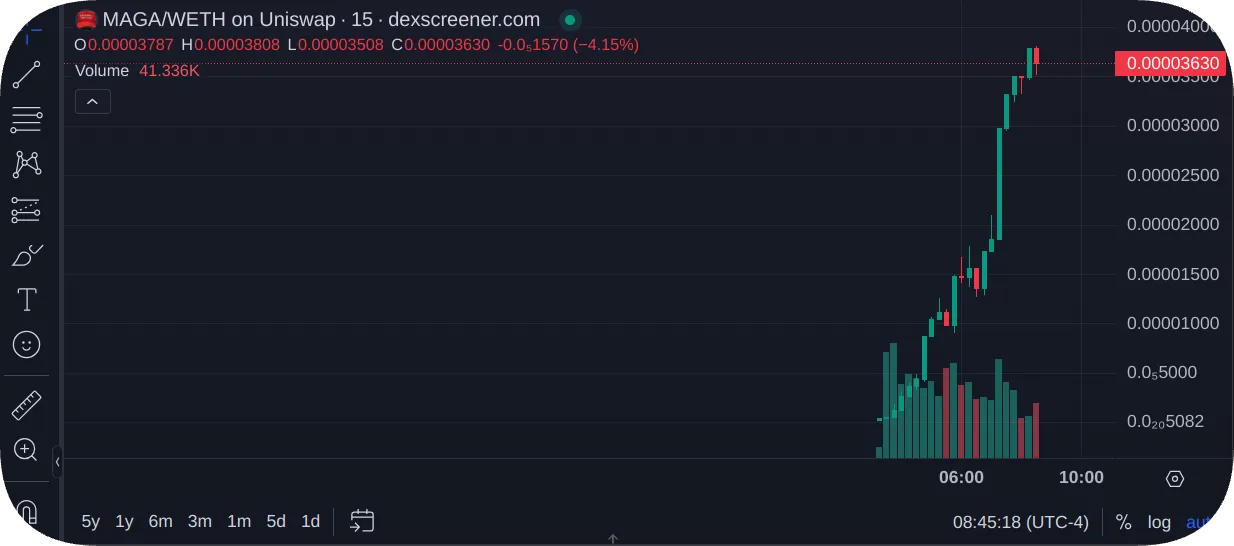
The bullish chart is the bait. Based on the chart, traders want in for the next leg up on what looks like a moonshot.
Warning Signs Investors Can Spot Early
Common warning signs seen across honeypot cases include:
- Sudden vertical price spikes with little sell pressure.
- Complex or unreadable smart contract code.
- Heavy focus on short-term gains.
- Liquidity that disappears after rapid early growth.
Dump Tokens Into Liquidity Pool
DEX tokens use a liquidity pool, which allows traders to swap ETH for the other token in the pool. The market cap grows as token buyers swap ETH for tokens, filling the liquidity pool with more ETH. Low-liquidity tokens are especially vulnerable to honeypots and rug pulls, which is why many investors prefer starting with more established meme coins, as they have deeper liquidity and broader scrutiny.
However, the scammers are on a timeline. Auditing tools like GO+ Security, Quick Intel, and Token Sniffer scan token contracts. At some point, the token will be flagged as a honeypot.
The scammers then sell their token stash into the liquidity pool, draining the pool. Another possibility is to simply close the liquidity pool and take out the ETH. Many traders are savvy to this, though, so scammers may lock or burn the liquidity to make the token look legitimate.
The result is the same. The scam tokens are worthless, and the ETH is gone.
Note: In the other type of honeypot scam, a scammer gives the target the private keys to a wallet with miscellaneous (junk) tokens, pretending to be a new user who needs gas money to swap. The target sends a small amount of ETH from their own wallet to the wallet, thinking they can then transfer the tokens themselves. However, the ETH is quickly swept from the wallet. While a small scam, repeated often enough, the ill-gotten gains add up quickly.
The Best Honeypot Crypto Checker Tools
Several crypto tools can help you detect honeypots. However, the solution isn’t foolproof, especially against newer scams, as many honeypots now use delayed activation. These tools don’t offer complete or real-time protection even in 2026. A token with blacklist or whitelist functions isn’t necessarily a honeypot. After the function is triggered, these tools can detect a honeypot.
Honeypot Checker Tools Overview
Here’s a quick comparison table of the most commonly used honeypot detection tools and their features.
| Tool Name | Chains Supported | Primary Feature |
| Honeypot.is | Ethereum, BSC, Base | Simulates buy/sell behavior to detect sell restrictions and extreme taxes |
| De.Fi Scanner | Multi-chain | Honeypot detection plus broader contract risk scoring |
| DetectHoneypot.com | Ethereum (ERC-20) | Single-purpose honeypot detection |
| TokenSniffer | Multi-chain | Comprehensive token risk analysis with scoring system |
Honeypot.is
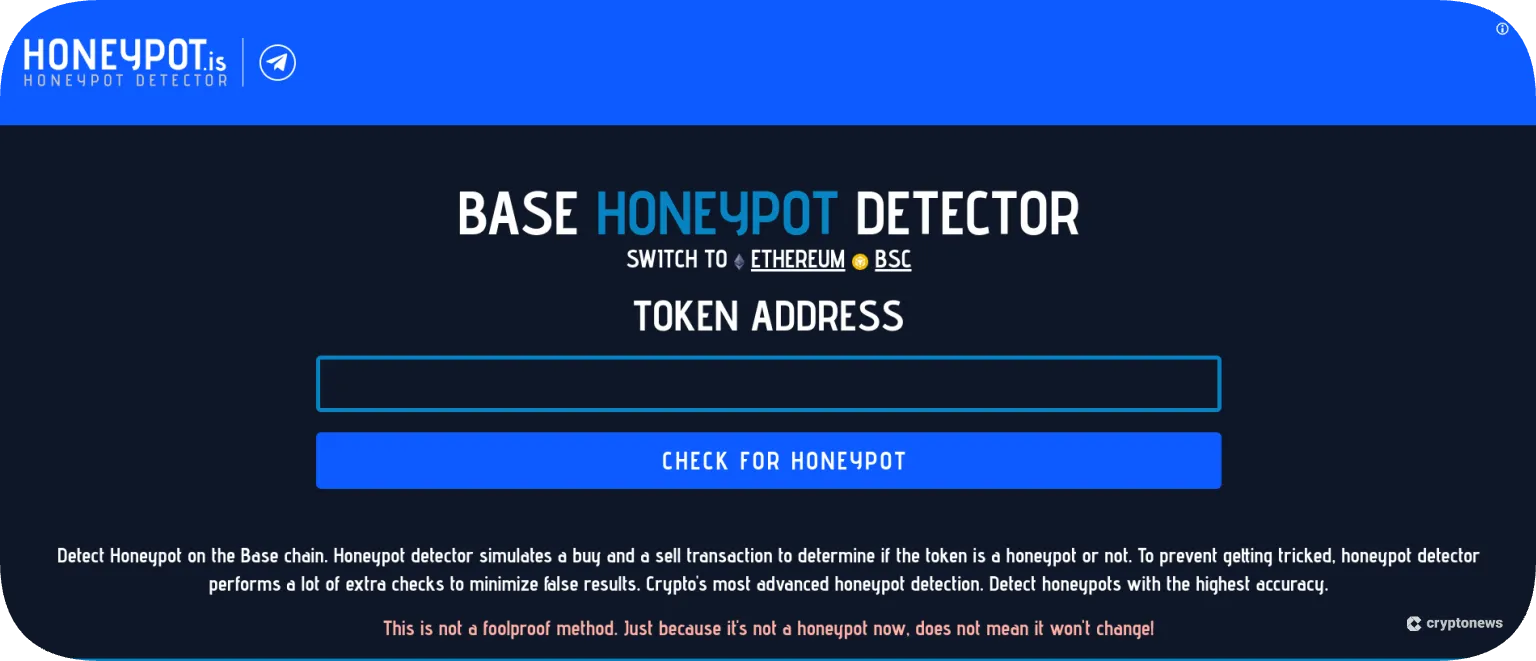
Honeypot.is checks for honeypot tokens on Base, Ethereum Mainnet, and BSC. Just copy the token address from Dexscreener or a similar site and paste it into the box. The app simulates buys and sells to determine if the token is using blacklists or high taxes and transaction costs. TokenSniffer uses the Honeypot.is API as part of its more comprehensive token analysis.
Pros
- Live buy and sell simulations
- Integrated as a data source into other tools
- Trusted by other crypto dashboards
Cons
- Focuses only on honeypots
- Can miss obfuscated or delayed-condition honeypots
De.Fi Scanner
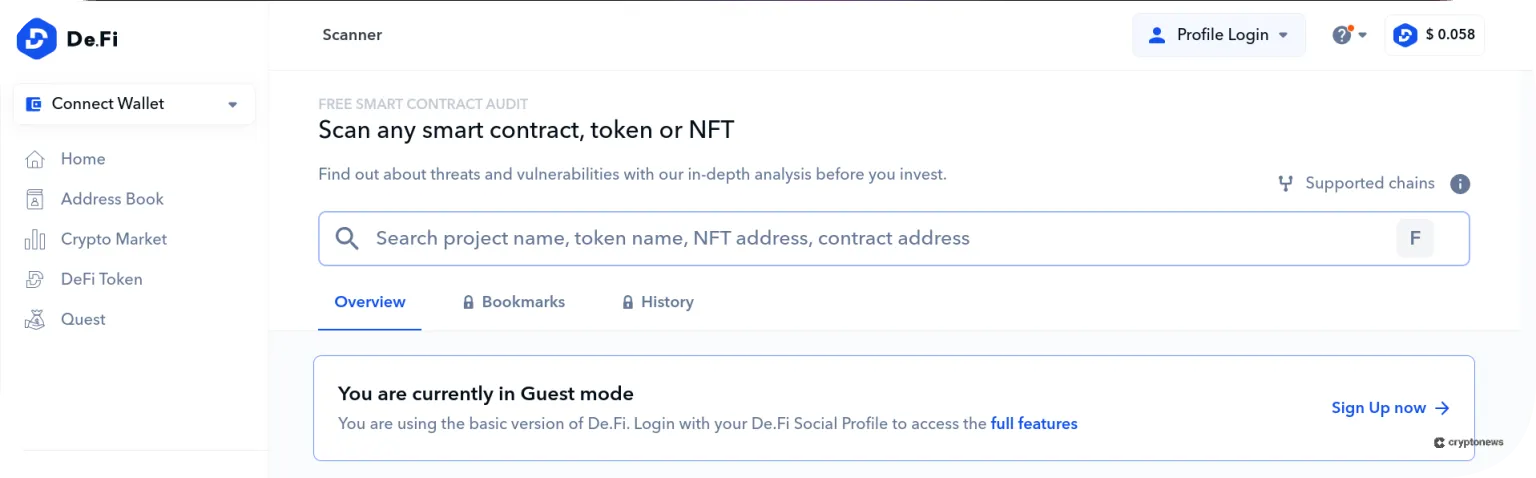
The scanner at De.Fi can help you identify honeypot scams and evaluate the token’s overall health score. You may still need to research further. For example, De.Fi Scanner flagged some coins with burned liquidity as having no liquidity. Burned liquidity means the liquidity can never be removed, making the token safer in regard to that one metric.
Pros
- Broad contact risk coverage
- Support different chains
- Fast and free to use
Cons
- Users must interpret context instead of treating scores as absolute
- Off-chain allowlists and obfuscated code can slip through the system
Detecthoneypot.com
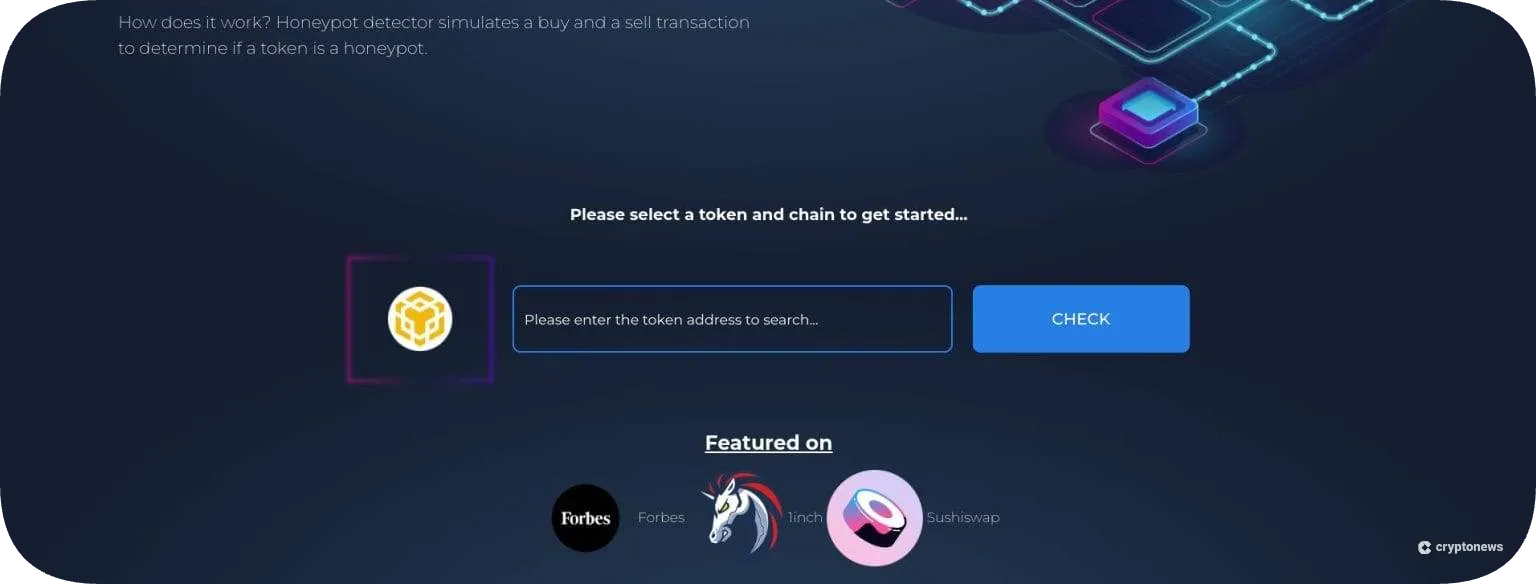
Like it says on the tin, Detecthoneypot.com does one thing and does it well. Paste the contract address in the box to check the token’s safety. However, a token with the correct functions can become a honeypot even if it is not one already.
Pros
- Free and unlimited web usage
- Offers top 100 holders analysis
- Notable for offering live buy/sell simulations on Solana
Cons
- Not very high confidence rate yet
- Long-term maintenance depends on monetizing the Chrome extension
TokenSniffer
Cryptocurrency projects often use TokenSniffer results in their marketing to reassure buyers. The tool offers a more comprehensive evaluation of the token and is considered the gold standard by many.

To check a token, just paste the token contract address in the box. TokenSniffer uses cached data that updates every 15 minutes.
Pros
- All-in-one token checker
- Widely referenced by traders
- Very accessible for non-devs
Cons
- Limited chain support
- Not 100% foolproof
Can You Get Out of a Honeypot Crypto?
The best way to get out of a honeypot is to not get into one, as there’s no reliable way to escape one once its restrictions are active, despite better tooling and awareness.
If you’ve already done your due diligence with token scanners and checked for locked or burned liquidity, you can make a small test purchase and then sell the token. It might not hurt to do this a few times to be sure you can sell when the time comes and to evaluate slippage. High slippage could indicate a sell tax on the token.
Sadly, there’s often no way to escape a honeypot. If the scammer pulls the liquidity, it’s over. If you can’t sell due to a blacklist feature of the token, you can try sending the token to another wallet address you control. However, in many cases, this tactic won’t work either.
Research the coin thoroughly and watch for flags by the community on sites like Dexscreener. Once you’re in a honeypot, the lost money pays for your crypto trading tuition. However, if you do your research and test the waters with small buys, investing only a few dollars rather than all the funds you plan on investing, you may be able to avoid becoming a honeypot statistic.
Conclusion
Honeypots are one of the common rug-pull scams on decentralized exchanges in 2026 carried out on unsuspecting users. While altcoin trading on DEX platforms can be profitable, it also exposes users to a range of threats, including contract obfuscation and honeypot-as-a-service schemes.
Utilize token screening tools like TokenSniffer to help guide your decisions. However, these tools aren’t perfect and may provide delayed results. It’s also wise to perform test transactions and evaluate user feedback from the community.
The best and safest approach is to be cautious and to do rigorous research before you invest in any hype-driven tokens.
FAQs
Are crypto honeypots illegal?
Can you sell honeypot crypto?
Can you get your money back from a honeypot?
What are the main signs of a honeypot?
References
2M+
250+
8
70






 in numbers

About Cryptonews
Our goal is to offer a comprehensive and objective perspective on the cryptocurrency market, enabling our readers to make informed decisions in this ever-changing landscape.
Our editorial team of more than 70 crypto professionals works to maintain the highest standards of journalism and ethics. We follow strict editorial guidelines to ensure the integrity and credibility of our content.
Whether you’re looking for breaking news, expert opinions, or market insights, Cryptonews has been your go-to destination for everything cryptocurrency since 2017.


 Leon Waters

 Camila Karam
 Anatol Antonovici