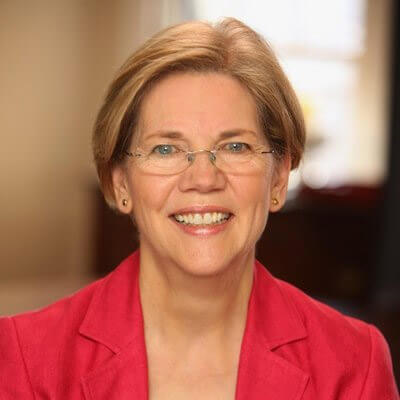
Elizabeth Warren is a United States Senator from Massachusetts and one of the most prominent Democratic lawmakers shaping the debate over financial regulation, consumer protection, and digital assets. A longtime critic of Wall Street misconduct and opaque financial products, she has become a leading voice for stricter oversight of cryptocurrencies, stablecoins, and related markets, arguing that they pose risks to consumers, financial stability, national security, and the environment.
Overview
Born in 1949 in Oklahoma City, Warren built a career as a law professor specializing in bankruptcy and consumer finance before entering politics. She served as a key architect of the Consumer Financial Protection Bureau (CFPB) and was elected to the U.S. Senate in 2012. In the Senate, she has focused on banking regulation, corporate accountability, and household financial resilience, using her positions on the Banking, Housing, and Urban Affairs Committee and related panels to push for stronger rules on digital assets and their intermediaries.
Academic and Regulatory Background
Warren taught law at several universities, including the University of Houston, the University of Texas at Austin, the University of Pennsylvania, and Harvard Law School. Her research on personal bankruptcy and predatory lending practices helped bring national attention to the ways in which medical costs, credit card debt, and abusive loan terms can destabilize middle class families.
Following the 2008 financial crisis, she chaired the Congressional Oversight Panel tasked with monitoring the Troubled Asset Relief Program (TARP). She was then instrumental in designing the Consumer Financial Protection Bureau, a federal agency with a mandate to police abusive practices in mortgages, credit cards, and other consumer financial products. Although she did not become the CFPB’s first director, her work solidified her reputation as one of the strongest advocates for consumer financial protections in Washington.
Crypto Policy and Legislative Priorities
In the realm of digital assets, Warren has consistently pushed for a framework that treats crypto-related activities as part of the broader financial regulatory perimeter rather than a special exception. She has pressed agencies such as the Securities and Exchange Commission (SEC) to apply existing securities laws to token offerings and trading platforms, calling for robust enforcement against fraud and market manipulation in crypto markets.
As a member and now ranking Democrat on the Senate Banking Committee, she has advanced policy principles for crypto market structure that emphasize investor protection, financial stability, anti-money laundering (AML) compliance, and closing sanctions loopholes. She has also argued that public officials, including presidents and senior policymakers, should face restrictions on their personal involvement in crypto ventures, citing conflicts of interest and the risk that regulatory decisions could be influenced by private token holdings.
Stablecoins, CBDCs, and Digital Dollar Debates
Warren has been a sharp critic of stablecoins, comparing some privately issued dollar-pegged tokens to 19th century “wildcat” bank notes. She has warned that rapid growth in lightly regulated stablecoins could create runs, undermine deposit safety, or concentrate power in large technology or financial firms without adequate safeguards.
At the same time, she has expressed openness to the concept of a U.S. central bank digital currency (CBDC), often referred to as a “digital dollar,” arguing that a well-designed public alternative could improve financial inclusion and payment efficiency while displacing riskier private tokens. She has framed CBDCs as a potential way to offer secure digital money backed by the state, provided privacy, security, and oversight concerns are addressed.
National Security, AML, and Sanctions Concerns
Warren has emphasized the role of cryptocurrencies in enabling illicit finance and sanctions evasion, frequently citing the use of digital assets by adversarial states, cybercriminals, and terrorist organizations. She has called for strong AML and counter-terrorist financing rules to apply to crypto platforms, wallet providers, and intermediaries, arguing that failing to do so would create parallel channels for unmonitored capital flows.
In hearings and public letters, she has questioned intelligence and defense officials about how adversaries might exploit crypto-based revenue streams and urged the Treasury Department, Department of Justice, and other agencies to treat digital asset enforcement as a priority area. Her focus on national security has become one of the central lenses through which she approaches crypto policy, alongside consumer protection.
Environmental Critique of Proof-of-Work Mining
Warren has been one of the most vocal critics in the U.S. Senate of the environmental impact of proof-of-work cryptocurrency mining, particularly for Bitcoin. She has co-authored letters to the Environmental Protection Agency (EPA) and the Department of Energy (DOE) urging them to require miners to disclose their energy use and emissions, and to assess how large-scale mining operations affect local grids, electricity prices, and greenhouse gas reduction goals.
Her position reflects concerns that energy-intensive mining could undermine climate policy, strain regional power systems, or lock in fossil fuel generation. Supporters of her stance see heightened scrutiny as necessary to align digital asset growth with climate commitments, while critics argue that it may disadvantage U.S.-based miners and push activity to jurisdictions with weaker environmental standards.
Relationship with the Crypto Industry
Within the digital asset ecosystem, Warren is often characterized as one of the leading skeptics or critics of the industry. She has questioned the industry’s lobbying efforts, warned against what she sees as attempts to weaken oversight through legislation, and opposed bills that she believes could leave consumers exposed or give politically connected actors preferential treatment.
These positions have made her a frequent target of criticism from some crypto advocates and executives, who argue that her approach underestimates the potential benefits of decentralized finance, tokenization, and open blockchain networks. Warren’s supporters counter that her skepticism has been validated by repeated cycles of fraud, exchange failures, and retail losses, and that strong rules are essential before integrating crypto more deeply into the financial system.
Significance for the Digital Asset Ecosystem
Elizabeth Warren’s role in the crypto debate is significant because she connects digital asset policy to broader themes of consumer protection, financial stability, national security, and climate risk. As a senior Democrat and high-profile member of the Senate Banking Committee, her support or opposition can shape the trajectory of major crypto legislation and influence how regulators interpret and enforce existing laws.
For the digital asset industry, Warren represents a regulatory perspective that prioritizes caution, strict enforcement, and limits on conflicts of interest over rapid expansion or experimentation. Whether one views her as a necessary counterweight or an obstacle to innovation, her influence ensures that questions of oversight, accountability, and public interest remain central to the development of U.S. policy on cryptocurrencies, stablecoins, and emerging forms of digital money.
