
Kraken Exchange Review
Kraken cryptocurrency exchange suits security‑minded traders who want deep USD/EUR liquidity, bank rails in the U.S., UK, and EU, and low maker–taker fees on Kraken Pro. Instant buys cost more than pro‑tier trades, and staking is restricted in the U.S.
- Regular proof of reserves and long security record
- Pro‑grade platform with low maker–taker fees
- Strong ACH, SEPA, and Faster Payments support
Pro‑grade platform with low maker–taker fees
Kraken Overview
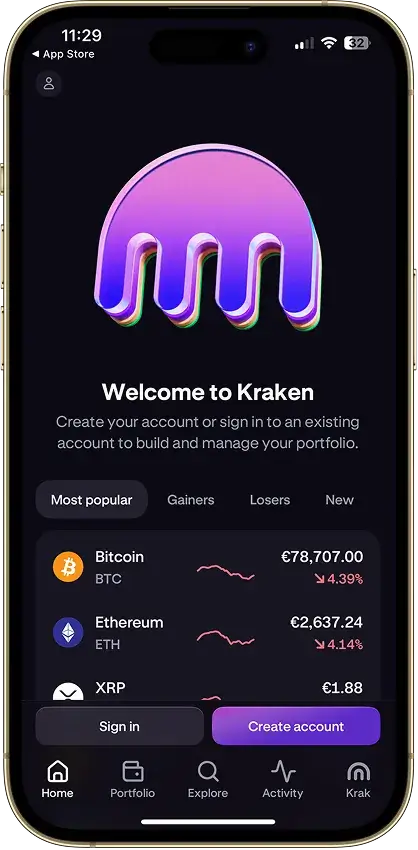
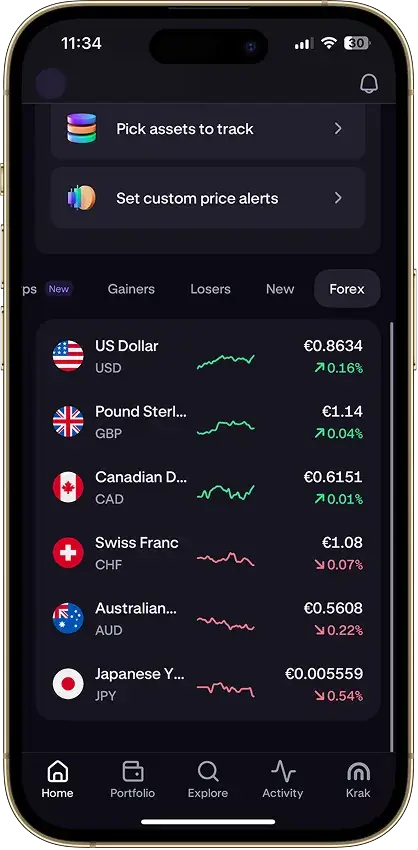
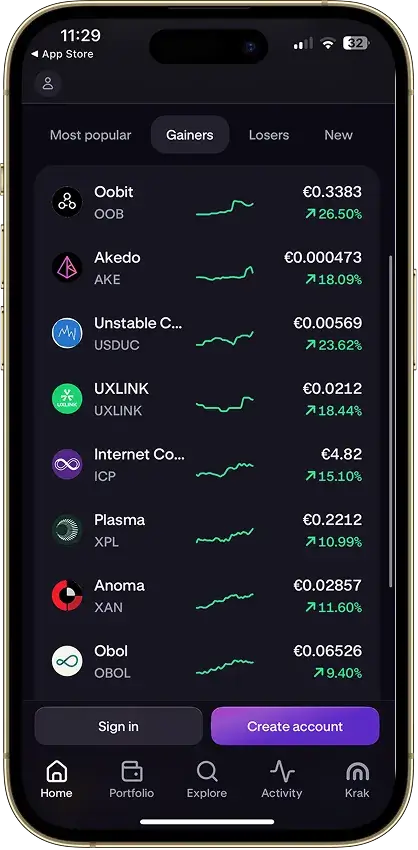
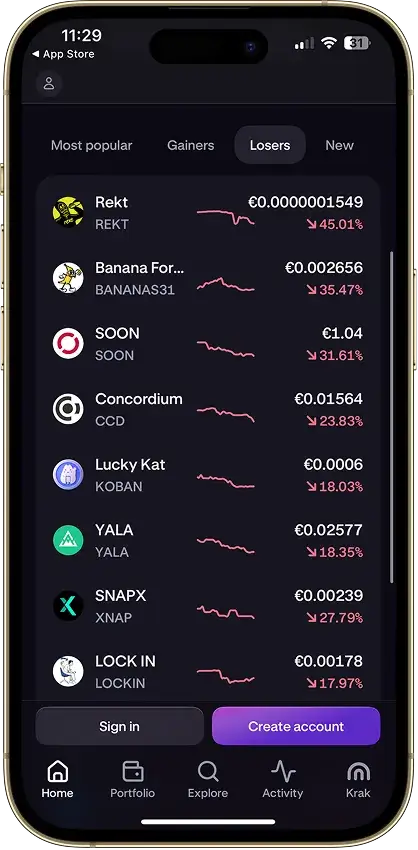
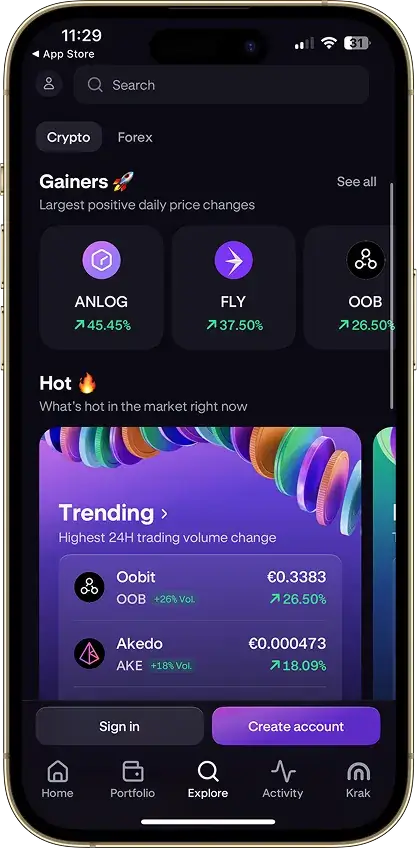
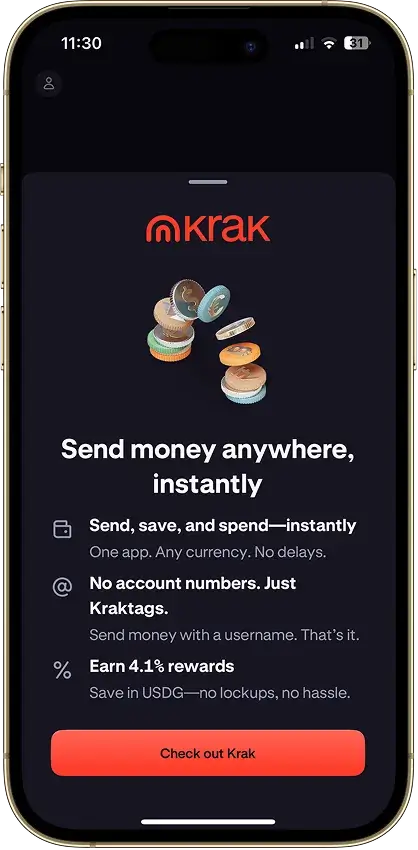
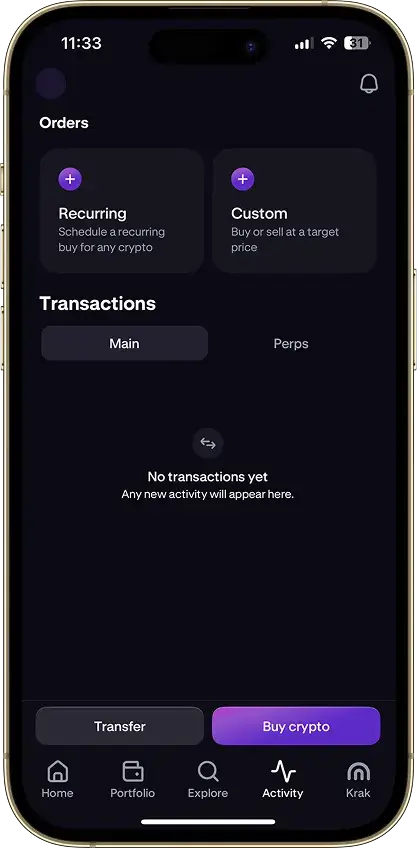
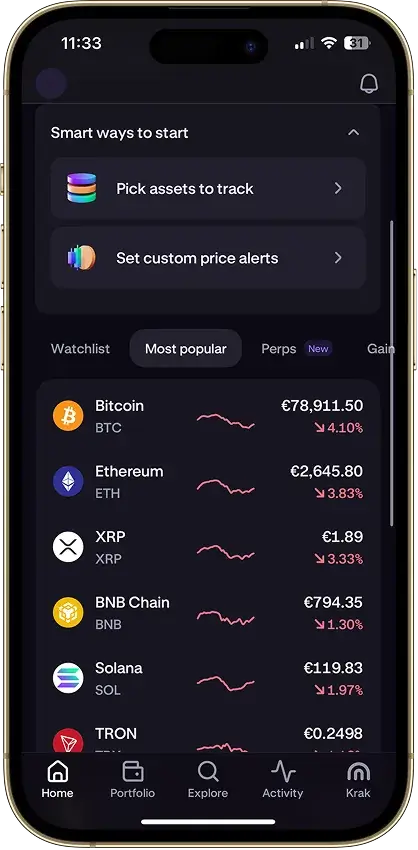
Kraken Screenshots
Kraken Pros and Cons
Pros
- Strong security posture with regular proof‑of‑reserves audits
- Deep liquidity on major fiat pairs and top crypto assets
- Competitive maker–taker fees on Kraken Pro without holding a token
- Broad fiat on‑ and off‑ramps across U.S., UK, and EU
- 24/7 live chat and multilingual interface
Cons
- Instant buy costs are high versus pro‑tier trading
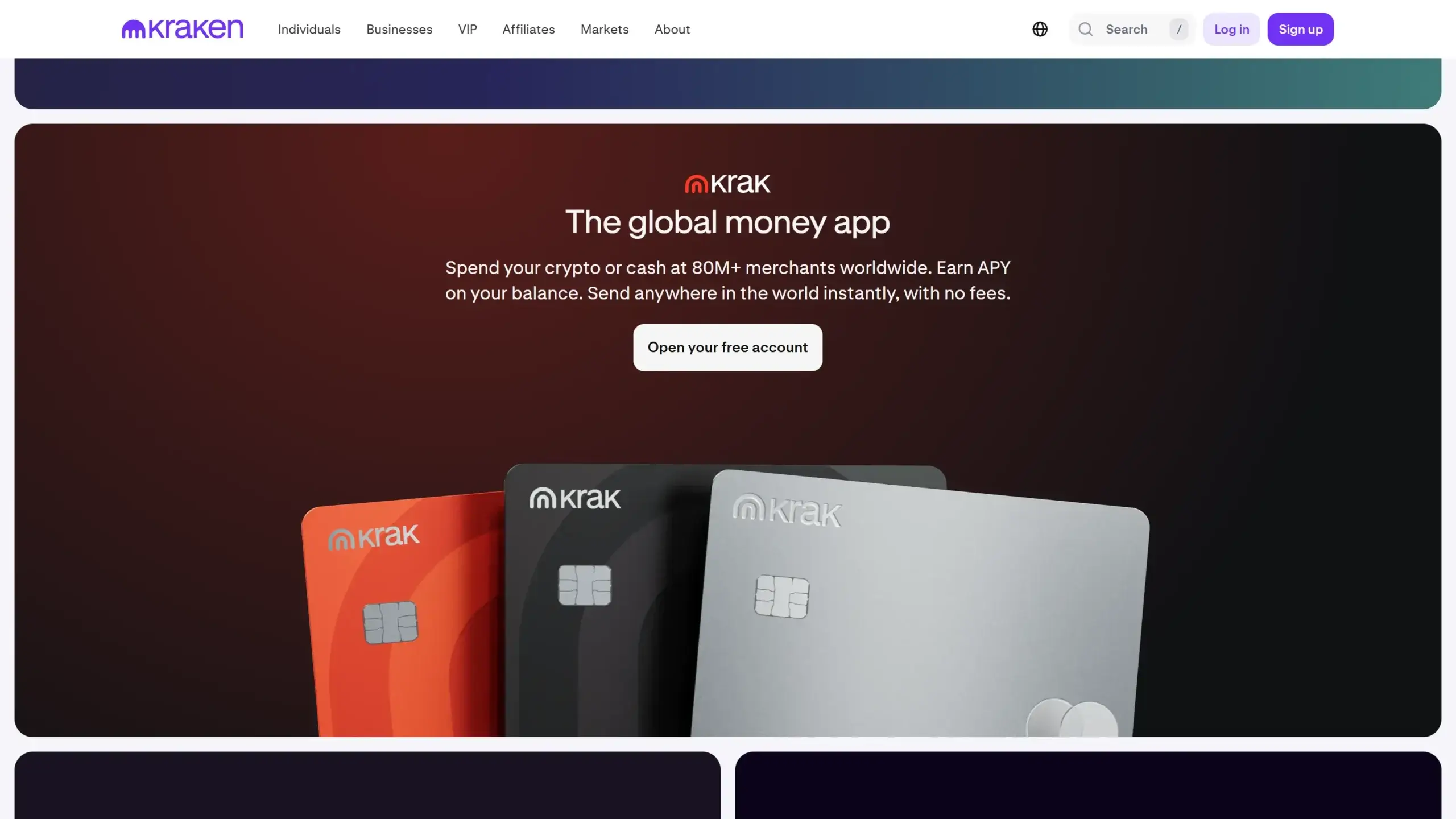
- No crypto debit card
- Opt‑In Rewards unavailable in the U.S.; staking limited to certain U.S. states and parts of the UK and EU
- Region‑specific product gaps for derivatives
What is Kraken? Exchange Background and Oversight
Kraken is a centralized, custodial cryptocurrency exchange (CEX) and brokerage platform for spot, margin, derivatives, and U.S.-listed stocks and ETFs, operated by Payward, Inc. It launched publicly in 2013 after a 2011 founding and now serves a global client base with more than 500 crypto assets and multiple fiat markets. Kraken remains privately held, with co‑CEOs Arjun Sethi and Dave Ripley.
It became known for a security‑first posture and early proof‑of‑reserves audits. Notable steps include acquiring Crypto Facilities to power futures and securing a Wyoming SPDI bank charter for Kraken Bank in 2020. Leadership shifted in 2023 when Dave Ripley became CEO and founder Jesse Powell moved to chairman; in 2024 Arjun Sethi joined as co‑CEO. This expansion into securities brokerage moves Kraken beyond a pure crypto exchange into a combined brokerage platform for eligible U.S. clients.
Kraken’s appeal centers on regulated bank rails in core markets, pro‑grade trading tools, and steady listings. Incidents and insurance specifics are addressed in the Safety section.
Kraken is operated by Payward, Inc. and affiliated entities, a privately held company co‑led by CEOs Arjun Sethi and Dave Ripley, with founder Jesse Powell as chairman.

Recent Kraken Exchange News
In April 2025, Kraken launched commission‑free trading on more than 11,000 U.S.-listed stocks and ETFs for select U.S. clients, expanding beyond crypto for the first time. In July 2025, the company introduced Kraken Derivatives US, giving eligible U.S. users regulated access to CME‑listed crypto futures from within Kraken Pro.
In October 2025, Kraken agreed to acquire Small Exchange, a CFTC‑regulated futures venue, in a $100 million deal that paves the way for a fully U.S.-native derivatives platform.
Features and Services
Kraken’s toolkit prioritizes regulated access and pro‑grade controls over hype features. Compared with offshore venues that push higher leverage or broader small‑cap listings, Kraken focuses on spot, margin, and regulated derivatives, plus strong fiat rails.
Core Kraken exchange features include spot and margin order books, perpetual futures where allowed, fiat on‑ and off‑ramps, staking products, token launches via Kraken Launch, full API access, and the Kraken Wallet for self‑custody. As of Oct.–Nov. 2025, it offers perpetual futures with up to 10x buying power for most retail clients outside the U.S./UK, and U.S. clients can access CME‑listed futures via Kraken Derivatives US (launched Jul. 15, 2025).

Trading Options
- Markets offered. Live markets include spot, margin and perpetual futures, plus an institutional OTC desk. Eligible U.S. clients can also trade U.S.-listed stocks and ETFs for cash inside the main Kraken app; there is still no listed options venue for retail. Options are available via OTC for eligible institutional clients. Margin on Kraken Pro supports up to 10x on selected assets and 5x across most enabled markets; perpetual futures on Kraken Pro generally advertise up to 10x buying power, with contract- and region-specific limits. Derivatives availability varies by region and entity; see KYC and geographic access for details.
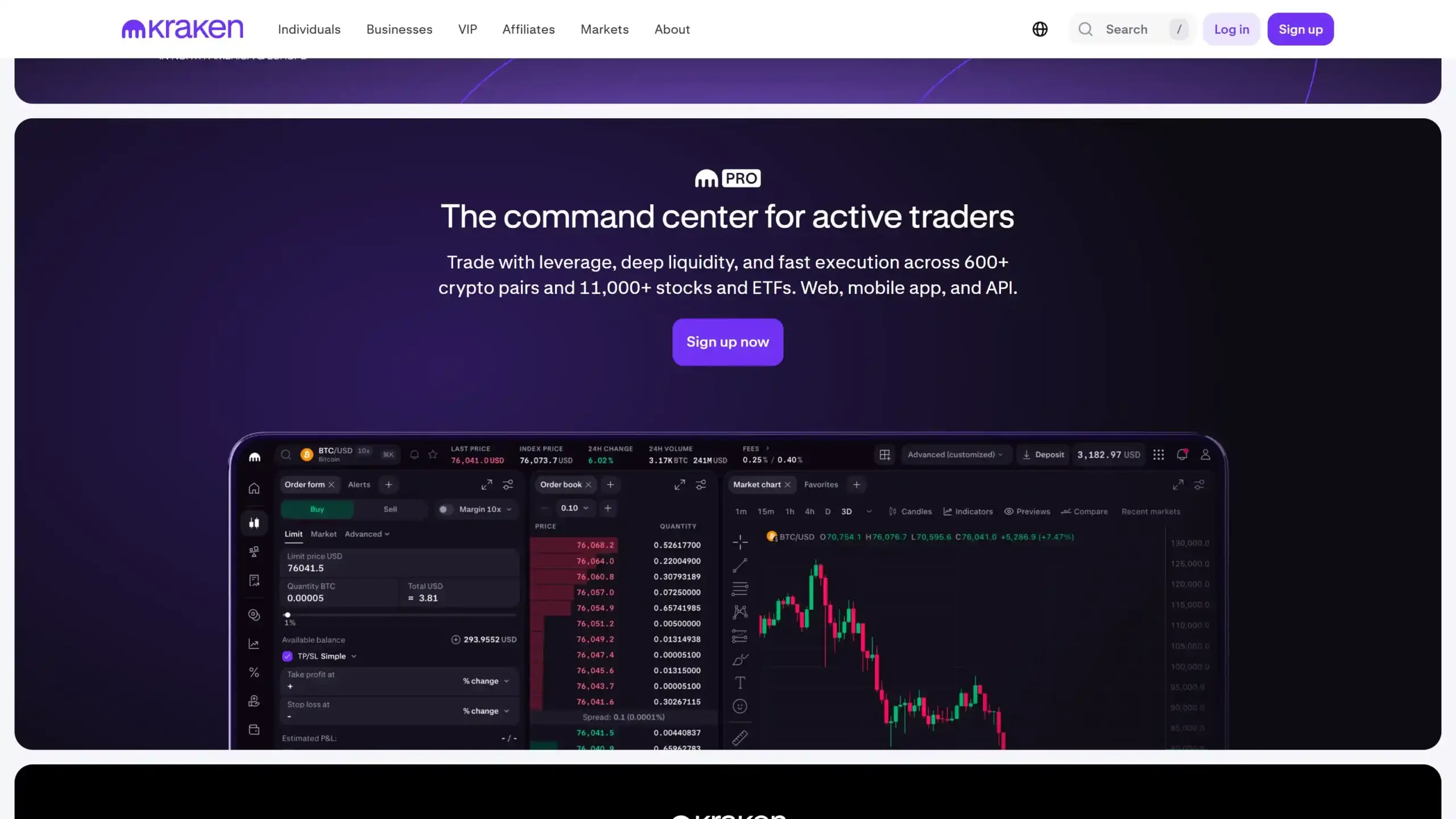
- Interface modes. The consumer Kraken: Buy Crypto & Stocks app handles instant crypto buys and stock and ETF orders, while Kraken Pro (web/desktop/mobile) adds TradingView charts, deep order books, and advanced orders (market, limit, stop, stop‑limit, take‑profit, post‑only, reduce‑only). Layouts are modular with multi‑panel workspaces; mobile and web have near feature parity for spot, margin, and derivatives.
- Pairs and assets. Spot coverage spans hundreds of pairs across USD/EUR/GBP/JPY fiat markets and major quote assets (USDT, USDC, BTC, and fiat). The derivatives venue lists linear USD‑margined perps across 350+ markets. U.S. stocks and ETFs are available to eligible accounts only and sit in a separate instruments list rather than the crypto spot pair roster.
Brokerage and Simple‑buy Experience

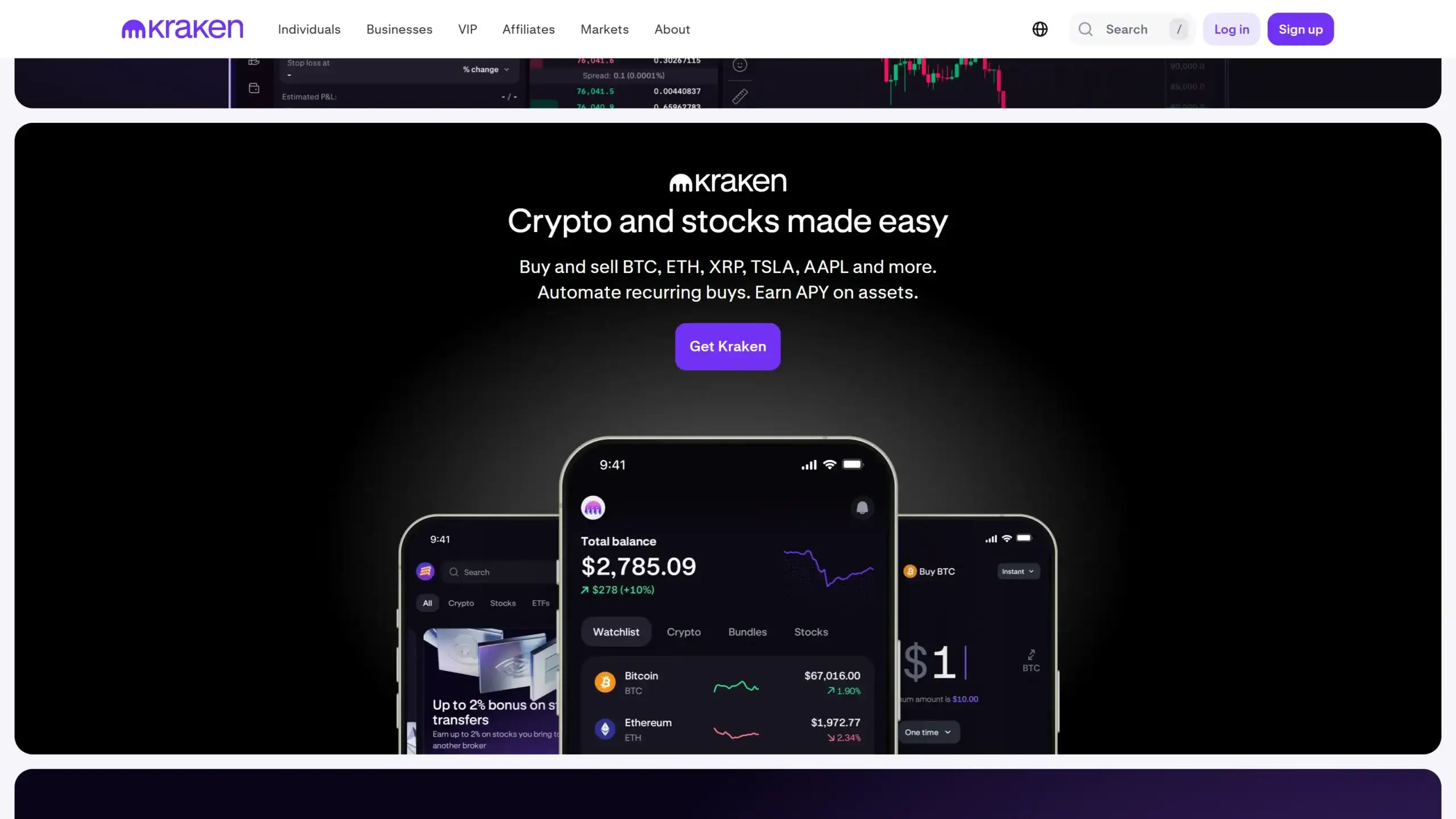
Kraken’s simple‑buy and brokerage layer lives in the main Kraken app. Crypto buyers can deposit cash by ACH, SEPA, Faster Payments, or card and then tap to buy a fixed amount of BTC, ETH, or other assets without touching order books; U.S. clients who qualify for equities can use the same interface to buy and sell U.S.-listed stocks and ETFs for cash.
Simple-buy crypto orders use a fixed 1% trading fee plus a variable spread on top of mid-market. The all‑in rate, including any spread and card or wallet processing fees, is shown on the confirmation screen before you commit. Published minimums start around 1 unit of local currency for buy/sell orders and around 10 units for card and digital wallet payments.
Some smaller assets are available only via the advanced Pro view, while others appear in both simple‑buy and Pro. Equities access is limited to eligible U.S. clients and is not available in all states. Daily or rolling limits can apply to card and wallet purchases, with higher limits available for bank transfers.
For active traders, fees are usually lower when placing limit orders on Kraken Pro than when using simple‑buy. The simple‑buy flow trades higher costs for fewer steps and less complexity, which can suit first‑time buyers and small, infrequent orders.
Derivatives and Leverage Controls

- Availability and eligibility. Kraken offers perpetual and fixed-maturity crypto futures across multiple venues. Most retail clients outside the U.S. and UK access perps and futures via Kraken Pro; in the U.S., Kraken Derivatives US provides regulated CME-listed futures to eligible clients. Derivatives access requires at least Intermediate verification and depends on your country and operating entity; see KYC and geographic access for current restrictions.
- Leverage and margin modes. Kraken’s perps and futures support both cross and isolated margin at the contract level. Kraken Pro marketing emphasizes up to 10x buying power on perps, with instrument- and venue-specific caps.
- Risk disclosure. Leverage amplifies gains and losses. Perpetual futures can incur funding payments, and positions may be liquidated if maintenance margin is not met.
Supported Assets
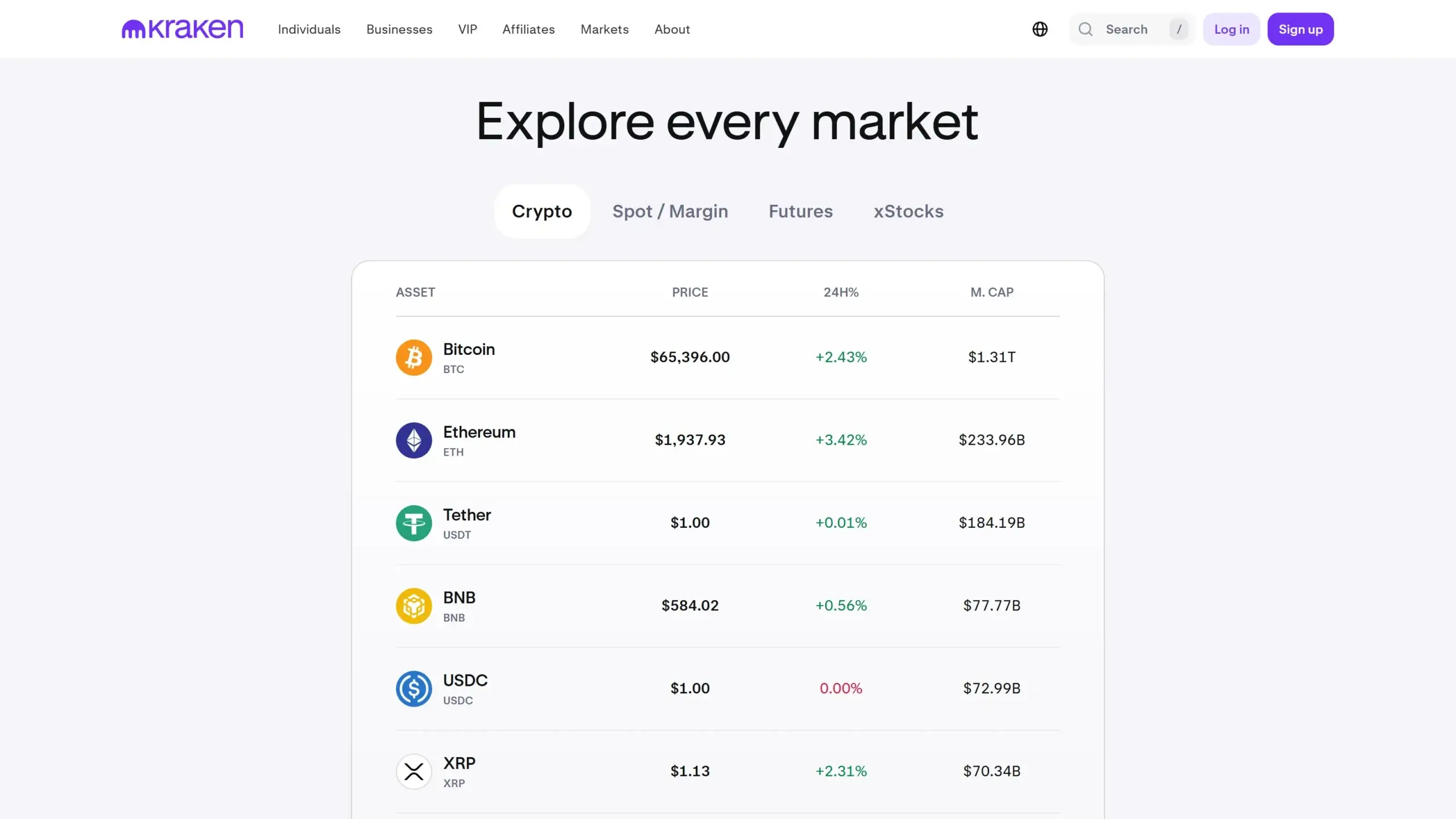
- Asset coverage. Kraken lists 500+ cryptocurrencies across layer‑1s, DeFi, majors, and stablecoins, plus hundreds of spot pairs and broad USD/EUR/GBP coverage. Use the official supported assets roster for live availability. Coverage remains conservative versus offshore venues; certain privacy coins or micro‑caps are absent in regulated markets.
- Stablecoins and networks. Supported stables include USDT, USDC, DAI and others, often on multiple networks. For example, USDT supports TRC‑20 and ERC‑20 (and additional L2/L1s); USDC appears on ERC‑20 and selected L2/SPL networks. Deposit/withdrawal network support can differ from trading routes; always match the chosen network.
- Listing cadence and policy. Listings and delistings are announced on the Kraken Blog, multiple new assets were added through Sep.–Nov. 2025. Policy is compliance‑led with periodic expansions to margin‑enabled pairs.
- Native token impact. Kraken has no native exchange token. Fees and VIP tiers are volume‑based only; there are no token‑holding discounts.
Staking and Rewards

Product scope and yields. Kraken offers Opt‑In Rewards on around 25 proof‑of‑stake assets (for example, ETH, DOT, ATOM) alongside separate on‑chain staking services for certain networks. Advertised rates can reach the high‑teens APR range, vary by asset and network, and can change over time. The products are custodial and administered by Kraken; rewards are sourced from on‑chain staking activity.
Fees/commission and payout cadence. Displayed yields are net of Kraken’s commission. Rewards typically accrue and pay out weekly to your spot balance. Most assets have no fixed lockup on the platform, though protocol‑level unbonding periods may apply where relevant. The app shows reward history and current APR per asset.
Eligibility, limits, and exit. Opt-In Rewards are not available to U.S. clients. Separate on-chain staking services are offered in many U.S. states, while access for UK retail and some EEA markets is restricted under local rules. Intermediate verification is required. Per-asset minimums apply; exiting is immediate on the platform, but on-chain unbonding delays can affect when funds become fully transferable. For up-to-date regional availability, see KYC and geographic access.
Yields vary and are not guaranteed.
Copy Trading and Bots
Availability and access. Kraken has no built‑in copy trading at this time. The platform allows third‑party bots via API keys, and lists ecosystem partners for advanced tooling. Bots and copy features, if used, are accessed through external providers. Intermediate verification on Kraken is required to trade.
Is Kraken a decentralized or peer‑to‑peer exchange?
Kraken is not a decentralized exchange (DEX) and does not run a peer‑to‑peer (P2P) marketplace. Trading happens on a central order book and Kraken holds custody of your funds unless you withdraw to a self‑custody wallet.
Launchpad, Launchpool and Airdrops
At the time of writing, Kraken runs Kraken Launch for token sales and Kraken Drops for issuer airdrops. These products give verified users access to new tokens and campaigns ahead of or alongside exchange listings, with per-sale rules on caps, fees, and regional access. Token launches and airdrops are high risk; always read the official Launch or Drops terms before participating.
Wallet and Self‑custody Options
Kraken accounts are custodial by default. For self-custody, Kraken offers Kraken Wallet, an open-source mobile app where keys stay on your device. You move assets between the exchange and wallet via on-chain deposits and withdrawals, paying standard network fees. Kraken Wallet supports major networks like Bitcoin, Ethereum, Polygon, Arbitrum, Optimism, Solana, Dogecoin, Base, and Blast, with dApp and NFT support where available.
API and Programmatic Trading

Kraken provides REST, WebSocket, and FIX APIs covering market data, trading, account, and funding. Requests use HMAC-signed API keys with granular scopes and optional IP allowlists, and higher verification tiers unlock higher limits. There is no public spot sandbox, but a demo environment exists for futures. Full specifications and SDKs live in the Kraken API Center.
Other Notable Features
Tax tooling and reporting. Users can export full account history and tax reports in CSV/Excel and connect third-party tax tools; U.S. clients may receive 1099 forms where required.
Institutional/Prime. Institutions get OTC/RFQ block trading, multi-user account controls, higher limits, and priority support, with settlement in major fiat and stablecoins.
Web3 and NFT. Kraken Wallet supports WalletConnect, dApp signing, and NFT viewing on supported networks, but there is no native NFT marketplace on the exchange.
Listings and Delistings Policy
Kraken publishes listing updates on the Kraken Listings hub and Kraken Blog then Asset Listings, and posts delisting notices on Support. Updates are also surfaced in‑app and on the status page for operational timing.
Selection and review criteria. Kraken’s five‑step process evaluates security, legal/regulatory posture, liquidity potential/market fit, and engineering readiness before approval and integration. Projects apply via the Listings Application Form; Kraken states there is no paid fast‑track.
Delisting triggers and timelines. Support notices cite scheduled pauses and deadlines. Example: Nov. 6, 2025 at 14:00 UTC — trading and deposits paused for specified assets; Jan. 23, 2026 — any remaining balances liquidated to complete the delisting. Withdrawals remain available until the liquidation date, and clients are urged to withdraw or convert in advance.
Regional/entity variance. Listings can differ by operating entity and local rules. Availability may vary by U.S./UK/EU entity or due to sanctions, with some assets restricted in certain regions. Users should confirm local availability on the asset’s Support page and the Where Kraken is licensed article.
Recent change. Nov. 6, 2025: Kraken announced FOLKS is live for trading on the blog; a separate Support notice detailed a scheduled delisting window for several assets starting the same day.
Kraken Fees and Fee Schedule
Kraken’s fee schedule covers Instant Buy/Sell, Kraken Pro trading, deposits/withdrawals, conversions, and staking commissions. Kraken Pro uses 30‑day USD volume to set maker/taker tiers. Percentages are quoted against the quote currency unless noted.
On Kraken Pro, base fees are 0.25% maker / 0.40% taker and step down to 0.00% / 0.08% at the highest tiers measured over the last 30 days. Most pairs follow the same schedule. There are no negative maker rebates. On Instant Buy/Sell, pricing consists of a fixed 1% trading fee plus a spread embedded in the quoted price; the final rate is displayed before you confirm the order.
Funding and payouts. ACH and SEPA deposits are typically free to receive; FedWire USD withdrawals are a flat ~$4 and post in 0–1 business days. SWIFT deposits/withdrawals vary by corridor and can take 1–5 business days. Debit/credit card and PayPal purchases are near‑instant but carry processor fees and may trigger a short withdrawal hold. That means most Kraken deposit fees on bank rails (ACH, SEPA, Faster Payments) are $0, while Kraken USD withdrawal fees via FedWire are usually around $4 per transfer. Exact Kraken SEPA deposit and withdrawal fees depend on your bank and corridor and are shown before you confirm.
Crypto withdrawals. Kraken passes through network fees. Costs depend on the network you select (for example, USDT‑TRC20 is usually cheaper than ERC‑20). The exact amount is shown when you choose a network on the withdrawal screen.
For U.S. stocks and ETFs, Kraken advertises commission-free trading for eligible U.S. clients, although standard regulatory fees and any FX or conversion costs may still apply.
Kraken Crypto Withdrawal Fees (BTC, ETH, USDT, USDC, XRP, SOL)
Kraken does not charge fixed per‑asset withdrawal fees. Instead, your bitcoin withdrawal fee, and ETH, USDT, USDC, XRP and SOL withdrawal fees are the underlying network fees required to send each transaction. For example, BTC on‑chain withdrawals are generally more expensive and slower than USDT‑TRC20 or XRP. The precise Kraken withdrawal fee for each asset and network is calculated dynamically and shown on the withdrawal page before you confirm.
Staking commission. Displayed APRs for Opt‑In Rewards are net of Kraken’s commission and can change over time. Kraken does not guarantee yields.
Discounts and ways to pay less. Volume‑based Pro tiers lower maker/taker automatically. Kraken+ is an opt‑in subscription (around $4.99/month or $49.99/year in major currencies) that waives Instant Buy/Sell/Convert trading fees on up to $10,000 equivalent in monthly volume; spreads and card processing fees still apply, and the subscription does not affect Pro spot, derivatives, OTC, or API trading. See the fee schedule and Kraken+ FAQ for details.
There is no monthly fee to use Kraken Pro itself — you only pay trading, deposit, or withdrawal fees when you transact. Kraken+ is an optional subscription that costs around $4.99/month or $49.99/year in supported currencies and waives Instant Buy/Sell/Convert trading fees on up to $10,000 equivalent in monthly volume.
Here's how you can minimize your fees at Kraken:
- Place trades on Kraken Pro instead of Instant Buy/Sell when possible.
- Use maker limit orders and consolidate activity to reach lower 30‑day volume tiers.
- Prefer ACH/SEPA over cards for funding; pick low‑fee networks for withdrawals.
Inactivity fee. Kraken does not list an inactivity fee for standard accounts; you are charged only when you trade, fund, or withdraw.
Kraken Pro Fee Structure (maker/taker)
The VIP tiers below show how Kraken Pro maker and taker fees step down based on your 30‑day USD trading volume.
| Tier | 30‑day volume | Maker | Taker | Notes on discounts or exclusions |
|---|---|---|---|---|
| $0+ | $0 | 0.25% | 0.40% | Default base tier; volume measured in USD over the last 30 days. |
| $250,000+ | $250,000 | 0.10% | 0.20% | Most spot pairs use this schedule; fee currency defaults to quote. |
| $10,000,000+ | $10,000,000 | 0.00% | 0.10% | No maker rebate below zero; Kraken Pro only. |
| $100,000,000+ | $100,000,000 | 0.00% | 0.08% | Institutional qualification applies; see fee page for perks. |
Note. Kraken+ subscription waives Instant Buy/Sell/Convert trading fees on up to $10,000 equivalent in monthly volume; it does not discount Kraken Pro spot, derivatives, OTC, or API trades.
Payments and fiat support
Base account currencies include USD, EUR, GBP, CAD, AUD, CHF, and JPY. Primary rails are ACH/FedWire in the U.S., SEPA in the EU/EEA, Faster Payments/CHAPS in the UK, and SWIFT for international transfers. Cards, Apple Pay/Google Pay, and PayPal are processed by integrated providers with fees shown at checkout. Limits are enforced per transaction and by rolling 24‑hour windows tied to verification level.
| Payment method | Minimum deposit | Minimum withdrawal | Maximum withdrawal |
|---|---|---|---|
| ACH (US) | $1 | — | — |
| FedWire (US) | $1 | — | — |
| SEPA (EU/EEA) | €1 | — | — |
| Faster Payments (UK) | £1 | — | — |
| SWIFT (intl.) | $100 | $100 | — |
| Debit card (Visa/Mastercard) | ~$10/€10/£8 | — | — |
| Apple Pay / Google Pay | ~$10/€10 | — | — |
| PayPal (US/EU) | ~$10/€10 | — | — |
Limits and timing. Per‑method caps vary by verification level and are enforced per transaction or per 24‑hour period. ACH/SEPA/FPS typically credit same day. FedWire USD withdrawals post in about 0–1 business days. SWIFT settles in 1–5 business days depending on corridor. Cards and PayPal fund near instantly but may impose a short withdrawal hold.
Currency matching and conversion. Kraken supports multiple fiat balances. Bank withdrawals must return to an account in the same currency. If you trade in a different currency, the platform applies a conversion rate which is shown in the order or conversion flow.
Address and beneficiary management. Bank account names must match the Kraken account. Withdrawal addresses can be whitelisted with cooldowns. Newly deposited fiat may require turnover before withdrawal.
On‑ramp and off‑ramp partners. Instant card and wallet payments use integrated processors. Processing fees and eligibility are shown in‑flow. Card chargebacks and wallet disputes are handled by the payment provider under its terms.
Fiat rails by region
| Region | ACH | SEPA | Faster Payments | Wire | Cards | PayPal | Notes |
|---|---|---|---|---|---|---|---|
| US | Yes | — | — | Yes | Yes | Yes | ACH credits quickly with withdrawal holds on new funds. FedWire posts same or next business day. |
| EU or EEA | — | Yes | — | Yes | Yes | Yes | SEPA is typically same day. SWIFT varies 1–5 business days by corridor. |
| UK | — | — | Yes | Yes | Yes | Yes | FPS is near instant. CHAPS handles large same‑day GBP transfers. |
| RoW | — | — | — | Yes | Yes | — | SWIFT for fiat where available. Cards supported in selected countries. |
Withdrawal Networks and Fees Matrix
This example shows how typical Kraken bitcoin withdrawal fees, ETH gas fees, and USDT TRC‑20/ERC‑20 withdrawal fees are network‑only and can change with on‑chain congestion. The actual Kraken withdrawal fee for each asset and network is calculated in real time on the withdrawal page before you confirm.
| Asset or network | Fee model | Typical confirmation window | Notes |
|---|---|---|---|
| BTC on‑chain | Network fee only | About ten to sixty minutes | Priority setting affects time and cost. |
| ETH ERC‑20 | Network fee only | About five to fifteen minutes | Gas varies with network load. |
| USDT TRC‑20 | Network fee only | About two to ten minutes | Lower‑fee network for stablecoin moves. |
| USDT ERC‑20 | Network fee only | About five to fifteen minutes | Higher gas at peak congestion. |
Is Kraken a Safe Crypto Exchange? Security and Proof of Reserves
Kraken is generally considered a safe, regulated crypto exchange thanks to strong cold-storage practices, robust account security, and regular proof-of-reserves attestations, but it is still a custodial platform so users share counterparty and exchange risk.
Controls. Key Kraken exchange security features include storing the majority of client assets in offline cold storage with secure facilities under 24/7 surveillance. Hot‑wallet exposure is minimized. User‑level controls include 2FA (TOTP and hardware keys), withdrawal address whitelists with email confirmations and cooldowns, device and session management, and a Global Settings Lock that freezes critical changes. Email security supports PGP. Specific details on MPC/HSM implementation are not disclosed. Security certifications include ISO/IEC 27001:2022 and a completed SOC 2 Type 1 examination.
Custody and insurance. Custody is operated in‑house across regulated entities with client assets held segregated from corporate funds. Fiat balances are held at partner banks, where deposit insurance applies to cash under bank rules and limits. Crypto balances are not insured by government programs. Kraken does not publish blanket crime insurance for client crypto; any coverage scope is not disclosed.
Proof of reserves or audits. Kraken performs regular Merkle‑tree PoR attestations by an independent accounting firm. Reports in Mar. 2025, Jun. 2025, and Sep. 2025 verified 1:1 coverage of in‑scope assets and liabilities and enabled self‑verification of account inclusion. The latest report as of Sep. 30, 2025 is linked from the PoR hub and blog.
Incidents and remediation. Jun. 2024 — a funding‑system bug was exploited to withdraw roughly $3 million from Kraken corporate funds. No client funds were affected. Kraken patched the flaw quickly, tightened controls, and referred the case to law enforcement. The CSO’s incident thread provides the primary account.
How to Verify PoR Yourself
- Open the Proof of Reserves page and follow the link to the latest attestation. Confirm the attestation date and the accounting firm named on the report.
- Log in to your Kraken account and use the PoR self‑verification tool to retrieve your Merkle leaf and verify inclusion against the published tree.
- Review the scope and limitations noted in the report, including which assets are covered and the frequency of attestations. Note that PoR is not a full financial audit.
Status Page and Incident History
Status page. status.kraken.com lists real‑time incidents, maintenance, and historical entries. Updates post throughout the day, with times presented in UTC unless otherwise noted.
Recent material incident (last 24 months).
- Jun. 2024 — Funding‑system bug → about $3M from corporate funds, no client impact, patched and escalated to law enforcement.
UX and Customer Support — KYC and Geographic Access
Kraken splits workflows between the consumer Kraken app (instant buys, funding, basic portfolio) and Kraken Pro (advanced trading on web, desktop, and mobile). Navigation is conventional — Markets, Trade, Funding, and Earn are easy to reach — and support runs 24/7 via Help Center chat, with phone support from the mobile app in specific cases. Official docs: Support Center, Phone support policy, and Status.
Kraken Exchange Interface
The Kraken cryptocurrency exchange interface splits flows between the simple Kraken app for instant buys and the advanced Kraken Pro interface for trading, with consistent layouts across web, desktop, and mobile.
Layout and workflows. The web and desktop layouts surface account, funding, and markets on top‑level menus. Kraken Pro uses modular panes for chart, order book, depth, and trades with quick search and watchlists.
Performance and stability. The Kraken and Kraken Pro apps carry high 4‑star ratings across the Apple and Google app stores, with regular updates through 2025. System incidents and maintenance windows are posted on status.kraken.com.
Accessibility and localization. The iOS listing shows 13 languages (EN plus 12) and Pro supports language selection on web and derivatives dashboards. Pro offers light and dark themes and configurable alerts; core flows work across web, desktop, and mobile with near parity.
Mobile app

Platforms and availability. Official apps: Kraken: Buy Crypto & Stocks and Kraken Pro on iOS and Android. Store availability follows your Apple/Google account region rather than Kraken account residency.
Feature parity. The Kraken app focuses on instant buy/sell, funding, recurring buys, and account management. Kraken Pro supports spot and margin trading, with derivatives for eligible regions, and mirrors most web Pro features including advanced orders and alerts.
Performance, security, and notifications. Authentication is username + password with 2FA (TOTP or hardware key) after sign‑in. Device biometrics are supported by the OS. Pro and web offer price alerts and watchlist alerts; push delivery requires enabling notifications at OS and in‑app levels. Phone support is initiated from the app where eligible; otherwise live chat and tickets are the primary channels.
Registration

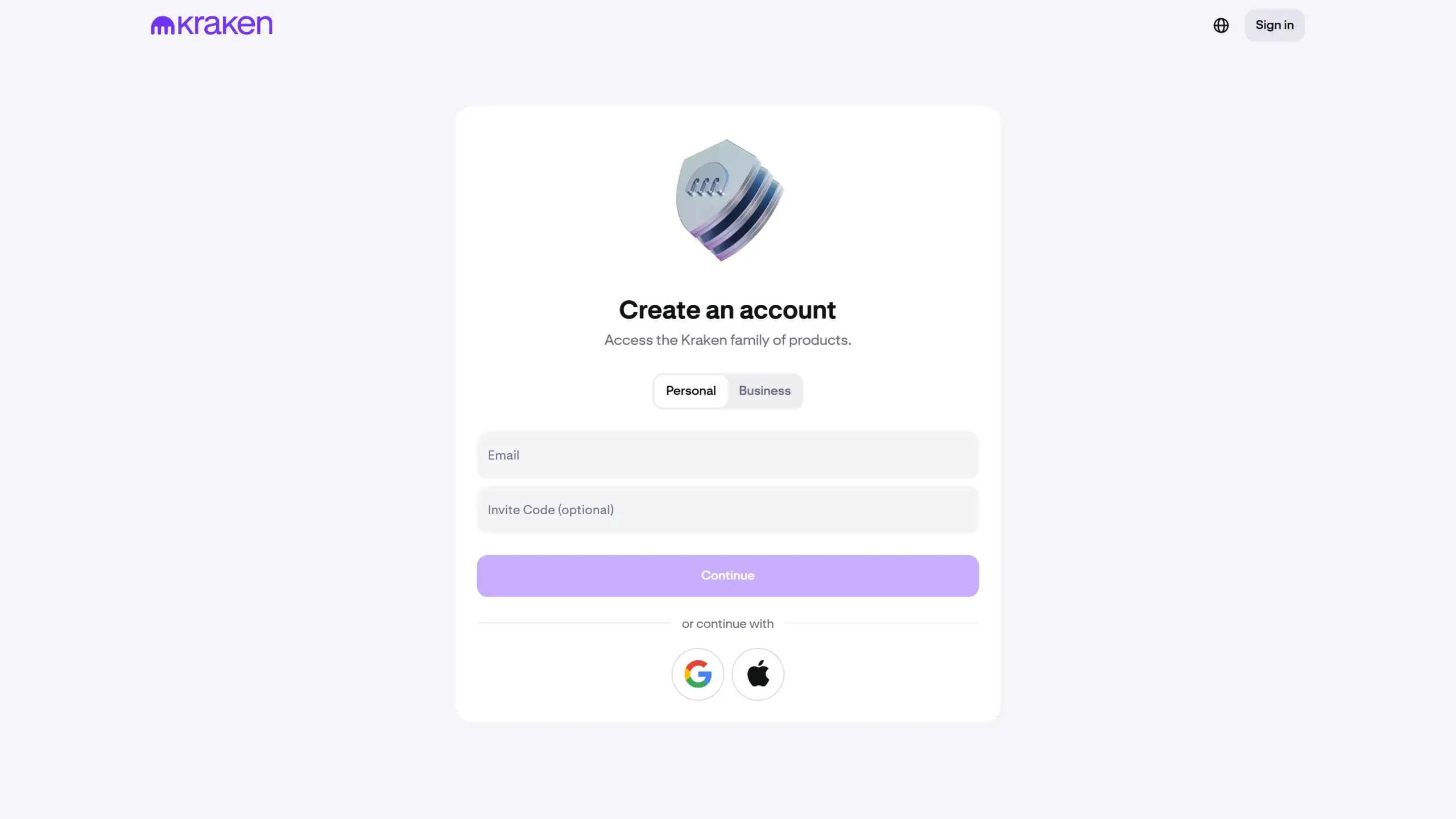
Sign up with email, country, and password, then confirm the email. Intermediate verification is required to enable deposits and withdrawals. The flow collects personal details and a government ID — some regions request proof of address. Many accounts clear within minutes when images are legible.
After first login, enable 2FA for sign‑in and withdrawals. Kraken does not offer Google or Apple SSO; authentication is account‑based. Recovery tools include a Master Key and Global Settings Lock, managed under Security.
Apps are listed in the Apple App Store and Google Play, and availability tracks your app‑store account region. Geographic gating occurs at the product level (for example, no retail crypto derivatives in the UK; some buy methods unavailable in NY/ME).
KYC and Geographic Access
Kraken uses two personal verification levels: Intermediate and Pro. Intermediate unlocks fiat deposits and withdrawals, spot, margin, OTC, and API. Pro increases limits and API thresholds. Triggers include first fiat deposit/withdrawal, derivatives eligibility checks, large transfer reviews, and flags from ongoing monitoring. Enhanced due diligence can request source‑of‑funds or source‑of‑wealth and may pause withdrawals until cleared. Pending upgrades retain existing Intermediate functionality.
Accepted documents and timelines. Intermediate requires government ID, full name, DOB, address, phone, and SSN/Tax ID for U.S. users. Proof of address or a face photo may be requested based on country and whether address auto‑verifies. Pro adds a short KYC questionnaire and may ask for additional documents. Typical Intermediate reviews finish in under about 30 minutes when automated, Pro is usually less than 5 business days when complete documentation is provided. Peak periods can extend these windows.
Availability and notable restrictions. Kraken serves most countries, but New York and Maine are not supported for exchange services. Kraken’s app distribution docs also note that the mobile app is not available in Crimea, Donetsk, Luhansk, Cuba, Iran, North Korea, or Syria, and the company states that it does not operate in other sanctioned or embargoed regions. UK retail cannot access crypto derivatives. Australia limits derivatives to wholesale clients. U.S. staking relaunched in Jan. 2025 in select states, while CA, MD, NJ, WI remain excluded. Sanctioned and embargoed jurisdictions are prohibited. Always confirm on the official list before onboarding.
Official restricted list. See Where Kraken is licensed or regulated in the Support Center for the canonical availability and product‑by‑entity notes; policies can change without notice.
Verification Levels and Withdrawal Limits
| Level | Required documents | Fiat deposit limit | Fiat withdrawal limit | Crypto withdrawal limit | Typical review time |
|---|---|---|---|---|---|
| Intermediate | Government ID, personal info, phone, address; SSN/Tax ID for U.S.; PoA or face photo if prompted | $100,000 / 24h · $500,000 / 30d | $100,000 / 24h · $500,000 / 30d | $500,000 / 24h · $15,000,000 / 30d | Often <30 min when automated; longer if manual |
| Pro (Personal) | Intermediate + KYC questionnaire; may request additional docs | $10,000,000+ / 24h · $100,000,000+ / 30d | $10,000,000+ / 24h · $100,000,000+ / 30d | $10,000,000+ / 24h · Unlimited / 30d | Up to ~5 business days with complete info |
Geo Access and Entity Mapping
| Region or country | Operating entity | What is available | Notes |
|---|---|---|---|
| United States | Payward, Inc.; Kraken Derivatives US (FCM) | Spot, margin, OTC, CME crypto futures via Derivatives US; staking in select states | NY and ME not served; staking not available in CA, MD, NJ, WI; confirm state access before onboarding |
| EU/EEA | Payward Europe Solutions Ltd (CASP); Payward Ireland Ltd (EMI) | Spot, margin, perps, staking (where permitted), OTC, API | SEPA rails; entity and country rules govern asset and Earn availability |
| United Kingdom | Payward Ltd (FCA‑registered cryptoasset firm; EMI partner) | Spot, margin, staking availability subject to FCA rules; no retail crypto derivatives | UK consumer rules require categorisation tests and in‑flow risk warnings |
| Canada | Payward Canada, Inc. (CSA Restricted Dealer; FINTRAC MSB) | Spot, staking per terms, OTC, API; derivatives access per local rules | PRU completed; RD status as of Apr. 2025; funding via Interac e‑Transfer and wires |
| Australia | Bit Trade Pty Ltd (AUSTRAC) | Spot, staking per terms, OTC, API; derivatives for wholesale clients only | Wholesale eligibility required for derivatives; retail derivatives blocked |
Customer Support
Channels and availability. Support runs 24/7 via live chat and email tickets; phone support is available from the mobile app to eligible clients. Documentation covers contact flows and identity checks for sensitive requests.
Responsiveness and SLAs. First responses on chat are often minutes off‑peak; complex compliance reviews take longer. Incident and maintenance communications post on the Status page with UTC timestamps; check status before opening tickets.
Authentication and safety. Support will never ask you to approve a withdrawal. Email confirmations contain device and IP details for new withdrawal addresses. Verify domains and reach support only through in‑app links or the Support Center.
Self‑serve resources. The Help Center has hundreds of articles for funding, security, KYC, API, and product guides. Status pages and service notices provide real‑time updates and archives.
Escalation and account holds. For urgent holds or EDD reviews, prepare ID, PoA, and SOF/SOW if requested. Escalations occur through the ticket system; certain cases route to compliance with additional checks before release.
Who is Kraken Best for
Kraken crypto exchange fits security-focused traders long-term investors who want regulated access, low maker–taker fees on Pro, and reliable bank rails in the U.S., UK, and EU, as well as eligible U.S. clients who want commission-free stock and ETF trading alongside crypto in a single app.
Alternative Sites like Kraken
- Binance — broader altcoin roster and slightly lower taker fees for high‑volume spot traders.
- Bybit — wider derivatives selection and higher leverage than Kraken for experienced futures traders.
- Crypto.com — integrated Visa card and rewards if you need a spendable crypto balance.
Pick Kraken when regulated access, deep USD/EUR liquidity, and verifiable reserves matter more than a card or maximum leverage.
Final Verdict
Kraken is a secure, regulation‑minded crypto exchange and brokerage that combines deep USD/EUR liquidity, strong bank rails, and low maker–taker fees on Kraken Pro with a simple‑buy flow and commission‑free access to U.S. stocks and ETFs for eligible clients. It scores 9.1/10 in our methodology. It works best for security‑focused traders and long‑term investors who care about proof‑of‑reserves transparency and fiat on‑ and off‑ramps, and for U.S. users who want to manage both crypto and equities in one app. You should weigh higher instant‑buy costs versus Pro, the lack of a card, and regional limits on staking and derivatives.
Overall Score
9.1Best For
Security-minded traders and long-term investors who want bank-funded crypto trading and, in eligible U.S. states, commission-free stocks and ETFs in one app.
PROS
- Strong security posture with regular proof‑of‑reserves audits
- Deep liquidity on major fiat pairs and top crypto assets
- Competitive maker–taker fees on Kraken Pro without holding a token
- Broad fiat on‑ and off‑ramps across U.S., UK, and EU
- 24/7 live chat and multilingual interface
CONS
- Instant buy costs are high versus pro‑tier trading
- No crypto debit card
- Opt‑In Rewards unavailable in the U.S.; staking limited to certain U.S. states and parts of the UK and EU
- Region‑specific product gaps for derivatives
Disclaimer: CryptoSlate may receive a commission when you click links on our site and make a purchase or complete an action with a third party. This does not influence our editorial independence, reviews, or ratings, and we always aim to provide accurate, transparent information to our readers.
FAQ
Is Kraken safe and regulated?
Kraken is a regulated crypto exchange in multiple jurisdictions and uses cold storage, 2FA, and withdrawal whitelists to protect accounts. It publishes regular Merkle-tree proof-of-reserves attestations so users can self-verify inclusion. For full details on custody, certifications, and incidents, see the Is Kraken safe section.
What types of trading does Kraken support?
Kraken supports simple-buy crypto orders, spot and margin trading on Kraken Pro, perpetual futures in eligible regions, OTC block trades, and U.S.-listed stocks and ETFs for qualifying U.S. clients. Availability depends on your country, operating entity, and verification level; KYC and geographic access in this review explains the main carve-outs.
What are Kraken simple-buy fees and spreads?
Simple-buy crypto orders on Kraken charge a fixed 1% trading fee plus a variable spread on top of mid-market. The all-in rate depends on asset, payment method, order size, and volatility, and is shown on the confirmation screen before you commit. Kraken+ can waive the 1% fee up to a monthly volume cap.
What are Kraken maker and taker fees on the advanced interface?
On Kraken Pro, base spot fees start at 0.25% maker and 0.40% taker and step down to 0.00% and 0.08% at the highest 30-day USD volume tiers. There are no negative maker rebates. The fee schedule page lists the full tier ladder and any product-specific variations.
Does Kraken require KYC and what documents are needed?
Yes. Intermediate verification, with a government ID, personal details, and SSN or tax ID in the U.S., is required for fiat deposits and withdrawals. Pro adds a short questionnaire and may require extra documents. Automated Intermediate checks often clear in under half an hour, while Pro reviews can take several business days.
Which countries and US states does Kraken support?
Kraken serves most regions but does not offer exchange services to residents of New York and Maine in the U.S. The app is also unavailable in Crimea, Donetsk, Luhansk, Cuba, Iran, North Korea, or Syria, and other sanctioned regions are blocked. The geo access table in this review shows how availability and products differ by entity.
Which assets and trading pairs does Kraken offer?
Kraken lists 500+ cryptocurrencies across majors, DeFi, and stablecoins, plus hundreds of spot pairs and access to U.S.-listed stocks and ETFs for eligible clients. Exact availability varies by country and entity; Supported assets and KYC and geographic access explain coverage and gaps.
How long do deposits and withdrawals take, and what are BTC and USDT withdrawal fees?
Fiat deposits and withdrawals settle in anything from near-instant (ACH, SEPA, Faster Payments) to one to five business days on SWIFT and some wires. Crypto withdrawals process after internal checks and then depend on network congestion. BTC withdrawals typically confirm in 10–60 minutes, while USDT on TRC-20 is faster and usually cheaper; exact fees and timings are shown on the withdrawal page.
Does Kraken offer staking rewards?
Yes. Kraken offers Opt-In Rewards and separate on-chain staking services on a range of proof-of-stake assets, with weekly payouts shown net of Kraken’s commission. Access is restricted in some regions, especially for U.S. and UK retail. Yields are variable and not guaranteed.