
Uphold Exchange Review

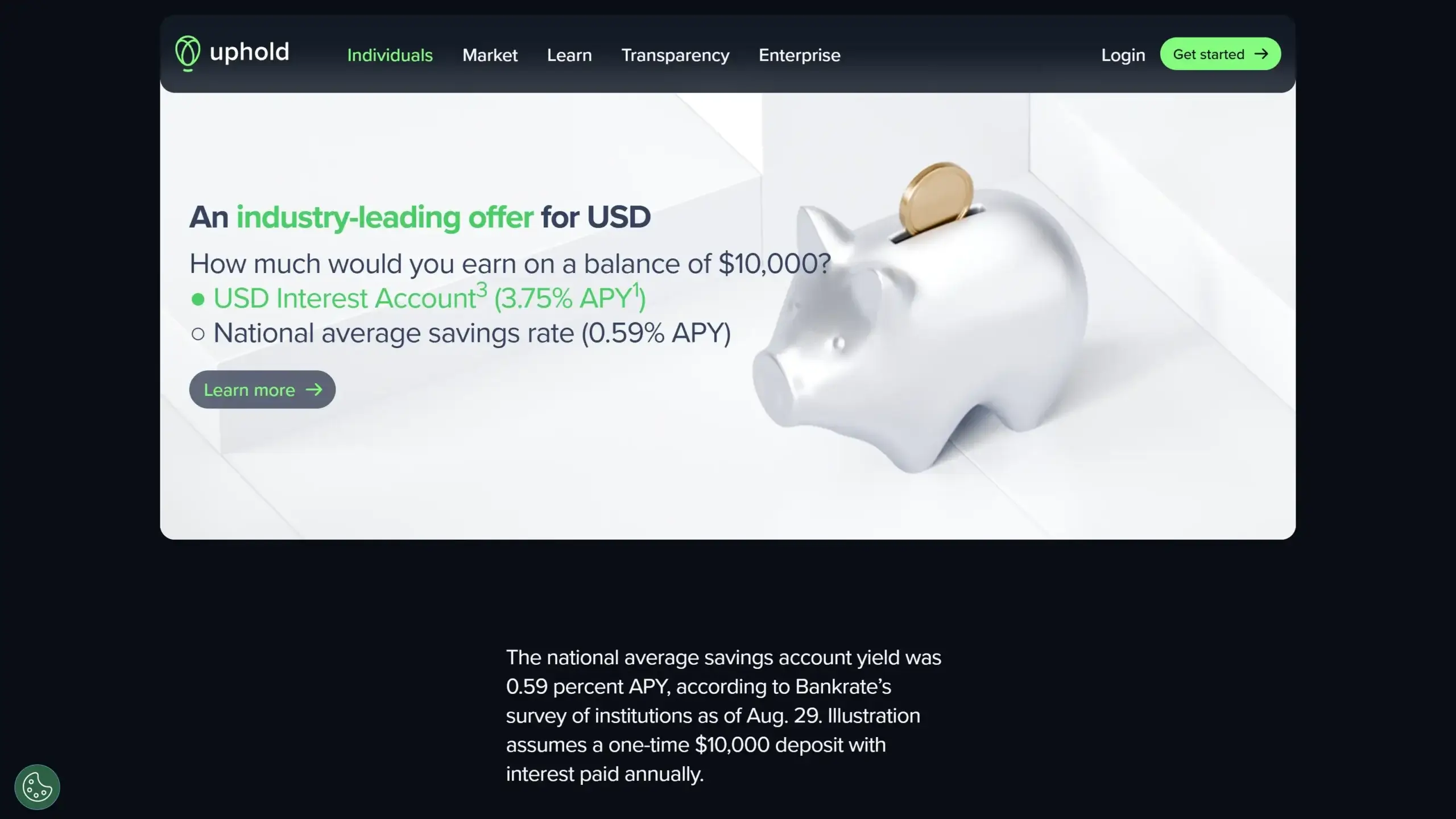
Best for users who want a simple app to buy, stake and move money across crypto, 27 fiat and metals. Strength: 360+ cryptocurrencies with one-step “anything-to-anything” swaps. Trade-off: spreads are higher than maker-taker venues.

Verified Review Checked against CryptoSlate standards
Published Dec. 16, 2025
Updated Dec. 17, 2025
Andrej
Reviewed by Andrej
Since Sep 2025 7 articles & reviews
Nate Whitehill
Fact-Checked by Nate Whitehill
Since Aug 2017 7 articles fact-checked

This operator is not available in your region.

We're sorry, but some of the content on this page is not accessible from your region. This page is for informational purposes only.

Checking your location...

Launched in 2015
7.6
  • Anything-to-anything swaps across crypto, fiat and metals
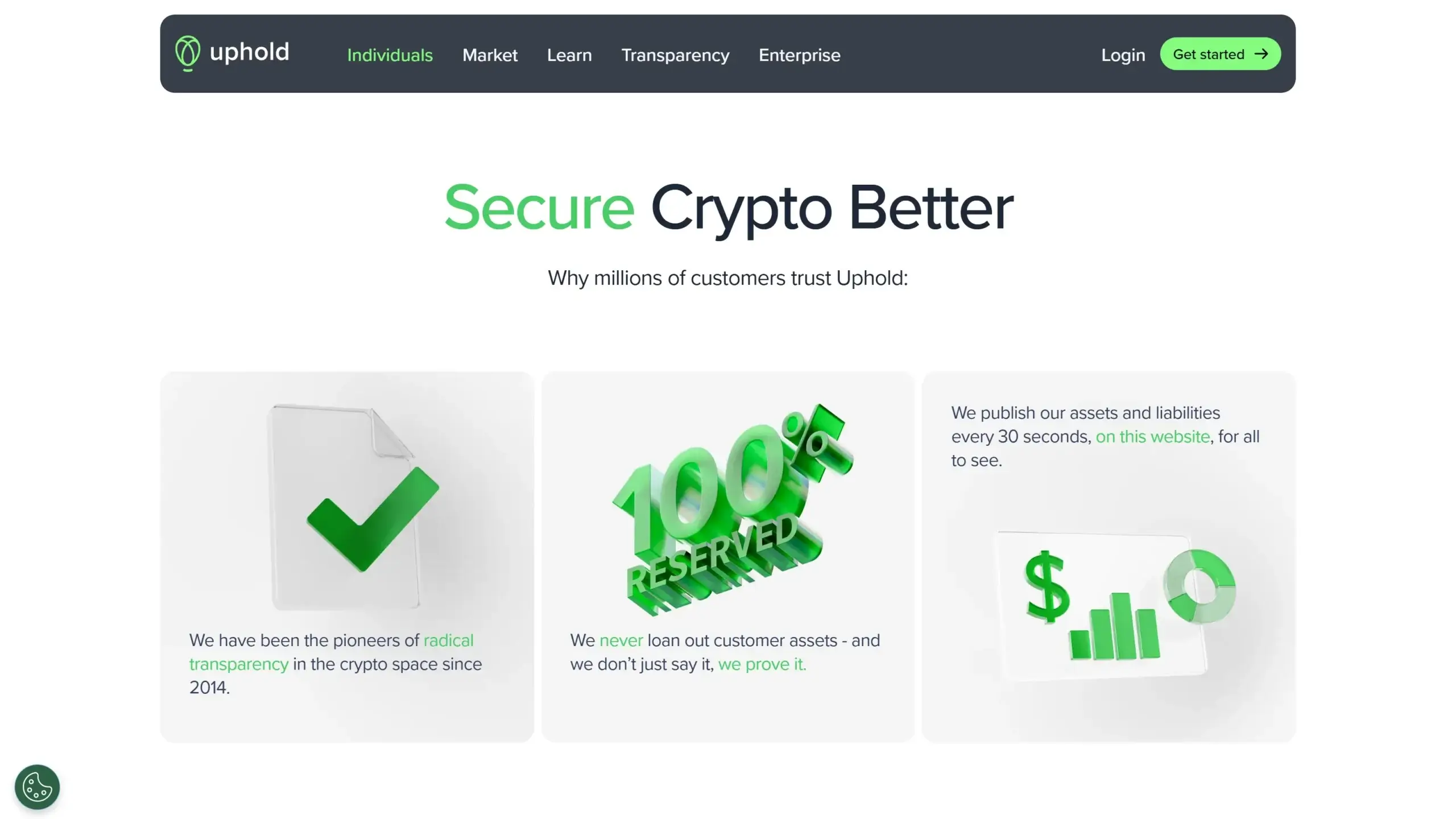
  • Real-time proof of reserves with 100%+ coverage
  • Strong fiat rails: ACH, Faster Payments, SEPA, instant card payouts

Anything-to-anything swaps across crypto, fiat and metals

Uphold Overview

Exchange Name Uphold
Parent Company Uphold HQ Inc.
Launch Year 2015
Languages English, Spanish
KYC Yes
Products Spot, OTC, Simple-buy Broker
Total Assets 360+
Staking Yes
Copy Trading No
Derivatives No
Proof of Reserves Yes
Trading Fees 0.25% - 2.95%
Maker Fee 0%
Payout Time Fiat: Instant - 3 days
Restricted Countries Canada, Anguilla, Belarus, Cuba, Iran, …

Uphold Screenshots

Uphold Pros and Cons

Pros

  • Cross-asset “anything-to-anything” swaps across 300+ digital assets, 27 fiat currencies and four metals
  • Real-time reserves page shows 100%+ backing of customer balances
  • Robust on-/off-ramps: free bank withdrawals in US, UK and EU plus instant card payouts
  • Staking available on select assets with weekly payouts and disclosed commission
  • Debit card in US/UK with no FX fees and 4–6% intro XRP rewards

Cons

  • Spreads are higher than pro maker-taker exchanges, and $0.99 applies to trades under $250
  • No margin, futures, options or copy trading
  • Customer-support responsiveness and account holds are frequent user complaints on Reddit/Trustpilot
  • Availability gaps: not supported in New York, Louisiana or Canada; card not available in EU

What is Uphold? Background and Oversight

Founded in 2015 after a rebrand from Bitreserve, Uphold is a centralized, custodial Uphold crypto exchange and multi‑asset platform operated by Uphold HQ Inc. in the U.S. with Uphold Europe Ltd. in the U.K. Uphold is a US‑based company with regulated entities in the UK and EU. The Uphold app lets users convert between cryptocurrencies, 27 fiat currencies and precious metals in a single, one‑step “anything‑to‑anything” trade.

Today it serves over 10 million users across 140+ countries, lists 300+ assets, and publishes live proof‑of‑reserves showing 100%+ backing of customer balances. Broad asset coverage, direct cross‑asset swaps and strong bank rails have made Uphold popular with newcomers and cross‑border users.

Recent development has focused on transparency via the real‑time reserve page, expanding staking options, and adding self‑custody tools, while keeping the core app simple and swap‑led.

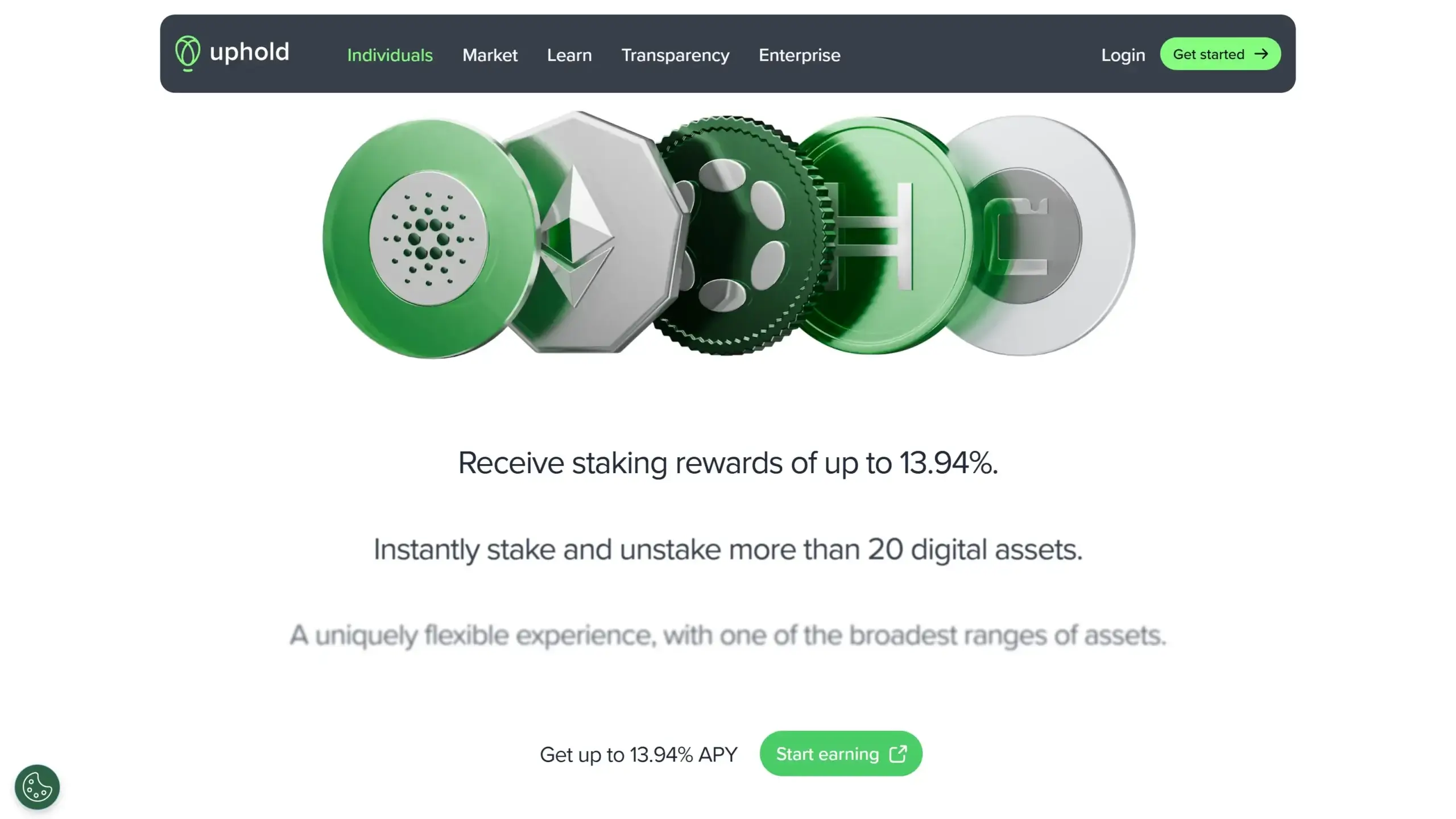
Uphold “Earn Crypto Better” hero section featuring a glowing staking rewards tile that promotes earning staking rewards on more than 20 cryptocurrencies, with a Get the app button.

Features and Services

Uphold sits between a crypto brokerage and a multi‑asset wallet. Compared with order‑book venues like Coinbase Advanced or Kraken, the Uphold app prioritizes brokered swaps over exchange‑style books, and it does not offer margin or derivatives. In return, it leans on broad cross‑asset coverage and strong fiat rails. Pricing is via spreads rather than maker or taker fees.

Trading Options

Markets offered. Uphold is spot‑only across the US, UK, EU and most supported regions. There is no margin, futures or options. Large orders can route through an OTC or deferred‑settlement facility, but these remain spot trades. No leverage is available, and product availability is otherwise consistent across supported jurisdictions.

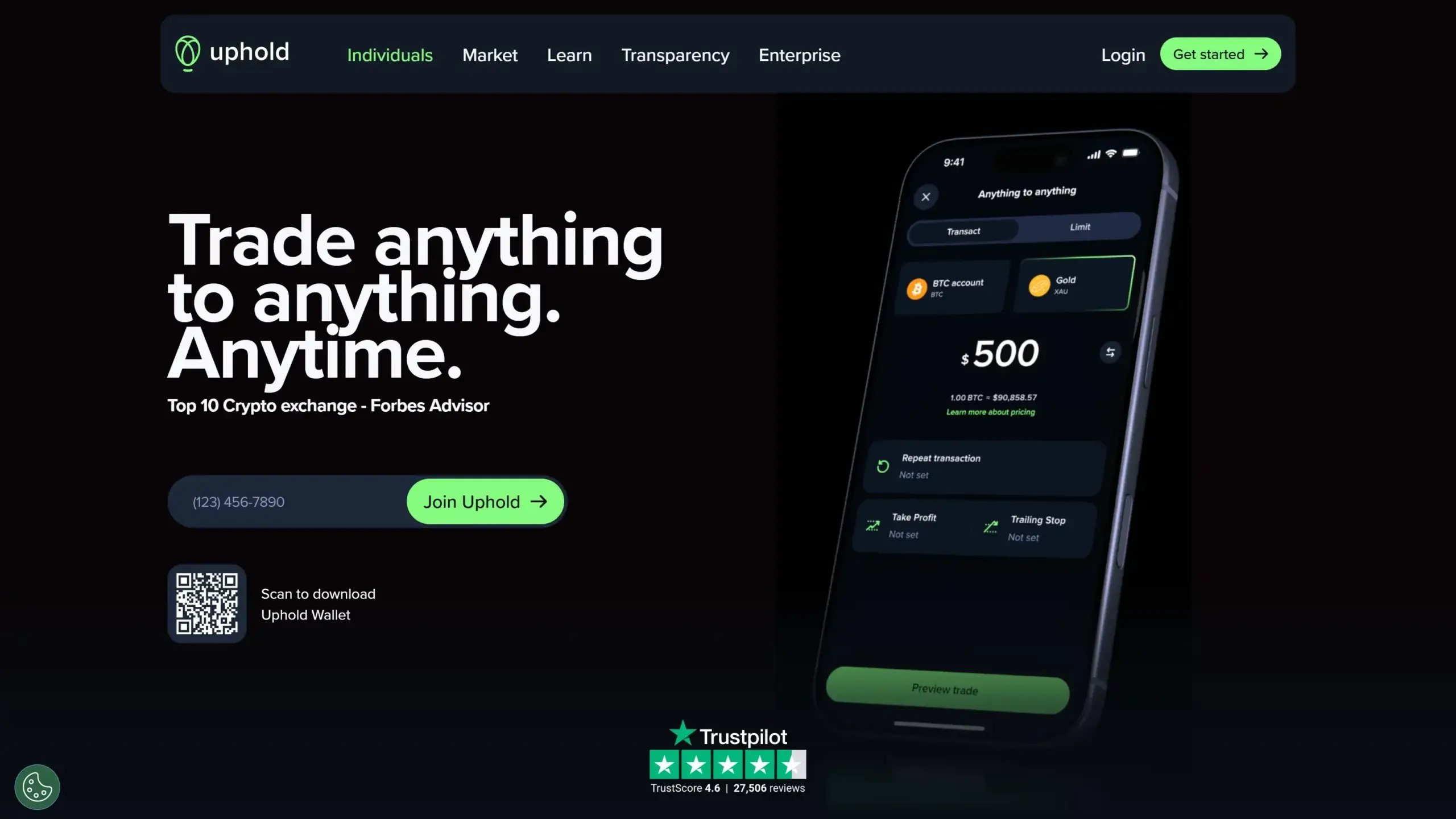
Interface modes. Trading is built around a simple swap ticket on web and mobile. Users can place limit orders, plus optional take‑profit and trailing‑stop triggers. You can keep up to 50 limit orders open at once. Card‑funded orders are typically ineligible for limits. There is no live order book, depth ladder, or pro charting. Charts are basic. Mobile and web have near‑parity for core actions.

Pairs and assets. Markets are presented as source and destination rather than classic base or quote pairs. You can trade directly between cryptocurrencies, 27 national currencies such as USD, EUR and GBP, and four metals in one step. Stablecoins and major fiats are common quotes.

Brokerage and Simple‑buy Experience

Uphold Crypto products page showing a grid of supported coins such as BTC, XRP, ETH, AAVE, BAT, ADA, ATOM and many others, with a headline explaining bank connectivity, card payments and blockchain integrations.

Simple‑buy flow. By default, trading on Uphold is a one step brokered swap. You pick a funding source or asset, choose a destination asset, then confirm the quote on Preview trade. The same flow exists on web and mobile, and most users never see a separate pro screen.

Pricing model. Simple buys use the same spread engine as other orders. Typical all in spreads on BTC and ETH versus USD or EUR sit around 1.4–1.6%, with 2.5–2.95% on many altcoins. A $0.99 small trade fee applies on most swaps under $250 and is shown before you confirm.

Limits and coverage. Minimum ticket sizes and per day caps depend on asset, rail and region. Limits are shown in the ticket before you confirm, and some assets are buy only or restricted in certain jurisdictions. Uphold withdrawal limits follow your verification level and appear in the cashier.

Comparison with advanced controls. There is no separate order book view. Advanced on Uphold means adding limit, take profit or trailing stop logic to the same brokered engine. Pricing uses the same spread model, but using bank rails, larger tickets and lower fee networks usually cuts total cost compared with frequent small card funded buys.

Supported Assets

Asset coverage. At the moment, Uphold lists 360+ cryptocurrencies, plus 27 fiat currencies and four metals. It surfaces pairs as direct conversions rather than traditional order‑book pairs. Major fiat bases include USD, EUR and GBP. If an asset is restricted for a jurisdiction, the app hides it for that locale.

Stablecoins and networks. Uphold supports the major USD‑pegged stablecoins and multiple networks for popular tokens. Examples include USDT and USDC on ERC‑20 and TRC‑20, with additional support for networks like Arbitrum and Polygon on select assets. Deposit and withdrawal network menus in the app show what is live for each coin. Trading routes remain internal even when on‑chain networks differ.

Listing cadence and policy. New listings are announced on the official blog and help center. Delistings occur for liquidity or compliance reasons. For current coverage and the Uphold supported cryptocurrencies list, check the Supported assets page and any regional caveats.

Native token impact. Uphold has no exchange utility token. There are no fee discounts, VIP tiers, or trading rebates tied to holding a house token. Spreads and staking commissions apply uniformly by asset and region where available.

Staking and Rewards

Uphold “Earn Crypto Better” hero section featuring a glowing staking rewards tile that promotes earning staking rewards on more than 20 cryptocurrencies, with a Get the app button.

Product scope and yields. Uphold offers on‑platform staking for a rotating list of proof‑of‑stake assets alongside a monthly “Uphold Rewards” program for stablecoins. Yields are variable and depend on network conditions and Uphold’s commission. Headline APYs on supported coins typically range from ~3% to ~16%, while stablecoin rewards in the loyalty program pay a published APY on qualifying balances.

Fees/commission and payout cadence. Uphold charges a commission between 20% and 25% on staking rewards (asset‑dependent). Rewards accrue continuously on‑chain and are paid to your Uphold wallet on a weekly cycle, shown in the asset’s activity feed. Some assets auto‑compound by adding new rewards to the staked balance; others post to the spot balance for you to re‑stake manually. Minimums and lockups depend on the underlying chain and will appear in the staking prompt before you confirm.

Eligibility, limits, and exit. Staking requires a verified account and is available in most supported regions, including the US, UK and EU, with per‑asset geo exceptions where local rules apply. Unbonding or cooldown periods are set by each network and can range from hours to several weeks; redemptions settle once the chain releases funds. Early exits may be unavailable or subject to network delays rather than Uphold policy. Check the in‑app staking panel for current availability and limits.

XRP and Flare pilots. As of late 2025, Uphold has piloted XRP yield features via the Flare (FXRP) ecosystem for a limited group of users; availability is narrow and experimental, so check the app and official announcements for your account and region.

Uphold Debit Card

Uphold Debit Card hero banner with the tagline “The card with the most XRP rewards,” describing up to 6% XRP back on purchases and a Get the card button.

The Uphold debit card is available in the US and UK only. In the US it runs on Visa; in the UK it runs on Mastercard via an e‑money partner. Both virtual and physical cards are offered, you can add them to Apple Pay or Google Pay, and full KYC is required. The card is not currently available in the EEA.

Rewards are paid in XRP with introductory cashback promos and higher‑tier rates for heavier spenders. Uphold advertises 0% FX fees on international purchases, ATM access is supported, and spends are settled in local fiat at Uphold’s quoted rate; spending crypto may be a taxable disposal, so many users fund with USD or stablecoins instead. Limits, caps and reward mechanics vary by region.

The app lets you freeze/unfreeze the card, change PIN, and set alerts. The card is not available in New York or Louisiana, and some merchant categories are blocked. For detailed limits, full fee tables and promo structures, see our dedicated Uphold card review.

Wallet and Self‑custody Options

Custodial by default. Uphold works as a custodial wallet for most users: assets sit in your Uphold account and can be swapped, staked or withdrawn on‑chain. It runs as a centralized crypto exchange and wallet provider, not a decentralized exchange or hardware cold wallet. Internal user‑to‑user transfers are off‑chain.

Vault and standalone wallet. For self‑custody, Uphold offers a 2‑of‑3 multisig Vault inside the app (two keys with you, one with Uphold for recovery) plus a separate standalone wallet for full self‑custody. In the custodial wallet, Uphold holds the keys; in Vault and the standalone wallet, you control movement with your keys. Account‑level controls include 2FA, device/session review and optional address whitelisting via support.

Networks and costs. Uphold supports deposits and withdrawals on major L1s and L2s (for example, Bitcoin, Ethereum ERC‑20, Solana, XRP Ledger, Polygon and Arbitrum). Network availability is asset‑specific and shown in the deposit/withdraw menu. On‑chain sends incur network fees, while internal transfers are free. The standalone wallet can connect to dApps and sign on‑chain transactions where supported.

API and Programmatic Trading

Interfaces and capabilities. Uphold provides a REST API for account, funding, quotes, orders, and transfers, plus public market‑data endpoints. There is no order‑book stream since trades execute as brokered swaps. Endpoint coverage and versioning are documented in the developer docs. There are no public numeric rate limits; limits are partner‑specific. Rate‑limit responses include a Reset-After header indicating when to retry.

Authentication and permissions. API keys are created in the account Settings, with scopes for read‑only and trading. Keys are signed and can be rotated or revoked at any time. Transfer or withdrawal permissions are restricted and may require extra verification; least‑privilege keys are recommended by default.

Account structure and access controls. Retail accounts use a single account context for keys. Business accounts can request advanced configurations. Keys support IP allowlists to limit where calls originate. Sensitive actions may require step‑up verification. Manage keys, scopes and allowlists in Settings.

Reliability and environments. Uptime and incident notices are posted on the public status page. Scheduled maintenance windows are announced in advance. The docs outline expected latency bands; if you need non‑production testing, contact support about partner access or use low‑value orders.

Developer resources. Use the official Developer Documentation for endpoints, examples and a changelog of breaking changes. Support is available via help‑center tickets; community discussion is available on public channels. Keep SDKs and libraries pinned to current versions noted in the docs.

Other Notable Features

Tax reporting and Uphold tax documents. Uphold lets you export your full transaction history in CSV or PDF format and, for eligible US customers with taxable events, it issues tax documents such as Forms 1099‑B and 1099‑MISC. You can generate Uphold tax documents in the Activity section of the app or website and reuse them with tax software or a professional.

Integrations and tools. Exported activity can be plugged into third‑party tax calculators and portfolio trackers. Uphold’s Learn and Help Center resources cover US crypto tax basics, but they are not tax advice; always confirm your obligations with a qualified adviser.

Listings and Delistings Policy

Uphold does not publish a separate listings rulebook, but new coins and removals are announced through the blog, help center and the Supported assets page. New listings tend to focus on major networks and higher demand tokens after basic legal and technical checks. Delistings usually follow low liquidity, project changes or regulatory pressure.

When an asset is removed, Uphold normally pauses trading first, then keeps withdrawals open for a period and notifies affected users in app and by email. Availability and timelines can differ by region and entity, so always check the Supported assets and Country availability pages for the latest status before you trade or hold a niche asset.

Fees and Pricing

Uphold uses an all‑in spread model for trading rather than maker/taker commissions. In practice, Uphold trading fees show up as the spread on your quote, while Uphold deposit fees mostly apply to card payments and Uphold withdrawal fees are driven by network charges plus a small platform fee on some networks.

Simple buy or sellAll‑in spread by asset class, typical ranges:
Stablecoins less than 0.25%,
Major FX about 0.3%, BTC/ETH roughly 1.4–1.6%,
Altcoins ~2.5–2.95%,
Metals ~1.9–2.95%; $0.99 applies to trades < $250
Advanced maker or takerSpread‑based — no maker/taker or 30‑day volume tiers.
Card depositUS & RoW: 3.99% on debit/credit and Apple/Google Pay;
UK/EEA: 0% on card/Apple/Google Pay.
Bank transferUS ACH deposit: $0
ACH withdrawal: $0 standard or 1.75% instant (min $1)
UK Faster Payments / EU SEPA: $0/£0/€0 deposits and withdrawals
US wire in: $10 <$2,000, $0 ≥$2,000.
Crypto withdrawalNetwork fee only for most assets; +$0.99 platform fee on specified networks

Final pricing is shown on Preview trade; confirm only if the rate suits you.

Funding and cash‑out. In the US, ACH deposits are free and instantly available to trade; standard ACH withdrawals are free (up to 5 business days), and instant ACH/debit/Apple Pay withdrawals cost 1.75% (min $1). UK bank transfers via Faster Payments and EU SEPA deposits and withdrawals are free. Card deposits are 3.99% in the US and most regions but 0% in the UK/EEA. Incoming USD wires cost $10 below $2,000 and $0 at $2,000 or more.

Crypto withdrawals. Uphold passes through network fees for on‑chain withdrawals and publishes per‑asset schedules (example: BTC 0.00004 BTC). A short list of networks incurs an extra $0.99 platform fee (e.g., TRX, FLR, XDC, SGB, COREUM, KAS); all others are network‑only. On‑chain fees are variable and depend on congestion.

Staking commission. Uphold takes a commission on staking rewards of 20%–25% (asset‑dependent). Rewards accrue continuously and are paid weekly to your Uphold account; some assets auto‑compound; unstaking follows the network’s unbonding rules.

Ways to pay less. There are no VIP tiers or native‑token discounts. To reduce effective costs:

  • Prefer bank rails (ACH/SEPA/Faster Payments) over cards when funding.
  • Keep trades ≥$250 to avoid the $0.99 small‑trade fee.
  • Favor lower‑spread assets (stablecoins, major FX) and low‑fee networks for withdrawals (e.g., USDT‑TRC20 vs ERC‑20 when available).

Payments and Fiat Support

Uphold supports multi‑currency funding and cash‑out across USD, EUR and GBP as primary bases. Core on‑ramps/off‑ramps are ACH and wire in the US, Faster Payments in the UK, SEPA in the EU/EEA, and cards (debit/credit, Apple Pay, Google Pay) in most regions — PayPal funding is US‑only.

Rails are provided directly and via third‑party processors (e.g., open‑banking/ACH aggregators and card acquirers). Per‑method limits are enforced per transaction and/or per rolling daily window and are displayed in‑app.

Payment methodMinimum depositMinimum withdrawalMaximum withdrawal
ACH (US)$10$10$25,000 (daily)
SEPA (EU/EEA)€10€25,000 (daily)
Faster Payments (UK)Deposits paused£10£25,000 (daily)
Wire (USD)Not supportedNot supported
Cards (debit/credit, Apple Pay, Google Pay)$/£/€10$10$25,000 (daily)
PayPal (US)$10

All methods require KYC verification; some instant rails and higher limits may require enhanced checks.

Limits and timing. Method limits vary by verification level, region, and tenure, and appear in the cashier before you confirm. ACH and bank wires follow bank business‑day cut‑offs; Faster Payments and SEPA are typically same‑day, while instant rails (push‑to‑card/Apple Pay) fund within minutes. ACH standard withdrawals typically take 1–3 business days (up to ~5), SEPA is 1–2 business days, and Faster Payments is usually near‑instant once released. Cards fund instantly; card‑based withdrawals land within minutes when supported.

Currency matching and conversion. You can fund in USD, EUR or GBP and hold multiple bases. When spending or trading in a different currency, Uphold converts at its quoted rate (spread model). Bank withdrawals must generally return to a like‑named account in a supported currency; if you withdraw a currency your bank cannot accept, the app prompts you to convert first.

Address and beneficiary management. Crypto withdrawals support address whitelisting on request. Fiat withdrawals require named bank accounts; first‑time recipients may be subject to manual review. Risk‑based controls can impose turnover checks (e.g., card/ACH deposits may need on‑platform activity before crypto withdrawals are enabled) and may trigger step‑up verification on unusually large or rapid movements.

Third‑party on/off ramps. ACH, open‑banking and card processing run through regulated partners; responsibilities for settlement timing and chargebacks follow each rail’s rules. In‑app messaging names the provider where relevant. Users remain responsible for ensuring network and currency selections are correct to avoid misroutes.

Fiat rails by region

RegionACHSEPAFaster PaymentsWireCardsPayPalNotes
USYesYesYesYesACH free (standard); instant push‑to‑card/Apple Pay available; card deposits 3.99%.
EU or EEAYesYesNoSEPA deposits/withdrawals free; card deposits 0%.
UKYesYesNoFaster Payments free; card deposits 0%.
RoWYesCard funding widely supported; bank rails vary by country and bank.

Withdrawal networks and fees matrix

Asset or networkFee modelTypical confirmation windowNotes
BTC on‑chainNetwork fee onlyAbout 10 to 60 minutesPriority affects time
ETH ERC‑20Network fee onlyAbout 10 to 15 minutesGas varies by load
USDT TRC‑20Network fee + $0.99 platform feeAbout 2 to 10 minutesLower‑fee network
USDT ERC‑20Network fee onlyAbout 5 to 15 minutesHigher gas at peaks
XRP LedgerNetwork fee onlyAbout 2 to 5 minutesDestination tag required
Solana (SOL)Network fee onlyAbout 1 to 3 minutesFast finality
Polygon (ERC-20)Network fee onlyAbout 2 to 5 minutesLower fees than L1 ETH

Where an asset supports multiple networks (for example, USDT on ERC‑20 and TRC‑20), choose the lower‑fee network for withdrawals when available, and always match the selected network on both deposit and withdrawal.

Is Uphold safe? Security & Proof of Reserves

Uphold is reasonably safe as a centralized custodial platform for day‑to‑day use if you enable 2FA and follow basic security hygiene, but like any exchange it is not risk‑free: crypto balances are uninsured, reserves are self‑reported rather than auditor‑attested, and you remain exposed to market, custody and regulatory risk.

Controls. Uphold operates a custodial wallet by default. A user‑controlled Vault and a standalone self‑custody wallet are available. The company states that customer assets are held 100%+ in reserve and that it never lends client balances. The platform enforces 2‑factor authentication and supports SMS or authenticator‑app codes by region.

Users can freeze accounts from the app if compromise is suspected. Device and session management is available in Settings. Address whitelisting is not self‑serve in the app. Cold‑to‑hot storage split and key‑management specifics are not disclosed. SOC 2 Type II, ISO 27001 and PCI‑DSS compliance are published at the Security Center.

Custody and insurance. Crypto assets held in the custodial wallet are not insured and are held off‑balance sheet in a segregated Reserve separate from corporate funds. Fiat treatment varies by product and region. In the United States, USD placed into the USD Interest Account is swept to program banks and is FDIC insured up to an aggregate $2.5 million via the bank network. Funds linked to the Uphold Visa card sit in a USD account at the issuing bank and are FDIC insured while on the card account. In the UK and EU, e‑money balances are safeguarded under local rules rather than being deposit‑insured. Coverage limits and exclusions are set in the relevant terms and disclosures.

Proof of reserves or audits. Uphold publishes a real‑time transparency page that shows total customer obligations and total assets held in reserve side‑by‑side, with a timestamped ratio that the company represents as 100%+. The Membership Agreement notes a short reporting delay on the public view. There is no third‑party PoR attestation published and no Merkle‑tree inclusion check for individual accounts; the public view is delayed about 15 minutes per the Membership Agreement. Users can review the aggregate reserve and liability figures at any time.

Incidents and remediation. Uphold’s public status page shows routine maintenance events and a small number of operational incidents in recent months. Notable entries include: a crypto withdrawals delay on Oct. 26–27, 2025 that was investigated, fixed and then monitored until resolved; scheduled payments infrastructure maintenance on Oct. 28, 2025 that temporarily disabled several third‑party rails; and a Polkadot network migration maintenance window on Nov. 4, 2025 that paused DOT deposits and withdrawals. No material breach disclosures were posted in the last 12 months on the status page.

Overall, Uphold is a legitimate, centralized crypto exchange and wallet provider with a conservative reserve model, but it remains a custodial platform and still carries market and regulatory risk.

How to Verify PoR Yourself

  1. Open Uphold’s transparency or Reserve page from the help center and note the timestamp and the assets vs liabilities totals.
  2. Compare the displayed reserve ratio to 100% to confirm full backing at the time you view it.
  3. There is no per‑user Merkle proof or independent auditor’s report available. You cannot validate individual account inclusion beyond the aggregate figures shown.

UX and Customer Support — KYC & Geographic Access

Day‑to‑day, the Uphold app presents a simple swap‑first experience with portfolio, funding and activity views a tap away. Performance is stable on web and mobile, and core flows are consistent across regions where the service is available. Primary support is via the Help Center and ticket/email; the public Status page announces maintenance and incidents. Funding and withdrawals require KYC.

UI and Navigation

Layout and workflows. The web dashboard and mobile app center on a From and To trade ticket alongside Portfolio and Activity. Common tasks—add funds, swap, withdraw, stake—surface from the asset card or a persistent Transact button. Search and simple filters speed asset discovery, while Limit/take‑profit/trailing‑stop toggles expose advanced orders without leaving the ticket.

Performance and stability. Quotes lock for about 18 seconds at preview, reducing re‑quotes during volatile periods. Routine tasks (funding, swaps, transfers) complete quickly under normal conditions; any service disruptions post to the Status page. Session handling is predictable, with automatic logout on long idle periods.

Accessibility and localization. Web supports basic keyboard navigation, scalable type, and a dark theme. Currency and time display follow account preferences. The interface is available in English and select additional languages (e.g., Spanish) with consistent terminology across web and mobile.

Uphold Mobile App

Platforms and availability. The Uphold app is available on iOS and Android in the US, UK and EU app stores (regional availability follows account eligibility). Distribution in restricted jurisdictions may be limited.

Feature parity. Mobile supports the core set: fund via bank/cards where available, swap and set limit/TP/trailing orders, stake supported assets, withdraw on‑chain, and manage the Uphold card (US/UK). Most web features have mobile equivalents; pro charting and order‑book views are not present by design.

Store snapshots. As the time of our Uphold review, the Uphold app holds roughly 4.5–4.7 ratings on major iOS and Android app stores, though scores vary slightly by country.

Performance and stability. The app is responsive on modern devices and handles intermittent connectivity by retrying quotes and sends. Background operation follows OS constraints; long‑running deposits/withdrawals continue server‑side and update on reopen.

Security and privacy. Sign‑in supports biometric unlock plus 2FA (app code or SMS by region). Device and session listings are available in Settings, and step‑up checks may be required for sensitive actions. Data and permissions are managed in the app’s Privacy/Security menus.

Notifications and alerts. Users can enable push/email for account events (security prompts, funding confirmations, withdrawal notices). Alert management lives under Settings; delivery is server‑side so critical notices can arrive even if the app is closed.

Accessibility and localization. Mobile mirrors web accommodations: adjustable type, a dark theme, and localized UI strings where available. Language coverage tracks the account’s region settings.

Registration

Uphold sign-up page in dark mode with a phone number registration form for individual or business accounts, plus Google Play and App Store ratings and a QR code to download the Uphold app.

Account creation flow. Sign up with email and password, confirm your email, and choose region and base currency. KYC is prompted before funding or withdrawals: submit government ID and a selfie/liveness check; proof of address may be requested depending on region and activity. Most users can reach trading within minutes once documents pass automated checks.

Security setup. During onboarding, Uphold encourages 2FA (authenticator app recommended; SMS availability varies by region). You can enable biometrics on mobile, review active devices and sessions, and set recovery options. OAuth/SSO via Apple/Google may be available for faster sign‑in, but identity verification still requires standard KYC documents.

App availability and coverage. The Uphold app is listed on iOS and Android stores in supported regions. Distribution is gated by geographic eligibility; users in unsupported jurisdictions cannot complete onboarding. Some national ID types are not accepted; the app guides alternative documents where permitted.

KYC and Geographic Access

Policy and triggers by level. Uphold operates a verified customer model with enhanced due diligence at higher risk or volume. KYC is required to enable deposits, withdrawals and staking. Re‑verification or source‑of‑funds checks may trigger on large or unusual activity, payment disputes, or profile changes. Functionality can be limited pending approval. Policy captured Nov. 7, 2025; check the help center for updates.

Accepted documents and timelines. Accepted IDs typically include passport, national ID card or driver’s license, plus proof of address (bank statement or utility bill) where required. Liveness may be requested. Automated reviews often clear within minutes; manual reviews can take hours to ~72 hours during peak periods. Rejections commonly cite blurry images, expired IDs, or mismatched details; resubmission uses the same in‑app flow.

Availability and notable restrictions. Uphold is available in 140+ countries with restrictions. In the US, all states are supported except New York; in the UK and EU/EEA, core services are available subject to local rules. Canada onboarding is currently unavailable. Sanctioned or embargoed jurisdictions are prohibited. Some products, such as the Uphold Card or certain promotions, may exclude additional US states (including Louisiana) and US territories; check product-specific terms. Confirm availability before onboarding.

Verification Levels and Withdrawal Limits

Uphold withdrawal limits and deposit limits vary by region and method.

LevelRequired documentsFiat deposit limitFiat withdrawal limitCrypto withdrawal limitTypical review time
UnverifiedEmail confirmed
VerifiedGovernment ID + selfie (liveness); POA if requestedShown in-app; varies by method/region (per-day)Shown in-app; varies by method/region (per-day)Shown in-app; varies by tenure/region (per-day); whitelist available via supportMinutes to hours; up to ~72h if manual

Geo Access and Entity Mapping

Region or countryOperating entityWhat is availableNotes
United States (ex‑NY)Uphold HQ Inc. (US)Spot, staking, OTC, API, card (Visa)No derivatives. ACH and instant push‑to‑card rails. USD Interest Account not available in NY, TX or IL. Uphold Card and some promotions are not available in certain states and US territories per card terms.
New York (US)Not supportedOnboarding unavailable.
United KingdomUphold Europe Ltd. (UK)Spot, staking, OTC, API, card (Mastercard)E‑money safeguarded funds. No derivatives.
EU / EEAUphold Lithuania UABSpot, staking, OTC, APISEPA rails. Card not available. No derivatives.
CanadaNot supportedNew onboarding unavailable as of 2025.
Selected Latin American marketsUphold HQ Inc. (US)Spot, OTC, APICard not available. Local bank rails vary by country.
Rest of world (where permitted)Uphold HQ Inc. (US)Spot, OTC, APIStaking where allowed. No derivatives. Sanctioned jurisdictions blocked.

Customer Support

Channels and availability. Uphold customer service is provided through the Help Center and a ticket/email system; there is no general support phone number. The status page communicates maintenance and incidents. Language coverage is led by English with selected localization for common markets. Identity checks apply before account‑specific help. Links: help center and status page.

Responsiveness and SLAs. First responses are typically via email. Resolution times vary by case severity and verification status. Urgent issues related to security, account lockouts or payment failures are triaged; routine requests may queue. Always check the status page before opening a ticket.

Authentication and safety. Uphold will not ask for your password or your 2FA codes. Confirm messages originate from official domains and initiate sensitive actions from inside the app or website. Use 2FA and device approvals to protect access.

Self‑serve resources. The Help Center covers funding, withdrawals, staking and card usage with step‑by‑step articles. Tickets can be opened from those pages. The status page shows real‑time component health and the history archive for recent incidents.

Escalation and account holds. For account lockouts, failed KYC or withdrawal reviews, submit a ticket with a clear description and attach required documents: government ID, proof of address, and source‑of‑funds if requested. Uphold may restrict features until reviews complete; responses include next steps and any outstanding items.

Who is Uphold Best for

Uphold Direct Deposit promo page explaining how bundling paychecks with direct deposit and the Uphold Debit Card can earn up to 10% back in XRP rewards.

Uphold best fits multi‑asset buyers and casual‑to‑moderate traders who value a simple swap flow, broad coverage (crypto, 27 fiat, four metals) and strong bank rails in the US/UK/EU. It works well for cross‑currency moves and on‑platform staking, and for US/UK users who want a linked debit card. The trade‑off is pricing: swaps use spreads (not maker/taker tiers), and small trades incur a $0.99 fee.

There are no derivatives or leverage, and product access excludes New York and Canada; some products, such as the card, also exclude Louisiana and certain US states and territories. Transparency is strong via live proof of reserves, though there’s no third‑party attestation.

If you prioritize order‑book tools, volume‑tiered fees or leverage, consider a pro exchange if you want breadth, fiat on/off‑ramps and a clean app, Uphold is a practical choice.

Alternative Sites like Uphold

  • Kraken — Order‑book trading with volume‑tiered maker/taker schedule and deeper pro tooling.
  • Coinbase Advanced — Pro interface with maker/taker fees and broader charting/order controls.

Pick Uphold when you want a unified app for crypto, multi‑currency balances and metals with easy funding; pick these Uphold alternatives or apps like Uphold if you need exchange‑style books, lower maker/taker trading fees vs Uphold, or more advanced trading controls.

Final Verdict

Uphold is a convenient, multi‑asset on‑/off‑ramp with live reserve transparency and broad coverage, but costs are spread‑based and there are no derivatives. It suits multi‑asset buyers and casual‑to‑moderate traders who want simple “anything‑to‑anything” swaps, strong bank rails in the US/UK/EU, and optional staking and a linked card. The app’s portfolio and funding flows are straightforward and the platform supports crypto, 27 fiat currencies and four metals. The trade‑offs are higher effective spreads (plus a $0.99 fee on sub‑$250 swaps), no maker/taker tiers or leverage, and availability gaps (for example, New York and Canada; the card and certain offers also exclude Louisiana and some US states and territories). Pro‑style order books and advanced charting aren’t present.

Overall Score

7.6

Best For

Multi-asset buyers and casual traders who want easy “anything-to-anything” swaps and solid US/UK/EU fiat on-/off-ramps more than the lowest possible trading fees.

PROS

  • Cross-asset “anything-to-anything” swaps across 300+ digital assets, 27 fiat currencies and four metals
  • Real-time reserves page shows 100%+ backing of customer balances
  • Robust on-/off-ramps: free bank withdrawals in US, UK and EU plus instant card payouts
  • Staking available on select assets with weekly payouts and disclosed commission
  • Debit card in US/UK with no FX fees and 4–6% intro XRP rewards

CONS

  • Spreads are higher than pro maker-taker exchanges, and $0.99 applies to trades under $250
  • No margin, futures, options or copy trading
  • Customer-support responsiveness and account holds are frequent user complaints on Reddit/Trustpilot
  • Availability gaps: not supported in New York, Louisiana or Canada; card not available in EU
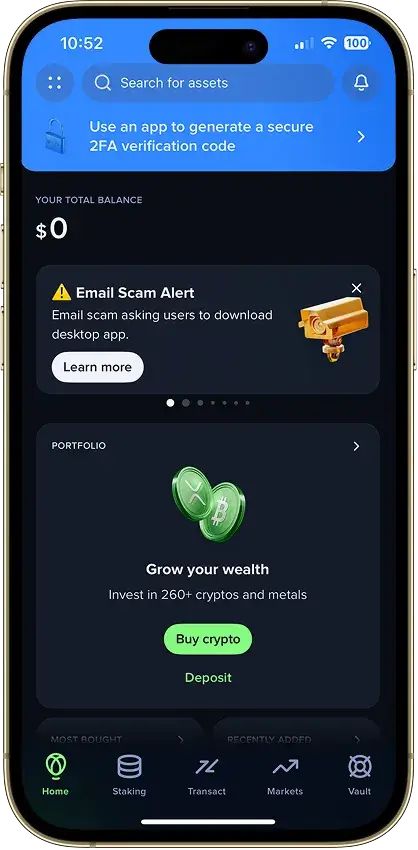
Uphold app Home dashboard showing a security reminder to use an app for 2FA codes, plus a portfolio card prompting users to grow their wealth by buying crypto.

Disclaimer: CryptoSlate may receive a commission when you click links on our site and make a purchase or complete an action with a third party. This does not influence our editorial independence, reviews, or ratings, and we always aim to provide accurate, transparent information to our readers.

FAQ

Is Uphold safe and regulated?

Uphold is a centralized custodial platform with live asset-versus-liability reserves and SOC 2, ISO 27001 and PCI-DSS compliance. Crypto balances are not insured, and proof of reserves is self-reported rather than auditor-attested. Licensing is as a money-services business and e-money firm, not a securities exchange.

What types of trading does Uphold support?

Uphold supports spot trading only, with brokered swaps across crypto, 27 fiat currencies and four metals. There is no margin, futures or options, and no public order book. Advanced controls mainly add limit, take-profit and trailing-stop logic on top of the same simple swap engine.

What are Uphold simple-buy fees and spreads?

All trades use an all-in spread model plus a $0.99 small-trade fee on most swaps under $250. Typical spreads are about 1.4–1.6% on BTC and ETH versus USD or EUR and higher on smaller altcoins, with free bank rails in US, UK and EU.

Does Uphold require KYC and what documents are needed?

Yes. You must complete identity verification to deposit, withdraw or stake. Uphold typically asks for a passport, national ID or driver’s license plus liveness and, in some cases, proof of address. Automated checks clear in minutes, while manual reviews can take longer.

Which countries and US states does Uphold support?

Uphold serves more than 140 countries but does not support New York (US) or Canada, and blocks a list of sanctioned or embargoed jurisdictions. Some products, such as the Uphold Card, are also unavailable in additional US states (including Louisiana) and US territories. The Fees & Limits and Restricted territories pages keep the current list.

Which coins and assets does Uphold offer?

Around 360 cryptocurrencies are listed, plus 27 fiat currencies and four metals. Exact coverage varies by region and can change with new listings or delistings. Uphold’s Supported assets page holds the canonical list and any per-country caveats.

How long do deposits and withdrawals take on Uphold?

Bank deposits and withdrawals usually settle in one to three business days for ACH, one to two business days for SEPA, and near-instantly for UK Faster Payments once released. Crypto withdrawals typically confirm in two to sixty minutes depending on network load.

Does Uphold provide tax documents?

For eligible US customers who have submitted a W-9 and met reporting thresholds, Uphold issues Forms 1099-B and 1099-MISC alongside downloadable transaction history. Users in other regions rely on CSV or PDF exports for tax reporting.