

Cardano (ADA) Price Prediction 2026, 2027–2030
We believe in full transparency with our readers. Some of our content includes affiliate links, and we may earn a commission through these partnerships. However, this potential compensation never influences our analysis, opinions, or reviews. Our editorial content is created independently of our marketing partnerships, and our ratings are based solely on our established evaluation criteria. Read More





Despite its technological merits and sustained position as a high market cap project, many cryptocurrency investors know little about the Cardano blockchain and its token ADA. Currently as of July 17, 2026, Cardano (ADA) is trading at $0.15, which is a -1.87% change over the past 24 hours.
In this Cardano price prediction, we dive into what Cardano offers users and what the technological future looks like for this blockchain. But first, we provide a Cardano price prediction for each year between now and 2030 and discuss how we came to these conclusions.
- In This Article
- In This Article
- Show Full Guide
Cardano Price Prediction Overview
Before you start investing on Cardano, and diving deeper into its price predictions, here is all information you need to know about this coin:
| Coin Name | Cardano (ADA) |
|---|---|
| Cardano Price | $0.15 |
| Cardano ATH | $3.10 (September 2, 2021) |
| Cardano Price Change 24h | ▼ -1.8700% |
| Cardano Price Change 7d | ▼ -5.32% |
| Cardano Market Cap | $7.15B |
| Circulating Supply | 45.00B |
Cardano has experienced lots of price changes since its launch in 2017, with over 2,000% growth during that time Here are the main events that this project went through regarding its valuation:
- Cardano launched in 2017, and its first listed price was $0.02461.
- However, Cardano didn’t gain smart contract capabilities until 2021, when it also hit its all-time high of $3.10 on September 2, in the middle of a market-wide bull run.
- The price of ADA steadily declined over the next few years, finding critical support at the $0.25 mark in Q3 of 2023.
- From here Cardano’s ADA joined a market-wide, Bitcoin ETF-fueled rally to enter 2024 priced above $0.60, a price it regained in later February after falling to $0.46.
- In November 2024, Cardano’s price surged from $0.32 to $1.08 during the U.S. presidential election race, marking a 237% monthly gain.
- Cardano surged to $1 in early 2025, becoming the top-performing major cryptocurrency, fueled by network upgrades (CIP-113 proposal) and bullish market sentiment around upcoming developments.
- We expect Cardano to close in on highs of $0.32 in 2030, posting new all-time highs (ATHs) in the 2 years prior to that. This could make Cardano a good investment in the long run.
- Among other things, the price of ADA is affected by the SEC and crypto exchange lawsuits, network scaling solutions, and the effectiveness of soon-to-be-introduced community governance.
Cardano Price Predictions 2025-2034
It’s likely that Cardano’s price will move a lot in the next decade, being pushed up and down by several global and crypto events. Here are our main predictions on how ADA’s price could behave between 2025 and 2035:
For a quick overview, the table below breaks down our Cardano price and ROI projections from 2026 through 2035. You can see the potential low, average, and high price scenarios for each year at a glance.
| Year | Potential Low (ROI) | Average Price (ROI) | Potential High (ROI) |
|---|---|---|---|
| 2027 | $0.17 (11.85%) | $0.19 (23.69%) | $0.21 (35.54%) |
| 2028 | $0.19 (23.70%) | $0.23 (49.92%) | $0.28 (78.66%) |
| 2029 | $0.21 (35.28%) | $0.28 (78.02%) | $0.36 (128.93%) |
| 2030 | $0.23 (46.28%) | $0.32 (107.01%) | $0.45 (184.95%) |
| 2031 | $0.24 (56.36%) | $0.37 (135.67%) | $0.54 (244.33%) |
| 2032 | $0.26 (65.22%) | $0.41 (162.58%) | $0.64 (303.68%) |
| 2033 | $0.27 (72.55%) | $0.45 (186.21%) | $0.72 (358.82%) |
| 2034 | $0.28 (78.10%) | $0.48 (205.11%) | $0.80 (405.23%) |
| 2035 | $0.28 (81.66%) | $0.50 (217.97%) | $0.85 (438.60%) |
| 2036 | $0.29 (83.08%) | $0.51 (223.83%) | $0.88 (455.42%) |
Cardano Price Prediction For 2025
Cardano’s price in 2025 is expected to show significant movement, with our team forecasting a range between No price prediction available for the specified year. on the lower end and No price prediction available for the specified year. on the higher end of predictions. These projections consider both Cardano’s technological roadmap and broader cryptocurrency market trends.
Several key developments could positively influence Cardano’s price trajectory throughout 2025. Implementing layer-2 scaling solutions like Hydra can drastically improve network performance, potentially attracting more users and developers to the ecosystem.
The cryptocurrency’s performance will also be closely tied to overall market sentiment and Bitcoin’s price movements, as these factors typically set the tone for altcoins like Cardano. A potential integration with Ripple’s stablecoin could introduce new liquidity and use cases for the network.
While price predictions vary a lot, the combination of technological improvements, growing ecosystem adoption, and evolving market conditions suggest Cardano could see a meaningful increase in value during 2025, provided these positive developments materialize as expected.
Cardano Price Prediction For 2026
According to our predictions for 2026, Cardano’s price is expected to move between $0.16 and $0.17. The average prediction is around $0.16, showing potential for steady growth from previous years.
Several important factors could push Cardano’s price upward in 2026. The continued development of Hydra and other technical improvements should make the network faster and more efficient, likely attracting more users.
As more dApps choose to build on Cardano, the demand for ADA tokens should increase. Big institutional investors showing interest could bring more stability to the price. Positive regulatory decisions, especially in major markets like the U.S., would also help build confidence in Cardano.
Suppose these elements and general market sentiment come together favorably. If the technology keeps advancing, more people use Cardano’s ecosystem, institutions get involved, and regulations are clear, then ADA could see significant price growth in 2026.
Cardano Price Prediction For 2030
If Bitcoin draws coin prices up in 2029 it’s likely to draw them down again in 2030. However, with large parts of the world now onboarded into blockchain technology, the fallout from the 5th Bitcoin Halving event is likely to be much smaller than before, and tokens are likely to begin consolidating their value.
This means that our Cardano price prediction for 2030 holds a high of $0.45, a low of $0.23, and an average price of $0.32.
Historical Performance of Cardano
The Cardano network was first funded by an Initial Coin Offering (ICO) that sold ADA vouchers to verified participants in Asia. The majority of this initial distribution of ADA was sold in Japan, and Cardano still has a strong connection with the Japanese crypto scene.
A total of 25,927,070,538 ADA were sold during presale, representing 57.62% of its total supply. ADA’s ICO price was just $0.0024 per token; at the time of writing, each costs $0.15, representing a 2,500% increase in value.
Purchasing tokens in crypto presales comes with risks, but it also increases the likelihood of generating massive gains — early ADA investors are the living proof of that.
Cardano’s Nomenclature
The names of the Cardano protocol, roadmap, and its hardforks are purposefully selected for their historical significance and symbolism.
The blockchain is named after Gerolamo Cardano, a prominent 16th-century mathematician. Its token, ADA, is named after Ada Lovelace, a 19th-century mathematician considered to be the first computer programmer—the divisible units of ADA are also called Lovelace.
2017–2019: Cardano’s Release and ADA’s Early Days
Cardano is one of the top dino coins; its development started in 2015. However, the network’s mainnet was not released until September 29th, 2017, with the release of the Byron era. This primitive version of the network allowed users to buy and sell ADA and was aimed at bootstrapping the Cardano community.
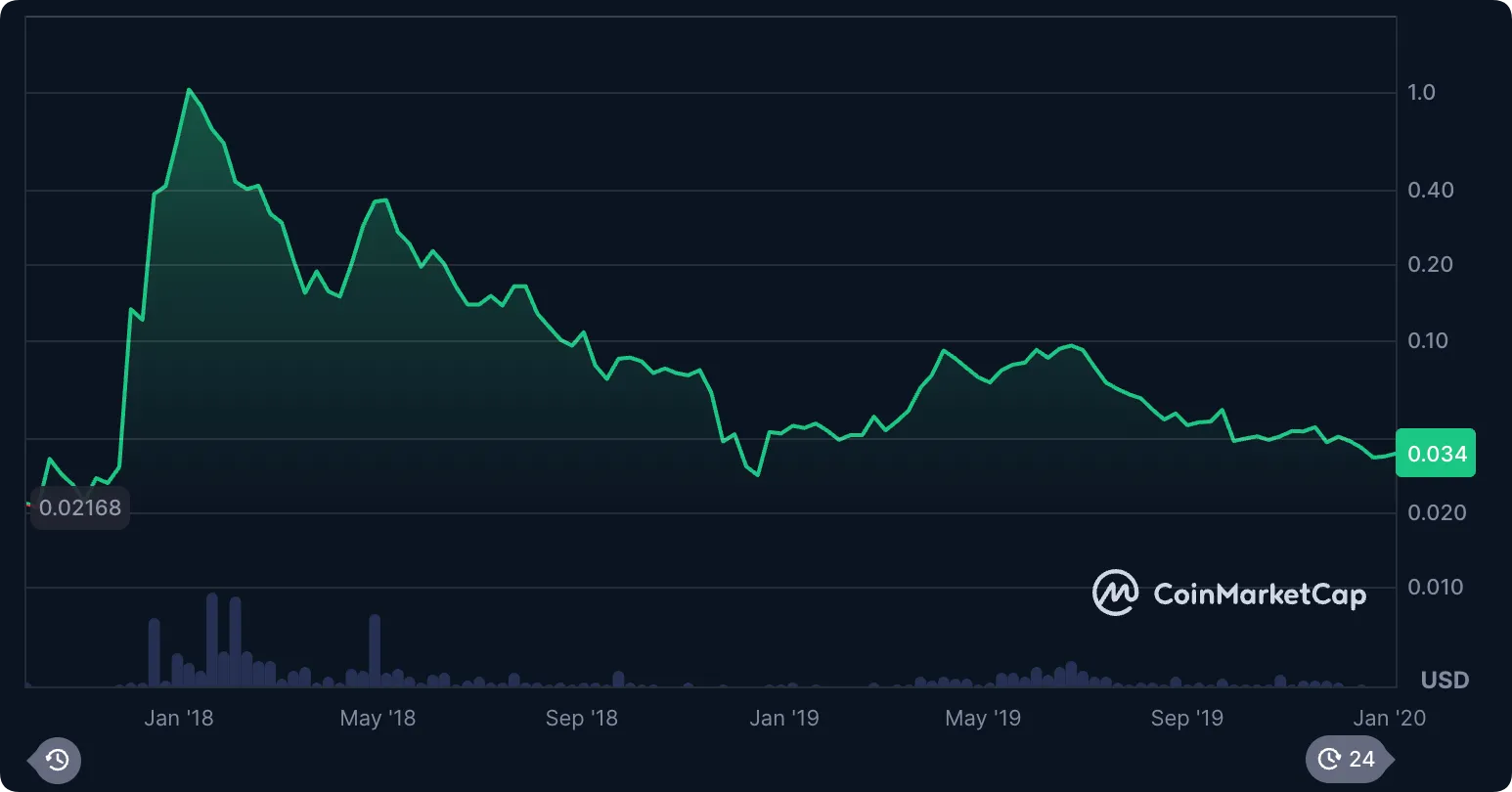
The first price for Cardano on CoinMarketCap is for October 1, 2017, and prices Cardano’s native ADA token at $0.02461. The price of ADA traded between $0.02 and $0.03 until the end of November—when it joined the wider market rally that saw Bitcoin hit the mainstream with a bang as it closed the year just under $20,000. In this rally, the ADA price gained 731% to top out just above $1 on January 3, 2018.
From there, it followed the wider market decline in 2018, steadily decreasing to find support at $0.03 in December 2018—97% down from its high just 12 months before. Despite this, Cardano entered the CoinMarketCap top 10 in 2018 and has held its position ever since.
2019 saw Cardano rise off its bottom of $0.03 at the end of December 2018, and meet resistance of $0.10 through June. From there it declined to find support at $0.033, finishing the year at $0.03347.
2020–2021: The Rise of Cardano and ADA
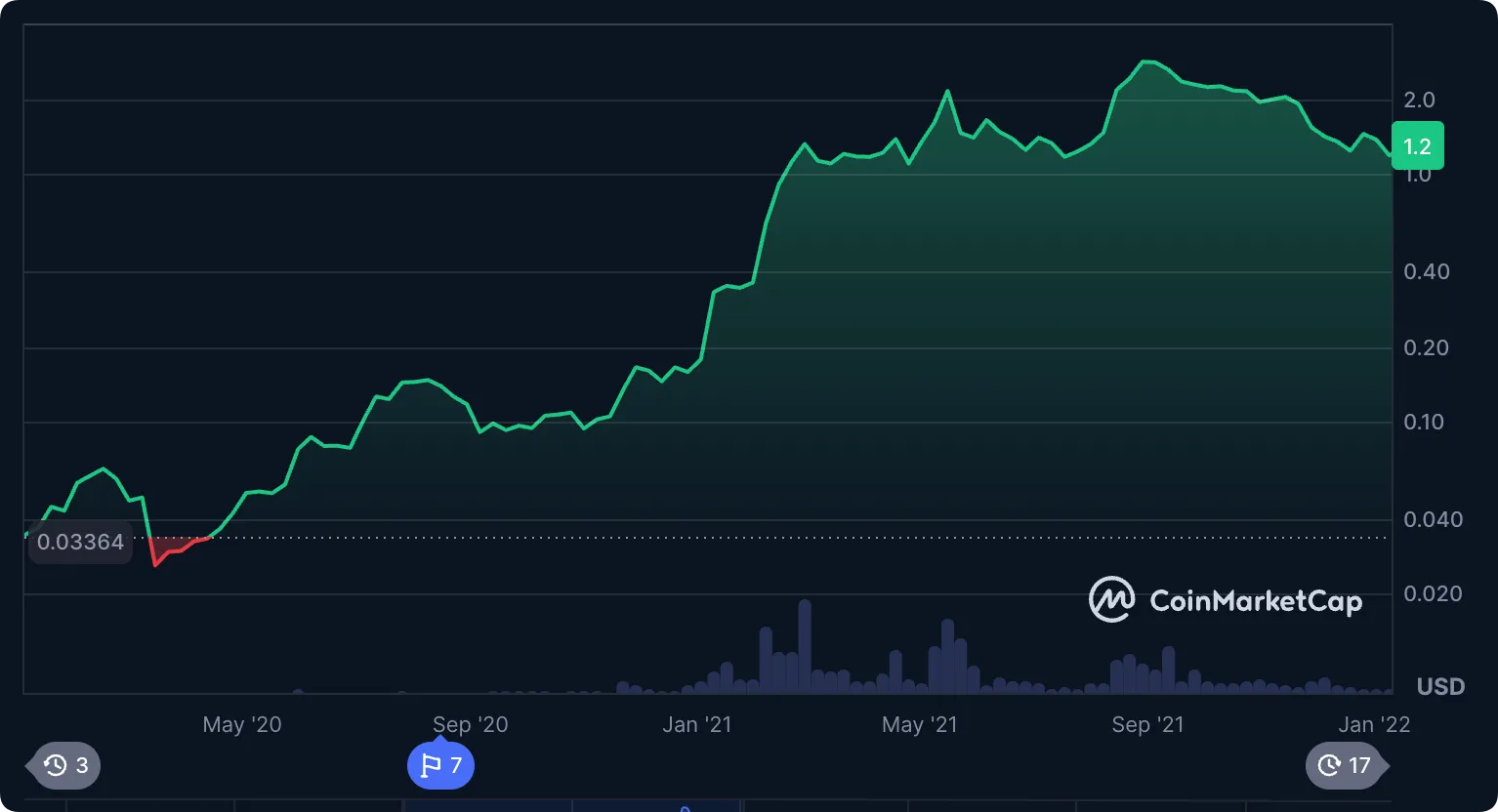
Cardano continued into 2020 as it had traveled through 2019, testing $0.10 again, before dipping below the $0.03 mark for two weeks in March. It then rallied in July, in anticipation of the Shelly hardfork on July 29, peaking at $0.1454, 11 days later on August 9—a 334% increase since the start of the year.
Until 2020, Cardano’s utility was exclusively just the trading of ADA as the rest of the platform was researched, built out, and extensively tested on the Cardano testnets. Shelly introduced staking to the network, Cardano’s first proper utility, allowing users to start staking pools, and to delegate their tokens from their wallets to these stake pools to secure the network.
After this release, work started on the development of smart contracts for the platform, along with support for native tokens, fungible and non-fungible (NFTs).
On the back of this peak, ADA dipped in price, hitting $0.08 in September, before joining a wider market bull run into 2021. ADA’s climb was also fueled by the release of native tokens to the Cardano network, hitting $1.29 at the beginning of March. Then, after plateauing for seven weeks, it climbed above $2.02 in mid-May 2021.
Predictably, the price of ADA dipped after this, losing 44% of its value in 2 months, to $1.1228 in mid-July. However, in anticipation of the launch of smart contracts on the network in September, the price of ADA started to rise, hitting its all-time high of $3.1 on September 2—a 3,775% change since last September.
Despite Bitcoin rising above $68,000 in November 2021, ADA seemed to have run out of steam and declined, finishing the year at $1.31—a 57.54% decrease from its all-time high.
2022–2023: Price Declines But Increasing Activity
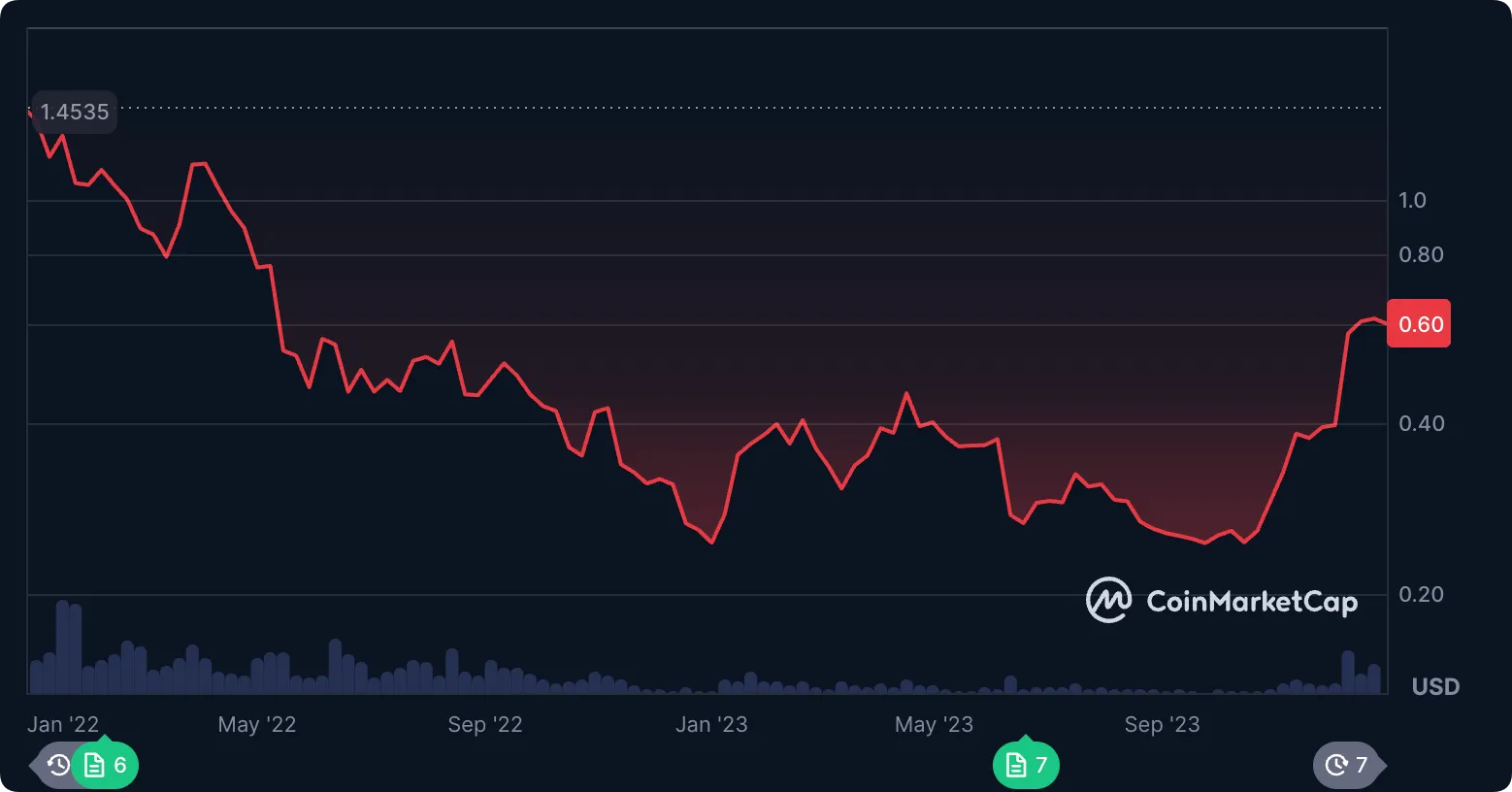
Into 2022, Cardano followed the decline of the rest of the crypto markets, finding support at $0.50 along the way before finishing the year just under $0.25, the beginning of the formation of support at this level, an 80% decrease in its price from the start of the year, and a 91.94% decrease from its all-time high in September 2021.
ADA started 2023 well, beginning by climbing the charts to find resistance at $0.4 in February, before declining to $0.3. ADA then peaked above $0.4 in April, meeting resistance at $0.45 and steadily declining through late April and May, as the bulls and bears tussled around the $0.4 mark.
However, things were thrown into disarray in early June, as the SEC sued Binance and Coinbase in quick succession, for the sale of unregistered securities. In both these lawsuits the SEC named Cardano’s ADA as an unregistered security, which then saw ADA lose 27.82% of its price in a week. Cardano’s developers, IOG, have provided a strong rebuttal to these claims.
In mid-October 2023, a false report that the SEC had approved a Bitcoin ETF set Bitcoin surging above $30,000 and started the upward trajectory that saw the crypto markets continue climbing on the back of Bitcoin ETF speculation through to the approval of all 11 Bitcoin spot ETFs applications in January of 2024.
In this time, ADA climbed 152%, from $0.2469 on October 19 to $0.6231 0n the last day of 2023. It then followed the moves of Bitcoin and the wider crypto market, initially dipping—to just under $0.50—after the approval of ETFs before climbing back above $0.60 at the end of February.
2024–2025: Price Volatility Amid Market Shifts
Due to market changes and important Cardano projects, Cardano’s price fluctuated greatly between 2024 and July 2026.
In August 2024, ADA started at about $0.34. The price then went up a lot, reaching $1.08 by November 2024, that’s more than 200% higher. But after this big increase, the price dropped some and was around $0.84 in December 2024.
The price changes continued in 2025. In January 2025, ADA went up to $0.94. This happened because people felt good about the market and because Cardano’s leader, Charles Hoskinson, talked about new products and network improvements coming soon. More people using Cardano for DeFi apps and big investors putting money in also helped the price go up. But then the price went down again, falling to about $0.66 by late March 2025.
From April to July 2025, ADA climbed as more apps went live and the network felt easier to use. A mid-year upgrade sped things up and lifted confidence. Institutions staked more, some markets launched Cardano-linked ETFs, and clearer guidance on staking eased worries—together adding fresh demand and liquidity.
It wasn’t all green. Tighter money, shaky sentiment, and the November sell-off knocked prices back at times. Still, the stretch looks like progress with interruptions: upgrades shipped, usage broadened, and bigger holders got involved, while risk-off days cut rallies short.
On July 2026, ADA was trading near $0.15, just - higher than the previous year.
Current State of Cardano
Since the launch of native tokens and smart contracts in late 2021, Cardano has grown from having no projects or dApps to a flourishing ecosystem that is steadily overcoming its issues, with multiple vertical scaling solutions implemented, and emerging as a solid platform for conducting decentralized activity.
Here are some Cardano statistics, revealing its current state:
- #31 in DappRadars ranking of protocols by dApp count
- $264.81m in TVL, #24 when ranked by TVL, on DeFiLlama
- #18 in developer count, with almost 615 developers working in the ecosystem
- 57% ($21.85 billion) of the circulating ADA supply is staked and securing the network
- A Nakamoto coefficient of 32, one of the highest in the top 20 blockchains
While Cardano might be nearing the end of its roadmap with the launch of minimum-viable decentralized governance targeted for this year, there are many protocols and solutions under development.
Examples include layer 2 scaling solutions, smart contracting language improvements, privacy centric sidechains, and the ability for other execution environments to use Cardano in a modular fashion as their settlement layer.
Market Position and Performance
As of the latest data, Cardano (ADA) is trading at $0.15 with a market cap of $7.15B. The coin has seen 45.00B in current circulating supply.
This year, ADA reached a high of $1.12 and dropped as low as $0.55, showing significant volatility. The price has recently increased by about - in the last month.
By late 2025, Cardano’s ecosystem shows broad growth: more dApps across DeFi, NFTs, gaming, and enterprise; better interoperability through bridges to Ethereum and Bitcoin; expanding government and industry partnerships; stronger developer support via grants and hackathons; rising DeFi activity and staking; and active community governance through Project Catalyst, guiding funding and upgrades.
While often compared to Ethereum, Cardano focuses more on energy efficiency and careful research than raw speed. Ethereum still leads in developer activity, but Cardano offers more price stability. It also competes with platforms like Solana, standing out through its unique governance system and scalability solutions.
What is Cardano and What is it Used For?
Cardano is an open source and decentralized blockchain network that runs using a proof-of-stake consensus model. It aims to solve the blockchain trilemma, is based on peer-reviewed research, and employs multiple novel concepts to try and bring a secure, decentralized, and scalable solution to the world.
Cardano, whose native token is ADA, was the brainchild of Charles Hoskinson, one of the cofounders of Ethereum. Cardano and Hoskinson took a lot of flack from the blockchain community during the protocol’s steady development, where the common insult was to call Cardano a “ghost chain” (i.e., a chain with nothing where nothing happens).
However, with a steadfast and growing community, as well as continued protocol updates, including the launch of smart contracts and native tokens in 2021, Cardano is growing to become a force to be reckoned with in the layer 1 blockchain space.
Despite all the criticism thrown its way, it has been a member of the CoinMarketCap top 10 list since 2018, and hosts a burgeoning DeFi space, NFTs, and native liquid staking.
Cardano has three founding entities:
- IOHK: Core developers of the Cardano protocol and spearheaded by Charles Hoskinson—now also known as IOG.
- Cardano Foundation: An independent non-profit that aims to advance Cardano and its “utility for financial and social systems”.
- EMURGO: The enterprise arm, aiming to develop commercial applications for Cardano.
Below we’ll delve into some of the main facets of the Cardano protocol and ecosystem.
Cardano Staking
Cardano’s proof-of-stake consensus protocol, called Ouroboros, is the first peer-reviewed proof-of-stake protocol and allows for native, liquid staking, where a user simply delegates their wallet to a stake pool, retaining full control of their funds along with their ability to spend those funds at will. Currently, 57% of the ADA in circulation is staked, and stakers are earning an average APY of 3.5%.
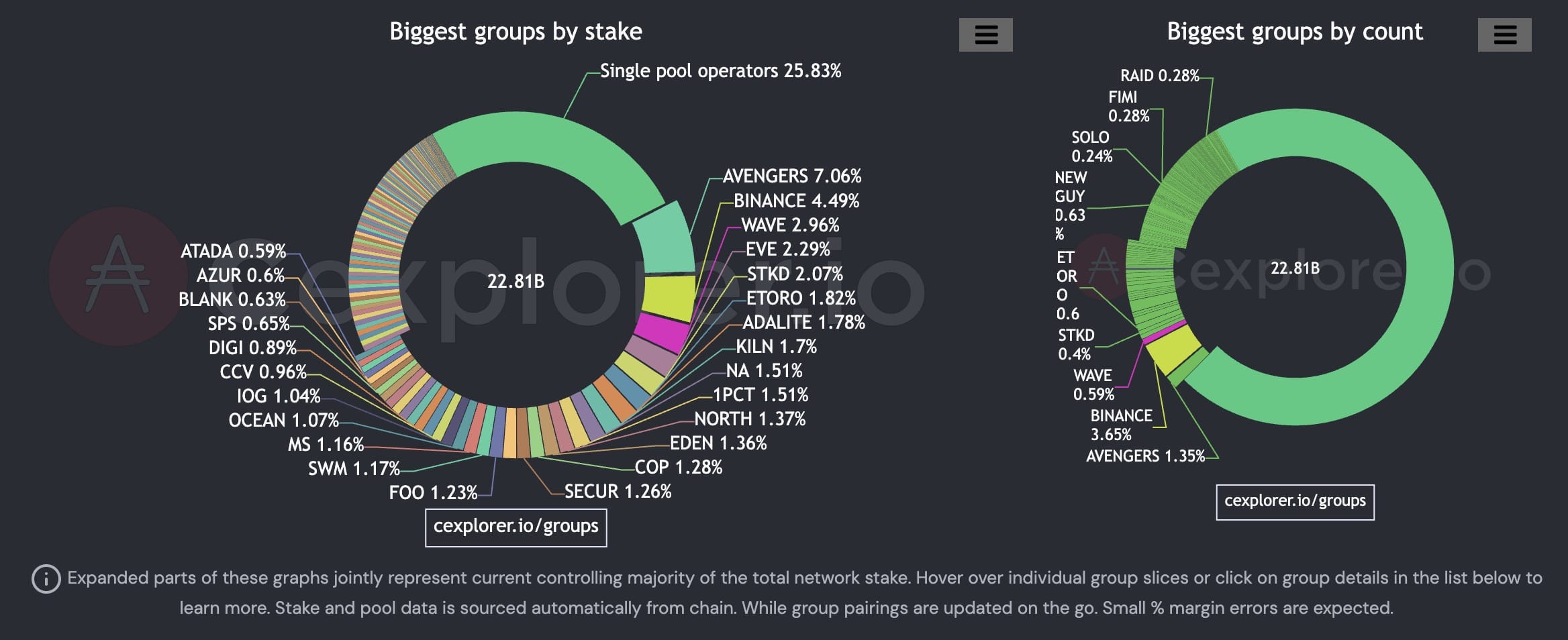
There are over 3,000 stake pools on Cardano, with unique stake pool operators, called Single Pool Operators, making up 70% of these.
Cardano’s Decentralization
A blockchain’s decentralization is measured by a number called a Nakamoto Coefficient, which is the number of individual parties who can conspire together to control the chain, also called a minimum attack vector. Cardano’s Nakamoto Coefficient is a healthy 32 (meaning that all of the top 35 stake pool operators must conspire to take control of the chain).
By comparison, the Nakamoto Coefficient of Ethereum is 2.
Cardano’s Next Steps in Decentralization
In addition to being secured by community-run stake pools, Cardano has its own decentralized funding mechanism for projects, called Project Catalyst. Here ADA holders vote on proposals asking for funds, distributed from a treasury of ADA. This program is constantly iterating and improving with each funding round it holds.
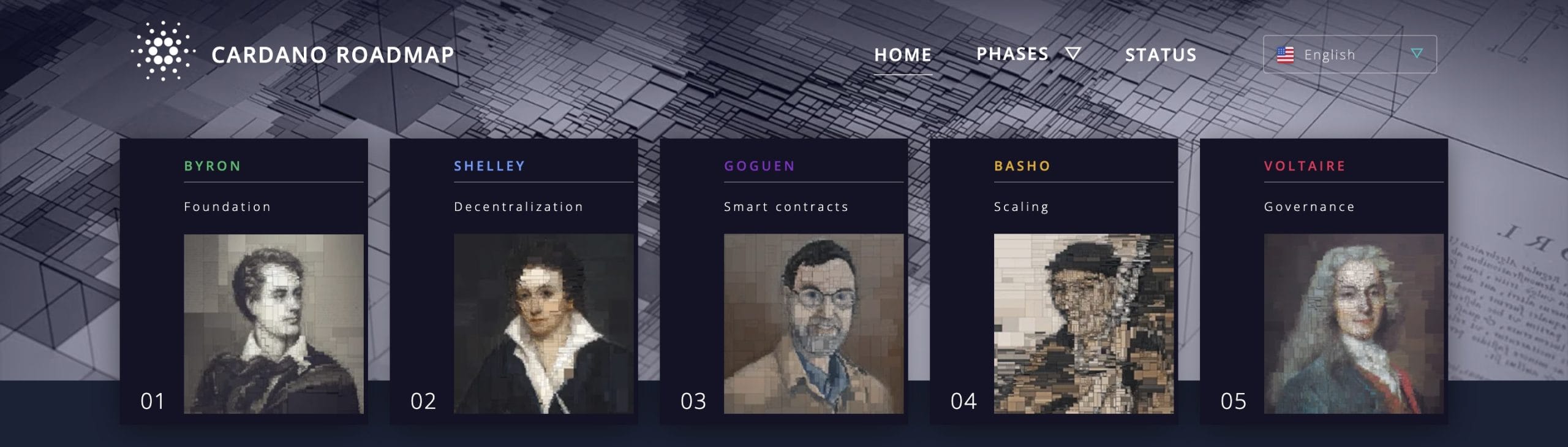
The final stage of the Cardano roadmap is focused on governance. Specifically, the Cardano community is currently focused on writing the Cardano Constitution, which will be implemented on-chain and represent minimum viable community governance for the blockchain—making it a truly decentralized chain.
A Secure Programming Language and The eUTxO Model
Smart contracts on Cardano came 8 years after Ethereum’s. This is partially due to its later start, but also due to the founder’s insistence on developing in the Haskell programming language.
Haskell is a purely functional programming language and a lot less popular than the languages used as a base for Solidity, the smart contracting language used for EVM-based smart contracts and the most popular smart contracting language by a long way.
However, as put by the Cardano Foundation: “[Haskell] is well-suited to write code that is robust and correct.” It can be combined with formal verification—the industry gold standard for audits and correctness—to produce high-assurance, robust code, which is potentially the reason why Cardano’s growing ecosystem is yet to see a smart contract hack.
Cardano also uses the UTxO model, just like Bitcoin, and unlike many other popular blockchains, like Ethereum and Solana, which use an account-based model. Cardano took Bitcoin’s UTxO model and extended it, eUTxO, to allow for extra functionality, like smart contracts, to be built on top of the ledger.
While this adds extra complexity and is why Cardano initially struggled to increase its transaction rate, it also gives the blockchain determinism.
Determinism means that a transaction’s validity can be known before submitting it to the chain and the transaction fee can also be determined before submitting it. This means that a user can know exactly how much a transaction will cost and whether it will be accepted by the chain before submitting it—this is in direct contrast to Ethereum as transactions on Ethereum can be rejected, with users also losing their gas fee in the process.
Cardano’s Set Transaction Fee
Cardano operates without a fee market, as Bitcoin and Ethereum do, so transaction fees are set and only change based on the complexity of the transaction. Currently, the minimum fee for a transaction is, and always has been, 0.17 ADA (about $0.11 at the time of writing).
Unlike on Bitcoin and Ethereum—as is visualized live on TxStreet.com—users cannot jump the queue by paying a higher gas fee on Cardano.
Scaling Cardano
Scaling is an element of the blockchain trilemma that the whole blockchain space is trying to address to help improve the user experience as it continues to onboard new users. Cardano’s scaling solution is called Hydra, after the multi-headed beast of Greek mythology.
Hydra is an isomorphic, multi-party, state-channel protocol. To break this down:
- Isomorphic: Hydra copies the on-chain execution environment, allowing for smart contracts that work on the Cardano mainnet to be executed in Hydra—also meaning that any disputes can be executed and settled on the main chain.
- Multi-Party: Multiple users can join a single instance of Hydra.
- State-channel: Hydra is an environment where these users can make as many fee-less transactions as they want between themselves. These transactions are not recorded and, therefore, they are private as only the members of the channel know what happened. Just like on the Bitcoin Lightening Network.
Hydra takes its name from the mythical beast because many instances of it can be deployed on the mainnet, each running their own functions and allowing the blockchain to scale in the most decentralized and efficient manner.
In addition to this, there’s also the idea that Cardano can be used in a modular way, paving the way for what IOHK are calling Partner Chains, that allow other computational environments, e.g., the EVM, to settle to the Cardano settlement layer—therefore utilizing Cardano security.
What Can Cardano’s Native ADA Be Used For?
So, while esoteric in the coding language that it uses, Cardano is built on a more robust base than many of the smart contracting platforms of today, offering a greater level of decentralization, native liquid staking, hosting a wild array of dApps and projects, being is explicitly intended for the good of the people, and has partnered with numerous companies and institutions around the globe.
But what can you use Cardano’s ADA for?
- Delegating to a stake pool from a wallet to secure the network and earn rewards
- Paying transaction fees on the network
- Main token pair in Cardano’s growing world of DeFi dApps
- Buying Cardano NFTs
- Voting on which projects should receive Funding in Project Catalyst
In addition to all this ADA can be used to vote in governance proposals that concern the running of the Cardano network. They will also be able to be delegated to dReps, decentralized representatives who amass delegated voting power and use it to vote on governance proposals on behalf of their delegates.
Factors Influencing Cardano’s Price
Those asking, “will Cardano go up?”, as to take into account factors both inside and outside the Cardano ecosystem, like we did in our Cardano price prediction above. Below we’ve outlined major factors impacting the price of Cardano and shaping the future of the ADA chart.
💻 Technological Advancements
Cardano is improving its network with smart contracts and Hydra layer-2 solutions to increase speed and efficiency, which could raise ADA’s value. The addition of zero-knowledge proofs provides affordable scaling options, making the platform more attractive to developers and users.
🔗 DeFi Adoption and Ecosystem Growth
Cardano’s DeFi ecosystem has hit $264 million in locked value, showing strong growth that could push ADA’s price higher. More dApps like Minswap and SundaeSwap are launching on Cardano, making the network more useful and attractive to users.
🔒 Institutional Adoption and Regulatory Environment
Grayscale and other institutions are buying more ADA, bringing stability and long-term growth potential to Cardano. Possible ETF approvals and other regulatory changes could boost investor confidence and influence ADA’s price movement.
🌎 Market Sentiment and Broader Crypto Trends
Cardano’s price often follows Bitcoin’s movements and overall crypto market trends. When economic uncertainty rises, more investors may turn to ADA, potentially driving up its demand and value.
👥 Community Support and Partnerships
Cardano’s active community helps drive its growth and maintain price stability through governance participation. Partnerships with African governments and businesses are expanding real-world ADA use cases, boosting adoption.
Cardano Price Predictions by Other Experts and Analysts
“ADA could reach a high price range of $5-10 in 2025, with possibilities of hitting $10-15, and at a lower probability, even $15-20 and beyond. By Q3 2025, ADA could be in a much better position than it is today, price-wise.” – Sebastien (BlockNews Cryptocurrency Analyst)
“ADA has ‘bottomed for a grand bull market.’ Cardano’s price may have hit a key support level, signaling the start of a long-term upward trend.” – Peter Brandt (Veteran Trader)
“If Cardano breaks $0.68, it has two targets: $1.16 and $2.15.” – Krisha (Mango Research)
“ADA could hit $1.35 in 2025 and $3.28 in 2030, climbing steadily year-on-year.” – Alex Kind (Coin Market Cap Researcher)
How to Buy Cardano?
Cardano is one of the top-ranked coins in the ecosystem, and this means that many exchanges offer it — even those that have been targeted by the SEC in the USA for doing so.
1. Pick your Exchange
Select a platform that you have confidence in and that includes Cardano. MEXC has ADA spot markets, clean fee schedules, and adequate liquidity to make regular purchases. In case you already have another exchange, make sure that it has ADA and the types of funding that you want to do.
2. Create and Verify your Account
Sign up on MEXC and complete identity checks to unlock deposits and withdrawals. Keep your details handy (ID, address proof if asked), set a strong password, and turn on two-factor authentication before moving any money.
3. Add Funds
Deposit fiat (such as EUR, USD, and GBP) via card or bank transfer where supported, or send crypto (USDT, BTC, etc.) to your MEXC wallet if you already hold coins.
4. Find the ADA Market
On MEXC, search “ADA.” Common pairs you might find on exchanges include ADA/USDT, ADA/USDC, and ADA/BTC.
Choose the one you prefer and open it.
5. Place Your Buy Order
Before choosing an order type, decide how fast you want to buy and at what price:
- Market order: buys immediately at the current price.
- Limit order: sets your price and waits to fill.
Enter the amount of ADA you want and confirm the trade.
6. Secure your ADA
For long-term holding, withdraw to a private wallet. Hardware options (Ledger, Trezor) or Cardano software wallets (Daedalus, Yoroi) give you self-custody. Keeping funds on an exchange adds custodial risk.
7. Track and Manage
Monitor price and news. Consider staking ADA in a stake pool to earn rewards while maintaining control of your keys.
Quick recap: Open and verify a MEXC account, fund it, buy ADA on a spot pair, then move it to a secure wallet and optionally stake.
Conclusion
Cardano’s price from 2025-2030 will depend on its technology improvements and how many people use its network. If Cardano keeps upgrading its system and more apps get built on it, the price could grow steadily. However, like all cryptocurrencies, ADA’s value may go up and down with market changes and competition from other blockchains.
The coin’s future also ties to bigger factors like government rules and the overall crypto market. While experts see potential for growth, prices could still swing based on investor confidence and real-world adoption. Watching Cardano’s development progress and market trends will help understand where ADA’s price might head.
FAQs
Will Cardano recover?
Is Cardano a good long-term investment?
What are the risks and considerations in Cardano investments?
Will Cardano be the next bitcoin?
References
- Kraken Joins Binance, Coinbase Seeking Dismissal of SEC’s Lawsuit – Bloomberg.com
- Genesis – Cardano.org
- On the Origin of Cardano – Medium.com
- BYRON – Cardano.org
- Cardano Alonzo Hard Fork: What You Need to Know – CoinDesk.com
- What is the Blockchain Trilemma? – TheBlock.co
- Nakamoto Coefficient — how decentralized is your blockchain – Medium.com
- Cardano Roadmap – Cardano.org
- Hydra (Cardano Docs)
- Vasil (Cardano Docs)
2M+
250+
8
70






 in numbers

About Cryptonews
Our goal is to offer a comprehensive and objective perspective on the cryptocurrency market, enabling our readers to make informed decisions in this ever-changing landscape.
Our editorial team of more than 70 crypto professionals works to maintain the highest standards of journalism and ethics. We follow strict editorial guidelines to ensure the integrity and credibility of our content.
Whether you’re looking for breaking news, expert opinions, or market insights, Cryptonews has been your go-to destination for everything cryptocurrency since 2017.
