
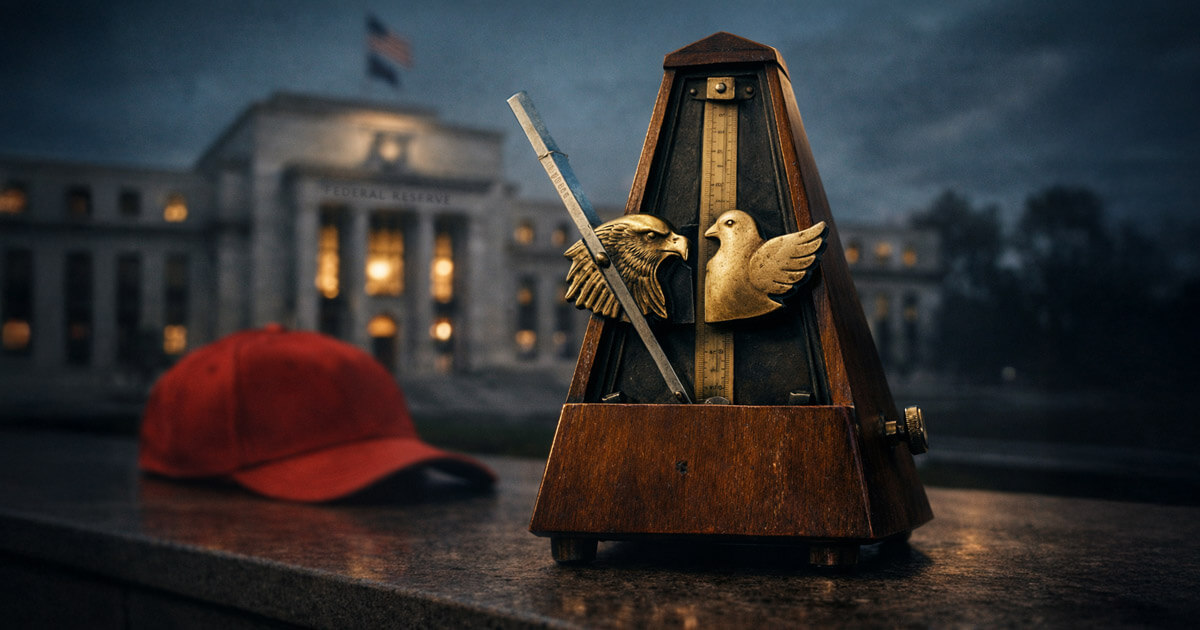


Trump picked Kevin Warsh for Fed chair, the first big market change may be the way the Fed talks
When Donald Trump says Jerome Powell “got it wrong,” he usually means one thing: rates should have come down faster.
Powell, for all the heat he takes, has still been a fairly standard Fed chair. He speaks like a central banker.
He repeats himself on purpose. He tries to keep the Fed’s message boring, even when the numbers are doing anything except boring.
That boring style is a feature for markets. Traders price the decision, they price the dots, they price a handful of key lines in the press conference, then they move on.
Now Trump has nominated Kevin Warsh to take over as chair, and my thinking immediately shifts from “when do cuts start” to something more uncomfortable: “what happens when the person holding the mic changes the whole vibe?”
Trump and his allies increasingly communicate in a blunt, combative, slogan-driven style that prioritizes confidence, loyalty, and media impact over technocratic precision.
I don't think it is outlandish to suppose that Warsh will adopt similar rhetoric as Fed Chair… which is kind of wild when you think about it.
Instead of the usual sedative-laced prose about “symmetric inflation targets” and “labor market equilibrium,” imagine Warsh leaning into the mic with a weary, predatory confidence:
Look, we’re done with the forensic bed-wetting of the previous regime. We aren't going to sit here squinting at spreadsheets like ‘Too Late Powell.'
…
Everybody knows the economy is screaming for a win, and we’re going to give it one. We’re deploying interest rates so sharp, so aesthetically pleasing, and so unapologetically massive that the DXY will look like a vertical line of pure, unadulterated testosterone.
…
It’s not ‘data-dependent'; it’s ‘destiny-dependent.' We’re making the dollar king of the universe. If you can’t see the genius in that, you’re just not paying attention.
This is where it gets interesting for traders, and for everyone who ends up paying the bill when markets get jumpy.
The question is not simply whether Warsh is “dovish” or “hawkish.” The question is whether the Fed becomes easier to read, or harder to trust, or both at the same time.
The ground we’re standing on right now
The Fed has decided to hold the policy rate steady at 3.50–3.75%, with the latest decision coming in its Jan. 28 statement.
Inflation is still above target, even if it looks calmer than the ugly years. The Bureau of Labor Statistics reported a 2.7% year-over-year increase in the December CPI, with core CPI at 2.6%. PPI also came in hot this week at 3.3%, up from 2.9%.
The Fed’s balance sheet is also still huge, sitting around $6.58 trillion as of the Jan. 21 weekly level on FRED.
Bond volatility is currently sitting in a fairly chilled-out place. The MOVE index closed around 60.7 on Jan. 29.
That is not “nothing can happen” calm. It is more like “people have stopped paying up for protection” calm.
This matters because the calmer volatility gets, the more violent the repricing can be when something shifts, especially something as squishy as credibility.
Warsh has priors, and they point in more than one direction
Warsh has a long record of criticizing the Fed’s post-crisis growth in power and its giant balance sheet.
He has been consistently uncomfortable with the idea that the Fed can buy trillions of assets, shape markets, and then act surprised when everything starts depending on the Fed.
That view is all over the coverage, including the Financial Times reporting on his desire to shrink the balance sheet and rethink how the institution operates.
He has also argued that a quieter printing press can open a path to lower policy rates, which is a very specific kind of dovishness, the kind that comes with a catch.
If you try to reduce him to one label, it gets messy quickly. Warsh can support lower short-term rates while remaining hawkish about the plumbing of the system.
He can talk about getting rates down and still want the Fed to pull back from being the main character in every market story.
A Federal Reserve with MAGA-speak
Then there is the communication piece, which is where this gets very Trump-shaped.
Warsh is linked to the argument that too much central bank transparency can become counterproductive, partly because it encourages theater and partly because it turns every sentence into a tradable asset.
That debate shows up in the background of his “Warsh Review” era work on Bank of England communications.
So, yes, there is a plausible world where Warsh talks less than Powell, gives markets less guidance, and makes the Fed harder to front-run.
There is also a plausible world in which Warsh speaks more like the people Trump likes to keep close, such as Hegseth, Mellor, and Lutnik. More confident, more declarative, more story-driven, and far less allergic to stepping on headlines.
Either way, the market impact comes from a simple reality. Traders do not only trade rate levels; they trade the reaction function, and the confidence they have in that reaction function.
The real risk, and the real opportunity, is the independence premium
Markets have a long memory for moments when politicians try to lean on central banks. Trump already ran that experiment in public, and researchers have studied it in detail.
One of the cleanest pieces of evidence is NBER work showing that Trump’s public attacks on the Fed moved expectations in fed funds futures, using tight time windows around tweet timestamps.
That research is basically a proof of concept: political pressure can become market pricing.
There is also a peer-reviewed version of the same idea in the Journal of Monetary Economics family, showing similar effects from Trump criticism on policy expectations.
Now take that lesson and apply it to a chair transition framed, openly, as Trump choosing someone he thinks will be more aligned with his economic goals.
The coverage has captured that tension clearly, including the risk that confirmation politics becomes part of the story.
Here is the key market point. When traders worry about independence, you can get a weird split where the front end and back end of the curve move in different emotional directions.
Front-end logic says political pressure means higher odds of cuts, sooner. That pushes short yields down.
Back-end logic says political pressure means more inflation risk over time, more uncertainty, and more term premium. That pushes long yields up.
That is the kind of environment where people feel like “rates are coming down,” and still get hit with higher mortgage rates anyway because the long end refuses to cooperate.
It is also the kind of environment where risk assets can do that confusing dance: initial relief rally, then a grind lower when the discount-rate story starts dominating again.
Three scenarios traders will actually trade, and what each one does to the tape
- Scenario one: Warsh goes institutional.
He walks into the building, looks at the committee, and decides continuity is the cleanest way to keep credibility. Messaging stays measured. The Fed keeps doing what it has already been doing: waiting on data, staying patient, trying to land the plane.In that world, the baseline path looks a lot like the Fed’s own projections. As of December’s Summary of Economic Projections, the median funds rate drifts lower through 2026, with inflation easing.Markets still move, obviously. But the “chair risk” premium fades, and volatility stays relatively contained. - Scenario two: Warsh strips away the guidance.
This is the version where his discomfort with modern central bank communication shows up fast.Less signaling, fewer hints, less hand-holding, and more emphasis on the fact that the Fed reacts to data and does not owe the market a script.That sounds healthy in theory. In practice, it often raises volatility because the market fills the silence with its own narrative.You get bigger moves on CPI days, payroll days, and any surprise that forces traders to guess at the Fed’s tolerance for pain.With MOVE sitting near 60, this scenario has a simple mechanical effect. Options get repriced, hedging gets more expensive, and leverage becomes less comfortable. - Scenario three: Warsh speaks with Trump-era confidence.
This is the version everyone is tiptoeing around: the one where optimism becomes part of the policy signal.A chair who talks up growth, talks down risks, and feels comfortable sounding aligned with the White House story. Markets can rally hard on that, at least at first. The front end can price faster cuts. Equities and crypto can pop, because both behave like liquidity-sensitive assets when the rate story turns friendly.The risk is that inflation is still sitting above 2%, and credibility is the thing you spend when you insist everything is fine while households still feel prices. CPI at 2.7% is not a crisis. It is also not victory.In this scenario, the back end becomes the adult in the room. Long yields can rise because traders demand more compensation for future inflation risk and for the possibility that the Fed becomes less willing to deliver bad news.
That is the split outcome that confuses everyone watching from the outside. Cuts get talked about, long rates stay sticky, and the economy feels more expensive anyway.
What this means for crypto, and for anyone trading risk
Crypto is basically a stress test for the macro mood. When real rates fall and liquidity expectations improve, crypto tends to benefit.
When volatility jumps and the discount rate becomes unstable, crypto can get hit, even if the policy rate is drifting down.
A Warsh Fed, especially one perceived as politically aligned, adds a specific kind of uncertainty: whether the Fed can stay credible while also staying popular.
That uncertainty tends to show up first in volatility markets, then in long-dated yields, then in the parts of risk that rely on easy financial conditions staying easy.
So for crypto traders, the watchlist is not just “did the Fed cut.” It is whether the curve starts telling a story that looks like: short rates are falling, long rates are rising, and vol is waking up.
The simple things to watch in real time
If you want to track which path we are drifting into, keep it simple.
- Watch the Fed’s official wording, especially how they talk about “additional adjustments” and “balance of risks.”
- Watch CPI and core CPI, because the market is still hypersensitive to any sign that inflation is reaccelerating.
- Watch the balance sheet discussion, because Warsh’s own public comments keep circling back to shrinking it.
- Watch MOVE, because it is the quickest way to see whether traders have started paying up for uncertainty again.
- Keep an eye on the confirmation story, because Senate friction around the nomination adds another layer of event risk.
The human story inside all of this
This is not just a markets story. The chair of the Fed is one of the few people in America whose tone can change people’s lives without a single law being passed.
Powell’s version of power has been technocratic: data first, language carefully managed, emotional volume kept low.
Trump’s version of power is the opposite. Volume is part of the strategy, confidence is part of the product, and public narrative is treated as a tool.
If Warsh walks into the Fed and sounds more like the world Trump likes, markets will trade that, whether it is fair or not, whether it is logical or not.
They will trade it because they always trade perceived incentives.
The best case is that Warsh uses the moment to tighten the institution, simplify the message, keep independence intact, and let the data do the talking.
The messy case is that traders start pricing the Fed like it is another political actor. Once that happens, volatility becomes a feature, because credibility is no longer assumed; it is constantly being tested.
That is the real impact to watch. Rates will move either way.
The bigger change might be how confident markets feel about what those rates mean, and how quickly that confidence can disappear.
Mentioned in this article



Editorial credits