Gemini Exchange Review

Best for security-conscious buyers who want a regulated on-ramp with bank rails. Operates as a New York trust with SOC 1/2 audits and a full-reserve model. Simple buys cost more than pro-tier trades.

Verified Review Checked against CryptoSlate standards
Published Dec. 22, 2025
Updated Dec. 22, 2025
Andrej
Reviewed by Andrej
Since Sep 2025 10 articles & reviews
Fact-Checked
Pending Assignment A fact-checker will be added soon.

This operator is not available in your region.

We're sorry, but some of the content on this page is not accessible from your region. This page is for informational purposes only.

Checking your location...

Launched in 2015
8.1
  • NYDFS-regulated trust with full-reserve and SOC 1/2 Type 2 audits.
  • Perpetual futures available in selected regions via Gemini Perpetuals.
  • Gemini Credit Card with instant crypto rewards and no annual or

$50 when you refer a new customer

Gemini Overview

Exchange Name Gemini
Parent Company Gemini Space Station, Inc.
Launch Year 2015
Languages English, Spanish, French, Portuguese, Italian
KYC Yes
Products Spot, Futures or Perps, OTC, Simple-buy Broker
Total Assets 80+
Staking Yes
Copy Trading No
Derivatives Yes
Proof of Reserves Yes
Trading Fees 0.00% - 0.40%
Maker Fee 0.20%
Payout Time 5 days
Restricted Countries Afghanistan, Iran, North Korea, Sudan, Syria, …
Supported Cryptos Bitcoin, Ethereum, Zcash, Litecoin, Gemini Dollar, …

Gemini Screenshots

Gemini Pros and Cons

Pros

  • Regulated New York trust with full-reserve disclosures and SOC 1/2 Type 2 audits
  • Bank-friendly rails: ACH, wires, SEPA and Faster Payments. Deposits are typically fee-free on Gemini
  • Perpetual futures access in supported regions for advanced traders
  • Staking available with no minimums. Service fee auto‑deducted from rewards
  • Credit card rewards paid instantly with no annual or foreign transaction fees

Cons

  • Simple buys carry higher costs than pro-tier trades
  • No spot margin or options. Derivatives not available in some jurisdictions, including the U.S
  • ACH deposits have withdrawal holds until funds clear
  • No universal phone support for the exchange. Primary channels are email and tickets

What Is Gemini? Background and Oversight

Gemini is a U.S. centralized, custodial crypto exchange launched in 2015 by Cameron and Tyler Winklevoss and operated by Gemini Trust Company, LLC, a New York State‑chartered trust company supervised by NYDFS. It positions itself as a full‑reserve exchange and custodian with SOC 1/2 Type 2 audits.

As a regulated Gemini cryptocurrency exchange, it targets users who prioritize compliance and fiat access over maximum altcoin breadth.

The platform serves users in 60+ countries, including all 50 U.S. states (see KYC and geographic access), and offers a curated lineup of liquid assets, bank integrations, and a pro interface called ActiveTrader. Staking and a U.S. credit card broaden the product set.

Recent context includes a public listing of its parent company on Nasdaq under ticker GEMI in September 2025, and continued expansion of regulated services in Europe, including access to derivatives in selected jurisdictions.

Gemini homepage hero with bright orange background, the tagline “Your bridge to the future of money,” a Get started button and a phone mockup showing the Gemini app with credit card rewards in BTC.

IPO and Stock Overview

Gemini Space Station, Inc., the parent of the Gemini crypto exchange, completed an IPO on Nasdaq under ticker GEMI in September 2025. This review does not track the GEMI stock price or valuation; check your brokerage or market-data provider for live quotes and historical performance.

Gemini Cryptocurrency Exchange Overview

At a high level, the Gemini crypto exchange combines regulated spot markets, basic staking, a U.S. credit card, and EU/EEA derivatives access under one brand. This overview focuses on how the platform handles security, fees, fiat ramps, and product limits in 2025.

Features and Services

Gemini focuses on regulated spot trading, a pro interface, and a growing European stack for perpetuals and tokenized stocks. Its roster is smaller but curated. Expect roughly 70–80 listed coins and just over 100 spot pairs versus several hundred at larger global exchanges.

That context matters when you weigh breadth against compliance and fiat access.

Trading Options

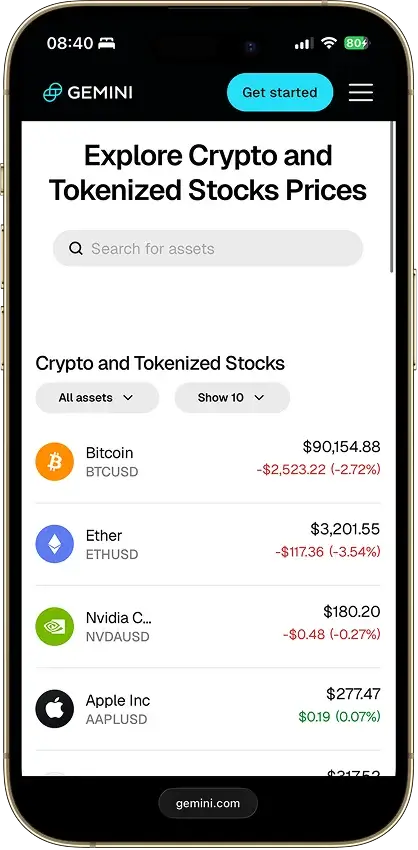
Gemini Prices page inviting users to “Explore Crypto and Tokenized Stocks Prices,” featuring cards for trending tokens, top movers and new listings above a table of crypto and tokenized stocks.

Markets offered. Live markets include spot trading across USD and selected fiat pairs, plus an OTC desk for block trades. There is no spot margin or listed options on the core exchange. Perpetual futures are handled by Gemini’s derivatives entities, separate from the spot venue.

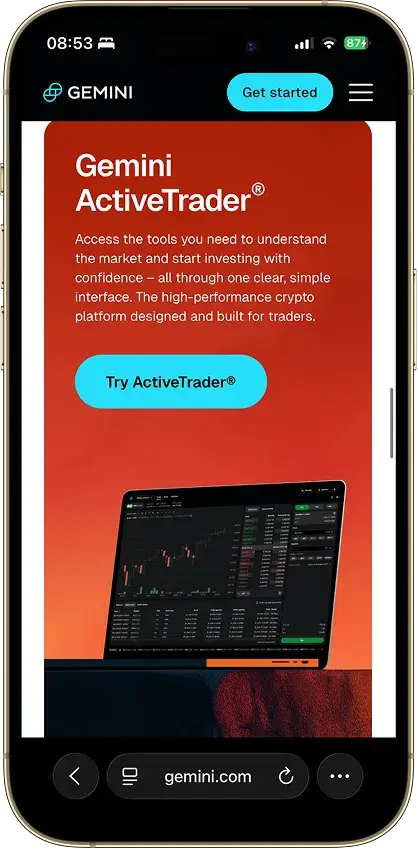
Interface modes. The standard web and app flow covers instant buys and simple sells. ActiveTrader adds a full order book, TradingView‑style charts, depth, and market, limit, and stop‑limit orders with GTC, IOC, FOK, and maker‑only time in force. ActiveTrader can be enabled on mobile. An Advanced Trading view brings most pro features into the app.

Pairs and assets. Gemini runs USD order books and supports fiat pairs in EUR, GBP, AUD, and SGD on selected markets. It recently combined USD with supported USD‑stablecoins into unified order books to deepen liquidity.

Liquidity. CoinMarketCap reported roughly $108 million in 24‑hour spot volume on Gemini, with deeper books on majors and thinner flow on small caps.

Brokerage and Simple-Buy Experience

Simple-buy flow. Gemini mode is the default for many small buyers. You pick a fiat amount, choose an asset, and pay with a bank transfer, debit card, Apple Pay, or Google Pay where supported. The app shows the estimated quantity, fees, and total before you confirm. Simple buys are available on both web and mobile and do not require using ActiveTrader.

Pricing model. Instant Orders use a spread on the market rate plus two explicit fees. A 1.00% convenience fee is built into the quoted price and a 1.49% transaction fee is shown on the confirmation screen. Recurring buys follow the same structure. The all in price will usually sit above an independent mid market index because of the spread and fees. You can compare the quote to an external price feed before you lock it in.

Limits and coverage. Simple buys cover the main BTC, ETH, stablecoins, and larger altcoins in supported regions. Some smaller assets are only available on the advanced interface. Simple buys do not access derivatives or tokenized stocks. Availability depends on your country, KYC level, and the local payment methods that are enabled.

Comparison to ActiveTrader. Simple buys are faster and easier for first time users. Fees are higher than using limit orders on ActiveTrader where the maker taker schedule can be much lower once volume grows. Power users who care about tight spreads and fee control are better served by switching to ActiveTrader after they learn the basics.

Derivatives and Leverage Controls

Gemini Perpetuals landing page with headline “Gain exposure to crypto with perpetual contracts,” buttons to Trade Perpetuals or Demo the product, and a TradingView-style chart for ETHGUSD perpetual contracts.

Availability. Gemini offers linear perpetual futures with no expiry. Contracts are GUSD‑ or USDC‑margined depending on venue, with linear P&L in the quote currency and hourly funding.

Leverage and margin modes. Maximum leverage is up to 100× depending on product and tiering. Cross‑collateral is supported for approved assets. Isolated and cross behavior is documented in platform help. Funding is hourly from a perp‑spot basis. Liquidation uses risk tiers that increase margin requirements with notional size.

Regions and eligibility. Access is jurisdiction‑dependent. EU/EEA customers can trade perps under Gemini’s regulated EU entity. Some non-EU jurisdictions access perps via Gemini’s non-US derivatives venue. The U.S. and UK remain restricted.

Risk disclosure. Leveraged derivatives can result in rapid and total loss of capital. Products use hourly funding, forced liquidation, and insurance‑fund or ADL style backstops. Leverage amplifies gains and losses.

Supported Assets

Asset coverage. Gemini lists a curated set of about 70-80 crypto assets and just over 100 spot pairs. Coverage skews to majors and selected mid‑caps. In the EU, tokenized stocks and ETFs are available via Dinari (dShares™) — these sit outside the crypto asset count.

Stablecoins and networks. Trading and transfers support GUSD, USDC, and RLUSD, plus other major USD‑stablecoins where listed. Gemini has unified USD and supported USD‑stablecoins (GUSD, USDC, RLUSD) into single order books for deeper liquidity. For transfers, USDT and USDC are available on multiple networks including Ethereum, Solana, Base, Optimism, Arbitrum, and Avalanche where supported.

Listing cadence and policy. Listings follow a formal framework with jurisdictional approvals where required. New assets and any delistings are announced on the blog and support hubs with dated notices.

Native token impact. Gemini has no exchange utility token. Fees are volume‑tiered. Holding GUSD does not change trading fees or VIP tiers.

Staking and Rewards

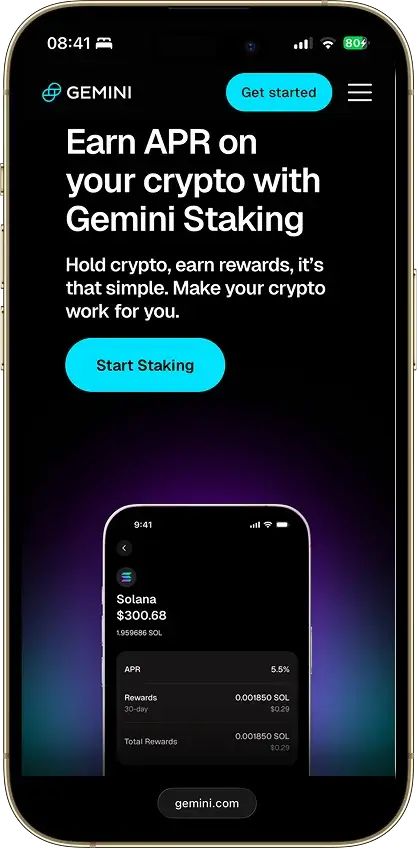
Gemini Staking hero section with the headline “Earn APR on your crypto with Gemini Staking,” a Start Staking button, a phone preview of a Solana staking screen and stats about users, support and ratings.

Product scope and yields. Gemini offers staking for ETH and SOL in supported regions. Yields are variable, shown in‑app, and driven by network conditions; Gemini does not commit fixed APY. Counts and rates can change and should be checked in the app.

Fees and payout cadence. Gemini deducts a staking service fee from rewards. Basic Staking can take up to 30% of rewards (25% in the EU); some regions offer Staking Pro with a 15% service fee for dedicated validators . Rewards accrue daily and post after the network pays out.

Eligibility, limits, and exit. Staking is region‑gated and subject to KYC. In the U.S., SOL staking availability varies by state; New York is typically excluded. There is no platform lockup, but protocol exit queues and network delays can affect unstaking, especially on ETH. Per‑asset limits and current APRs appear in the staking panel.

Gemini Card

Gemini Credit Card hero banner titled “The Card of the Future” featuring multiple Gemini credit cards on a desert backdrop and a breakdown of up to 4% crypto back on categories like gas, dining, groceries and everyday spending.

Program and eligibility. The Gemini Credit Card is a crypto credit card on the Mastercard network and is issued by WebBank. It is currently available to U.S. residents only, subject to credit approval and standard KYC. A physical, numberless card ships after approval and a virtual card is available immediately in‑app. You can add the card to Apple Pay and Google Pay.

Rewards and costs. Earn crypto rewards on every purchase with tiered categories: 4% back on gas/EV/transit/rideshare up to $300 per month (then 1% that month), 3% on dining, 2% on groceries, and 1% on other purchases. Rewards post instantly in the asset you select. No annual fee and no foreign transaction fees. Cash advances/ATMs count as cash advances and typically do not earn rewards.

Funding and settlement. This is a credit product. Purchases settle in USD like a normal credit card; you are not spending your crypto at the point of sale. Rewards are converted to your chosen crypto when the transaction posts; Gemini states there is no exchange fee to acquire rewards and the rate follows market at posting.

Controls and restrictions. The app supports card freeze/unfreeze, instant virtual card numbers, secure in‑app number reveal, spending alerts, and category summaries. Common exclusions apply for rewards, such as cash‑like transactions and gift cards.

Copy Trading and Bots

Availability and access. Gemini does not offer native copy trading, strategy bots, or paid signals in the app or web platform. Users can connect third‑party tools via the API (see API and programmatic trading), but these are not Gemini products and require caution.

Pricing and fees. There are no platform fees for copy trading because no native service exists. Third‑party tools may charge subscriptions, performance fees, or profit shares. These costs are outside Gemini’s fee schedule.

Controls and risk disclosures. Because there is no native copy feature, Gemini does not provide follower allocations, stop‑loss templates, or leader dashboards. If you use external bots, set allocation caps and max drawdown rules on the third‑party platform and understand that losses can exceed expectations.

Execution and limitations. External automations route via the Gemini API and inherit normal order‑book liquidity and latency. Copied strategies cannot bypass regional product limits; for example, bots cannot place derivatives trades in regions where perps are unavailable.

Launchpad, Launchpool, and Airdrops

Gemini does not run a token Launchpad or Launchpool at this time. The exchange occasionally supports promotional distributions or handles token migrations, but there is no ongoing staking‑based allocation program.

Wallet and Self‑Custody Options

Gemini Wallet landing page with headline “Meet the Gemini Wallet,” describing a self-custody onchain wallet above a large screenshot of the Onchain interface showing portfolio, swap and balance details.

Custody model. Gemini accounts are custodial by default, with a built‑in Gemini crypto wallet for exchange balances. Your spot balance sits in Gemini‑managed hot and cold wallets. You can withdraw on‑chain to any supported network wallet you control. Gemini also offers Gemini Wallet®, a self‑custodial smart wallet where keys are managed on your devices; exchange balances remain custodial.

Keys and recovery. Gemini holds the private keys for custodial balances using HSM‑backed infrastructure and offline storage. Users do not receive a seed phrase for custodial funds. Recovery for account access uses email, 2FA, and identity checks. Optional address whitelisting lets you restrict withdrawals to approved addresses; new whitelist entries have a safety delay before use.

Networks and asset support. Deposits and withdrawals are available on a per‑asset, per‑network basis. Bitcoin uses the native chain. EVM assets use Ethereum and selected L2s. Major stablecoins support multiple networks such as Ethereum, Arbitrum, Optimism, Base, Avalanche, and Solana where listed. Network coverage can change; check the deposit screen for current routes. See the Withdrawal networks and fees matrix below for common paths.

Security, controls, and costs. Controls include TOTP 2FA, device approvals, withdrawal emails, and optional whitelists. Gemini charges network fees for on‑chain withdrawals after any free‑withdrawal quota. Internal reviews can add short approval delays, and ACH‑funded buys have withdrawal holds until bank funds clear.

API and Programmatic Trading

Interfaces and capabilities. Gemini provides REST and WebSocket APIs. Public endpoints cover symbols, tickers, order books, and candles. Private endpoints cover order entry, cancels, status, and account balances. A sandbox environment is available for testing at exchange.sandbox.gemini.com. Rate limits: REST public 120 rpm (recommend ≤1 rps), REST private 600 rpm (recommend ≤5 rps), WebSocket ~1 request/symbol/min.

Authentication and permissions. API keys are created in the account settings. Scopes include read, trade, and funds/withdrawal access. Requests are signed with HMAC headers and a nonce. Keys can be rotated or revoked at any time. Withdrawal permissions are off by default and should be enabled only when needed.

Account structure and access controls. Business and institutional accounts can use sub‑accounts and role‑based access. Each sub‑account can have segregated API keys. Optional IP allowlists restrict where keys can be used. Apply least‑privilege: dedicate read‑only keys for analytics and separate trade keys for execution.

Reliability and environments. Production uptime is published on the status page with maintenance windows noted in advance. The sandbox mirrors major endpoints for paper testing. Latency and throughput vary by region and market conditions; monitor order acknowledgements and WebSocket heartbeats.

Developer resources. Reference the developer docs for endpoint specs, examples, and changelogs. Gemini provides example code and support via tickets; community SDKs exist for popular languages. Keep libraries updated as endpoints deprecate.

Other Notable Features

Gemini Institutions page showing ‘How Gemini supports professional traders’ with a large screenshot of the ActiveTrader interface, featuring multiple order books, charts, and account panels on a gradient blue background.

Tax tooling and reporting. The Tax Center provides CSV exports, trade history, and cost‑basis reports. U.S. customers receive the required IRS forms, including 1099‑DA for reportable digital asset proceeds starting with the 2025 tax year. Data can be imported to third‑party tax software.

Institutional/Prime. Gemini offers Custody with segregated cold storage, OTC/RFQ for blocks, and operational controls like multi‑user roles. Onboarding requires entity KYC, beneficial‑owner documents, and bank verification. Timelines vary by jurisdiction and completeness of documents.

Web3 and NFT. Gemini does not provide a built‑in dApp browser or WalletConnect in the exchange app. Users connect to web3 apps with external wallets and can move assets on‑chain via standard withdrawals. NFT activity is supported via external marketplaces; Gemini’s focus in‑app remains spot, staking, and fiat ramps.

Listings and Delistings Policy

Gemini publishes its listings workflow and asset disclosures on official pages and announces changes on its blog and status sites.

Selection and review criteria. Gemini discloses a multi‑step process that includes application, initial screening, due diligence, and compliance review. The Singapore framework specifies governance, legal, market‑integrity, technology, token economics, and issuer disclosures. Final decisions and timing are communicated via official posts and support articles.

Delisting triggers and timelines. The Singapore policy states Gemini will, where practicable, give 30 days’ prior written notice before a delisting takes effect. Notices outline reasons, trading and withdrawal timelines, and customer options. For derivatives, blog posts specify the delist time, auto‑cancellation of open orders, and forced closing of positions at the published index price at the cutoff.

Regional and entity variance. Criteria and notice periods can differ by operating entity. Gemini SG publishes formal frameworks under local rules. U.S. and EU entities communicate through the blog, support articles, and the asset disclosures page. Availability varies by jurisdiction.

Recent change. Earlier, in April 2025, Gemini Derivatives announced that several GUSD-margined perp contracts would be delisted on 2 May 2025, with a specified cutoff and automatic position closeout.

Fees and Pricing

Gemini uses two pricing tracks. The Gemini mode interface quotes an all‑in price with a separate transaction fee. The ActiveTrader interface uses a volume‑tiered maker‑taker schedule. Fees are charged in the quote currency. Tiers are based on 30‑day USD notional across continuous order books.

Simple buy or sellInstant Orders: 1.49% transaction fee + 1.00% convenience fee. Quoted price shown before submit.
Advanced maker or takerMaker 0.00–0.20% · Taker 0.03–0.40% by 30‑day USD notional volume.
Card depositDebit card 3.49% of total purchase.
PayPal 2.50% of deposit amount.
Bank transferACH deposits free. Wire deposits free. USD wire withdrawal $25.
SEPA/FPS withdrawals free.
SGD Fast Transfers 3 SGD.
Crypto withdrawalDynamic network fee only. Shown before you confirm the withdrawal.

Details. On ActiveTrader, fees start at 0.20% maker and 0.40% taker at $0–$9,999 in 30‑day volume. They fall to 0.03% maker and 0.10% taker at $5M+, and 0.00% maker and 0.03–0.05% taker at the highest tiers. Volume is recalculated daily at midnight UTC. Fees are charged in the quote currency.

On Gemini mode, Instant Orders add two components. A 1.00% convenience fee is embedded in the quoted price and a 1.49% transaction fee is shown separately. Recurring orders follow the same structure. Limit orders in Gemini mode charge the 1.49% transaction fee with no convenience fee. The final rate is shown in the order confirmation. In practice, Instant Orders will usually execute above mid‑market; check the quoted rate against an external index if you want to see the all‑in spread before submitting.

Funding and payouts. ACH and wire deposits have no Gemini fee. Debit card deposits are 3.49%. PayPal deposits are 2.50%. ACH withdrawals are free. USD wire withdrawals cost $25. Non‑USD bank withdrawals via SEPA or FPS are free on Gemini. Settlement windows vary by rail. ACH typically clears in 4–5 business days. Bank wires often arrive same or next business day. EU transfers via SEPA and UK FPS usually arrive next business day.

Crypto withdrawals. Gemini passes through a dynamic network fee that tracks on‑chain conditions. The fee is displayed before you submit. ERC‑20 withdrawals consume gas in the asset you send. Gemini covers conversions from the token to ETH for gas on ERC‑20 routes. There is no platform surcharge on crypto withdrawals.

Staking commission. Gemini deducts a staking services fee from rewards. Basic Staking can take up to 30% of rewards (25% in the EU). Some regions offer Staking Pro with a 15% service fee for dedicated validators. Rewards accrue and post after the network pays them.

Lowering fees. Use the ActiveTrader interface instead of Instant Orders for lower trading fees. Place maker limit orders where practical. Increase 30‑day volume to reach better tiers. Prefer bank transfers over card or PayPal deposits. Batch withdrawals and select lower‑cost networks where a coin supports more than one route.

VIP tiers and fee discounts table

ActiveTrader maker‑taker schedule — spot orders. Default rates.

Tier30‑day volumeMakerTakerNotes on discounts or exclusions
0$0–$9,9990.20%0.40%Fees recalc daily at midnight UTC.
1≥ $100,0000.08%0.20%Charged in quote currency.
2≥ $5,000,0000.03%0.10%Stablecoin pairs may have fixed low fees.
3≥ $50,000,0000.00%0.05%Some USD stablecoin pairs list 0.00% maker and 0.01% taker at all tiers.
4≥ $250,000,0000.00%0.03%RLUSD/USD is 0.00% / 0.00% per schedule.

Stablecoin pair exceptions apply to specific books. They do not change Instant Order pricing and do not apply to derivatives. For full details, see the ActiveTrader Fee Schedule.

Payments and Fiat Support

Gemini supports fiat on‑ramps and off‑ramps in USD as the primary base currency, with GBP and EUR supported in the UK and EEA, and local options in selected markets. Rails include ACH and domestic wires in the U.S., SEPA in the EEA, and Faster Payments in the UK. Card rails run via debit networks and Apple Pay or Google Pay in supported regions. Limits are enforced per‑transaction and by rolling daily windows, and vary by verification level.

Payment methodMinimum depositMinimum withdrawalMaximum withdrawal
ACH (U.S.)Not published (shown in‑app)Not published (shown in‑app)Not published (shown in‑app)
Domestic wire (USD)Bank‑dependent; no Gemini feeBank‑dependent; $25 Gemini fee outBank‑dependent
SEPA (EUR)Not published (shown in‑app)Not published (shown in‑app)Bank‑dependent
Faster Payments (GBP)Not published (shown in‑app)Not published (shown in‑app)Bank‑dependent
Debit cardProcessor‑dependent; quoted at buy
Apple Pay / Google PayProcessor‑dependent; quoted at buy
PayPal (U.S.)2.50% processing fee; amount quoted— (no PayPal withdrawals)PayPal/account limits

Coverage and timing. U.S. users fund via ACH and domestic wire. The EEA uses SEPA. The UK uses Faster Payments. Most regions also support debit card buys and Apple Pay / Google Pay. ACH deposits credit for trading fast but typically clear in 4–5 business days before off‑platform withdrawals are allowed. Wires often land same or next business day. SEPA and Faster Payments usually arrive next business day or faster subject to bank cut‑offs. Card and wallet buys post immediately in the account but can be subject to fraud holds on withdrawals. These bank and card costs make up the core Gemini deposit and transfer fees for most users.

Limits and prerequisites. Limits depend on KYC level and account history. They are shown in Transfer → Deposit/Withdraw before you submit. Some rails enforce per‑transaction caps and daily limits. Larger withdrawals may require beneficiary verification or source‑of‑funds checks.

Currency matching and conversion. Balances are held in the funding currency. You can trade USD books directly or use available EUR and GBP pairs where listed. If you fund in a different currency than your target market, Gemini uses the prevailing rate at order time. Bank FX fees may apply on your side for non‑local wires. Gemini shows the all‑in price on Instant Orders and the execution price + fees on ActiveTrader.

Address and beneficiary management. For fiat withdrawals, the bank account name must match the Gemini account name. You can store beneficiaries for faster payouts. For crypto withdrawals, whitelisting is optional but recommended; new addresses have a safety delay. A 1× turnover expectation can apply to fiat deposits before withdrawal as part of AML controls.

On‑/off‑ramp partners. Gemini processes bank transfers in‑house. Card and Apple/Google Pay transactions run over the card networks. When third‑party services are used in a region, their terms and fees apply and are disclosed in the checkout flow. For live funding and withdrawal limits and fees, see the Transfer Fee Schedule and payments/limits articles in the Gemini Help Center.

Fiat Rails by Region

RegionACHSEPAFaster PaymentsWireCardsPayPalNotes
USYesYesYesYesACH clears in 4–5 business days; wires same or next business day; card buys post instantly with potential withdrawal holds.
EU or EEAYesYesYesSEPA credits by next business day; international wires 1–2 business days.
UKYesYesYesFPS near‑instant during bank hours; wires 1 business day.
RoWYesYesCoverage varies by country; use USD multi‑currency wires where supported.

Withdrawal Networks and Fees Matrix

Fee model and timing. Gemini passes through network fees; no platform surcharge. Confirmation windows assume normal network load.

Asset or networkFee modelTypical confirmation windowNotes
BTC (on‑chain)Network onlyAbout 10 to 60 minutesHigher fee tiers can speed inclusion.
ETH (ERC‑20)Network onlyAbout 5 to 15 minutesGas varies with network demand.
USDC (ERC‑20)Network onlyAbout 5 to 15 minutesHigher gas at peak load.
USDC (Avalanche C‑Chain)Network onlyAbout 2 to 10 minutesLower fees than ERC‑20 in most periods.
USDC (Solana)Network onlyAbout 2 to 10 minutesFast finality; check maintenance windows.
USDT (ERC‑20)Network onlyAbout 5 to 15 minutesSelect a supported EVM route.
USDT (Solana)Network onlyAbout 2 to 10 minutesLower fees than ERC‑20; fast finality.

Is Gemini Safe? Security and Proof of Reserves

Gemini is a security‑first, full‑reserve exchange with strong custody and user controls, audited financials, and insurance on cold storage. It does not publish a user‑verifiable Merkle‑tree proof of reserves.

Controls. Gemini states it keeps the majority of customer crypto in cold storage with a limited hot‑wallet float. Keys are managed using HSM‑backed systems and multi‑party approvals. User defaults include email verification and 2FA (TOTP or SMS) for sign‑in; hardware keys are supported. Optional controls include withdrawal address whitelisting and device/session approvals. Withdrawal reviews and funding holds can apply after ACH or card deposits. Where Gemini does not disclose a detail, we mark it as not disclosed.

Custody and insurance. Gemini Trust Company is the custodian for exchange balances. Customer assets are segregated from corporate assets on the ledger. USD cash held at partner banks is eligible for FDIC pass‑through coverage up to statutory limits; crypto is not insured by the FDIC. Gemini maintains digital‑asset insurance for custodial cold storage and a separate crime policy for hot‑wallet risks, subject to policy limits and exclusions.

Proof of reserves or audits. Gemini publishes audited financial statements and undergoes SOC 1 Type 2 and SOC 2 Type 2 examinations. It does not publish a customer‑verifiable Merkle‑tree proof‑of‑reserves that includes liabilities and lets users check inclusion. Audit and disclosure dates are listed on the Trust Center and Legal pages.

Incidents and remediation. No material breach of Gemini’s wallet infrastructure is disclosed. In Dec. 2022, a third‑party marketing vendor exposed a file containing Gemini customer email addresses and partial phone numbers; Gemini systems were not breached. In the last 12–24 months, the status page shows short service degradations and planned maintenance windows that were resolved the same day. Gemini advises customers to enable 2FA and whitelists to mitigate phishing risks.

Gemini “Trade with confidence on a secure, trusted platform” section showcasing awards from Forbes Advisor, NerdWallet and The Ascent, plus AICPA SOC certifications, followed by product feature highlights.

How to Verify PoR Yourself

  1. Open the Trust Center and Legal → Supported Digital Assets & Disclosures to find the latest audited financials and SOC reports. Confirm the report date, provider, and scope.
  2. Check whether Gemini has posted a customer‑verifiable PoR. At the time of our Gemini exchange review, no Merkle‑tree PoR is published and users cannot self‑verify account inclusion on‑chain.
  3. Note the update cadence on each report. Record the date, coverage, and any stated limitations before relying on it.

Status Page and Incident History

  • Status page: status.gemini.com — updated in near real time; incident timestamps display in UTC.
  • Recent examples (past 12–24 months):
    • 2025 — Periodic degraded performance events and scheduled maintenance noted, with trading and transfers restored the same day.
    • 2024 — Routine maintenance windows and isolated delays to deposits/withdrawals during upgrades; no material security incident disclosed.

For full details and historical logs, use the Status → Incident History archive on the status page.

Gemini Withdrawal Codes and Text Scams

Some users search for their “Gemini withdrawal code” after receiving texts or emails about withdrawals. A genuine Gemini withdrawal confirmation happens in‑app or via logged‑in email flows, not through random links in SMS. If you receive a “your Gemini withdrawal code” text that you did not request, treat it as suspicious, do not click links, and check your account directly. Official support will never ask you to share a withdrawal code or 2FA code over chat, phone, or email.

UX And Customer Support — KYC And Geographic Access

Gemini’s web and mobile apps are clean and predictable. Navigation exposes Markets, Trade, Transfer, and Portfolio with an optional pro layout. Performance is stable in normal conditions. Support runs through a help center, an in‑app assistant, and email tickets. There is no general customer service phone number for the exchange; the Gemini Credit Card has its own dedicated phone line. Outage updates post on the public status page.

UI and Navigation

Gemini’s default layout starts with a portfolio dashboard and a top navigation to Markets, Trade, and Transfer. The quick‑buy flow is prominent, while ActiveTrader is one toggle away for a full order book, depth, and advanced tickets. Staking and card live under Account tabs. Most tasks take one to three taps from the home screen.

Web pages and charts load quickly on modern browsers. Order forms respond without noticeable lag. During volatility, updates may slow but remain functional. Status notices appear on the banner when maintenance is planned.

Accessibility is solid. Dark mode is available. Font scaling and keyboard navigation work in core forms. Localization covers major languages, with English most complete. Web and app features largely match, with charts and book views denser on desktop.

Gemini Crypto App (iOS and Android)

The Gemini app is available on iOS and Android in most supported regions. Distribution follows local store rules. If your country is unsupported, the app listing will not appear. The Gemini crypto app is the main way many users log in, check balances, and trade on the platform, with the same account and security settings as the web login.

Feature parity is strong. You can buy, sell, convert, deposit, withdraw, stake supported assets, and toggle ActiveTrader on mobile. U.S. users also manage the Gemini Credit Card in‑app. Push alerts cover fills, price moves, and security events.

The app is responsive on recent devices and degrades gracefully on weak networks. Security options include biometrics, passcode lock, 2FA prompts on sensitive actions, and device/session management. Privacy controls live under Settings → Security and Notifications.

Registration

Gemini create account page with a phone mockup of the Gemini app on the left and a sign-up form on the right where users choose Personal or Business, enter email and password, and select country and language.

Create an account with email, password, and country. Verify email and phone, then complete identity checks before trading or moving funds. U.S. users provide SSN as required by law. Some regions request proof of address. Liveness checks may trigger.

Security setup encourages 2FA at first login. TOTP and hardware keys are supported. SMS works as a fallback. OAuth single sign‑on is not offered. Apps are available via the official stores only; sideloaded packages are not supported.

KYC and Geographic Access

Gemini requires full identity verification to deposit, trade, and withdraw. Enhanced due diligence may trigger on larger or unusual activity, on document expiry, or when product access changes. Derivatives remain geo‑gated by entity.

Accepted documents include a government ID and, where requested, proof of address. Liveness checks apply in some flows. Typical approvals clear in minutes to 24 hours. Complex reviews can take longer.

Availability is broad across the U.S., EU/EEA, UK, and selected APAC and LATAM markets. Sanctioned and high‑risk jurisdictions are prohibited.

Verification Levels and Withdrawal Limits

Limits vary by jurisdiction and KYC status.

LevelRequired documentsFiat deposit limitFiat withdrawal limitCrypto withdrawal limitTypical review time
Verified individualGovernment ID, phone, email; proof of address where requiredMinutes to 24 hours
InstitutionalEntity docs, beneficial‑owner KYC, bank verification1–5 business days

Gemini does not publish universal fiat or crypto limits. Live limits appear in‑app and vary by verification level, account history, operating entity, and region. Higher limits may require address whitelisting, enhanced due diligence, or additional bank verification.

Geo Access and Entity Mapping

High‑level snapshot. Confirm your serving entity in Settings → Legal.

Region or countryOperating entityWhat is availableNotes
United StatesGemini Trust Company, LLCSpot, staking (where permitted), card, APINo derivatives. Card U.S. only.
EU/EEAGemini Intergalactic EU, Ltd (MiCA); Gemini Intergalactic EU Artemis, Ltd (MiFID II)Spot, staking, derivatives (perps)Perps/tokenized stocks via Artemis; country variances.
United KingdomGemini Intergalactic UK, Ltd (FCA MLRs FRN 921817)Spot, stakingNo derivatives. Card unavailable.
SingaporeGemini Digital Payments Singapore Pte. Ltd. (IPA)Spot, stakingPerps availability subject to local rules.
Rest of worldVaries by jurisdictionSpot, staking where allowedCheck Supported countries before onboarding.

Customer Support

Channels and availability. Help Center articles and an in‑app assistant handle common tasks. Account‑specific help uses email/ticket. There is no general phone support for the exchange; the Gemini Credit Card has its own dedicated phone number. Support replies in English; other languages may be translated.

Responsiveness and SLAs. First responses often arrive same day. Complex KYC or funds‑flow reviews can take 1–3 business days or more. VIP and institutional accounts may receive priority routing. Check the status page before opening tickets.

Authentication and safety. Support will not ask for your password or 2FA codes. Verify sender domains and in‑app banners. Use the app’s Contact Support flow to open tickets from a signed‑in session.

Self‑serve and escalation. The Help Center covers funding, trading, tax, and security topics. The status page lists outages and maintenance. For account holds or EDD reviews, be ready to submit updated ID, proof of address, and source‑of‑funds documents via the secure upload link.

How to Contact Gemini Customer Service

Gemini customer service runs through the Help Center and an email/ticket system. You start from the in‑app Contact Support link or from gemini.com/help. There is no 24/7 public Gemini customer service phone number for the exchange; only the Gemini Credit Card has a dedicated customer service line, which is printed on the back of the card and in the cardholder terms.

Other ChannelsX, Facebook

Who Is Gemini Best For

Gemini suits security‑first users who want a regulated on‑ramp with simple bank transfers and a clean app. It works well for long‑term buyers and medium‑volume traders who can switch to ActiveTrader for lower fees and use staking on ETH or SOL. U.S., UK, and EU readers benefit from broad fiat coverage and clear disclosures.

Power users chasing the lowest taker fees, very wide altcoin menus, or high‑leverage derivatives should weigh the trade‑offs we outlined in our Gemini crypto exchange review. For readers asking whether Gemini is a good crypto exchange overall, it works best if you value regulated custody, straightforward fiat ramps, and a polished app more than the absolute lowest fees or widest altcoin list.

Alternative Sites like Gemini

  • Kraken — consider if you need spot margin and a broader coin lineup than Gemini.
  • Coinbase — larger retail coin selection and mainstream fiat rails for casual buyers.
  • Bybit — broad perpetuals roster and higher leverage than Gemini in supported regions.
  • Crypto.com — global app with integrated card perks where available.

Pick Gemini when regulated custody, predictable fiat ramps, and a straightforward app matter most. Consider the above if you prioritize margin, a larger alt list, or expansive derivatives.

Final Verdict

Gemini is a secure, regulation‑first exchange that trades some breadth and ultra‑low taker fees for clarity, custody quality, and easy fiat ramps. It suits security‑conscious buyers and medium‑volume traders who prefer a clean app, **ActiveTrader** fee tiers, and reliable **bank rails** across the U.S., UK, and EU. If you need the lowest costs on aggressive volume, hundreds of small‑cap listings, or high‑leverage derivatives in the U.S., weigh those trade‑offs against Gemini’s strengths.

Overall Score

8.1

Best For

Security-first buyers who want regulated fiat ramps and simple staking.

PROS

  • Regulated New York trust with full-reserve disclosures and SOC 1/2 Type 2 audits
  • Bank-friendly rails: ACH, wires, SEPA and Faster Payments. Deposits are typically fee-free on Gemini
  • Perpetual futures access in supported regions for advanced traders
  • Staking available with no minimums. Service fee auto‑deducted from rewards
  • Credit card rewards paid instantly with no annual or foreign transaction fees

CONS

  • Simple buys carry higher costs than pro-tier trades
  • No spot margin or options. Derivatives not available in some jurisdictions, including the U.S
  • ACH deposits have withdrawal holds until funds clear
  • No universal phone support for the exchange. Primary channels are email and tickets
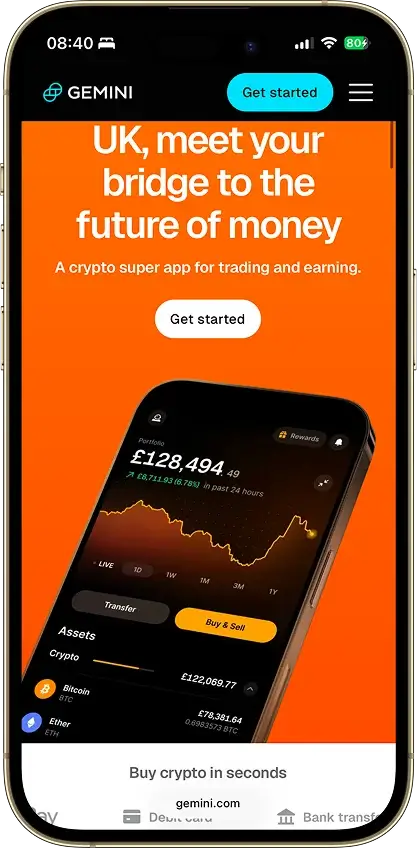
Gemini UK mobile hero screen advertising crypto super app for trading and earning

Disclaimer: CryptoSlate may receive a commission when you click links on our site and make a purchase or complete an action with a third party. This does not influence our editorial independence, reviews, or ratings, and we always aim to provide accurate, transparent information to our readers.

FAQ

Is Gemini safe?

Gemini holds most crypto in cold storage, keeps 1:1 reserves, and carries insurance on custody. USD cash sits at partner banks with FDIC pass‑through eligibility. Gemini does not publish a user‑verifiable Merkle proof of reserves.

What are Gemini fees?

Instant Orders show an all‑in quote with a 1.49% transaction fee and a 1.00% convenience fee. ActiveTrader uses a 30‑day volume maker‑taker table from 0.20%/0.40% down to 0.00%/0.03–0.10%. Withdrawal fees are network‑only.

Does Gemini require KYC?

Yes. Full identity verification is required before deposits, trading, or withdrawals. Enhanced due diligence may apply for higher limits, unusual activity, or product access changes.

Which coins does Gemini support?

Gemini lists a curated set of around 70–80 assets and just over 100 spot pairs as of Nov. 2025, with majors and selected mid-caps.

Can I withdraw crypto from Gemini to my own wallet?

Yes. Most supported assets can be withdrawn on‑chain to your own wallet on supported networks, subject to network fees, minimum amounts, and any funding holds or security reviews. Always match the withdrawal network to your destination wallet and check fees and limits on the confirmation screen.

How long do withdrawals take?

ACH deposits credit for trading but typically require 4–5 business days to clear before off‑platform withdrawals. Wires often arrive the same or next business day. Crypto withdrawals send in minutes after review, then follow network confirmation times.

What is a Gemini withdrawal code?

Gemini may require extra confirmation on some withdrawals, usually handled in‑app or via secure email links. There is no single universal “Gemini withdrawal code” you must enter for every payout. If you receive a withdrawal code text you did not request, verify your account activity directly in the app and ignore suspicious links, since many scam texts misuse the phrase “your Gemini withdrawal code.”

Is Gemini available in my country?

Gemini serves the U.S., UK, EU/EEA, and selected markets, with products varying by entity. Sanctioned jurisdictions are restricted. Availability can change without notice.

Does Gemini offer staking or rewards?

Yes. Gemini offers staking for ETH and SOL in supported regions. Rewards are variable and net of a service fee that can be up to 30% on Basic Staking or about 15% on select validator options.

How can I lower fees on Gemini?

Use ActiveTrader instead of Instant Orders, place maker limit orders where possible, and increase 30‑day volume to reach better tiers. Prefer bank transfers over cards to avoid processor charges.