What is Anti-Money Laundering (AML) in Crypto?





Anti-money laundering, or AML, is a set of practices, rules, and efforts to discover, prevent, and eliminate financial misbehavior like money laundering. Individuals and organizations may use money laundering techniques to transform funds earned from illegal activities, such as public corruption, tax evasion, theft, human trafficking, or drug trafficking, into legitimate or “clean” money.
The United Nations Office on Drugs and Crime (UNODC) estimated that up to 5% of global GDP is laundered each year.
Since one of the channels used to “wash” dirty money involves cryptocurrencies, which are decentralized, borderless networks with no governing authority, crypto AML focuses on the flow of crypto assets.
Due to their decentralized design, crypto assets seem to be ideal for money laundering, but crypto AML practices have emerged to address these challenges across various jurisdictions and crypto platforms.
Key takeaways
- Crypto AML rules require exchange platforms, wallet providers, and other services to identify users through KYC onboarding and monitor suspicious transactions.
- Regulators worldwide enforce AML based on guidelines and rules like FATF’s Travel Rule, MiCA in the EU, and FinCEN guidelines in the U.S.
- DeFi and privacy tools like mixers pose unique AML challenges to regulators and law enforcement.
Why Does AML Matter in the Cryptocurrency Space?
The emergence of blockchain-based cryptocurrencies can reshape the architecture of global finance. The World Economic Forum (WEF) estimated that about 10% of the global economy would be stored on blockchain by 2030.
While crypto assets bring new opportunities, they also introduce new challenges, particularly because they are easy to exploit for money laundering.
AML efforts are essential in making the fast-growing crypto market a safe environment for all stakeholders. Let’s discuss in more detail why crypto AML practices are imperative.
The Risk of Anonymity
Bitcoin (BTC), the first application of blockchain technology, was envisioned as a decentralized peer-to-peer (P2P) money system offering anonymity. Wallet addresses used to hold and manage BTC are random strings of numbers and letters that reveal nothing about the owner’s identity.
When cryptocurrency was still an underground phenomenon, it was actively used in illicit activities. For example, it was the main currency on the infamous Silk Road, a dark web marketplace where users could trade drugs, firearms, and other illegal goods anonymously.
With the rise of centralized exchanges (CEXs), P2P transactions became less dominant, while blockchain’s transparency made anonymity less relevant.
In the end, Bitcoin’s design actually helped U.S. authorities shut down Silk Road, as prosecutors could trace the flow of BTC and identify criminals.
To increase the level of anonymity, privacy coins eventually introduced full privacy by integrating zero-knowledge proof (ZKP) technology to hide wallet addresses during transactions. Due to the risk of anonymity, financial regulators across major jurisdictions are restricting the use of privacy coins like Monero and Zcash.
During the last few years, financial watchdogs have been shaping AML rules to find a balance between privacy and transparency.
Use Cases of Crypto in Money Laundering
Cryptocurrencies have often been used in money laundering, especially when crypto AML rules were not enforced properly.
However, even with AML rules in place, criminals often turn to services like mixing platforms, which pool and redistribute cryptocurrencies to hide the link between senders and receivers. Cross-chain swaps, where tokens are moved between different blockchains without a centralized intermediary, further complicate tracking efforts.
Meanwhile, ransomware groups continue to demand Bitcoin or privacy coins as payments to make recovery efforts harder, although the total volume of ransom payments decreased in 2024 by 35% compared to the previous year.
Interestingly, the largest volumes of ransomware crypto funds were held in personal wallets at the end of 2024, while the share of funds sent to crypto exchanges and the use of mixing services declined.
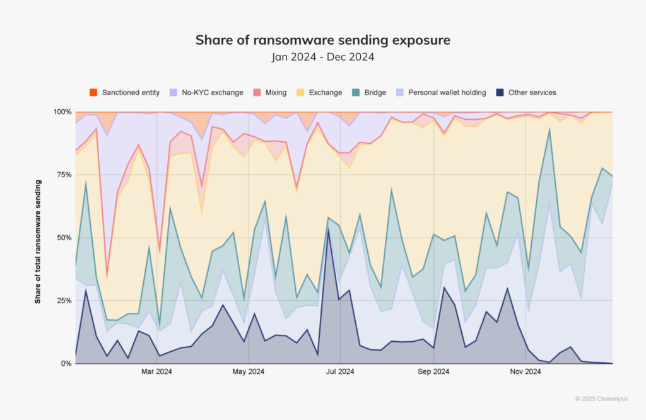
In recent years, sanctioned entities, including governments, have also turned to crypto to evade international restrictions. In 2024, they received nearly $16 billion in crypto, accounting for about 39% of all illicit crypto transactions.
AML frameworks are essential in preventing money laundering, ransomware, and sanctions evasion.
What are the Core Principles of Crypto AML?
Crypto has grown into a $3 trillion market, and AML measures are one of the primary mechanisms through which governments can control this industry built around decentralization. The following AML rules have become mandatory for major CEXs and other crypto services, which have to integrate several core elements to prevent illegal activities.
Know Your Customer (KYC) Crypto Requirements
KYC is the main component of any effective AML program. Crypto platforms verify user identities to reduce the risk of anonymity, preventing bad actors from conducting crypto transactions.
KYC programs usually imply three parts: customer identification, due diligence, and ongoing monitoring.
- A customer identification program (CIP) ensures that a client is who they claim to be. Verified information usually includes the client’s legal name, date of birth, address, and verification of documentation like an ID, passport, or driver’s license. Often, crypto exchange users have to upload pictures of their documents as part of their KYC verification process.
- Customer due diligence (CDD) is a risk assessment program in which crypto platforms assign risk ratings to accounts based on customer surveys, background checks, and transaction reviews.
- Crypto exchanges rely on continuous monitoring to identify transaction red flags in real time. Platforms may be required to file Suspicious Activity Reports with financial regulators.
Transaction Monitoring
Major crypto exchanges regularly track and analyze crypto transactions to detect suspicious activity that may be related to illicit activities. They use advanced tools to spot suspicious behavior, such as large transaction sizes, rapid wallet movements, or patterns associated with illicit activities.
Some platforms may use artificial intelligence (AI) and machine learning (ML) tools to detect red flags automatically.
As a rule, crypto exchanges don’t check every user systematically but instead focus on transactions that deviate from normal usage patterns.
Recordkeeping and Reporting Obligations
Recordkeeping is also part of AML compliance, with crypto platforms required to store transaction records and user activity. Crypto exchanges must be able to provide audit trails when asked by financial regulators. While this may seem challenging due to decentralization, the transparency of public blockchains makes it much easier. Once user identities are verified, on-chain transaction histories can be easily associated with real-world individuals.
As mentioned earlier, crypto platforms must submit Suspicious Activity Reports (SARs) when their records show potential money laundering or fraud behavior.
Crypto exchanges have been gradually implementing KYC and AML practices, with the goal of legitimizing the broader crypto industry and contributing to its integration with traditional finance.
How Is Crypto AML Enforced Worldwide?
Governments and financial regulators across the world are intensifying efforts to implement AML standards focused on crypto assets. AML rules are imposed based on global, international, and local standards and frameworks.
FATF and the Travel Rule
At the global level, the Financial Action Task Force (FATF) plays a key role in setting international AML standards for cryptocurrencies. This intergovernmental organization was founded in 1989 at the request of the G7 nations and currently includes 40 countries. Its main task is to develop policies to combat money laundering and terrorist financing.
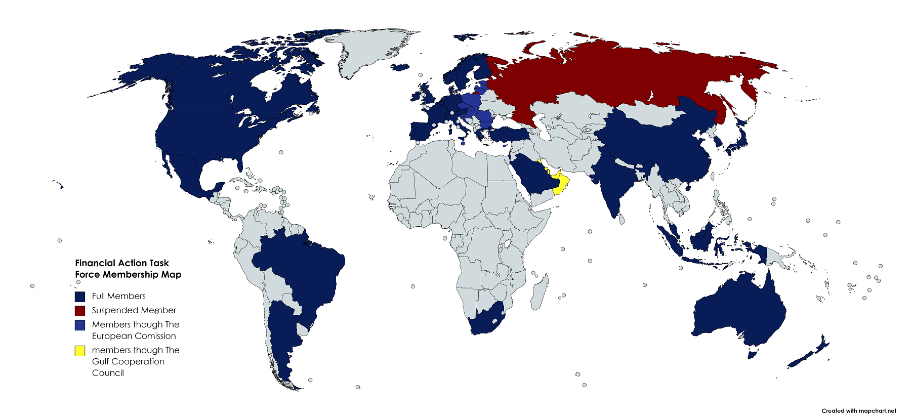
As an international organization, FATF issues guidelines that member countries must adopt into their national laws.
In 2019, FATF presented the first crypto guidance and introduced the “Travel Rule” for Virtual Asset Service Providers (VASPs) — including crypto exchanges, custodians, and wallet providers. It requires them to share certain customer information when conducting crypto transactions. The guidance was updated in 2021.
The Travel Rule and other FATF guidelines can only be adopted by centralized platforms. Applying them to decentralized finance (DeFi) platforms creates significant technical challenges.
Regional Frameworks
At the regional level, countries and jurisdictions can adopt FATF guides and develop their own AML rules, which can be stricter or more tailored to their specific legal and financial systems. Here are the main regulatory practices across the main jurisdictions:
- The U.S.: In the U.S., there are several agencies that oversee crypto AML implementation, which creates confusion. To begin with, the Financial Crimes Enforcement Network (FinCEN) requires certain crypto businesses to register as Money Services Businesses (MSBs) and comply with AML obligations, including KYC and reporting suspicious activities. For example, Coinbase, the largest crypto exchange in the U.S. by trading volume, is registered with FinCEN. Interestingly, in 2024, the FinCEN congratulated Coinbase for its contribution to a significant criminal case, receiving the agency’s Law Enforcement Award.
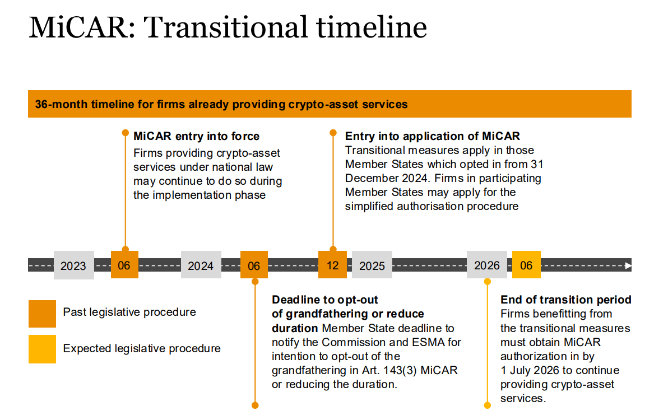
Meanwhile, the Securities and Exchange Commission (SEC) and the Commodity Futures Trading Commission (CFTC) have an impact too, especially when tokens resemble securities or commodities. - European Union (EU): In 2023, the EU became the first major jurisdiction to adopt a crypto-friendly regulatory framework, when the EU Parliament passed the Markets in Crypto-Assets (MiCA) law.
It introduced a mandatory pan-European licensing regime for all Crypto-Asset Service Providers (CASPs), which requires them to implement AML rules.
 Today, the EU has a new body focusing on enforcing AML rules on financial institutions, including crypto platforms and wallets. The Anti-Money Laundering Authority (AMLA) has been in development for years and opened its Frankfurt office in January 2025.
You can read our article comparing US crypto regulations and the EU’s MiCA framework. - Asia-Pacific (APAC): The APAC region is home to several financial hubs and major economies, including Japan, Singapore, and Hong Kong.
The countries have developed robust crypto AML frameworks. The Monetary Authority of Singapore (MAS) regulates crypto platforms under its Payment Services Act, requiring strict KYC and reporting practices.
Elsewhere, Japan was one of the first countries to introduce crypto exchange regulations. Its Financial Services Agency (JFSA) has enforced some of the strictest crypto AML regulations.
Challenges of Regulatory Fragmentation
Despite FATF rules and other international efforts, crypto AML implementation still faces regulatory fragmentation. Although most FATF members adopted crypto AML guides, they may interpret and implement them differently, resulting in significant inconsistencies.
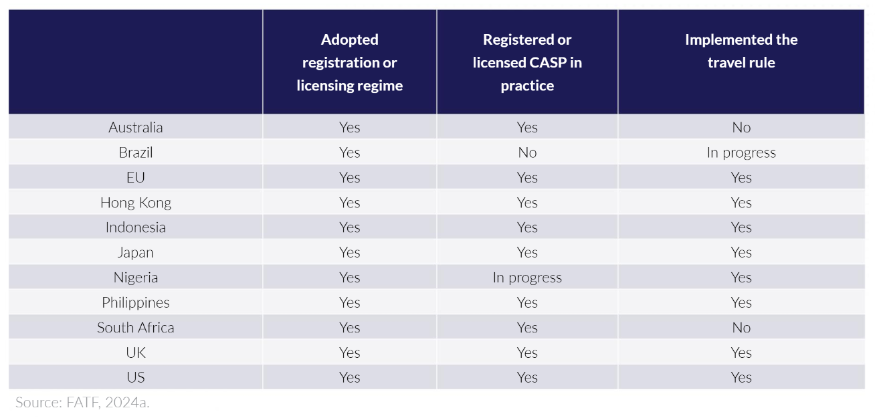
For example, countries like Japan and the EU impose strict AML requirements on all transactions, while others apply lighter rules.
These discrepancies open the door for arbitrage opportunities for bad actors, who can choose more lenient jurisdictions to evade compliance.
While global crypto AML rules and enforcement evolve quickly, they remain a work in progress.
How Do Crypto Businesses Implement AML Programs?
Despite regulatory fragmentation, major crypto exchanges and wallets are implementing AML rules to be able to operate across most jurisdictions. Top-tier exchanges have entire legal teams that ensure regulatory compliance.
Exchange and Custodian Crypto AML Practices
CEXs and custodians like Coinbase, Binance, and Kraken implement KYC procedures at onboarding. They require users to submit ID documents and undergo risk assessments.
Some of these platforms assign risk scores to user accounts based on geography, transaction behavior, and other indicators. High-risk accounts or transactions may trigger enhanced due diligence, such as manual reviews or additional verification steps.
Several major platforms learned the importance of AML compliance the hard way. In 2024, Binance and its CEO at the time, Changpeng Zhao, pleaded guilty to money-laundering charges, agreeing to pay $4.3 billion to settle cases from the CFTC, the U.S. Department of Justice, and the Treasury Department. This is the largest corporate penalty in U.S. Treasury history.
In 2023, Coinbase agreed to pay a $50 million fine to the New York State Department of Financial Services (NYDFS) to settle allegations of AML breach. The platform also had to invest an additional $50 million to improve compliance.
Enforcing AML in Decentralized Protocols
While CEXs pay millions and even billions to settle AML charges, enforcing AML rules on DeFi protocols is challenging, as they operate without central authorities and intermediaries. There is no entity to monitor crypto flows and verify users. Therefore, most DeFi platforms have no KYC requirements, enabling users to interact directly with blockchain smart contracts, which are self-executing programs.
Integrating DeFi into the existing crypto regulatory framework is difficult. This is why leading CEX OKX suspended its decentralized exchange (DEX) aggregator tool to comply with the EU’s MiCA rules.
Some DeFi projects looking to attract liquidity from traditional finance are experimenting with “permissioned DeFi” systems where only vetted addresses can interact with the protocol. Such systems can be efficient in use cases like cross-border payments.
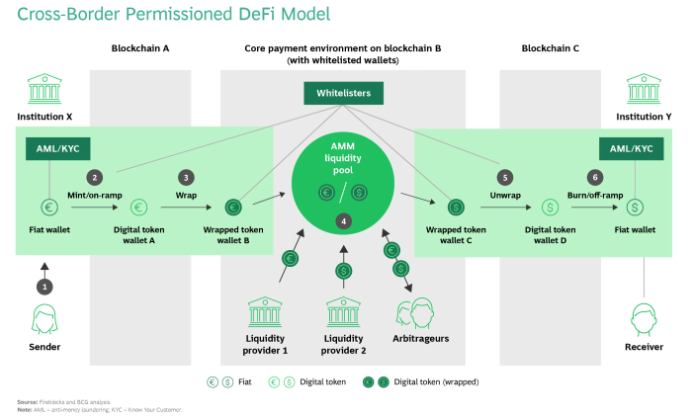
Others are exploring zero-knowledge (ZK) compliance layers. They allow users to prove compliance with KYC/AML requirements without revealing sensitive identity information. For example, PureFi is a ZK-based compliance infrastructure provider that focuses specifically on DeFi projects.
Blockchain Analytics and Compliance Tools
Specialized analytics tools simplify the tracing of crypto transactions, including cross-chain movements. CEXs, organizations, government agencies, and other entities rely on blockchain analytics firms like Chainalysis, Elliptic, and TRM Labs to monitor wallet addresses and identify illicit transactions.
Elliptic processes over 100 million screenings per month across hundreds of exchanges and dozens of blockchain networks. Its products are used by the likes of Binance, Coinbase, Revolut, Unicef, Paysafe, and even the U.S. Secret Service.
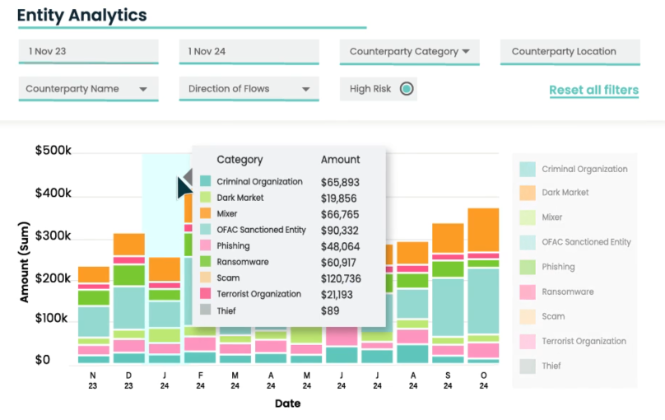
Some of these companies use AI to automate pattern analysis, offering real-time alerts. For example, in January 2025, Chainalysis acquired Alterya, a fraud detection tool that uses AI.
Thanks to AI-powered supervision, any sudden movement of crypto funds from a privacy mixer to a known exchange wallet might trigger an internal compliance review.
Which AML Challenges are Unique to Crypto?
Given their decentralized design and global reach, enforcing AML rules on cryptocurrencies implies unique challenges that differ from those in traditional finance. From privacy coins to AI-powered synthetic IDs, bad actors are using different methods to avoid AML compliance.
These are some of the main crypto AML challenges:
Privacy Coins and Mixing Services
As mentioned earlier, privacy coins like Monero and ZCash hide transaction details by default, enabling users to move crypto without leaving traces. Unlike Bitcoin or Ethereum, where addresses are publicly visible and can link to real individuals through KYC requirements, privacy coins can resist tracking efforts. While privacy advocates encourage the use of such cryptocurrencies, money launderers are some of the main beneficiaries.
Similarly, mixing services like Tornado Cash aim to help users hide the traceable links between wallet addresses by pooling and redistributing funds. Regulators have responded with force: the U.S. Treasury’s Office of Foreign Assets Control (OFAC) sanctioned Tornado Cash in 2022. This marked a precedent in targeting code-based tools rather than individuals.
The Biden administration accused Tornado of helping launder over $7 billion worth of crypto for hackers from North Korea and other states. However, at the beginning of 2025, the U.S. Treasury lifted sanctions against the platform. Also, a court’s decision from April 2025 interdicts OFAC from reinstating sanctions on Tornado.
This is a big win for crypto privacy, but regulators will likely continue to keep an eye on these tools and will come up with more sophisticated rules.
Anonymity vs. Privacy Rights
Crypto also raises deeper questions about financial freedom. On one hand, financial watchdogs demand accountability, and they can cite financial crimes. On the other, crypto users value the privacy that anonymity brings.
This has sparked a legal and ethical debate: should decentralized systems prioritize surveillance resistance or embrace compliance for the sake of a safer Web3 environment? Balancing AML obligations with civil liberties remains an ongoing challenge.
Evolving Criminal Techniques
Meanwhile, crypto criminals evolve as well. They now use NFTs, cross-chain swaps, and DeFi platforms to hide illicit flows.
There’s also a rise in synthetic identities — fake IDs created with AI-generated documents — to pass KYC checks.
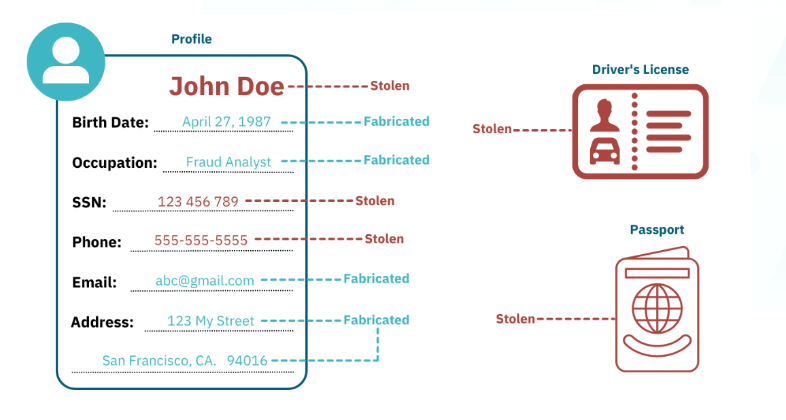
As newer tactics become more sophisticated, AML programs must adapt to counteract criminal activity through innovation.
The Future of AML in the Crypto Sector
Crypto is here to stay, and AML rules will continue to evolve by adopting technological innovation, enhancing international cooperation, and improving existing regulatory frameworks to find the ideal balance between privacy and transparency.
Tech-Enabled Compliance
One of the main targets for crypto AML will be in real-time, automated compliance mechanisms. Blockchain smart contracts can be programmed to enforce AML rules automatically. For example, they may be able to halt suspicious transactions or restrict access to certain wallets, all without any human intervention. Additionally, on-chain KYC tokens and decentralized identity protocols can already verify user IDs while preserving privacy.
Projects like Civic and Privado ID (built by Polygon) offer decentralized ID protocols. These tools let users share proof-of-identity without revealing sensitive data.
These tools can automate real-time compliance, reducing human errors and corruption.
International Collaboration
Crypto AML compliance cannot be addressed by one jurisdiction alone. The crypto market will see how regulators, law enforcement agencies, and crypto businesses are sharing intelligence.
Initiatives led by intergovernmental organizations like the FATF aim to create a globally coordinated approach to enforcement.
Regulatory Trends to Watch
Looking ahead, we should be ready for greater harmonization of AML rules at a global level. This will increase in response to high-profile crypto attacks and fraud.
Governments may adopt tougher penalties, demand real-time reporting, and expand AML oversight to new areas like DEXs and decentralized autonomous organizations (DAOs), which are community-driven entities powering DeFi projects. Some jurisdictions, such as certain U.S. states, already recognize DAOs as legal persons.
While these shifts may tighten operations, they are essential for making the crypto industry safer.
Crypto AML FAQ
What does AML mean in crypto?
Is crypto AML the same as traditional AML?
Who is responsible for AML compliance in crypto?
What is the Travel Rule and how does it apply to crypto?
Can DeFi protocols be AML compliant?
What are the penalties for failing to comply with crypto AML laws?
Can NFTs be used for money laundering?
How does AML compliance differ between centralized and decentralized platforms?
What KYC documents are typically requested in crypto?
References
- Ransomware Sending Exposure Chart (Chanalysis)
- FATF Member Countries Map (Wikipedia)
- MiCA Adoption Timeline (PwC)
- FATF Adoption (University of Cambridge)
- Cross-Border Permissioned DeFi Model (Boston Consulting Group)
- Synthetic ID Diagram (Unit 21)
2M+
250+
8
70







 in numbers