Explore CryptoSlate’s Institutional Playbook, a 3-part guide series on exchange due diligence, crypto-as-a-service, and token listing strategy for institutional teams.
The global financial markets are a complex web of interconnected factors, where even seemingly unrelated events can have profound implications for various asset classes, and one such connection is the relationship between the U.S. Treasury market, the Japanese yen, and Bitcoin.
In this report, CryptoSlate dives deep into the connection between the Japanese yen and U.S. Treasuries and its potential impact on Bitcoin.
Examining potential consequences for Bitcoin requires exploring the dollar-yen carry trade, a popular trading strategy that heavily influences the demand for U.S. Treasuries coming from Japan. By analyzing the effects of changes in interest rates and the overall market situation in Japan, we aim to shed light on how these factors can impact the demand for U.S. Treasuries and, subsequently, Bitcoin.
US Treasuries
U.S. Treasuries, issued by the U.S. Department of the Treasury, are debt securities that serve as a means for the U.S. government to finance its operations and fund various projects. Treasuries are considered one of the safest and most reliable investments in the global financial market, as they have historically proved stability, liquidity, and the backing of the U.S. government.
Investors value Treasuries as a haven during times of economic uncertainty or market volatility as they provide a relatively low-risk investment option.
The yield on U.S. Treasuries represents the return an investor can expect from holding these securities. Yields fluctuate based on supply and demand dynamics, prevailing economic conditions, and market sentiment.
A high yield indicates that investors are demanding a higher return for holding Treasuries, which typically corresponds to a perception of higher risk or uncertainty in the market. Conversely, a low yield suggests that investors are willing to accept lower returns, often indicating a flight to safety or a belief in the stability of the U.S. economy and government.
The concept of a yield curve is crucial when analyzing U.S. Treasuries. The yield curve illustrates the relationship between the interest rates of bonds with different maturities. It depicts the yields for short-term, medium-term, and long-term Treasuries.
A normal yield curve is upward-sloping, indicating that long-term Treasury bonds have higher yields than short-term ones. This pattern usually reflects expectations of economic growth, as investors demand higher compensation for lending money over longer periods.
Graph showing an example of a normal, upward-sloping yield curve (Source: Investopedia)
In contrast, an inverted yield curve occurs when short-term Treasury yields exceed long-term yields, often signaling expectations of an economic downturn or recession.
Graph showing the yield curve for U.S. Treasuries on June 16, 2023 (Source: U.S. Treasury Yield Curve)
US Treasuries and Bitcoin
As the U.S. Treasury yield plays a crucial role in shaping investor sentiment and market dynamics across all asset classes, yield fluctuations have historically impacted Bitcoin’s performance.
When Treasury yields rise, it often indicates an increase in borrowing costs, which can lead to a risk-off sentiment among investors. In theory, market participants tend to reallocate their investments from riskier assets, such as Bitcoin, to safer options like U.S. Treasuries.
Conversely, when Treasury yields decline, it can signal a decrease in borrowing costs, potentially prompting investors to seek higher returns in riskier assets, including Bitcoin.
Shifts in the yield curve can also affect Bitcoin. An inverted yield curve, where short-term yields surpass long-term yields, has historically indicated economic downturns and recessions. An impending recession should push market participants to reallocate their investments away from risky assets like Bitcoin, but this has not been the case.
While rising Treasury yields have correlated with a drop in Bitcoin’s price, the effects seem to have been short-lived. As the market reassesses its risk exposure, Bitcoin and its high returns seem to become an attractive long-term investment.
The dollar-yen carry trade
Carry trades are investment strategies that capitalize on interest rate differentials. Investors borrow funds in a currency with low interest rates and invest in a currency with higher interest rates, aiming to profit from the interest rate spread. They play an essential role in the global financial market, facilitating capital flows, promoting liquidity, and balancing interest rate differentials between currencies.
They contribute to efficient capital allocation and can provide stability to foreign exchange markets. Additionally, carry trades often involve large sums of money, influencing demand for various assets, including government bonds such as U.S. Treasuries.
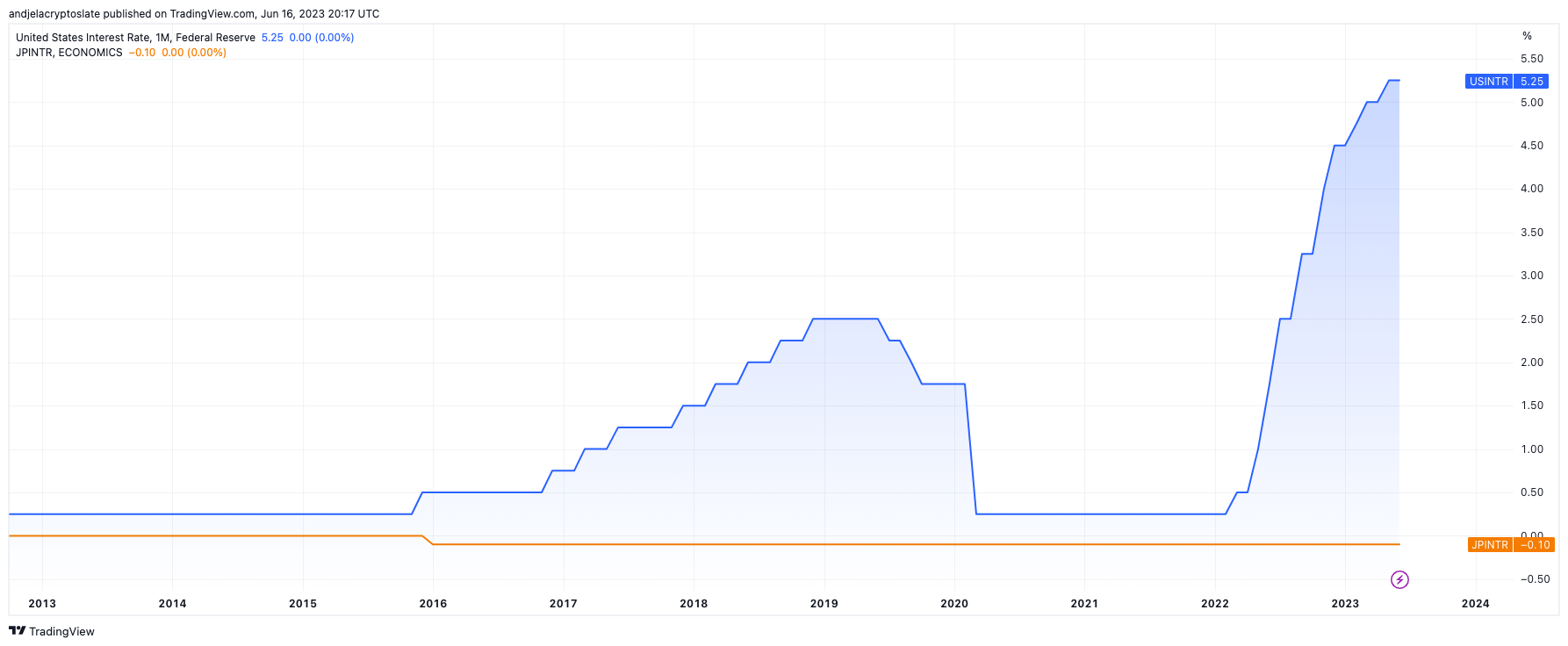
The dollar-yen carry trade has gained prominence as one of the most popular carry trades on the market. This popularity stems from the historically high divergence between interest rates for the yen and the U.S. dollar — Japan has maintained historically low to even negative interest rates, while the United States has typically offered higher interest rates.
Graph showing the interest rates in U.S. and Japan from 2013 to 2023 (Source: TradingView)
The dollar-yen carry trade has led to a high demand for U.S. Treasuries from Japan. Investors in Japan and those holding the yen have sought higher yields by investing in U.S. Treasuries due to the interest rate differential. And while determining the exact size of the carry trades between the dollar and the yen is challenging, the substantial discrepancy in interest rates indicates a significant portion of Treasury demand could be reliant on the low rates in Japan.
Currently in Japan
Japan is grappling with various economic challenges, including higher-than-expected inflation and slow economic growth.
The Bank of Japan (BOJ) has been striving to achieve its inflation target of 2%, but progress has been slow. Core inflation has remained above the 2% target for 13 consecutive months, creating an environment where the central bank must continue implementing measures to combat inflationary pressures.
The BOJ has opted to maintain ultra-low rates to stimulate borrowing and spending. The most recent central bank meeting, held on June 16, ended without any changes to existing policy.
However, the bank said there could be “potential surprises in the future” regarding its Yield Curve Control (YCC) policy. The BOJ implemented the monetary policy framework to control the yield curve of Japanese government bonds. It involves targeting a specific yield range on 10-year government bonds to maintain stability in long-term interest rates — ranging from 0.25% to 0.50%.
Graph showing the 10-year government bond yield and CPI in Japan from 2013 to 2023 (Source: Reuters)
The tight control over government bond yields has pushed many Japanese banks and companies into overseas bonds, particularly U.S. Treasuries. Low yields and a risk of a significant bond sell-off in case the BOJ lowers interest rates even further have made investing in Japan largely unattractive.
But, if the BOJ widens the YCC range to 1%, the market could see insurance and pension funds jump into government bonds.
This could have significant implications for the dollar-yen carry trade. A rise in interest rates could make the yen a less attractive currency for borrowing, potentially increasing the cost of the dollar-yen carry trade and lowering its profitability. It could lead to
A lower demand for Treasuries coming from Japan and investors holding the yen could put upward pressure on yields, further steepening the yield curve and causing market instability.
Conclusion
Bitcoin and the Japanese yen share an interconnected relationship that goes beyond the BTC/JPY spot price.
Bitcoin’s sensitivity to the Treasury market means that all factors affecting U.S. government bonds indirectly affect its price.
Changes in U.S. Treasury yields resulting from higher interest rates and a looser YCC policy in Japan could potentially affect Bitcoin. Rising Treasury yields could reduce demand for riskier assets, potentially diverting institutional and large investors away from Bitcoin.
However, a further decline in Treasury yields due to reduced demand from Japanese investors may create conditions that favor Bitcoin.
Bitcoin’s decentralized nature can appeal to investors who value greater autonomy and seek protection against potential risks associated with centralized financial systems. Its limited supply makes it a good hedge against inflation and a store of value, especially when fiat currencies experience significant fluctuations. This can further attract investors looking to diversify their portfolios and hedge against the traditional financial system.
















:max_bytes(150000):strip_icc():format(webp)/YieldCurve2-362f5c4053d34d7397fa925c602f1d15.png)