
Project Overview
Introduction
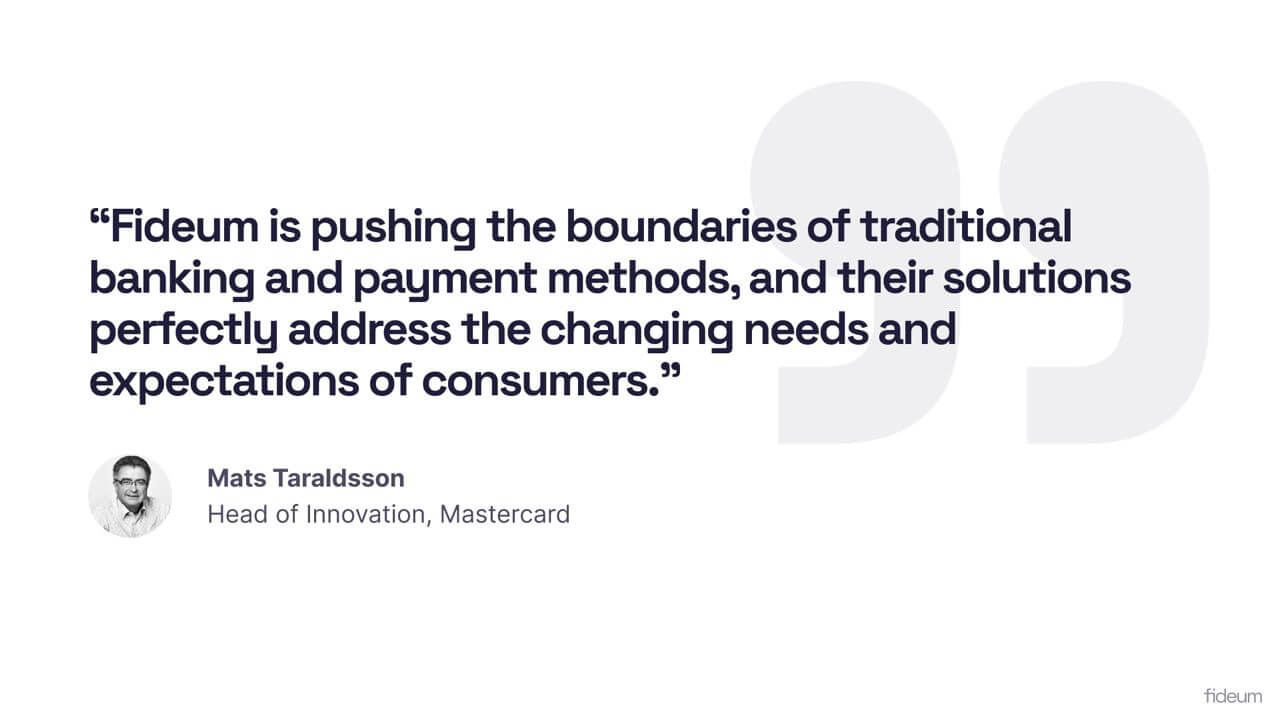
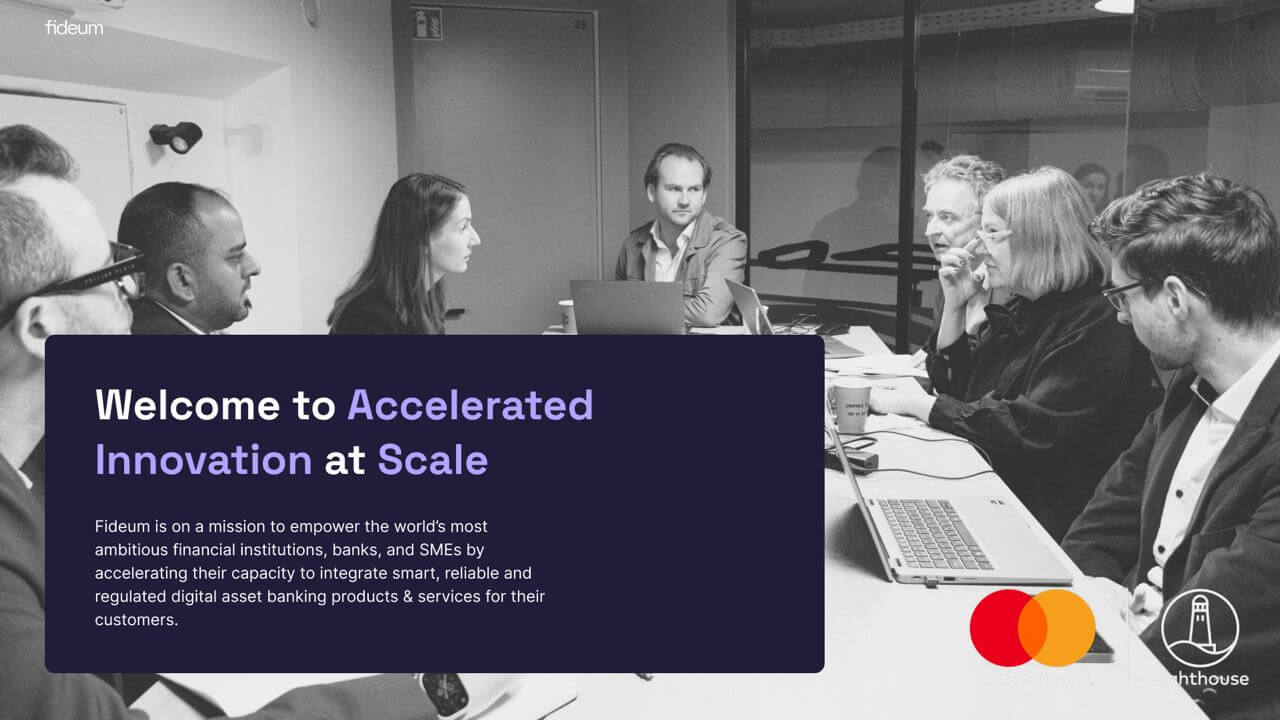
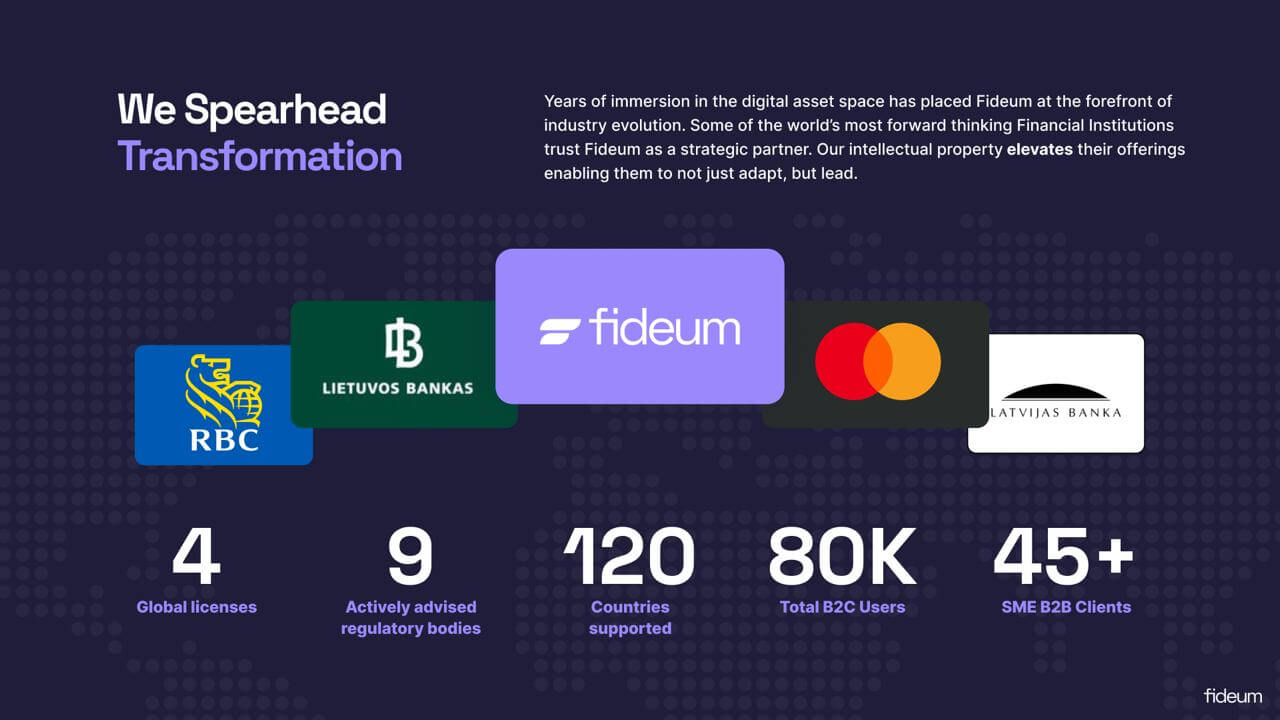
Fideum is a fintech company focused on accelerating the digital transformation of financial institutions, banks, and small—to medium-sized enterprises (SMEs) through its eponymous blockchain infrastructure. With the strategic backing of Mastercard Europe and a recent win at the Mastercard Lighthouse program, Fideum aims to position itself as a reliable partner for entities seeking to delve into and capitalize on digital assets.
Founded in 2018, the project initially made waves with its non-custodial mobile wallets, amassing a user base of over 80,000.
In response to the 2022 bear market, Fideum pivoted towards serving institutional clients, developing white-label solutions that cater to high-net-worth individuals and larger entities. This shift, leveraging existing infrastructure, led to profitability by 2023 and cemented Fideum’s position as a fintech innovator, continually adapting to market needs and regulatory landscapes.
This report delves into Fideum’s market, technology, tokenomics, team, partnerships, audits, roadmap, and the risks and opportunities it faces.
Market Landscape
Market
Fideum operates at the intersection of traditional finance (TradFi) and DeFi, focusing on providing tools for financial institutions’ digital transformation.
The integration of TradFi and DeFi creates a more interconnected and versatile financial landscape. This integration is expected to drive significant growth in both sectors, with DeFi continuing to expand rapidly. As of 2024, the total value locked (TVL) in DeFi protocols exceeds $100 billion, highlighting the immense potential for digital financial services.
In the TradFi market, financial giants such as JPMorgan and Goldman Sachs have been the dominant players for decades, providing a range of financial and technical services. However, the rise of fintech companies coming from the Web3 industry is challenging these traditional models by offering more agile, tech-driven solutions. In the DeFi market, protocols such as Aave, Compound, and Uniswap have set benchmarks for innovation and efficiency. Fideum differentiates itself from the rest of these companies by bridging the gap between TradFi and DeFi, providing institutions with regulatory-compliant blockchain solutions that leverage the strengths of both ecosystems.
Its addressable market ranges from financial institutions, banks, and SMEs to individual investors seeking secure, compliant digital asset solutions. Its blockchain infrastructure was designed to support a wide range of applications, from trading and custody to remittance and staking. If blockchain technology continues to penetrate the traditional market at this rate, we can expect the demand for such integrated solutions to grow. This presents a significant opportunity for Fideum to expand its market presence.

Technical Architecture
Technology
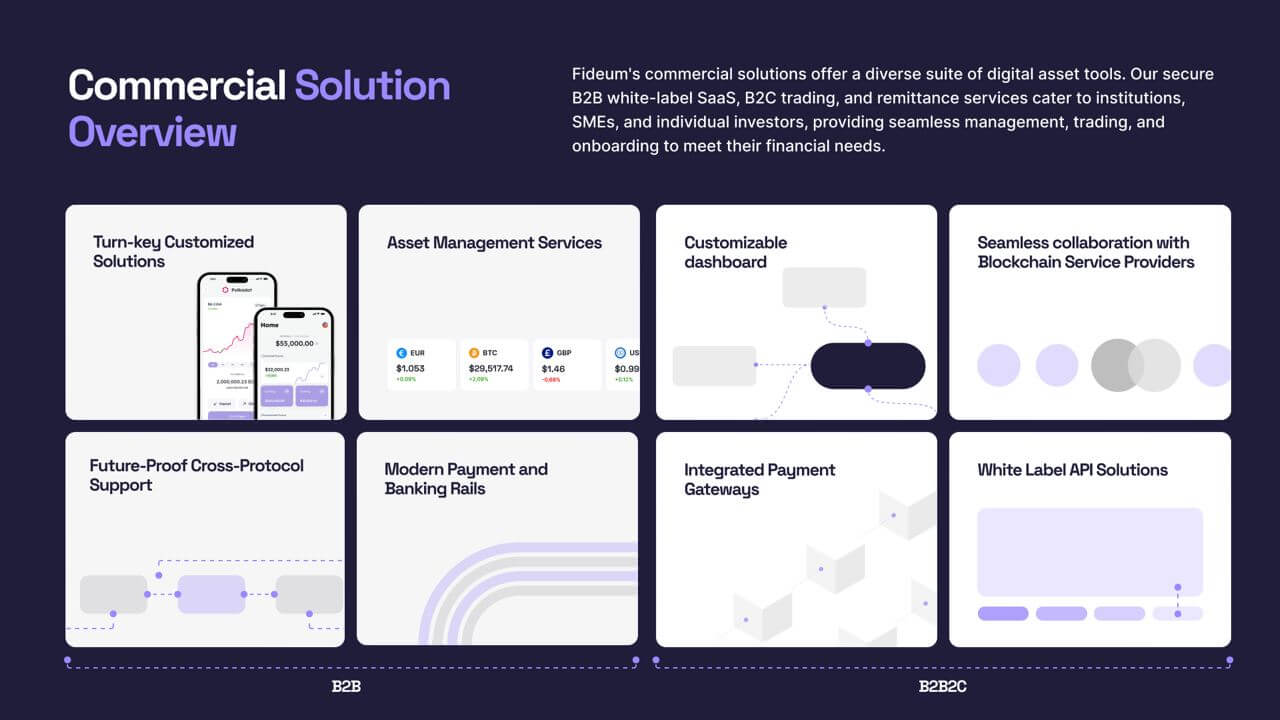
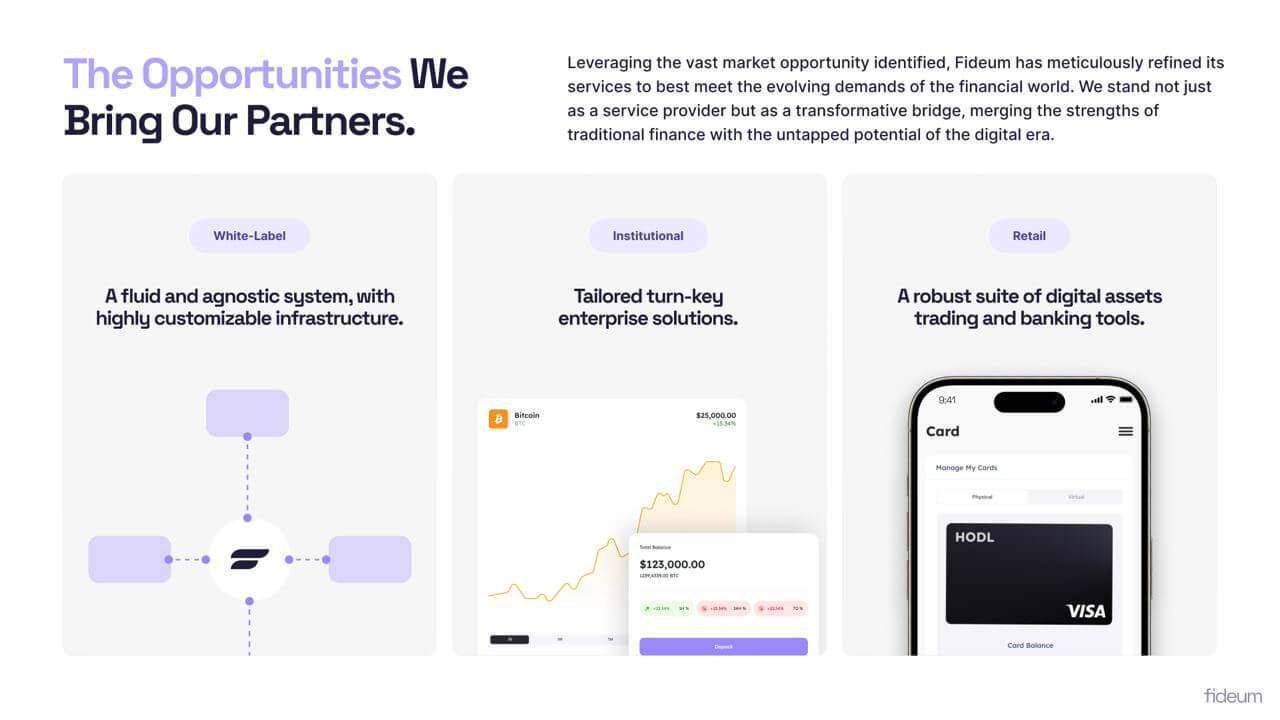
Fideum’s tech foundation is built on a scalable blockchain infrastructure designed to meet the diverse needs of financial institutions, banks, SMEs, and individual investors. The platform blends both B2C and B2B services, underpinned by a turn-key, regulatory-compliant blockchain architecture. The architecture and technology stack emphasize performance, scalability, and maintainability, relying on established frameworks and best practices from the industry.
The platform offers a suite of crypto trading and banking tools that make dealing with digital assets accessible and intuitive. The platform aims to achieve versatility by supporting various financial activities, including banking, custody, trading, staking, and remittance.
- Banking and custody: Fideum streamlines business transactions by offering versatile currency support, tailored setups, secure vault storage, and full reserve banking. These features enable institutions to operate across global markets while maintaining security standards.
- Trading: The platform enhances institutional trading capabilities with features that include OTC trading, a broad range of assets, real-time execution, and a 24/7 white glove service.
- End-to-end staking: Fideum also offers staking solutions, allowing users to earn rewards and plan for asset growth. The platform supports flexible staking options and node validators.
- Remittance solutions: Fideum facilitates global transfers by offering global cross-border transfers and secure vault storage.
Technical specifications:
Fideum’s technical stack is designed to provide security and scalability. The platform has a microservice architecture that ensures flexibility and modularity, allowing for various services to be incorporated seamlessly.
- Backend technologies: The core backend is developed using Java OpenJDK 17, with Spring Boot and Hibernate to streamline development and manage database interactions.
- Frontend technologies: The web and mobile user interfaces are built using React and Expo, with Firebase providing real-time database and authentication services. TypeScript enhances code quality and maintainability.
- Blockchain infrastructure: The platform supports ERC20, BEP20, and TRC20 standards, ensuring compatibility with major blockchain networks such as Ethereum, BNB Chain, and Tron.
- Smart contracts: The use of smart contracts automates transactions and agreements, reducing the need for intermediaries and enhancing efficiency.
- On-chain monitoring solutions: Fideum provides real-time insights into blockchain transactions and activities, allowing for proactive monitoring of suspicious activities.
- Database management: PostgreSQL is used for data storage and management.
- Additional technologies: Kafka is used for real-time data processing, and Minio provides scalable storage for unstructured data.
Token Model
Tokenomics
Fideum’s tokenomics are designed to incentivize and reward user engagement within its ecosystem. The FI token plays a central role in the platform, serving multiple purposes, from loyalty and rewards to access to exclusive services.
The token is aimed mainly at Fideum’s retail user base. It enables users to earn additional tokens through staking, card cashback rewards, and participating in the Fideum launchpad. Staking FI allows users to receive allocations in new token launches. The company has focused on backing FI’s token structure and utility with a comprehensive legal opinion to ensure regulatory compliance.
The token is available on Ethereum and BNB Chain and supports ERC20 and BEP20 standards. It has a total supply of 4 billion tokens. The company chose to cap the supply at 4 billion because it believes it’s ideal to sustain the expanding ecosystem without diminishing value.
Leadership & Backing
Team & Investors
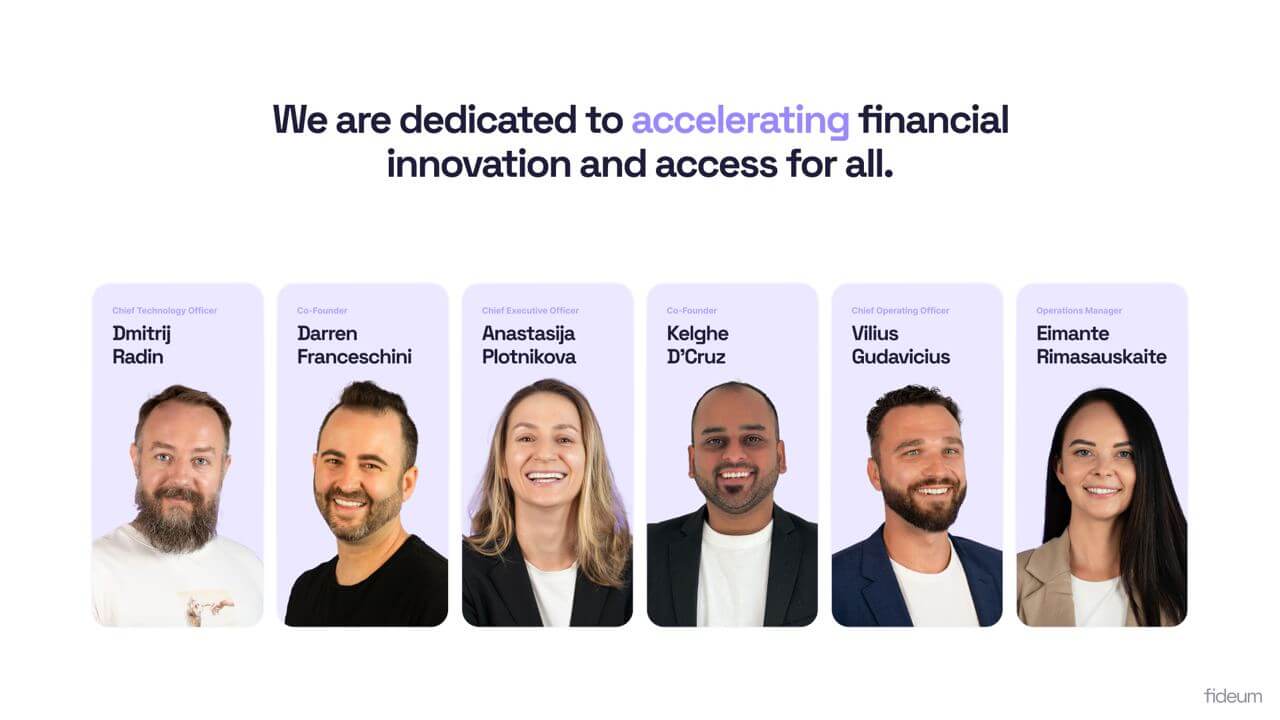
Fideum was created and is led by a team of professionals with experience in blockchain technology, finance, and business development.
Core team:
- Anastasija Plotnikova (Co-Founder and CEO): Anastasija’s career began in European Union law enforcement, where she focused on regulatory compliance. She applied this experience to the private sector as a COO of a Canadian company leading blockchain and AI projects. At Fideum, she focuses on fusing tradfi mechanisms with blockchain technologies. She is a foundational member of AAVE, one of the leading DEXs on the market. Anastasija has also been inducted into the Crypto Economy Organization, a government-supported association committed to fostering the growth and regulation of the crypto economy. The organization collaborates with key industry players such as Chainalysis and Binance, representing the interests of crypto professionals and Web3 companies. This is set to enhance Fideum’s role in the global crypto market and enable the company to be at the forefront of discussions that shape the future of crypto regulation and innovations.
- Darren Franceschini (Co-Founder and Director of Blockchain Strategy): Since 2013, Darren has been involved in mining, trading, and launching his own crypto projects. He has collaborated with over 100 ventures through strategic market entry, branding, and technical applications. Darren frequently speaks at major blockchain conferences and contributes to leading crypto exchanges and ATM companies.
- Kelghe D’Cruz (Co-Founder & Director of Business Growth): Kelghe has previously founded a leading online nursing education platform and established a blockchain mining operation. At Fideum, Kelghe drives growth through strategic partnerships, enhancing the firm’s capability to integrate digital and traditional financial systems.
- Dmitrij Radin (Chief Technology Officer): Dmitrij’s expertise in machine learning and blockchain technology brings the latest tech innovations to Fideum’s banking partners, promising efficiency and security.
- Eimante Rimasauskaite (Operations Manager): Eimante brings over nine years of experience in operations and compliance within the banking and fintech sectors, including roles at Western Union, Danske Bank, Intrum, Revolut, and Lindstrom.
- Vilius Gudavicius (Chief Operating Officer): Vilius has over a decade of high-level business management experience in some of Europe’s highest-ranking companies. He has a proven sales, marketing, mergers and acquisitions, and process optimization track record.
Ecosystem Alliances
Partnerships
Since its launch, the company has been backed by notable investors and strategic partners.
Mastercard Europe: Fideum’s credibility and potential for growth were enhanced through its recent partnership with Mastercard. The company won the Mastercard Lighthouse FINITIV Program Grand Finale at Slush 2023, opening doors to collaborating with other financial companies. The award enabled Fideum to partner with leading banks such as SEB and Danske Bank.

Extensive banking relationships: Fideum has established a network of banking relationships to support its operations and ensure seamless payment processing. These partnerships include Bankera, AlphaPay, ClearJunction, AlchemyPay, and LPB Bank.
Security Posture
Audits & Security
Fideum’s development process focused on providing security and compliance. The platform has undergone various third-party audits to ensure its reliability.
- Compliance with regulatory standards: Fideum operates within the Markets in Crypto-Assets (MiCA) framework, an EU regulatory standard that ensures consumer protection and market integrity.
- Licenses: Fideum holds multiple licenses, including Virtual Asset Service Provider (VASP) licenses in Lithuania, Canada, Australia, and El Salvador.
- Infrastructure and security: Fideum’s infrastructure is built on AWS, leveraging services like Amazon EKS for container management, RDS for database services, and S3 for object storage. Security measures include VPC for network isolation, KMS for encryption key management, and CloudWatch for monitoring and logging.
Fideum’s infrastructure is built on AWS, leveraging various services to ensure scalability, reliability, and security. All services are hosted in Europe, more specifically in Frankfurt, Germany.
Fideum has prioritized security and regulatory compliance through its development process. The company has implemented various security measures and undergone audits to safeguard its operations and user assets.
Security
Aside from the third-party audits mentioned earlier, one of the ways Fideum enhances security is through continuous monitoring and updates. The company employs proprietary monitoring tools to assess the security of its platform. These tools provide real-time insights into blockchain transactions and activities, enabling quick identification and mitigation of any potential security threats. It also regularly introduces updates and improvements to address vulnerabilities and ensure the platform remains secure.
Execution Timeline
Product Roadmap
Fideum has a clear and ambitious roadmap that reflects its commitment to innovation, regulatory compliance, and user engagement.
- Q1 2024: Fideum implemented enhanced security measures, streamlined transactions in EUR, and integrated Apple Pay. It expanded its marketing efforts through enhanced brand positioning and participation in Token 2049 and DAF London.
- Q2 2024: Fideum has already launched a V4 update and introduced a complete website redesign. By the end of June, the company will have participated in Consensus Austin, prepared to obtain EMI licenses, and launched multi-channel user acquisition campaigns.
- Q3 2024: Fideum will release its Launchpad and engage in a marketing campaign to increase engagement. By the end of the quarter, the company should obtain EMI licenses, launch the Fideum EVM, and complete its launch on Solana.
- Q4 2024: The company will launch various customer success initiatives and marketing campaigns for new regions. By the end of the year, a new round of asset listings and a regulatory and compliance check-in are also expected.
- Q1 & Q2 2025: In 2025, Fideum plans to expand to new regions, with services launched in the US, Latin America, India, the UAE, and ASEAN markets. New asset listings and the implementation of advanced analytics are also planned in the first half of the year.
Risk-Reward Outlook
Risks & Opportunities
Despite its focus on security and regulatory compliance, Fideum still faces many risks as it navigates the rapidly evolving fintech landscape. Understanding these factors and their opportunities is crucial for assessing the project’s potential for success.
Risks:
- Regulatory uncertainty: Changes in regulations could impact Fideum’s operations and require adjustment to ensure compliance. This could prove especially tricky if Fideum begins expansion in several markets at the same time, as the time and resources needed to comply could strain the company and hinder its growth not just in those markets but globally as well.
- Technological challenges: The rapid pace of development in the blockchain space presents both opportunities and challenges. Sitting at a crossroads between traditional and decentralized finance, Fideum could find it hard to keep up with the Web3 tempo while ensuring it’s compliant in its tradfi segment.
- Dependency on third-party services: Fideum’s reliance on third-party services such as decentralized oracles, blockchain networks, and auditing companies could introduce potential service availability and reliability risks. Internal issues on particular blockchain networks could also cause the company to lose some users.
- Market competition: The FinTech and Defi sectors are highly competitive, with numerous projects competing for market share. To position itself as a leader in the space, the company will have to differentiate itself to maintain its competitive edge.
Opportunities:
- Market Growth: The convergence of TradFi and DeFi presents significant growth opportunities. As financial institutions increasingly adopt blockchain technology, Fideum could be well-positioned to capitalize on this trend.
- Innovation and Expansion: Fideum’s commitment to innovation and technological foundation enables it to expand its offerings and enter new markets. Integration with additional blockchain networks and the development of new financial products are key areas for growth.
- Strategic Partnerships: Collaborations with major financial institutions, technology providers, and fintech startups could enhance Fideum’s capabilities and market reach. These partnerships could provide opportunities for joint innovation and the development of integrated financial solutions.
- User and Community Engagement: Fideum’s focus on user engagement and community-driven initiatives fosters an active user base. This engagement provides valuable feedback for improvement and helps build a strong community around the platform.
Final Take
Conclusion
Fideum is positioning itself at the forefront of the financial sector’s digital transformation, offering blockchain infrastructure designed to meet the diverse needs of financial institutions, banks, SMEs, and individual investors. The company’s strategic shift to serving institutional clients and its focus on regulatory compliance, security, and innovation have the potential to position it as a leader in the fintech space.
Fideum is developing an EVM that aims to address some of the core challenges faced by traditional systems, including double-spending and regulatory compliance. Its multi-nodal network will be equipped with Zero Knowledge ID proofs to ensure transaction security and anonymity.
Fideum’s approach will integrate a compliant framework that adheres to regulatory standards such as those outlined in the Markets in Crypto-Assets (MiCA) framework. This blockchain solution will be built to tackle high transaction fees, enhance cross-chain interoperability, and address scalability issues that fragment user experience and hinder innovation. Fideum is moving away from traditional grant models and is instead opting for a Proof-of-Participation system that actively engages with and rewards network participants.
The company’s robust technological foundation, including its versatile platform, advanced security measures, and compliance with regulatory standards, will ensure its offering is trustworthy and reliable. The strategic partnerships it established with major financial institutions enhance its capabilities and enable it to achieve a wider market reach. The tokenomics behind its proprietary FI token were designed to incentivize user engagement without compromising the ecosystem’s long-term sustainability. The combination of staking rewards and cashback incentives further adds to the resilience of the economic model.
While Fideum faces risks related to regulatory uncertainty, market competition, and technological challenges, the opportunities for growth and innovation are significant. By leveraging its strengths and addressing potential risks, Fideum is well-positioned to drive the financial sector’s digital transformation and achieve long-term success.