An intro to Bitcoin mining fundamentals
CryptoSlate's latest market report dives deep into key quantitative metrics that show the operational and economic conditions of Bitcoin mining.


Introduction
Bitcoin mining is the backbone of the Bitcoin network. It secures the blockchain by validating transactions and maintaining consensus across the decentralized network. Miners use computational power to solve complex mathematical problems, earning block rewards and transaction fees in return. This process not only introduces new bitcoins into circulation but also ensures the integrity and security of the network.
The significance of mining extends beyond mere coin generation. It plays a crucial role in the overall health and sustainability of the Bitcoin ecosystem. Understanding miner fundamentals is important for grasping the underlying forces that drive the market. Miner fundamentals refer to key quantitative metrics that reflect the operational and economic conditions of Bitcoin mining. These metrics include the hash rate, mining difficulty, hash ribbons, and miner revenue.
In this report, CryptoSlate examines these fundamentals in depth, analyzing each metric. Understanding these metrics allows us to predict market trends, assess the network’s security, and understand miners’ behavior.
Hash rate and hash ribbons
Hash rate
Hash rate represents the total computational power used to mine and process transactions on the blockchain. Measured in hashes per second (H/s), it indicates how many calculations miners perform every second. A higher hash rate means more computational power is being contributed to the network, enhancing its security and robustness.
The hash rate is significant because it is directly related to network security. A higher hash rate makes it more difficult for any single entity to control over 50% of the network’s mining power, thereby preventing double-spending attacks. Furthermore, the hash rate serves as an indicator of miners’ confidence and investment in the network. A rising hash rate suggests that miners are optimistic about the future profitability of Bitcoin mining, leading them to invest in more powerful hardware and expand their operations.
Hash rate trends significantly impact Bitcoin’s price and network stability. A rising hash rate typically indicates increasing miner participation and investment, which can boost market confidence and, consequently, the Bitcoin price. Conversely, a declining hash rate may signal miner attrition and reduced confidence, potentially leading to price volatility.

Since the beginning of the year, the Bitcoin network’s hash rate has experienced notable fluctuations. At the start of the year, it was approximately 600 exahashes per second (EH/s). It increased to around 720 EH/s by mid-February, reflecting miner confidence and technological upgrades. It dropped significantly in mid-April as the market was gearing up for the upcoming halving.
Despite regulatory challenges and the impact of the halving, the hash rate has been trending upward this year.
Hash ribbons
Hash ribbons are a technical indicator used to identify miner capitulation and recovery periods. This metric is derived from the hash rate’s 30-day and 60-day moving averages. Miner capitulation occurs when mining becomes unprofitable, leading some miners to shut down operations. This causes a drop in the hash rate, which can signal a market bottom.
The hash ribbons for this year highlight distinct phases of miner capitulation and recovery. At the start of the year, the hash ribbons indicated a period of miner stability, with the 30-day and 60-day moving averages closely aligned. However, in mid-April, a significant dip in the hash rate led to a period of miner capitulation, marked by the red-shaded area in the graph below.
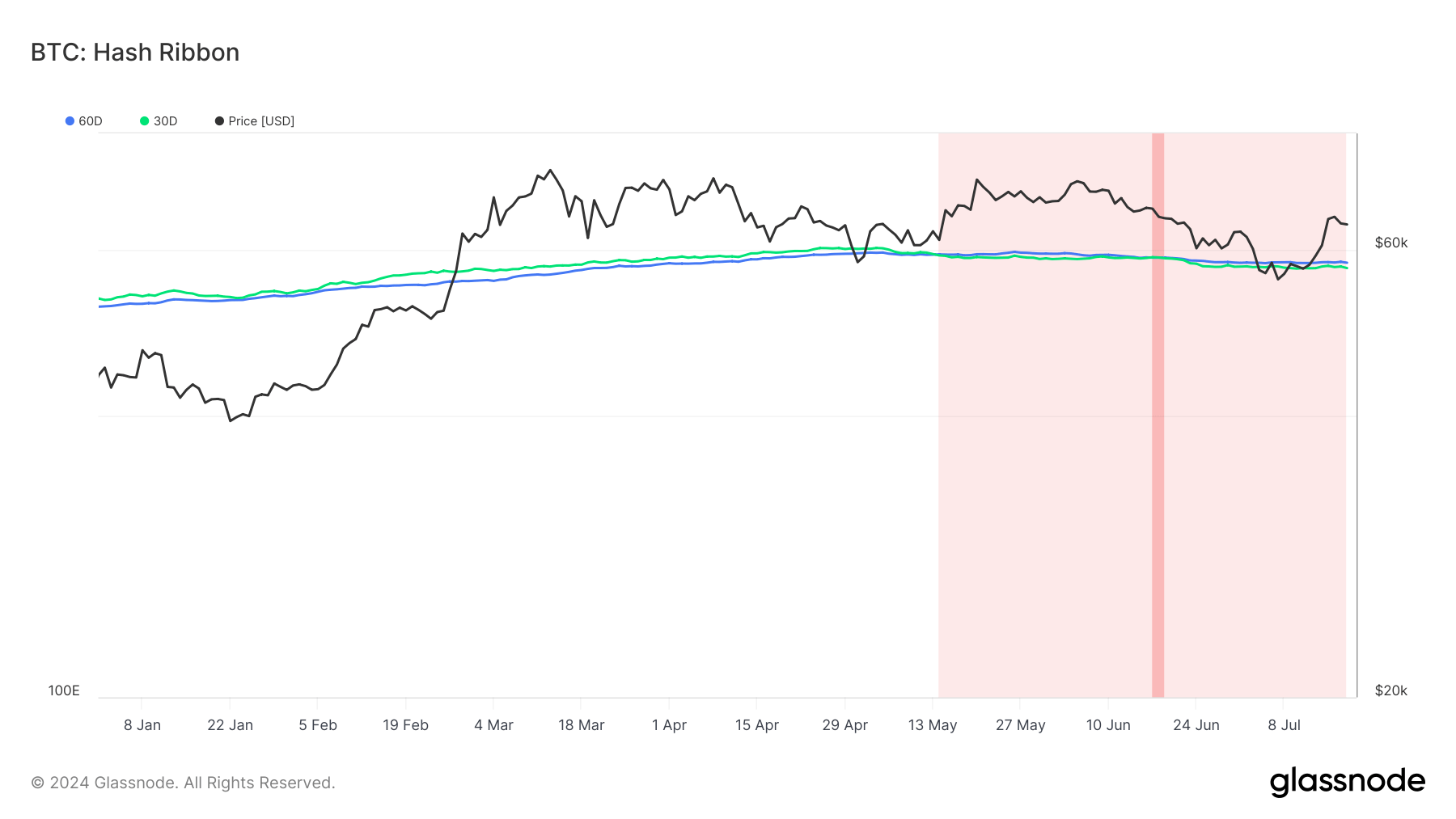
The Bitcoin halving event had a significant impact on the hash ribbons. The reduction in block rewards prompted some miners to temporarily cease operations due to lower profitability, resulting in a dip in the hash rate. As the hash rate began to recover in May, the 30-day moving average crossed above the 60-day moving average, signaling the end of miner capitulation and the start of a recovery phase. This pattern correlates with Bitcoin’s price movements, reaffirming the predictive value of hash ribbons.
The hash ribbons’ recent recovery phase suggests a strengthening miner confidence and potential bullish market trends.
Mining difficulty
Mining difficulty measures how hard it is to mine a new block. It is adjusted approximately every two weeks (or every 2016 block) to ensure that blocks are produced at a consistent rate of one block every ten minutes, regardless of the network’s total hash rate. This automatic adjustment mechanism maintains the network’s predictability and stability.
Mining difficulty adjusts based on changes in the hash rate. When more computational power is added to the network, the difficulty increases to maintain the ten-minute block production target. Conversely, if miners exit the network and the hash rate drops, the difficulty decreases, making mining less challenging and ensuring that blocks continue to be mined steadily.
Mining difficulty helps balance the block production rate, ensuring a predictable supply of new bitcoins. This predictability is essential for maintaining network security and user trust. Additionally, mining difficulty serves as an indicator of network health and miner competition. High difficulty levels suggest a robust and competitive mining environment, which enhances the network’s security by making it harder for any single entity to control most of the hash rate.
The halving event, which reduced the block reward from 6.25 BTC to 3.125 BTC, temporarily dropped the hash rate as miners adjusted to the decreased rewards. Consequently, the difficulty experienced a significant adjustment, decreasing by about 6% in May, one of the most substantial declines since the FTX collapse. This adjustment was necessary to maintain the block production rate amid the reduced hash rate.
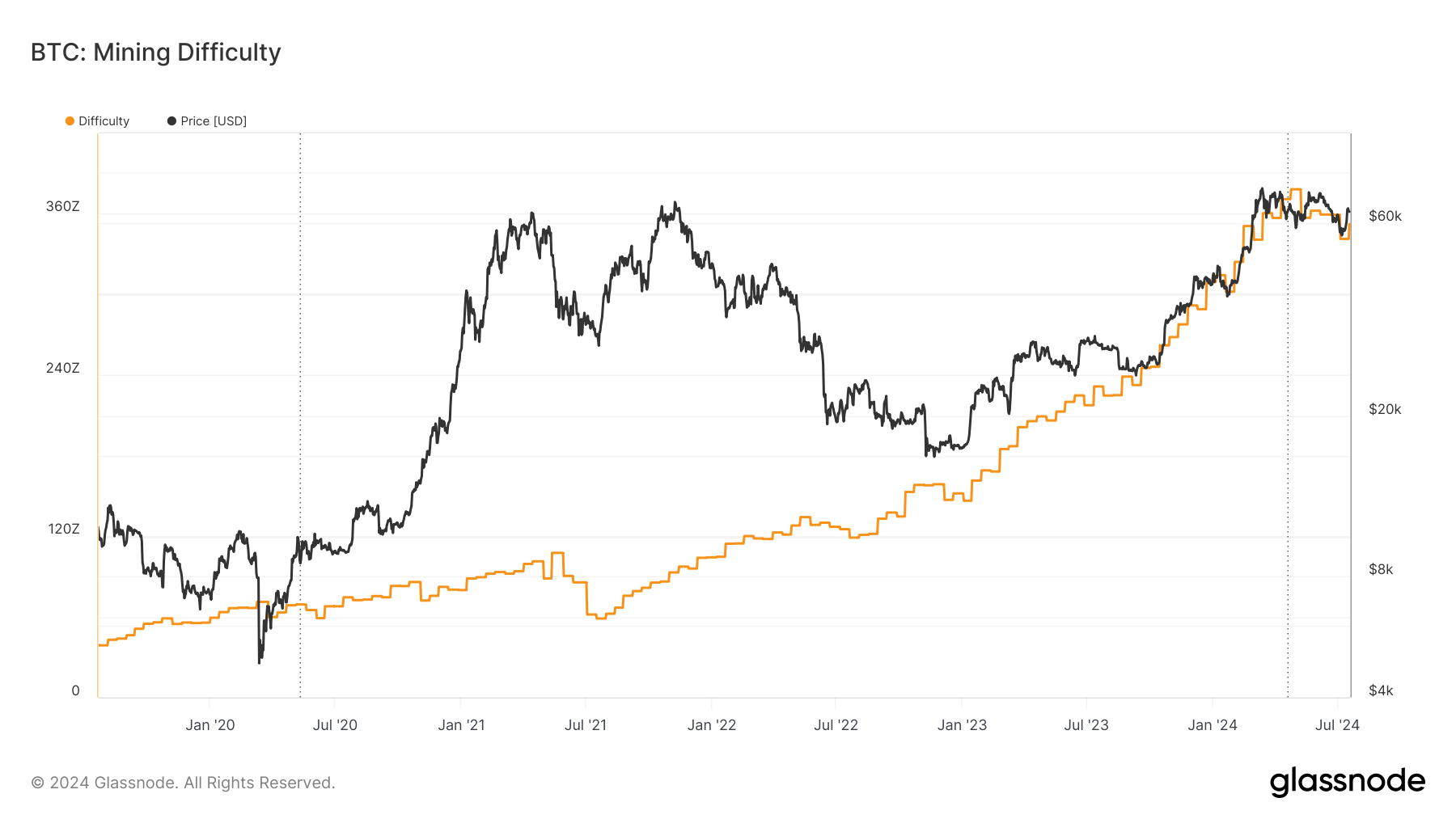
Over the next few months, the difficulty continued to fluctuate in response to changes in the hash rate. Another negative adjustment occurred in June, followed by a recovery period as miners adapted to the new economic conditions post-halving. By July, the difficulty had stabilized around 38 trillion, reflecting the network’s resilience and the miners’ ability to adapt to new challenges.
Mining difficulty directly impacts miner operations and profitability. Higher difficulty levels mean miners need more computational power (and thus higher operational costs) to achieve the same rewards. This can squeeze profit margins, especially for smaller or less efficient mining operations. Conversely, lower difficulty levels can improve profitability by making it easier to mine new blocks with less computational power.
The relationship between mining difficulty and Bitcoin’s price stability is also significant. When the difficulty rises, it can indicate increased confidence and investment in the network, often correlating with rising Bitcoin prices. Conversely, sharp decreases in difficulty may signal miner capitulation and can precede periods of price volatility.
Revenue
There are two primary components of miner revenue: block rewards and transaction fees. Block rewards are the new bitcoins generated and awarded to miners for adding a new block to the blockchain. Initially set at 50 BTC per block, block rewards undergo halving approximately every four years, reducing the reward by 50%. The most recent halving on April 20, 2024, reduced the reward from 6.25 BTC to 3.125 BTC per block. On the other hand, transaction fees are paid by users to include their transactions in a block. These fees vary based on network congestion and the urgency of the transaction.
Several factors influence miner revenue, including the price of Bitcoin, the total volume of transactions, and network congestion. A higher Bitcoin price generally increases miner revenue as the value of the block rewards and transaction fees rises in fiat terms. Similarly, increased transaction volume and congestion lead to higher transaction fees, boosting miner revenue.
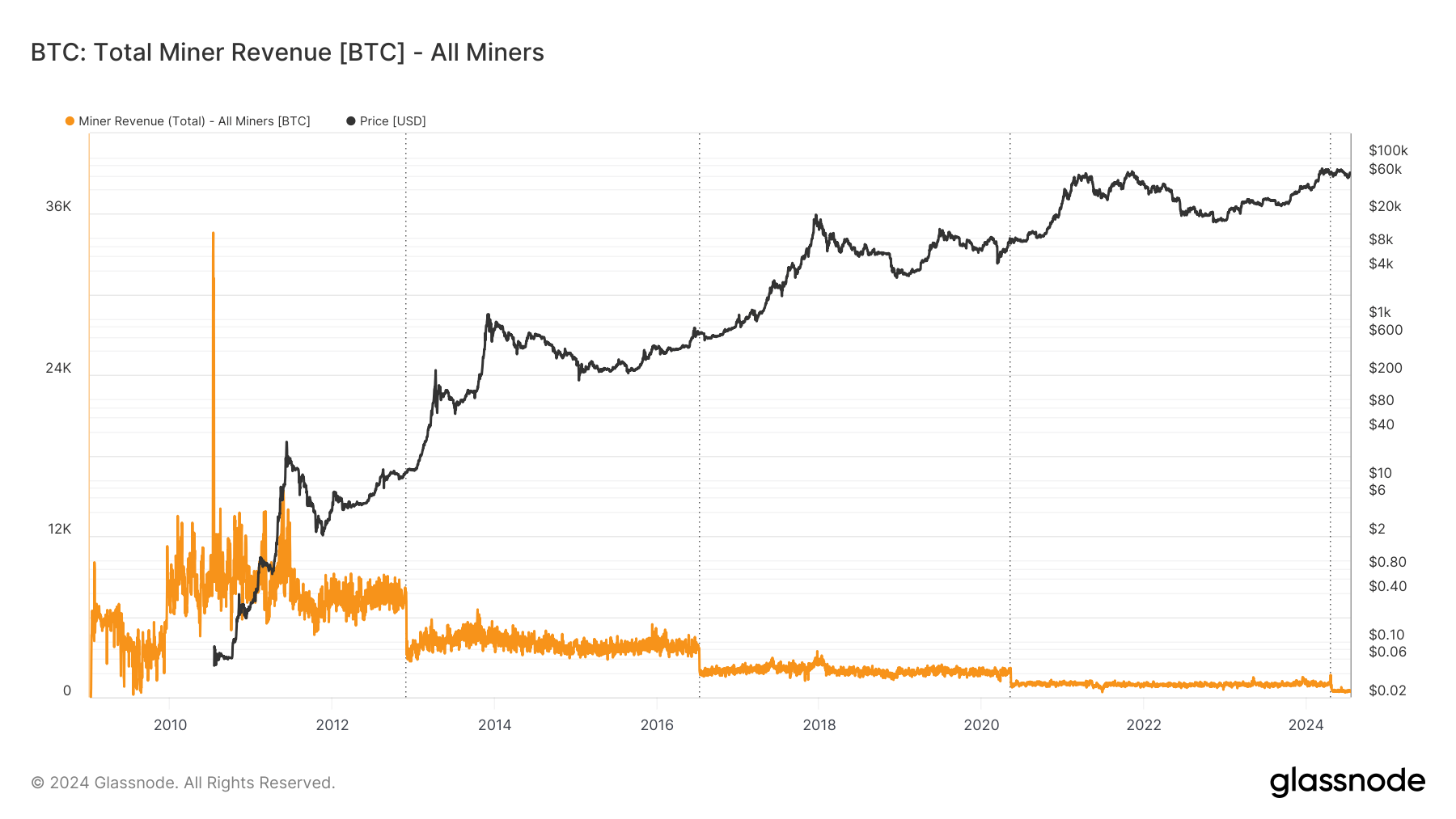
High revenue periods encourage miners to invest in new hardware and expand operations. In contrast, low revenue periods can lead to miner capitulation, where miners shut down their rigs due to unprofitability. Miner revenue also impacts network security, as higher profitability attracts more computational power to the network, enhancing its security.
Historically, block rewards have been the primary source of miner revenue. However, as block rewards decrease with each halving, transaction fees are expected to play a more critical role.
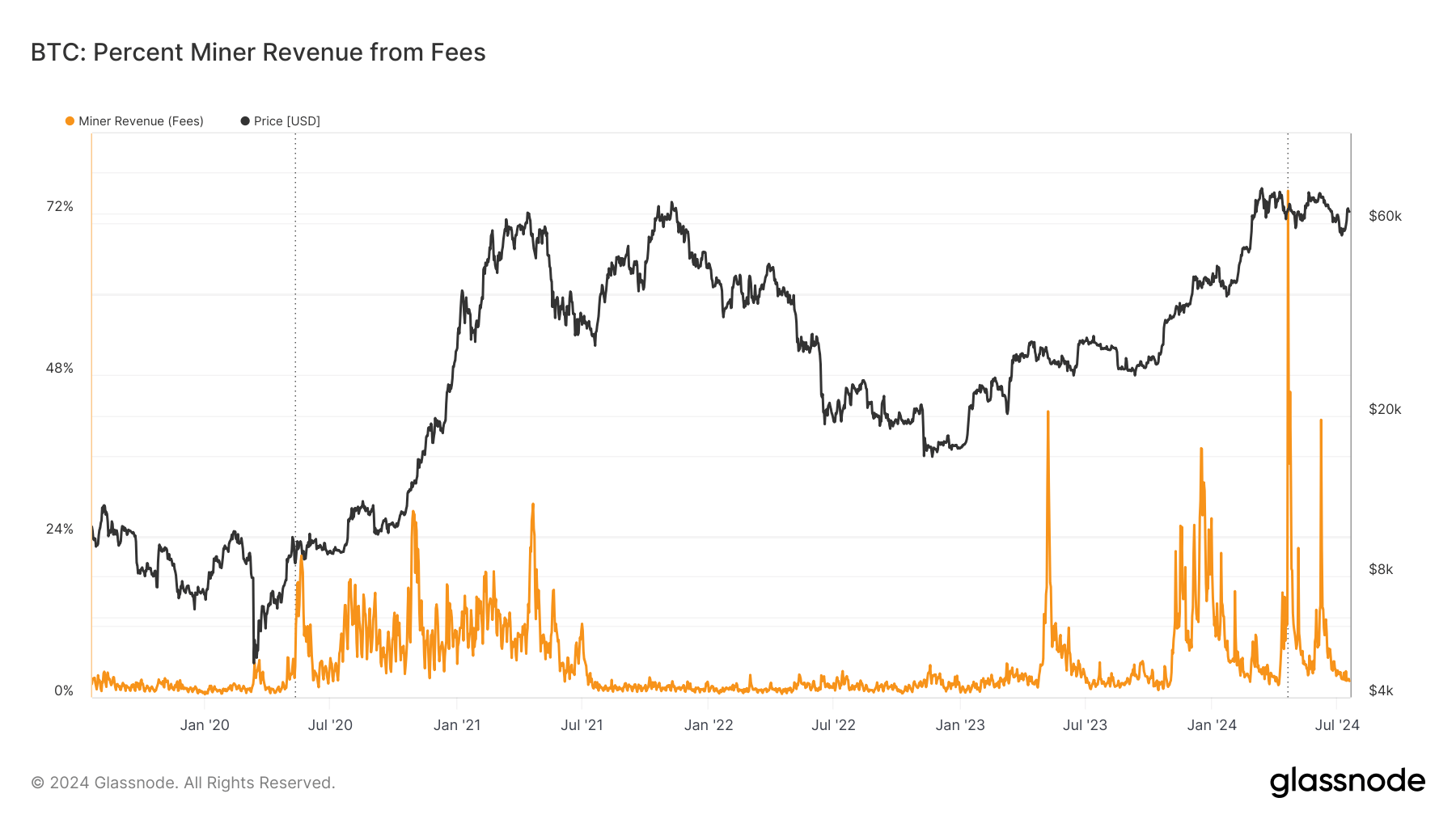
The shift from block rewards to transaction fees has profound implications for miner behavior and network security. Miners are incentivized to prioritize transactions with higher fees, potentially leading to longer confirmation times for transactions with lower fees. This shift also encourages miners to optimize their operations to maximize fee revenue, using more efficient mining hardware and strategies to reduce operational costs.
In the long term, the decreasing block rewards highlight the importance of a healthy transaction fee market to sustain miner profitability and network security. As block rewards diminish, a robust fee market is essential to ensure that miners remain incentivized to contribute computational power to the network, maintaining its security and stability.
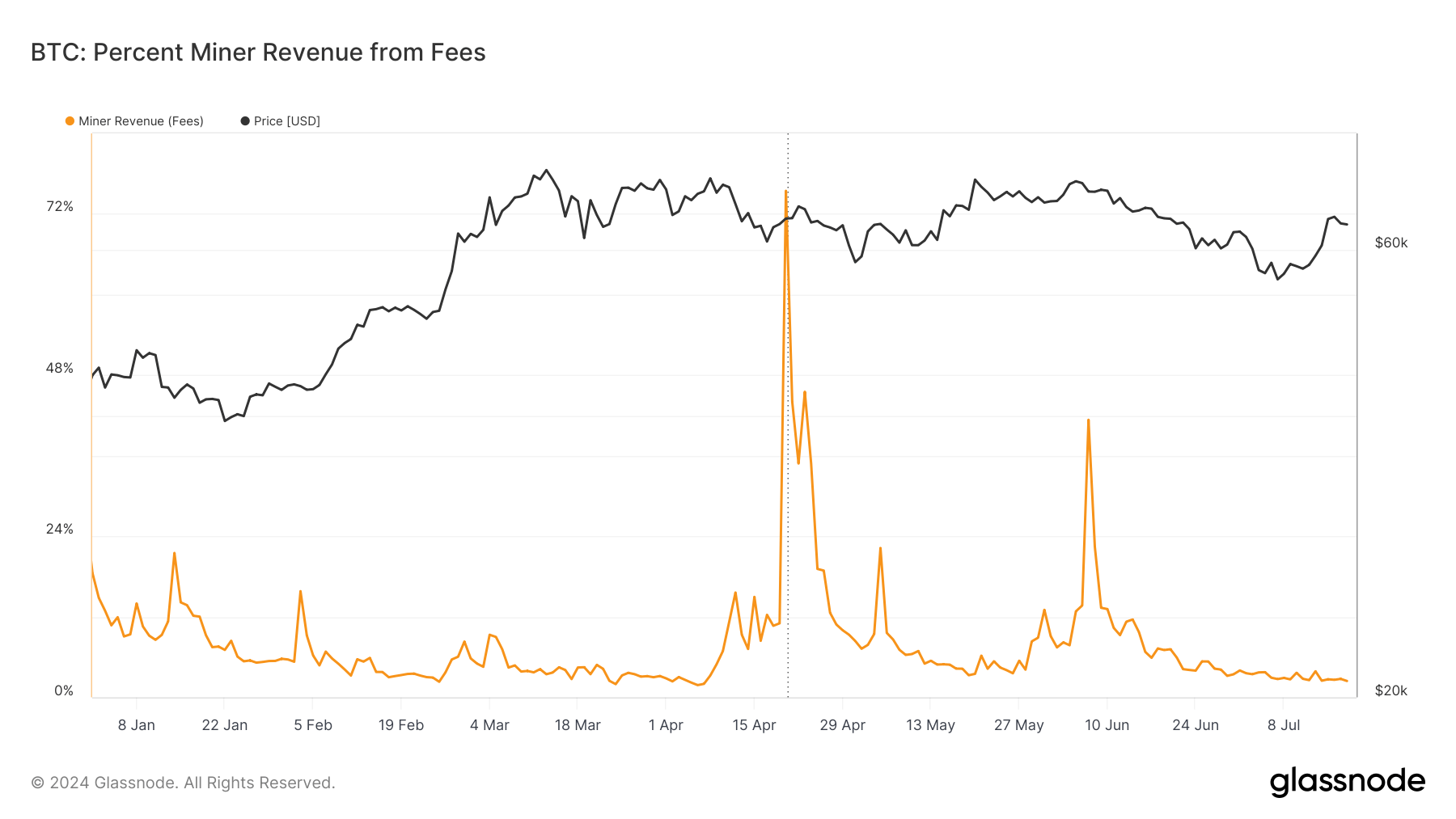
While block rewards still make up the overwhelming majority of miner revenue, we’ve seen transaction fees briefly become miners’ primary source of income. This was evident last year with the rise of Inscriptions and during the Bitcoin halving when the block reward reduction and the launch of Runes pushed transaction fees to make up as much as 75% of miner revenue.
Conclusion
Each of these metrics provides valuable insights into the operational health and economic viability of the Bitcoin network.
The hash rate, which measures the network’s total computational power, has shown resilience despite regulatory pressures and the impact of the April 2024 halving. The hash rate’s recovery to around 720 EH/s indicates strong miner confidence and investment. This metric is crucial for network security, as a higher hash rate makes the network more robust against attacks.
Mining difficulty, which adjusts to ensure a stable block production rate, experienced significant fluctuations this year. The 6% decrease in May, one of the largest since the FTX collapse, followed the halving. Miner revenue, comprising block rewards and transaction fees, showed miners’ economic challenges. The April halving reduced block rewards, leading to a sharp drop in total miner revenue. However, transaction fees spiked to over 70% of total revenue immediately after the halving, emphasizing the growing importance of fees in sustaining miner profitability.
Hash ribbons, which indicate miner capitulation and recovery periods, provided additional context to the hash rate fluctuations. The end of miner capitulation in May, marked by the crossover of the 30-day moving average above the 60-day moving average, signaled a recovery phase and potential buying opportunities.
As miners continue to invest in more efficient hardware and expand operations in regions with favorable regulations, the hash rate is expected to rise further. This will enhance network security and stability. With block rewards diminishing after each halving, transaction fees will become increasingly significant in miner revenue. This shift will likely lead to a more competitive fee market, influencing miner strategies and transaction processing times.
More Market Reports