Every prop firm payout runs on four clocks, and the advertising quotes whichever one is shortest. The funding clock runs from the purchase of an evaluation to the first funded trade. The eligibility clock decides when a funded trader is allowed to ask for money at all. The approval clock is how long the firm takes to say yes. The rail clock is how long the money is in transit once the firm lets go of it.
A prop firm payout is the firm paying its own cash against the simulated profit on a funded account, sent over whichever transfer rail the program supports. Money arrives when the last clock stops, so the honest payout time is the sum of all four, and a 24-hour claim can honestly describe any single one of them. The comparison below covers the firms we have scored, with values read from each firm's published terms and our review testing in August 2026, since windows, commitments and rails are terms a firm can edit overnight.
Fastest Payout Prop Firms in 2026
- Reward cycles from 60% weekly to 100% monthly
- 10% max loss and 5% daily on 2-Step Standard
- Zero trailing drawdown is easy to overlook
- Static drawdown that never trails
- On-demand USDC payouts, 24/7
- Owned by Kraken since 2025
- 24-hour payout or $1,000 compensation
- CFD and futures under one firm
- No consistency rule on any CFD model
- Public rules conflict with model terms
- Simulated service with no regulation
- Scaling ceiling of $4,000,000
- Pay Later: $5 now, rest on passing
- Reward Guarantee or they pay $1,000
- Scales to $2,000,000
CryptoSlate may earn a commission when you visit partner sites through links on this page, at no extra cost to you. Our rankings and reviews remain editorially independent and based on our published methodology. Read disclosure
Disclaimer: CryptoSlate may receive a commission when you click links on our site and make a purchase or complete an action with a third party. This does not influence our editorial independence, reviews, or ratings, and we always aim to provide accurate, transparent information to our readers.Fastest Payout Prop Firms Compared
Compare the scored firms by market coverage, evaluation structure, account size, drawdown, profit split and first-payout timing.
| Prop Firm | Markets | First Payout | Payout Processing | Profit Split | Maximum Drawdown |
|---|---|---|---|---|---|
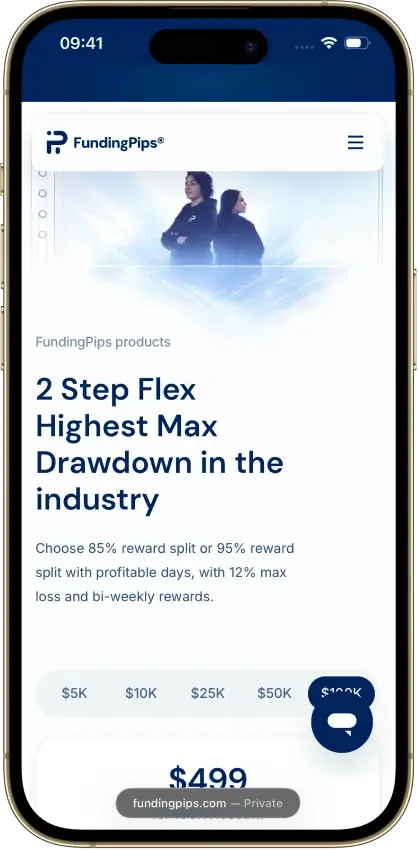
 FundingPips FundingPips | Forex / CFD | 3 calendar days | — | 60%–100% | Intraday Trailing (Real-Time Equity): 5%; Static (Initial Balance): 6–12% |
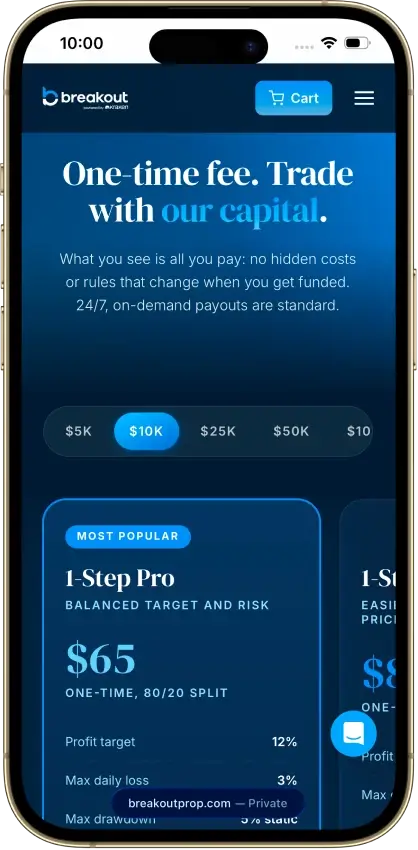
 Breakout Breakout | Crypto | No waiting period at all. A payout can be requested as soon as net profit after the split clears $50, which can be the same day the account is funded. | — | 80%–90% | 3–6% |
 FundedNext FundedNext | Forex / CFD, Futures | Fastest is Rapid Daily at one day. Stellar 1-Step pays after 5 business days, Stellar 2-Step and Stellar Lite after 21 days, Stellar Instant on demand or bi-weekly, and Rapid Pro every 3 days. Flex and Legacy gate the first withdrawal on 5 benchmark days rather than elapsed time. | Crypto: 24 hours; Rise: 24 hours; Bank Transfer: 24 hours; Confirmo: 24 hours; Direct deposit into FNmarkets: 24 hours | Forex / CFD: 80%–95%; Futures: 80%–95% | Forex / CFD: Balance-Based Trailing (Closing Balance): 6%; Static (Initial Balance): 6–10%; Futures: 3–4% |
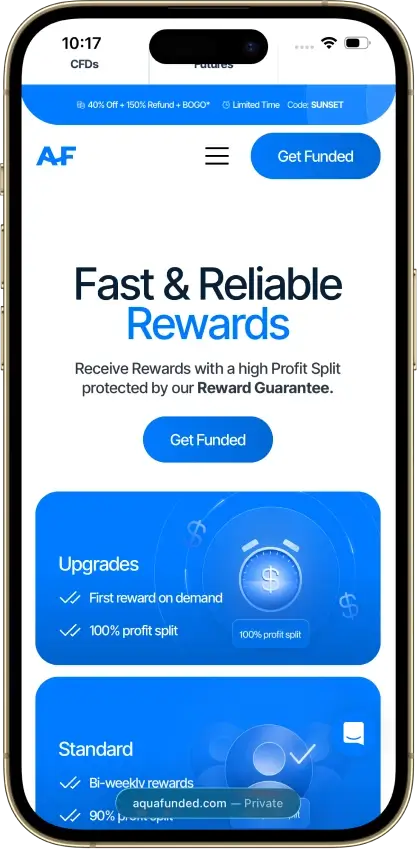
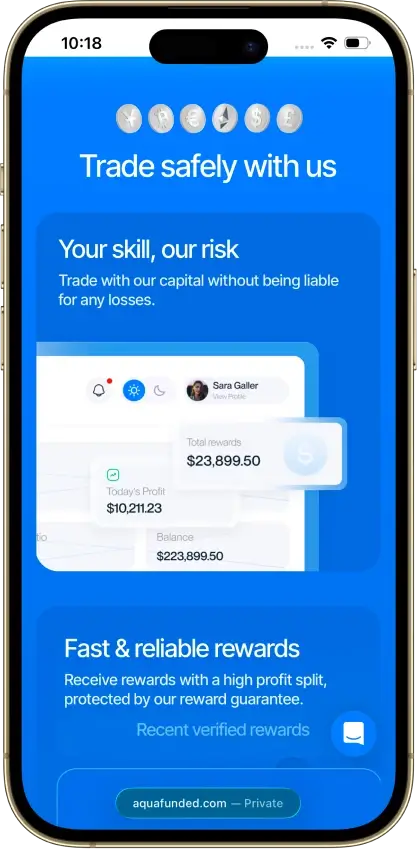
 AquaFunded AquaFunded | Forex / CFD, Futures | 14 calendar days | — | Forex / CFD: 90%–100%; Futures: 80%–100% | Forex / CFD: Intraday Trailing (Real-Time Equity): 6–10%; Static (Initial Balance): 8–10%; Futures: Balance-Based Trailing (Initial Balance): 4%; End-of-Day Trailing (Initial Balance): 3–4% |
 Goat Funded Trader Goat Funded Trader | Forex / CFD | 14 calendar days | Rise: 2 business days; Bank Transfer: 2 business days; Skrill, capped at $5,000 per payout: 2 business days; Crypto: 2 business days | 80%–100% | Intraday Trailing (Real-Time Equity): 6–8%; Static (Initial Balance): 6% |
The score reflects the whole rubric, while the payout columns map to the four clocks defined below. The window column covers eligibility and the commitment column covers approval. The rail carries the rest.
Fastest Payout Prop Firms in Detail
FundingPips
Pros
- Five account models, including instant funding
- Among the lowest entry fees in the industry
- Reward cycles paying up to a 100% profit split
- Forgiving loss limits on 2-Step Standard
- Choice of MT5, cTrader, and MatchTrader
Cons
- News trading limited on Master Accounts
- Leverage drops on larger positions
- Zero has strict consistency and activity rules
- Weekend holding suspended on Master Accounts





Breakout
Pros
- Static drawdown on all three plans
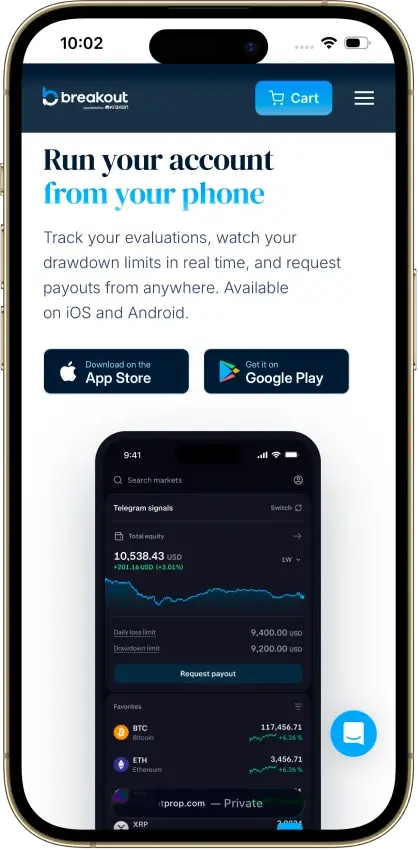
- Payouts on demand 24/7, $50 minimum
- No consistency rule or minimum days
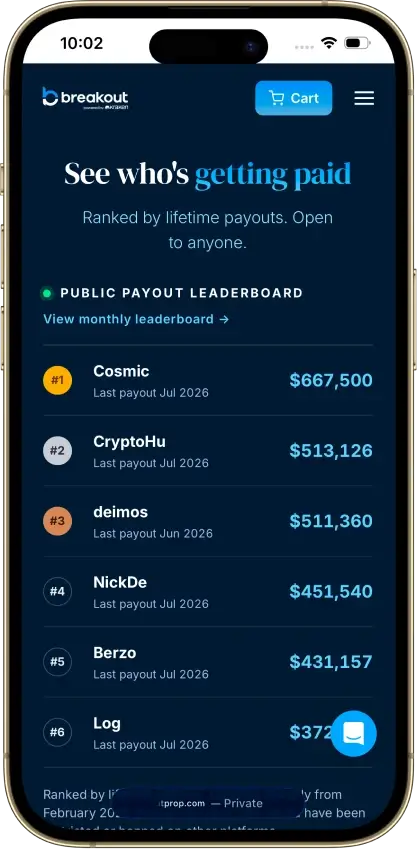
- Public payout leaderboard with totals
- Kraken-owned since September 2025
Cons
- Your order may never reach an exchange
- Evaluation fee is never refunded
- Leverage varies by coin, 2x on many alts
- No MetaTrader on either terminal
- Funded capital caps at $200,000 total



FundedNext
Pros
- Both CFD and futures under one firm
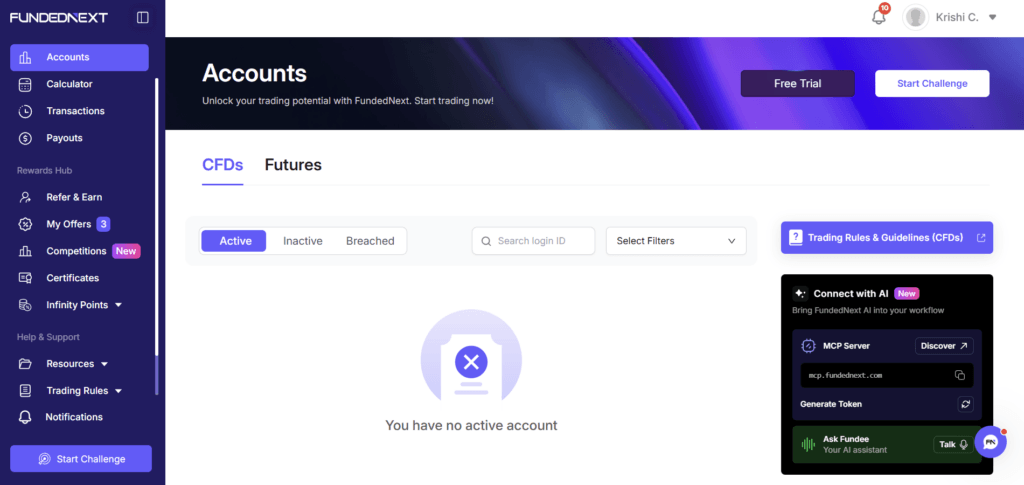
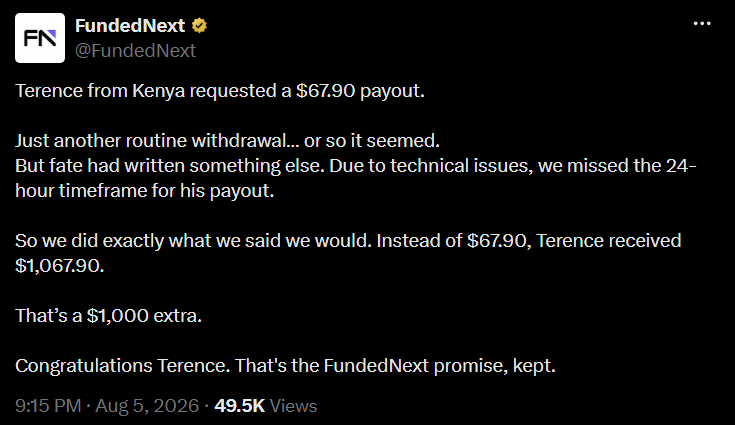
- 24-hour payout or $1,000 compensation
- No consistency rule on any CFD model
- News and weekend trading open on CFD
- Futures contract limits fixed, not tiered
Cons
- CFD add-ons stack up in cost quickly
- Futures limited to Tradovate and NinjaTrader
- $100K+ CFD accounts get MT4 and MT5 only
- Payout total is the firm's own figure
- Stellar Instant trails, the other three don't



AquaFunded
Pros
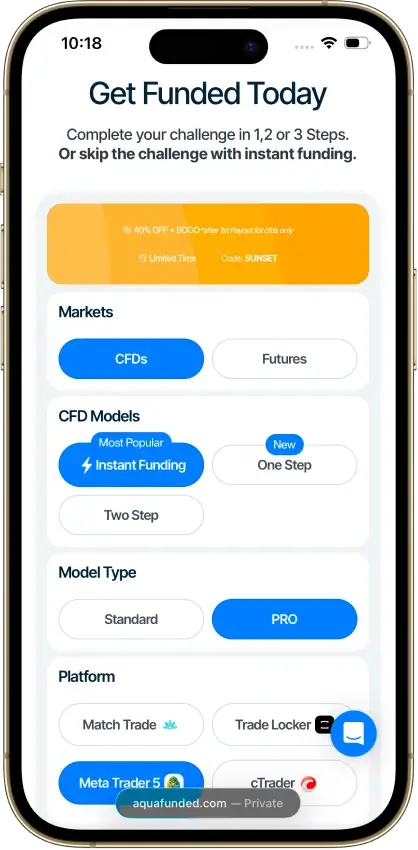
- 90% profit split on every CFD model
- $1,000 penalty if a payout misses 24 hours
- Three futures types have no daily loss cap
- Aqua Elite adds $1,000-$3,000 a month
- Five of ten CFD models skip consistency
Cons
- The drawdown documents contradict themselves
- -2% floating loss closes the account for good
- The refund only lands on your fourth payout
- 9.4/10 headline is not a Trustpilot score
- 30 days without a trade breaches funding


Goat Funded Trader
Pros
- Two live codes, 40% and 50% off
- Evaluation fees refunded on passing
- Pay Later starts at $5 upfront
- $100 minimum payout, paid in 2 days
- Scales to $2M with up to 100% split
Cons
- Trustpilot pulled its rating over fake reviews
- Up to three loss limits run at once
- $3,000 cap on profit in a single day
- Complaints cluster on payout denials
- Hong Kong and Saint Lucia entities






Payout speed is treated as the full journey rather than the shortest advertised window. We compare when a trader becomes eligible to request money, how clearly the firm commits to reviewing that request, which transfer rail carries the payment and whether the available evidence supports the claim. A quick rail cannot compensate for a long eligibility wait or an undefined approval process, so the order reflects the complete payout experience within the wider review score.
Four Clocks, One Advertised Number
| Clock | Starts | Ends | Who Controls It | Where It Hides in Advertising |
|---|---|---|---|---|
| Funding | The purchase of the evaluation | The first funded trade | The trader's pace against phase targets, plus the firm's activation steps | “Instant funding” sells this clock away and says nothing about the other three |
| Eligibility | The first funded trade, or the last payout | The first day a request may be filed | The program's terms, fixed at purchase | “Daily payouts” and “weekly payouts” describe this clock only |
| Approval | The request being filed | The firm releasing the money | The firm, entirely, at its own pace | “24-hour payouts” and any published average processing time |
| Rail | The firm releasing the money | Money spendable on the trader's side | Block confirmations, provider schedules or banking hours | Rarely quoted, and the only clock that can leave a public record |
The clocks run in sequence, never in parallel.
The Funding Clock Runs Before Any Payout Rule Applies
The longest wait in most payout timelines is the one payout advertising never mentions, because it ends before the first payout rule takes effect. Phase count and profit targets set the pace of an evaluation, and minimum trading days put a floor under it no matter how well the trading goes. A two-phase program with a five-day minimum per phase cannot be cleared in under ten trading days even by a flawless run, and most runs are not flawless.
Passing the evaluation only ends one part of the funding clock. The firm's activation steps still stand between the final target and the first funded trade. Those steps may include identity verification at funding. The trader may also need to sign an agreement before the firm issues the account on its own schedule. Instant routes remove this wait at checkout and price it into the fee. The prop firm fees, resets and splits show what each program charges to enter, retry and upgrade.
The Eligibility Clock Starts Long Before the Request
Eligibility is the gap between earning a simulated profit and being permitted to ask for it. Programs may require minimum funded trading days and a first-payout window counted from the first funded trade. They can also set a profit floor beneath which no request is accepted. Once the first request clears, cadence rules fix how often another may be filed. Where the window restarts the day a payout lands, that cadence sets the rhythm of the account's whole life.
On a $100,000 account with a 14-day first-payout window, profit earned in the opening session waits 13 more days before a request can even be filed. The firm can approve in an hour and pay over a rail that settles in minutes, and the trader still waits two weeks, because the binding clock was the one the headline never mentioned.
Shorter windows usually carry a checkout price, just as a higher profit split can be sold as a paid upgrade. Futures-style accounts run payout floors and cycles of their own under the futures programs' session-close rulebook. The CFD side has a separate set, compared across forex prop firm account structures.
The Approval Clock Belongs to the Firm Alone
Between the request and the release, the firm re-reads the account. It checks consistency rules at withdrawal time and applies prohibited-strategy clauses in hindsight. Identity verification also commonly lands at the first payout after an account has already been opened. Each check is legitimate on its face, yet each extends a clock no outsider can watch. The firm controls that clock because the funded account is simulated throughout. A payout is its own cash paid against a simulated profit figure.
This hidden review stage creates the category's conflict of interest. Every evaluation that ends in failure and a repurchase brings the firm a fee, while every approved request is paid out of the firm's own pocket. A firm's own terms sometimes state this plainly. That does not make any given approval dishonest. It means the clock that runs entirely out of sight is also the one where the firm's incentive favors delay.
The Rail Clock Is the Only One With a Public Face
| Rail | Transit Once Released | What Pauses It | Cost Pattern |
|---|---|---|---|
| Stablecoin transfer | Minutes to hours after broadcast | Network congestion, nothing on the calendar | A network fee and any conversion spread |
| E-wallet or internal balance | Near-instant to the balance, then the provider's own schedule for the leg to a bank | The second leg, which the headline number never times | Provider charges, flat or percentage |
| Bank wire or card | One to several business days | Weekends, holidays, cut-off times, intermediary banks on cross-border routes | Wire fees at either end and currency conversion |
A stablecoin rail settles when the network confirms it, without cut-off times or weekends. No intermediary holds the transfer for review, so a prop firm paying on-chain hands over money the same day it approves the request. A wire posts in business days and pauses for holidays on either side of the route. Each intermediary bank can add more time. Firms that run crypto markets end to end tend to keep payouts on the rails they already trade on, as shown by crypto prop firm market coverage.
Transfer services and internal balances make speed claims harder to read because receipt splits into two legs. The firm's leg ends quickly at a balance inside the provider. The onward transfer to a bank follows the provider's schedule. A minutes-long headline and a multi-day wait can therefore describe the same payout, with the headline timing the first leg while the trader lives on the second.
The rail can only move money the first three clocks have already released. A program paying on-chain behind a monthly eligibility window delivers later than a program paying by wire behind a weekly one. Compressing the eligibility window increases a firm's risk. Compressing the rail costs it a network fee.
Each Firm's Rails, Caps and Charges
| Firm | Stablecoin or Crypto | E-Wallet or Internal Balance | Bank or Card | Speed Record |
|---|---|---|---|---|
| FundedNext | USDT on ERC20 and TRC20, USDC on ERC20 | RiseWorks, Confirmo, direct deposit into FNmarkets | Bank transfer | 24 hours from the request, $1,000 paid to the trader when missed |
| Breakout | USDC on Ethereum, from $50 | None | None | Most requests inside hours, the firm's own figure, matched by trader reports |
| FTMO | Offered from $50, network not disclosed | Skrill, capped at $3,000 per payout | Wire from $20 to $20,000, card payouts to $20,000 | 24 to 48 hours once approved. Trader reports of arrival within hours |
| The5ers | USDT on Tron, USDC on Ethereum, ETH, LTC. Default under $1,500, 2% commission | Rise above $1,500 at 2%. Hub credits spend only on new accounts | Bank transfer at 3% | 16-hour average advertised, trader reports run 3 to 7 days. Large payouts split into weekly $10,000 installments |
| AquaFunded | Default under $5,000, network not disclosed, network and exchange fees deducted | Rise from $1,000 at a flat $35 | Not disclosed | 24 business hours once approved, $1,000 paid when missed. Weekends pause the clock |
| Goat Funded Trader | Capped at $4,000 per payout, network not disclosed | Rise uncapped, Skrill to $5,000 | Bank transfer to $10,000, offered in eight African countries only | 2 business days, $1,000 paid when missed. A 2% charge applies after the split |
| Crypto Fund Trader | USDT and USDC | Not disclosed | Bank transfer | Not disclosed |
| FundingPips | USDT | Rise | Card and bank transfer | No published figure. Payout speed recurs as praise in its review volume |
The speed column records published firm figures and trader reports. We have not timed these payouts, and the two sources disagree where the rows say so.
What a 24-Hour Payout Claim Actually Commits To
Read against the four clocks, a 24-hour claim usually describes approval. It promises that once a valid request is filed, the firm will say yes or no within a day. It promises nothing about when the request may be filed or about transit. A claim defined as “24 hours on business days” excludes the weekend from its own arithmetic.
A daily payout prop firm is making a claim about the eligibility clock instead. Daily means a request may be filed every day, not that money lands every day. Approval and rail are untouched by the word, so a daily-eligibility program paying by wire can deliver on a weekly rhythm without breaching a single term.
The four clocks together define the full span. Consider a $100,000 account with a 14-day first-payout window and a 48-hour approval. If its wire crosses a weekend, profit earned on the first funded day becomes money roughly three weeks later, with every clock performing exactly as advertised. Add the four weeks a two-phase evaluation took to pass and the span from purchase to money is closer to seven weeks. The program's profit split takes its share of that figure before anything is released. Swapping the wire for a stablecoin rail removes the last few days but leaves everything upstream unchanged.
Why a Firm's Own Payout Average Is a Claim
A firm's own payout average is measured by the party it flatters, on a clock nobody outside can watch, so we treat first-party speed figures as claims. They do not count as independent evidence. The rails differ in what they leave behind. A stablecoin payout creates a public-ledger transaction that an outsider can confirm without permission. A wire leaves a bank statement visible only to its recipient, while an internal balance leaves no public trace until its second leg runs. The public methodology explains how we weigh payout evidence.
Risk Disclosure
Evaluation fees are at risk from the moment they are paid, and most participants never reach a payout. Funded accounts are simulated throughout, and a simulated allocation does not necessarily represent live firm capital. No funds held for the trader back a payout, which depends on the firm's terms and solvency. Nothing here is financial advice. CryptoSlate may earn commissions through links in this comparison, which has no effect on any score.
