A futures prop firm funds traders on exchange-listed futures contracts. Its accounts follow different rules from the CFD accounts that dominate the rest of the sector. The maximum loss floor resets at each session close against the highest closing balance. Position size uses contracts, while CFD programs use lots. Every position closes at a fixed time each afternoon, so overnight financing charges do not apply.
Futures programs differ from each other more than the marketing suggests. Some loss floors stop moving, while others do not. Contract caps may rise after funding. The fee at checkout may not be the last charge. Price cards show none of those conditions.
The comparison below covers every futures program we have scored. No firm that built its business on futures alone is among them. Those firms appear further down.
Top Futures Prop Firms in August 2026
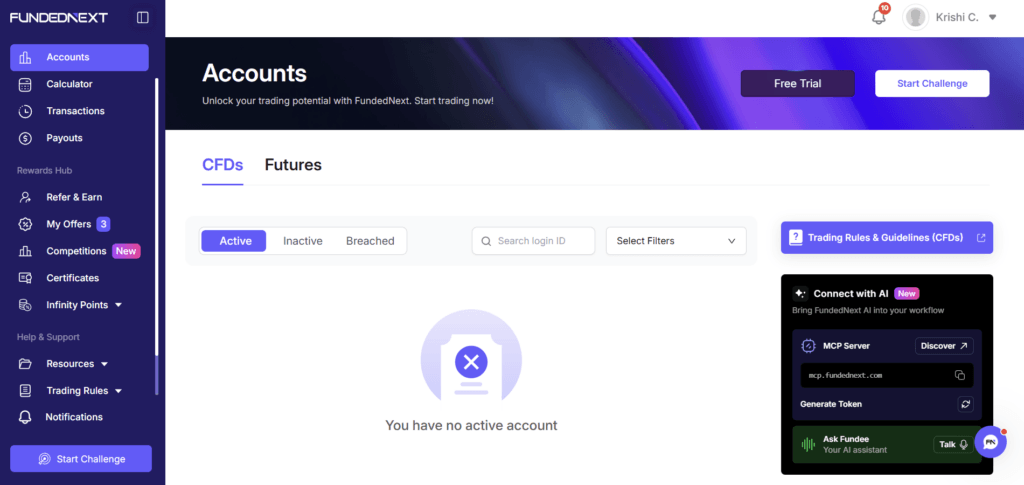
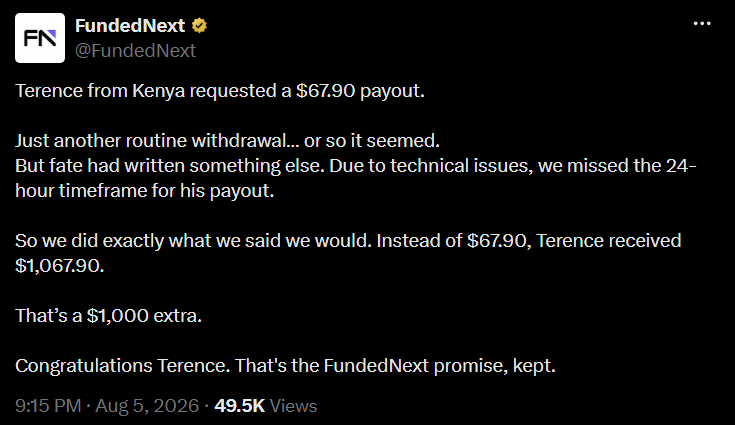
- 24-hour payout or $1,000 compensation
- CFD and futures under one firm
- No consistency rule on any CFD model
- Scaling ladder reaches $4,000,000
- Funding traders since 2016
- One, two, three-step and futures plans
- Public rules conflict with model terms
- Simulated service with no regulation
- Scaling ceiling of $4,000,000
CryptoSlate may earn a commission when you visit partner sites through links on this page, at no extra cost to you. Our rankings and reviews remain editorially independent and based on our published methodology. Read disclosure
Disclaimer: CryptoSlate may receive a commission when you click links on our site and make a purchase or complete an action with a third party. This does not influence our editorial independence, reviews, or ratings, and we always aim to provide accurate, transparent information to our readers.Futures Prop Firms Compared
Compare the scored firms by market coverage, evaluation structure, account size, drawdown, profit split and first-payout timing.
| Prop Firm | Markets | Evaluation Types | Account Sizes | Maximum Drawdown | Profit Split | First Payout | Payout Processing |
|---|---|---|---|---|---|---|---|
 FundedNext FundedNext | Futures | Futures Evaluation | $25,000–$150,000 | 3–4% | 80%–95% | Fastest is Rapid Daily at one day. Stellar 1-Step pays after 5 business days, Stellar 2-Step and Stellar Lite after 21 days, Stellar Instant on demand or bi-weekly, and Rapid Pro every 3 days. Flex and Legacy gate the first withdrawal on 5 benchmark days rather than elapsed time. | Crypto: 24 hours; Rise: 24 hours; Bank Transfer: 24 hours; Confirmo: 24 hours; Direct deposit into FNmarkets: 24 hours |
 The5ers The5ers | Futures | Futures Evaluation | $25,000–$150,000 | 4% | 80% | 14 calendar days | — |
 AquaFunded AquaFunded | Futures | Instant, Futures Evaluation | $25,000–$150,000 | Balance-Based Trailing (Initial Balance): 4%; End-of-Day Trailing (Initial Balance): 3–4% | 80%–100% | 14 calendar days | — |
The floor column has more bearing on account behavior than the score column. A fixed dollar allowance stops at the opening balance. A percentage allowance recalculates against the growing balance and never stops. Identical trading leaves the two accounts with different failure levels.
Rated Firms With No Futures Program
| Firm | Score | What It Runs Instead |
|---|---|---|
| FundingPips | 9.0 | CFD programs only. Its documentation cites futures firms purely to price against them, and publishes no futures line of its own. |
| Breakout | 8.4 | Crypto perpetual futures, not exchange-listed futures. Different instrument, different clearing, a static floor and no session close. The shared label invites a category mix-up. |
| FTMO | 7.8 | CFD programs only, with CFD platforms and CFD payout rails throughout. |
| Goat Funded Trader | 5.9 | CFD programs only, despite the firm publishing its own ranked list of futures firms. |
| Crypto Fund Trader | 5.9 | CFD and exchange-routed crypto. No futures platform or exchange connectivity appears in the reviewed product. |
Perpetual futures on crypto share a name with exchange-listed futures but operate differently. They clear off-exchange and trade continuously without a session close. We assess off-exchange perpetuals with crypto prop-firm market exposure, not exchange-listed futures.
Best Futures Prop Firms in Detail
FundedNext
Pros
- Both CFD and futures under one firm
- 24-hour payout or $1,000 compensation
- No consistency rule on any CFD model
- News and weekend trading open on CFD
- Futures contract limits fixed, not tiered
Cons
- CFD add-ons stack up in cost quickly
- Futures limited to Tradovate and NinjaTrader
- $100K+ CFD accounts get MT4 and MT5 only
- Payout total is the firm's own figure
- Stellar Instant trails, the other three don't



The5ers
Pros
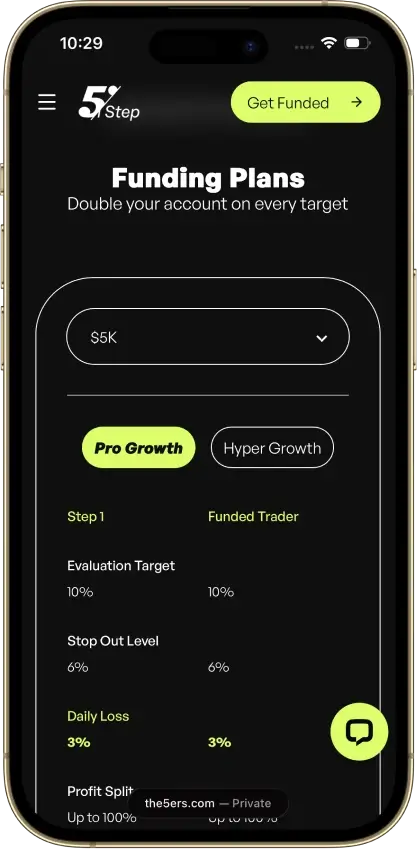
- Static drawdown on all five CFD programs
- No time limit to pass any challenge
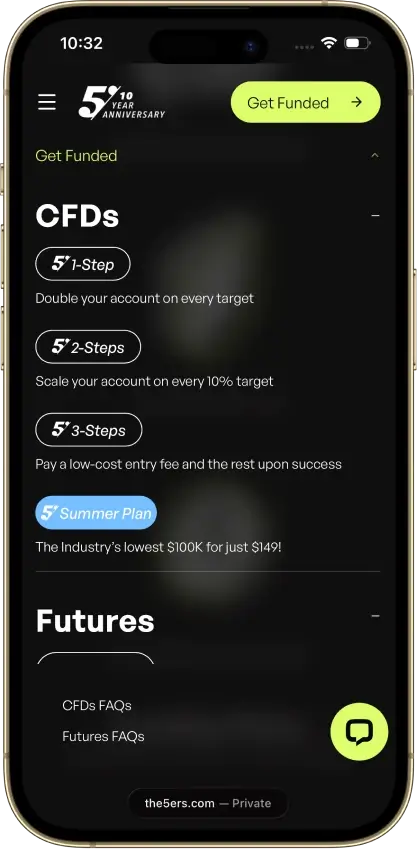
- Entry from $19 for a 2-step $2.5K account
- Scales to $4M on Bootcamp and Hyper Growth
- Overnight and weekend holding on CFD plans
Cons
- Refund terms conflict on its own page
- Futures drawdown trails, unlike CFD plans
- Splits start at 50/50 on two programs
- 1:30 leverage on three of five CFD plans
- Scaling resets the 14-day payout clock



AquaFunded
Pros
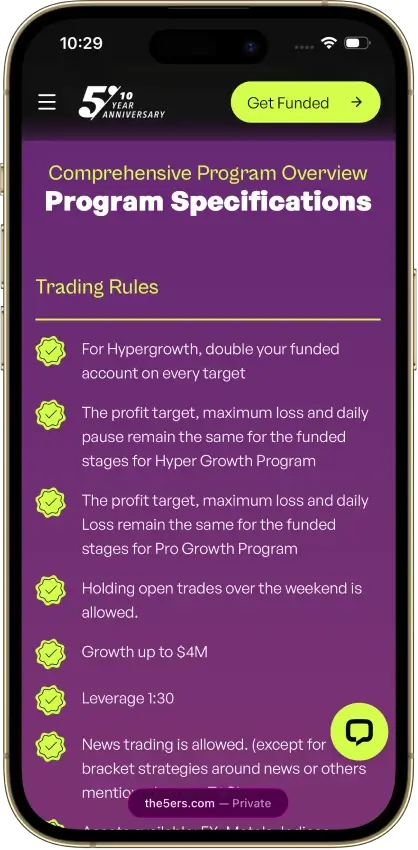
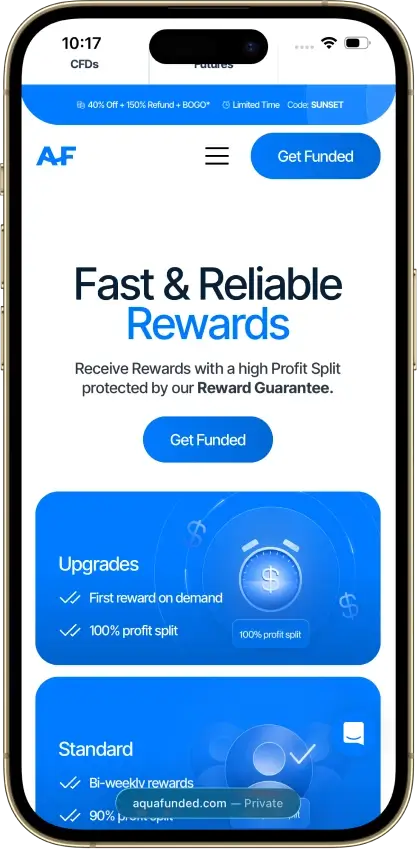
- 90% profit split on every CFD model
- $1,000 penalty if a payout misses 24 hours
- Three futures types have no daily loss cap
- Aqua Elite adds $1,000-$3,000 a month
- Five of ten CFD models skip consistency
Cons
- The drawdown documents contradict themselves
- -2% floating loss closes the account for good
- The refund only lands on your fourth payout
- 9.4/10 headline is not a Trustpilot score
- 30 days without a trade breaches funding

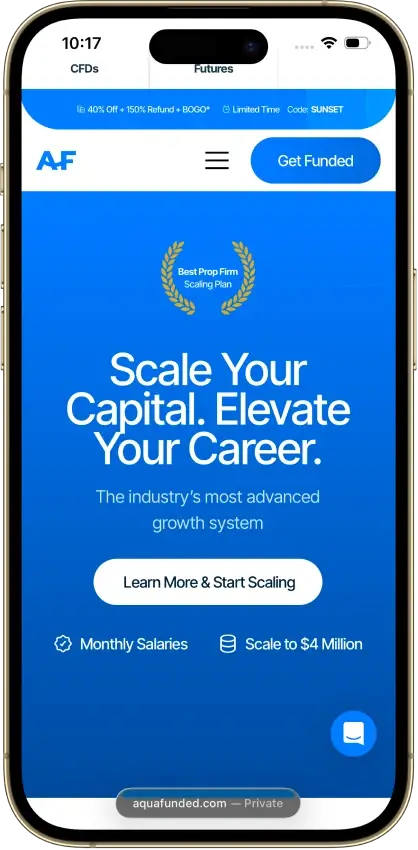
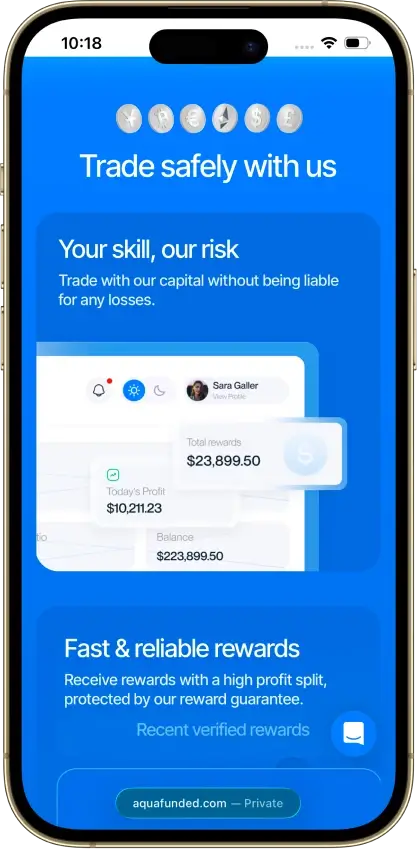
A futures account is read as a connected rule system. The loss floor, contract cap, platform access, session close and charges after checkout are assessed together because no single field describes how much room the account gives a trader. A high split or low entry fee cannot carry the comparison when the floor keeps tightening or key operating terms remain unpublished. The order follows the overall review score, with futures-specific conditions made visible beside it.
Which Futures Program Fits Which Trader
- Best for the highest reward share on a futures account: FundedNext Flex at 95%, with no daily loss limit and no consistency rule once funded.
- Best for the cheapest way into a funded futures evaluation: The5ers Day Trade at $59, with market data included and no monthly charge. The lower fee comes with an 80/20 split that scaling does not improve.
- Best for a full profit split: AquaFunded pays 100% on both Instant models and on One Step Beginner. That split needs to be considered alongside gaps in AquaFunded’s published rules.
- Best for being paid on the shortest cycle: FundedNext Rapid Daily, which pays daily with no consistency rule at either stage. It carries a daily loss limit that Rapid Pro does not.
- Best for holding a position overnight: The5ers Swing, the only program here that permits an overnight carry, capped at 1 mini or 10 micros.
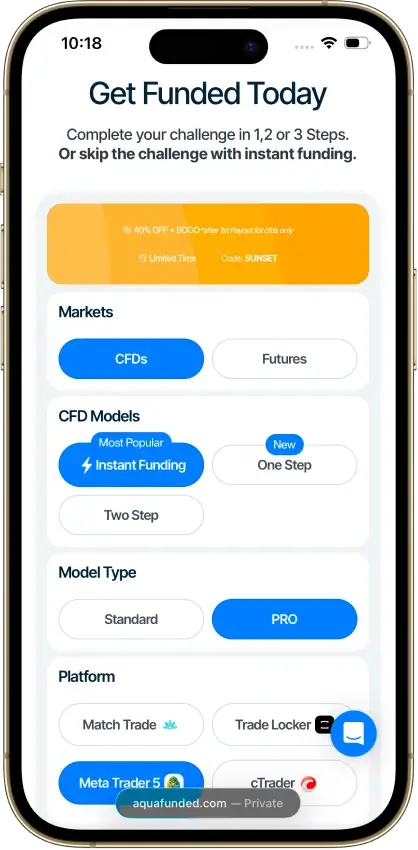
- Best for skipping the evaluation entirely: AquaFunded Instant Standard and Instant PRO, which set no profit target. At $50,000 that route costs $410 against $108 for the same firm's cheapest evaluated model.
The Floor Recalculates Once a Day, Then Either Locks or Keeps Climbing
Futures programs use end-of-day trailing where CFD programs use a static floor or one that follows live equity. Only the closing balance moves the floor. Profit pushes it upward, while losses never move it back down. After that, two behaviors share the same label wherever they appear in a table.
A Fixed Allowance That Stops Moving
Take a $50,000 account carrying a $2,000 end-of-day maximum loss. The floor opens at $48,000 and only a closing balance moves it.
- Close at $50,900 and the floor ratchets to $48,900, which is only $1,100 below the opening balance.
- Close the next session at $50,400. A one-way floor does not follow the balance back down, so it holds at $48,900. The balance still shows $400 of profit, but only $1,500 remains before failure, down from the original $2,000. Earning $900 and giving $500 back has permanently reduced the buffer.
- Close at $52,000 and the floor would land on $50,000, exactly at the opening balance. It stops there permanently.
Once the floor stops, it behaves like a static limit. If the balance reaches $100,000, the account still fails at $50,000, leaving half the balance as room. The exposed period comes before the stop, when profit sits above a thinner buffer than the account started with.
The model determines the stopping point. Two programs on one price list can stop in different places. A floor that stops a fixed amount above the opening balance means the account can never again close at break-even without failing.
A Percentage Allowance That Never Stops
Now take the same $50,000 account with a 4% end-of-day allowance instead of a fixed $2,000. The floor still opens at $48,000, but it recalculates against the new balance every session instead of holding a fixed dollar gap.
- Close a session at $55,000 and the allowance becomes 4% of $55,000, or $2,200. The floor climbs to $52,800, which is $2,800 above the opening balance.
- Give back $2,300 the next session and the balance reads $52,700. That is $2,700 of profit still showing, and the account is finished.
Because the allowance is a percentage of a growing number, this floor climbs for as long as the account does. At a $100,000 balance, it fails at $96,000. Under identical trading, the fixed-allowance account fails at $50,000 while the percentage account fails at $96,000. Both are labeled end-of-day trailing despite the difference.
Position Size Is Capped in Contracts, Not Lots
Futures programs cap exposure by contract count across two instrument families, minis and micros. A micro is one-tenth the size of its mini. A limit of three minis or 30 micros expresses one risk budget in two units. Micros let a smaller account size positions in tenths.
The contract cap determines how much exposure the program permits. Three minis losing $700 each exceed the $2,000 end-of-day allowance on a $50,000 account and end it within one session. The allowance sets how much can be lost. The cap sets how quickly the account can reach that limit.
Comparison tables routinely omit whether the cap ever moves. Some firms fix it at account creation for the life of the account. Others increase it once when the evaluation converts to a funded account. A profit ladder can also start a funded trader on a single mini, withholding larger position sizes until the trader clears its profit tiers.
Buying Power Is Not an Account Balance
Some futures programs express account size as buying power. This is the amount available for positions, not a credited balance. The profit target, loss allowance and cap tier are calculated from that figure. Scaling increases buying power and the cap together, while a balance account receives a higher balance. A $50,000 buying-power account and a $50,000 balance account represent different purchases.
What a Futures Account Costs After Checkout
| Firm | Entry Fee | Activation Fee | Monthly Subscription | Market Data | Payout Frequency | Minimum Withdrawal |
|---|---|---|---|---|---|---|
| FundedNext | From $69.99 | None published | None published | Not disclosed | Daily on Rapid Daily, every 3 days on Rapid Pro, per cycle on Flex and Legacy | $500 of cycle profit before any request |
| The5ers | From $59 | None | None. The firm states there are no monthly fees | Included at no extra cost | Every 14 days, first payout 14 days after funding | $2,000, against $150 on the same firm's CFD accounts |
| AquaFunded | From $83 | None. Fees are one-time, with no activation or monthly platform charge | None | Not disclosed | On demand, except One Step Beginner, which pays weekly | $100 |
The three rated firms in that table do not represent typical futures funding costs. Futures-native firms typically charge a one-time evaluation fee, an activation fee when the funded account is issued, and a monthly platform and data subscription for as long as it stays open. The activation fee arrives after the evaluation has been paid for and passed. Near-continuous sitewide discounts tend to exclude it. Data is billed per exchange per month, allowing firms to recover a low entry price after checkout.
All three rated firms price their futures programs like CFD challenges and publish no activation fee or monthly subscription. Those charges appear among the unrated firms. The table shows what these firms charge, not the broader cost structure of a futures account.
Published prices are list prices because rotating discount codes may reduce them at checkout. Retry fees after a failed evaluation can change which firms rank among the best prop firms overall.
What Has to Happen Before a Payout Is Released
| Firm | What Releases a Withdrawal | Consistency Rule | Stage It Binds |
|---|---|---|---|
| FundedNext | 5 benchmark days before each withdrawal on Flex and Legacy, each clearing $100 to $250 of profit by account size. None on either Rapid model. Every model needs $500 of cycle profit | 40% | Challenge only on Flex and Legacy. Funded only on Rapid Pro. Neither stage on Rapid Daily |
| The5ers | 3 profitable days, where a profitable day means closed positions netting at least 0.5% of the starting balance | 40%, measured against a single position rather than a single day | Evaluation and funded |
| AquaFunded | 14 days from the first funded trade, then 14 days from the first trade after each withdrawal | Not disclosed for futures. The published thresholds cover CFD models only | Not disclosed |
Benchmark days count only sessions that clear the minimum profit for an account size. Five benchmark days require five qualifying sessions, however many total sessions that takes. Breakeven sessions leave the counter where it started.
When a futures consistency rule applies during an evaluation, exceeding it raises the target without failing the account. On a $3,000 target with a 40% cap, a day earning $1,500 exceeds the permitted $1,200, so the target recalculates to $1,500 divided by 0.40, or $3,750. The session that should have finished the evaluation extended it because the trading went well.
On funded accounts, the same percentage can be measured against accumulated profit and block a withdrawal. Futures also carries a minimum withdrawal an order of magnitude above the same firm's CFD minimum.
Platforms, Connectivity and the Daily Close
Futures prop execution relies on a small group of systems with different roles. Tradovate is the browser and mobile default at most firms. NinjaTrader provides the desktop option and order-flow tools. TradingView is often a charting front end that routes execution through the firm's existing connection. Rithmic provides connectivity and can open access to Quantower, MotiveWave and similar tools. No rated firm above publishes a Rithmic connection.
A futures program that does not name its platform leaves a core specification missing. The platform sets the data bill, the order route and whether a trader's existing charts can connect.
| Program | Overnight Holding | Weekend Holding | Hard Close |
|---|---|---|---|
| FundedNext, every futures model | No | No | 3:10 PM CT, with trading resuming at 5:00 PM CT and at 5:00 PM CT Sunday |
| The5ers Day Trade | No | No | Flat by 4:50 PM ET. Missing it terminates the account |
| The5ers Swing | Yes, up to 1 mini or 10 micros | No | Not applicable |
| AquaFunded futures | Not disclosed separately for futures | Not disclosed separately for futures | Not disclosed |
Platforms flatten open positions at a fixed clock time, and some programs terminate an account when the deadline is missed. The rule removes overnight flexibility, but it also eliminates swap charges and the need for a swap-free upgrade. The swap-free costs on CFD programs show what futures accounts avoid. Most futures programs allow news trading.
The Futures Firms We Have Not Scored Yet
Every ranked list on this subject presents itself as complete. This one is not. The firms above are CFD-first firms that added a futures arm. The firms that built nothing else are absent because we have not published reviews of them, and they are named below.
| Firm | What the Public Documentation Shows |
|---|---|
| Topstep | A daily loss breach locks the account out of the session instead of failing it, which is a different breach class from a hard fail even where the percentage matches. It publishes its own evaluation pass rates, which almost no firm does |
| Apex Trader Funding | Sells an intraday-trailing and an end-of-day-trailing version of the same account and prices the end-of-day one higher. The funded account is opened with a separate activation fee, and the sitewide evaluation discount does not apply to it |
| Take Profit Trader | The floor changes type between program tiers, hardening from end-of-day to intraday trailing on the tier where a payout becomes possible. One loss-floor row per firm cannot describe it |
| MyFundedFutures | Some programs carry no maximum daily loss at all, which removes the intraday limit and leaves the total floor as the only thing standing between a bad session and a closed account |
| Alpha Futures | Its terms state that a trader is not entitled to payment of the virtual funds held in the account, which is the clause that decides what passing an evaluation is worth |
| Elite Trader Funding | Its terms describe the account balance as synthetic currency, not legal tender, and state that trading it does not amount to trading financial instruments |
| Tradeify | Connects through Rithmic as well as Tradovate, and pays a flat 90% across its lineup with fewer minimum trading days |
| Lucid Trading | Connects through Tradovate and Rithmic, and ties contract size to a profit ladder that starts a funded trader on a single mini |
Those notes draw on public documentation and third-party sources and do not constitute our assessment. Missing from the ratings means unreviewed, not rejected.
Operating status can change faster than this table. Firms in this category have wound down at a few weeks' notice, and at least one turned pending payouts into refunds of the evaluation fee on the way out. Check that an unrated firm is still operating before paying it anything.
What a Score Measures on a Futures Account
Futures programs use the same scoring pillars as the rest of the site, but two require different inputs. Cost includes every charge after the evaluation fee because a low entry fee plus monthly platform billing can exceed a larger one-time charge over a year. Trading conditions depend on connectivity and contract caps. The exchange sets margin, and the firm sets the maximum number of contracts.
Proof that a firm pays carries the most weight, and futures payouts are the hardest to verify because they largely use bank rails that outsiders cannot reproduce. A firm's own total-paid figure remains a claim and does not affect the score. The score weights and accepted evidence explain the scoring. Offering futures earns nothing by itself. Scores depend on payment evidence, not listed asset classes.
Risk Disclosure
Evaluation trading puts the fees paid at substantial risk, and most traders never reach a payout. Simulated accounts are not deposits of trading capital. Nothing here is financial advice. CryptoSlate may earn a commission through links in this comparison and may receive free evaluation accounts for testing. Neither arrangement affects the scores.
