The label crypto prop firm is often applied to any forex challenge that adds a few crypto symbols. This page uses a narrower standard: crypto must be central to the product, with perpetual-futures infrastructure or a dedicated crypto trading route rather than a CFD added to a currency account.
The firms retained here are built around crypto markets. They differ on an important point: a crypto-focused interface does not prove that every order reaches an exchange. The governing terms, account stage and selected platform determine whether trading is live, discretionary or simulated.
Crypto CFDs inside general forex accounts are excluded from the ranking. Stablecoin payouts alone also do not qualify a firm.
Top Crypto Prop Firms in August 2026
- Static drawdown that never trails
- On-demand USDC payouts, 24/7
- Owned by Kraken since 2025
- Static maximum loss floor that never moves
- Trades run on your own Bybit sub-account
- Unlimited time on every evaluation phase
- Bybit-integrated interface with simulated execution
- Instant route scales to $1,280,000
- Cheapest 1-phase starts at $40
CryptoSlate may earn a commission when you visit partner sites through links on this page, at no extra cost to you. Our rankings and reviews remain editorially independent and based on our published methodology. Read disclosure
Disclaimer: CryptoSlate may receive a commission when you click links on our site and make a purchase or complete an action with a third party. This does not influence our editorial independence, reviews, or ratings, and we always aim to provide accurate, transparent information to our readers.Crypto Prop Firms Compared
Compare the retained firms by crypto market model, evaluation structure, maximum drawdown, profit split and first-payout timing.
| Prop Firm | Markets | Evaluation Types | Maximum Drawdown | Profit Split | First Payout |
|---|---|---|---|---|---|
 Breakout Breakout | Crypto | One Step | 3–6% | 80%–90% | No waiting period at all. A payout can be requested as soon as net profit after the split clears $50, which can be the same day the account is funded. |
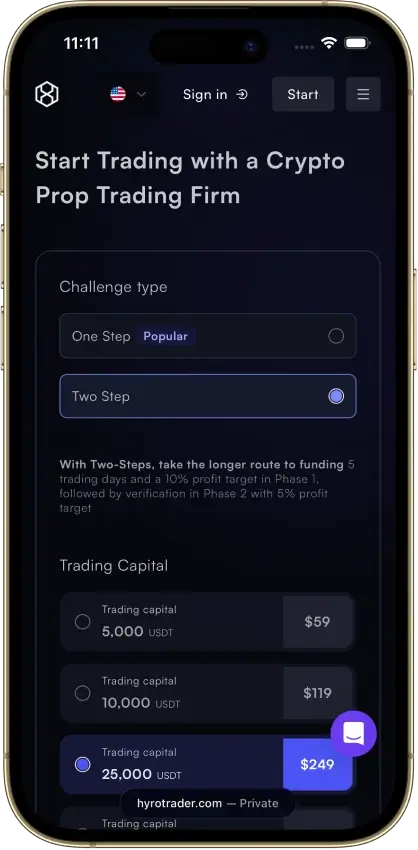
 HyroTrader HyroTrader | Crypto | One Step, Two Step | 6–10% | 80%–90% | 1 trading day |
 Crypto Fund Trader Crypto Fund Trader | Crypto | Two Step, One Step, Instant | Static (Initial Balance): 6–10%; Trailing until 6% profit, then static (Real-Time Equity): 6% | 50%–90% | 15 trading days |
Both categories are unregulated and marketed under the same phrase, but they are distinct products. The leverage column shows the practical cost of that difference. Evaluation phases, loss limits and cost structures work the same way regardless of asset class. Account-wide prop firm rules cover those shared mechanics.
Best Crypto Prop Firms in Detail
Breakout
Pros
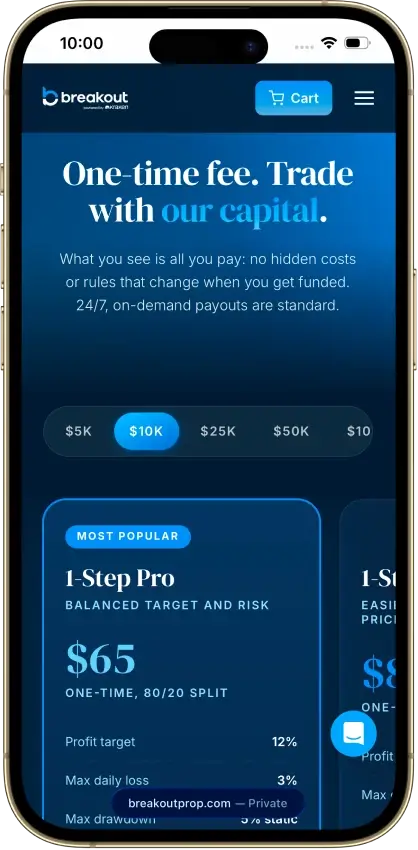
- Static drawdown on all three plans
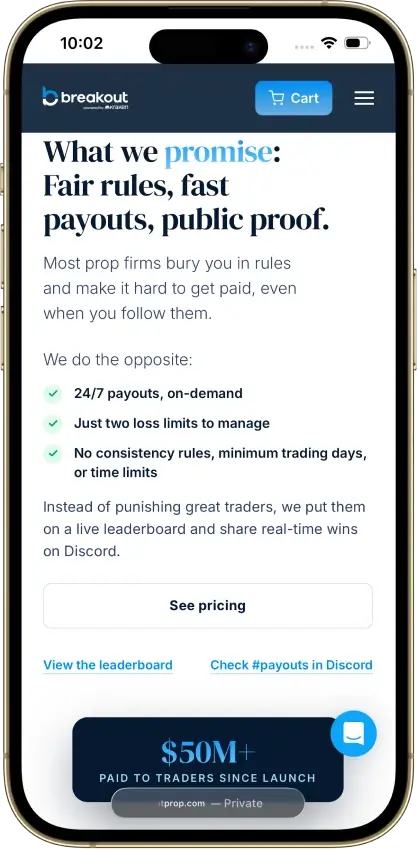
- Payouts on demand 24/7, $50 minimum
- No consistency rule or minimum days
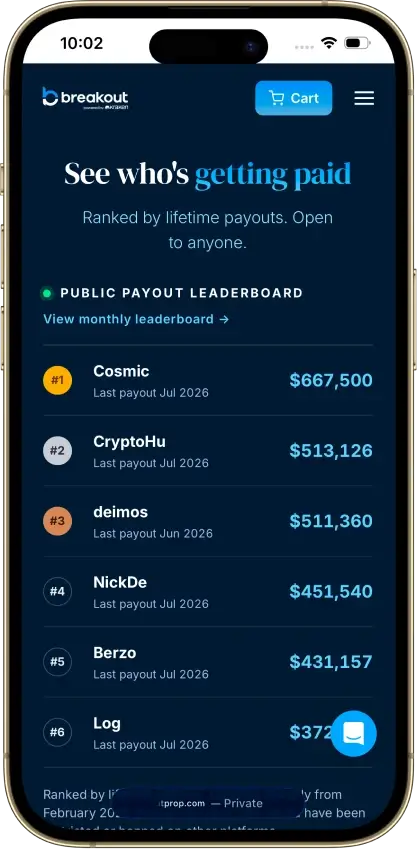
- Public payout leaderboard with totals
- Kraken-owned since September 2025
Cons
- Your order may never reach an exchange
- Evaluation fee is never refunded
- Leverage varies by coin, 2x on many alts
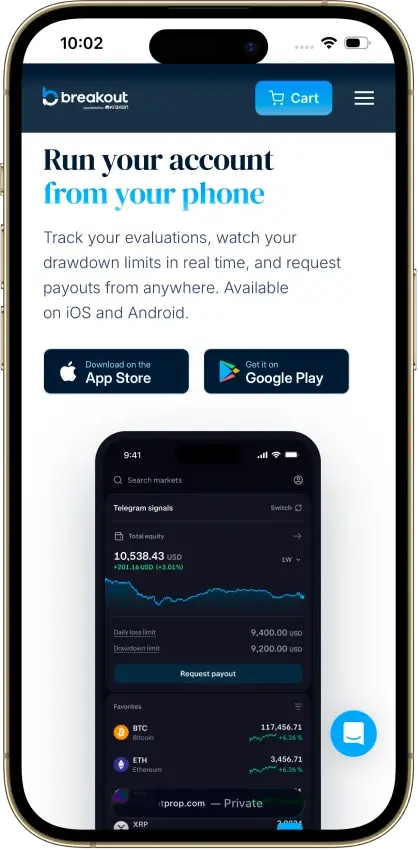
- No MetaTrader on either terminal
- Funded capital caps at $200,000 total


HyroTrader
Pros
- Static drawdown on maximum loss, never trails up
- No time limit on any evaluation phase
- No mandatory stop loss on any trade
- Fee returns with your first funded payout
- Bybit route runs on your own sub-account
Cons
- Daily drawdown trails within each session
- Forced withdrawal at 5%, excess forfeited
- 3% per-trade rule is not auto-monitored
- API keys permit prohibited instruments
- CLEO is a B-book, not exchange execution



Crypto Fund Trader
Pros
- 715 crypto pairs on a Bybit-integrated interface
- 715 crypto pairs, 900+ instruments
- No time limit and no minimum trading days
- Entry from $40 for a 1-phase $5K account
- 1:100 advertised across all instruments
Cons
- Trustpilot rating pulled for a guideline breach
- On FINMA's warning list since August 2024
- Evaluation fee is never refunded
- 90% split and weekly payouts cost extra
- Registered as an education company



Before the score is read, the page confirms what “crypto” means in each account. Instrument type, leverage, execution model, position-holding costs and payout rails are considered together, while marketing labels carry no weight on their own. Exchange-style routing does not automatically make a firm better, and simulation does not automatically make it worse. The order still follows the overall review score, with the comparison fields showing whether the product suits the kind of crypto trading a reader intends to do.
Which Crypto Prop Firm Fits Which Trader
- Breakout best fits traders who want a crypto-first perpetual-futures terminal, static drawdown options and on-demand USDC payouts. Kraken owns the firm, but its terms still allow Payward Oceanic Ltd to decide whether an order is routed or recorded internally. Read the full Breakout review.
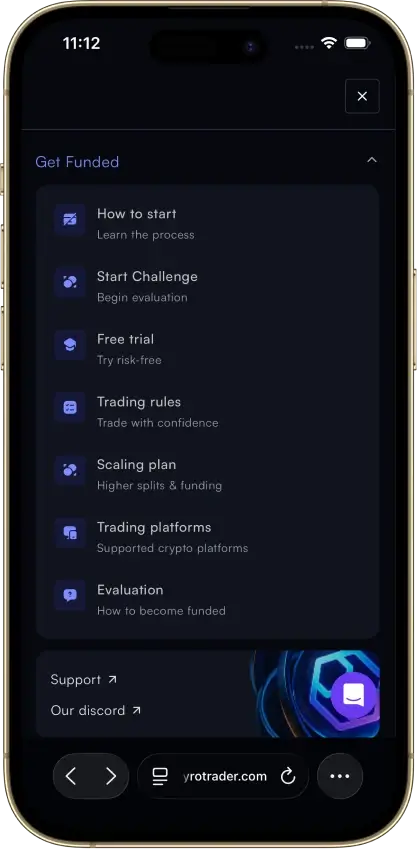
- HyroTrader is the clearest fit for traders seeking USDT perpetual futures rather than CFDs. Its current platform documentation lists Bybit, Tealstreet and CLEO and explicitly says spot and CFD trading are not supported. Read the HyroTrader review.
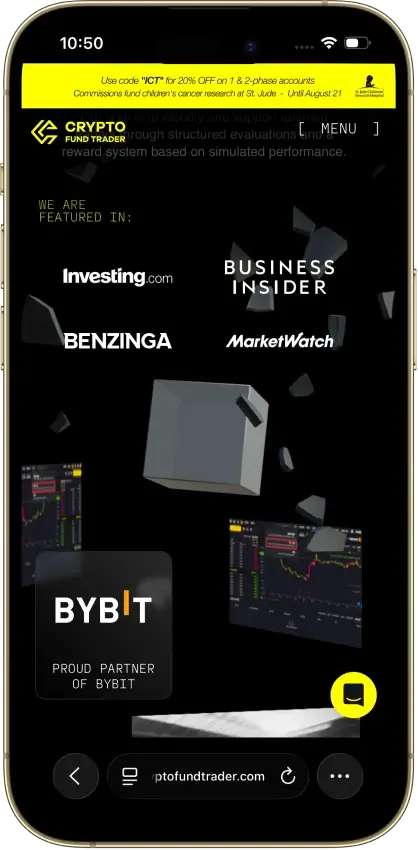
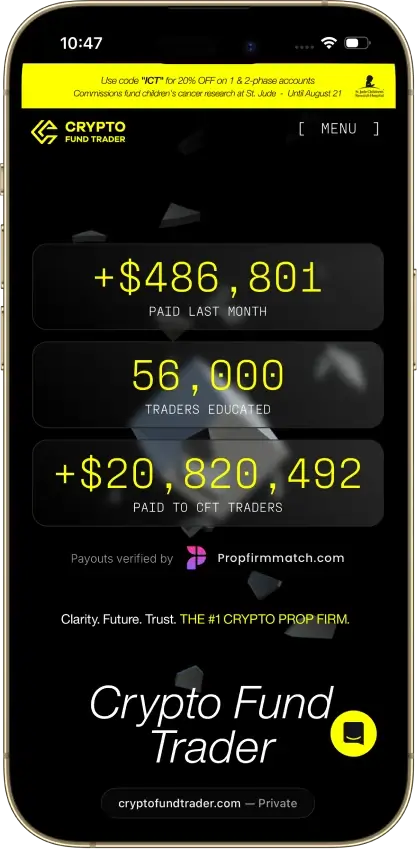
- Crypto Fund Trader offers a crypto-first instrument list and a Bybit-integrated interface, but its governing terms describe the trading service as simulated. MetaTrader 5 and Match-Trader also present simulated crypto CFDs, so the platform choice matters. Read the Crypto Fund Trader review.
Why Crypto CFDs Are Excluded
A crypto CFD follows the price of an asset without giving the account access to that crypto market. It normally sits beside forex, indices and metals, uses the firm’s forex rulebook and may charge swaps rather than perpetual-futures funding.
A crypto-focused account is built around crypto instruments. Perpetual contracts dominate the symbol list, trading continues around the clock and the platform is designed for crypto order types and funding mechanics.
This ranking excludes firms where crypto is only a CFD asset class inside a broader forex evaluation. Those firms may still provide directional exposure to crypto prices, but they are not crypto-focused prop products.
Crypto Leverage Is Cut Where Forex Is Not
A $100,000 prop account may reserve its advertised 1:100 figure for forex while placing crypto several steps lower. One standard lot of a major currency pair then needs about $1,000 of margin, so the daily loss limit is more likely to end the account than the margin requirement. The same account at 1:1 consumes $100,000 of margin for $100,000 of crypto exposure. At 1:2, it consumes $50,000.
Those margin requirements create a different account behind the same login. A trader who sizes a crypto position the way the platform allows a forex position will run out of margin long before reaching the loss limit.
Crypto leverage can fall again when an evaluation converts to a funded account, so the checkout figure may not apply afterward. A swap-free upgrade can reduce it again. The forex programs explain forex swap-free leverage limits.
A firm that publishes a low crypto cap gives traders a risk control they can plan around. At 2x, an altcoin needs a 50% adverse move to erase an account, which puts the daily loss rule ahead of liquidation. The problem is a headline figure that describes forex while excluding the asset class the account was bought for.
Where a Funded Crypto Order Actually Goes
A crypto-focused product can still use live, discretionary or simulated execution. A familiar exchange interface is not enough on its own. The governing terms and account stage decide what happens to an order.
| Firm | Routing Model | What the Published Documents Establish |
|---|---|---|
| Breakout | At the firm’s discretion | Payward Oceanic Ltd may settle an order as an internal administrative entry or pass it to an outside counterparty. The trader is not shown which route applied. |
| HyroTrader | Perpetual-futures infrastructure with demo-stage caveats | The firm offers USDT perpetuals through Bybit, Tealstreet and CLEO and explicitly says it does not support CFD trading. Its platform FAQ says Challenge and Verification accounts use demo environments or demo market data, so traders should not assume every stage uses live capital. |
| Crypto Fund Trader | Simulated under the governing terms | The Bybit option uses a Bybit-integrated interface and may reference its pricing and fee schedule. The firm’s terms describe the trading service as simulated, while MetaTrader 5 and Match-Trader present simulated CFD instruments. The interface does not establish that customer orders reach a live exchange. |
You Never Hold the Coin
None of these accounts gives the trader custody of crypto, a wallet or private keys. The account records trading performance and pays an eligible share of the result. Any exchange relationship belongs to the firm or platform provider.
How These Firms Settle a Payout
All three retained firms support stablecoin payouts, but the eligibility clock and processing promise differ. A payout rail does not change whether the trading account is simulated or routed.
| Firm | Crypto Payout Rails | Conditions |
|---|---|---|
| Breakout | USDC on Ethereum | Requests can be made at any time once profit after the split clears $50. No fiat rail is offered. |
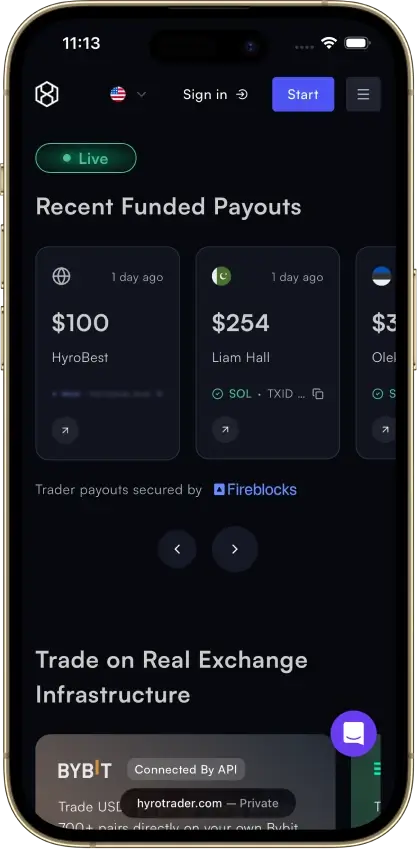
| HyroTrader | USDT or USDC | First eligibility begins after one funded trading day. The operator says requests are normally processed within 12 hours. |
| Crypto Fund Trader | USDT or USDC | Bank transfer is also available. The structured program record places the first payout after 15 trading days. |
Firms We Rate That Are Not in This Comparison
This comparison is intentionally narrower than a list of firms that merely display a crypto symbol. A firm is excluded when crypto is only a CFD inside a general forex account or only a payout method.
| Firm | CryptoSlate Score | Why It Is Not in the Comparison |
|---|---|---|
| FundingPips | 8.4 | Crypto is offered as a CFD inside its Forex/CFD evaluation programs rather than as a crypto-focused product. |
| FundedNext | 8.4 | Crypto is a 1:1 CFD asset class within the Stellar Forex/CFD programs. |
| FTMO | 7.8 | No tradable crypto asset class is disclosed. Crypto appears only as a withdrawal method. |
| The5ers | 7.1 | Crypto instruments sit inside broader Forex/CFD programs rather than a dedicated crypto product. |
| AquaFunded | 6.4 | Its current crypto access is through CFD accounts. The advertised standalone crypto product has not launched. |
| For Traders | 6.3 | Its dedicated crypto rows still use a simulated crypto-CFD product model with no exchange connection. |
| Goat Funded Trader | 5.9 | Crypto pairs are part of a broad simulated multi-asset CFD account rather than a crypto-focused product. |
How These Scores Are Set
Every score uses the same weighted pillars across the site. A crypto-native firm and a forex firm with a crypto tab face identical weights. Payout evidence is graded by class, so a firm's own figure for how much it has paid remains a claim until independently verified. We publish our evidence-weighted scoring model.
Crypto exposure determines inclusion, while the score measures the deal a trader gets. Exchange routing adds no points and simulation subtracts none. Fees and evaluation rules apply regardless of asset class.
Risk Disclosure
Evaluation trading puts the fees paid at substantial risk, and most traders never reach a payout. Simulated accounts are not deposits of trading capital, and nothing here is financial advice. CryptoSlate may earn a commission through links on this comparison and may receive free evaluation accounts for testing, and neither affects the scores.
FAQ
Crypto Prop Firm FAQs
Do crypto prop firms give you actual crypto?
Do these firms trade spot crypto or perpetual futures?
The comparison is about crypto-first prop products, not custody of spot coins. Breakout and HyroTrader focus on perpetual-futures markets. Crypto Fund Trader combines a crypto-first Bybit-integrated interface with simulated crypto instruments on its other platforms. None gives the trader ownership of spot crypto.
Can a prop firm pay you in crypto if it does not let you trade crypto?
What happens to a crypto position over a weekend?
Perpetual-futures markets continue trading through the weekend, and open positions can continue accruing funding. Individual prop firms may still restrict weekend holding, reduce leverage or apply their own risk rules, so check the selected program rather than assuming 24/7 market hours guarantee 24/7 position access.
