


Prop-firm fees are at risk, most participants do not reach a payout, and simulated funding does not necessarily represent live firm capital. This review is informational, not financial advice.
BrightFunded Overview
BrightFunded Screenshots
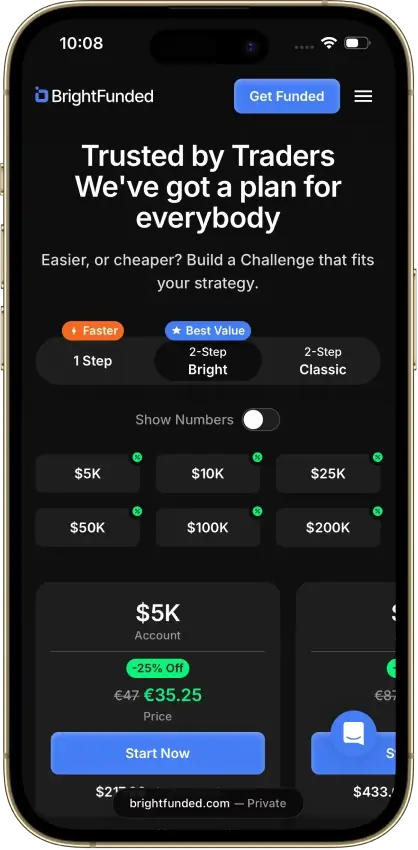
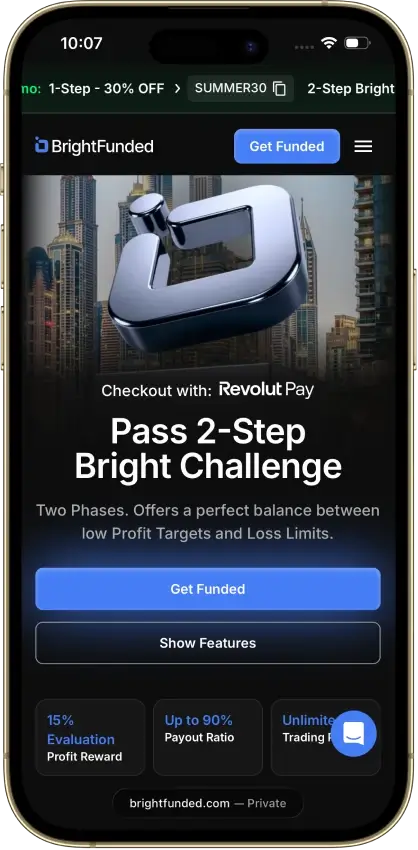
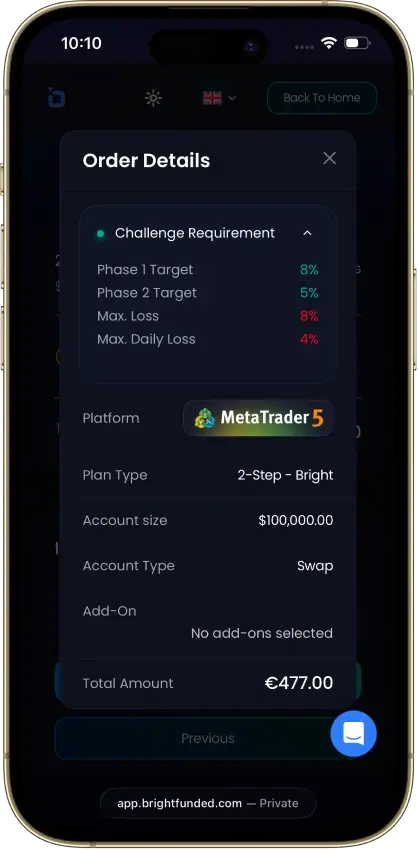
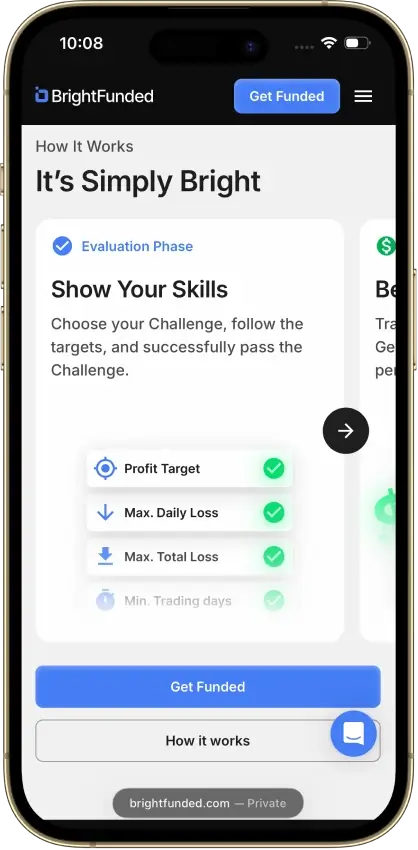

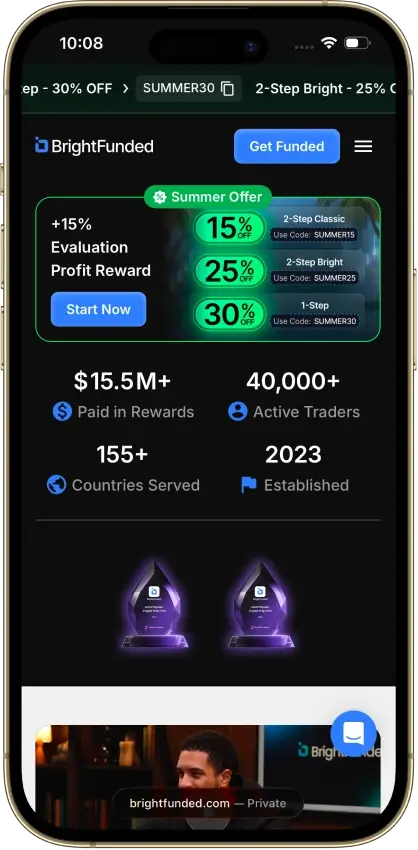
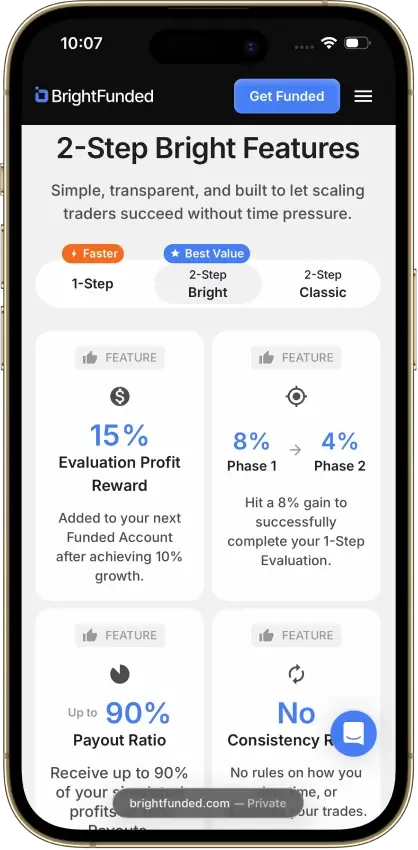
Screenshot 1 of 8
BrightFunded Pros and Cons
Pros
- EAs allowed on supported platforms
- Unlimited time on every evaluation
- $0.01 payout minimum, no firm fee
- Help center publishes drawdown math
- Payouts reported inside 24 hours
Cons
- 6% floor trails, checkout omits the type
- Guarantee scope and remedy undefined
- Default payout waits 30 days
- VAT appears only after buyer details
- Contract and app conflict on sole provider
BrightFunded Discount Code
Account sizes are quoted in USD while fees are billed in EUR, so a “$100,000 account” costs €477 on 2-Step Bright and €497 on the other two programs. Product figures are company-published unless otherwise labeled.
Three codes appear on every page of the company’s site, one per program, and the discounted figures on the plan pages are arithmetically exact against them. The codes reverse the price order. The €497 1-Step falls to €347.90 while the €497 2-Step Classic falls to €422.45, so the trailing-drawdown product becomes the cheaper of the two. The checkout shows the list price until the coupon is entered at its final step. Verified 15 August 2026.
A fourth code, NEW15, appears only after login. Its program compatibility and expiry are not established.
| Code | Discount | Applies to | Verified | Expires |
|---|---|---|---|---|
| SUMMER30 | 30% off | 1-Step only | 15 August 2026 | Not disclosed |
| SUMMER25 | 25% off | 2-Step Bright only | 15 August 2026 | Not disclosed |
| SUMMER15 | 15% off | 2-Step Classic only | 15 August 2026 | Not disclosed |
| NEW15 | 15% off | Logged-in only, program compatibility not established | 15 August 2026 | Not disclosed |
How BrightFunded Works
BrightFunded sells evaluations: one phase on the 1-Step, two on the 2-Step Bright and 2-Step Classic. Its 1-Step sits alongside the other single-phase evaluations we rank. Every phase requires 5 minimum trading days and none carries a time limit. Pass, and KYC runs through SumSub, followed by a risk-team check of one to two business days, up to four in peak periods. The funded stage is then governed by a separate agreement that the company does not provide before purchase. Buyers can read published payout, breach, risk-measure and scaling provisions, but cannot inspect the complete funded agreement or know whether it changes those terms before paying. Under the default terms, the first payout can be requested 30 days after the first funded trade, while the +15% add-on removes that wait.
Free Challenge Access and Limits
The Free $1K Challenge is a $0.00 evaluation carrying the same 80% split, and the same funded route as the paid programs. It runs the same 6% intraday trailing floor as the paid 1-Step. Claiming it takes four gates (a verified email with no aliases or disposable domains, a WhatsApp phone code, a survey, and no active account) under an undisclosed rolling 24-hour claim cap per country. The page’s own top banner misstates the product, printing a 6% target and a 100% payout ratio where its own body and the help center both say 10% and 80%. Four of the six dated KYC reports in the selected complaint sample concern this signup.
1-Step
| Phase | Profit target | Daily loss | Maximum drawdown | Minimum days | Time limit | Consistency rule |
|---|---|---|---|---|---|---|
| EvaluationNote 1 | 10% | 3% | 6% | 5 | None | None |
- The floor sits a fixed 6% of the original balance below the equity high-water mark, including open positions, and locks once it reaches the initial balance. It never rises above the initial balance. The breach test is on equity. A trade must stay open 60 seconds to earn minimum-day credit. There is no time limit and no consistency rule.
Accounts grow 30% of original size per scale-up. The split reaches 90% at the first and 100% at the third, over twelve months minimum. Scaling is requested by emailing support and a single missed objective resets all parameters.
2-Step Bright
| Phase | Profit target | Daily loss | Maximum drawdown | Minimum days | Time limit | Consistency rule |
|---|---|---|---|---|---|---|
| Phase 1Note 1 | 8% | 4% | 8% | 5 | None | None |
| Phase 2Note 2 | 5% | 4% | 8% | 5 | None | None |
- The floor is static and never moves. The daily loss is measured against the original account size. A trade must stay open 60 seconds to earn minimum-day credit. There is no time limit and no consistency rule.
- The floor is static and never moves. The daily loss is measured against the original account size. A trade must stay open 60 seconds to earn minimum-day credit. There is no time limit and no consistency rule.
Accounts grow 30% of original size per scale-up. The split reaches 90% at the first and 100% at the third, over twelve months minimum. Scaling is requested by emailing support and a single missed objective resets all parameters.
2-Step Classic
| Phase | Profit target | Daily loss | Maximum drawdown | Minimum days | Time limit | Consistency rule |
|---|---|---|---|---|---|---|
| Phase 1Note 1 | 10% | 5% | 10% | 5 | None | None |
| Phase 2Note 2 | 5% | 5% | 10% | 5 | None | None |
- The floor is static and never moves. The daily loss is measured against the original account size. A trade must stay open 60 seconds to earn minimum-day credit. There is no time limit and no consistency rule.
- The floor is static and never moves. The daily loss is measured against the original account size. A trade must stay open 60 seconds to earn minimum-day credit. There is no time limit and no consistency rule.
Accounts grow 30% of original size per scale-up. The split reaches 90% at the first and 100% at the third, over twelve months minimum. Scaling is requested by emailing support and a single missed objective resets all parameters.
Free $1K Challenge
| Phase | Profit target | Daily loss | Maximum drawdown | Minimum days | Time limit | Consistency rule |
|---|---|---|---|---|---|---|
| EvaluationNote 1 | 10% | 3% | 6% | 5 | None | None |
- Identical rules to the paid 1-Step. The floor locks at the $1,000 starting balance. Claiming the account takes four gates, a verified email with no aliases or disposable domains, a phone code over WhatsApp, a survey, and no active account, under an undisclosed rolling 24-hour claim cap per country.
Accounts grow 30% of original size per scale-up. The split reaches 90% at the first and 100% at the third, over twelve months minimum. Scaling is requested by emailing support and a single missed objective resets all parameters.
BrightFunded Rules and Restrictions
How the BrightFunded 1-Step floor moves with a winning trade
A $100,000 example showing how the intraday trailing floor rises with floating profit and never falls back.
The 1-Step and the free challenge trail intraday. Both two-step paths are static. The daily limit is always a percentage of the original account size, and it resets during the nightly no-trade window, which the app describes as closed to trading and the help center merely as not recommended. Every marketing page a buyer reads presents the 1-Step 6% as “Max. Total Loss”, a flat cap, and the floor in fact trails. The trailing model itself is common across the category.
How the 6% Floor Moves
The help center article BrightFunded 1-Step, which the contract incorporates as binding product specification, states the rule: “The maximum drawdown is trailing, meaning it follows the high-water mark (the highest equity ever reached on the account). As your equity grows, the minimum threshold rises with it.” The recalculation runs in real time at every new intraday high, and equity includes floating profit on open trades.
On the $100,000 ladder BrightFunded publishes, the floor starts at $94,000 and rises dollar-for-dollar with each new equity peak. Equity of $101,000 lifts it to $95,000 and $103,000 lifts it to $97,000. The trail remains a fixed $6,000 below the peak, not 6% of the current peak. Once balance reaches $106,000, the floor locks at $100,000 and never moves again. The breach test is on equity. The floor tops out at breakeven, so a 1-Step account can be breached at exactly its starting balance, never above it.
Balance $100,000, and an open trade at +$4,000 lifts equity to $104,000 and the floor to $98,000, in BrightFunded’s own worked example. The floating peak raises the floor by $4,000. The trade reverses and closes at −$3,500, leaving a balance and equity of $96,500 against a floor of $98,000, so the account breaches the raised floor by $1,500. A static 6% floor at $94,000 would have kept it alive.
The product documentation contains two unresolved conflicts. The dashboard tooltip words the loss as 6% below the running peak while every worked example uses a fixed $6,000 from the initial balance. Most published materials indicate the fixed-dollar method, but document frequency does not establish contractual precedence. The lock trigger is stated on balance in four places and on equity in one. BrightFunded’s own application text carries the full rule with a worked example, and it reads: once the balance reaches $106,000 on a $100,000 account, the maximum loss level fixes at $100,000. The Rule Summary, the Free $1K specification and the dashboard tooltip agree. The body of the 1-Step help article says equity, and the contract names both drawdown families without naming the trigger. Most published materials indicate a balance trigger, but the contradiction remains unresolved because buyers cannot inspect the complete funded agreement.
Why the 1-Step and 2-Step Look the Same at Checkout
| Product | $100,000 fee | Checkout label | What the floor actually does |
|---|---|---|---|
| 1-Step | €497 | “Max. Loss 6%” | Trails intraday on equity including floating profit, locks at the initial balance |
| 2-Step Classic | €497 | “Max. Loss 10%” | Static from the initial balance |
| 2-Step Bright | €477 | “Max. Loss 8%” | Static from the initial balance |
The 1-Step and the 2-Step Classic cost the same to the cent at every size. The checkout displays “Max. Loss 6%”, “Max. Loss 10%” and “Max. Loss 8%” in identical styling and position, but each uses the same generic “Max. Loss” descriptor without stating trailing or static. A full-page scan at the moment of selection returns no match for “trailing”, “static” or “high water”. The word appears on no plan page at all, and the help center FAQ headed “What kind of DD Style BrightFunded offer?” answers only with the daily end-of-day method.
The help center publishes the omitted distinction with a worked table as contract text. The disclosure is missing from the screen where a buyer pays. Five dated reports since the 13 April 2026 product reset describe breaches under the current 6% trailing rule. Four earlier drawdown-breach reports concern accounts sold under the former 10% static floor and do not support a finding about the current trailing product. BrightFunded’s public replies, undated in our capture, confirm the current rule instead of disputing it. These selected reports are complaints, not incidence rates, and the sampling limits appear in the legitimacy section.
CryptoSlate’s reviewed peer comparison ranks this as the most permissive rulebook on the rules that end accounts. There is no consistency rule on any program at any stage, no time limit, no mandatory stop loss, EAs on supported platforms and hedging within one account are permitted, and news trading is unrestricted through both evaluation phases. Short trades are permitted, but a trade must stay open 60 seconds for minimum-day credit. The help articles that carry the rules are incorporated into the contract by reference, which makes them binding product specification rather than marketing.
Additional funded restrictions apply. The Risk Department holds a published and undefined power to apply “temporary risk measures” to funded accounts, and five dated reports between November 2023 and 15 August 2026 describe a 1% risk measure on accounts sold at 5%, one with a public reply confirming a restriction was imposed, against a homepage that sells “No Hidden Rules”. The published materials do not establish whether the 1% measure refers to risk per trade, total open risk, position size or another calculation. The contract permits the tightening “on any or all of a trader’s accounts”, and the most recent of those traders describes it applying across every funded account on his profile, not only the one that breached. There are no resets. A breach ends the account, and the dashboard then shows a BOUNCE25 code for 25% off the next purchase. No formal breach-appeal route is published beyond contacting support.
| Rule | Limit | Consequence | Applies To |
|---|---|---|---|
| Max daily loss, 1-Step and Free $1K Challenge | 3% | Account breached. Measured against the original account size | All Stages |
| Max daily loss, 2-Step Bright | 4% | Account breached. Measured against the original account size | All Stages |
| Max daily loss, 2-Step Classic | 5% | Account breached. Measured against the original account size | All Stages |
| Max total loss, 1-Step and Free $1K Challenge, intraday trailing | 6% | Account breached. The floor trails equity including open positions and locks at the initial balance, never above it | All Stages |
| Max total loss, 2-Step Bright, static | 8% | Account breached. The floor never moves | All Stages |
| Max total loss, 2-Step Classic, static | 10% | Account breached. The floor never moves | All Stages |
| Minimum trading days | 5 trading days | Phase not credited. Short trades count, but a trade must stay open 60 seconds to earn minimum-day credit | Evaluation |
| News trading | 5 Minutes either side of a high-impact release during which no execution is permitted | Soft breach. The profit on the trade is deducted and the account stays open | Funded |
| Rollover window, 11:30pm to 11:59pm CET | 29 Minutes nightly, from 11:30pm to 11:59pm CET, while daily levels reset | Orders blocked while daily levels reset | All Stages |
| Hedging across own accounts, other prop firms and other brokers | 1 trades | First detection is a warning, one per lifetime. A second is a hard breach | All Stages |
| Copy trading, own accounts only and no signal groups | 1 All copied accounts must be held by the same person | Profit deducted and the account reset, or closed if it is not in profit | All Stages |
| Inactivity | 30 calendar days | Account deactivated. Support reactivates it, and it becomes a hard breach after six months | All Stages |
Prohibited Strategies
- Grid trading
- High-frequency trading
- Tick scalping
- Arbitrage
- Latency trading
- Ultra-high-speed order entry
- Hedging across accounts, including a trader's own accounts, other prop firms and two platforms on one profile
- Copy trading outside accounts owned by the same person, and all signal groups
Marketing vs. Contract
Marketing language is checked against the terms that govern the selected program.
Consistency Rule
BrightFunded imposes no consistency requirement at any point — no largest-day cap, no largest-trade cap, and no profit-distribution requirement anywhere in the contract or the help articles. Several firms CryptoSlate reviews also carry none.
News and Weekend Trading
News trading is unrestricted in Phase 1 and Phase 2. On funded accounts, no execution is allowed five minutes either side of a high-impact release, explicitly a soft breach that deducts the trade’s profit and leaves the account open, with positions opened at least 48 hours before the event exempt. Weekend and overnight holding are both permitted.
Restricted Countries
The contract names five restricted countries: Cuba, Iran, North Korea, Syria and Vietnam. Three operative pages and the live signup data all name six, adding Pakistan with a carve-out for existing accounts, so the operative list is six and the contract is the outlier. MetaTrader 5 is separately declared not intended for US or UAE residents — a platform restriction, not a country ban, and both can trade on cTrader or DXtrade.
BrightFunded Pricing and Account Sizes
Six sizes across three programs run €47 to €997, one-time, with no activation fee, subscription, data fee or reset product. Two firms among the lowest evaluation entry fees we track open below €47. BrightFunded publishes every charge identified in this review. A complete like-for-like price comparison across every asset and competitor is not available, so this review does not claim that every rate is the cheapest. The pricing-screen disclosures are the concern.
The payment screens contain five disclosure defects.
| Defect | What the screen says | What it actually is |
|---|---|---|
| Bi-weekly payout add-on | A sixth priced checkout option at +15%, on no marketing page | It removes the default 30-day wait before a first payout, which the marketing copy never says |
| “Avg. reward” column | A dollar figure on every pricing row | Defined nowhere on the site |
| “15% Evaluation Profit Reward” | $1,500.00 beside the $100,000 fee | A discretionary balance credit on a later funded account, reached through eight steps that include emailing support |
| Add-on stacking | Six add-ons at +10% to +25% each | The +15% bi-weekly and +25% weekly payout-cycle add-ons cannot stack, so the maximum basket contains five add-ons totaling +80%. Swap-free plus the 90% split plus the fee refund takes a €497 1-Step to €695.80. The five-add-on surcharge is €397.60 from the €497 list fee or €278.32 from the €347.90 discounted fee, a €119.28 difference. Base plus add-ons totals €894.60 or €626.22. PayPal adds a further 1% |
| EU VAT | €497 labeled “Total Amount” and “Amount to be paid” | The company’s country data lists VAT rates of 17% to 27% across 27 EU states, but the tax line appears only after a buyer enters name, address, postal code and phone. The review did not record a completed transaction confirming whether VAT was added |
The observed VAT defect is delayed and ambiguous tax disclosure, not a demonstrated overcharge or confirmed exclusion from the final checkout total. Two further charges sit outside the fee. Swap is charged by default unless a trader buys the swap-free add-on at +10%, and the payout terms assign a $5 to $50 processor and bank charge to the trader while the company itself levies no payout fee.
| Account balance | 1-Step | 2-Step Bright | 2-Step Classic | Free $1K Challenge |
|---|---|---|---|---|
| $1,000 | — | — | — | EUR 0 One-time |
| $5,000 | EUR 49 One-time | EUR 47 One-time | EUR 49 One-time | — |
| $10,000 | EUR 97 One-time | EUR 87 One-time | EUR 97 One-time | — |
| $25,000 | EUR 197 One-time | EUR 187 One-time | EUR 197 One-time | — |
| $50,000 | EUR 297 One-time | EUR 277 One-time | EUR 297 One-time | — |
| $100,000 | EUR 497 One-time | EUR 477 One-time | EUR 497 One-time | — |
| $200,000 | EUR 997 One-time | EUR 947 One-time | EUR 997 One-time | — |
BrightFunded Payouts and Profit Split
Payout Terms
Every product carries the same 80% default, the free challenge included, confirmed in five places on the company’s own site down to the checkout tooltip. The homepage promotes “Keep up to 100% of the Profits” without stating the 80% default. The withdrawal amount and frequency terms include no company-levied payout fee, no per-cycle, profit or withdrawal-count cap, and no minimum — “even $0.01” can be requested. Five of nine peers charge a company-side payout fee. At a $10,000 gross payout, the 80% entitlement is $8,000. After the $5 to $50 third-party pass-through, the trader receives $7,950 to $7,995 before FX, or 79.5% to 79.95% of gross simulated profit. Bank transfers pay in EUR against a USD account at an unpublished rate.
Reported speed puts BrightFunded near the top of the firms ranked on payout speed, but the default first-payout schedule requires 30 days after the first funded trade, nine days longer than the next-longest default schedule in the set. The +15% bi-weekly add-on removes that initial wait. Four of the company’s pages carry the phrase “24-Hour Guaranteed Payouts”, while the logged-in payouts screen says “we aim to process your Reward Split within 24 hours”. The contract’s discretionary-reward clause governs eligibility but does not necessarily conflict with processing an eligible, approved request within 24 hours. The guarantee’s scope, starting clock, stopping clock and remedy are undefined, and no stated contractual remedy was identified. Of the nine peer firms whose payout terms CryptoSlate has read, four attach a stated remedy to a payout guarantee and five make no guarantee at all.
Verified Payout Evidence
The payout evidence is Reported and covers speed and occurrence only. CryptoSlate did not run a payout itself, and whether accounts survive to the payout screen is a separate question the record does not establish.
Claimed = the firm’s own figure. Reported = traders, on platforms the firm does not run. Verified = a record the firm does not control.
| Evidence | Evidence Class | Source | Date accessed |
|---|---|---|---|
| An independent broker directory ran its own bank-transfer withdrawal in Q1 2026 and the funds cleared in under 24 hours | Reported | The directory’s own published test | 15 August 2026 |
| Two named, dated traders describe three payouts each, arriving smoothly | Reported — discounted, the platform carries a 30% code for the company | Third-party comparison platform, reviews dated 10 April and 9 July 2026 | 15 August 2026 |
| Payout speed named as the dominant positive across roughly 65 reviews read, with reports from 15 minutes to 17 hours | Reported | Trustpilot and a trader forum | 15 August 2026 |
| The company’s own replies on one-and-two-star reviews state that two payouts were processed, one “successfully” and one “without delay” | Reported | Trustpilot replies, dated 31 July 2026, partial read of the low-star band | 15 August 2026 |
| Seven dated traders describe an account terminated or a reward denied on a coordinated-hedging finding, one naming $3,599 — disputed by the company in public replies naming the alleged conduct | Reported | Trustpilot and comparison-platform reviews, 6 February to 31 July 2026 | 15 August 2026 |
| Lifetime payout totals — the company’s own pages and third parties have carried $6M, $7M, $12.8M, $15M and $15.5M across roughly twelve months, with “15.5 Million+” shown inside the app | Claimed | The company’s own displays | 15 August 2026 |
One reported case describes a payout followed by termination, in the company’s own words on a reply dated 31 July 2026. The reply states that the account “was paid out successfully”, the activity was then “reviewed and found to be in breach”, and the contract was terminated. This is not a reported withheld payout, since the same reply states that the payout ran “without delay”, and the contract is silent on recovering a reward already disbursed. A trader stopped before requesting never appears in reported speed evidence.
Scaling Plan and Trade2Earn
Accounts grow 30% of original size per scale-up, and the split reaches 90% at the first and 100% at the third, over twelve months minimum, with every four-month objective met. A single miss resets all parameters, and scaling is not automatic, so each trader must email support to request it. The scaling page promises “no upside balance limitations” while the contract caps total simulated capital at $400,000 per “customer or strategy”. Two funded $200,000 accounts fill that cap exactly, and any later scale-up would exceed it. The available comparison point has a $200,000 ceiling, which is not enough to call BrightFunded’s cap generous. The material issue is the contradiction between the cap and the unlimited marketing claim.
Trade2Earn is the other route to the advertised 100%. Tokens accrue on every trade, win or lose, and the redemption shop lists a 90% profit share at 171 tokens, a 100% share marked “Rare” at 336, and a free challenge at 708. Tokens have no cash value and can be voided. The +20% add-on provides a stated route from 80% to 90%. The two stated routes to 100% are the third scale-up and a Rare voucher. None of them is the 80% account a buyer opens.
- First scale-up, account grows 30% of original size: 90%
- Third scale-up, twelve months minimum with every four-month objective met: 100%
BrightFunded Platforms and Trading Conditions
BrightFunded runs three platforms, MetaTrader 5, cTrader and DXtrade, with 46 forex pairs including exotics and 48 crypto pairs plus indices and commodities. Leverage is 1:100 on forex, 1:40 on gold and commodities, 1:20 on indices and 1:5 on crypto, identical on challenge and funded accounts by the company’s own statement. Commission is charged on evaluation and funded accounts alike, and the $3 per lot on forex is a published per-lot figure where most firms in how forex firms compare on cost disclose none.
Spread is undisclosed in every form, on the plan pages, the checkout and the help center alike. The company is not a broker, holds no liquidity relationship and names no data-feed supplier, which matters most for how prop firms handle crypto exposure, since its crypto pricing is an aggregated feed at 1:5 and two traders put the round-trip cost at 0.2% to 0.4%. Thirteen dated execution reports in the selected complaint sample between 25 September 2024 and 12 August 2026 describe slippage and spread spikes, one naming a stop filled at $118 against an intended $50. An independent broker directory’s own Q1 2026 test found approximately 0.1-pip EUR/USD spreads and no major-pair slippage. The adverse reports concentrate in crypto and news windows, but the sample does not establish incidence. Two platform constraints apply. Automated trading is unsupported on DXtrade, and both mobile apps are white-label builds.
Is BrightFunded Legit and Safe?
BrightFunded operations have been visible since October 2023, and the company holds no financial license, which is category-normal and not by itself a warning sign. The company writes its name closed, and the Bright Funded spelling traders search returns the same company. Six entity strings appear across four jurisdictions, and two checkable registrations were found. The documents contain a material provider conflict. The contract states “The Services are provided by Bright Global FZCO”, in Dubai, under UAE law and exclusively in the Dubai courts, while the in-app footer states the services “are offered solely by BrightFunded Ltd.”, a Saint Lucia company the contract never mentions. The documents therefore conflict over provider identity and may create uncertainty about the contracting entity. Only the contract supplies a court clause, pointing to Dubai courts. Google Play describes the purchase itself as an “Evaluation Course” buying “educational materials”.
BrightFunded’s Trustpilot profile displays no rating. The count stands at 549 reviews, checked 15 August 2026, and the platform says the rating was suppressed for a guidelines breach after fake reviews were removed. The notice never attributes the removed reviews, so nothing in it separates a company that bought them from one that was targeted by them. The same suppression sits on four of nine peer profiles CryptoSlate scores, which makes it a category condition and not a BrightFunded finding. An unattributed 4.5 badge in the app resolves to a third-party comparison site’s rating, and the App Store shows 2.4 from 12 ratings, too thin to carry a conclusion. The company’s own statistics disagree with themselves. Six pages show both “40,000+” and “27,500+” active traders in the same panel, and the lifetime payout total has been printed five ways in twelve months.
The complaint sample includes roughly 65 Trustpilot and trader-forum reviews considered for payout evidence, 19 indexed forum posts, and selected one- and two-star reviews. It does not measure the incidence of drawdown, coordinated-hedging, execution, risk-measure or KYC complaints across all customers. The sample includes five current-product drawdown reports, four former-product drawdown reports, seven coordinated-hedging reports, thirteen execution reports, five risk-measure reports and six KYC reports. Four of the six KYC reports concern the free-challenge signup. Reports identifiable as the same trader and incident were counted once, but cross-platform duplicates may remain. These are selected complaint reports, not incidence rates.
Two traders allege, on 20 May 2026 and 20 July 2026, that reinstatement was offered against removing a review, and the company’s replies address other points and never the allegation. Thirteen of the nineteen indexed forum posts about the company sit in a subreddit it runs itself, at one upvote each. Two checkable registrations were found, and the reviewed documents contain no speech-restraint clause.
BrightFunded Alternatives
BrightFunded offers no consistency rule, no time limit and, at a $10,000 gross payout under the default terms, $7,950 to $7,995 after the $5 to $50 pass-through before FX. Each of the firms below differs on other terms. FTMO’s published funded terms provide more detail than BrightFunded’s, including funded trading objectives, while BrightFunded does not provide its complete funded agreement before purchase. FundingPips entries from $29 undercut the €47 door, and its one-step floors are static.
A reader who has just met the 1-Step’s moving floor should look at a fixed floor on every Breakout plan, which applies across its whole range. The gap that matters is not the headline percentage but where the floor sits after a winning morning.
Final Verdict
At a $10,000 gross payout under the default terms, the 80% entitlement is $8,000 and a $5 to $50 pass-through leaves $7,950 to $7,995, or 79.5% to 79.95% of gross simulated profit before FX. CryptoSlate nine-firm comparison ranks BrightFunded rulebook as the most permissive on rules that end accounts. What holds it at 5.9 is the paperwork. The checkout uses the same generic Max. Loss descriptor for trailing and static floors, VAT disclosure begins only after personal details are entered, the payout guarantee has undefined scope and no stated contractual remedy identified, and the contract and in-app footer conflict over the sole provider of the service.
No consistency rule on any program · 79.5%-79.95% net at $10K gross payout · Three platforms: MT5, cTrader and DXtrade
Prop-firm fees are at risk, most participants do not reach a payout, and simulated funding does not necessarily represent live firm capital. This review is informational, not financial advice.
Disclaimer: CryptoSlate may receive a commission when you click links on our site and make a purchase or complete an action with a third party. This does not influence our editorial independence, reviews, or ratings, and we always aim to provide accurate, transparent information to our readers.
Scoring methodology
The overall score is calculated from seven fixed categories whose weights remain consistent across prop-firm reviews.
BrightFunded scores 5.9 out of 10 under CryptoSlate’s published prop-firm methodology. Its permissive trading rules and published withdrawal terms are offset by conflicting provider records, unclear checkout disclosures and a payout guarantee with no stated remedy.
| Category | Weight | Assessment | Score |
|---|---|---|---|
| Payout Reliability and Evidence | 25% | Independent payout evidence, every item discounted, classed Reported on speed and occurrence only. No firm fee, no minimum, no cap, but the first payout waits 30 days. | 6.0 out of 10 |
| Rules Fairness and Transparency | 20% | The most permissive rulebook in the reviewed peer set: no consistency rule, no time limit, no mandatory stop loss. Checkout labels trailing and static floors identically. | 5.4 out of 10 |
| Cost and Value | 15% | Every charge is published. The deductions are all pricing-screen accuracy, five defects where money changes hands, led by VAT appearing only after buyer details. | 6.0 out of 10 |
| Trading Conditions | 15% | Three platforms, four asset classes, leverage identical on challenge and funded. No published spread figure, and thirteen dated execution reports hold it at the peer floor. | 7.0 out of 10 |
| Profit Split and Scaling | 10% | An 80% default nets 79.5-79.95% at a $10,000 payout. The ladder resets on any miss, needs a support email each step, and hits a $400,000 cap marketing calls infinite. | 6.8 out of 10 |
| Firm Transparency and Stability | 10% | The contract and the in-app footer each name a different sole provider, in different countries. Named founders and two checkable registrations keep it off the floor. | 4.3 out of 10 |
| Support and Reputation | 5% | 24/7 chat and email, a tested 4.2/5 support sub-score, and replies that cite the rule. Response time untested, and Trustpilot shows no rating for buyers to consult | 5.2 out of 10 |
| Weighted total | 5.9 out of 10 | ||
FAQ
BrightFunded FAQs
Is BrightFunded legit or a scam?
Two registered entities were found, BrightFunded operations have been visible since October 2023, and no adverse finding naming the company was identified across the four European registers checked. It is unregulated, which is normal for prop firms. Its Trustpilot profile displays no rating over 549 reviews, checked 15 August 2026. Selected complaint reports concern the current 1-Step trailing drawdown, coordinated-hedging terminations and KYC delays, but the sample does not establish incidence.
What is BrightFunded's Trustpilot rating?
There is no displayed rating. The profile shows 549 reviews, checked 15 August 2026, under a Trustpilot notice that suppresses the rating for a guidelines breach after fake reviews were removed. The notice does not say who wrote them. The app separately shows a third-party 4.5 badge, and the App Store shows 2.4.
Does BrightFunded actually pay out?
Payouts are reported by traders, not verified by CryptoSlate, and the evidence covers speed and occurrence only, running from 15 minutes to 17 hours across independent reports, while an independent directory’s own 2026 withdrawal reportedly cleared in under 24 hours. Set against that, seven dated traders in the selected complaint sample describe a reward denied or an account closed on a coordinated-hedging finding, disputed by the company in public replies. Those reports do not establish an incidence rate.
Where is BrightFunded based?
The contract and the app footer give different answers. The contract names Bright Global FZCO in Dubai, under UAE law and Dubai courts. The app footer says services are offered solely by BrightFunded Ltd. of Saint Lucia, a company the contract never mentions. Both statements use exclusive language and name different companies, while only the contract supplies a court clause.
How do you get funded by BrightFunded?
Pass one phase on the 1-Step or two on either 2-Step, each needing 5 minimum trading days with no time limit. Short trades are permitted, but a trade must stay open 60 seconds for minimum-day credit. Then complete KYC with photo ID and proof of address, pass a risk check of one to two business days and up to four in peak periods, and sign a separate funded agreement that the company does not provide before that point.
Is there a BrightFunded discount code?
Yes. SUMMER30 cuts the 1-Step 30%, SUMMER25 cuts the 2-Step Bright 25%, and SUMMER15 cuts the 2-Step Classic 15%, verified 15 August 2026. The logged-in area also shows NEW15, but its program compatibility and expiry are not established. The plan pages already display the discounted figures, and the voucher is entered at the final checkout step. The codes make the trailing 1-Step the cheaper of the two €497 products.
Is the BrightFunded drawdown trailing?
On the 1-Step and the Free $1K Challenge, yes. The 6% floor is recalculated intraday on equity including floating profit, locking at the initial balance and never rising above it. The trail remains a fixed dollar amount below the peak, and the lock trigger is measured on balance. On the 2-Step Bright and 2-Step Classic, no: those are 8% and 10% static floors. The word trailing appears on no plan page or checkout screen.
Can US traders use BrightFunded?
Yes. The United States is not on the restricted-country list. MetaTrader 5, however, is declared not intended for US or UAE residents, so American traders pick cTrader or DXtrade, and the app prompts the switch in a dialog. Automated trading is unsupported on DXtrade, which matters for EA traders.
