

D’CENT Wallet vs Ledger Nano X: Which Crypto Hardware Wallet Wins in 2026?





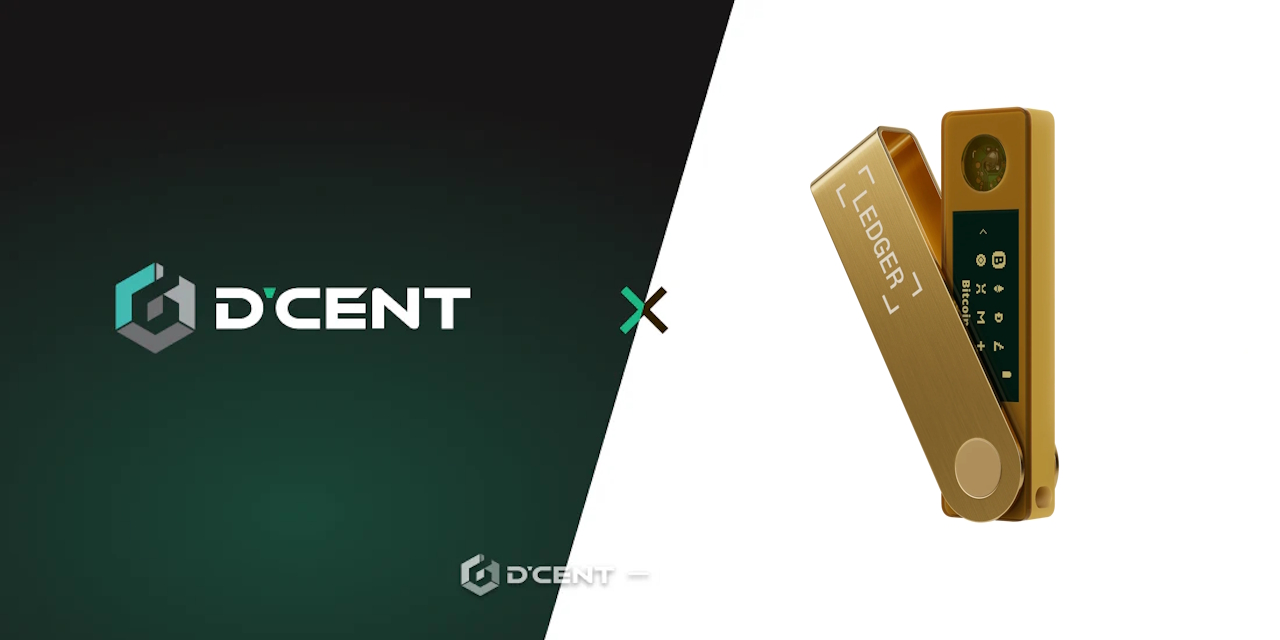
Ledger is a leading crypto hardware wallet provider, renowned for its unique selling points such as reliability, top-tier security, and appealing design. Lately, other manufacturers have been emerging in the market to challenge the dominance of go-to brands with their own cold wallet solutions. One of them is D’CENT, a contender with a new take on hardware wallets that aims to disrupt the industry with its innovative approach.
But how does D’CENT compare to Ledger’s widely known and hugely popular offer? In our detailed D’CENT Wallet vs. Ledger Nano X comparison, we examine what makes the established brand so attractive and what the new challenger brings to the table to settle the debate on which of these crypto hardware wallets comes out on top in 2026 once and for all.
D’CENT Wallet versus Ledger Nano X – Key Takeaways
There’s no denying that Ledger Nano X is much more popular than the D’CENT Wallet. In its 10-year history, Ledger has reportedly sold over 7.5 million devices, with a large portion of this number being its popular Ledger Nano X model. In comparison, D’CENT wallet has reported 100,000 monthly active users in 2021, with the number now estimated to exceed 200,000, a very respectable, but markedly lower count than Ledger’s.
While Ledger Nano X is designed to be mobile-first and built for easy daily use either at home or on the go, the central selling point of D’CENT Wallet is its fingerprint technology. This makes it one of the few biometrically secure hardware wallets, something that Ledger definitely isn’t.
Both wallets offer top-notch security, but Ledger is more widely recognized for its security, thanks to its combination of a CC EAL5+ Certified Secure Chip, ANSSI CSPN certification, and its proprietary BOLOS operating system. Moreover, Ledger is based on open-source software, achieving greater transparency, while D’CENT is a closed-source device.
Both devices feature small displays for basic functions and offer similar battery life, with the Ledger Nano X lasting for up to 5 hours and the D’CENT Wallet holding up to 4 hours.
Both wallets support thousands of cryptocurrencies, including all the crypto staples and some more niche coins. There’s little separating them in the software department, too, as both come with accompanying apps that allow users to manage their assets easily.
- Ledger wallets are a no-brainer for most, especially considering the top-notch security they offer.
- D’CENT Wallet is the perfect choice for anyone looking for biometrics, ease of use, and security without compromising on security.
- Outside of a few minor advantages of the Ledger Nano X, the two wallets are nearly equal in quality.
| Feature | D’CENT Wallet | Ledger Nano X |
| Number of supported cryptos | 4,600+ | 5,000+ |
| Number of supported networks | 84 | Not published |
| Fees | Only gas fees | Only gas fees |
| Mobile app | Android, iOS | Windows, macOS, Linux, Android, iOS |
| NFT support | Yes | Yes |
| Trading tools | Swapping in app. Staking, cross-chain swaps, and other capabilities through dApp integration. | Buying with fiat, swapping, and staking in the app. |
| dApp explorer | Yes, in the app | Yes, in the app |
| Warranty | 1 year | 1 year (3 years with Ledger Replace) |
| Authentication | Biometric (fingerprint), PIN | PIN |
| Secure Element Chip | Secured Firmware with EAL5+ certification | Certified Secure Element (CC EAL5+)
ANSSI CSPN certification |
| Battery type and life | Lithium-ion Polymer 530mAh
Lasts up to 4 hours |
Lithium-ion 100mAh
Lasts up to 5 hours |
| Size | 78.2 mm × 43.2 mm × 10.8mm | 72 mm × 18.6 mm × 11.75 mm |
| Weight | 36 g | 34 g |
| Launch date | 2018 | 2019 |
D’CENT Wallet and Ledger Nano X Explained
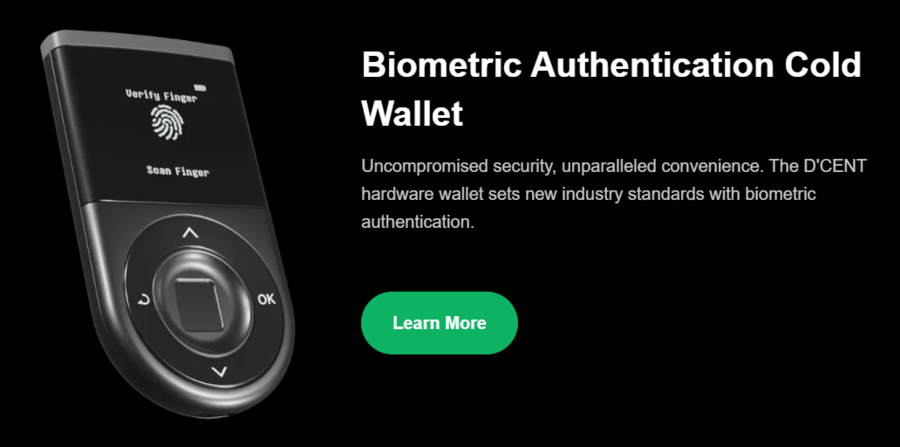
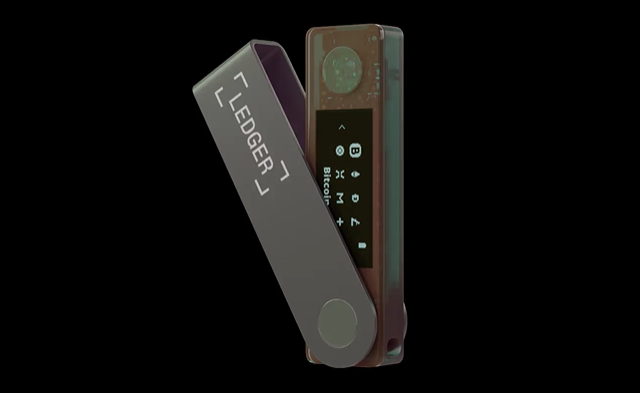
Both D’CENT Wallet and Ledger Nano X are crypto hardware wallets made to store crypto assets in secure cold storage. Design-wise, the Ledger Nano X resembles a USB stick with a display and two physical buttons, while the D’CENT Wallet is akin to an old media player or small remote, featuring a display, fingerprint scanner, and four physical buttons.
While they look different and have some unique features and functionalities, they’re essentially intended for the same purpose: ensuring your crypto enjoys the best possible level of security. But before we compare their main features, let’s look at each separately.
What Is D’CENT Wallet?
D’CENT is a biometric hardware crypto wallet designed for secure storage and easy access via fingerprint. This is one of the wallet’s defining characteristics and a key selling point, as biometric wallets are rare, especially when designed by a trusted development team.
It enables you to store and manage over 4,600 cryptocurrencies and comes with an accompanying app for simplified handling. Moreover, the app is independent, allowing it to function as a standalone hot wallet. This means you can use the app for multiple D’CENT Wallets, each with its own recovery phrase, and easily switch between them within the app.
A variant of the D’CENT biometric wallet is the D’CENT Card Wallet, a full hardware wallet in its own right, designed for easy storage and convenience. It’s significantly cheaper, priced at only $38, making it one of the most affordable hardware wallets on the market. It comes in the shape of a standard credit card, so it fits snugly in your actual wallet.
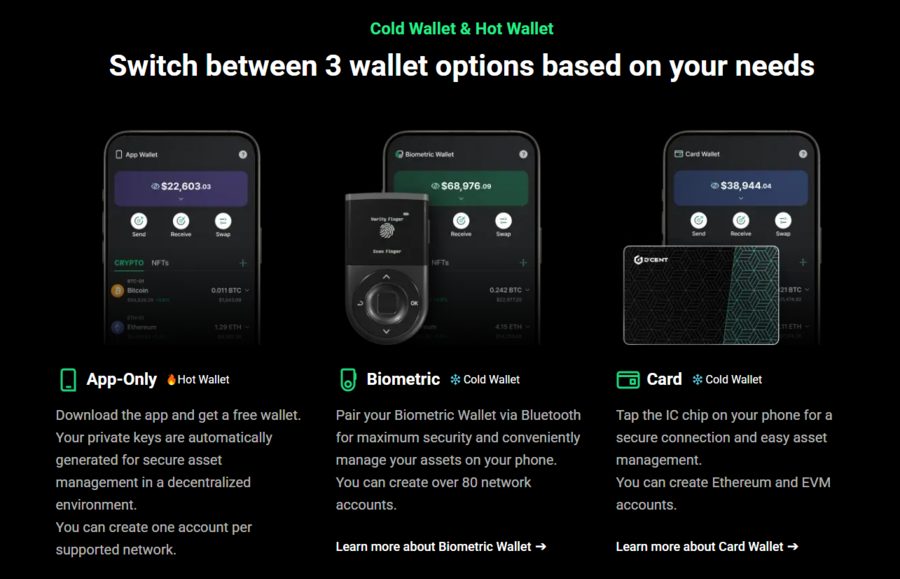
The D’CENT Wallet supports a total of 84 networks, has swapping capabilities, and also lets you store NFTs. The device’s fingerprint scanner enables you to access your crypto without entering a password or PIN. You can also authorize transactions with it, making them even more secure.
The wallet features a Certified Security Chip (CC EAL5+), the industry standard, and connects via Bluetooth. Keys are generated directly in the hardware wallet, completely offline.
You can complete the setup within 5 minutes, and since the device comes with four buttons and a screen, the process is easier than with most other cold wallets.
As a hardware wallet, the D’CENT Wallet charges no fees (apart from network fees), and using the app is also free. The device itself costs $159 but is often available at a discount.
What Is Ledger Nano X?
The Ledger Nano X is one of several Ledger hardware wallets, and one of the provider’s most popular models, catering primarily to users with a mobile-first approach. It’s shaped like a USB stick with a small Monochrome OLED display, making it relatively convenient to use and incredibly easy to store or carry with you at all times. The device weighs only 34 grams, or approximately 1.2 ounces. It’s made of plastic, while the swivel is stainless steel.
Ledger is known for its industry-leading security and is one of the companies that has set the standard for the entire market. All Ledger wallets rely on Certified Secure Element (CC EAL5+) security chips. The Ledger Nano X also has ANSSI CSPN certification. It connects via Bluetooth and uses BOLOS, Ledger’s proprietary operating system.
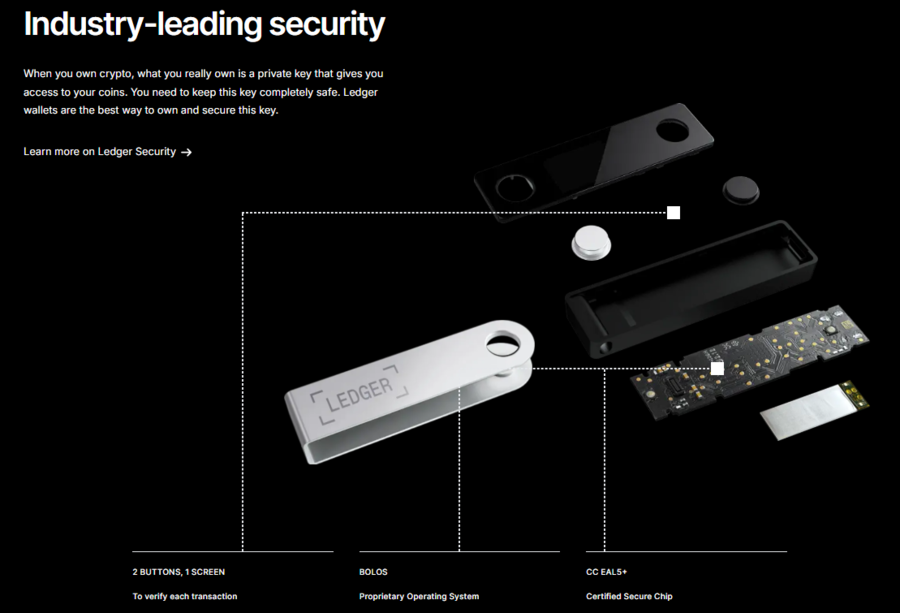
The wallet is equipped with two buttons, which are enough for basic functions, but can be inconvenient for daily use. However, it includes the Ledger Live app, which serves as your go-to solution for everyday transactions and more complex operations.
The app lets you manage crypto and NFTs stored in your hardware wallet. You can use it to swap, buy, and even stake cryptos, including Polkadot (DOT), Tron (TRX), Cosmos (ATOM), Tezos (XTZ), and Algorand (ALGO). It is available on mobile and desktop for Windows, Linux, and macOS operating systems.
The Ledger Nano X is also very versatile, supporting use with over 50 hot wallets other than Ledger Live. While the experience is optimized for Ledger Live, this versatility will be attractive to power users managing diverse crypto holdings.
The setup process can be a bit cumbersome due to the tiny screen and only two buttons, but the app makes it somewhat easier.
The Ledger Nano X is a mid-range option in terms of price, costing $149. The company also offers the Ledger Nano S Plus, which serves as the entry point for most users, priced at $79. There are also the high-end Ledger Flex ($249) and Ledger Stax ($399) wallets, both of which feature larger E-Ink screens.
D’CENT Wallet vs Ledger Nano X: Supported Cryptos
The wallets are tightly matched in terms of the cryptocurrencies they support. Ledger Nano X supports over 5,000 cryptocurrencies from numerous networks, while D’CENT Wallet lets you store over 4,600 cryptocurrencies and currently supports 84 networks. This puts the two on relatively equal ground, especially when considering that both support the storage of NFTs, as long as they are created on blockchains that the wallets support.
It’s worth noting that Ledger supports over 500 coins as well as Ethereum and Polygon NFTs through the use of the Ledger Live app. The 5,000+ number stems from the fact that you can connect third-party wallets to your Ledger Nano X, which extends the supported cryptocurrency list.
This isn’t the case with D’CENT, which allows users to access all supported coins and tokens directly within the app. While some wallets on the market, such as the best anonymous crypto wallets, support even more cryptocurrencies, we find that most of our assets are covered in both wallets.
If you’re looking for hardware wallets with even broader compatibility than the two, check our list of where you’ll find several with over 9,000 or 10,000 supported cryptocurrencies.
D’CENT Wallet vs Ledger: Web3
Since these are hardware wallets, people don’t expect much in terms of advanced features from either device, but thanks to the proprietary apps they come with, they offer a good deal of Web3 functionality.
With either app, you can safely locate and interact with a variety of decentralized applications (dApps) and decentralized finance (DeFi) protocols. And yes, you can interact with various NFT marketplaces and store NFTs in the wallets, as long as they are made on blockchains that the wallets support.
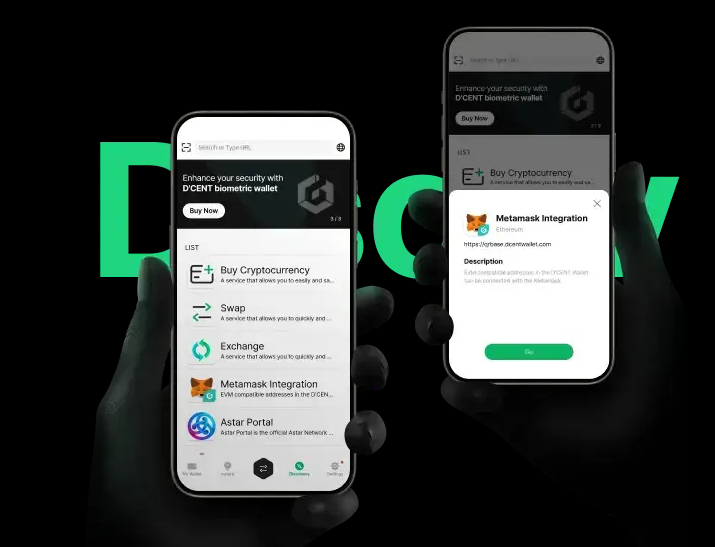
The D’CENT Mobile App, which uses dApps and DeFi protocols, enables cross-chain swaps, lending and borrowing protocols, and stakes various cryptocurrencies. D’CENT has also entered the gamified Web3 world through its Tap That Drop seasonal campaigns.
The Ledger Live app offers similar features, but it also provides some of these Web3 capabilities directly, including staking, swapping, and buying crypto. Outside of that, users have access to dApps that offer options such as lending and borrowing.
Ledger also features a Clear Signing option, designed to ensure transparency by displaying all transaction details on the wallet, allowing you to easily verify them before signing. However, the popularity of Ledger has led many scammers to target people with fake Clear Signing features.
D’CENT vs Ledger Fees
Being hardware wallets, D’CENT Wallet and Ledger Nano X do not charge fees. The companies primarily generate revenue by selling the devices directly to customers.
There are no required subscriptions, but optional ones are available. For example, the Ledger Recover annual subscription, a service that offers secure backup for wallets, is entirely optional.
The main fees people run into while using the wallets are network fees from the blockchains that handle the transactions. You pay these fees whenever you transfer cryptocurrency from one address to another, so whenever you send, swap, lend, or borrow coins, or mint NFTs. These fees are always paid to the network that’s handling the transaction, regardless of the crypto you’re dealing with in the transaction itself.
It’s worth noting that even features like swapping and staking in Ledger Live, for instance, are charged by third-party partners that provide them, such as Changelly or Coinify. The same is true for D’CENT.
Ledger Nano X or D’CENT Wallet: Quality of UX
The design of the two wallets couldn’t be more different, aside from the fact that both feature a small OLED display and a few buttons.
The D’CENT Wallet is shaped like a small remote—or, more accurately, like an old media player. The top half is reserved for the screen, and the bottom half is for the buttons and the fingerprint scanner in the middle.
The Ledger Nano X, on the other hand, is made to resemble a USB stick with a screen and two buttons. It even comes with a steel swivel designed to protect the screen and conceal information.
Both designs are interesting, so it comes down to personal preference. However, the D’CENT is slightly better since it has more buttons, making it easier to use. The fingerprint scanner also makes things simpler, as you don’t have to input a PIN.
However, due to the form factor of hardware wallets in general, neither is very user-friendly. Moreover, the primary purpose of hardware wallets is to be simplistic, thereby reducing potential entry points for cybercriminals.
They are somewhat inconvenient to use, slower than most devices, but relatively suitable for beginners, at least once the setup process is over. This is a small price to pay for the unprecedented level of security. And don’t forget, you’ll interact with your hardware wallet primarily through the app.
D’CENT Wallet vs Ledger Nano X: Mobile Apps
D’CENT Wallet has an accompanying D’CENT Wallet App designed to make using your crypto assets easier and more streamlined. Interestingly, the app can be used independently as a hot wallet with its own addresses, so if you’re not looking for a hardware wallet and only want a free software one, you should consider it. You can install it on an Android or iOS device.
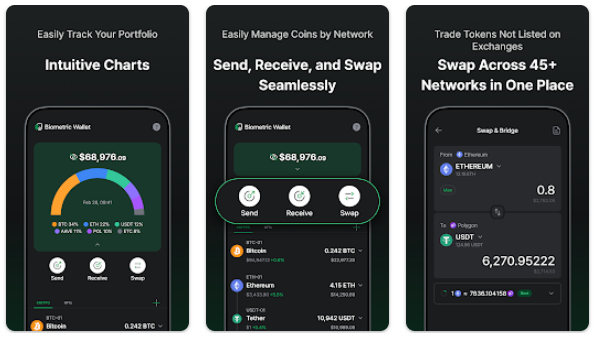
The app enables fast and secure transactions along with D’CENT Wallet and its biometric capabilities. You can swap coins and tokens directly in the app and explore the vast world of Web3. This unlocks additional features like staking, lending, borrowing, and more.
You can monitor assets in real-time within the app, with their fiat values automatically updating. You can send and receive cryptos and view a detailed transaction history. The app allows you to add accounts by simply adding the token, and it will create the necessary mainnet for you. Additionally, you can manually add unsupported assets.
The app supports Wallet Connect, enabling you to connect your D’CENT Wallet with most others.
As for Ledger, the company offers a proprietary Ledger Live companion app that facilitates daily access and use of your crypto and NFT assets on the Ledger Nano X. You can install it on Android, iOS, Windows, macOS, and Linux.
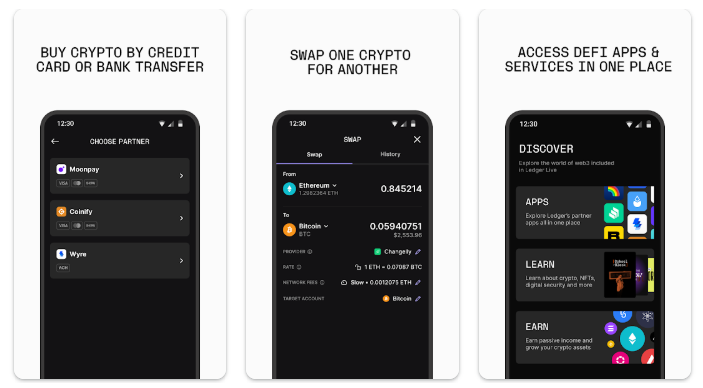
The app increases the number of cryptocurrencies you can store and makes tracking your portfolio easier with a neat layout and real-time view of fiat prices.
Ledger Live also enables you to purchase crypto using bank cards and bank transfers. Swapping and staking of select coins are also available. This is all embedded in the app, but it also allows you to explore the world of Web3, enabling easy connection to third-party services that facilitate staking of additional cryptocurrencies and advanced options such as borrowing and lending.
Ledger Nano X vs D’CENT Wallet Features
Both types of hardware crypto wallets share the primary aspects of storing crypto and signing transactions. D’CENT offers a more interesting and arguably better method of authentication by utilizing biometrics, specifically fingerprint verification, through its embedded scanner located between the buttons.
Both wallets have small OLED screens and support a similar number of coins and tokens, including NFT storage. They pair with dedicated companion apps, which enable further and more robust options, mainly through the connection of third-party dApps and DeFi protocols.
The D’CENT app is more interesting, though, as it doubles as a standalone hot wallet that can operate independently, whereas Ledger Live serves only as a companion app.
| Feature | D’CENT Wallet | Ledger Nano X |
| Authentication | Fingerprint scanner and PIN | PIN |
| Secure element | CC EAL5+ | CC EAL5+ |
| Display | OLED, 128×128 pixels | 128×64 pixels |
| Connection | Bluetooth, USB-C | Bluetooth, USB-C |
| Crypto support | 4,600+ cryptos from 84 networks | 5,000+ cryptos from an undisclosed number of networks |
| dApp interaction | Yes, in the app | Yes, in the app |
| NFT support | Yes | Yes |
| Swapping | Yes, in the app | Yes, in the app |
| Staking | Yes, through third parties | Yes, both in-app and through third parties |
What About Customer Service?
The customer support leaves much to be desired, particularly in terms of the variety of contact methods and the ease of reaching agents.
Neither option has phone support, while live chat is available to some extent with Ledger, since you’ll typically rely on the LedgerBot. For both, the primary method is the ticketing system and detailed help centers.
Ledger doesn’t state when its customer service is available, while D’CENT lists the exact hours.
The good news is that when you reach the agents, they are usually very accommodating and helpful with both brands.
| Customer Support | D’CENT | Ledger |
| Availability | 10 am to 5:30 pm KST Mon-Fri
Lunch break 12:30 pm to 1:30 pm KST |
No information |
| Phone support | None | None |
| Live chat | None | LedgerBot, occasional live support |
| Ticket system | Yes | Yes |
| Agents respond via email when you submit a ticket. No separate email support. | Agents can respond via email when using the site chat widget. No separate email support. | |
| Other materials | User guide, developer guide, D’CENT Academy | Help Center, a dedicated page for ongoing problems |
Are Ledger and D’CENT Legit?
Both companies have established track records and excellent reputations. Ledger has been available since 2014, and D’CENT has been available since 2018. User reviews are largely positive for both.
When it comes to regulations, there’s not much to say here as crypto hardware wallets are merely devices, not financial products. Additionally, crypto regulations vary from country to country and don’t encompass products like hardware wallets.
Ledger is a French company that follows French and EU laws. D’CENT is developed by IoTrust, a South Korean firm, and is therefore subject to the laws of that country.
Both options are very secure when it comes to security. Both use CC EAL5+ certified secure element chips, while Ledger also has ANSSI CSPN certification. Both options are self-custody, and they are counted among the best non-custodial wallets. The main difference is that Ledger is open-source, whereas D’CENT isn’t.
If you would like to compare D’CENT against another brand, check out D’CENT vs Trezor comparison review.
D’CENT Wallet vs Ledger Nano X – And The Winner is?
Because both hardware wallets perform the same basic functions well, it’s all about choosing the one that offers the features you want or like more than the other. Both offer top-notch security, a similar number of supported cryptocurrencies, and broad Web3 and NFT support.
The Ledger Nano X is the more obvious choice for many due to the brand’s strength and its slightly more features, such as buying crypto and staking directly in the app, a slightly stronger battery, and compatibility with app usage on computers.
On the other hand, D’CENT Wallet’s strength lies directly in its biometric capabilities, which don’t exist on any Ledger wallet. Additionally, the app can serve as an independent hot wallet, while D’CENT also offers a very affordable, card-shaped hardware wallet.
If you appreciate the app’s versatility and the ability to sign transactions with your fingerprint, D’CENT is a solid choice. With constant discounts and an easy buying process, you can get your D’CENT Wallet right now without a hitch.
FAQs
Is Ledger Nano X really safe?
Can you cash out from Ledger Nano X?
How does the D’CENT Wallet work?
Is D’CENT Wallet safe to use?
What coins does D’CENT Wallet support?
References
- Ledger Hardware Devices Explained: The 10-Year Evolution (Ledger Academy)
- Ledger Nano X (Ledger)
- D’CENT Biometric Wallet (D’CENT)
- Ledger Nano X vs. DCENT Biometric (etherbit)
- Crypto Hardware Wallets: Everything You Need to Know (Debut Infotech)
- What EAL5+ is, and why receiving it is such a significant achievement (Trustonic)
- Web3 wallets: A complete guide (Kraken)
2M+
250+
8
70






 in numbers

About Cryptonews
Our goal is to offer a comprehensive and objective perspective on the cryptocurrency market, enabling our readers to make informed decisions in this ever-changing landscape.
Our editorial team of more than 70 crypto professionals works to maintain the highest standards of journalism and ethics. We follow strict editorial guidelines to ensure the integrity and credibility of our content.
Whether you’re looking for breaking news, expert opinions, or market insights, Cryptonews has been your go-to destination for everything cryptocurrency since 2017.
