ETHGas Launches GWEI: Can This New Protocol Finally End Ethereum’s Gas Wars?




ETHGas has officially launched $GWEI, a governance token designed to transform the way Ethereum handles transaction fees and blockspace allocation.
The move shows the beginning of what the project calls the Realtime Ethereum era, seeking to solve long-standing issues around Ethereum’s gas market by turning blockspace into a structured, tradable asset.
Unlike traditional gas markets, where users compete in a mempool and fees fluctuate wildly, ETHGas enables predictable execution through pre-confirmations, blockspace commitments, and instant settlement, effectively creating a “gasless” experience at scale.
ETHGas Wants Gasless to Mean Managed, Not Free
The introduction of $GWEI comes at a time when Ethereum’s gas fees are historically low, with base fees averaging 0.03 to 0.054 gwei and simple transactions costing only a few cents.
For example, token swaps average $0.06, NFT sales $0.10, and transfers around $0.02, as even during slightly higher gas settings, total transaction costs remain under $0.01 in most cases.
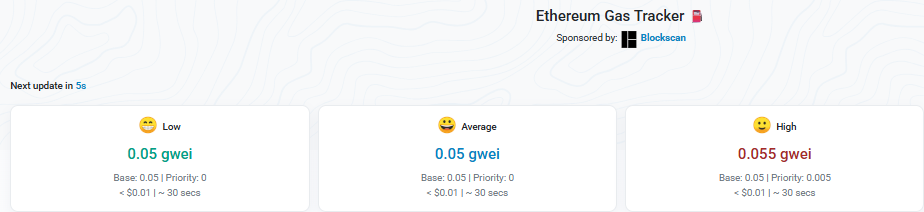
Network utilization is below 50%, block production is steady, and confirmation times average roughly 30 seconds.
Compared with early 2024 peaks, gas prices are down more than 90%, largely due to Layer 2 adoption, capacity increases, and recent protocol upgrades.
Yet ETHGas is not targeting today’s quiet conditions, as its thesis is built around what happens when demand returns and when execution speed, certainty, and cost predictability once again become competitive constraints.
ETHGas noted that the core problem is not simply high fees but the way Ethereum allocates blockspace.
The existing mempool model forces users and applications to bid blindly for inclusion, creating fee spikes, failed transactions, and uncertainty during periods of congestion.
ETHGas seeks to transform blockspace into a structured, tradable asset by using commitments, pre-confirmations, and real-time settlement guarantees, replacing ad hoc bidding with more predictable execution.
In this framework, “gasless” does not mean free transactions but rather abstracted and budgeted costs that are invisible to end users and manageable for applications and institutions.
In December, Ethereum co-founder Vitalik Buterin proposed a trustless, on-chain gas futures market that would allow users to lock in transaction fees, offering greater predictability and a way to hedge against sudden spikes as the network scales.
GWEI Empowers ETHGas Holders With Real Governance Power
GWEI sits at the center of this system as the governance token of the ETHGas protocol and foundation.
The token is designed to give holders direct influence over protocol parameters, treasury allocation, incentive structures, and upgrades.
Staking GWEI converts it into veGWEI, which carries voting power that increases with longer lockups, a model intended to favor long-term participants over short-term traders.
Delegation is built in, allowing voting power to be assigned without transferring ownership, and governance is positioned as the final authority over both routine changes and emergency actions.
The total supply of GWEI is set at 10 billion tokens, with distribution structured around a long-term, 10-year horizon focused on ecosystem growth and protocol sustainability.
ETHGas has also announced a community airdrop, framed as the “Genesis Harvest,” which emphasizes historical gas usage and community verification rather than wallet farming or short-term activity.
The project says this approach is meant to reward users who have actually borne the cost of Ethereum’s fee system over time.
The timing of the launch intersects with a broader shift in where Ethereum’s so-called “gas wars” now occur.
While Layer 1 fees are compressed, intense bidding has moved to Layer 2 environments and MEV-heavy trading venues, where priority fees, pre-confirmations, and execution guarantees can still drive localized fee spikes that are multiples above baseline costs.
Data shows that on some L2s, priority fees make up the majority of daily revenue, paid by a small set of sophisticated users competing for speed-sensitive trades.
- [LIVE] Fed Payments Innovation Conference: Real-Time Updates as Federal Reserve Discusses Crypto, Stablecoins, and AI with Industry Leaders
- China’s Alibaba AI Predicts the Price of XRP, Shiba Inu and Bitcoin By the End of 2026
- China’s DeepSeek AI Predicts the Price of XRP, Bitcoin and Cardano By the End of 2026
- Crypto Price Prediction Today 13 January – XRP, Dogecoin, Maxi Doge
- New ChatGPT Predicts the Price of XRP, Ethereum and Solana By the End of 2026

2M+
250+
8
70





- [LIVE] Fed Payments Innovation Conference: Real-Time Updates as Federal Reserve Discusses Crypto, Stablecoins, and AI with Industry Leaders
- China’s Alibaba AI Predicts the Price of XRP, Shiba Inu and Bitcoin By the End of 2026
- China’s DeepSeek AI Predicts the Price of XRP, Bitcoin and Cardano By the End of 2026
- Crypto Price Prediction Today 13 January – XRP, Dogecoin, Maxi Doge
- New ChatGPT Predicts the Price of XRP, Ethereum and Solana By the End of 2026
More Articles


 in numbers