

XRP Futures Trading Guide: What Is It and How to Start?
We believe in full transparency with our readers. Some of our content includes affiliate links, and we may earn a commission through these partnerships. However, this potential compensation never influences our analysis, opinions, or reviews. Our editorial content is created independently of our marketing partnerships, and our ratings are based solely on our established evaluation criteria. Read More





XRP (Ripple), the native cryptocurrency for the XRP Ledger blockchain, has become one of the most traded cryptocurrencies due to its high volatility. Whether you’re betting long or short, there’s a good chance you’re right – it’s just a question of timing. XRP futures provide a way to bet on Ripple’s price movements while using leverage to amplify your gains.
However, leverage also multiplies losses, making XRP futures trading one of the most exciting and potentially risky trades in crypto. In this guide, we’ll explore how to trade XRP futures, including the different types of futures contracts and where to trade. We’ll also discuss other considerations, such as funding rates, leverage, and liquidation risk. Let’s get started with an introduction to futures and how they work for XRP.

Best Crypto Futures & Options Trading Platform

What are XRP Futures?
XRP futures are a way to trade the future price of XRP without buying or selling XRP itself. Futures are an agreement to buy or sell an asset at a specified price at a future date. Traditional futures use an expiration date, but perpetual futures never expire, and traders can keep the contract open indefinitely.
In most cases, XRP futures contracts settle in cash or stablecoin cash equivalents like USDT or USDC. This means that positions on the price, whether long or short, don’t require buying or selling the underlying asset.
Futures trading has become one of the most popular ways to trade cryptocurrencies due to the leverage available and the ability to hold a trade open with perpetual futures contracts (perps).
How Does XRP Futures Trading Work?
Futures allow market participants to bet on either side of the trade, long or short, while making leverage (borrowing against collateral) available to amplify price movements. Let’s look at perpetual futures because they are more commonly available on trading platforms, and they offer greater flexibility because they have no expiration dates.
Traders pledge collateral (margin) to back the trade, which might be USDT, USDC, or even a coin-margined trade that uses the base asset (XRP in this case). As long as the maintenance margin level is maintained, the trade can remain open. However, if the market starts to turn against the trade or funding rates chip away at the margin enough, the trade may be liquidated.
Let’s define those terms:
- Initial margin: The initial margin requirement is the amount of collateral needed to open the trade. This amount will vary depending on the size of the trade and the amount of leverage used.
- Maintenance margin: To keep the trade open, traders must maintain a specified amount of maintenance margin. For example, a trade with $1,000 initial margin requirements may have a $500 maintenance margin requirement. If the market turns against the trade, the maintenance margin shrinks. If the maintenance margin falls below the minimum requirement, the trade is at risk of liquidation.
- Funding rates: Perpetual futures use funding rates to create incentives and disincentives that keep the contract price close to the market price. For example, if the short side of the trade is too heavy, shorts pay a fee to longs in the trade. Funding rates can add to or reduce the maintenance margin, depending on whether the trader is earning or paying.
- Liquidation: If the maintenance margin falls below the required level, the exchange or trading platform can close the position to protect itself from losses. In the end, the trader keeps the remaining equity after the trade settles, less any liquidation fees.
Leverage in Action
Let’s use an XRP futures trade as an example. You think XRP’s price will go down, so you open a $1,000 short position at 10x leverage. To make this trade, you’re using 10% of your own money (margin) and the exchange provides the remaining 90%.
- Initial margin: $100
- Maintenance margin: $50
In this example, if XRP’s price rises by 5%, your position is at risk of liquidation. However, if it falls by 5%, you have $50 in profit.
However, for perpetual futures, traders also have to consider funding rates, which are typically charged every 8 hours and can add or subtract from the equity in the trade.
How to Trade XRP Futures: Step-by-Step Guide
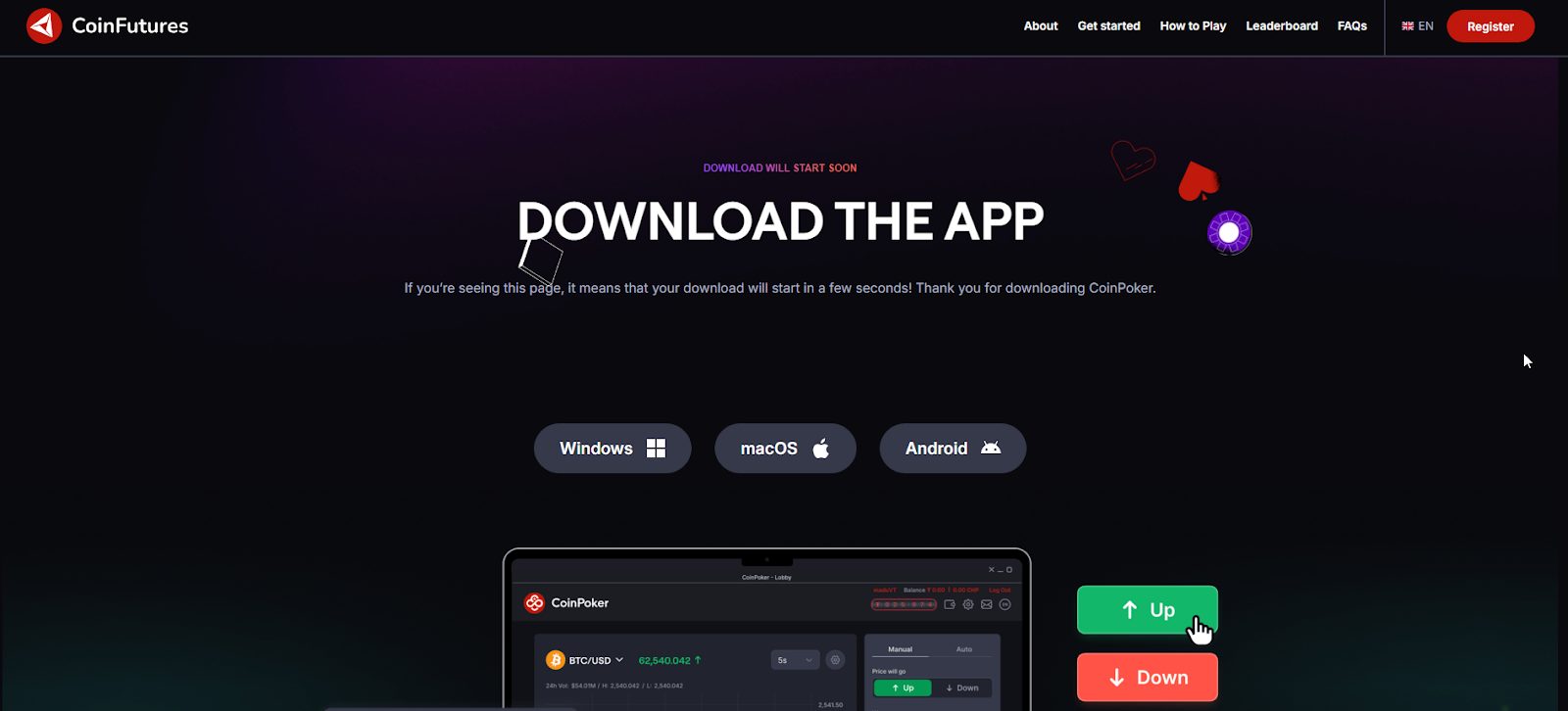
The CoinFutures app, available for Windows, macOS, and Android, simplifies XRP futures trading and doesn’t require Know Your Customer (KYC) identity verification. We’ll use the Windows app for a quick walkthrough on one of the easiest ways to trade futures.
1) Set up an Account
Visit the CoinFutures website and create an account. Provide an email address, then choose a nickname and a secure password.

Then, download the app. CoinFutures supports Windows, macOS, and Android.
2) Fund Your Account
Tap the Wallet icon on the top menu to see payment options for trades. In this example, we chose USDT on the Ethereum network, where we already had funds.
If you don’t have USDT, you can use a low-fee crypto exchange to buy USDT and send it to your “CoinPoker” wallet address (CoinPoker powers CoinFutures), which is displayed in the app.

3) Choose Crypto Futures to Trade XRP
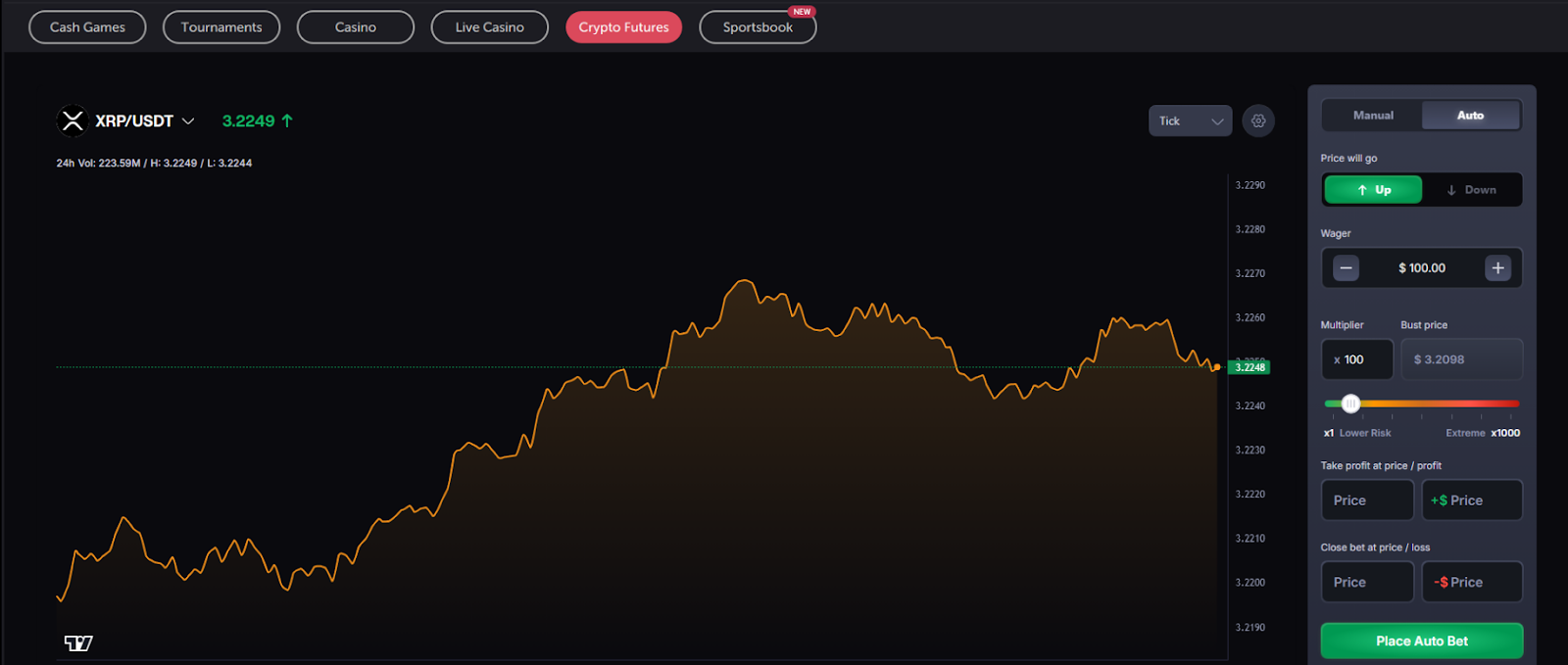
Select Crypto Futures from the top menu in the app, then select XRP/USDT from the drop-down list.

4) Choose a Price Direction
Choose a price direction for your bet (Up or Down), then select a wager amount. Although CoinFutures gamifies futures trading, the mechanics under the hood work like futures on an exchange.
Next, choose a “wager” amount. This amount acts as your margin. The platform also shows your “Bust price,” which is the point at which you lose the bet.
5) Choose a Multiplier
This is the leverage discussed earlier. Leverage amplifies gains by using a smaller amount of capital to control a larger trade. CoinFutures offers leverage of up to 1000x, but remember, leverage amplifies losses as well. At 1000x, a minuscule price move against your trade could make you go bust.
CoinFutures also offers an “auto” setting, which allows you to set a price to take profit or cut your losses without watching the chart.
6) Place Your Bet
Check your settings and place your bet if everything looks right. Be aware that CoinFutures charges a funding rate based on the duration of the trade. Trades open for more than 1 hour incur additional costs that can reduce your available margin.
Best Platforms to Trade XRP Futures
While apps like CoinFutures simplify XRP futures trading, a growing number of platforms now offer trading tools and direct access to trading markets.
These include centralized exchanges (CEXs), which remain the most popular choice for retail traders, as well as decentralized exchanges (DEXs), XRP futures ETFs, and futures trading on the Chicago Mercantile Exchange (CME).
Centralized Exchanges
Many centralized crypto exchanges have long offered XRP futures trading, primarily through perpetual futures contracts. Regulatory uncertainty led US-based exchanges to shy away from derivatives like futures, but today, traders can access CFTC-regulated Coinbase XRP futures trading with up to 10x leverage.
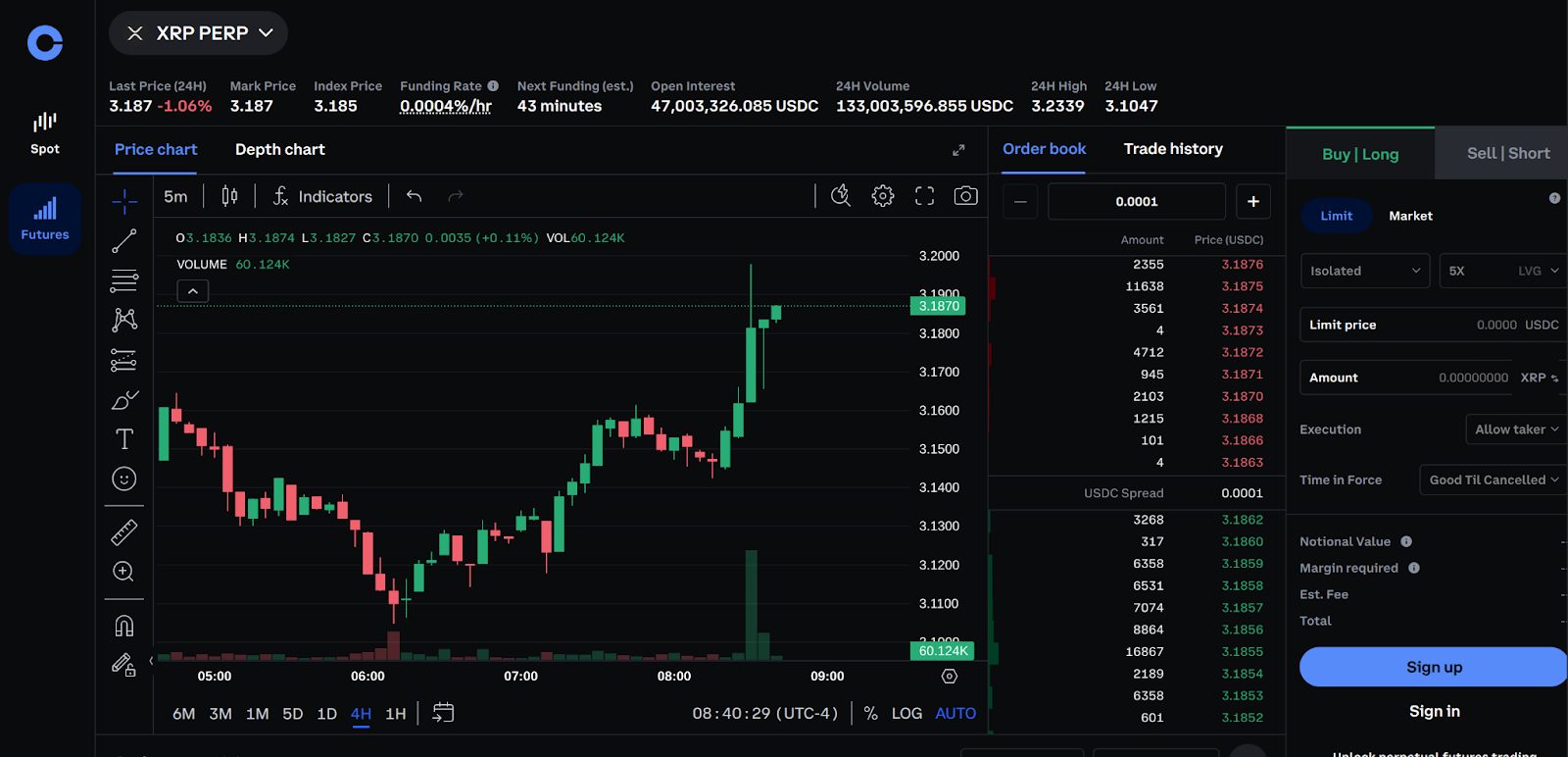
Kraken also offers XRP futures, again limiting leverage to 10x for safety reasons. Other platforms, such as Binance, increase available leverage on XRP futures to 50x.
Decentralized Exchanges
Smart contracts (computer programs that run on the blockchain) make it possible to build trading platforms that are accessible to everyone. Some of the best-known examples include dYdX and GMX, both of which offer XRP futures trading alongside other leading cryptocurrencies and even meme coins.
For example, GMX enables XRP futures with up to 100x leverage. Users connect a crypto wallet to access the platform and can use a wide range of cryptocurrencies to fund the trade.
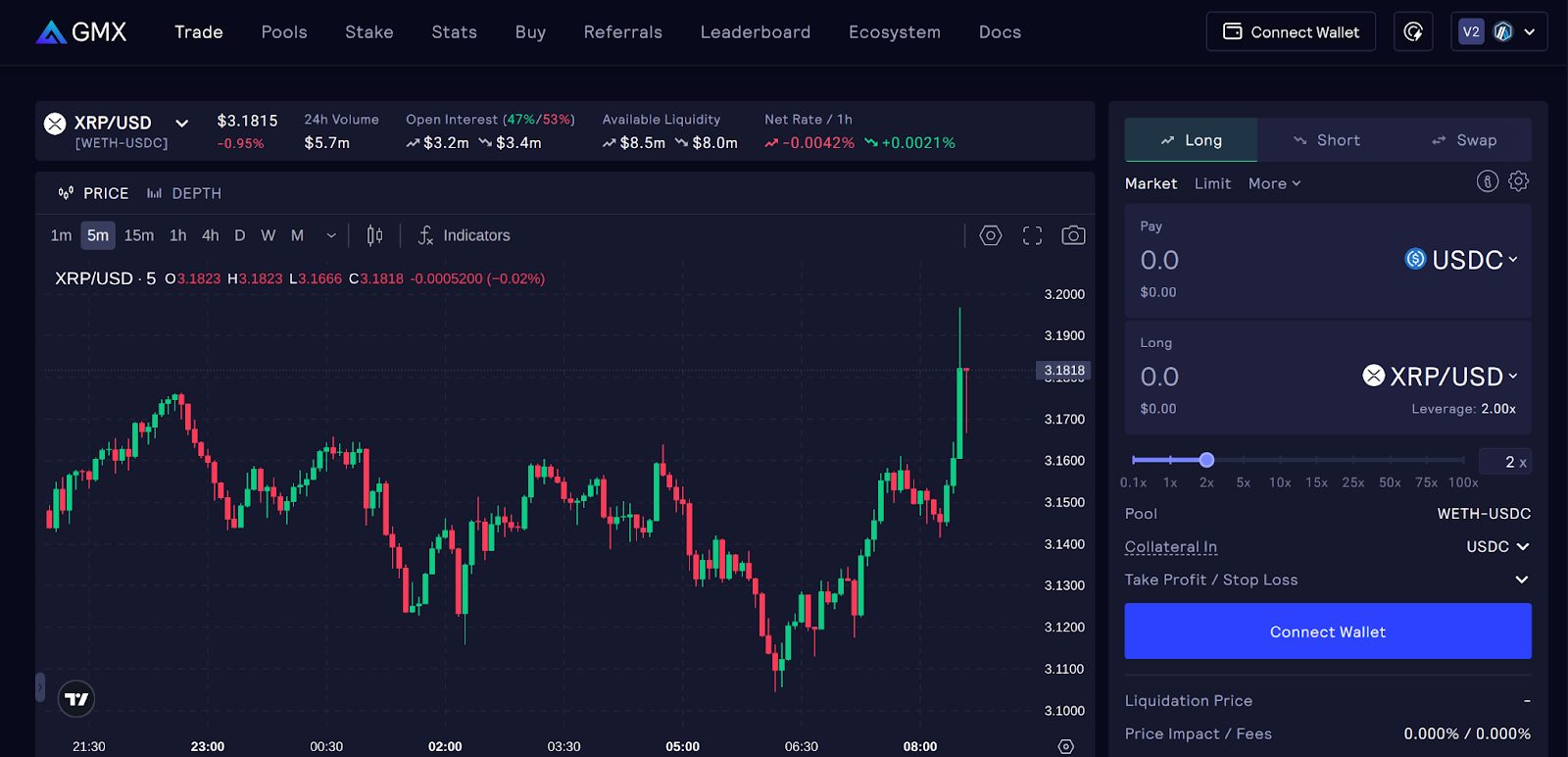
DEXs cater to more experienced traders as they require a bit more knowledge of crypto wallets, and higher leverage brings more risk, particularly for newer traders.
XRP Futures ETFs
Before the US SEC approved spot crypto exchange-traded funds (ETFs) for Bitcoin, crypto futures ETFs provided a proxy for crypto markets, allowing investors to gain exposure to crypto prices in stock brokerage accounts.
These crypto futures ETF funds buy and sell crypto futures contracts on the Chicago Mercantile Exchange, which we’ll discuss in the next section. While these products initially focused on Bitcoin and Ethereum, investors can now access XRP futures through ETFs.
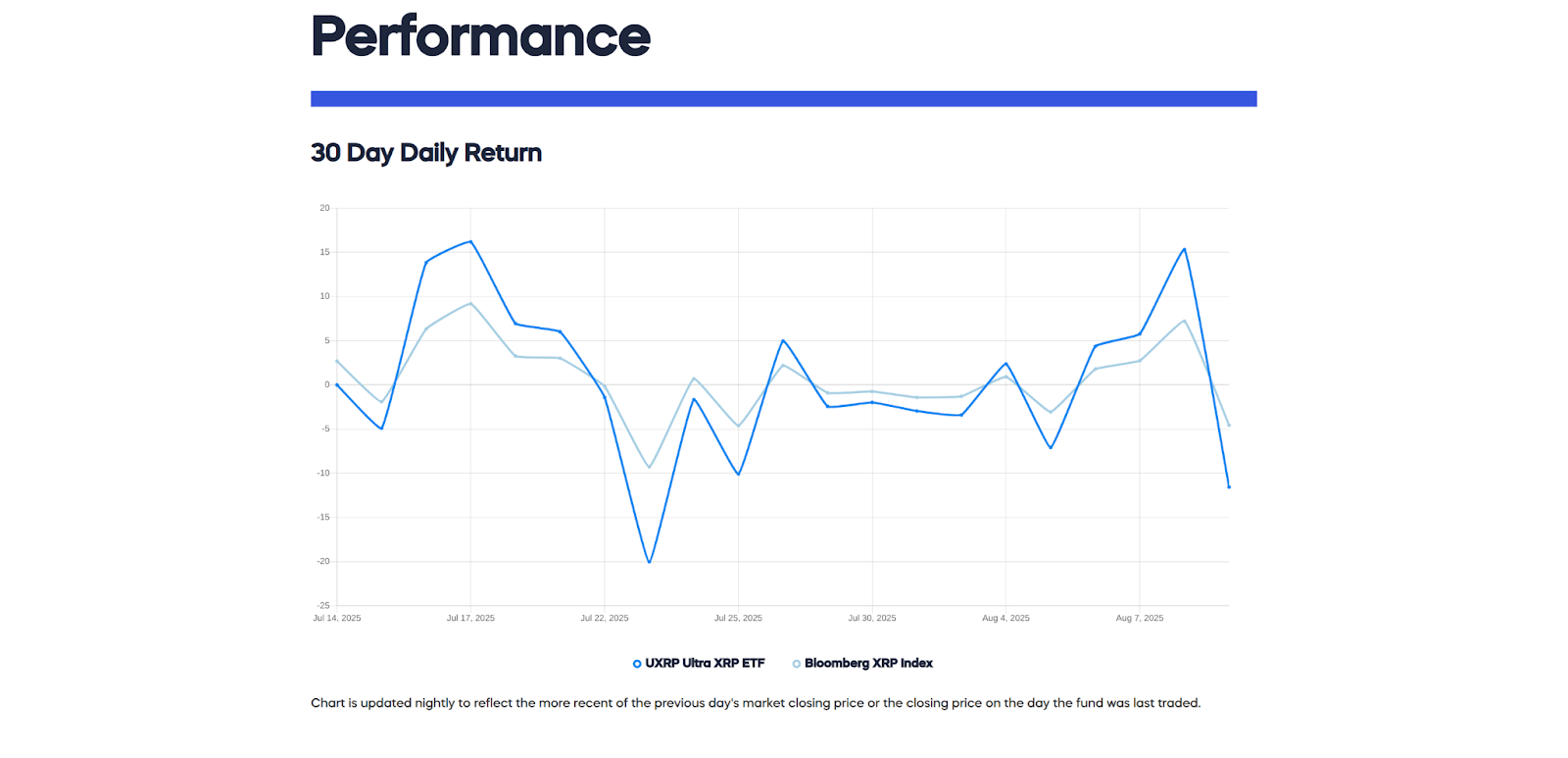
For example, the ProShares XRP futures ETF launch in 2025 gave investors access to XRP price action with a leverage multiplier. ProShares Ultra XRP ETF (UXRP) targets a 2x return compared to the Bloomberg XRP index.
Unlike futures contracts on DEX or CEX platforms, investors don’t need to set up a complicated trade or monitor maintenance margin levels and funding rates. Instead, buying or selling is as easy as clicking the buy or sell button on a brokerage platform.
CME Trading
Primarily used by institutional investors, hedge funds, and professional traders, futures markets on the Chicago Mercantile Exchange (CME) offer another way to trade XRP futures.
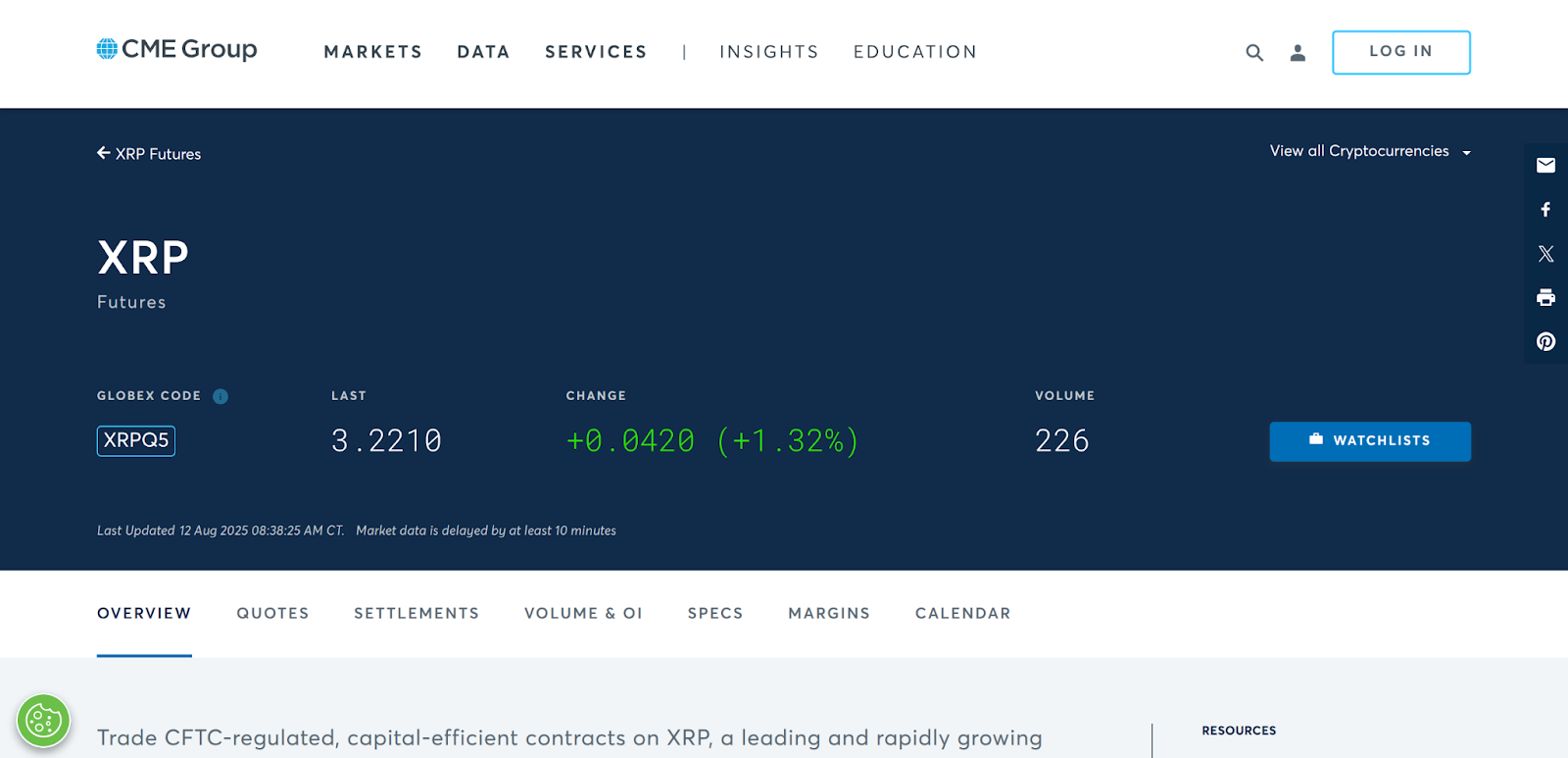
US-regulated XRP futures on the CME ensure compliance with regulatory requirements, which is essential for many institutions. The CME itself monitors trading. The US Commodities Futures Trading Commission (CFTC) regulates commodities on the exchange.
Types of XRP Futures Trading
While CEX and DEX trading largely centers on perpetual futures contracts, some trading platforms offer delivery futures contracts. Both types of futures contracts provide a settlement mechanism when the trade concludes, but delivery contracts use a fixed date for settlement. Typically, these delivery contracts use a quarterly schedule.
By contrast, perpetual XRP futures contracts can be held open indefinitely, assuming traders maintain the minimum maintenance margin requirements.
In CEX and DEX trading, traders can also choose between coin-margined and stablecoin-margined futures contracts. The distinction between these is based on the type of asset used as collateral in the trade.
For example, an XRP coin-margined contract uses XRP as collateral for the trade. If XRP dips, the trade becomes riskier as the falling value of the collateral affects the maintenance margin. However, if XRP rises, traders benefit from more breathing room.
By contrast, stablecoin-margined futures use a popular stablecoin as collateral in the trade. Common choices include USDT and USDC, both of which are cryptocurrencies designed to track the value of the US dollar.
Benefits of XRP Futures Trading
XRP futures trading offers several benefits, including capital efficiency through leverage (enabling control of a larger trade with less money) and the ability to trade the market in both directions.
- Leverage: Using 10x leverage, which is commonly available even on more conservative platforms, traders can multiply gains by 10x. For example, a 5% gain on XRP equals a 50% return based on the trade collateral.
- Capital efficiency: With leverage, traders don’t need to put as much money into each trade. This allows them to make additional trades or larger trades.
- Short or Long trades: Short trades represent a bet on falling prices. XRP futures trading offers a way to profit from falling markets or short-term dips.
- Hedging: Traders who are long on the market can use XRP futures contracts to earn profits during short-term reversals without selling their long holdings.
- High liquidity: On some trading platforms, futures trading is the largest trading market. This higher liquidity and trading volume helps ensure there is always someone to take the other side of the trade, making trading more efficient.
Risks and Drawbacks of XRP Futures Trading
While XRP futures trading offers several advantages, there are also some potential risks and drawbacks to futures vs spot trading. These include the risk of amplified losses, which can also make trading more stressful.
- Leverage losses: Leverage works both ways in futures trading, so a 5% price dip on a 10x long trade means a 50% loss based on the trade collateral. In many cases, this is the level at which exchanges can liquidate the position, locking in the loss. By contrast, spot traders can ride out the dip without taking a forced loss.
- Liquidation risk: Both XRP’s price movements and funding rates can contribute to liquidation risk. If the trading platform liquidates a position, losses are locked in. Liquidation fees may also apply, increasing the loss further.
- Margin calls: In brokerage trading, traders may receive a margin call, which is a request for additional collateral. This may force the sale of other positions, and if the margin can’t be raised, the position can be liquidated.
- Trade complexity: Futures trades can be more complex than spot trading. This can lead to trading decisions that put investment capital at risk.
- Emotional effects: Market volatility can lead to wide swings between profits and losses. Leverage compounds these price moves, which can cause more stress compared to spot trading.
Conclusion
XRP futures provide a more efficient way to trade XRP’s price moves. Usually, a platform that supports XRP futures also supports perps, whereas delivery futures with an expiration date are less common. However, while XRP futures offer better capital efficiency and the opportunity for outsized gains if the trade goes right, it’s important to consider the risks as well.
Many platforms now offer demo accounts that allow new traders to learn the ropes and let experienced traders test trading strategies without risking money.
The ability to chart patterns and weigh market sentiment indicators can also increase the odds of successful trades. With careful risk management and a time investment in learning trading patterns, XRP futures trading offers a way to trade the market that can outperform the asset itself.
FAQs
What is the difference between XRP futures and spot trading?
What crypto exchanges allow XRP futures trading?
Where can you trade XRP futures in the US?
Is XRP a security?
What is the minimum amount you need to trade XRP futures?
What time does CME XRP futures open?
References
- CFTC Regulation 40.2(a) Certification: Listing of XRP Futures Contract (cftc.gov)
- Statement on the Approval of Spot Bitcoin Exchange-Traded Products (sec.gov)
- UXRP Ultra XRP ETF (proshares.com)
- Market Regulation (cmegroup.com)
- CME Group Rules and Regulation Overview (cmegroup.com)
2M+
250+
8
70







 in numbers

About Cryptonews
Our goal is to offer a comprehensive and objective perspective on the cryptocurrency market, enabling our readers to make informed decisions in this ever-changing landscape.
Our editorial team of more than 70 crypto professionals works to maintain the highest standards of journalism and ethics. We follow strict editorial guidelines to ensure the integrity and credibility of our content.
Whether you’re looking for breaking news, expert opinions, or market insights, Cryptonews has been your go-to destination for everything cryptocurrency since 2017.
