


Bitstamp Overview
Additional details
Bitstamp Screenshots
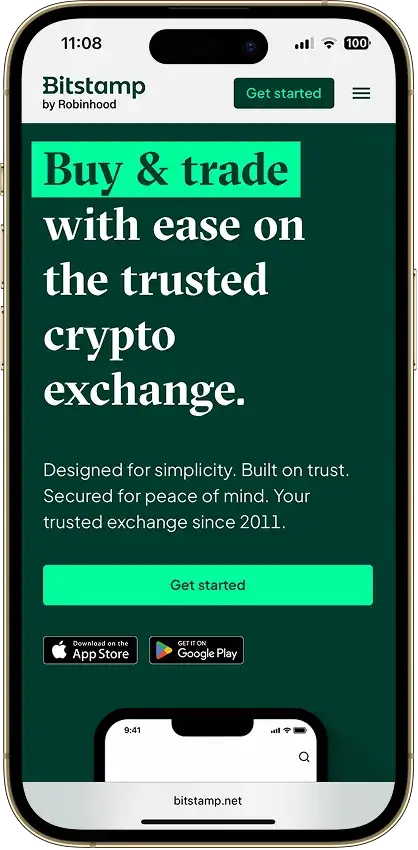
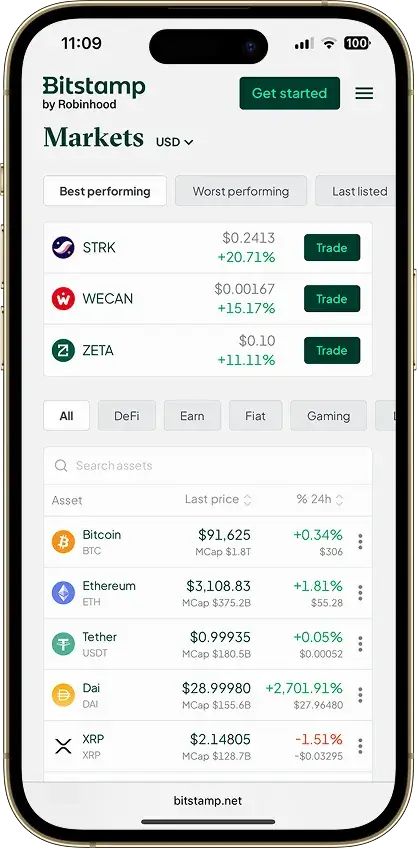
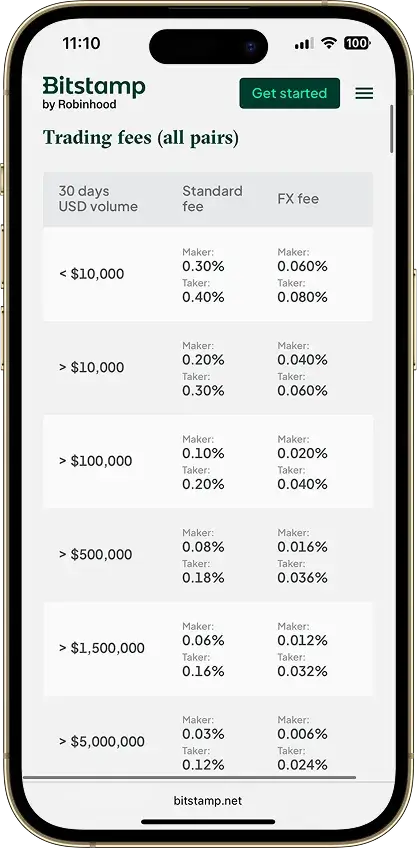

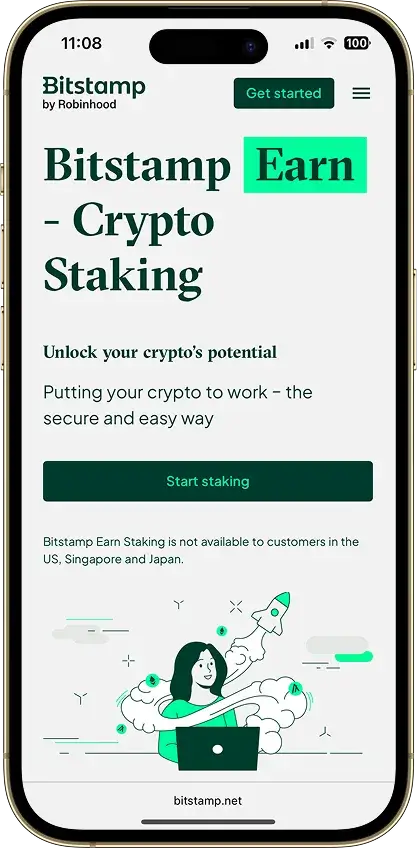


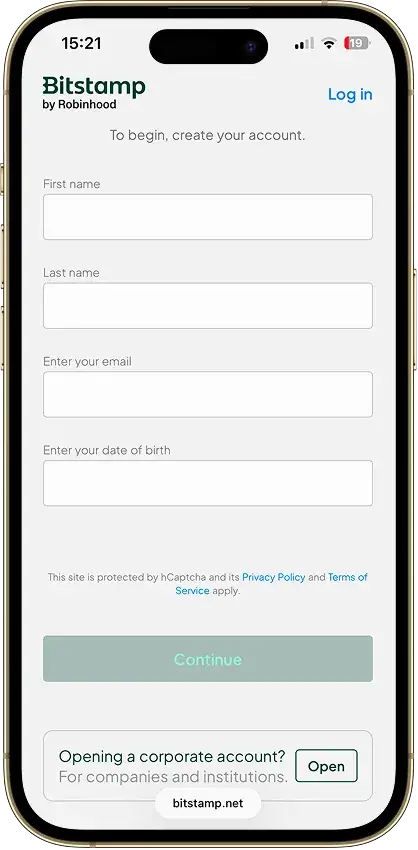
Screenshot 1 of 8
Bitstamp Pros and Cons
Pros
- Free ACH withdrawals, flat €3 SEPA cash-outs
- Fees to 0.00%/0.03%, FastPass from 0.01%
- Per-asset networks shown before login
- ~95% cold storage; BitGo custody + insurance
Cons
- No public proof-of-reserves page confirmed
- Support reputation is a real drag
- Fewer extra products than larger global rivals
- Instant Purchase costs 4% vs order-book path
Quick Decision: Is Bitstamp Worth It?
Bitstamp is worth using if you want a mature fiat bridge, can live with less public fee transparency, and plan to trade on the order book or use the API. It falls short for users who need a wide retail feature set, want instant cost clarity before signing up, or expect fast support when an account gets restricted.

Use Bitstamp if you want a solid exchange with real API depth. Skip it if you need a feature-heavy retail ecosystem or best-in-class support.
Who Bitstamp Is Best For And Who Should Skip It
Bitstamp's clearest strengths are in its markets, currencies, and API documentation, not in flashy promotional surfaces. The users who get the most out of it tend to care about infrastructure over experience, and that shapes almost everything about how the platform is built.
Bitstamp makes the most sense for users who want a mature trading venue with bank-friendly DNA and strong programmatic access. If you want copy trading, deep Earn marketing, a broad card product, or a polished retail funnel, Binance, Coinbase, or Kraken will look better on almost every front. You can see how the full field stacks up in CryptoSlate's crypto exchange comparisons.
Features And Services

Bitstamp's feature set is more complete than its public reputation suggests. Its API surfaces, navigation, and market endpoints show spot trading, perpetuals, mobile support, and earn tools, even if the brand markets them more quietly than louder retail-first rivals do. The gap between what Bitstamp supports and what it advertises loudly is real, and it catches users who judge the exchange by its marketing rather than its product.
Supported Assets And Markets
Bitstamp lists over 159 crypto assets, 4 fiat currencies, 298 spot markets, and 20 perpetual markets across its currencies and markets endpoints. That scale is easy to underestimate: Bitstamp isn't a small legacy venue, it's a substantial one that happens to run quietly.
The fiat coverage includes USD, EUR, GBP, and SGD. Stablecoins span USDC, USDT, RLUSD, GUSD, DAI, and other fiat-linked assets. That combination, real fiat pairs plus a reasonable stablecoin stack, is part of why Bitstamp still appeals to users who want a proper fiat bridge rather than a crypto-only venue.
Product access varies by jurisdiction, so US users should confirm availability for specific markets, particularly derivatives, before treating the full list as accessible to them.
Staking And Rewards
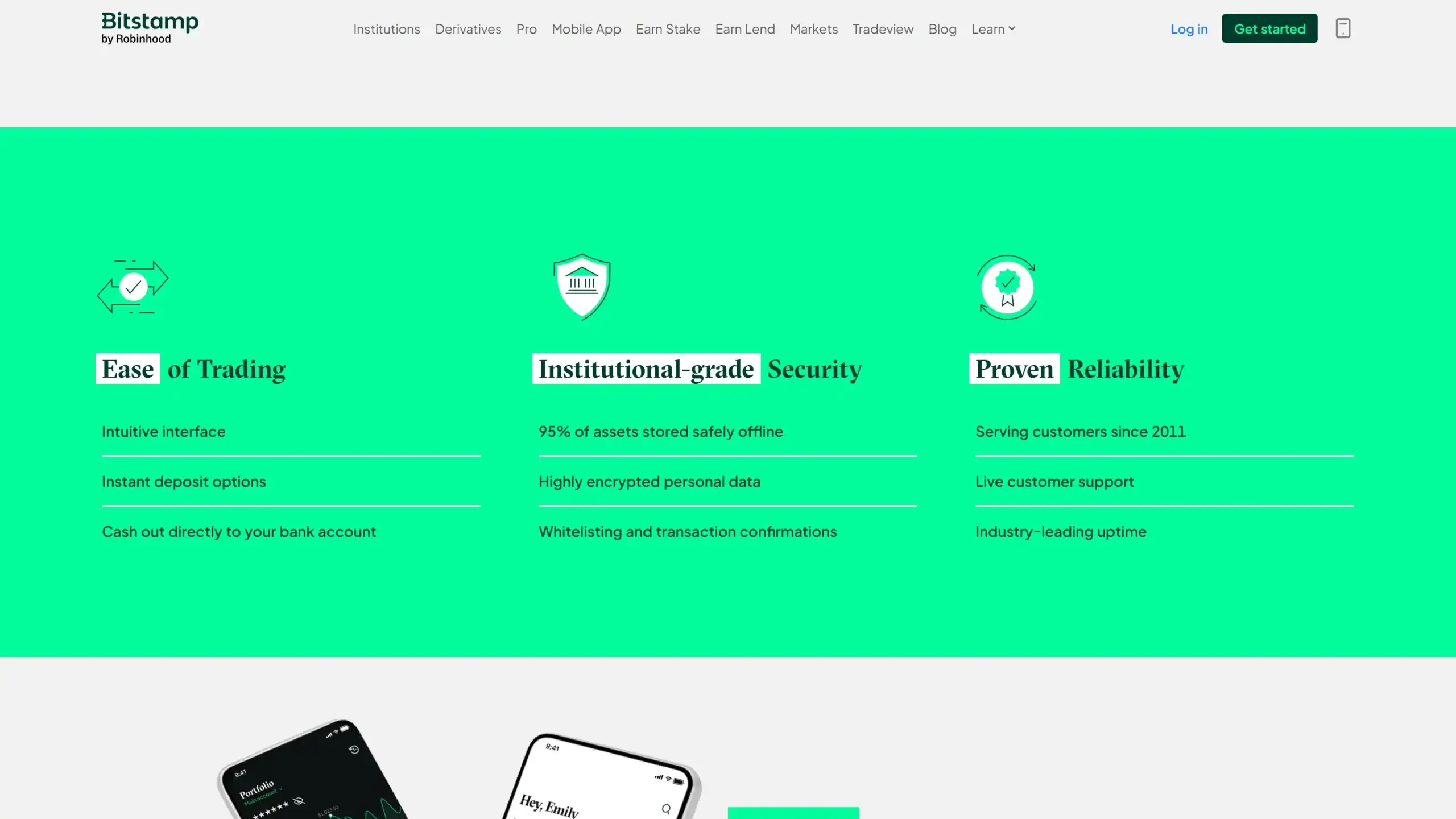
Bitstamp offers both Earn Stake and Earn Lend, and the API stack includes earn subscription and transaction endpoints. ETH and ADA are currently listed for staking, with yields up to 4.40% APY and monthly reward payouts. That's a workable earn product, though payout detail and regional limits are thinner in public-facing materials than on larger retail platforms. Earn staking is also unavailable in several US states.
For users comparing staking-focused crypto exchanges, the honest read is that Bitstamp's earn product exists and functions, but it's secondary. It's not the reason to choose this exchange.
Card
Bitstamp does not offer a branded spending card. It does support credit and debit card crypto purchases via Instant Purchase, but that route carries a 4% service fee before issuer fees apply. That makes it a convenience option, not a cost-efficient one.
Wallet And Self-Custody Options
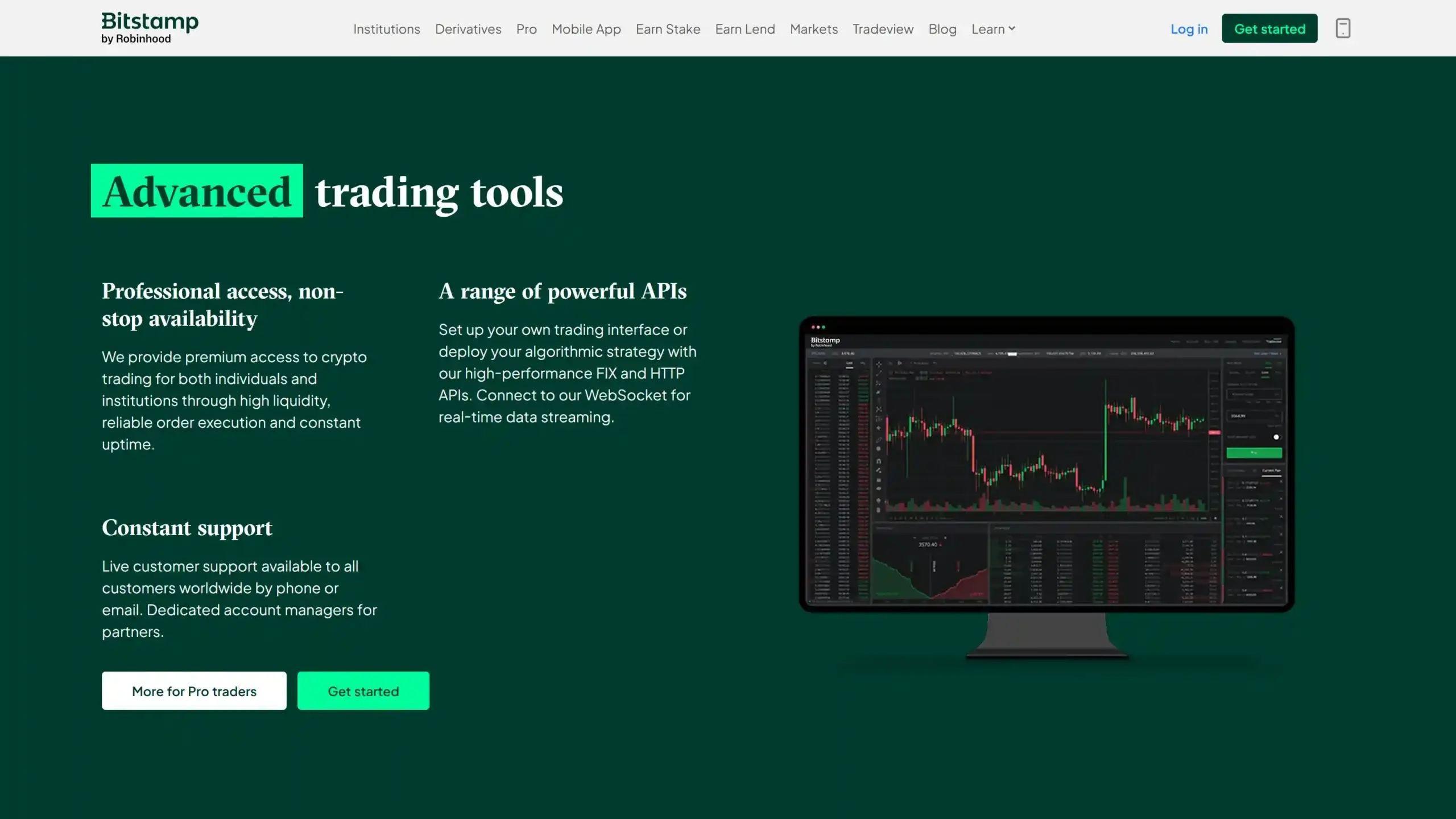
Bitstamp is a custodial exchange and doesn't market a self-custody wallet ecosystem. Your assets are held by Bitstamp directly, with roughly 95% in cold storage and custody partners including BitGo providing an additional layer. That's a trade-off: you get a clean exchange account with fiat support, and you give up self-custody control. For users who want to hold their own keys, that means pairing Bitstamp with a separate wallet setup.
API And Programmatic Trading
API access is where Bitstamp scores best in its category. The public documentation is detailed enough that experienced traders can evaluate the exchange without opening an account, which itself reflects well on how Bitstamp approaches technical users.
The exchange publicly documents an HTTP API, WebSocket API v2, FIX v2, and PSD2 open-banking API. A sandbox environment is also available. Supported order types include limit, market, and instant orders, with multiple account and order workflows exposed in the docs. For traders whose stack depends on programmatic execution, the FIX v2 support alone puts Bitstamp ahead of most retail-oriented exchanges. If crypto trading strategies requiring automated execution are part of your workflow, Bitstamp's API depth is a genuine advantage.
Fees And Pricing
Bitstamp has a full public fee schedule across nine volume tiers. Standard spot fees start at Maker 0.3% and Taker 0.4%, dropping to 0.00% maker and 0.03% taker at the top tier. FX and stablecoin pairs run cheaper at every level, starting at Maker 0.06% and Taker 0.08%. The order book is the right benchmark for cost comparison, not Basic Trading or Instant Purchase.
Hidden Costs To Watch On Bitstamp
The cost issue on Bitstamp is knowing which trading mode you're in before you compare prices. The public fee page is detailed, but the gap between trading modes is wide enough to cost real money if you default to the wrong one.
Before trading any meaningful size, these are the four areas worth checking:
- Basic Trading versus Pro or Tradeview: the fixed 1.8% spread on Basic Trading, plus the variable volatility spread, makes it meaningfully more expensive than order-book execution. Instant Purchase via card adds a 4% Instant Service fee on top of that.
- Withdrawal costs run separately from trading fees. ACH is free and SEPA costs 3 EUR, but international wire exits run 0.1% with a 25 USD minimum, and your bank may charge additional fees beyond that.
- Stablecoin and FX volume is discounted 80% in the tier calculation, so users who trade primarily in those pairs will advance through tiers much more slowly than their nominal volume suggests.
- Compliance holds can create time cost even when the fee table looks fine. A restricted account during a fast-moving market is a documented friction point on Bitstamp based on third-party complaint patterns.
The best low-fee path is to trade on Pro or Tradeview using the order book, verify your current tier before sizing up, and use ACH or SEPA for fiat withdrawals where possible.
VIP Tiers And Fee Discounts
Bitstamp's tier ladder runs across nine volume brackets from under $10,000 to over $1 billion in 30-day volume. Maker fees reach 0.00% at the upper tiers, taker fees drop to 0.03%, and the FastPass program offers fees as low as 0.01% for users trading $500,000 or more.
The calculation quirk to know before assuming your tier: FX and stablecoin volume counts at only 20% weight in the 30-day calculation. A trader doing most of their volume in EUR/USD or USDC/USDT pairs will sit in a lower tier than their raw numbers suggest. Check your actual eligible volume in the live fee panel before sizing up, particularly if stablecoin pairs make up a large share of your activity.
Deposits, Withdrawals, KYC And Availability
Bitstamp is built around fiat access in a way that most crypto-native exchanges aren't. The currencies endpoint and API docs show bank transfers and crypto withdrawals as part of the core workflow, not add-ons. That makes it a more practical option for users who move regularly between bank accounts and crypto markets, but it also means the KYC and verification requirements are central, not optional.
What US Users Need To Check Before Signing Up
Bitstamp operates in the US through Bitstamp USA, Inc., which holds a BitLicense from the New York State Department of Financial Services, money transmitter licenses across most states, and a Money Services Business registration with FinCEN. For US users, that bank-aware, licensed footing is often more relevant than what the exchange lacks. The checks that matter most are product scope, bank support, and whether the specific feature you want is available in your state.
The state gaps are specific: Bitstamp is not available to residents of Hawaii or Nevada, where it has not pursued state licensing. Derivatives aren't available to US users, nor to users in Canada, Japan, and some other jurisdictions. Earn availability also varies by product and state. What does carry through is core spot trading, fiat funding via ACH and wire, and bank cash-out access, which is Bitstamp's most consistent competitive advantage over crypto-native rivals.
On taxes, Bitstamp reports to the IRS like other US-licensed platforms. It issues Form 1099-DA for digital asset sale and exchange proceeds, starting with the 2025 tax year under the IRS digital asset broker rules, and Form 1099-MISC for staking and similar rewards income of $600 or more. Keep your own transaction records either way, since cost basis reporting on 1099-DA only phases in for later tax years.
Separately, for users specifically looking at crypto exchange options in the US, the regulatory track record and license count, 50+ active licenses and registrations across Luxembourg, UK, US, Singapore, BVI, and Slovenia, give Bitstamp a more credible compliance story than many alternatives.
Payment Rails, Networks, And Limits
Bitstamp exposes more public market structure than payment-rail marketing, so users should research supported currencies, withdrawal methods, and account verification flow rather than expecting an instant-buy showcase.
Fiat Rails By Region
Bitstamp's fiat support is real, but the marketing around it isn't especially clear about which specific rails are live in which markets. US users get ACH and wire, with free ACH withdrawals; wire exits carry the 0.1% international fee where applicable. European users get SEPA deposits and withdrawals for EUR, with SEPA withdrawals typically settling in 1 to 2 business days. UK availability is confirmed but withdrawal friction complaints appear with some regularity in third-party reviews. Everywhere else, product access varies enough by jurisdiction that it's worth confirming directly.
Withdrawal Networks And Fees
The public currencies endpoint shows supported deposit and withdrawal networks asset by asset, which is more useful than a generic withdrawal page because it gives you route visibility for specific assets before you're logged in.
BTC withdrawals are supported with minimum amounts disclosed in the currencies endpoint. ETH has Ethereum plus some alternate network support visible for selected assets. USDC carries multiple network options. USDT shows Ethereum and TRON support. Final withdrawal fees still require the live fee screen, but the public network data makes route planning more concrete than on exchanges that bury it behind login.
Verification Levels And Withdrawal Limits
Bitstamp should be treated as a full-KYC exchange from the moment you sign up. The public docs and error codes show that verification and account-status controls are built into how the platform operates, not bolted on as optional compliance steps. An unverified account has limited utility, and additional review processes can trigger restrictions or delays without much warning.
This is also why the support story matters so much. Verification isn't background admin. If an account gets flagged or a withdrawal goes under compliance review, the time it takes to resolve that depends entirely on support responsiveness, which is Bitstamp's weakest point.
Is Bitstamp Safe? Security, Custody And Proof Of Reserves
Bitstamp is an older, operationally serious exchange, and that shows in how its infrastructure is built. The risk that matters most in day-to-day use isn't a weak matching engine. It's whether an account restriction or withdrawal review becomes slow and opaque, which is where most third-party complaints concentrate.
Controls
The API stack includes explicit security functions, including the ability to revoke all API access. The exchange infrastructure looks mature and carefully segmented. For traders who care about operational seriousness, that's a real positive.
Custody And Insurance
Bitstamp is custodial and holds customer assets 1:1, keeping roughly 95% of crypto in cold storage. Custody partners include BitGo, and crime and custody insurance is in place. That's a reasonable setup for a regulated centralized exchange, but it isn't the same as a user-verifiable proof-of-reserves page.
Proof Of Reserves Or Audits
No public proof-of-reserves or user-verifiable liability page was confirmed on Bitstamp's public-facing sources. That doesn't automatically mean the exchange is unsafe, but it does weaken the public trust case compared with rivals that publish user-verifiable reserve attestations. For users who consider on-chain verification a hard requirement, this is a gap that Bitstamp hasn't filled.
Incidents And Remediation
Bitstamp's most serious historical incident was a 2015 hot wallet hack where approximately 19,000 BTC was stolen. The exchange covered the losses and continued operating. Since then, its infrastructure posture has visibly matured, though the exchange has also had periods of account restriction complaints that generated sustained third-party friction.
App, UX And Customer Support
Bitstamp's interface is cleaner than most feature-heavy rivals, but it's also less forgiving. The platform is built for users who know what they want from an exchange, not for users still figuring that out.
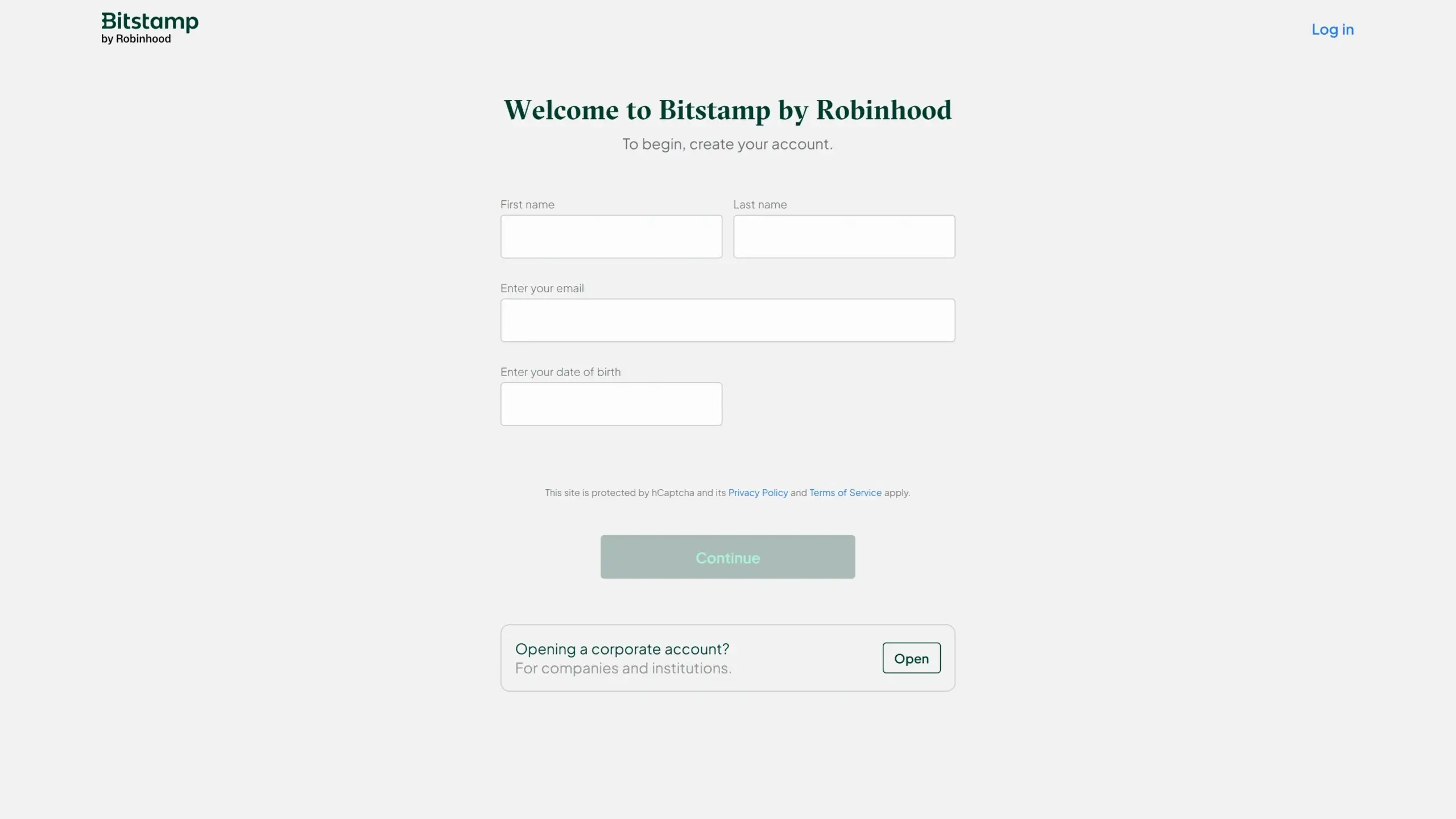
UI And Navigation
The UI keeps markets, balances, and order entry close together, which works well once you know the flow. The gap is that the cheapest trading path, Pro or Tradeview, and the easiest path, Instant Purchase, aren't explained especially clearly to users who don't already know the difference. A first-time buyer could easily default to Instant Purchase and pay the 4% fee without realizing a better option exists two clicks away.
Mobile App
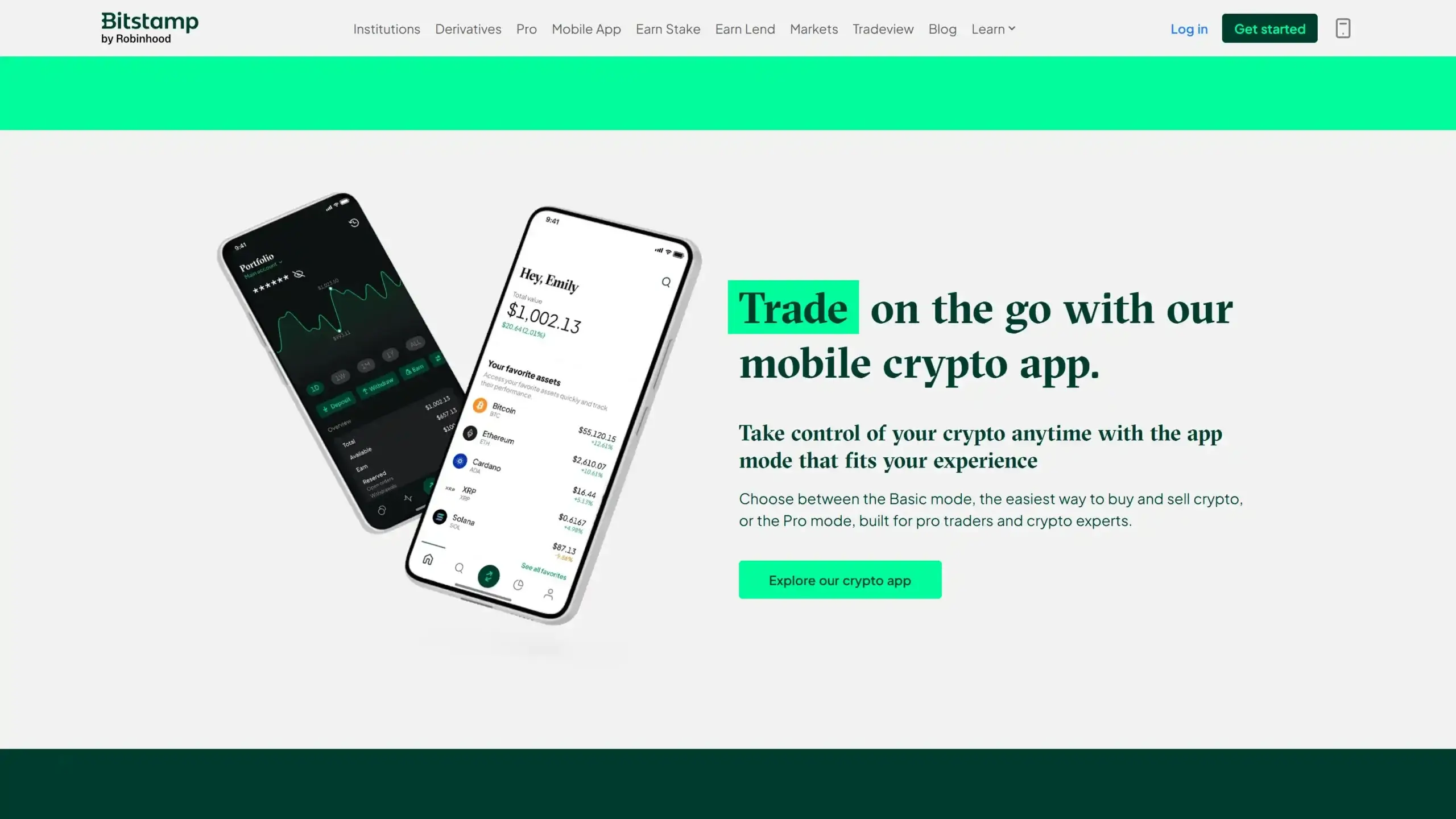
The mobile app covers the core jobs: checking balances, placing trades, and managing the account without a desktop. It carries the same utilitarian feel as the web product. For users already familiar with Bitstamp's flow, that works fine. For users who want heavy in-app guidance or an onboarding experience closer to what exchanges built for beginners offer, it falls short.
Reliability And Status Page
Bitstamp's trading engine and API infrastructure look operationally serious. Uptime hasn't been a consistent complaint in third-party reviews. Where reliability breaks down for individual users is at the account level: a stable matching engine doesn't help if a withdrawal review or restriction case becomes slow to resolve.
Customer Support
Support is Bitstamp's clearest weak spot, and the gap between trading-engine quality and support quality is wide enough to affect the overall rating. Complaint patterns across third-party review platforms cluster around frozen accounts, slow responses, and extended withdrawal disputes. Routine questions get answered, but when something important goes wrong, the escalation path is where users lose confidence.
Bitstamp Category Scores
These scores highlight how this review performs in specific categories, with each score tailored to the focus of that category.
Final Verdict
Bitstamp's strengths are its fiat infrastructure and API depth. Spot fees start at 0.30% maker and 0.40% taker, the public API documentation is among the most detailed in the category, and real fiat pairs set it apart from most crypto-native exchanges. For API traders and users who move regularly between bank accounts and crypto markets, that combination still holds up. The trust picture has gaps. No public proof-of-reserves page exists, and support is the platform's clearest weak spot. Complaints about frozen accounts, delayed withdrawals, and slow escalations appear consistently. Robinhood completed the acquisition in June 2025, but the product still runs with the same operational DNA. Use Bitstamp if you want a mature fiat bridge, detailed API documentation, and a regulated exchange with a long track record. Skip it if you need proof of reserves, a wide retail feature set, or fast support resolution.
Mature fiat bridge with exchange-first tooling · Detailed public API, WebSocket & FIX docs · Spot + perpetual markets, no bloated retail stack
Disclaimer: CryptoSlate may receive a commission when you click links on our site and make a purchase or complete an action with a third party. This does not influence our editorial independence, reviews, or ratings, and we always aim to provide accurate, transparent information to our readers.
