








Research
XRPL consensus freezes after removing just 12% of central nodes – but a simple tweak triples XRP defense
At 60% participation, two random links raised simulated quorum-failure thresholds from 11% to 38% and 12% to 33%.
XRP is the native asset of the XRP Ledger.

$2.84B traded Price signal supported
Trading Activity price-reliability indicator with 100 percent data coverage. Low activity replaces price-derived sentiment because the displayed market price may not be supported by meaningful trading.Target
Peg Health price-stability indicator with 0 percent data coverage. It measures observed market pricing, not reserve quality or redemption safety.30D +32.0% 63.9% below ATH
Price-based current market conditions indicator with 100 percent data coverage. This is not a price forecast.See how XRP could move across bullish, bearish and black swan scenarios, with the evidence behind each range.

CryptoSlate uses historical XRP price data and statistical models to estimate a range of possible future prices. The models account for both normal market movements and unusually large price swings, then test how well their predictions perform on past data. The forecast shows possible scenarios, rather than a guarantee or investment recommendation. An additional stress model estimates the potential impact of an extreme downturn.
The forecast combines a horizon-aware, drift-shrunk Student-t GARCH model, filtered historical simulation, and regularized quantile regression. Nonnegative model weights are learned from earlier Monday-UTC forecast dates without using future data. A 52-week embargo separates training from testing, followed by 10 held-out forecasts spaced 371 days apart. Performance is measured using CRPS and coverage diagnostics against a stronger predeclared simple baseline. An EVT model extends the downside tail for the black-swan stress scenario. Polymarket has zero weight in forecast.v1.
Price data CoinMarketCap, CryptoSlate
Momentum shifts the regularized quantile component while shrinkage limits extrapolation.
Higher conditional volatility widens both upside and downside predictive bands.
The first release retains a zero-weight boundary until historical overlay validation is available.
Past market behavior may not represent a new market structure or regulatory shock.
The forecast targets one UTC terminal price and does not predict the full intraday path.
Actual prices can finish outside every displayed interval.
Non-overlapping labels reduce mechanical overlap, but regime dependence can persist and manual review remains required.
An origin is a historical date when the model is tested as if it were issuing a live forecast.
Public raw backtest origins are fixed to Monday UTC to prevent schedule shopping, meaning results cannot be improved by choosing unusually favorable start dates. This horizon requires at least 2,714 continuous daily candles, including up to six days of weekday-alignment slack.
Calibration origins are earlier forecasts used to choose the ensemble weights. Held-out origins are kept separate and used only to evaluate the chosen model.
This run used 72 weekly calibration origins and compared weight selection with filtered historical simulation. An embargo then skipped 12 weekly dates, creating a deliberate gap before evaluation.
The final 20 held-out origins were issued 91 days apart across a 248-position validation span so their 90-day outcomes do not overlap.
CRPS stands for Continuous Ranked Probability Score. It measures the accuracy of the full probability forecast rather than a single price target; lower is better because it rewards both an accurate center and honest uncertainty bands.
The held-out point edge against the strongest simple baseline was 0.0%. The minimum one-sided 95% paired lower bound was -0.9%; this conservative check asks whether the measured advantage remains above zero after accounting for sample variation.
The monitoring target is a point edge of at least 2% and a positive lower bound against both GARCH and filtered historical simulation. These regime-dependent diagnostics remain advisory and do not interrupt publication.
A simulation path is one plausible 90-day price journey drawn by the model.
The published run used 2,000 paths for the displayed distribution and 2,000 paths at each backtest origin.
RNG seed 1,082,485,391,619,784,832 fixes the random-number stream so an identical run can be reproduced. It is deterministically derived from the frozen forecast.v1 production salt, horizon, asset ID, and modeled reference-close timestamp; candles, provenance, and market inputs do not select the random stream. The modeled reference close is timestamped 2026-08-30T23:59:59Z.
No quality-qualified Polymarket evidence contributed to this forecast, so prediction-market prices did not move the published distribution.
The bullish scenario is the model P80 terminal estimate, with its P70-P90 corridor shown as a range.
The bearish scenario is the model P20 terminal estimate, with its P10-P30 corridor shown as a range.
This stressed downside marker extends the fitted loss tail beyond ordinary simulations and should not be read as a precise probability forecast.
Snapshots remain immutable so readers can inspect exactly what CryptoSlate published at each forecast date.
| Published | Target date | Median | 80% range | Status |
|---|---|---|---|---|
| $1.51 | $0.89–$2.83 | Target pending | ||
| $1.48 | $0.85–$2.95 | Target pending | ||
| $1.59 | $0.93–$3.39 | Target pending | ||
| $1.49 | $0.86–$3.04 | Target pending | ||
| $1.55 | $0.88–$2.97 | Target pending |
Probabilistic scenario analysis, not a guarantee or investment recommendation.
$2,844,175,987.01 traded over the last 24 hours. The available activity evidence is sufficient to retain the asset’s price-derived signal.
Low activity can make the displayed price sensitive to a handful of trades. Trading Activity assesses price reliability—not project development, legal status, reserves, or solvency.
Price movement Not interpreted while trading support is below the reliability threshold.
What it measures
The model combines reported 24-hour volume, market-cap turnover, valid-pair liquidity, active exchange breadth, and quote freshness. Missing optional evidence lowers coverage; missing volume or a known-stale quote suppresses price-derived interpretation.
Configured model weights
When inputs are missing, these configured weights are renormalized across the available evidence; data coverage records what is missing.
How to read it
Scores of 0–19 are dormant, 20–39 are thin, 40–69 are supported, and 70–100 are active. Scores below 40 withhold price-derived interpretation.
Short-term volume confirms the weaker move, while logarithmic historical position supports it. Together these inputs produce a price-neutral reading rather than a price forecast.
A complete ATL and ATH range is not available for this asset.
What it measures
The model converts price momentum, logarithmic historical position, milestone recency, and short-term volume confirmation into one 0–100 score. Missing evidence lowers data coverage instead of counting as neutral.
Configured model weights
When inputs are missing, these configured weights are renormalized across the available evidence; data coverage records what is missing.
How to read it
50 is the neutral midpoint. Scores of 60 or higher are bullish, 40 or lower are bearish, and 41–59 are neutral.
Showing 10 spot markets sorted by CoinMarketCap exchange rank. Markets excluded from CMC price or volume calculations are hidden.
| Pair | |||||
|---|---|---|---|---|---|
| 1 | XRP/USDT | $1.39 | $164.38M | 830 | |
| 2 | XRP/USDC | $1.39 | $41.39M | 750 | |
| 3 | XRP/USD | $1.39 | $147.62M | 767 | |
| 4 | XRP/KRW | $1.40 | $144.11M | 629 | |
| 5 | XRP/USDT | $1.39 | $59.01M | 722 | |
| 6 | XRP/USDT | $1.39 Best price | $32.11M | 606 | |
| 7 | XRP/USDT | $1.39 | $23.6M | 758 | |
| 8 | XRP/USDT | $1.39 | $38.27M | 736 | |
| 9 | XRP/USDT | $1.39 | $81.48M | 678 | |
| 10 | XRP/USDT | $1.39 | $39.24M | 650 |
Affiliate Disclaimer: CryptoSlate may receive a commission when you click trading links on this page and complete an action with a third party. This does not influence our editorial independence or coverage.
At 60% participation, two random links raised simulated quorum-failure thresholds from 11% to 38% and 12% to 33%.

Leveraged funds doubled their net short even as CME open interest climbed almost 40% and XRP recovered from $1.

The firm can authorize up to 10 billion shares, but its pitch to investors rests on growing XRP faster than its diluted share count.
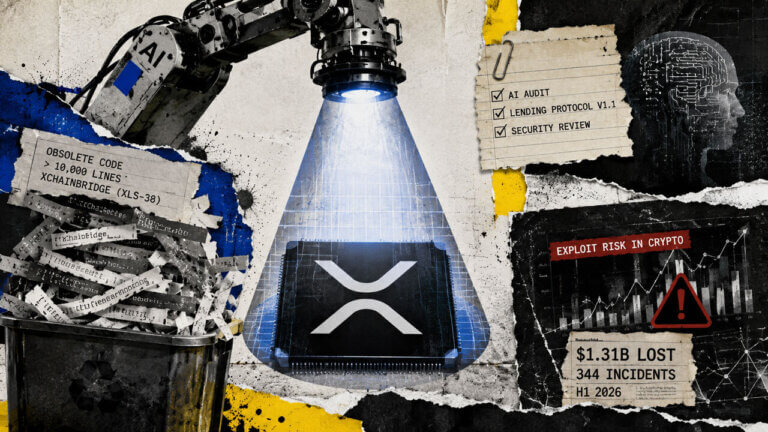
More than 10,000 lines of dormant bridge code could disappear as an AI-only audit probes Lending Protocol V1.1.
See XRP across major fiat currencies and swap the active converter instantly.
Quick SelectUsing the live USD market price. Additional fiat rates will appear after the daily sync.
XRP is the native asset of the XRP Ledger, a payments-focused Layer 1 blockchain that launched in June 2012 after development by David Schwartz, Jed McCaleb, and Arthur Britto began in 2011. XRP is used on the ledger for transaction costs, anti-spam protection, value transfer, and bridge liquidity across XRPL's payment and exchange features. Unlike mined assets such as Bitcoin, all XRP already exists, and no more than the original 100 billion XRP can be created.
XRP should not be confused with Ripple. Ripple is a company that builds payment and digital asset infrastructure, while XRP is the native asset of the XRP Ledger. After XRPL launched, its creators allocated 80 billion XRP to the company that later became Ripple, and Ripple later placed much of that position in escrow. That history makes distribution, escrow, and Ripple-related adoption part of XRP's market context.
For price-focused users, the most important signals are XRP liquidity across major exchanges, XRPL transaction activity, DEX and AMM usage, Ripple-related payment demand, tokenization activity, and regulatory treatment. The SEC case against Ripple ended in 2025, but the final judgment left a $125 million civil penalty and injunction in effect. That gives XRP a clearer U.S. legal history than it had during the lawsuit, but it does not remove regulatory risk entirely.
| Field | Detail |
|---|---|
| Asset | XRP |
| Ticker | XRP |
| Asset Type | Native Layer 1 payment and settlement asset |
| Network | XRP Ledger |
| Launch | XRP Ledger launched in June 2012, after development began in 2011 |
| Founders / Early Developers | David Schwartz, Jed McCaleb, and Arthur Britto. Chris Larsen joined shortly after launch and helped form the company that became Ripple |
| Consensus | XRP Ledger Consensus Protocol |
| Mineable | No |
| Max Supply | 100,000,000,000 XRP |
| Circulating Supply | 62.74B |
| Total Supply | 99.99B |
| Main Use Cases | Transaction fees, anti-spam protection, payments, bridge liquidity, DEX trading, and issued assets |
| Website | XRPL.org |
| Explorer | XRPL Livenet |
| Whitepaper / Technical Reference | XRP Ledger Consensus Protocol |
| Main Risk Areas | Market volatility, regulatory treatment, Ripple-related supply distribution, escrow releases, validator trust-list design, transfer errors, and value-accrual risk |
XRP works through the XRP Ledger, a peer-to-peer ledger that uses validator consensus rather than proof-of-work mining or proof-of-stake rewards. XRPL validators share proposed transaction sets, and the network reaches consensus when a large enough share of trusted validators agrees on a transaction set. Confirming an invalid transaction would require more than 80% of trusted validators to collude.
Every XRP Ledger transaction must destroy a small amount of XRP as a transaction cost. The standard minimum cost for most transactions is 0.00001 XRP, though it can rise when the network is under heavier load. The fee is not paid to validators or miners — it is permanently destroyed, which makes XRP mildly deflationary at the protocol level but not in a way that usually dominates market pricing.
The XRP Ledger also includes native trading infrastructure. Its built-in decentralized exchange has operated since the ledger's 2012 launch, and automated market maker functionality now sits alongside the existing order-book DEX. That means XRP can be used directly in payments, trading paths, and liquidity pools inside the same ledger environment.
XRP has a fixed maximum supply of 100 billion tokens. All XRP already exists, and no new XRP can be mined or minted. The main supply factors are circulating supply, Ripple-related escrow releases, and the small amount of XRP destroyed through transaction fees. For a deeper breakdown, read CryptoSlate's guide to XRP supply, escrow unlocks, and Ripple's monthly releases.
Ripple's historical allocation is central to XRP's tokenomics. The XRPL founders allocated 80 billion XRP to the company that became Ripple, and Ripple later locked 55 billion XRP into escrow. That escrow structure was designed to make future releases more predictable, but it also remains one of the main supply and perception risks for XRP holders.
| Supply Metric | Detail |
|---|---|
| Circulating Supply | 62.74B |
| Total Supply | 99.99B |
| Max Supply | 100,000,000,000 XRP |
| Fully Diluted Valuation | $138.85B |
| Emissions or Issuance | No new XRP can be created |
| Burns | XRP transaction costs are destroyed |
| Unlocks | Ripple escrow releases are the main supply-release mechanism to monitor |
| Treasury or Foundation Allocation | The XRPL founders allocated 80 billion XRP to the company that became Ripple |
XRP is used to pay transaction costs, help protect the XRP Ledger from spam, and support payments and asset exchange across XRPL. It does not secure the network through mining rewards or staking rewards. Instead, XRPL relies on validator consensus, trusted validator lists, and high overlap between validator lists to reduce fork risk.
XRPL activity is broader than direct XRP transfers. The ledger supports issued assets, payment paths, a native DEX, AMM pools, and tokenization use cases. For XRP's market value, the key question is whether that activity creates durable demand for XRP itself, rather than only using XRPL as settlement infrastructure. CryptoSlate covers that question in its analysis of XRPL adoption and XRP value capture.
| Context Item | What To Watch |
|---|---|
| Network Activity | Transactions, active addresses, payment volume, fees, and DEX activity |
| Security Model | Validator participation, Unique Node List overlap, default validator lists, and consensus reliability |
| Ecosystem | Payments, issued assets, DEX trading, AMM pools, tokenization, and Ripple-related enterprise usage |
| Supply Mechanics | Escrow releases, circulating supply changes, total supply, and burned transaction fees |
| Upgrade Path | XRPL amendments, validator support, protocol releases, and ecosystem adoption |
| Resource | URL |
|---|---|
| XRP News | XRP News |
| Ripple Company Profile | Ripple |
| XRP Supply and Escrow Guide | /the-real-drivers-of-xrp-supply-a-guide-to-understand-ripples-monthly-releases-and-what-matters/ |
| XRPL Adoption and XRP Value Capture | /xrp-faces-a-brutal-2026-paradox-as-xrpl-adoption-surges-and-the-token-captures-little-value/ |
| Official XRP Overview | XRPL.org: XRP Overview |
| Official XRPL Transaction Cost Docs | XRPL.org: Transaction Cost |
| Official XRPL Destination Tags Docs | XRPL.org: Source and Destination Tags |
CryptoSlate's XRP news archive covers Ripple partnerships, ODL and payment developments, SEC case history, XRPL protocol updates, and broader XRP market headlines.


XRP is the native asset of the XRP Ledger. It is used for transaction costs, payments, bridge liquidity, and exchange activity on XRPL. Its market role depends on liquidity, network usage, Ripple-related adoption, supply distribution, and regulatory treatment.
XRP works through the XRP Ledger, where validators use consensus instead of mining. When trusted validators agree on a transaction set, a new ledger instance can be validated. Transactions require a small XRP cost, and that cost is removed from supply rather than paid to validators.
XRP is used to pay fees on the XRP Ledger, move value between users, support payment paths, and provide bridge liquidity in XRPL’s exchange system. It can also be used in trading and settlement flows where XRP liquidity is available.
No. XRP is the native asset of the XRP Ledger, while Ripple is a company in the XRP ecosystem. Ripple received a large XRP allocation early in XRPL’s history and remains a major ecosystem participant, but XRP and XRPL are not the same as Ripple.
No. XRP is not mineable. All XRP already exists, and the maximum supply is capped at 100 billion XRP. The XRP Ledger does not use mining rewards or staking rewards to create new supply.
XRP has a maximum supply of 100 billion tokens. No more XRP can be created. The circulating supply can change as escrowed XRP is released or returned, while transaction fees slowly reduce total supply because fees are destroyed. CryptoSlate’s XRP supply guide explains the escrow mechanics in more detail.
XRP carries market, regulatory, custody, validator-list, and transfer risks. Users should also pay attention to destination tags when sending XRP to exchanges or hosted wallets, because tags help the recipient credit the payment to the correct account.
CryptoSlate does not provide investment advice. XRP has deep market liquidity and a long operating history, but it also carries risks tied to regulation, escrow, market volatility, network usage, and whether XRPL activity creates direct demand for XRP.
Native XRP runs on the XRP Ledger. Some exchanges or apps may show wrapped or bridged XRP on other networks, but those are not native XRP. Always match the correct network, address format, and destination tag requirements before transferring funds.
You may need a destination tag when sending XRP to an exchange, broker, or hosted wallet. Destination tags help businesses using a shared XRP Ledger address identify which customer should receive credit for a payment. Leaving the tag out can make an exchange deposit slower to locate or harder to credit.
As of Aug 31, 2026, XRP trades at $1.39.
XRP has a market capitalization of $87,122,698,825.59.
XRP has a 24-hour trading volume of $2,844,175,987.01.
XRP reached an all-time high of $3.84, recorded on Jan 4, 2018. It is currently 63.86% below its all-time high.
XRP recorded an all-time low of $0.002802, recorded on Jul 7, 2014. It is currently 49.45 thousand percent above its all-time low.
Ripple is a financial technology and enterprise blockchain company focused on cross-border payments, stablecoins, and digital asset infrastructure.