


Wasabi Wallet Review 2026: Is It Still a Good Option for Privacy?
- Fully open-source non-custodial wallet
- Excellent privacy-focused features
- Supports hardware wallet integrations
Privacy in BTC trading poses a serious challenge because Bitcoin records all transactions on a public blockchain, making them traceable. Wasabi Wallet is a non-custodial wallet designed to make BTC transactions harder to trace by implementing features that prioritize on-chain privacy.
In this comprehensive Wasabi Wallet review, we’ll cover its privacy and security features, transaction fees, and main strengths and limitations.
To create an unbiased and accurate review, we downloaded the wallet and tested its usability and privacy features. We also checked its security rating on CER.live and went through hundreds of user reviews to find out how other traders rate this wallet and to identify its main limitations.
With that in mind, here’s all you need to know about Wasabi Wallet.
Our Take on Wasabi Wallet: Pros and Cons
Wasabi is a non-custodial software wallet. Its main use case is to make BTC transactions harder to trace by implementing advanced privacy features such as Tor integration, coin control, and silent payments. It also uses the WabiSabi Trustless Multi-Party Transaction Protocol, which enables you to batch payments and hide their origins.
This wallet is suitable for experienced BTC holders who value privacy. It can be integrated with hardware wallets, like Trezor, Ledger, and ColdCard, and its source code is publicly available on GitHub. Wasabi Wallet also included an integrated CoinJoin coordinator service. This service was permanently discontinued in 2024 due to regulatory concerns. However, you can still connect manually to an external coordinator.
On the downside, this is a Bitcoin-only wallet, meaning you can only send and receive BTC. What’s more, beginners may find it difficult to use due to its advanced privacy features.
Pros
- Non-custodial wallet, fully open-source software
- Can be integrated with hardware wallets, like Trezor, Ledger, and ColdCard
- Built-in Tor integration
- Advanced privacy features (coin control, dust attack protection)
- Enables you to connect to a Bitcoin full node
- Supports silent payments
- Doesn’t charge fees for sending BTC
Cons
- Supports only BTC
- No mobile app
- Lacks a dedicated customer support
- May be complex for beginners
What is Wasabi Wallet?
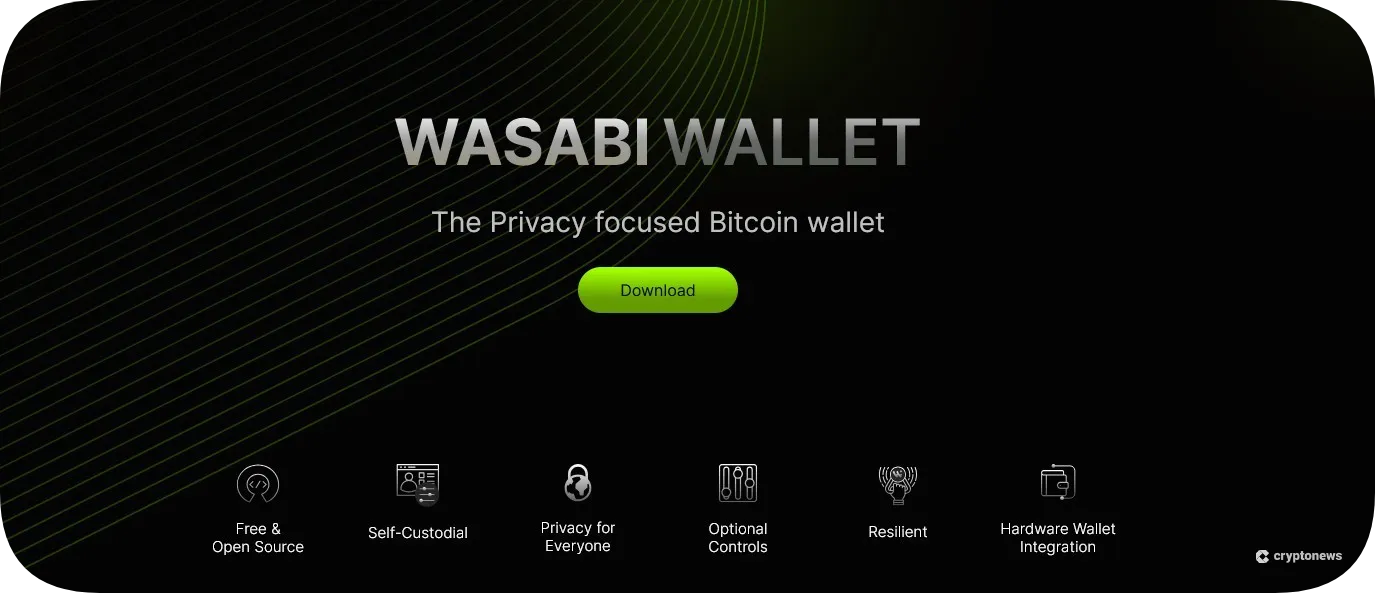
Wasabi Wallet is a non-custodial software wallet created by Ádám Ficsór, Gergely Hajdu, and Bálint Harmat – the team behind zkSNACKs Ltd. The first iteration of the wallet was released in 2018, while its second, improved version, went live in 2022. Wasabi Wallet was designed to enhance user privacy by making BTC transactions harder to trace on the public blockchain.
To achieve that, Wasabi Wallet integrates features like Tor integration, coin control, silent payments, BIP-158 block filtering, and dust attack protection.
Is Wasabi Wallet Safe?
We tested Wasabi Wallet’s security first-hand for this review. First, we checked if the wallet has a history of hacks and data leaks. While the wallet was never hacked, it was involved in a 2020 hacking incident. According to Crystal Blockchain data, hackers laundered over 437 BTC stolen from the Liquid exchange using Wasabi Wallet’s CoinJoin feature.
After the founders of Samourai Wallet (another privacy-focused Bitcoin wallet) were charged with money laundering in 2024, Wasabi Wallet discontinued its native CoinJoin service. It also prohibited US citizens from using its services due to the lack of legal clarity in the US.
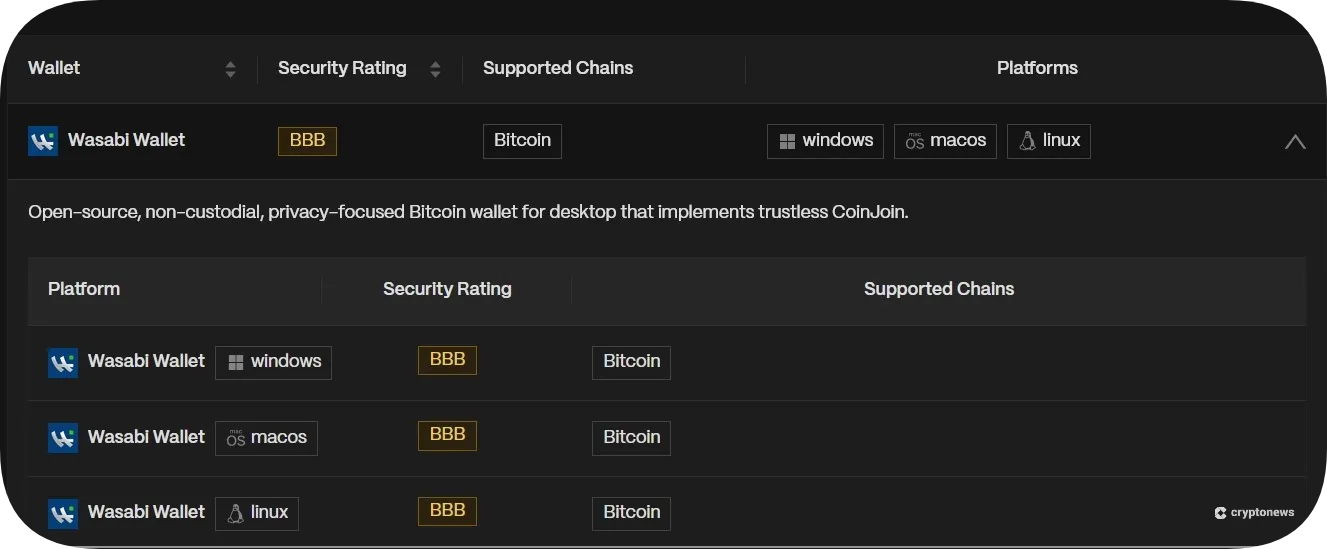
Secondly, we checked Wasabi Wallet’s security score on independent cybersecurity ranking platforms. The wallet has a BBB security rating on CER.live, which is considered a good score.
So generally, we consider Wasabi a safe wallet. This is a non-custodial wallet, meaning you have full control over your private key and funds. It uses open-source software, which means everyone can view and audit its code on GitHub. Wasabi Wallet can also be integrated with hardware wallets, like Trezor, Ledger, ColdCard, Blockstream Jade, and BitBox02, which further increases its security.
Before downloading the wallet, check your country’s laws and regulations on privacy-enhancing tools to avoid potential legal issues.
Is Wasabi Wallet Anonymous?
This is a privacy-focused Bitcoin wallet. It aims to make BTC transactions harder to trace by implementing features like Tor integration, coin control, BIP-158 filtering, and dust attack protection, which we’ll discuss in more detail in the next section of our Wasabi Wallet review.
This is also one of the best no-KYC crypto wallets for Bitcoin traders who seek enhanced privacy. However, since Bitcoin runs on a public ledger, Wasabi Wallet is not 100% anonymous. I.e., it can make it harder to track Bitcoin transactions, but it can’t completely remove all traces from the public blockchain.
What Coins Does Wasabi Wallet Support?
Wasabi Wallet supports only one coin – Bitcoin. This was done deliberately to direct all resources toward enhancing Bitcoin’s privacy features. So, if you want to trade other coins, you should opt for another wallet.
For example, MetaMask is a good alternative for Ethereum traders. It supports all ERC-20 tokens and can be integrated with Ethereum-based dApps. Solana traders can benefit from Best Wallet. This non-custodial wallet lets you manage and store SOL and SPL tokens, and use Solana to buy new coins from its integrated upcoming tokens page.
Here’s our list of crypto wallets that you can use to trade popular altcoins and NFTs:
Wasabi Wallet Review: Key Features
In this segment of our Wasabi Wallet review, we’ll discuss its main features in more detail.
Tor Integration
To send BTC, your wallet must use your real IP address to connect to a random node on the network. To prevent this, Wasabi Wallet routes all network traffic through the Tor Network. This ensures that no two important requests originate from the same source, which makes tracking BTC transactions much harder. There is no need to install the Tor network separately, as it’s already integrated.
Personal Bitcoin Node Support
Wasabi Wallet enables you to connect to a Bitcoin full node to verify transactions without relying on an external third party. When connected, the full node will fetch BIP 158 block filters and fee rate estimations, download blocks, and broadcast transactions.
Coin Control
While Wasabi Wallet automatically selects the best UTXOs to use for transactions, you can take advantage of its advanced coin control feature to manually choose which coins to use. The wallet also provides a labeling system to help you avoid privacy leaks and keep track of your transactions, i.e., where the coins came from.
BIP-158 Filtering
Wasabi Wallet uses a BIP-158 block filter. Instead of downloading the entire blockchain, Wasabi downloads only the blocks relevant to your transactions. This prevents third parties from determining which transaction is yours and how much Bitcoin you own. The wallet also integrates the WabiSabi Trustless Multi-Party Transaction Protocol. This protocol enables you to batch payments and hide their origins.
Fully Open-Source
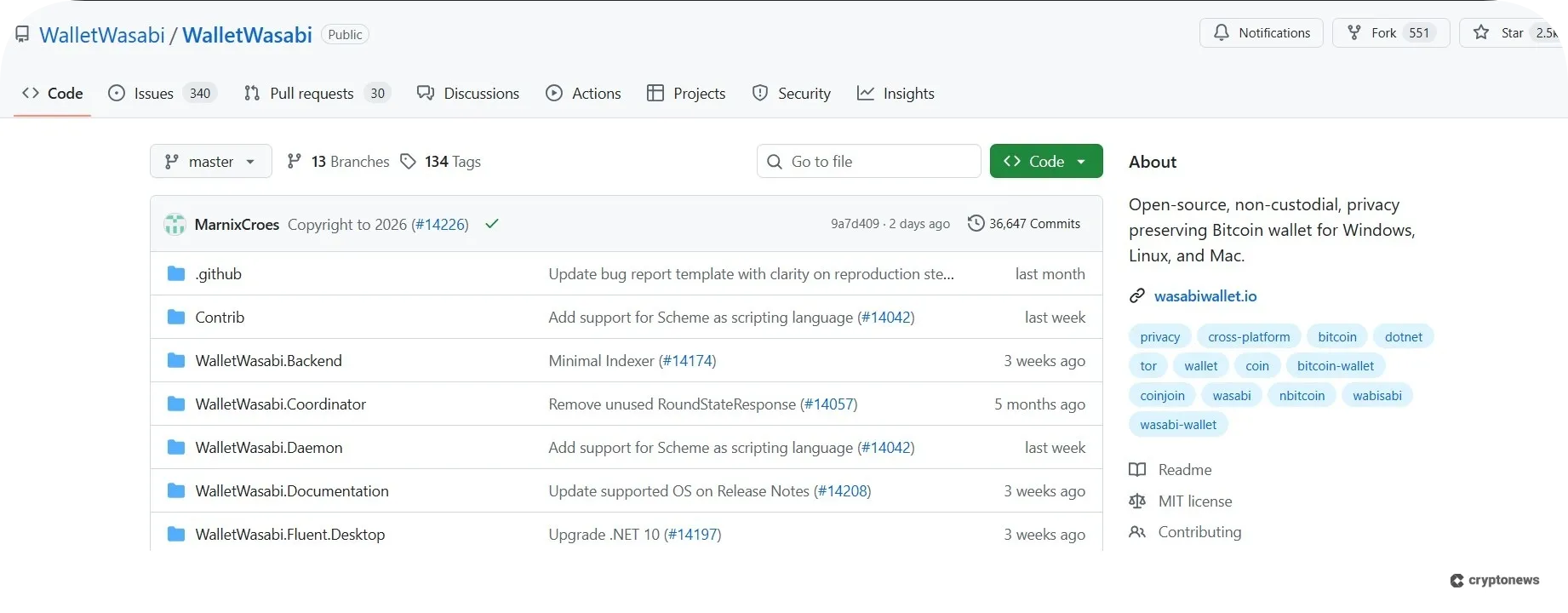
As mentioned before in our Wasabi Wallet review, this is a fully open-source wallet. Its source code is published under the MIT license and is publicly available on GitHub. This means that anyone can modify its code and inspect its software for bugs or potential vulnerabilities.
Dust Attack Protection
To protect its users from dusting attacks, Wasabi uses a modifiable dust limit. This means that it doesn’t show coins below a certain threshold value.
Silent Payments
Wasabi Wallet supports a feature called silent payments. This feature lets you create a single, static address that you can share with your friends or post publicly without compromising privacy. At the time of writing, the wallet only supports sending to silent payment addresses. However, the support for generating and receiving silent payment addresses is planned for future implementation.
CoinJoin Support
Wasabi Wallet discontinued its native CoinJoin coordinator service in 2024 due to regulatory concerns. However, you can still use this service by connecting to third‑party coordinators, such as OpenCoordinator or SwissCoordinator, via Wasabi. This crypto mixing protocol combines multiple BTC payments from multiple users into a single, large transaction to make it harder to track.
CoinJoin is legal in most jurisdictions. However, due to increased regulatory and legal pressure, many non-custodial wallets discontinued this service.
Can You Buy Bitcoin on Wasabi?
No, you can’t use Wasabi Wallet to purchase BTC. You can only use it to store, send, receive, and anonymize Bitcoin transactions. This means you must buy BTC from third-party services, such as crypto exchanges or P2P platforms, and then transfer it to your wallet. Next, you need to generate an address in the Receive dialog. Once you do that, the wallet will automatically hide this address to prevent you from accidentally reusing it.
Wasabi Wallet Transaction Fees
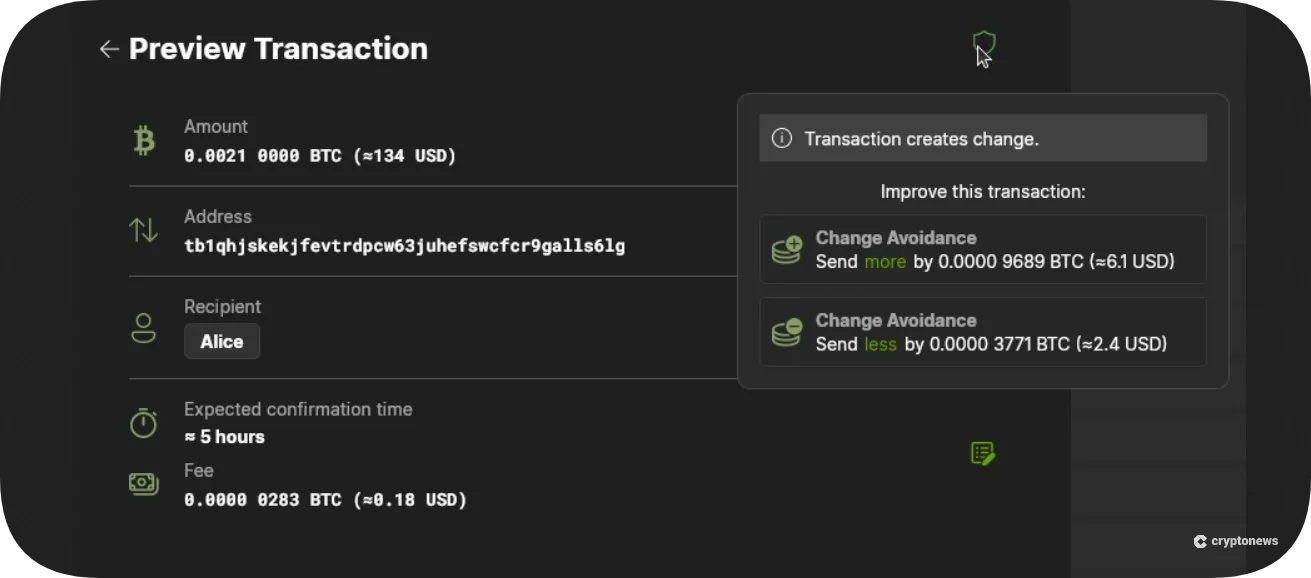
This part of our Wasabi Wallet review will focus on its fees. Wasabi Wallet doesn’t charge fees for sending BTC. You only need to cover the miner fee, which will be determined by the transaction size (in bytes) and current network congestion.
You can also set the fee rate manually. Keep in mind that higher fees equal faster confirmation time. The minimum transaction fee is 1 sat/vByte (1 satoshi per virtual byte). The wallet also charged a 0.3% coordinator fee for transactions above 0.01 BTC, while its CoinJoin service was still active.
Is Wasabi User-Friendly?
Wasabi Wallet is available as a desktop app for Windows, macOS, and Linux. You can install the wallet by downloading it from Wasabi’s official website or from the official Tor onion service. You should also verify its PGP signatures with zkSNACKs’ PGP public key.
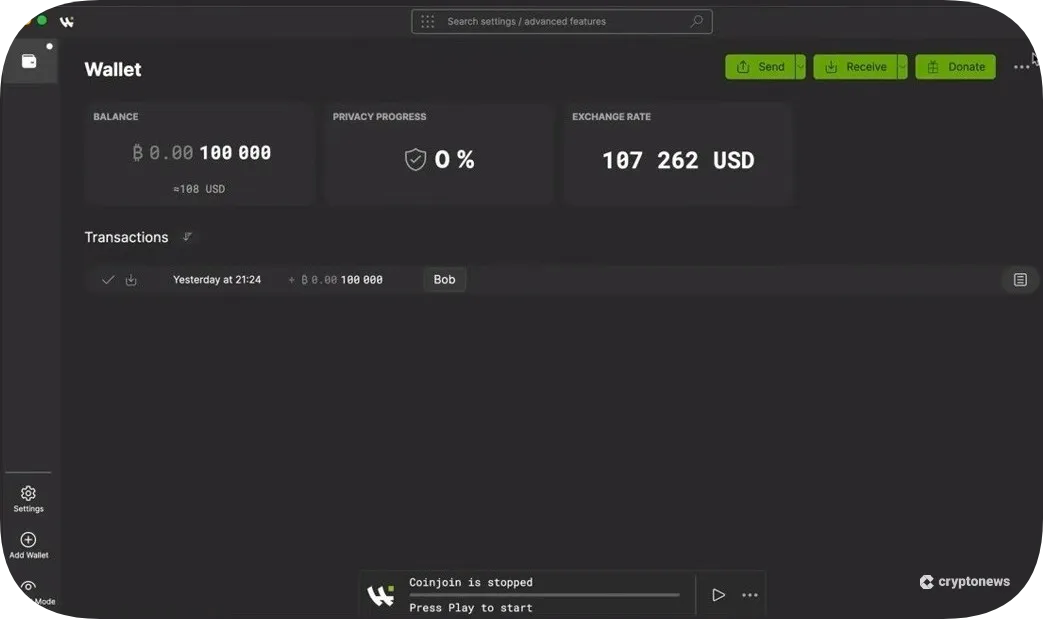
The app features a clean interface. On the left side, you’ll find a wallet icon that displays all your wallets, and a settings menu where you can configure network options. In the upper right corner, you’ll find Send and Receive icons. You can tap them to input the recipient’s address and generate new receiving addresses.
Your balance, privacy progress indicator, exchange rate, and transaction history are displayed in the middle of the screen. You can also use the search bar to find a specific setting.
On the downside, Wasabi Wallet doesn’t have a mobile app, making it unsuitable for traders on the go. Moreover, since it discontinued its built-in CoinJoin service, you must set up an external CoinJoin coordinator manually, which may feel complicated for beginners.
What Are the Cons of Wasabi Wallet?
As we already mentioned in our Wasabi Wallet review, this wallet doesn’t have a mobile app, which may deter active traders. Another downside is the lack of dedicated customer support, although you can find information about the wallet on its social media channels, X and YouTube, and join its chat groups on Slack, Telegram, and Discord.
On top of that, Wasabi’s interface feels a bit outdated, especially compared to wallets that use a more modern approach, like Best Wallet, Base App, and MetaMask. Plus, you can’t use it to buy altcoins or access dApps. You can only use it to store, send, receive, and anonymize Bitcoin transactions.
Although Wasabi Wallet has an intuitive interface, if you want to use its advanced privacy features, you need to understand how they work, which makes it a bit complex for inexperienced traders. The wallet also provides an RPC interface. However, to use it, you need to run the Wasabi Wallet Daemon, which involves using a command line.
Our Methodology: How We Tested and Reviewed Wasabi Wallet
To create an unbiased Wasabi Wallet review, we installed the wallet on our desktop and tested its main features – sending and receiving BTC, BIP-158 block filters, silent payments, coin control, etc. We also went through its official documentation to understand how the wallet works and how to use its privacy features.
Next, we checked its code on GitHub, its security rating on CER.live, and we did a background check to find out if the wallet has a history of hacks or data leaks. In addition to that, we read the reviews of other users to identify its strongest and weakest points. And lastly, we manually connected the wallet to third-party coordinators to test its interaction with CoinJoin.
Wasabi Wallet Review Conclusion: Is It The Best Privacy-Focused Bitcoin Wallet in 2026?
Wasabi Wallet is suitable for experienced Bitcoin users who value privacy. It routes all network traffic through the Tor Network to make tracking BTC transactions much harder. It also implements features like coin control, BIP-158 filtering, silent payments, and dust attack protection, and it can be integrated with hardware wallets like Trezor, Ledger, ColdCard, Blockstream Jade, and BitBox02.
Although you can no longer use its native CoinJoin coordinator service, you can still connect to third-party coordinators to mix your coins. However, this requires manual setup, making the wallet unsuitable for beginners. Moreover, altcoin traders and DeFi enthusiasts may look for another option since Wasabi supports only BTC.
FAQs
Is Wasabi Wallet free?
Is Wasabi Wallet decentralized?
Has Wasabi ever been hacked?
Is Wasabi Wallet illegal?
What are the best alternatives to Wasabi Wallet?
References


