


Bitpanda Review 2026
- Thousands of digital assets, paired with local fiat currency.
- Fee-free deposits and withdrawals via all payment methods.
- Perfect security track record with no prior hacking incidents.
Founded in 2014, Bitpanda is a European brokerage with a strong regulatory framework and a perfect security track record. As of January 29, the platform has expanded into a unified all-in-one investing app, giving users access to more than 10,000 stocks and ETFs alongside ETCs, precious metals, and commodities, all within a single regulated environment.
We opened and funded a Bitpanda account for this review, which enabled us to explore key factors like supported markets, commissions, payment methods, security, eligibility, and available trading tools.
Read on to decide whether Bitpanda is the right broker for you, with a deep dive into its strengths and weaknesses, and learn how to get started with a verified account in minutes.
Bitpanda Review Overview
Bitpanda operates as a brokerage, offering a simplified investing experience with competitive pricing relative to other regulated brokerages. This established provider holds multiple Tier 1 licenses and regional registrations, while its security systems feature cold storage and audited proof of reserves.
Here are the key takeaways from our Bitpanda review:
- Bitpanda holds over 16 licenses, issued by top European Union and UK regulatory bodies. It holds a perfect safety track record since its launch in 2014.
- The platform supports hundreds of fiat-to-crypto pairs via brokerage and spot trading markets. Additional trading instruments include margin accounts, CFDs, stocks, ETFs, and commodities.
- After completing KYC, verified users deposit local money without fees. Convenient deposit methods include Visa, MasterCard, PayPal, and SEPA.
- Brokerage investments cost between 0.99% and 2.49% depending on the asset. Spot traders initially pay 0.25%, with discounts on higher trading volumes.
- Alongside trading, Bitpanda offers DeFi yields, crypto cards, and a native self-custody wallet. However, users in some countries face geo-restrictions on some products.
Pros & Cons of Bitpanda
Based on our Bitpanda testing and research, here are the broker’s pros and cons:
Pros
- Trade a massive range of crypto markets (650+) through one unified account
- Top-tier security and heavily regulated in multiple regions
- Suitable for beginners and experienced traders alike
- Instant and free fiat deposits across many payment methods and currencies
- Earn competitive staking rewards with fair lock-up terms
- Available on desktop browsers and a native mobile app
- Over seven million registered clients trust the broker
Cons
- Mandatory KYC requirements for all account holders
- Not available in the U.S.
- Higher spot trading fees
- Unspecified spreads increase non-crypto trading costs
What is Bitpanda?
Based in Austria, Bitpanda is an online broker that launched in 2014. The platform serves over 7 million clients across 40 countries, with the majority of supported jurisdictions located in Europe.
Bitpanda prides itself as a security-first broker and holds more than 16 licenses and business registrations, including the Markets in Crypto-Assets Regulation (MiCAR), Payment Services Directive (PSD2), and Dubai’s Virtual Assets Regulatory Authority (VASP).

Bitpanda offers a large range of products that suit both beginners and experienced pros. Its brokerage service targets crypto beginners who seek a simple way to invest in digital assets. It supports low minimum investments of €1 and fee-free deposits and withdrawals across all available payment methods.
Seasoned traders access an advanced spot broker, leveraged derivatives, and extensive analysis tools. Non-trading features include a decentralized finance (DeFi) wallet, savings accounts with passive yields, and a crypto-backed payment card.
What Type of Broker is Bitpanda?
Bitpanda is a popular online broker that covers several trading mechanisms.
The broker offers spot and margin accounts with a volume-based fee structure. Traders place market and limit orders, and Bitpanda matches them based on available platform liquidity.
Bitpanda also operates a brokerage arm. In a recent update on January 29, 2026, the platform has evolved into a one-stop shop for unified investing, allowing users to buy and sell over 10,000 stocks, ETFs, ETCs, precious metals, and commodities through a single regulated app.
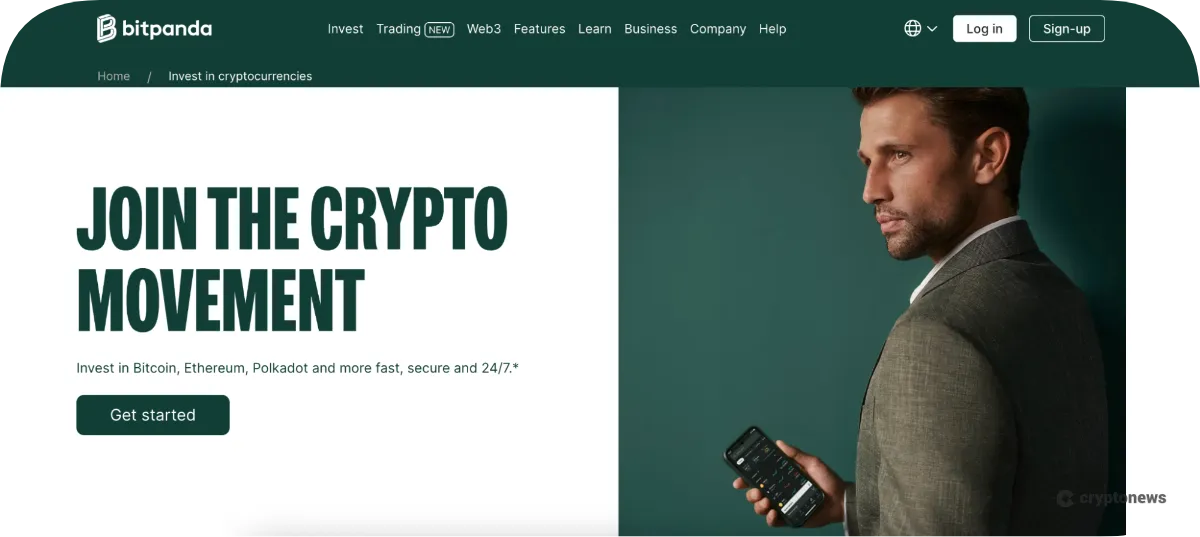
Alongside this, Bitpanda Fusion serves more active traders by offering true spot trading with deep liquidity. Fusion aggregates order books from leading global exchanges to deliver best execution and competitive pricing, supporting over 700 trading pairs and 100+ cryptocurrencies against major fiat and stablecoin currencies.
Those who prefer a non-custodial experience can also use the Bitpanda DeFi wallet. It links to the best decentralized crypto exchanges from multiple ecosystems, including Ethereum and BNB Chain.
Is the Bitpanda Broker Safe?
Bitpanda prioritizes safety, licensing, industry compliance, as well as affordable fees and pricing structures.
Its MiCAR, PSD2, and Electronic Money Institution (EMI) licenses are the core framework that enable it to offer regulated financial services in Europe. It also holds licenses at the domestic level; local registrations include the UK, Spain, Germany, Italy, Sweden, and Dubai.
Regarding platform security, Bitpanda holds client funds in segregated wallets, with the vast majority stored in cold storage. The broker allocates a smaller percentage of client-owned funds for daily withdrawal requests, which is standard practice with most licensed platforms.
Although it lacks public proof of reserves, it allows customers to request audited reports on their personal account holdings. Auditors confirm that Bitpanda holds 1:1 reserves entirely, and its strong licensing infrastructure prevents it from using client money for business operations.
To remain compliant with anti-money laundering (AML) regulations, Bitpanda employs robust know-your-customer (KYC) processes. New users must upload government-issued ID and proof of residency before they trade, which ensures a safe trading environment for everyone. As a European-based platform, Bitpanda complies with the General Data Protection Regulation (GDPR). Strict compliance ensures the broker stores client documents securely.
When users open a Bitpanda account, they access security tools in a straightforward user interface to help mitigate cybersecurity risks. They can enable two-factor authentication (2FA) via Google Authenticator, Authy, and Authenticator+. Device management and email confirmations add extra layers of security to the account.
Has Bitpanda Ever Been Hacked?
Bitpanda is one of the few Tier 1 brokers to avoid cybersecurity attacks since its inception. No users have lost money to hackers via the platform, and it remains one of the safest places to buy and sell digital assets.
Despite its perfect track record, security experts advise against storing large amounts in centralized exchange wallets. Withdrawing cryptocurrencies to top non-custodial wallets is the recommended solution for long-term holders.
Supported Coins
Bitpanda lists over 650 cryptocurrencies, which include market leaders like BTC, ETH, XRP, BNB, and Tron. It separates digital asset markets into six investment categories: meme coins, new coins, AI, DeFi, gaming, and staking.
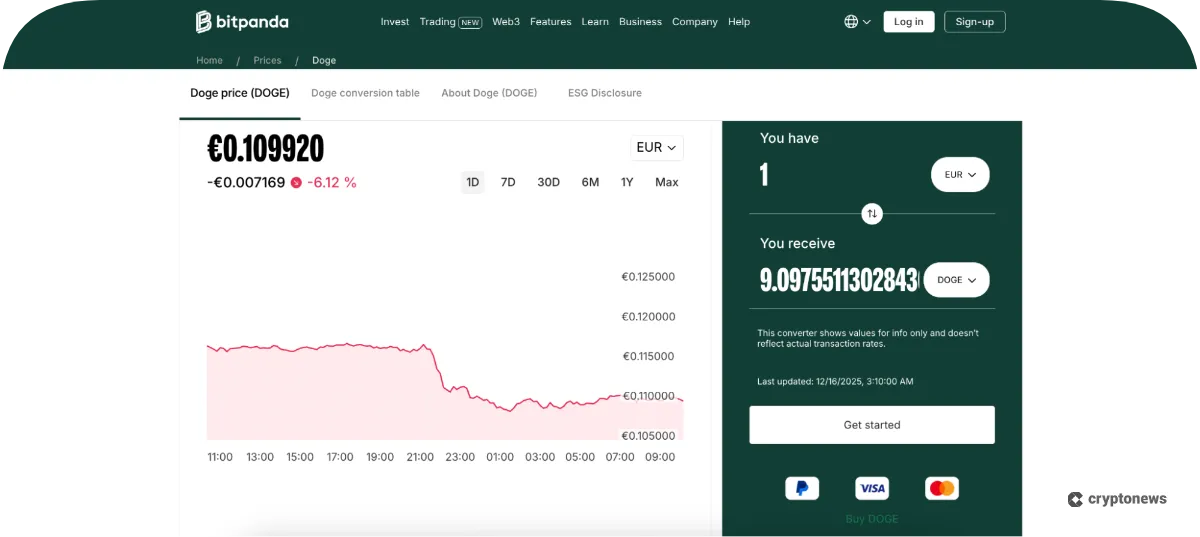
In the meme coin division, Bitpanda supports Dogecoin (DOGE), Shiba Inu (SHIB), Pepe (PEPE), Brett (BRETT), and Floki (FLOKI). Top Solana meme coins range from dogwifhat (WIF) and Bonk (BONK) to BOOK OF MEME (BOME) and Pudgy Penguins (PENGU). Notable meme omissions include OFFICIAL TRUMP (TRUMP), Fartcoin (FARTCOIN), and Toshi (TOSHI).
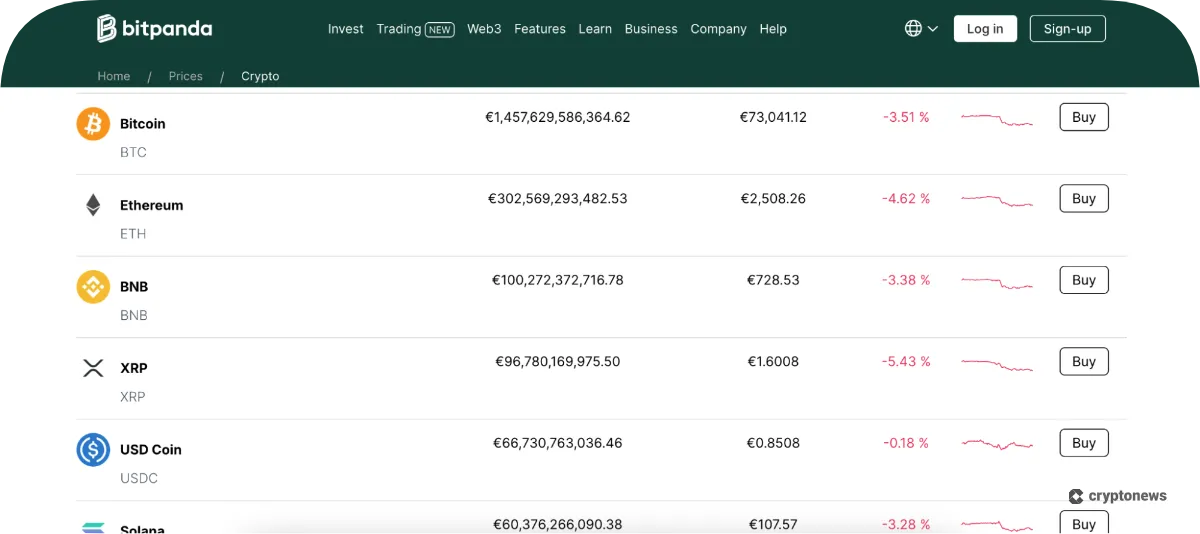
Since Bitpanda operates under strict regulatory requirements, licensing bodies enable the broker to offer fiat-denominated pairs. Verified users trade digital assets against local currencies such as EUR, USD, GBP, and CHF. Some markets support stablecoins like USDC and EURC. No Tether (USDT) support exists, as the stablecoin remains non-compliant with MiCA rules.
Disclaimer: Investing in crypto-assets carries risk and may not be suitable for all investors. Crypto is volatile. You could sustain a loss of some or all of your investment. Invest only what you can afford to lose. Bitpanda GmbH is authorised by the Austrian Financial Market Authority (FMA), and Bitpanda Asset Management GmbH is authorised by the German Federal Financial Supervisory Authority (BaFin), each as a crypto-asset service provider under Regulation (EU) 2023/1114 (MiCAR).
Bitpanda’s Key Features
Bitpanda offers a comprehensive selection of markets and ecosystem products. In addition to regular cryptocurrencies, the platform supports traditional asset classes and leveraged CFD instruments.
The platform also lets users earn yields, manage assets in non-custodial storage, and spend exchange balances in the real world via a Visa-issued debit card.
Our Bitpanda review discusses these core platform features in the following sections.
Crypto Brokerage
Bitpanda’s basic platform functions as a brokerage service, as users buy and sell cryptocurrencies directly with the provider. The simple brokerage form prompts users to select the purchase asset and amount, and Bitpanda executes the order at the best available price.
Similar to Coinbase and other brokerages, Bitpanda charges higher fees compared to the spot market. To fund crypto investments, users deposit fiat money into their Bitpanda account or purchase assets instantly with debit and credit cards and e-wallets.
Bitpanda Fusion
Experienced users trade cryptocurrencies on Bitpanda’s “Fusion” spot exchange to reduce commissions and access trading and analysis tools. The broker supports popular order types like limit, market, stop limit, and take-profit, which let traders enter and exit positions at specific price points.
Bitpanda Fusion’s unique selling point is that it combines order books from the best crypto exchanges, including Binance, Coinbase, OKX, and Kraken. This dynamic provides Fusion traders with market-leading liquidity depth and tight bid-ask spreads.
The spot exchange supports crypto-to-fiat pairs, plus a selection of stablecoin markets.
Margin Accounts
Eligible users can open margin accounts to increase their crypto purchasing power. Leverage limits are much lower compared with most derivative platforms due to Bitpanda’s European licenses. Large-cap cryptocurrencies offer 10x leverage, while less liquid markets have cap limits of 2x, 3x, or 5x.
Bitpanda charges margin interest rates every four hours, which equals 0.18% daily (at the time of writing).
Disclaimer: Margin trading involves borrowing crypto assets to amplify potential gains and losses. Even small price changes can lead to margin calls or liquidation, potentially resulting in the loss of your entire capital. Borrowing fees accrue every 4 hours and adversely affect your margin level. Margin trading is suitable for experienced traders only. Ensure you understand the risks and can bear substantial or total financial loss. Never trade with money you cannot afford to lose.
Alternative Asset Classes
Bitpanda recently expanded its asset library to include traditional securities. This update, launched on January 29, 2026, marked the rollout of Bitpanda’s one-stop-shop, unified investing app, allowing users to trade stocks, ETFs, ETCs, commodities, and precious metals alongside crypto through the same regulated platform.
It also supports fractional exposure from just €1, which includes major stocks like Apple, Microsoft, Amazon, and Nvidia. Popular ETFs feature the S&P 500 and U.S. High Yield Bonds, and commodities markets include crude oil, gold, silver, and wheat.
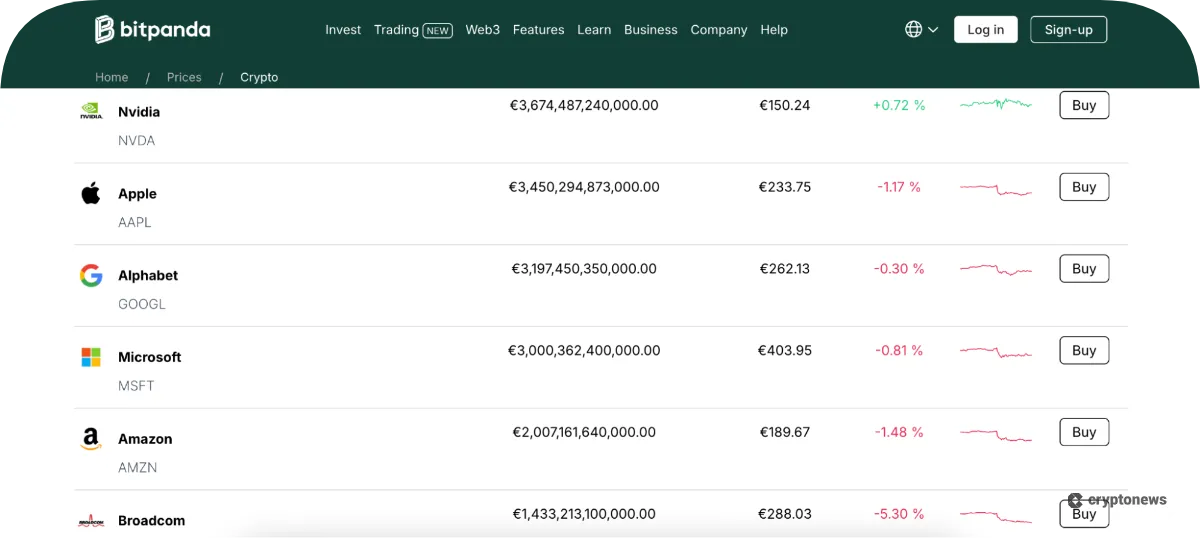
Note that users don’t directly own the underlying securities when they invest through Bitpanda. The platform offers contracts that represent economic exposure. It purchases and holds the assets in custody banks, and while this mitigates counterparty risks, it does not eliminate them.
DeFi Wallet
Bitpanda’s DeFi wallet lets users send, receive, and store cryptocurrencies in a non-custodial framework. Once users withdraw coins to the wallet, they retain full control of the assets. The wallet supports all EVM and SVM-compatible networks like Ethereum, BNB Chain, and Solana.
Our Bitpanda review identified several drawbacks with the DeFi wallet. It lacks support for decentralized applications (dApps), so users cannot manually engage with popular DEXs like Uniswap and PancakeSwap.
Despite its self-custodial model, Bitpanda retains one segment of the backup credentials. As such, investors could face third-party risks.
Staking Program
Bitpanda users can stake their account cryptocurrencies to earn passive rewards. The feature supports the best staking coins with competitive APYs. Small and mid-cap coins like Kusama (KSM), Chiliz (CHZ), and Secret (SCRT) yield up to 12%, and at 30%, Coreum (COREUM) is the highest paying asset.
Major altcoins such as ETH, BNB, and Cardano (ADA) yield between 1% and 4%, which resembles the real-time blockchain yield. Broker users also generate 7% yields on USDC and EURCV.
Bitpanda staking comes with a 14-day minimum holding period, and it deducts variable fees from the generated income. Investors receive their staking rewards weekly.
Disclaimer: Earn through Bitpanda Staking allows you to participate in transaction validation on Proof of Stake blockchains, for which you will be rewarded. Staking involves risks including no guarantee of rewards, potential loss from slashing or hacks, and depreciation in the value of assets while staked. Staking of crypto-assets is not classified as a regulated crypto-asset service under Regulation (EU) 2023/1114 (“MiCAR”). Staking through Bitpanda GmbH and Bitpanda Asset Management GmbH involves the use of crypto-assets already held under our regulated custody and administration service and remains subject to MiCAR obligations, including safeguarding and return of assets.
Bitpanda Debit Card
Issued by Visa, the Bitpanda card allows users to spend account balances online, in-store, and at ATMs. The card supports cryptocurrencies, precious metals, and stocks, and it converts those assets to the merchant’s local currency in real-time.
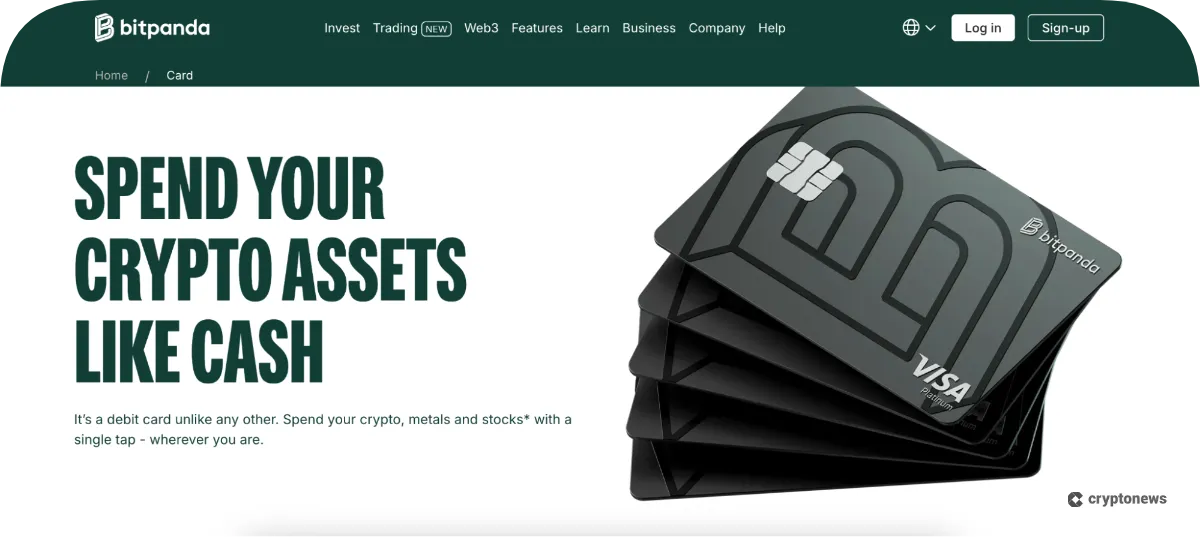
Cardholders avoid monthly and foreign exchange (FX) fees, although ATM withdrawals incur a 2% or €2 charge (the greater of). The card is available to verified Bitpanda customers located in the European Union only. We tested most features of Bitpanda, but not the card directly.
Vision Chain and VSN Tokens
Bitpanda launched a native Layer 2 network that complies with European securities regulations. Built for institutional compliance, the Vision Chain ecosystem supports real-world asset (RWA) tokenization and stablecoin ownership in a KYC-regulated environment.
Vision Chain targets banks, FinTech companies, asset managers, and other large-scale entities, and the native VSN token powers the infrastructure.
While Bitpanda focuses on institutional adoption, anyone can buy VSN to access utility features. Holders earn staking APYs of up to 10%, vote on governance proposals, and reduce brokerages and wallet fees.
Bitpanda Fees: Are They Competitive?
Bitpanda’s robust licensing and compliance structure results in higher platform fees. This section outlines the broker’s fee schedule across key markets and services.
Brokerage Fees
Buying and selling digital assets via the brokerage service remains the most expensive way to trade.
Bitpanda charges variable trading commissions depending on the asset type. Stablecoins, BTC, and VSN markets cost 0.99% per side, while major altcoins cost 1.49%. Users who trade cryptocurrencies with a market capitalization below €100 million pay 2.49%.
The brokerage includes commissions and bid-ask spreads as an all-in-one quote.
Fusion Fees
The spot exchange lets traders reduce commissions, and it uses a volume-based model to determine rates.
Most traders pay 0.25% per side, since they must trade over €100,000 within 30 days to increase their volume tier. These fees exceed other Tier 1 platforms such as Binance, OKX, and Bybit, which offer entry-level commissions of 0.1%.
Across seven VIP levels, the reduced commissions range from 0.02% to 0.21%. To secure the lowest trading fees, users must trade $250 million per month.
Note that, unlike the lowest-fee crypto exchanges, Bitpanda offers no discounts to market makers. This drawback is because Bitpanda sources liquidity from other spot exchanges.
Derivative Fees
Derivative commissions depend on the trading product.
Margin accounts incur the same trading commissions as regular spot traders, but they also pay interest fees every four hours.f Those fees are 0.18% per day, based on the total position value.
Crypto CFDs offer 0% commission on entry orders and a 1% fee when users close the position. Overnight financing fees cost 0.1% daily, which includes weekend positions.
Non-Crypto Trading Fees
Bitpanda offers commission-free trading on non-crypto assets like stocks, ETFs, and commodities. However, like most 0% commission platforms, it charges an unspecified spread.
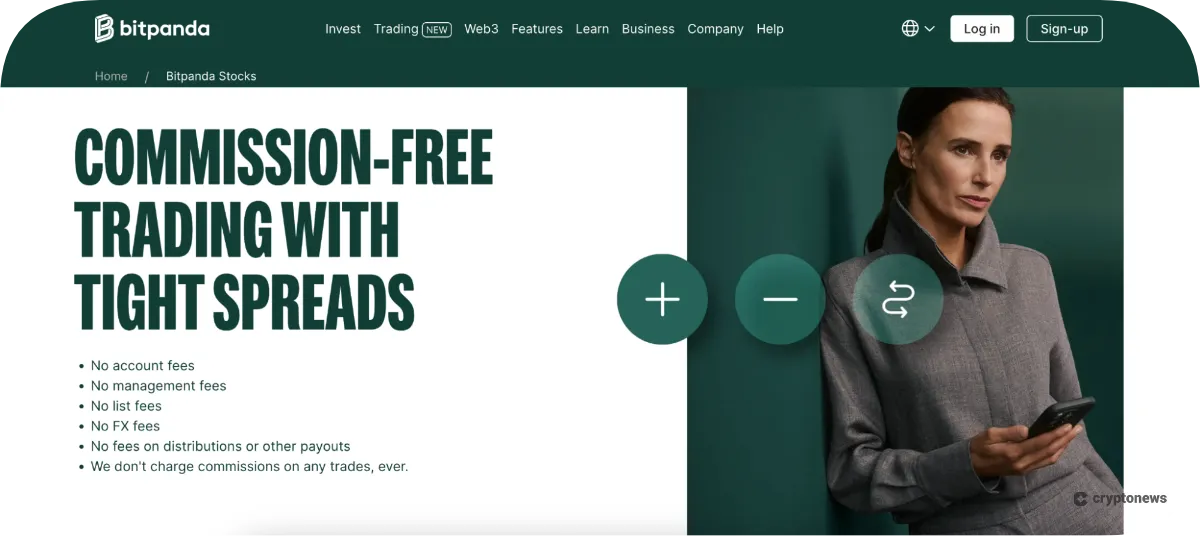
Spreads vary widely by market conditions, so traders must evaluate them before placing orders.
Deposit and Withdrawal Fees
Bitpanda does not charge any withdrawal and deposit fees on all supported payment methods. This covers all accepted currencies and payment methods, including Apple Pay, PayPal, bank transfers, and debit/credit cards. In contrast, most crypto exchanges apply an instant fiat fee of 2–5%.
Users must cover blockchain fees when they withdraw cryptocurrencies, yet they reflect real-time charges without additional markups.
| Fee Type | Charges Explained |
|---|---|
| Brokerage orders | 0.99% to 2.49% per side, depending on the crypto market |
| Bitpanda Fusion | 0.25% per side on monthly volumes below €100,000. Higher account tiers pay reduced fees of between 0.02% to 0.21% |
| Margin accounts | Same commissions as spot traders, but with daily interest fees of 0.18% (charged every four hours) |
| CFD trading | 0% and 1% on entry and exit orders, respectively. Overnight financing fees of 0.1% daily |
| Non-crypto assets | 0% commission with an unspecified spread |
| Fiat payments | Fee-free deposits and withdrawals on all supported payment methods and currencies |
| Crypto payments | No fees on deposits. Withdrawals mirror real-time blockchain fees |
| Staking fees | Between 10% and 20%, depending on the account tier |
Is Bitpanda User-Friendly?
Bitpanda has designed its trading platform for all experience levels, yet our research shows that casual traders are the key target market.
Most account holders buy and sell cryptocurrencies on Bitpanda’s brokerage platform, which requires no prior experience in trading. Available on desktop browsers and the native Bitpanda app for iOS and Android, beginners simply enter the digital asset and investment size. The process requires no spot exchange orders, and the brokerage executes investments instantly from just €1.
More experienced users trade on Bitpanda Fusion. The more advanced dashboard offers deeper liquidity, tighter spreads, and access to charts and other trading tools. Seasoned pros also access leveraged products like CFDs and margin accounts.
An exciting new update, which went live on January 29, 2026, is Bitpanda’s all-in-one unified investing app. Through this new feature, users can now trade more than 10,000 stocks, along with commodities, ETFs, ETCs, and metals, on the same platform.
Our Bitpanda review identified comprehensive guides that help users navigate the broker. They teach beginners the basics of cryptocurrencies and blockchain technology, as well as trading processes like placing orders or reading technical indicators.
Where is Bitpanda Available?
Bitpanda operates in over 40 countries, which include most European Union member states, the UK, and Turkey. It does not accept clients from the U.S, Canada, or other global jurisdictions.
As Bitpanda applies strict KYC verification, users must verify their identity before accessing payment and trading services.
How to Get Started With Bitpanda
We found it takes less than 10 minutes to join Bitpanda, including the KYC process. Verified users can instantly deposit fiat or cryptocurrencies without fees and access over 650 digital asset markets.
Follow our step-by-step walkthrough to get started with Bitpanda today.
Step 1: Open a Bitpanda Account
The first step is to visit the Bitpanda website to open an account. Click the “Sign Up” button and enter your first and last name, email address, and country of residence.
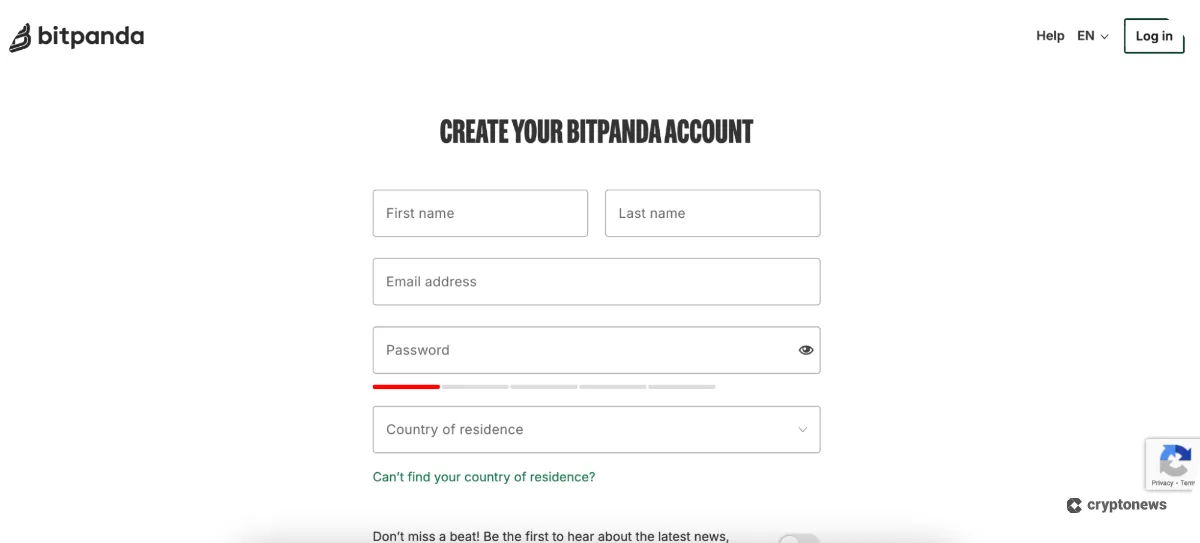
Set a strong password that other people cannot easily guess.
Click the email verification link to complete the initial sign-up steps.
Visit BitpandaStep 2: Complete KYC Verification
Bitpanda complies with the 5th EU Anti-Money Laundering Directive, which requires the broker to ask questions about the client’s trading profile. Questions include the customer’s investing goals, risk threshold, and prior experience.

To confirm your identity, upload an accepted government-issued document such as a passport, driver’s license, or national ID. Available documents vary by jurisdiction.
In most cases, Bitpanda approves document uploads in minutes.
Step 3: Deposit Funds
Bitpanda supports multiple payment methods, including local bank transfers, debit/credit cards, Apple Pay, and PayPal. It charges no deposit fees and accepts currencies including EUR, GBP, and CHF. The minimum fiat deposit is €10 or the currency equivalent, although funded accounts may invest in cryptocurrencies from just €1.
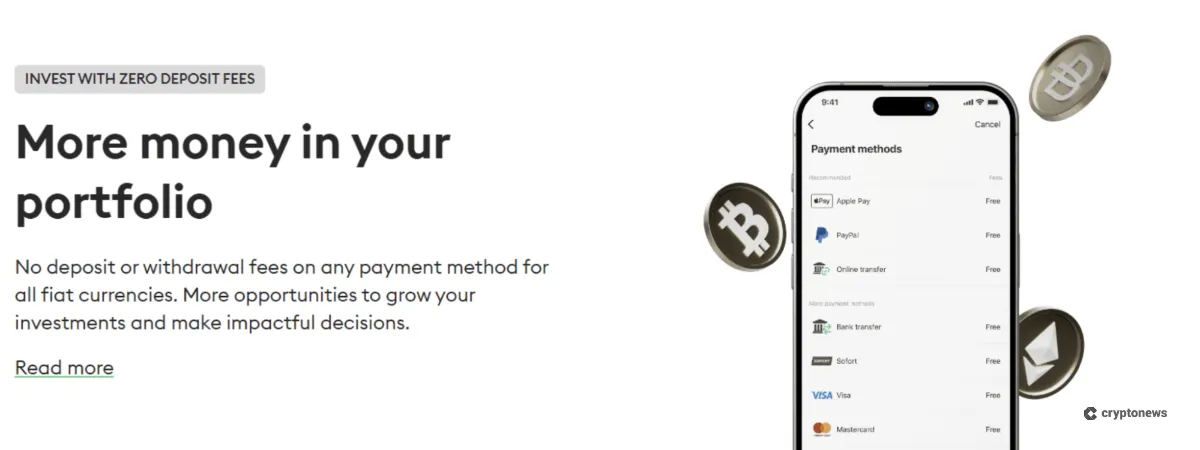
The platform also accepts crypto deposits from private wallets. Users may transfer any digital asset that the broker supports without additional fees.
Step 4: Choose a Crypto Market
Bitpanda users access hundreds of cryptocurrencies, including top altcoins like ETH, XRP, and BNB. Hover over “Invest” and select “See All Cryptocurrencies” to browse available markets.
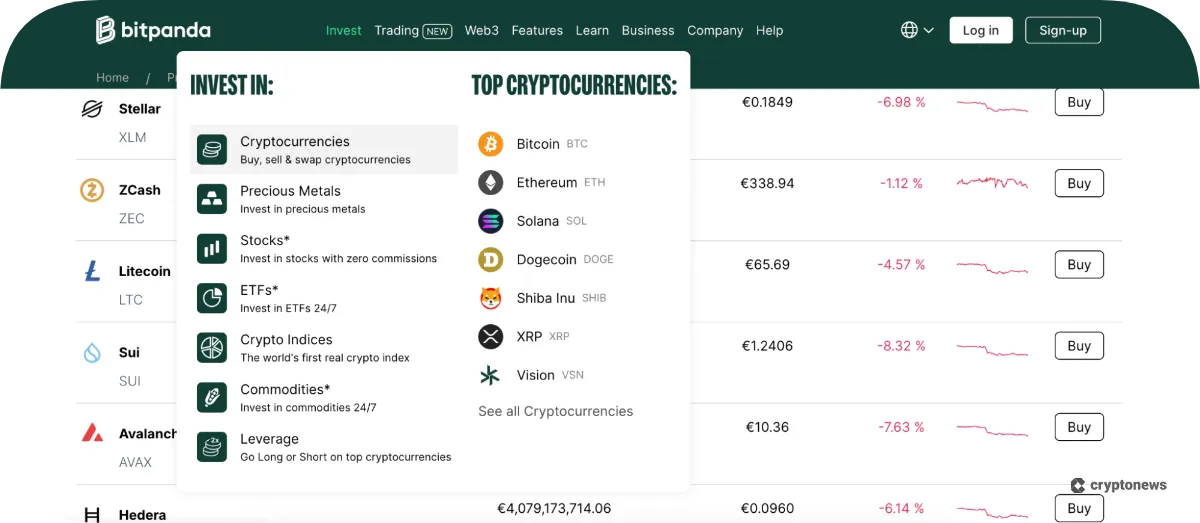
Bitpanda lists assets by market capitalization. Click the investment category to view specific crypto market types, such as DeFi or meme coins.
Step 5: Invest in Cryptocurrencies
The investment process varies by preferred instrument type.
To buy cryptocurrencies from the provider’s brokerage arm, enter the purchase size in the account currency. The “You Receive” field displays the total number of coins or tokens based on that amount.
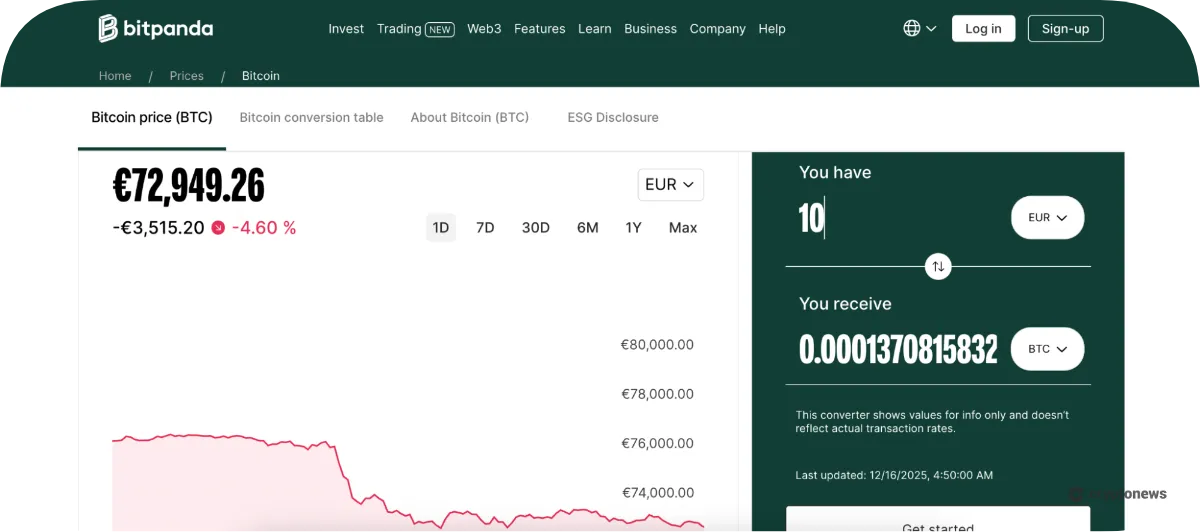
To reduce fees, head to Bitpanda Fusion and set up a market or limit order.
Both the brokerage and Bitpanda Fusion offer instant settlement, so Bitpanda adds purchased assets to the Bitpanda Fusion account right away.
We suggest withdrawing cryptocurrencies to a non-custodial wallet to secure true asset ownership.
Our Methodology: How We Tested and Reviewed Bitpanda
To experience the full platform journey, we registered, verified, and funded a Bitpanda account on desktop and mobile devices. We initially evaluated available jurisdictions, accepted currencies and payment types, minimum deposit requirements, and KYC onboarding.
After account verification, we explored listed markets across the brokerage, Bitpanda Fusion, and derivative trading platforms, and recorded trading commissions, average spreads, and trade execution speeds.
The research process also examined non-trading features such as staking tools and the Bitpanda DeFi wallet. To produce a platform safety rating, we assessed security features, custodianship framework, and audited proof of reserves.
To complete this Bitpanda review, we benchmarked our findings against over 50 competitor exchanges. Our methodology allows readers to make an informed decision about Bitpanda without bias.
Bitpanda Review Conclusion: Who Is It Best For?
Bitpanda offers products and services to suit most trading profiles, although it particularly appeals to casual investors with limited experience. The crypto broker service lets users buy digital assets instantly from just €1, and convenient payment methods include debit/credit cards and PayPal.
Those who seek advanced trading tools use Bitpanda Fusion, which supports margin accounts, indicators, and custom order types. Ultimately, Bitpanda is a legitimate broker with over 16 licenses, full AML compliance, and institutional-grade security.
As of January 29, Bitpanda has introduced its all-in-one investing app, bringing stocks, ETFs, ETCs, and other assets together in one platform. To mark the launch, users can earn 1% cashback on eligible stock, ETF, or ETC purchases and portfolio transfers made between January 29 and February 14.
Visit BitpandaDisclaimer: Execution only services for stocks, ETF and ETC are provided by Bitpanda Financial Services GmbH. Not a public offer. Investing involves risk of loss, and past performance is not a reliable indicator of future results. Consider your circumstances and consult an independent adviser prior to investing. Other costs (e.g. spreads, inducements, FX, product costs and taxes) may apply and reduce your returns. See the Cost Information Document before trading. Fractions generally do not carry voting rights and cannot be transferred or certificated; in corporate actions, entitlements (including dividends) are credited on a pro‑rata basis and may be rounded down to the nearest eligible increment. Execution of fractional orders may be aggregated with other client orders. Custody of fractions in stocks, ETF or ETC is provided on an omnibus basis in accordance with applicable client assets and safekeeping rules.
FAQs
Is Bitpanda broker legit?
Why is Bitpanda so popular?
Can U.S. residents use Bitpanda?
Does Bitpanda require KYC?
Who owns Bitpanda?
Can you withdraw money from Bitpanda?
Is Bitpanda good for beginners?
References
- Bitpanda General User Agreement (Bitpanda)
- Bitpanda GmbH Company Profile (Bloomberg)
- Markets in Crypto-Assets Regulation (MiCA) (European Securities and Markets Authority)
- ESMA to renew restrictions on CFDs for a further three months from 1 May 2019 (European Securities and Markets Authority)
- Granting of Licence (Financial Market Authority Austria)


