Uzbekistan Legalizes Stablecoins for Payments and Tokenized Stocks in Massive 2026 Overhaul





Uzbekistan is preparing to integrate stablecoins into its formal payment system and allow the issuance of tokenized stocks and bonds under a tightly regulated framework starting in 2026, according to local media reports.
The plan positions the country to become one of Central Asia’s most structured environments for regulated digital-asset activity.
It also represents a major shift for a jurisdiction that once imposed broad restrictions on crypto use but has spent recent years building a more controlled and supervised system for the sector.
Uzbekistan Prepares Licensed Exchanges for Tokenized Securities Trading in 2026
According to a Friday report by local news outlet Kun, under the new rules, a special legal regime will take effect on January 1, 2026, introducing a regulatory sandbox managed by the National Agency for Perspective Projects together with the central bank.
The sandbox will allow stablecoins to be tested as a means of payment inside a controlled environment, where authorities will monitor risk, market behavior, and technical implementation.
Pilot programs will also explore a distributed-ledger-based payment system and develop a regulated market for tokenized equities and bonds.
Starting the same day, legal entities registered in Uzbekistan will be permitted to issue tokenized securities, with licensed stock exchanges preparing dedicated trading platforms to support placement and circulation.
The move follows months of review. In September, central bank chairman Timur Ishmetov said stablecoins could be approved for payments but only under strict oversight given their potential impact on monetary policy.
He cautioned that expectations for digital currencies often exceed their practical use in mature payment systems, yet confirmed the bank will continue testing various models, including a wholesale CBDC designed to speed interbank settlements rather than serve the public.
The decree builds on Uzbekistan’s ongoing regulatory framework, which, since January 2023, has required all crypto transactions by residents to flow through locally licensed crypto asset service providers.
These rules ban anonymous transactions, prohibit the use of foreign exchanges, require mandatory customer identification, and mandate that providers store transaction data for at least five years.
Crypto is treated as an asset rather than legal tender, though stablecoins will now become the first category permitted for payment use inside a controlled model.
Mining remains legal but regulated, with companies required to use solar energy and register with the agency.
New Rules Coincide With Industry Push to Standardize Blockchain Payments
The new stablecoin law follows a series of cost adjustments for the industry. In March 2024, monthly fees for crypto exchanges were doubled to roughly $20,000 as part of a wider effort to tighten the market and ensure compliance.
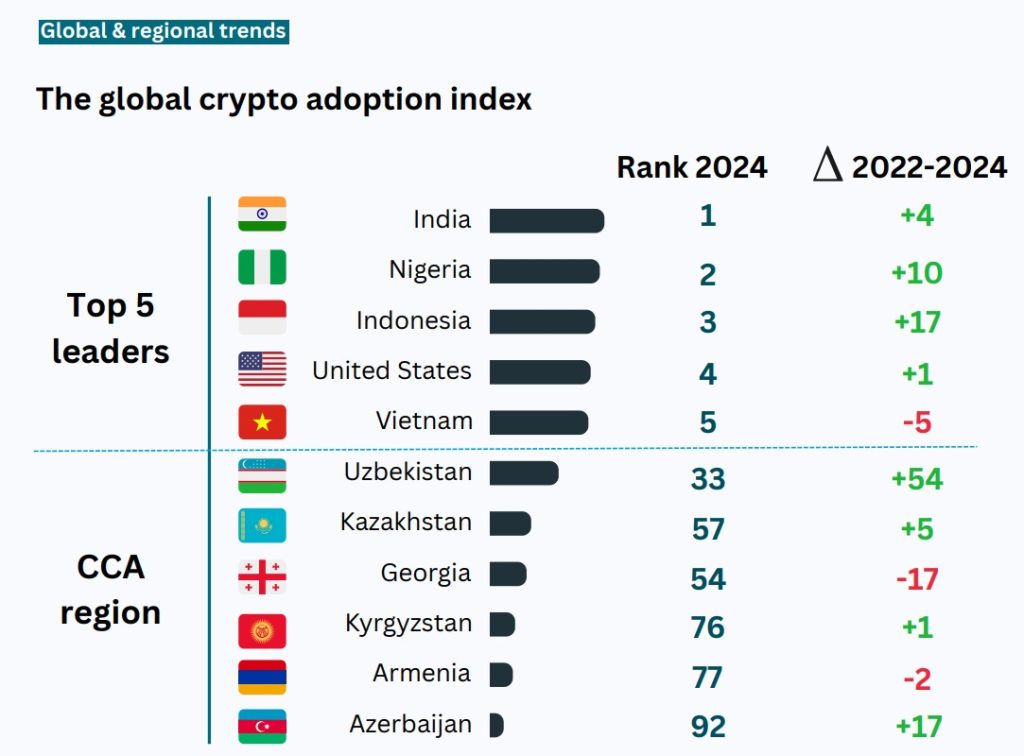
Uzbekistan has maintained a highly supervised approach even as activity grows. In 2024, nearly 1.5% of the population held cryptocurrency, and licensed domestic providers processed more than $1 billion in transactions.
The country ranked 33rd globally in adoption, leading Central Asia alongside Kazakhstan and Kyrgyzstan, which have each pursued their own approaches to mining, payments, and licensing.
The global context surrounding payments is also changing. Throughout 2025, several major jurisdictions formalized oversight for stablecoins.
The European Union began implementing its broad MiCA rules, the United States advanced federal legislation through the GENIUS Act, and regions such as Hong Kong and the UAE launched licensing systems that bring stablecoin issuers under direct supervision.
Canada proposed its Stablecoin Act, while South Africa, Kenya, and Brazil advanced frameworks for stablecoin usage in commerce and cross-border settlement.
These steps have come as blockchain-based payments continue to scale, with on-chain settlement volume surpassing levels seen in traditional card networks.
Another industry milestone came as Fireblocks, Polygon Labs, Mysten Labs, Solana Foundation, TON Foundation, Stellar Development Foundation, and Monad Foundation formed the Blockchain Payments Consortium intended to standardize how digital assets move across networks.
- [LIVE] Fed Payments Innovation Conference: Real-Time Updates as Federal Reserve Discusses Crypto, Stablecoins, and AI with Industry Leaders
- Crypto Market Prospect: After the Washout, the Soil Looks Richer
- XRP Price Prediction: Ripple Slams SEC’s Crypto Rules – Is XRP Finally Breaking Out of the Legal Cage?
- China’s DeepSeek AI Predicts the Price of XRP, Bitcoin and Cardano By the End of 2026
- Bitcoin Price Prediction: Trump vs the Fed Just Escalated – Is BTC About to Explode as Trust in the Dollar Crumbles?
2M+
250+
8
70





- [LIVE] Fed Payments Innovation Conference: Real-Time Updates as Federal Reserve Discusses Crypto, Stablecoins, and AI with Industry Leaders
- Crypto Market Prospect: After the Washout, the Soil Looks Richer
- XRP Price Prediction: Ripple Slams SEC’s Crypto Rules – Is XRP Finally Breaking Out of the Legal Cage?
- China’s DeepSeek AI Predicts the Price of XRP, Bitcoin and Cardano By the End of 2026
- Bitcoin Price Prediction: Trump vs the Fed Just Escalated – Is BTC About to Explode as Trust in the Dollar Crumbles?
More Articles


 in numbers