‘Crypto Will Fail Without Privacy’: Expert Says Public Blockchains Are a ‘Fatal Flaw’






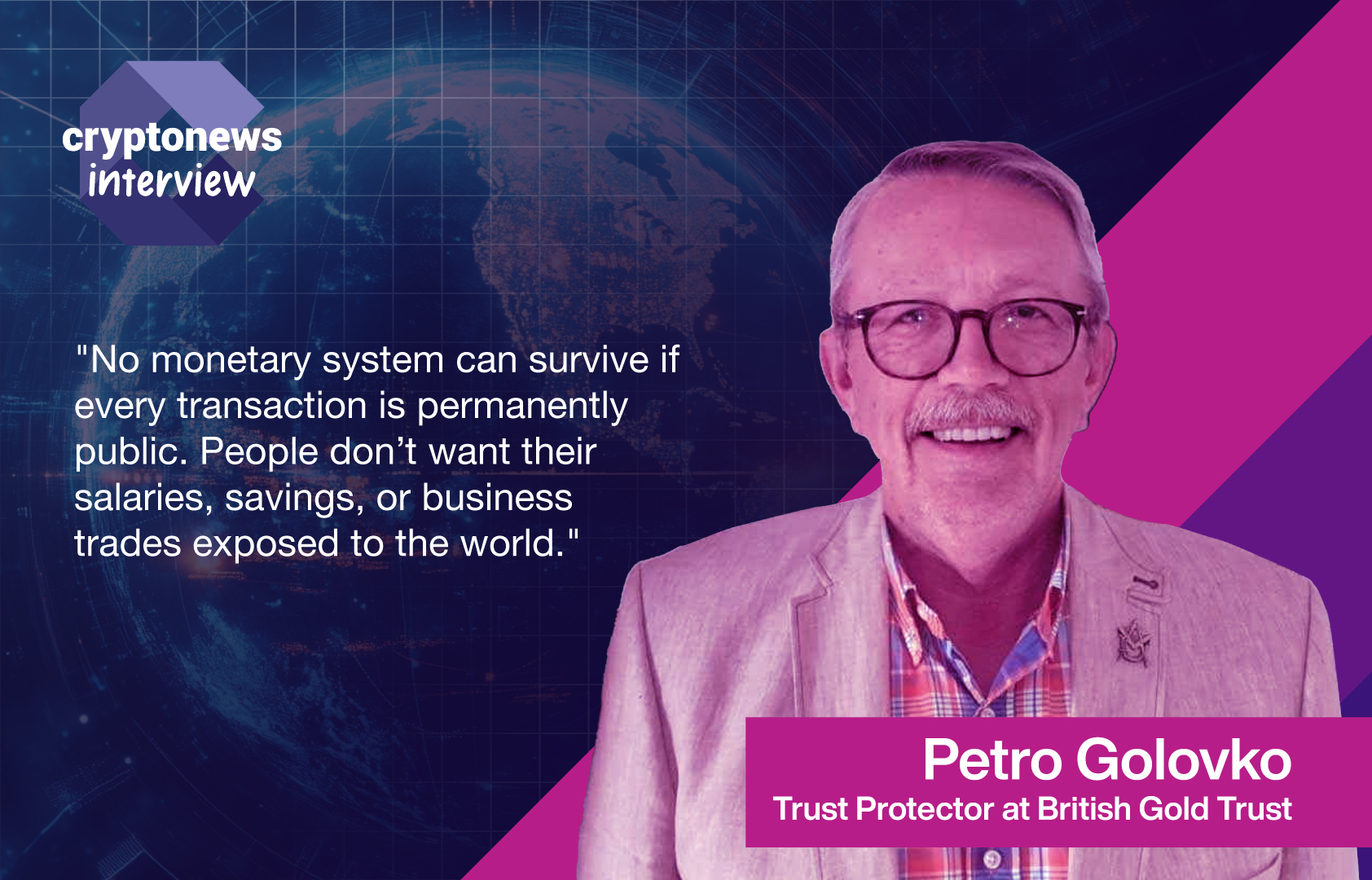
Crypto’s biggest undoing isn’t regulation or volatility, but something more fundamental: the lack of privacy, says Petro Golovko, a finance and gold veteran, with 40+ years of experience in the field.
Golovko, trust protector at British Gold Trust, says public blockchains make crypto unusable for regular people and impossible for institutions. They expose salaries, business deals, and entire balance sheets to the world, he says.
Interestingly, British Gold Trust operates a private blockchain where it oversees billions in tokenized assets, backed by physical gold. No cash changes hands on the underlying Goldtech Ecosystem, only gold, Golovko told us in a phone call.
Golovko, who is also a decentralized AI and quantum finance researcher, was keen to stress that the Trust’s blockchain is private, meaning that, unlike, say, the Bitcoin blockchain, Goldtech’s isn’t visible to the public.
Far from being the future of money, he sees crypto as a broken design chasing problems that don’t exist, as noted in a recent post on LinkedIn.
In this interview with Cryptonews, Golovko takes on the industry’s biggest assumptions and explains why privacy won’t save crypto, but only expose its limits and weaknesses.
‘Crypto Will Never Scale Beyond a Niche’
Cryptonews: You’ve said “crypto will fail without privacy.” What exactly do you mean by that?
Petro Golovko: Because no monetary system can survive if every transaction is permanently public. People don’t want their salaries, savings, or business trades exposed to the world. That’s not innovation — that’s surveillance disguised as openness. Without privacy, crypto will never scale beyond a niche.
CN: If privacy were added, wouldn’t that just reinforce the same corporate and banking power structures crypto was supposed to disrupt?
PG: No. Privacy is not about reinforcing power; it’s about enabling normal participation. Without it, only speculators tolerate the exposure. With it, you can actually build alternatives to banking systems. The problem isn’t privacy — it’s whether the architecture of trust is independent of fiat liabilities.
CN: Many in the crypto industry say transparency is a virtue. You see it as a fatal flaw for mass adoption. Why do you think they’re wrong?
PG: Transparency is useful for auditing, not for living. A system where your employer, competitors, or even strangers can see your balance is not transparent — it’s unlivable. True trust comes from selective visibility: private by default, verifiable when necessary.
CN: Your post says 95% of people don’t want their finances, like salaries, on display. What are the risks of having salaries publicly visible on-chain, and would you say crypto adoption has already peaked because of that?
PG: Public salary data creates competitive exposure, HR liabilities, and even personal security risks. No serious company will adopt a payroll system that exposes compensation globally. That’s why adoption has stagnated — the technology doesn’t fit human reality.
CN: How big a risk is it for businesses to have payroll or trade data exposed on a blockchain?
PG: It’s existential. Trade secrecy is the foundation of competitive advantage. If your supply chain or treasury movements are visible, you’ve already lost. No board of directors will approve such exposure.
CN: If institutions can’t transact privately on-chain, does that mean crypto will remain a niche tool for traders and speculators?
PG: Exactly. Public ledgers are great for speculation, for people comparing portfolios on Twitter. But they cannot underpin serious commerce. Without privacy, crypto remains a casino, not a monetary system.

The Bubble Will Pop: ‘Crypto Is For Hobbyists’
CN: And what would you say about the likes of BlackRock and Fidelity, which are already heavily invested in Bitcoin and Ethereum ETFs?
PG: That’s not adoption, it’s packaging. ETFs are fiat wrappers around speculative assets. Institutions are monetizing volatility, not building monetary systems. It’s financial engineering, not systemic change.
CN: Do you think regulators actually prefer the current setup because public ledgers make surveillance easier?
PG: Of course. Regulators love the visibility. It makes monitoring easy, but it also guarantees crypto will never become mainstream money. A system designed for surveillance will never attract mass adoption.
CN: Can you explain the comparison between the early internet’s lack of encryption and today’s blockchain transparency? What lessons from the dot-com boom is the crypto industry failing to learn?
PG: In the 1990s, nobody wanted to type credit card numbers into a browser because the internet had no encryption. Then SSL arrived, Amazon scaled, and e-commerce became a $6 trillion industry. Blockchain is stuck in the pre-SSL era. Until it solves privacy, it won’t scale. That’s the lesson the industry refuses to learn.
CN: Would you say the idea of a public ledger for money was fundamentally broken from the start?
PG: Yes. It works for hobbyists and traders, but not for societies. Money requires both permanence and discretion. A public ledger as default is a design flaw — it confuses auditability with exposure.
Additional note:
PG: The story of crypto is not about technology. It’s about the architecture of trust. And a system that demands total exposure of its users cannot sustain trust. That’s why privacy is not optional – it’s existential.
- XRP Price Surges as Ripple CEO Takes Role Influencing Crypto Regulation
- Bitcoin Price Prediction: Billion-Dollar Firm Says BTC is Acting Like a Growth Stock – Is That Good or Dangerous for You?
- Elon’s Grok AI Predicts the Price of XRP, Cardano and Bitcoin By the End of 2026
- Crypto Price Prediction Today 16 February – XRP, Ethereum, Cardano
- Google’s Gemini AI Predicts the Price of XRP, Solana and Bitcoin By the End of 2026


2M+
250+
8
70





- XRP Price Surges as Ripple CEO Takes Role Influencing Crypto Regulation
- Bitcoin Price Prediction: Billion-Dollar Firm Says BTC is Acting Like a Growth Stock – Is That Good or Dangerous for You?
- Elon’s Grok AI Predicts the Price of XRP, Cardano and Bitcoin By the End of 2026
- Crypto Price Prediction Today 16 February – XRP, Ethereum, Cardano
- Google’s Gemini AI Predicts the Price of XRP, Solana and Bitcoin By the End of 2026
More Articles



 in numbers