

Why Is Crypto Down Today?



Editor’s Note: This article is archived and exists for reference and historical context. It may contain outdated information or practices that no longer reflect current editorial standards. Please keep that in mind while reading.
The crypto market is down today, still feeling the impact of recent macroeconomic shifts, as well as the latest comments by the outgoing US Securities and Exchange Commission (SEC) Chair Gary Gensler.
He stated that the sector is driven by sentiment, not fundamentals, and that many crypto projects are unlikely to survive, while also calling for stricter regulations.
Over the past 24 hours, the global cryptocurrency market capitalization saw another drop. It’s down 3.3% to $3.41 trillion.
The daily crypto trading volume stands at $193 billion at the time of writing.
Also, 13 of the top 100 coins per market cap have recorded price increases since this time yesterday – about 10 more than yesterday.
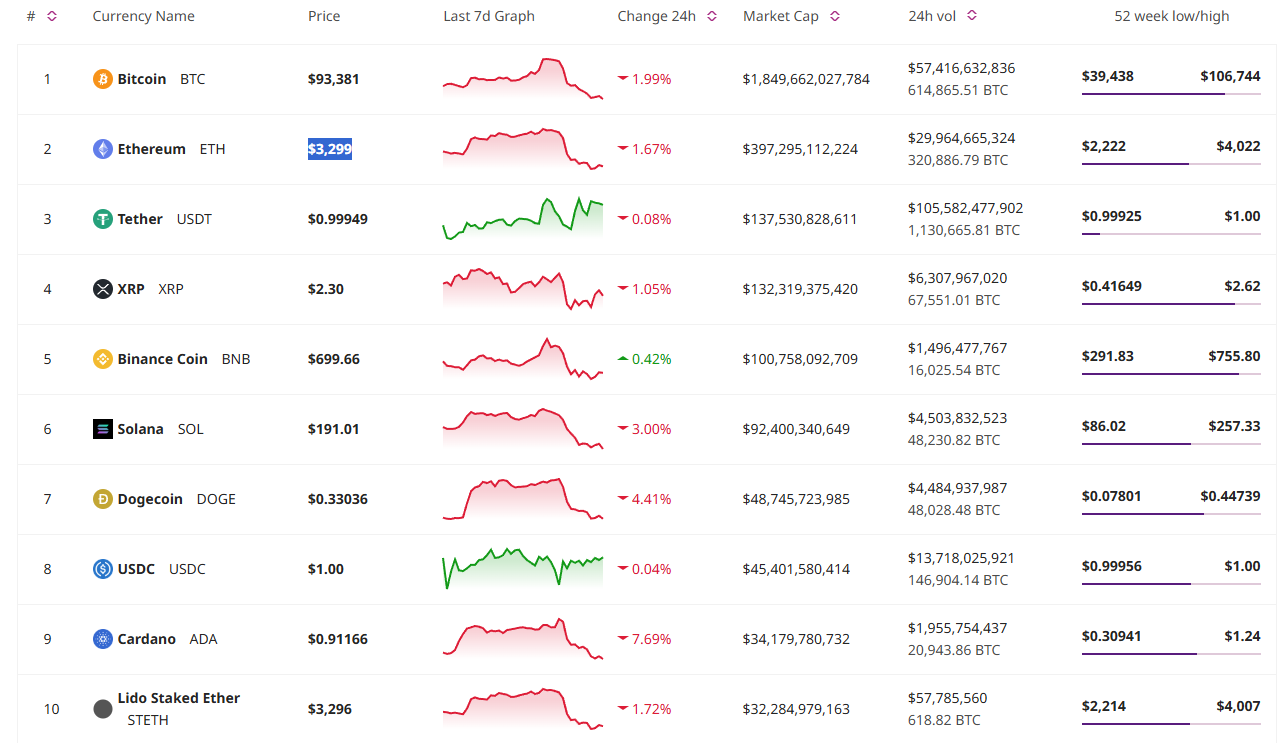
Top 10 Coins Are Down 2.6% On Average Today
The top 10 coins per market cap are nearly all down today.
Only one coin appreciated and less than 0.5%. Binance Coin (BNB) is up 0.4%, now trading at $699.66.
On the other hand, Cardano (ADA) recorded another major drop. Following yesterday’s nearly 14%, it is down 7.7% today to $0.91166.
The second biggest loss is 4.4% seen by Dogecoin (DOGE), which now changes hands at $0.33036.
The rest of the list is down between 1% and 3%.
At the same time, Bitcoin (BTC) decreased by 2%, falling to $93,381.
Also, Ethereum (ETH) is down 1.7%, changing hands at $3,299.
The market is still recuperating from the hit by the US economic reports on Tuesday of the US Federal Reserve’s plans to ease monetary policy.
Meanwhile, the US Department of Justice received approval to sell 69,370 BTC worth $6.5 billion, seized from the Silk Road dark web marketplace. It’s still unclear what the funds would be used for.
Top 10 Meme Coins Are Down 3.9% On Average Today
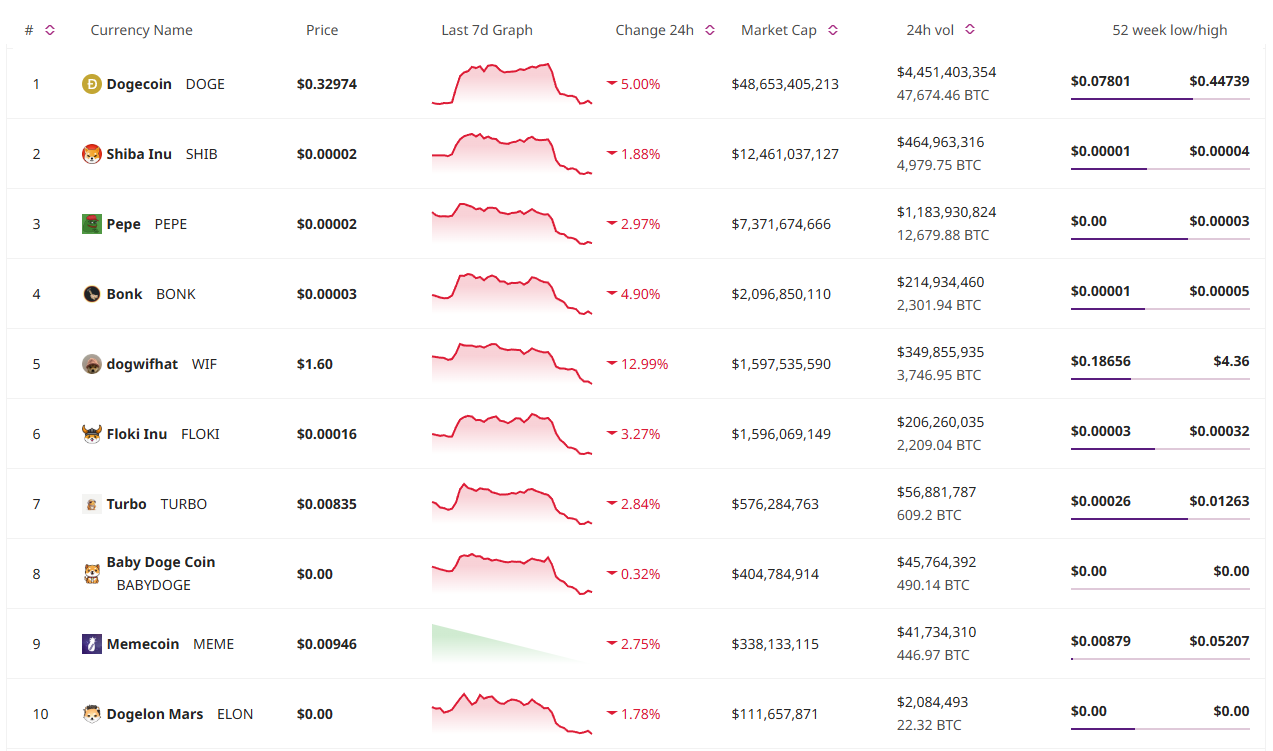
All top 10 meme coins are down today.
However, the drops are lower than those seen yesterday, and only one coin recorded a double-digit fall.
The category’s biggest drop is Dogwifhat (WIF)’s 13%, now trading at $1.6.
The next largest fall is 5%, seen by the first coin in this category, Dogecoin (DOGE). It’s currently trading at $0.32974.
It’s followed by Bonk (BONK)’s 4.9% decrease to the price of $0.00003.
The smallest decrease in this category is 0.3%, recorded by Baby Doge Coin (BABYDOGE).
Shiba Inu (SHIB), the category’s number two coin, is down 1.9% to $0.00002.
A number of recent economic releases have hurt the larger crypto market, so it’s unsurprising that meme coins felt the impact as well. Together, these releases indicate that the US Federal Reserve won’t be cutting interest rates in the near future.
Furthermore, South Korean crypto exchanges are reportedly set to delist meme coins, leaving crypto traders “concerned” that a looming “crisis” could follow.
Meanwhile, Pandana (PNDN), a meme coin built on the Solana blockchain, has surpassed $1.2 million in its presale.
Top 10 AI Coins Are Down 4.5% On Average Today
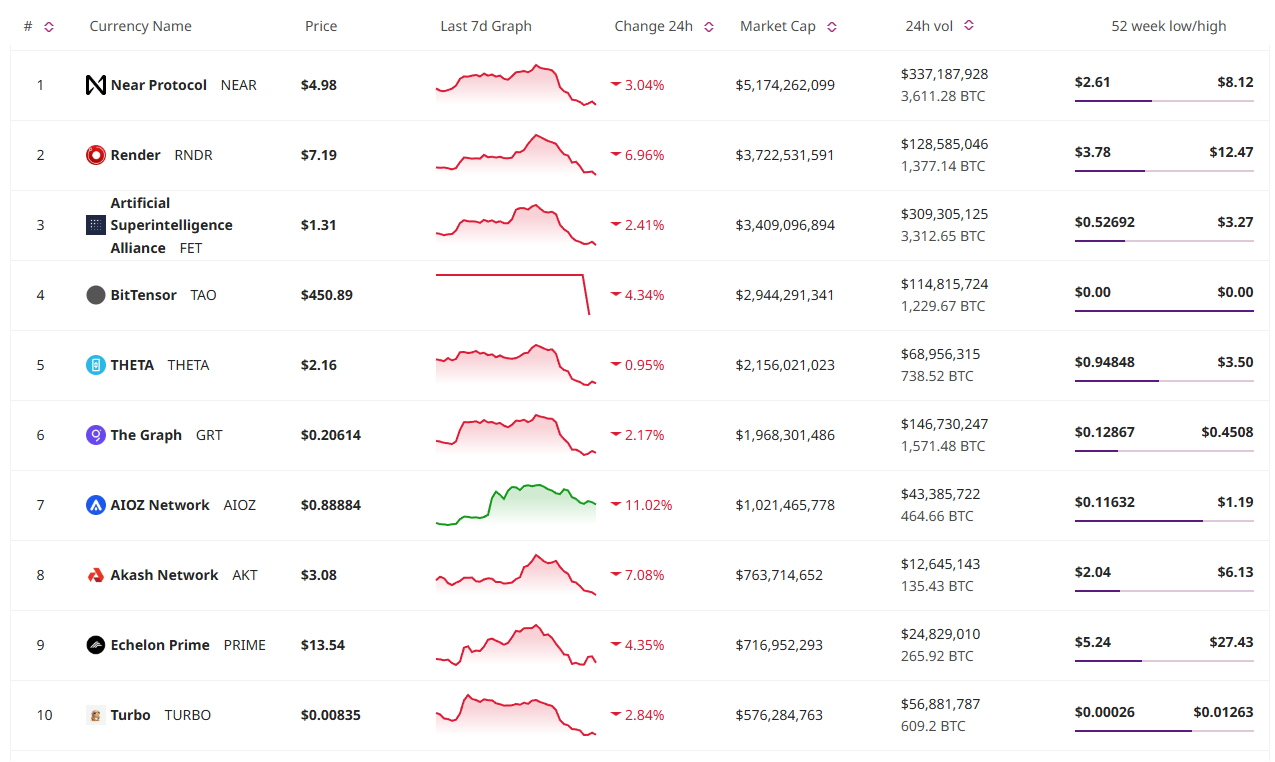
All coins in the top 10 AI coins category are down over the past day.
Like the previous category, compared to yesterday when most of these coins saw double-digit drop, there is only one such coin today.
AIOZ Network (AIOZ) decreased by 11%, currently trading at $0.88884.
The next two highest drops are Akash Network (AKT) and Render (RNDR), with 7.1% and 7% to $3.08 and $7.19, respectively.
The other red coins are down between 0.9% by THETA (THETA) and 4.35% by Echelon Prime (PRIME).
Near Protocol (NEAR), the top coin in this category, fell 3%, now trading at $4.98.
The team behind AZIOZ noted that they’re currently gearing up for the launch of W3Stream. Ahead of it, over the past couple of days, they’ve been discussing a few key models, “highlight down their pros and cons.”
Top 10 Metaverse Coins Are Down 1.9% On Average Today
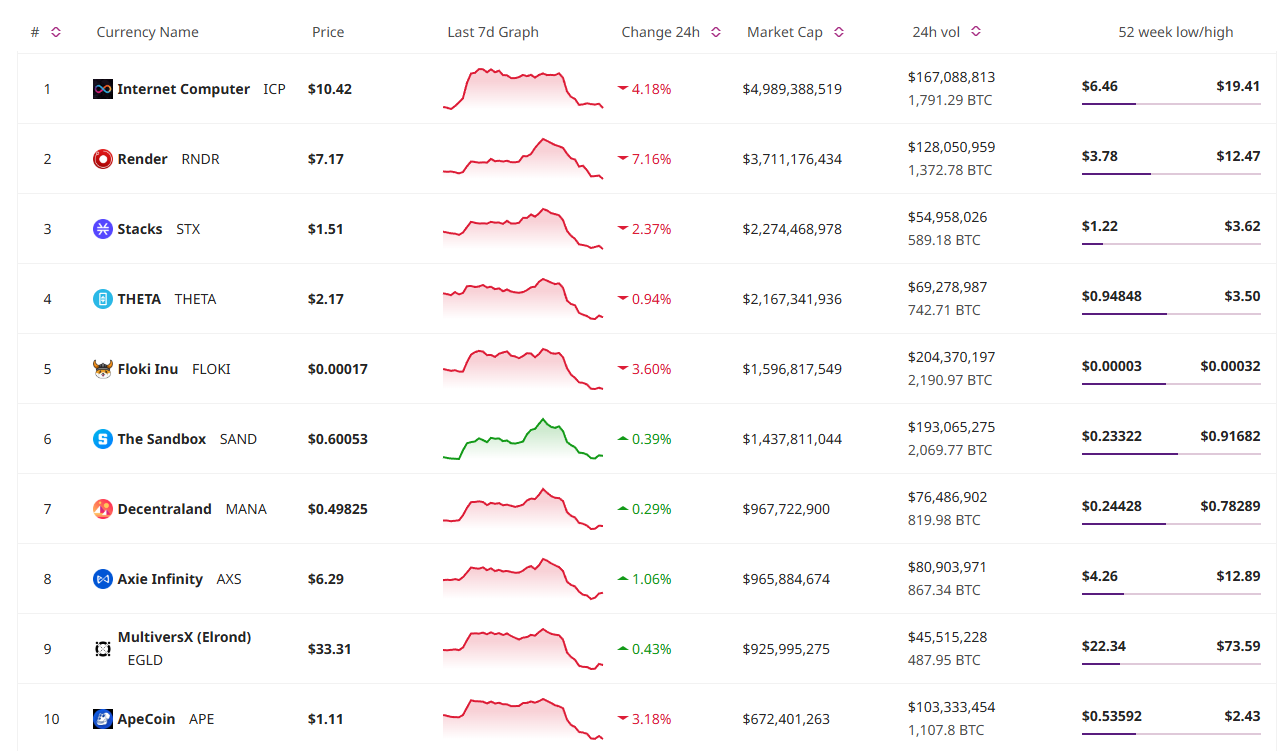
The top ten metaverse coins category has performed better than its peers over the past 24 hours.
Four of the ten have increased in price.
Axie Infinity (AXS) appreciated 1.1%, currently changing hands at $6.29.
The other three coins are up below 0.5% each, meaning that their prices have barely changed.
On the other hand, the category’s second coin per market cap, Render (RNDR), fell 7.2%, trading at $7.17.
This drop is followed by the category’s number one coin, Internet Computer (ICP). It decreased by 4.2%, changing hands at $10.42.
The rest of the list is down between 0.9% and 3.6%.
Meanwhile, on 8 January, the Axie team announced that the Ronin Waypoint is live on App.axie, coming with “easier onboarding and “extra perks.”
Also, it launched its Axie Classic Part Evo Community Ideas Contest to test 66 new Level 2 parts in Season 8. Winners get collectible axis, the post said.
Top 10 Gambling Coins Are Down 1.2% On Average Today
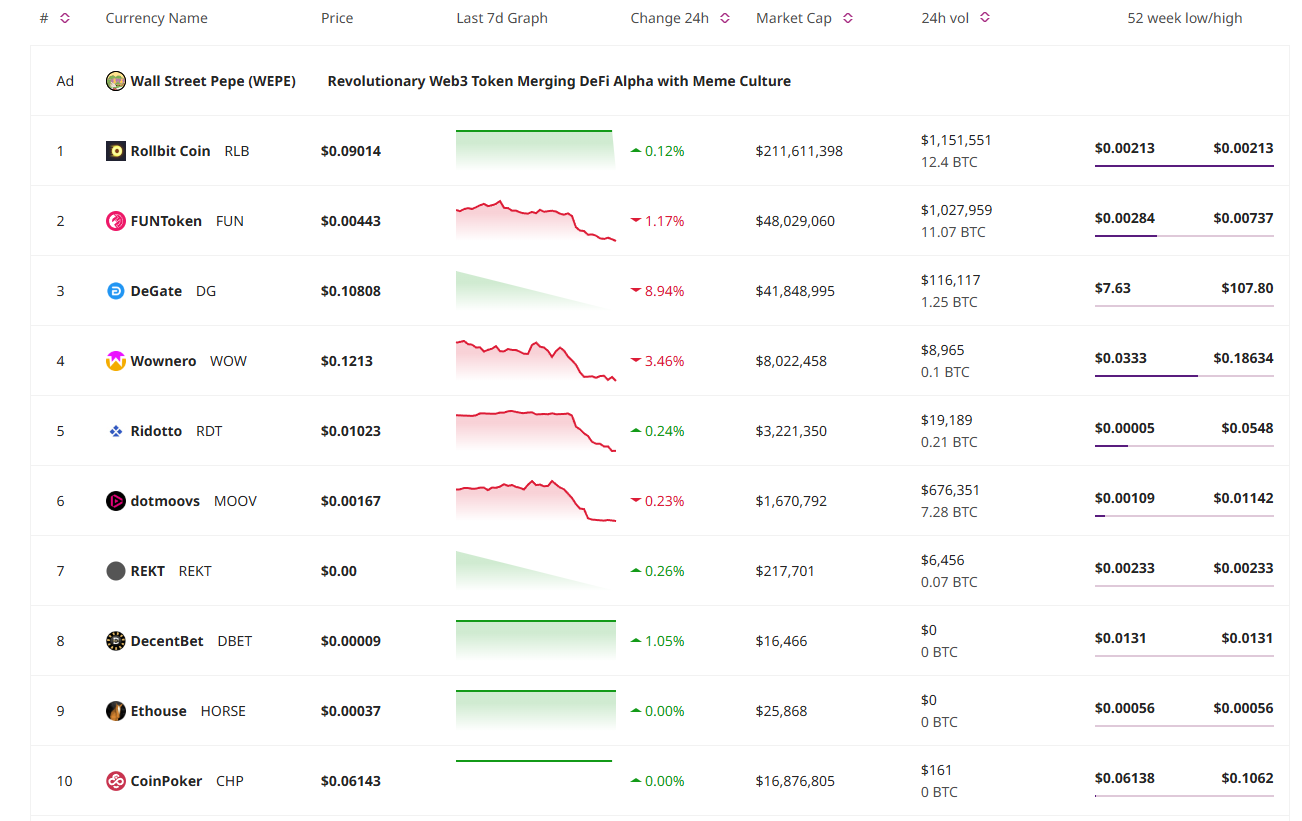
The top 10 gambling coins per market cap is the only category with the majority of green coins.
However, only one of the six saw a rise high enough to move its price.
DecentBet (DBET) appreciated 1%, now changing hands at $0.00009.
The other five rose between 0% and 0.3%.
As for the red coins, DeGate (DG) dropped 9% to the price of $0.10808.
The rest of this list is down 0.2%-3.5%.
The first coin in this category, Rollbit Coin (RLB), decreased by 0.12% to $0.09014.
On 8 January, the DeGate team announced that in December 2024, the trading volume on the DEX reached $832.9 million, marking a 31% increase compared to the previous month. “In fact, we’ve seen consecutive month-over-month volume growth for four straight months,” they said.
Also, its Grid Strategy generated $401,000 in grid profits for users in December, an 80% increase compared to the previous month.
Read more: What’s Happening In Crypto Today? Daily Crypto News Digest
Key Factors Behind Crypto Market Decrease
Crypto markets can move on a dime, switching from uptrends to sudden drops without warning. Part of the challenge lies in market size. The industry’s relative youth and smaller market capitalization make it more volatile.
For context, the entire crypto market is currently worth the same as Apple alone. The former’s total market cap is $3.54 trillion, and the latter’s is $3.55 trillion.
There are many reasons why the crypto market may go down.
They range from elements native to the crypto industry, over those typically related to traditional finance, to global events.
Some are long-lasting, while others cause short-term drops. Some may lead straight into a crypto winter.
Here’s a comprehensive list of the key factors that can lead to a decline in the crypto market.
1. Negative Market Sentiment
- Investor panic: A variety of events may cause investors to panic and start selling. Panic can lead to widespread fear, uncertainty, and doubt (aka FUD). This, in turn, results in investors selling off their holdings, driving prices lower.
- Negative media coverage: For most of the crypto industry’s existence, media coverage has been akin to enemy fire. We have seen the situation improve with greater adoption. However, as seen with Terra, FTX, and others, frequent reports of fraud, hacks, or scams can make people fearful. This may lead to FUD and a mass sell-off.
- Loss of trust: Investors may lose confidence in the market as a whole or a specific cryptocurrency. It can easily occur during turbulent times, such as the bankruptcy and fraud events mentioned above. In these cases, investors are likely to exit, decreasing demand.
2. Market Corrections
- Bubble bursts: The cryptocurrency market may enter a speculative bubble, and this is a dangerous territory holders must learn to recognize. Prices will rise too quickly without any strong fundamentals. Ultimately, the bubble bursts, followed by a market crash.
- Profit-taking: In a situation where prices rise fast, early investors may decide to take profits. Subsequent sell-offs may cause the market to correct, depending on the investors’ size (aka how much they’re holding and selling).
- Overvaluation: It is not uncommon for projects to be overvalued based on speculative hype rather than underlying utility and fundamentals. Hence, the market may eventually correct downwards.
3. Fundamentals
- Transaction volume: Transaction volume plays a vital role in coin and token prices. In addition, total value locked (TVL), a measurement of activity on smart-contract blockchains, becomes an important fundamental measurement that can impact prices in either direction.
- Revenue: Mining or staking revenue reflects the health of the network by ensuring decentralized participation in consensus when revenues are strong.
- Chart technicals: Chart technicals often play a large role in trading, now magnified by automated trading. Traders worldwide make trading decisions based on technical indicators, which, in a relatively small market, can create a self-fulfilling prophecy.
4. Market Liquidity Issues
- Low liquidity: To remain stable, a market needs high enough liquidity. However, low liquidity makes a market more susceptible to large price swings. This can lead to rapid declines when large trades are made in either direction.
- Exchange delisting: We’ve witnessed many times the effect listing on a major exchange has on a coin’s price – climbing fast, even if briefly. But when a major exchange delists a coin, it can reduce its market exposure. Therefore, demand decreases as well, followed by a price drop.
5. Supply Issues
- Increased coin issuance: Once supply outpaces demand, the price falls. In other words, if a coin’s supply increases too fast (through excessive mining, token creation, etc.), it can dilute its value.
- ‘Pump and dump’ tokens: These coins are common and can flood the market. An influx of new, low-quality, or fraudulent tokens, especially if they are manipulated, can lower confidence in the market.
6. Regulatory Crackdowns
- Government regulations: Harsh regulations can have a significant negative impact on the market. We’ve seen banning or restricting crypto use, trading, or mining in various countries (for example, China) push the prices down.
- Regulatory uncertainty: Lack of clarity on crypto regulations in major markets is a significant pain point. It can cause investors to hesitate or pull out their investments due to fear of future restrictions or even penalties. Industry participants will often abandon that market for a more crypto-friendly one.
- Taxation changes: Increased taxes on crypto transactions or capital gains can lead to reduced demand.
- Crackdowns on illegal activities: Governments globally are increasing their efforts to track and shut down illegal cryptocurrency activities. This includes money laundering and tax evasion. Though these actions are illegal, crackdowns can still negatively impact the market.
7. Macro Events
- Geopolitical tensions: Political instability in countries that are heavily involved in crypto can have a major negative impact on the market. Declines will also occur in cases of economic sanctions imposed on such countries.
- Global events: While major global events can spur the use of crypto, they can also be a double-edged sword. Combined with one or more factors on this list, they can lead to sell-offs.
8. Global Economic Policy Changes
- Stronger regulations in major markets: Some large markets, especially in parts of Asia, are more crypto-friendly. But others commonly impose stringent crypto regulations, such as in the US. This may reduce the appeal of cryptocurrencies, causing prices to drop.
- Central bank tightening: Central banks can (and do) raise interest rates or reduce monetary stimulus. However, these moves can lead investors to pull funds out of risky assets.
9. Economic and Financial Factors
- Economic downturns: A general economic recession or financial crisis can be devastating for industries across the board, including crypto. It can cause investors to withdraw their money out of riskier assets.
- Stock market crashes: It has been debated how correlated these two markets are. Either way, a decline in traditional markets can easily lead to decreased investor risk appetite. Consequently, investors may sell off speculative assets.
- High interest rates: Crypto investments are less attractive during periods of high interest rates. Traditional investments like bonds and savings accounts may offer better returns.
10. Legal Actions Against Crypto Companies
- Lawsuits or shutdowns of crypto firms: Crypto companies and their executives have been fighting legal battles on several fronts. These battles, as well as government shutdowns of major crypto-related companies, such as exchanges and wallet providers, can undermine market confidence.
- SEC enforcement actions: The US Securities and Exchange Commission (SEC) has been one of the biggest (if not the biggest) thorns in the crypto industry’s side. The SEC’s action against major crypto companies can cause significant price declines for specific projects or the entire market.
11. Security Breaches and Hacks
- Hacks: Unfortunately not an uncommon event, hacks of cryptocurrency exchanges or wallets can easily lead to a loss of confidence in the market. As users’ funds are stolen, people may lose trust that their coins are safe. It is also unknown what the hacker will do with the stolen funds, as some choices may affect the market.
- Blockchain vulnerabilities: Security flaws or vulnerabilities are often discovered in blockchain networks and are commonly quietly patched before a bad actor finds both them and a way to exploit them. However, if there is a major, exploitable vulnerability found in a popular chain, it can cause a sharp decline in trust, potentially panic, and consequently, sell-offs.
- Phishing scams and fraud: In addition to hacks, scams, rug pulls, and fraudulent projects can discourage potential investors, causing the market to drop.
12. Market Manipulation
- Whale sell-offs: Large holders (whales) can manipulate the market by dumping a significant amount of their holdings, leading to large drops in prices. They can create artificial market movements by making large trades. When whales create a large sell order, the price can drop fast because it sends the signal to the market that that particular asset is in low demand.
- Pump-and-dump schemes: This is another, more sinister, price manipulation method. Groups create a project, artificially inflate its coin’s price, and then quickly sell off (dump) their holdings, causing crashes and harming investor sentiment.
- Excessive speculation: Excessive speculative trading without real utility or fundamentals can lead to a correction when the market realizes the price is unsustainable.
13. Increased Volatility
- Price manipulation: Excessive volatility is often caused by market manipulation or speculative trading. Importantly, it can easily scare off investors and cause prices to fall.
- Flash crashes: These are abrupt, short-term market crashes caused by large sell orders or algorithmic trading. While a buying opportunity to some, these events can lead to a loss of confidence in the market.
14. FUD (Fear, Uncertainty, and Doubt)
- Negative rumors: Rumors about project failures, regulatory crackdowns, or technological issues can lead to FUD, which can cause panic selling.
- Competition from central banks: If central banks introduce their own digital currencies, so-called central bank digital currencies (CBDCs), they may raise concerns about the future of decentralized cryptocurrencies and, hence, the reason to invest in them.
15. Declining Investor Interest
- Loss of interest from retail investors: Many of the listed factors can lead to the general public’s waning interest in crypto. This commonly occurs during a prolonged bear market. In this case, demand can significantly decrease.
- Exodus of developers: It is not uncommon for a project to be abandoned for a variety of reasons, including lack of funds or various illicit schemes. Either way, if developers leave a project or stop contributing, there is reduced innovation and slower progress, diminishing the project’s value in the market.
16. Decreased Access to Crypto
- Closing of payment gateways: Major payment processors like PayPal, Visa, or Mastercard opening their doors to crypto can significantly push the prices upwards. However, a reduction in their crypto-related service can create barriers for people entering the market, pulling the prices downwards.
- Exchange outages: Major exchanges and other crypto-related businesses can experience outages or shutdowns during times of volatility. On the one hand, this damages investors’ trust in the affected company. On the other, it prevents investors from buying or selling, potentially leading to panic selling when trading resumes.
17. Increased Competition
- Newer, better technology: The rise of newer, more advanced blockchain technologies that outperform existing ones may lead to a shift in investment. Older projects would lose value.
- Shifts in developer focus: Developers or key contributors can abandon one project for another they deem to be better.
- Forks and splits: A network can undergo a fork or split, which can cause confusion among investors and lead to major instability and market decline.
18. Negative Technological Developments
- Blockchain congestion: Blockchains can become congested due to high transaction fees or slow processing times, for example. This diminishes trust in a particular project and may make cryptocurrencies less attractive, especially if it happens frequently.
- Failure to scale: Many networks struggle to scale effectively, meaning they are unable to handle increasing demand. This can potentially undermine confidence and lead to a decline in price.
Technology failures: If the underlying technology or code behind a cryptocurrency is proven to be flawed or buggy, it can lead to significant declines in market value.
Is Cryptocurrency Safe to Invest In?
Investing in cryptocurrency comes with risks. However, key crypto assets, such as BTC and ETH, have far outperformed traditional investments in the past decade. To reduce risk in crypto investments, consider making crypto a limited part of a larger investment portfolio.
To reduce volatility, use dollar-cost averaging (DCA) to purchase a fixed dollar amount at fixed intervals. This strategy buys more of the asset when prices swoon and smaller amounts when prices spike, often reducing average costs in the long run.
Conclusion
These are the largest factors to keep in mind when discussing cryptocurrency market price movements.
Each of the above-listed factors can contribute to a downturn in the crypto market.
Notably, it is often a combination of two or more of these elements that impact the price movements.
Due to the market’s volatile nature, large enough events or changes can trigger sharp price movements.
This creates a potential for both rapid gains and significant losses.
2M+
250+
8
70





 in numbers

About Cryptonews
Our goal is to offer a comprehensive and objective perspective on the cryptocurrency market, enabling our readers to make informed decisions in this ever-changing landscape.
Our editorial team of more than 70 crypto professionals works to maintain the highest standards of journalism and ethics. We follow strict editorial guidelines to ensure the integrity and credibility of our content.
Whether you’re looking for breaking news, expert opinions, or market insights, Cryptonews has been your go-to destination for everything cryptocurrency since 2017.
