


Crypto prices rarely behave the way you expect. One day you wait for a breakout, the next day the price drops back into the same zone it came from. For long stretches, you see price bounce between clear highs and lows, with no clear direction. What usually follows is that you take a trade, close it early, then watch the price reverse again. Over time, this price behavior can (and often does) lead to missed entries, premature exits, and inconsistent results.
However, that back-and-forth is not always random. Prices often return to familiar levels. And if you step back, you start to see a pattern of repeated moves instead of pure randomness. This shows that the issue does not always come from the market itself. More often, it comes from how hard consistent execution becomes when every decision requires constant attention.
That’s where automation and grid trading can help. With a rules-based approach, you can act on predefined price levels with consistency. This way, you can start focusing on planned execution instead of relying solely on predictions.
This article breaks down how grid-based trading does exactly that and why it fits sideways markets better than most people expect.
KEY TAKEAWAYS
➤ Grid trading turns sideways price movement into repeatable trades through predefined buy and sell levels.
➤ The strategy relies on execution consistency, not prediction, which explains its edge in range-bound markets.
➤ Spot grid bots avoid leverage risk, while futures grids add directional bias and require tighter risk control.
➤ Performance depends on realistic price ranges, sensible grid density, and disciplined oversight when market conditions change.
- What grid trading actually does inside a range
- Why grid trading fits range-bound markets better than directional strategies
- From strategy to execution: when grid trading meets real tools
- Phemex grid trading in action: spot vs futures
- The parameters that determine grid performance
- Step-by-step: setting up a grid bot on Phemex
- Frequently asked questions
What grid trading actually does inside a range
The fundamentals of grid trading are pretty simple. You pick a price range where an asset keeps moving back and forth. Inside that range, you place a series of buy orders below the current price and sell orders above it. Each order sits at a fixed distance from the next one. This is how it works:
- When the price drops and hits a buy level, the system buys.
- When the price rises back to the next level, it sells.
This cycle repeats as long as the price stays inside the range. There is no guesswork or last-minute decisions. Just the same action every time the price revisits a level.
The key point here is intent. Grid trading does not try to catch the big move. Rather, it accepts that price often goes nowhere for long periods. So instead of waiting for a breakout that may never come, it focuses on the movement that already exists.
Essentially, it is setting rules in advance for a market that refuses to pick a direction. Once those rules stay in place, the strategy responds automatically to price behavior rather than opinion. This switch from prediction to execution explains why grids appeal so much during sideways phases.
That said, this rule-based, reaction-driven logic only pays off when markets behave a certain way, which leads to the next question: why does this work so well when the price feels stuck?
Why grid trading fits range-bound markets better than directional strategies
More often than not, range-bound markets punish certainty. You might buy in expectation of continuation, only to see price drift back toward the middle. You might also short a breakdown, only for the move to stall within hours. Nothing follows through, yet price moves just enough to trigger entries and exits.
Put simply, directional trades depend on follow-through, and range-bound markets seldom offer that.
Grid trading, meanwhile, takes a different approach. It accepts that the price will keep revisiting the same zones. So, instead of hoping for momentum, it waits for repetition. This way, every return to a familiar level becomes a chance to act.
This approach works primarily because ranges create rhythm. There are repeat phases in a sideways market when the price pushes up, pulls back, then does so again. A grid treats those swings as expected behavior rather than failed breakouts. The system doesn’t really care why the price moves and reacts the same way every time.
That consistency matters, especially considering how most people struggle to place the same trade over and over without second-guessing. And this is precisely where automation starts to matter.
A grid system removes that burden. It reacts the same way every time the price reaches a level.
From strategy to execution: when grid trading meets real tools
At the risk of stating the obvious, a grid strategy can deliver only so long as the execution stays consistent.
Placing buy and sell orders at fixed levels may sound simple in theory. In practice, however, hesitation creeps in. As a result, orders may get skipped, adjusted, or canceled once the price starts moving faster than expected. Over time, that inconsistency erodes the entire setup.
This is why grid trading usually depends heavily on the tools you use. The strategy requires predefined rules, persistent orders, and fast execution that does not rely on constant attention. Without that structure, the idea remains theoretical.
For demonstration, we are using Phemex, home to one of the industry’s most promising grid trading setups, as a practical example.
For those out of the loop, Phemex offers built-in grid trading tools for both spot and futures markets, which makes it suitable for demonstrating how a grid strategy moves from concept to execution.
We explain the core ideas first, then use Phemex to show how it works in practice.
Phemex grid trading in action: spot vs futures
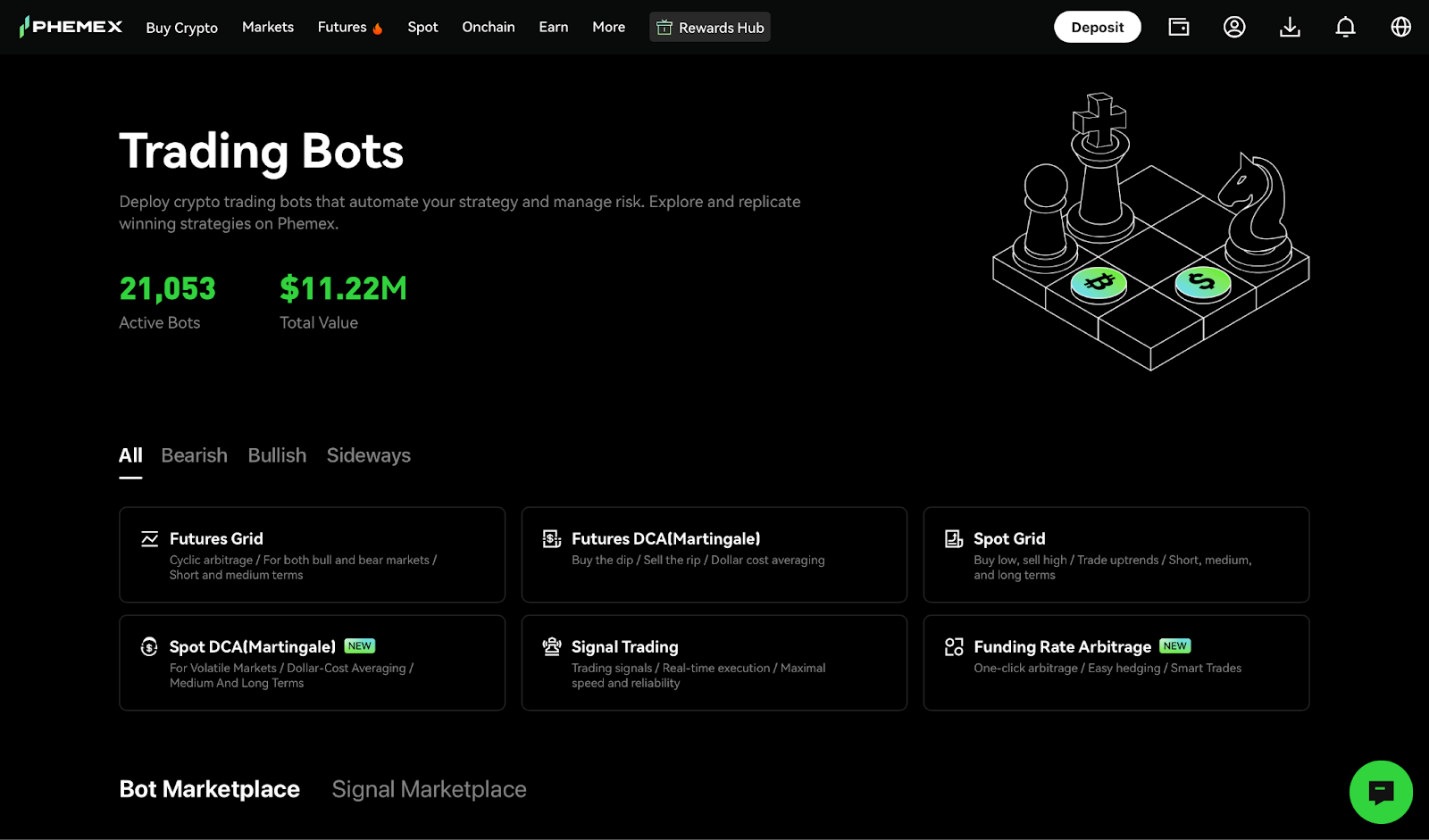
A grid strategy only works if the interface makes setup clear and execution predictable. On Phemex, for example, the grid tools focus on those exact points:
- Clear inputs
- Visible structure, and
- Constant feedback once the bot runs.
You basically have two ways to run a grid on Phemex:
- The spot version sticks to simple buy and sell orders using your own funds.
- The futures version lets you lean bullish, bearish, or neutral and use leverage if that fits your plan.
So, the mechanics basically remain the same, but the experience changes once leverage comes into play.
Spot grid bots: conservative automation without leverage
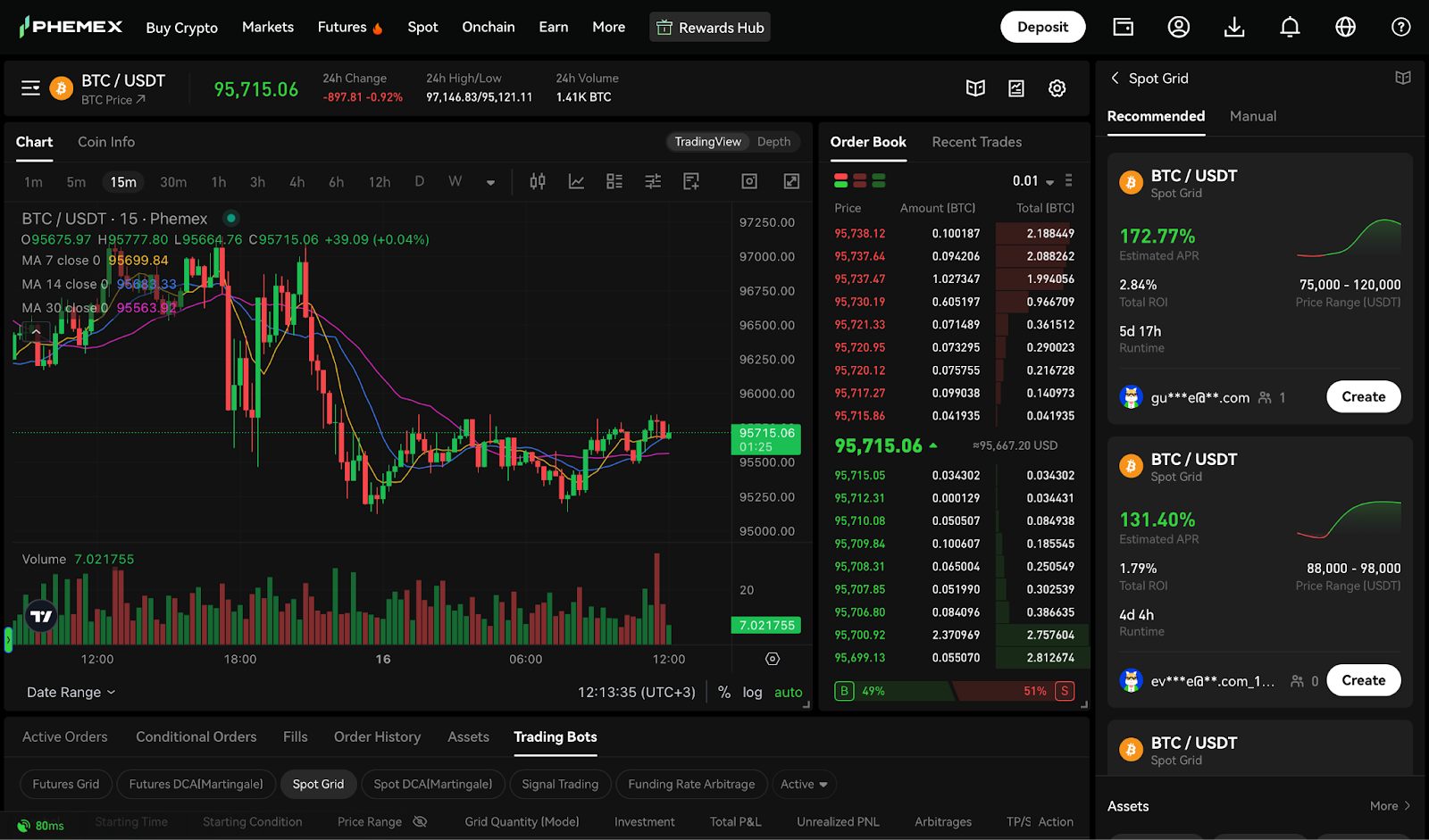
The spot grid screen feels relatively straightforward right from the first step. You choose a trading pair, define an upper and lower price, and decide how many grid levels sit inside that range. The system shows you a preview before anything goes live, so you see exactly where buy and sell orders will sit.
After that, you assign the amount of capital you want to commit and confirm. Once active, the bot places buy orders below the price and sell orders above it, then repeats that cycle every time the price moves back through the range.
The main draw here is simplicity. There is no leverage, no margin math, and no liquidation trigger. If the price drops hard, the bot keeps working inside the range you defined. And if the price moves outside it, execution pauses. That makes spot grids easier to reason about, especially when you want automation without extra layers of risk.
Futures grid bots: long, short, and neutral modes
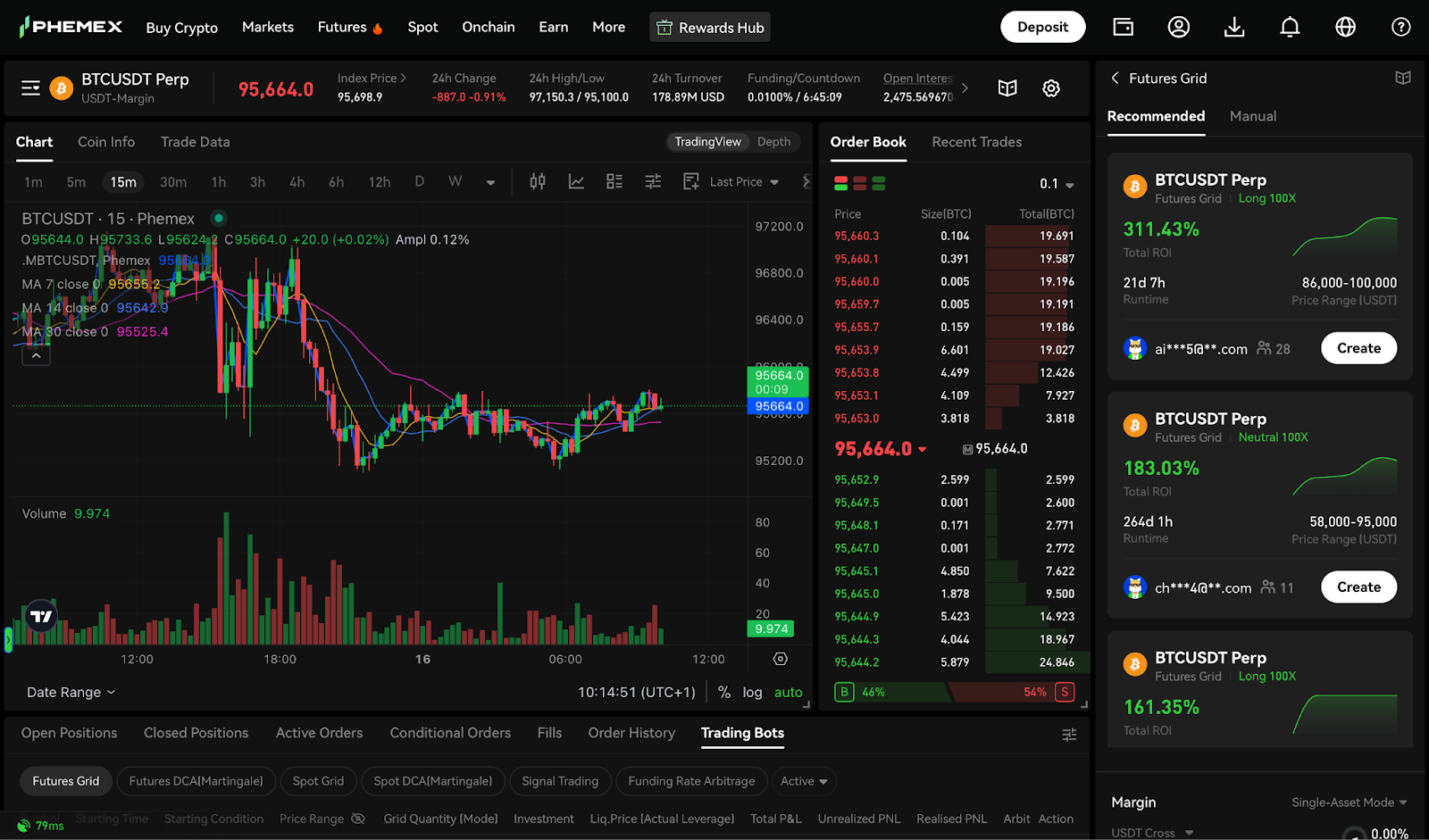
Phemex also offers grid bots on USDT-margined perpetual contracts. This lets you apply the same grid logic while adding a directional bias and, if you choose, modest leverage.
It’s important that you see this as an extension of grid automation, not a separate strategy.
On the futures grid screen, you first choose one of three modes:
- Long mode: The bot starts with a long stance and trades the grid, assuming mild upside bias. It still buys and sells around your grid levels, but the initial exposure leans bullish.
- Short mode: Here, the bot begins with a short position and works the grid with a bearish tilt. Same grid logic, inverted bias.
- Neutral mode: The bot does not take a directional stance first. It buys low and sells high across your defined range, just like a spot grid, but on perpetual contracts.
After choosing the mode, you set your price range, grid count, and capital allocation. You can also decide on leverage and any risk triggers you want to attach.
Note that unlike spot grids, futures grids involve margin and liquidation risk, so getting the range and leverage right matters a lot more.
The parameters that determine grid performance
One of the most common reasons grid trading may not work as intended is a mismatch between the settings and how the price actually moves.
Here’s a rundown of the three main inputs that matter more than everything else (note: each one affects behavior in a different way):
Price range selection
The price range defines where the bot operates and where it does nothing. If you set it too tight, the price exits the range often, and the bot sits idle. Similarly, if you set it too wide, trades happen less often and capital spreads too thin.
A practical approach helps here. Look at recent highs and lows over the last week or month. Use areas where the price already paused or reversed. The goal here is not to predict the next move, but to place the grid where the price already spends time.
Number of grids
Grid count controls how often trades trigger. More grids mean smaller gaps between orders and more frequent trades. Fewer grids mean wider gaps and larger profit per fill.
Neither option wins by default. Tight grids suit calm ranges with steady back-and-forth movement. Wider grids suit choppier ranges with sharper swings.
Besides, fees also matter. Each fill carries a cost, so the gap between buy and sell levels must exceed that cost.
Grid spacing type
Grid spacing defines how the distance between orders is calculated. It usually comes down to one simple choice: arithmetic or geometric.
On Phemex, for instance, you see this option directly in the grid setup screen, right after you define your price range and grid count.
Arithmetic spacing places orders at equal price gaps. If your range runs from $90,000 to $100,000, each grid step uses the same dollar distance. This works best when price moves calmly inside a tight band.
Geometric spacing uses equal percentage gaps instead. Lower prices get tighter spacing, while higher prices spread out. Because crypto prices move in percentages rather than fixed amounts, this option often behaves more naturally during volatile or uneven ranges.
Note that the choice between arithmetic and geometric spacing changes how often trades trigger and how capital is spread across the range. It does not change the grid logic itself, only how the structure responds to volatility.
Step-by-step: setting up a grid bot on Phemex
We are using Phemex as an example here because the actual setup on the platform feels pretty straightforward. In fact, the interface itself guides you through each decision, and nothing goes live until you confirm the full layout. Here’s how it goes:
1. Choose a trading pair: Pick an asset that already shows clear range behavior. Avoid pairs that move sharply on news or thin liquidity.
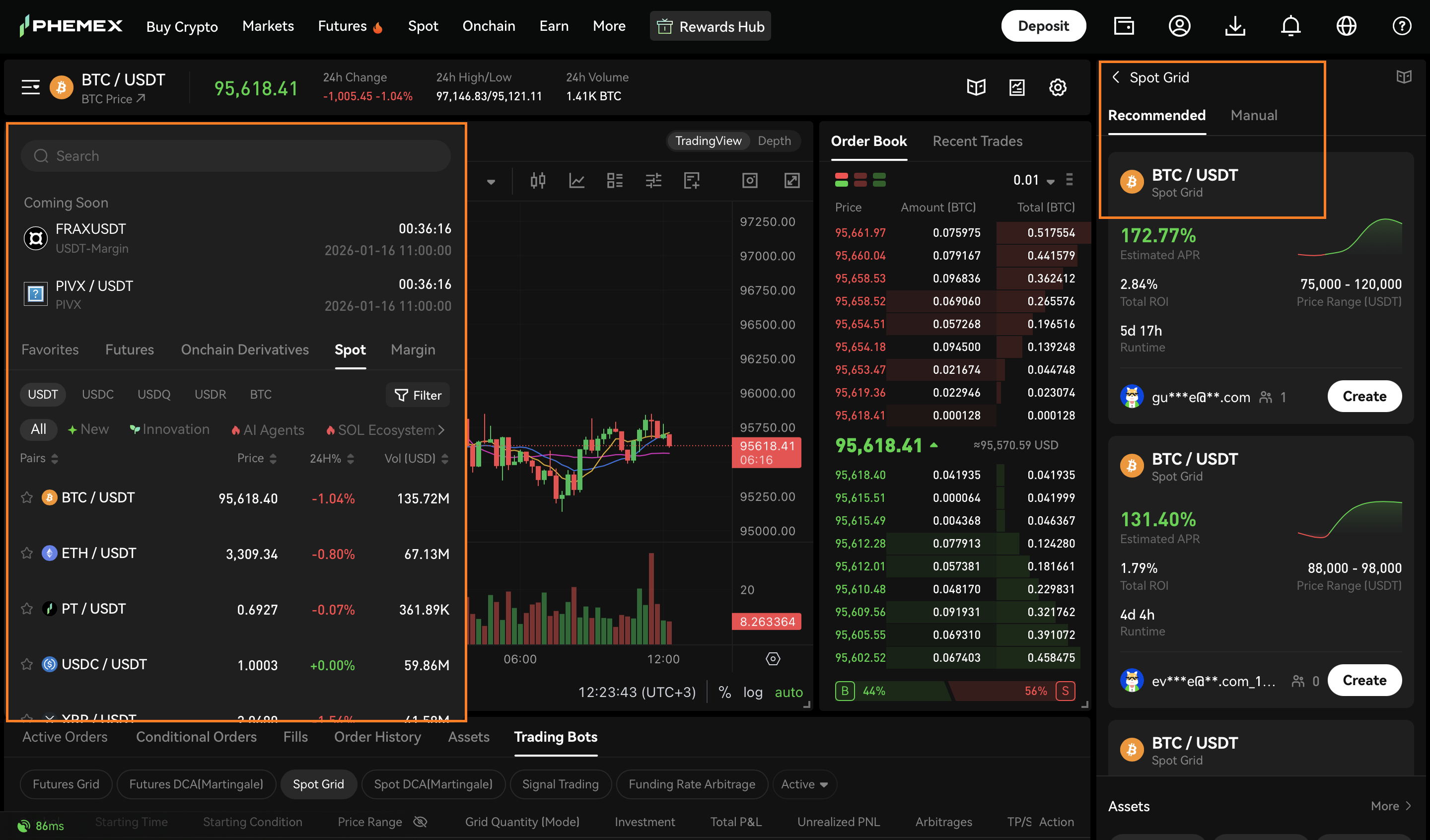
2. Define the price range: Set the upper and lower limits where the price has bounced before. This range tells the bot where to work and where to pause.
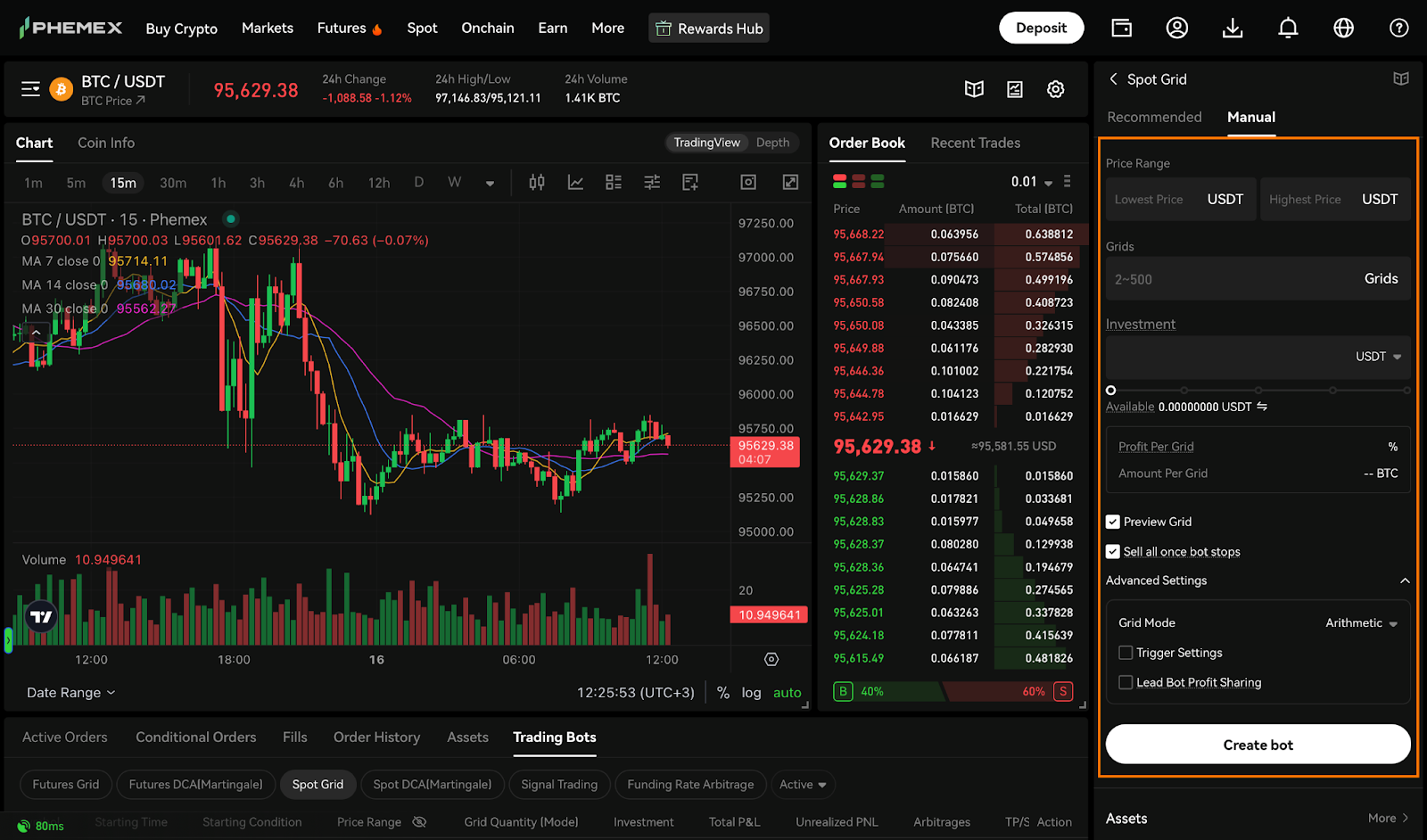
3. Select the number of grids: Decide how dense the grid should be. Fewer grids create wider gaps and larger profits per trade. More grids increase trade frequency.
4. Choose grid spacing: Pick arithmetic for tight, stable ranges or geometric for percentage-based movement across wider ranges.
5. Allocate capital: Assign only the amount you feel comfortable committing to this single strategy. The bot uses only this balance.
6. Configure risk settings: For spot grids, this mainly means choosing whether to add a stop price. For futures grids, set leverage carefully and define stop conditions before launch.
7. Preview the grid: Review the visual layout. You should clearly see where buy and sell orders will sit across the range.
8. Launch the bot: Confirm the setup and activate the grid. Orders are placed automatically, and tracking begins immediately.
Once the bot runs, the focus shifts away from constant decision-making. At this point, what really matters is supervision, knowing what to watch, and knowing when to step in or step out.
Common grid trading mistakes and how to avoid them
Grid trading often looks calm and efficient on the surface, which is exactly why small mistakes tend to slip through more often than you would find acceptable. Most losses here do not come from bad luck. They come from setups that ignore how price actually behaves.
- One common issue is setting the range too tight. When the price breaks out even slightly, the bot stops doing useful work and sits idle. A range that reflects recent highs and lows usually performs better than one squeezed around the current price.
- Another problem is spreading the range too wide. When levels sit far apart, trades trigger rarely, and capital stays underused. The grid exists, but it does not participate often enough to matter.
- Grid count can also be a trouble-maker if you are not careful with it. Too many grids, for example, create frequent trades with tiny profit per fill, which fees can quietly erase. Similarly, too few grids miss swings that happen inside the range. Therefore, the balance often matters more than precision.
Meanwhile, futures grids add their own risks: high leverage leaves little room for error when price moves sharply.
In contrast, modest leverage and wider ranges usually survive longer than aggressive settings.
And last but not least, many traders, for whatever reason, sometimes leave their bots running even after conditions change. This should be avoided at all costs considering that a grid fits a range, and it is important to stop the bots when the range disappears.
When does grid trading fit into your trading strategy?
To cut a long story short, grid trading fits you when the market keeps moving sideways without a clear direction. It works best when prices move back and forth without commitment and when you prefer rules over constant decision-making.
On the other hand, if you enjoy active judgment calls or rely on strong trends, grids may feel slow or restrictive.
So, all factors considered, if you value consistency, automation, and clearly defined risk, a grid trading platform like Phemex is worth considering. Just remember that while a grid strategy can replace impulse with a practical process, it does not remove the risks inherent to crypto markets or market participation.


