


Bitcoin price briefly tested $90,000 on Wednesday, extending a rebound from last week’s sharp sell-off. It comes ahead of the Federal Open Market Committee (FOMC) rate decision later today.
However, analysts warn that the move offers relief rather than resolution as crypto markets brace for a dense cluster of US macro and policy risks.
Bitcoin Tests $90,000 but Macro and Policy Headwinds Keep Downside Risks in Play
According to QCP Capital’s January 28 Market Colour, Bitcoin’s recovery has eased immediate liquidation pressure without removing the structural forces keeping downside protection firmly bid.
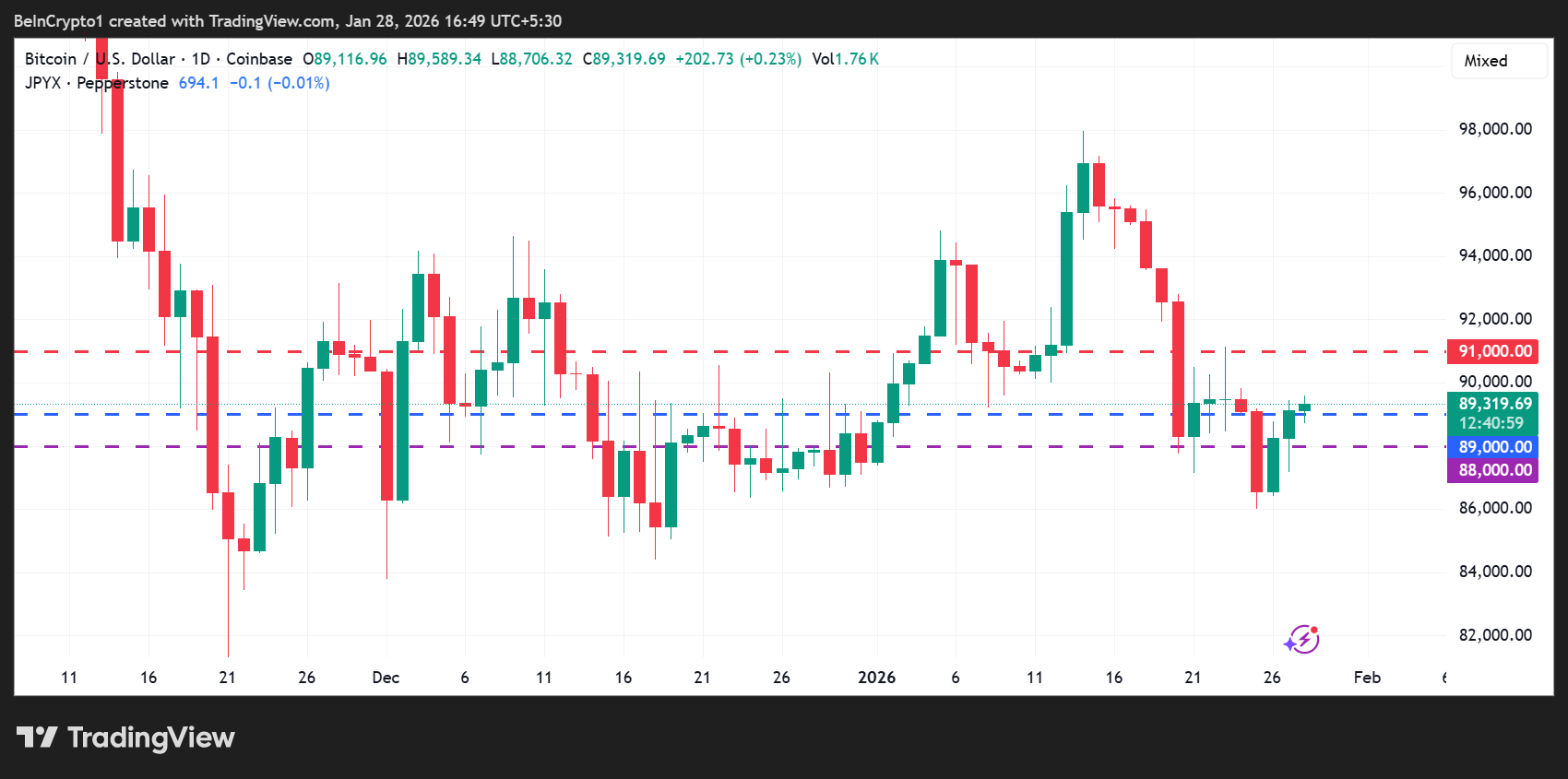
BTC’s reclaim of the $88,000–$89,000 zone remains technically important. QCP analysts describe $88,000 as a “trap door” level. The description comes as recent breaks have triggered rapid, liquidation-led air pockets, while swift reclaims have pulled the price back into range.
Sustained acceptance above that level matters more than brief intraday pushes, especially with macro catalysts converging in the days ahead. Those catalysts are stacking quickly. Markets are focused on:
- The FOMC’s rate decision later today
- A January 30 US government funding deadline that keeps shutdown risk alive, and
- Renewed Senate scheduling around crypto market-structure legislation.
At the same time, foreign exchange markets remain unsettled following USD/JPY rate-check signals that highlighted how quickly crowded positioning can unwind.
Options markets reflect this asymmetric risk profile. Volatility remains relatively contained, and the term structure stays in contango, suggesting consolidation rather than an outright crash.
However, the left tail is bid. Negative skew and rich near-dated downside options point to demand for gap-risk hedging rather than expectations of a smooth volatility expansion.
“…calm headline volatility does not equal safety, as traders continue to hedge gap risk,” QCP analysts noted.
Hawkish Rate Expectations Take Hold as Bitcoin Decouples from Surging US Equities
Beyond short-term macro risk, structural headwinds are also weighing on sentiment. Aurelie Barthere, Principal Research Analyst at Nansen, says markets have already internalized a more hawkish Federal Reserve outlook.
“Markets are pricing in fewer than two 25-basis-point rate cuts by the end of 2026, implying a Fed funds rate of around 3.2%,” she said in a statement to BeInCrypto.
Indeed, expectations for rate cuts have largely been priced out, with the CME FedWatch Tool showing a measly 2.8% probability.
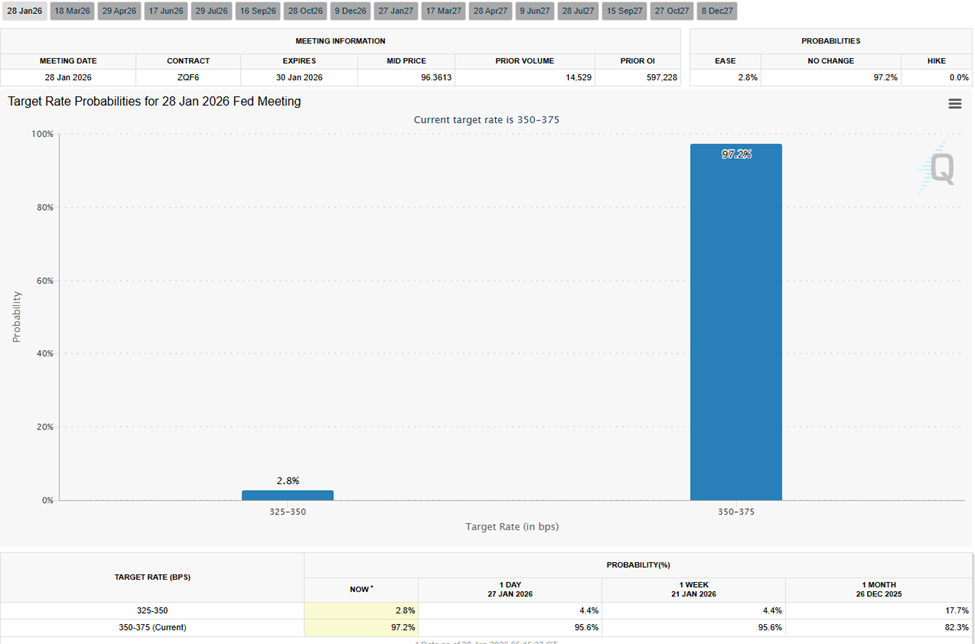
Meanwhile, the OIS market, which allows institutions such as banks, insurance companies, and pension funds to hedge against interest rate fluctuations, is even pricing in rate hikes over the next five years, with a terminal rate close to 3.8%. According to Barthere, Bitcoin has already absorbed much of that shift.
“After failing to hold the $91,000 support level, BTC has developed a negative correlation with US equities, a rare dynamic, as equities continue to rally without Bitcoin following,” she said.
With equity valuations appearing increasingly stretched, she warned that a stock correction “could further deteriorate Bitcoin’s price action.”
Policy Paralysis Weighs on Sentiment as Markets Price Capitulation, not a Crypto Revival
Policy uncertainty is compounding those pressures. Narratively, investors and traders appear to be pricing out the US ‘crypto mojo,’ according to Barthere, citing stalled legislation and shifting political priorities.
“The CLARITY Act remains stuck in the Senate, while Republicans are prioritizing purchasing-power-focused legislation ahead of the midterms, reducing near-term regulatory momentum for crypto.”
Positioning data suggests growing caution amid signs of capitulation, as options markets are pricing in only a 30% probability that Bitcoin will revisit its all-time high by year-end, alongside streaks of significant Bitcoin and Ethereum ETF outflows.
For sentiment to meaningfully improve, Barthere said a clear policy catalyst would be required.
“A meaningful upside catalyst would be progress on U.S. crypto regulation,” she said. “Passage of the CLARITY Act through the Senate, despite political and industry divisions, would likely improve sentiment and reintroduce a crypto-specific tailwind.”
Until then, Bitcoin’s move above $89,000 may reduce near-term stress. However, with macro cliffs approaching and downside hedges still in demand, markets remain positioned for volatility rather than a clean breakout.


