


Bots and AI-driven trading strategies are progressively transforming Polymarket’s ultra-short-term crypto markets, turning small stakes into jaw-dropping profits while human traders struggle to keep pace.
From temporal arbitrage to advanced machine learning models, these automated systems exploit mispriced contracts, thin liquidity, and market lag with a consistency that humans simply cannot match.
Polymarket Bots Print Money As Arbitrage and AI Redefine Prediction Markets
One of the most striking examples highlighted by Dexter’s Lab, a prediction markets analyst, is a bot that reportedly turned $313 into $414,000 in a single month.
This bot trades exclusively in BTC, ETH, and SOL 15-minute up/down markets, placing bets of $4,000–$5,000 each time with a 98%-win rate.
Its secret is not predicting market direction. Rather, it exploits a tiny window where Polymarket prices lag confirmed spot momentum on exchanges like Binance and Coinbase.
By entering trades when the actual probability is already ~85% but the market still shows 50/50 odds, the bot repeatedly buys mispriced certainty.
The result is thousands of micro-trades that generate consistent gains, dilute losses, and flatten variance. Meanwhile, human traders debate catalysts and chase high ROI.
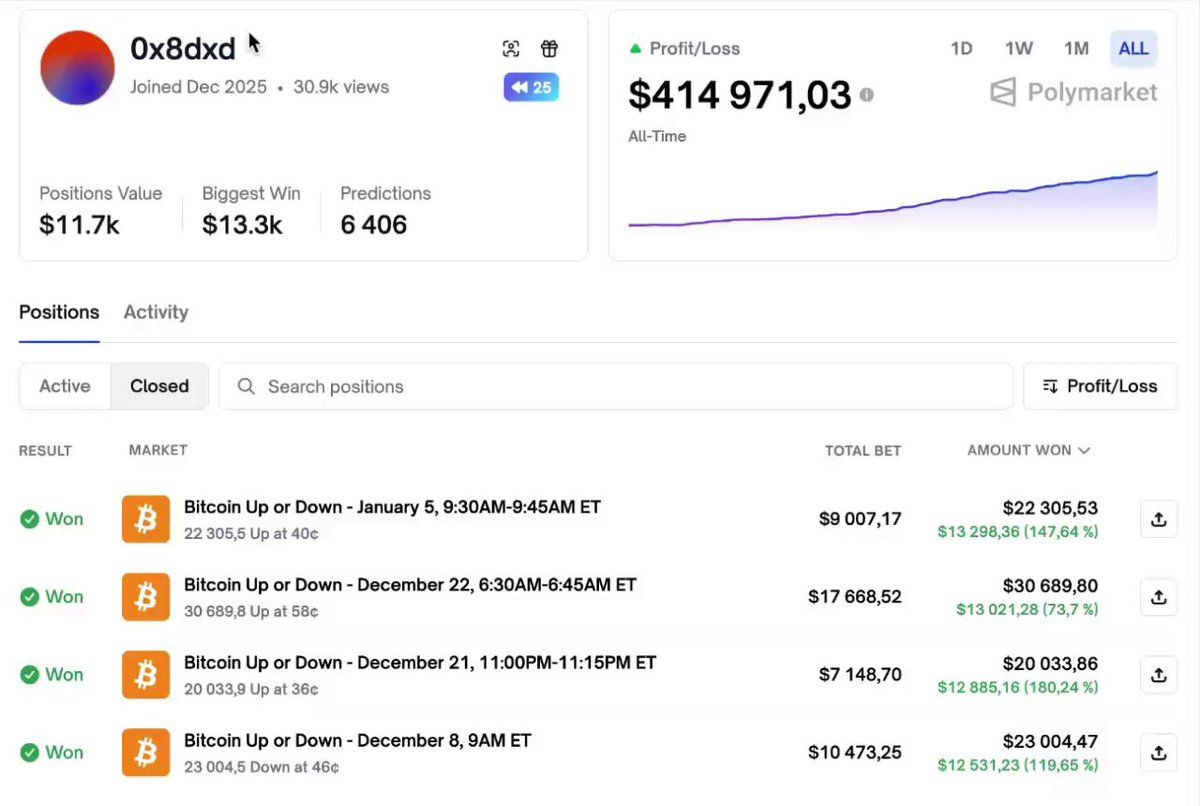
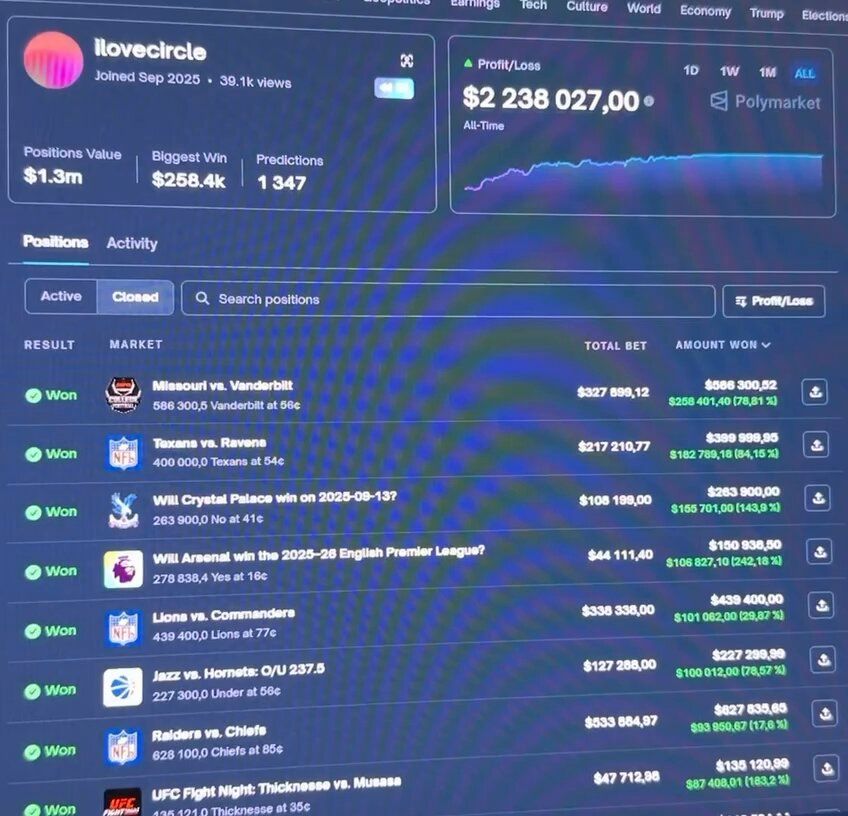
AI-powered strategies are also making waves. A bot profiled by Igor Mikerin generated $2.2 million in just two months. It utilizes ensemble probability models trained on news and social data to capitalize on market mispricing.
The bot continually retrains its models to stay current, targeting contracts that are undervalued relative to real-world probabilities.
This approach represents a new frontier in prediction markets, where algorithmic accuracy and real-time analysis can consistently outperform human judgment.
Arbitrage and high-frequency trading (HFT) tactics are now common on Polymarket. Ethan, another analyst, described a bot that front-runs thin liquidity orders, buying contracts just before market-buy orders push prices up.
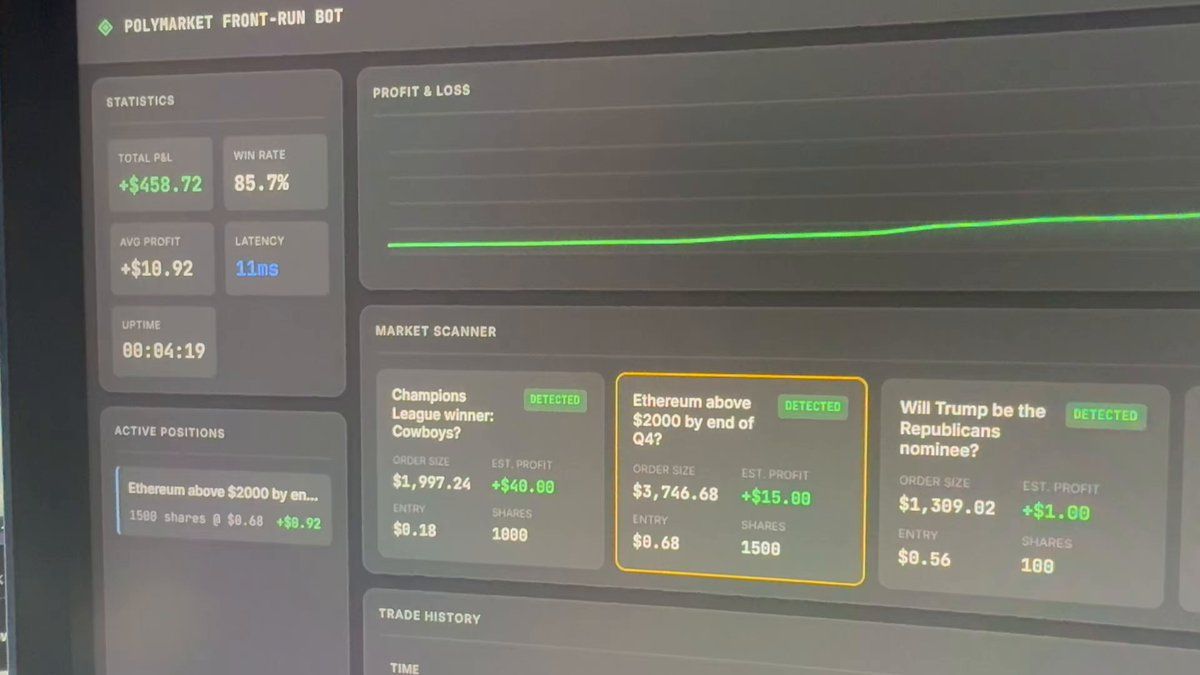
Other strategies include buying both sides of a contract when combined prices dip below $1. This guarantees small but nearly risk-free profits.
Bots like these have produced thousands of trades with steady, linear PnL curves, highlighting the efficiency of repetition and timing over human intuition.
What Polymarket’s Automation Surge Means for Traders
Human traders continue to struggle in this environment. Comparisons show that bots achieve a $ 206,000 profit with an over 85%-win rate, while humans employing similar strategies only capture around $ 100,000.
Oversized bets, poor risk management, and late entries often lead to cumulative losses, even when traders have a positive edge.
The general sentiment is that success in prediction markets still requires discipline, awareness of probability, and careful position sizing. However, bots are raising the bar in ways that most humans cannot match.
The rise of bots has also sparked debates around ethics and market fairness. Polymarket users share watchlists and bot profiles, highlighting top-performing accounts and strategies.
With dozens of bots now quietly farming 15-minute BTC markets, many generating monthly profits in the tens of thousands, the question emerges:
Are these bots simply a temporary exploit, or the start of a permanent “new meta” that will reshape prediction markets entirely?
Despite these developments, there are lessons for humans. Traders can learn from bots’ systematic approaches:
- Enter positions only when mispricing exists,
- Avoid excessive exposure and capitalize on repeated, low-risk opportunities.
While automation dominates the short-term playing field, knowledge, discipline, and probability-based strategies remain critical for sustainable human participation in Polymarket and other prediction markets.
Polymarket illustrates how bots and AI are going beyond making millions to redefine the game fundamentally. They leave human traders to adapt or risk being left behind, amidst an ecosystem increasingly shaped by timing, repetition, and algorithmic precision.


