


The SEC and CFTC issued a joint 68-page interpretation on March 17, classifying most crypto assets as non-securities and carving out safe zones for staking, airdrops and mining.
The move has prompted a growing chorus of market participants to ask whether Congress still needs to pass the Digital Asset Market Clarity Act of 2025 (CLARITY Act) at all.
Regulators Just Delivered 80% of the Clarity Act Without Passing It
The CLARITY Act passed the House in July 2025 with a bipartisan vote of 294-134. Since then, the bill has been stuck in the Senate, held up by a dispute between banks and crypto firms over whether stablecoins should pay yield.
The Senate Banking Committee delayed its markup in January 2026 after industry lobbying disputes. No new date has been set.
Meanwhile, the Senate Agriculture Committee advanced its separate draft on Jan. 29, but the two versions still need to be reconciled before any full vote.
Against that backdrop, the SEC and CFTC moved ahead without waiting. Their joint interpretive guidance introduces a five-part token taxonomy that divides crypto assets into:
- Digital commodities
- Digital collectibles,
- Digital tools,
- Stablecoins, and d
- Digital securities.
Only the last category falls under securities law. Sixteen tokens, including Bitcoin (BTC), Ether (ETH), Solana (SOL), XRP, Cardano (ADA), Avalanche (AVAX), Polkadot (DOT), Chainlink (LINK), Dogecoin (DOGE), and Shiba Inu (SHIB), received explicit classification as digital commodities.
“After more than a decade of uncertainty, this interpretation will provide market participants with a clear understanding of how the Commission treats crypto assets under federal securities laws. This is what regulatory agencies are supposed to do: draw clear lines in clear terms,” said SEC Chairman Paul Atkins, announcing the framework at the Digital Chamber’s DC Blockchain Summit.
What the Guidance Covers and What the Clarity Act Would Add
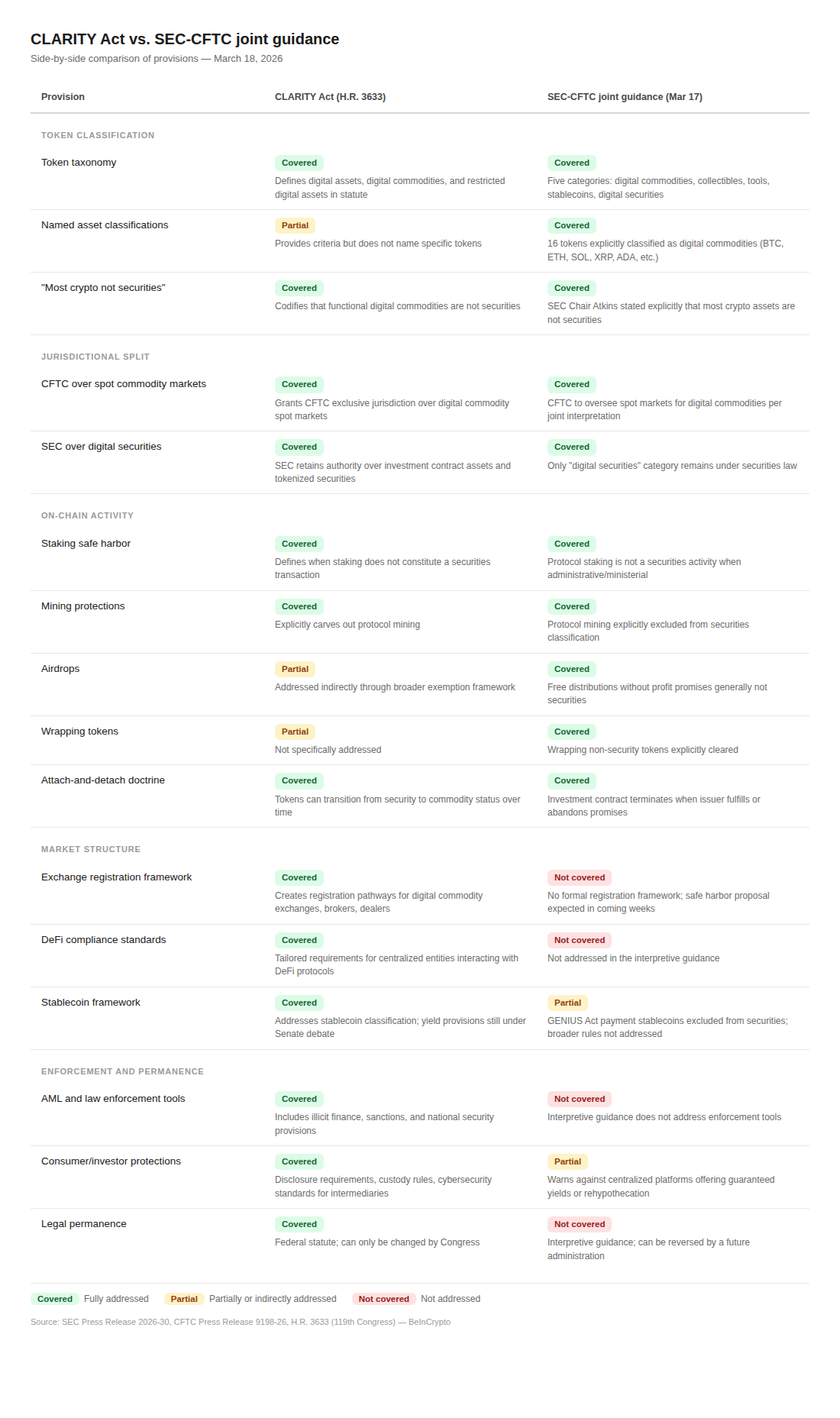
The overlap between the joint guidance and the CLARITY Act is significant, in the sense that:
- Both establish a token taxonomy that distinguishes between commodities and securities.
- Both assign CFTC oversight to spot digital commodity markets and SEC oversight to digital securities.
- Both address staking, airdrops, and mining.
The guidance also introduces an “attach-and-detach” doctrine. A token can initially qualify as a security during a presale phase when issuers make profit promises.
However, that investment contract status ends once the issuer fulfills or abandons those promises and the network operates independently.
This gives projects a regulatory path that previously existed only in theory.
“For far too long, American builders, innovators, and entrepreneurs have awaited clear guidance on the status of crypto assets under the federal securities and commodity laws. With today’s interpretation, the wait is over,” noted CFTC Chairman Michael Selig, framing the action as a direct response to years of regulatory limbo.
However, the guidance does not cover everything the CLARITY Act would. The bill includes formal registration pathways for digital commodity exchanges, brokers and dealers.
It sets compliance standards for centralized intermediaries interacting with Decentralized Finance (DeFi).
It also contains anti-money laundering provisions and law enforcement tools that interpretive guidance cannot create.
Crypto Community Reacts With Mixed Optimism
Several voices on X (Twitter) argue that the guidance renders the CLARITY Act less urgent.
Macro analyst MartyParty echoed the sentiment, writing that the agencies had “gone ahead without it.”
“We don’t need the Clarity Act to proceed as the agencies have gone ahead without it,” he noted.
Ryan Adams of Bankless described the guidance as delivering many of the benefits of the clarity bill, calling it almost equivalent to the Act passing through regulators.
Hunter Horsley, CEO of Bitwise, put it more simply, saying, “Clarity is arriving, Clarity Act or not.”
Still, it calls for caution, because the guidance is interpretive, not statutory. A future administration could rescind or reinterpret it.
Courts are not bound by agency guidance the way they are by legislation. The stablecoin yield question, which remains the central obstacle in the Senate, is only lightly addressed.
Atkins himself acknowledged this limitation at the Blockchain Summit, telling attendees that legislation being developed in Congress remains the only way to guarantee the permanence of recent pro-crypto policy shifts.
He added that the SEC plans to release a formal rulemaking proposal within weeks, potentially exceeding 400 pages, that would include an innovation exemption for crypto startups.
The CLARITY Act has roughly 18 working weeks before midterm election dynamics effectively close the Senate’s calendar. Whether Congress can act in time may determine whether 80% clarity from regulators is enough, or whether the industry needs the full legislative package to lock in the gains.
“IMO: SEC would not have announced this guidance if the Clarity Act was not getting approved very soon,” chimed macro analyst Marty Party.


