

Overview
Introduction
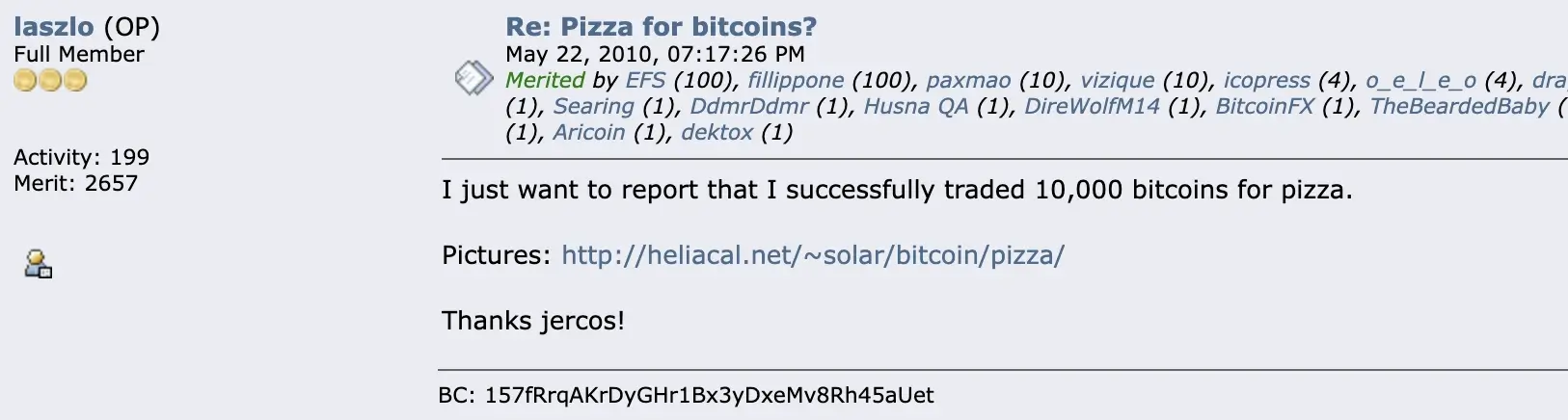
On May 22, 2010, a Florida programmer named Laszlo Hanyecz paid 10,000 BTC for two pizzas through a public BitcoinTalk forum post. At the time, those coins were worth roughly $41. At Bitcoin's 2025 peak, they crossed $1.1 billion.
Bitcoin Pizza Day is the annual May 22 anniversary of that trade, and it has become crypto's most repeated origin story for a reason: it was the first widely documented instance of Bitcoin being used to buy a physical good.
Key Takeaways
- What it is. Bitcoin Pizza Day marks the first famous real-world purchase made with Bitcoin.
- What it changes. The trade gave Bitcoin a practical payment story before it became a major investable asset.
- Main risk or limitation. The anniversary can make spending BTC look foolish when the real lesson is about opportunity cost.
Bitcoin Pizza Day Meaning and Date
Bitcoin Pizza Day falls on May 22 every year. That's the date in 2010 when Hanyecz confirmed on BitcoinTalk that he had successfully traded 10,000 BTC for pizza. The original forum offer went up on May 18, which is when the negotiation started. May 22 is when the trade closed, and that's the date the community uses.
At its core, this is a payments story. For Bitcoin to make a credible claim to being money, coins had to move between real people in exchange for something real. A completed pizza order, documented publicly on a forum, was that proof.
The dollar value attached to the anniversary changes every year as BTC trades. The date stays fixed at May 22. The core details never change: 10,000 BTC, two pizzas, one completed trade.
To understand why this was a big deal, you need to picture Bitcoin in May 2010. No exchanges. No mobile wallets. No merchant checkout tools. Mining was a hobbyist activity run on regular home computers. Most people who held BTC had produced it themselves, tinkering late at night, with no idea what any of it would become.
The BitcoinTalk Offer That Started the Story
It started with a single forum post.
On May 18, 2010, Hanyecz opened a thread on BitcoinTalk offering 10,000 bitcoins for “a couple of pizzas.” He updated it on May 22 to confirm the trade worked and to thank the user jercos.
Four days passed with no takers. Think about what that says. Someone was offering free money, essentially, and the internet sat on its hands for four days because nobody knew how to make it work. That gap alone tells you how raw and experimental all of this was.
The forum was the marketplace. Before any dedicated consumer tools existed, BitcoinTalk supplied reputation, coordination, and a public record. A participant found Hanyecz's post, agreed to the terms, placed a normal pizza order using conventional payment, and received 10,000 BTC in return.
The pizzas came from Papa John's, but Papa John's never touched Bitcoin. The transaction sits somewhere between peer-to-peer barter and early commercial payment history, which is exactly what made it useful evidence that the network could work.
Who Laszlo Hanyecz and Jeremy Sturdivant Were
Two people made this happen.
Laszlo Hanyecz was an early Bitcoin miner and developer. Jeremy Sturdivant was the forum user known as jercos who turned the pizza request into a completed purchase by arranging the real-world order and receiving the BTC. Hanyecz supplied the coins and the public ask. Sturdivant bridged the gap between a forum post and an actual delivery.
Here's the detail most anniversary headlines skip: Hanyecz was also the first Bitcoin miner to use GPU hardware instead of standard CPUs. That let him mine far faster than anyone else on the network at the time. It's why he had thousands of coins to experiment with. The pizza trade was not reckless spending. It was an experiment funded by coins he had produced himself, at a time when few people wanted them.
The known and unknown parts of the story deserve to stay separate. Hanyecz made the public offer and confirmed the trade on the same thread. The recipient was jercos, widely identified as Jeremy Sturdivant. The pizzas were Papa John's, delivered to Hanyecz. What happened to every coin from that trade afterward is not fully confirmed.
Why Paying 10,000 BTC for Pizza Made Sense Then
This is the part the “billion-dollar pizza” headlines always get wrong.
Paying 10,000 BTC for pizza was completely reasonable in 2010. Bitcoin was illiquid, experimental, and nearly impossible to spend. Early users could mine meaningful amounts at home, back when Bitcoin mining still looked like a weekend hobby. The proof-of-work design explains the accumulation: miners spent computing power to secure blocks and received newly issued BTC in return.
Several conditions made the trade reasonable at the time:
- Liquidity was thin, so turning BTC into food had real practical value.
- The market price was around $0.004 per coin, making 10,000 BTC worth roughly $41.
- A public purchase helped prove Bitcoin could circulate outside the forum.
- Forum reputation mattered because no merchant tools existed to establish trust.
- Early miners could replace coins more easily than later buyers entering a liquid market.
There is also a detail that rarely makes the anniversary headlines. Hanyecz kept the pizza offer open as a standing arrangement through the summer of 2010. Later forum posts suggest he spent closer to 80,000 BTC on pizza that year, but the claims are unverified. The May 22 trade was the first and the most documented, but it was not the only one.
What the Bitcoin Pizzas Are Worth Today?
This is the number everyone wants, and it changes by the hour.
The value of the Bitcoin pizzas shifts constantly because BTC trades around the clock on global markets. Any headline that freezes the figure is already outdated by the time most readers see it.
The calculation is simple: 10,000 multiplied by the current BTC price. At publication, verify that number against a live quote, not a fixed figure, because it can swing by hundreds of millions of dollars during a single volatile session.
| Value Reference | How To Present It |
|---|---|
| 2010 food value | The original thread placed the trade near a normal pizza order, with another user citing about $41 at the time. |
| 2025 anniversary value | The 10,000 BTC were worth about $1.1 billion on May 22, 2025. |
| Live value today | Use 10,000 multiplied by the live BTC quote, not an evergreen fixed figure. |
Common Myths About the 10,000 BTC Pizza
The most common Bitcoin Pizza Day myths come from compressing a messy forum story into a one-line punchline. The trade was real, the BTC amount was real, and the pizzas were real. But several details get blurred every time the story recirculates, and the errors tend to stick.
The table below covers the myths that appear most often in anniversary coverage.
| Myth | What To Say Instead |
|---|---|
| It was the first Bitcoin transaction. | It was the first famous real-world purchase with Bitcoin, not the first Bitcoin transaction on the network. |
| Papa John's accepted Bitcoin directly. | The pizzas came from Papa John's, but a forum user arranged the ordinary payment side. |
| Domino's was the pizza chain. | Domino's appeared in forum discussion, but the famous delivered pizzas were Papa John's. |
| The whole story was one clean retail checkout. | It was a peer-arranged exchange that used normal pizza delivery. |
| The recipient must have held every BTC. | Later outcomes for all coins are not fully confirmed. |
| Bitcoin Pizza Day is about a PIZZA token. | It is a Bitcoin history event, not a token branded around pizza. |
| Laszlo was foolish. | The trade helped prove Bitcoin could buy something before its future value was obvious. |
The first-transaction myth is the most persistent. Bitcoin had already processed transactions before May 22, 2010. The first Bitcoin transaction ever was a test transfer from Satoshi Nakamoto to Hal Finney on January 12, 2009. What made the pizza trade distinct was the physical good and the public, searchable record around a normal consumer purchase that anyone could read and verify.
The regret myth is also too simple. In a 2019 CBS interview, Hanyecz pushed back on the idea that fixating on the missed dollar value was a useful way to think about the trade. He framed the purchase as something that made Bitcoin feel real to him. Sturdivant has given a more mixed account over the years: in interviews he has acknowledged the scale of what he gave up while also saying he was acting as a community participant rather than an investor, and that he likely would have sold well before peak regardless.
How People Celebrate Bitcoin Pizza Day Today
People mark Bitcoin Pizza Day each year by ordering pizza, hosting community meetups, running exchange promotions, publishing updated value comparisons, and using the date as a hook for teaching Bitcoin history. Some of that activity is community-led and low-key. Much of it is marketing from exchanges, wallets, payment companies, and card providers attaching themselves to a familiar date.
The difference between the two is worth keeping clear before you act on any Pizza Day promotion:
- A meetup can use pizza as a low-pressure entry point to Bitcoin history and basic wallet education.
- A merchant campaign can demonstrate how crypto payments work in practice today.
- An exchange promotion is a marketing event. It is not connected to the original story.
- A value headline is a dated market snapshot. The number will be different by the time you read it.
- A PIZZA-branded token is a separate product with no direct relationship to the Bitcoin anniversary.
A lot of people use Pizza Day as an excuse to finally spend some BTC on something real, pizza included. If you want to try it, comparing Bitcoin card options is worth a few minutes. Check fees, supported regions, and whether the card spends your crypto directly or converts it to fiat before the purchase clears. And if you want to see where the market thinks Bitcoin's price goes from here, the best prediction markets guide tracks the platforms where those odds trade live.
FAQs
When is Bitcoin pizza day?
Bitcoin Pizza Day is May 22 every year. The date marks May 22, 2010, when Laszlo Hanyecz posted on BitcoinTalk that he had successfully traded 10,000 BTC for two Papa John’s pizzas. The original forum offer went up four days earlier on May 18, but the confirmed trade happened on May 22, and that is the date the community uses. The anniversary has been observed since at least 2014, when the story first reached mainstream press, and it now draws annual exchange promotions, community meetups, and a fresh round of value-comparison headlines every year.
What happened on Bitcoin pizza day?
Laszlo Hanyecz, a Florida programmer and early Bitcoin miner, posted on BitcoinTalk offering 10,000 BTC to anyone who would order him two large pizzas. Four days passed with no takers. Jeremy Sturdivant, then 19 and known on the forum as jercos, called a Papa John’s branch in Jacksonville and paid for the order with his debit card, then received the 10,000 BTC after Hanyecz confirmed delivery. The trade was documented publicly on the forum, and Hanyecz posted photographs of the pizzas as proof. He kept the offer running as a standing arrangement through most of the summer, and later told Bitcoin Magazine he spent closer to 100,000 BTC on pizza across 2010 in total, with the May 22 trade being the first and most documented.
Who got the 10,000 BTC for the pizza?
Jeremy Sturdivant, known on BitcoinTalk as jercos, received the 10,000 BTC. He was 19 at the time and spent the coins on a road trip with his girlfriend rather than holding them. In interviews, he has said that if he had been thinking like an investor he might have held longer, but that he probably would have sold much earlier than peak anyway, perhaps around the point where one BTC first equaled one dollar. Sturdivant has kept a much lower public profile than Hanyecz since 2010, and the full on-chain path of every coin from the trade has not been publicly confirmed.
How much is the Bitcoin pizza worth today?
The live answer is 10,000 multiplied by the current BTC price, so the figure changes every time Bitcoin moves. For reference, AP reported the same 10,000 BTC were worth approximately $1.1 billion on May 22, 2025, when Bitcoin was near record highs. At Bitcoin’s all-time high above $109,000, the same coins briefly crossed $1.09 billion. The number will be different again by May 22, 2026. Any article or social post that gives a fixed dollar figure without a date attached is already stale. Use 10,000 × live BTC price to get the current figure yourself.
Did the buyer regret spending Bitcoin on pizza?
Hanyecz has consistently pushed back on the regret framing. He said fixating on the missed dollar value was not a useful way to think about the trade, and that spending the coins made Bitcoin feel real to him. That does not erase the opportunity cost, but his stated position has been consistent across more than a decade of interviews. Sturdivant, the buyer, has given a more mixed account: he told in an interview that he regrets spending those bitcoins when he looks at the current value, but added he was acting as a community participant rather than an investor, and that he likely would have sold well before peak regardless — probably around the point where one BTC reached one dollar.
Was this the first Bitcoin transaction?
No. Bitcoin had processed transactions on-chain before May 22, 2010. The first Bitcoin transaction ever was a test transfer from Satoshi Nakamoto to developer Hal Finney on January 12, 2009. What made the pizza trade different was the physical good, the public forum record, and the fact that it involved a normal consumer purchase between two strangers with no prior relationship. Those elements combined to make it the first widely documented real-world purchase with Bitcoin, which is the specific claim the anniversary marks, not the first transaction on the network.
