


Cake Wallet Overview
Additional details
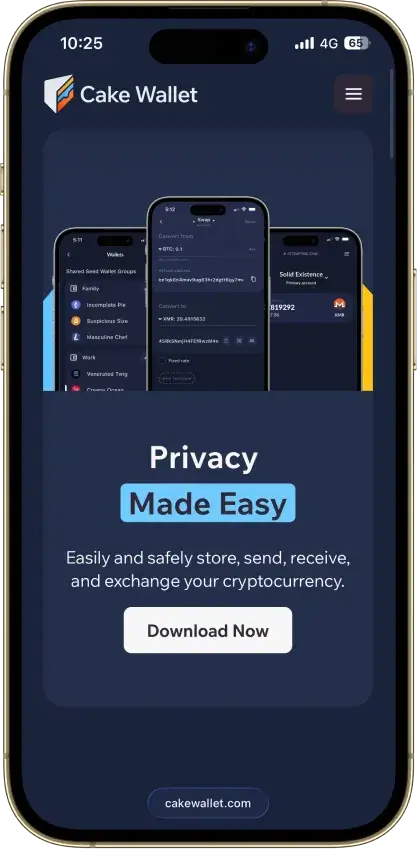
Cake Wallet Screenshots
Cake Wallet Pros and Cons
Pros
- Fully open source under an MIT license
- Non-custodial, no account, no wallet-level KYC
- Reference mobile Monero wallet since 2018
- 17+ chains and Lightning from one seed
- Pairs with Ledger hardware wallets
Cons
- Hot wallet — keys live on a connected device
- 2021 BTC weak-key bug, fixed in v4.1.7
- Builds not reproducible per WalletScrutiny
- No public third-party audit report
- No browser extension for dApp use
Who Cake Wallet is Best for — and Who Should Skip It
Cake Wallet is the default recommendation for anyone whose portfolio starts with Monero and extends into Bitcoin or mainstream chains, and a solid pick for privacy-minded users who want a no-account, no-KYC wallet from an identifiable company.
Get it if you:
- Hold Monero and want the most mature mobile XMR wallet
- Want one open-source app for XMR, BTC, Lightning, and EVM chains
- Refuse wallets that demand accounts or identity checks
- Want Tor routing and your own node without extra tooling
- Pair a hardware wallet and want a privacy-first interface for it
Skip it if you:
- Keep large long-term holdings — use a hardware wallet, alone or paired
- Live in DeFi and need a browser extension
- Want staking inside the wallet
- Want zero-setup simplicity with no node decisions ever
What is Cake Wallet and How Does it Work?
Cake Labs LLC is a US company registered in Orlando, Florida, founded by Vikrant Sharma. That is worth stating plainly, because it separates Cake Wallet from the anonymous-team wallets that dominate the privacy niche. The wallet shipped in 2018 as the first Monero wallet on iOS, has run for eight years without interruption, and reports around 1.75 million users. A named founder, a US business registration, and a public GitHub repo are exactly the trust signals a self-custody user should demand before trusting an app with seed generation, and Cake clears all three.
The product itself is one thing, cleanly. There is no exchange attached, no custodial account tier, no token, and no rename history. You download the app, it generates keys on your device, and Cake never holds your funds.
Security and Custody
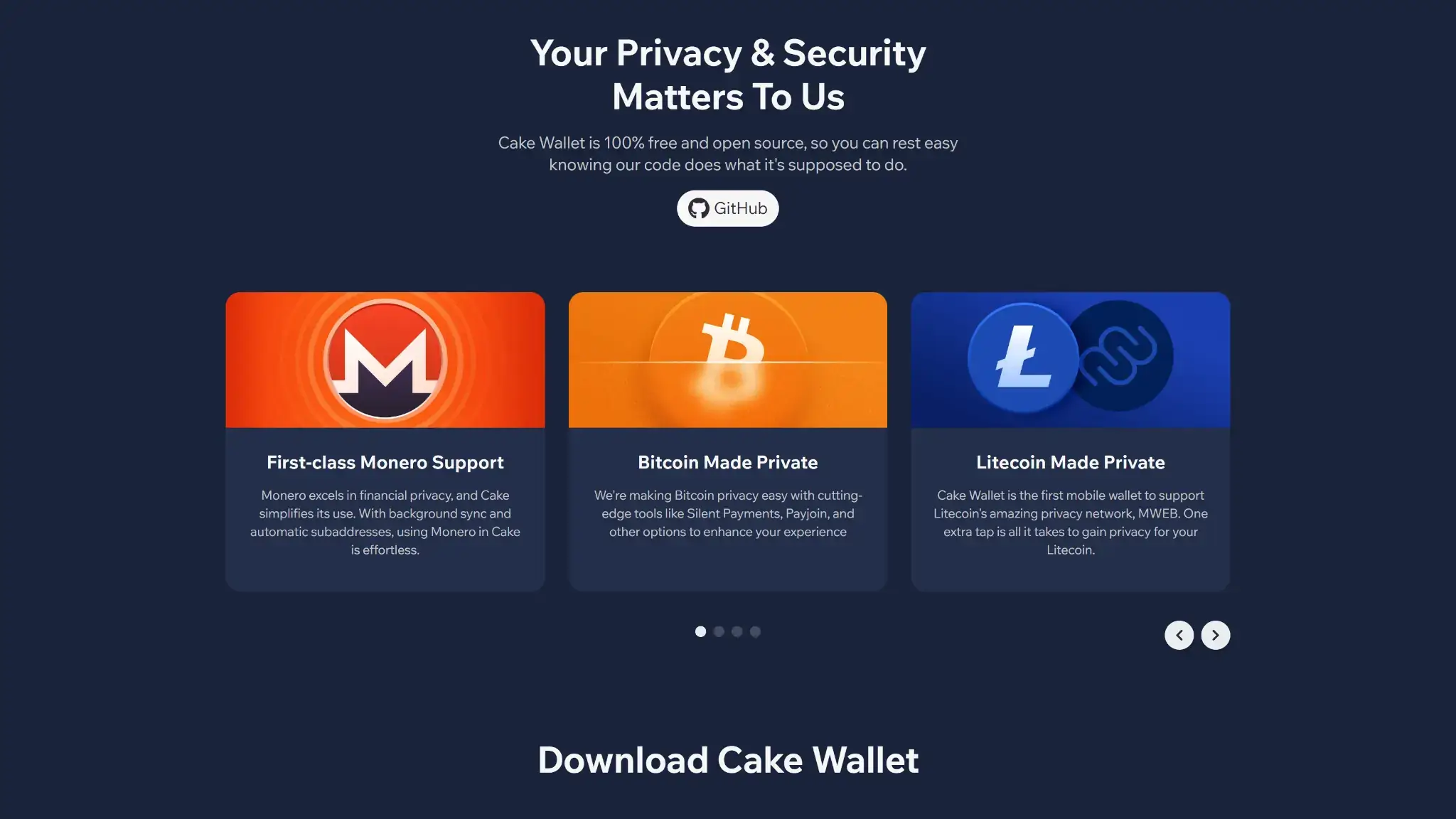
Cake Wallet is non-custodial in the plain sense: keys are generated and stored on your device, protected by a PIN and optional biometrics, and recoverable from a seed phrase. Monero wallets use a 16-word Polyseed by default (25-word legacy seeds restore too), while Bitcoin and the other chains use standard 12-word BIP39. The app routes traffic over Tor if you want it, lets you point any wallet at your own node, and pairs with Ledger hardware wallets for users who want hardware key storage behind Cake's interface.
The code is fully open source under an MIT license — the real thing, not source-available. That comes with an honest ceiling: WalletScrutiny closed its review of Cake Wallet as “Not Reproducible” in December 2024, meaning independent builders could not confirm that the binary shipped in app stores matches the public code. Open source you can read is good. Open source you can verify byte-for-byte is better, and Cake is not there yet. There is also no public third-party security audit report — the project leans on its open code, GitHub advisories, and the WalletScrutiny process instead.
The 2021 Bitcoin Weak-key Bug
Cake's one serious incident deserves specifics, not a soft clause. Versions before v4.1.7 generated 12-word Electrum-style Segwit Bitcoin wallets from a weak random-number generator, producing keys with far too little entropy — few enough that attackers could brute-force them. The flaw was disclosed in May 2021 and patched in v4.1.7. Later research by the Milk Sad team traced about 548.9 BTC flowing through 8,757 weak wallets between 2020 and 2024, with the later drains mostly malicious sweeps of stragglers who never moved their coins.
Two facts frame it fairly. Monero wallets were never affected — the bug lived only in the Bitcoin key path. And the fix shipped five years ago, with no comparable incident since. It stays in this review because a wallet that once shipped a key-generation flaw owes readers the scale, the fix, and the lesson: move funds off any Bitcoin wallet created in Cake before v4.1.7 if you somehow still have one.
Supported Chains and Assets
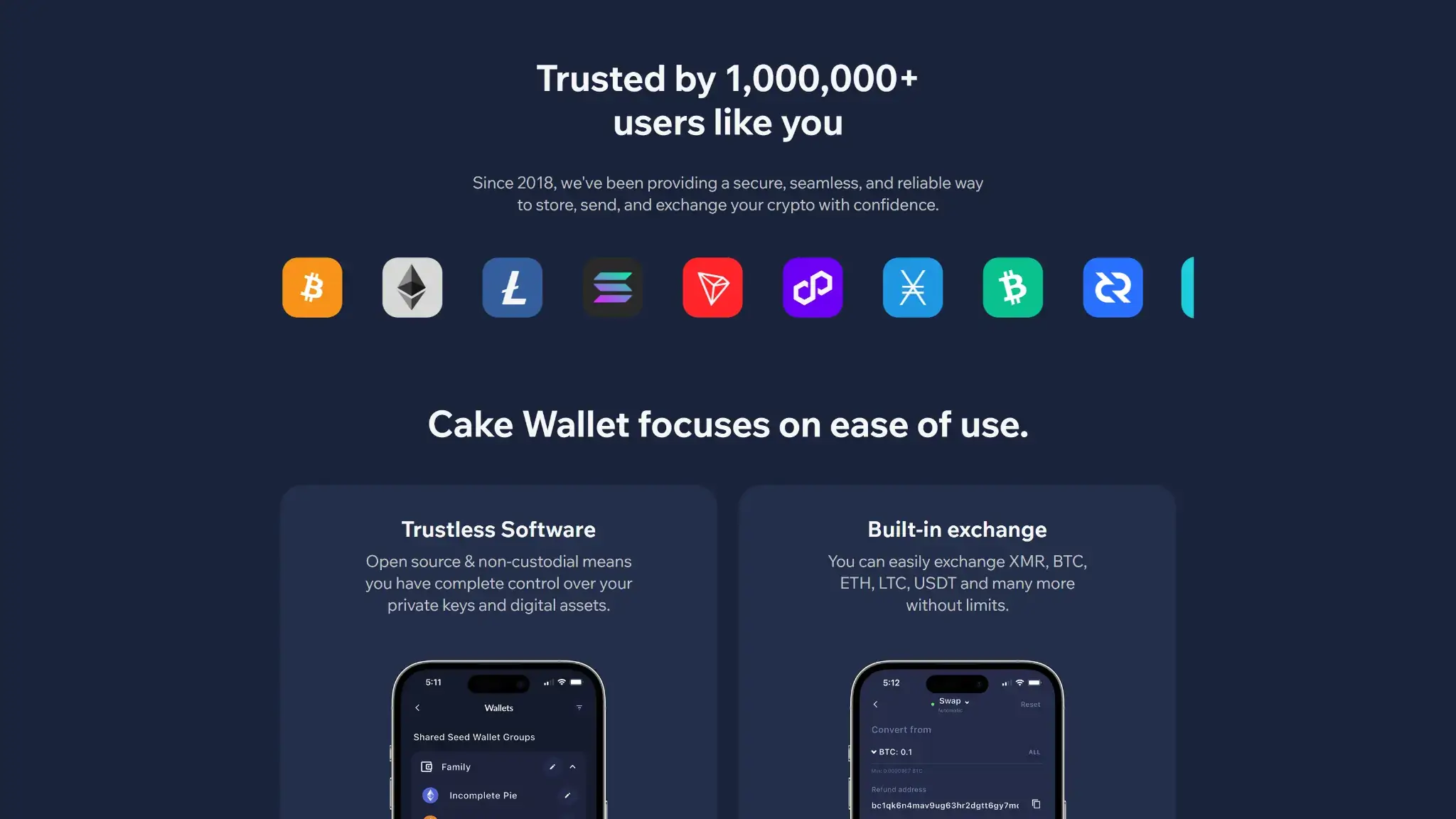
Cake started Monero-only and its XMR support is still the deepest part of the product — it is the wallet Monero users hand to newcomers, with Polyseed, Tor, and custom-node support built for that community. The multichain expansion is genuine rather than cosmetic: Bitcoin with Lightning, Ethereum and the major EVM networks (Polygon, Base, Arbitrum, BNB Smart Chain), Solana, Tron, Litecoin, Bitcoin Cash, Dogecoin, Zcash, Nano, Decred, and the niche privacy chains Zano and Wownero. Token standards cover ERC-20, BEP-20, SPL, and TRC-20.
That reach is wider than Cake's Monero-first reputation suggests. A user can realistically run Monero, Bitcoin over Lightning, and an EVM or Solana portfolio from one seed and one app.
Usability and Recovery
The app runs on iOS, iPadOS, Android (Play Store, direct APK, or Accrescent), macOS, Linux, and Windows. There is no browser extension and no web app, which is a real limit: connecting to dApps the way MetaMask or Rabby users do is not part of the product, so DeFi-heavy users will keep a second wallet.
The other friction is sync. Monero wallets scan the chain, node connections occasionally need switching, and a first-time user who has never picked a node can stall. Experienced users treat this as normal. Novices coming from an exchange app will find Cake less hand-holdy than a mainstream hot wallet, and that is the fair usability knock.
Recovery is standard seed-phrase self-custody with no custodial fallback: write the words down, keep them offline, and understand that losing them loses the funds. No email resets, no cloud escrow — the model privacy users want, stated plainly so nobody mistakes it for a forgiving one.
Features
The built-in exchange is Cake's signature feature, and it routes through third-party swap providers. Swaps have no KYC at the wallet level, so you can move between XMR, BTC, ETH, and the rest without creating an account anywhere. Provider selection and rates vary per pair, and the spread on any given swap is the true cost, so compare the quote against spot before accepting.
Fiat buy and sell run through partner on-ramps, and those partners apply their own KYC — the wallet stays account-free, but turning dollars into crypto through it does not. Cake Pay lets users buy gift cards with crypto in-app. There is no staking of any kind, which keeps the wallet simple but leaves ETH and SOL holders earning nothing here.
Cost
The app is free on every platform, with no account, subscription, or tier. What you actually pay: network fees on every transaction, the spread and provider fee baked into in-app swaps, and partner fees plus any markup when buying crypto with fiat. That cost profile is standard for a non-custodial hot wallet, and Cake adds no charges of its own on top of it.
Final Verdict
Genuine non-custodial design, a fully open MIT-licensed codebase, category-leading Monero support, real multichain coverage, hardware pairing, and a named US team with eight years of operating history behind roughly 1.75 million users. Free and account-free, with nothing mislabeled anywhere in the product. What holds it out of the 8s is specific. The 2021 Bitcoin weak-key bug was a real key-generation failure — long fixed, Monero never touched, but part of the record. Builds are not reproducible, so the open code cannot yet be independently matched to the shipped binary, and no third-party audit report is public. On top of that you have the inherent hot-wallet risk, the missing browser extension, and sync friction for novices.
Built-in KYC-free swaps via third-party providers, Cake Pay buys gift cards with crypto, Polyseed or legacy Monero seed restores
Why it stands out
- Fully open source under an MIT license
- Non-custodial, no account, no wallet-level KYC
- Reference mobile Monero wallet since 2018
- 17+ chains and Lightning from one seed
- Pairs with Ledger hardware wallets
What to consider
- Hot wallet — keys live on a connected device
- 2021 BTC weak-key bug, fixed in v4.1.7
- Builds not reproducible per WalletScrutiny
- No public third-party audit report
- No browser extension for dApp use
Disclaimer: CryptoSlate may receive a commission when you click links on our site and make a purchase or complete an action with a third party. This does not influence our editorial independence, reviews, or ratings, and we always aim to provide accurate, transparent information to our readers.
