World Cup Winner

France has the highest title path leverage because it meets Spain on July 14, and FIFA’s preview highlights its attacking talent as a matchup edge. A semifinal win would leave France one victory from the July 19 trophy and likely keep it the market’s central favorite.
Spain’s defensive run can blunt France’s attack, and a semifinal exit would remove the clearest route to the title despite France’s strong overall profile.

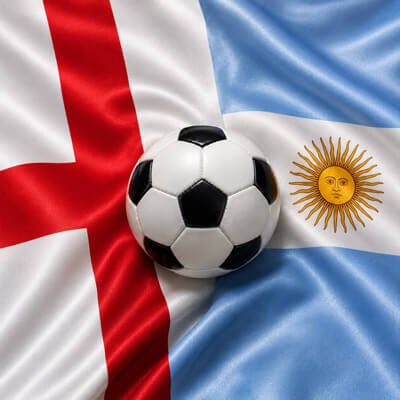
England’s immediate catalyst is the July 15 semifinal against Argentina, with the winner moving one step from the July 19 final. A deep run would be reinforced by a disciplined knockout performance and any edge from Argentina’s extra-time quarter-final workload.
Defeat to Argentina eliminates England before the final, and a tight match can swing against them if they fail to finish chances or control the tempo.

Spain’s path runs through France on July 14, and its five straight clean sheets plus just one goal conceded make a defense-first upset route credible. If Mikel Merino and the back line keep controlling knockout games, Spain can reach the July 19 final with a strong title case.
A loss to France ends the title path immediately, and Spain’s attack may struggle if it cannot convert a low-event semifinal into a narrow win.
Argentina’s case hinges on the July 15 semifinal with England, where a win would keep alive its bid to repeat as world champion for the first time since Brazil in 1962. Its extra-time quarter-final win over Switzerland shows knockout resilience, but also adds a fatigue angle into a short turnaround.
If England outlasts Argentina, the repeat-title path ends, and the extra-time quarter-final could matter if legs or squad depth fade late.
Current odds summary
France currently leads the World Cup Winner prediction market at 39.1% reported probability on Polymarket. The figures below combine live odds, liquidity, volume, and open interest so readers can compare the market signal before reading the full analysis.
Odds, liquidity, volume, and open interest are sourced from Polymarket and last synced at Jul 14, 2026 2:12 pm.
France Leads, Spain Surges, and the Bracket Is Compressing Fast
France’s price is being shaped by a confirmed semifinal berth, while Spain’s late escape over Belgium has turned their meeting into the market’s next major stress test. Argentina and England still carry brand strength, but an extra knockout hurdle changes how that demand is being priced.


The World Cup winner market has shifted from broad tournament handicapping to bracket-specific survival math. France’s 36.4% share is anchored in a confirmed semifinal berth after a 2-0 quarterfinal win over Morocco, while Spain’s move to 21.1% after a 3.8 percentage-point rise over 24 hours follows a late 2-1 win over Belgium. That matters because the market is now assigning value to a smaller set of facts: who is already through, who still needs another result, and which heavyweight must eliminate another before the final.
France is priced like the team with the cleanest known path
France’s lead is easiest to explain through path certainty. A semifinal place removes one layer of knockout risk at a point when Argentina and England still have quarterfinals to play. The AP report confirming France’s 2-0 win over Morocco also fixes the next catalyst: France will face Spain in the Dallas area on Tuesday. That clarity matters to pricing because France’s next obstacle is known, immediate, and binary.
The market’s 36.4% quote implies more than confidence in squad quality; it also reflects the mechanical advantage of already occupying one of four semifinal slots. With volume at $4.16 billion, liquidity at $37.13 million, and open interest near $67.91 million, the market has enough depth for bracket news to be absorbed quickly. France’s 2-point decline over 24 hours shows that a semifinal berth alone does not freeze sentiment. Once Spain qualified, France’s path became clearer and more difficult at the same time.
Spain’s late winner creates both momentum and fragility
Spain’s rise follows a specific event with market consequences: Mikel Merino scored in the 88th minute to beat Belgium 2-1, sending Spain to its first World Cup semifinal since winning the tournament in 2010, according to AP. The late goal supports the case that Spain can survive pressure moments, which matters in a knockout bracket where one sequence can reprice an entire market.
The same result also exposes the hidden assumption behind Spain’s move. A late quarterfinal winner can be read as resilience, finishing quality, or a narrow escape, and each interpretation changes how the France match is priced. Belgium’s 0.1% quote is consistent with elimination residue, while Spain’s larger move signals that the market treated the win as a genuine path upgrade. The next repricing point is less about Spain’s historical return to the semifinal stage and more about whether that Belgium match becomes evidence of clutch execution or defensive vulnerability against France.
Argentina and England still command attention, with extra elimination risk
Argentina’s 17.7% share sits below Spain despite its defending champion status because the team still has to clear Switzerland in Kansas City. AP reported that Argentina reached the quarterfinals by rallying from 2-0 down to beat Egypt 3-2, a result that sustains confidence in Lionel Messi’s side as a team capable of changing a match under pressure. The pricing implication is straightforward: comeback resilience keeps Argentina relevant, while the unfinished quarterfinal keeps its probability capped relative to semifinalists.
England’s 14.7% quote carries a different kind of demand. Its 3-2 round-of-16 win over Mexico became the most-watched World Cup game not involving the U.S. in English-language U.S. television history, according to AP, and England now faces Norway in the quarterfinals. That audience data matters because England outcomes can generate fast market attention after each match event. Norway’s 6.1% share indicates respect for a live quarterfinal opponent, while also showing how the market weighs the difficulty of converting a quarterfinal slot into a title.
| Team | Market share | Path implication |
|---|---|---|
| France | 36.4% | Already in semifinal, faces Spain next |
| Spain | 21.1% | Advanced on an 88th-minute winner |
| Argentina | 17.7% | Must beat Switzerland to reach semifinal |
| England | 14.7% | Must beat Norway after high-profile Mexico win |
The schedule compresses catalysts into a few decisive days
FIFA’s official schedule and AP’s tournament guide place the semifinals on July 14 and July 15, the third-place match on July 18, and the final on July 19 at MetLife Stadium in East Rutherford, New Jersey. The Polymarket event closes July 20 and resolves to the national team that wins the 2026 FIFA World Cup. That timing matters because there is little room left for slow narrative drift; actual results now dominate price movement.
- A France win over Spain would remove the second-largest current contender and place the market leader in the final.
- A Spain win would validate the post-Belgium repricing and force the market to rebuild around a new finalist.
- An Argentina win over Switzerland would convert defending-champion demand into semifinal certainty.
- An England win over Norway could combine bracket progress with a large audience-driven attention cycle.
- A hypothetical injury, suspension, or unexpected lineup change before either semifinal would matter because the remaining match sample is so small.
The main failure mode is concentration around known semifinalists
The strongest counter-signal to France and Spain’s combined weight is that their semifinal is mutually destructive. One of the two must exit before the final, so the market’s current concentration in that side of the bracket depends on the winner of that match carrying enough title probability to justify the combined attention. If Argentina or England wins a quarterfinal convincingly, the gap between confirmed semifinalist status and perceived championship strength could narrow quickly.
This is why the remaining quarterfinals still matter even with France leading. Switzerland and Norway sit at 1.7% and 6.1%, but their matches are also catalysts for Argentina and England. A routine favorite win would reduce path uncertainty for those larger teams; an upset would remove a major brand from the board and create a new semifinal pricing problem. The market is being pulled between bracket certainty and championship reputation, and the next whistle can change which force dominates.
Sources
What could move the odds?
Informational summary of factors that may affect the reported prediction-market probabilities.
Market-implied thesis
The market is pricing France as the most likely champion from a four-team field, effectively saying its path through Spain then the final is superior.
With only semifinalists listed, prices are less about long-run team quality and more about two remaining matchups under FIFA’s winner-based resolution.
What could reprice it
The France-Spain semifinal on July 14 and England-Argentina on July 15 are the immediate catalysts before the July 19 final in New Jersey.
Semifinal results, lineups, injuries, suspensions, extra time, and penalty outcomes can all reset title prices before final settlement.
Where the market may be weak
Depth is large, but the market is still a short-horizon binary-style sports event where one red card, penalty shootout, or injury can swamp form signals.
Resolution is clear, but market precision may overstate predictability because only two knockout matches remain and each outcome path is highly state-dependent.
Counter-signal
France’s lead may underweight Spain’s defensive profile: FIFA notes Spain has conceded just one goal and kept five straight clean sheets.
Argentina’s extra-time quarter-final could aid England, while Argentina’s repeated deep World Cup runs argue against treating it as a low-quality outsider.
AI-generated market summary, reviewed for clarity. This summary is informational only, may contain errors, and is not financial, investment, betting, or trading advice.
Market details
- Resolution criteria
- This market will resolve according to the national team that wins the 2026 FIFA World Cup.
- Platform
-


- Category
- Sports › World Cup
- Close date
- July 20, 2026, 12:00 AM UTC
- Market rules summary
- Multi-outcome Polymarket event. Each listed option is represented by its Yes price on the underlying market. View full rules
News driving World Cup Winner odds
 CryptoSlate 5 days ago Sam Altman’s Worldcoin cuts WLD unlocks by 43% but 4.9B tokens still need to prove demand
  CryptoSlate 1 week ago Bearish Coinbase World Cup error shows prediction markets still have a proof problem
  CryptoSlate 2 weeks ago Polymarket’s $3.3B World Cup boom exposes the longshot trap inside prediction markets
  CryptoSlate 3 weeks ago Bearish Binance will be cut off from Europe on July 1 – Removes the “best liquidity in the world” says CZ
  CryptoSlate 3 weeks ago Bearish Goldfinch wind-down raises a hard question – can DeFi RWA survive real-world debt?
  CryptoSlate 3 weeks ago Bullish Three World Cup betting accounts won $24M. Why did the money all go to one Binance address?
 Related World Cup markets
 England vs. Argentina
  France vs. Spain
  World Cup: Golden Ball Winner
 Frequently asked questions
What are the current World Cup Winner odds?
Polymarket reports World Cup Winner odds with France at 39.1%, England at 21.6%, Spain at 21.5%, and Argentina at 17.4%. These probabilities are market-implied and can change as liquidity and trading activity update. The latest market snapshot includes $4.22B volume, $31.54M liquidity, and $62.21M open interest. CryptoSlate last synced this market data at Jul 14, 2026, 13:12 UTC.
What could move the World Cup Winner prediction market odds?
The market is pricing France as the most likely champion from a four-team field, effectively saying its path through Spain then the final is superior. With only semifinalists listed, prices are less about long-run team quality and more about two remaining matchups under FIFA’s winner-based resolution. Catalysts to watch include France-Spain semifinal, July 14-15 semifinals, and Team news before semis.
How does the World Cup Winner prediction market resolve?
This market will resolve according to the national team that wins the 2026 FIFA World Cup. Multi-outcome Polymarket event. Each listed option is represented by its Yes price on the underlying market.
